

Set up a high-converting Shopify jewelry store by choosing the right theme, optimizing product pages with rich media and trust signals, and following the CRAFT readiness framework.
Published:
October 19, 2026
Author:
Yi Cui
A jewelry store has specific design needs most general Shopify themes fail at — zoomable product images, clean product grids, trust signals for higher-priced items. Here's what actually works.
Jewelry is one of the highest-trust, highest-consideration verticals in ecommerce. Unlike buying a t-shirt or a phone case, purchasing jewelry online requires a leap of faith. Customers cannot feel the weight of the metal, inspect the clasp, or see how the stones catch the light. Because of this touch-and-feel barrier, generic Shopify setups often under-serve jewelry brands, leading to high bounce rates and abandoned carts. To succeed, a Shopify jewelry store must be engineered specifically to bridge the gap between the digital screen and the physical product, building absolute confidence at every step of the buyer's journey.
Selling jewelry online presents specific UX and conversion challenges that most standard ecommerce templates are not built to handle. The purchase is highly considered, often involving items priced anywhere from $50 to $500 or more. This price point demands a premium digital environment.
Visual fidelity is the most critical requirement. According to Baymard Institute's UX research, 25% of ecommerce sites fail to provide product images with sufficient resolution or level of zoom [1]. For jewelry, where the details of a setting or the texture of a chain are paramount, inadequate zoom capabilities directly cause product abandonments. Furthermore, jewelry involves complex sizing requirements, such as ring sizes and chain lengths, which must be communicated clearly to prevent returns. Material transparency is equally vital; customers need to know the difference between gold-fill, solid gold, and gold-plated items to justify the price and understand the product's longevity.
Most jewelry founders over-invest in brand photography before fixing their product page architecture — but conversion rate optimization data suggests that structural trust signals (return policy, material specs, reviews) outperform aesthetics alone at the bottom of the funnel. A beautiful lifestyle image might draw a customer in, but a clear, frictionless return policy and detailed material specifications are what actually convince them to click "Add to Cart" [2].

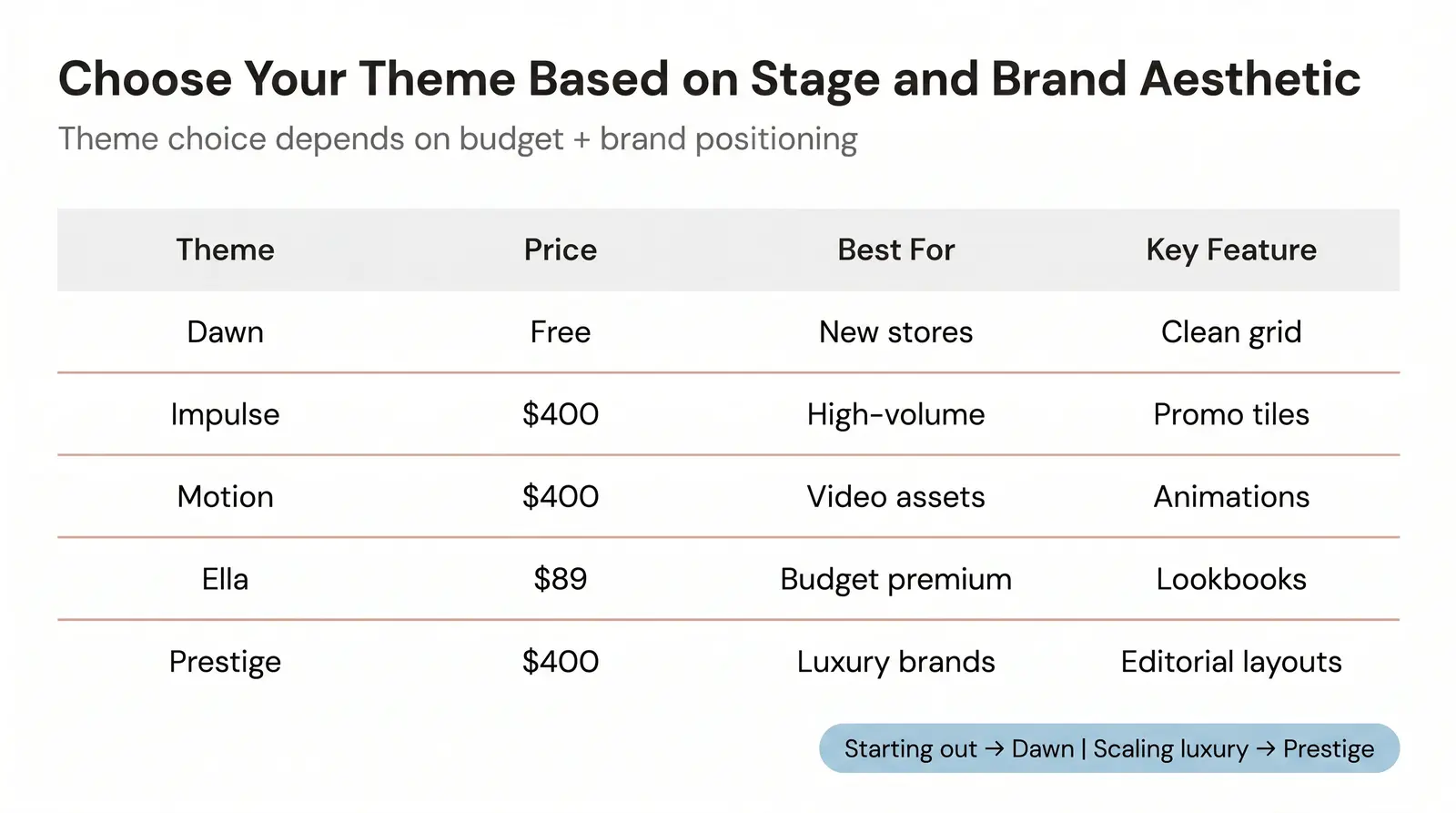
Choosing the right theme is the foundation of your store's success. A jewelry theme must support high-resolution imagery, offer robust zoom features, and provide a clean, elegant grid that doesn't distract from the products. Here is a comparison of the top five Shopify themes for jewelry stores.
| Theme Name | Price | Best For | Key Jewelry Features | Limitation |
|---|---|---|---|---|
| Dawn | Free | New stores testing the waters | Clean product grid, basic image zoom, fast loading | Lacks advanced merchandising features and editorial layouts |
| Impulse | $400 | High-volume stores needing advanced promotions | Custom promo tiles, robust filtering, video support | Can feel slightly generic without heavy customization |
| Motion | $400 | Brands with strong video and lifestyle assets | Smooth animations, autoplay video, visual storytelling | Animation-heavy design can slow down load times if not optimized |
| Ella | $89 | Budget-conscious stores wanting premium features | Multiple layouts, built-in lookbooks, mega menus | Requires more technical setup and configuration than native Shopify themes |
| Prestige | $400 | Luxury and high-end designer brands | Editorial layouts, high-res image focus, built-in lookbooks | Video autoplay is disabled in grid product layouts, limiting dynamic previews |
If you're just starting out and want zero upfront cost, Dawn is the most reliable choice. It is fast, mobile-optimized, and provides a clean slate. However, if you're scaling past $10K/month and need an editorial feel that communicates luxury, Prestige is the industry standard for high-end jewelry. For brands that rely heavily on video content to show how pieces move and sparkle, Motion offers the best native integration.
At Branvas, we audit new stores against the CRAFT framework before their first launch — and the T pillar (Trust Texture) is almost always the weakest. The CRAFT Store Readiness Framework is our proprietary 5-point checklist to assess whether a Shopify jewelry store is actually ready to convert visitors into buyers.

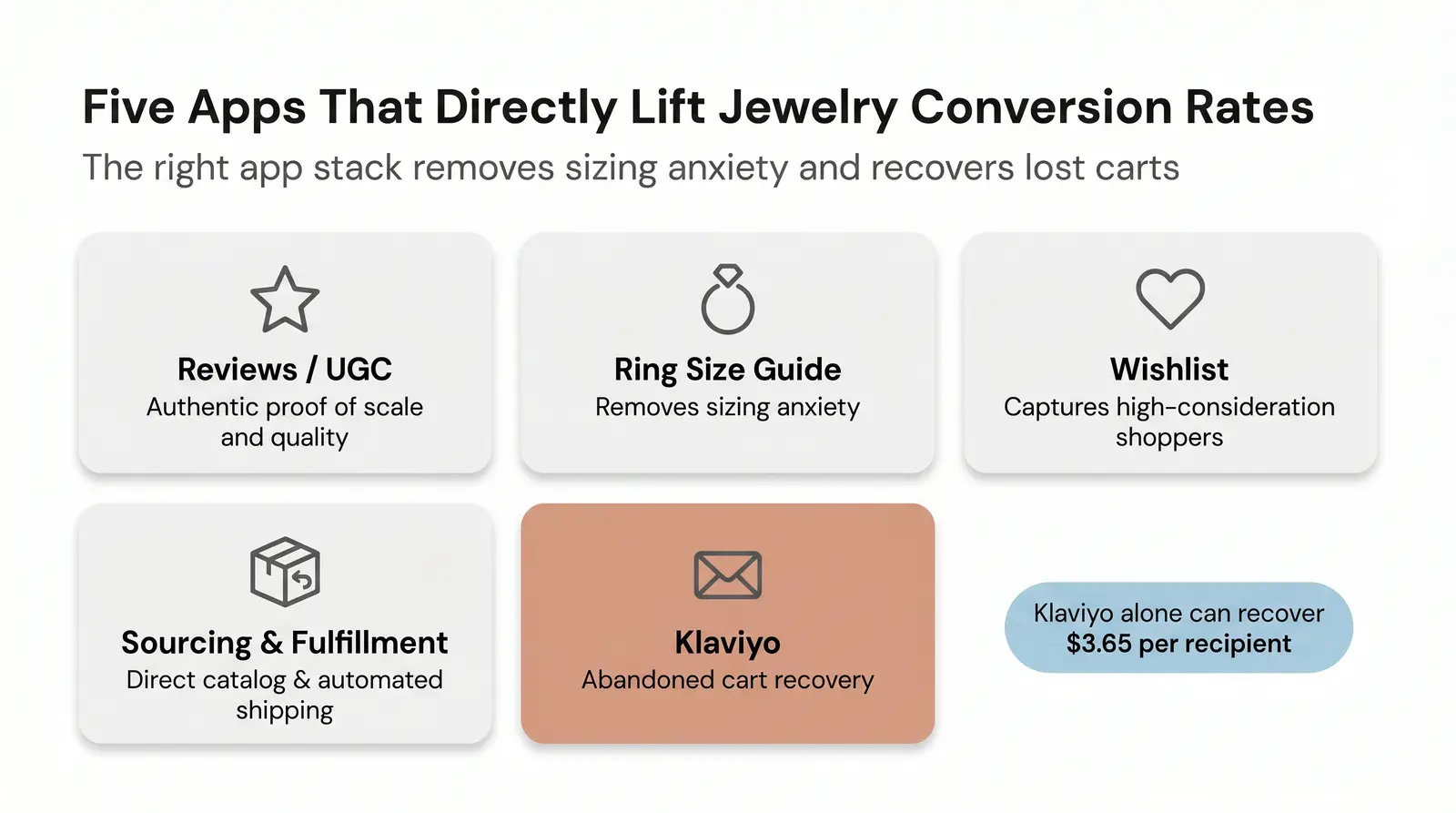
To maximize conversions, your theme needs to be supported by the right applications. These are the essential apps every jewelry store should install:
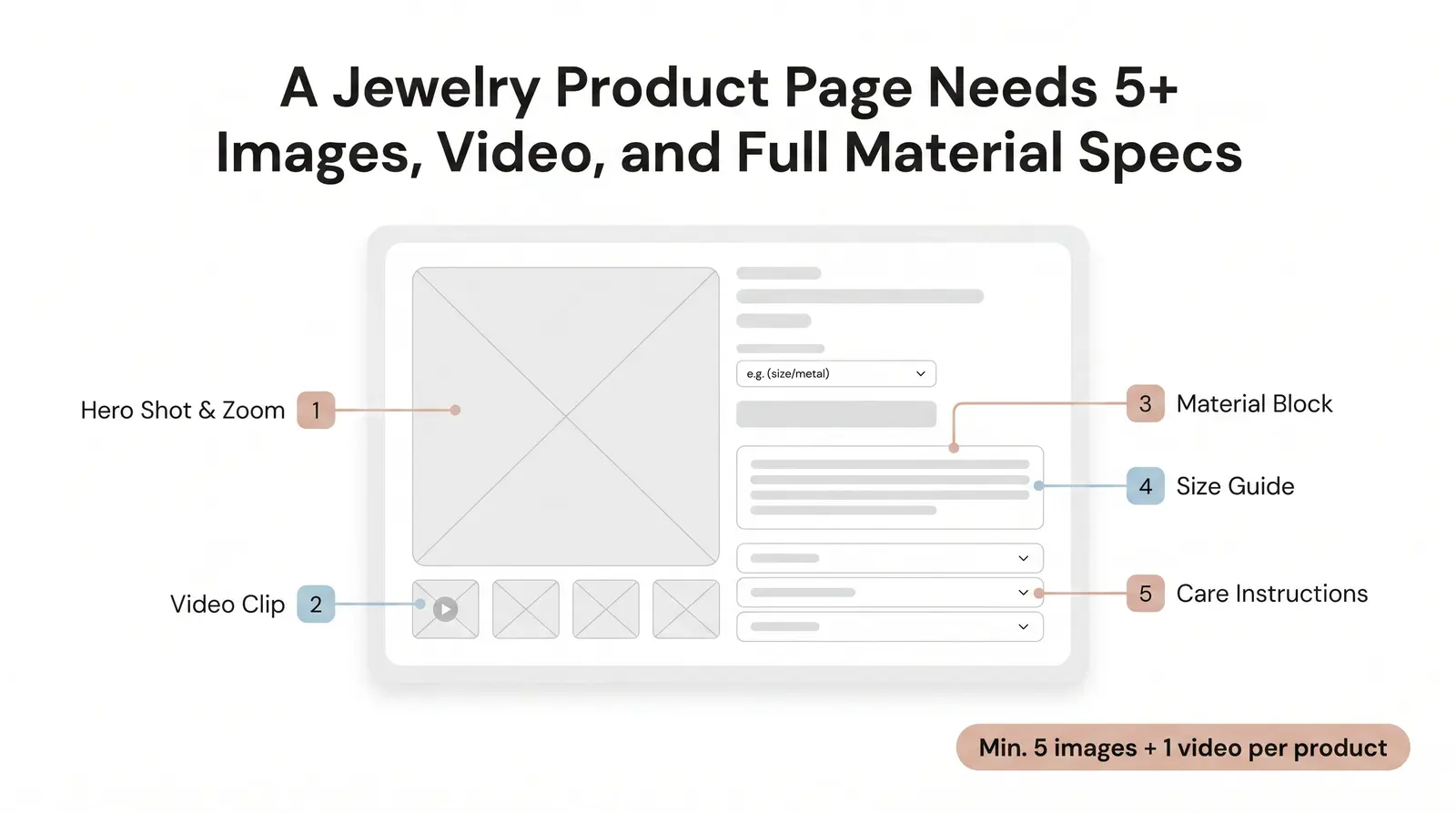
The product page is where the decision is made. For jewelry, it must be highly tactical and information-rich.
Image requirements: You need a minimum of five shots per product. This should include a hero shot on a clean white background, multiple angles (front, side, clasp detail), and at least one lifestyle or model shot to show scale. High-resolution zoom capability is mandatory so customers can inspect the craftsmanship.
Video: Static images cannot capture the sparkle of a gemstone or the drape of a chain. Include short, 5-10 second video clips showing the piece in movement and on the body.
Material information block: Be explicit. State the metal type (e.g., 14K solid gold, sterling silver), plating thickness if applicable, stone type and origin, and whether the piece is hypoallergenic or nickel-free.
Care instructions: Including specific care instructions (e.g., "Avoid contact with water and perfumes") increases the perceived quality of the item and sets proper expectations, which drastically reduces return rates.
Size/fit information: For rings, always link to your size guide. For necklaces, include a visual diagram showing where different chain lengths (e.g., 16", 18", 20") fall on the chest. For bracelets, provide exact circumference measurements.
Let's walk through a fictional product: "14K Gold-Fill Paperclip Chain Necklace, 18 inch".
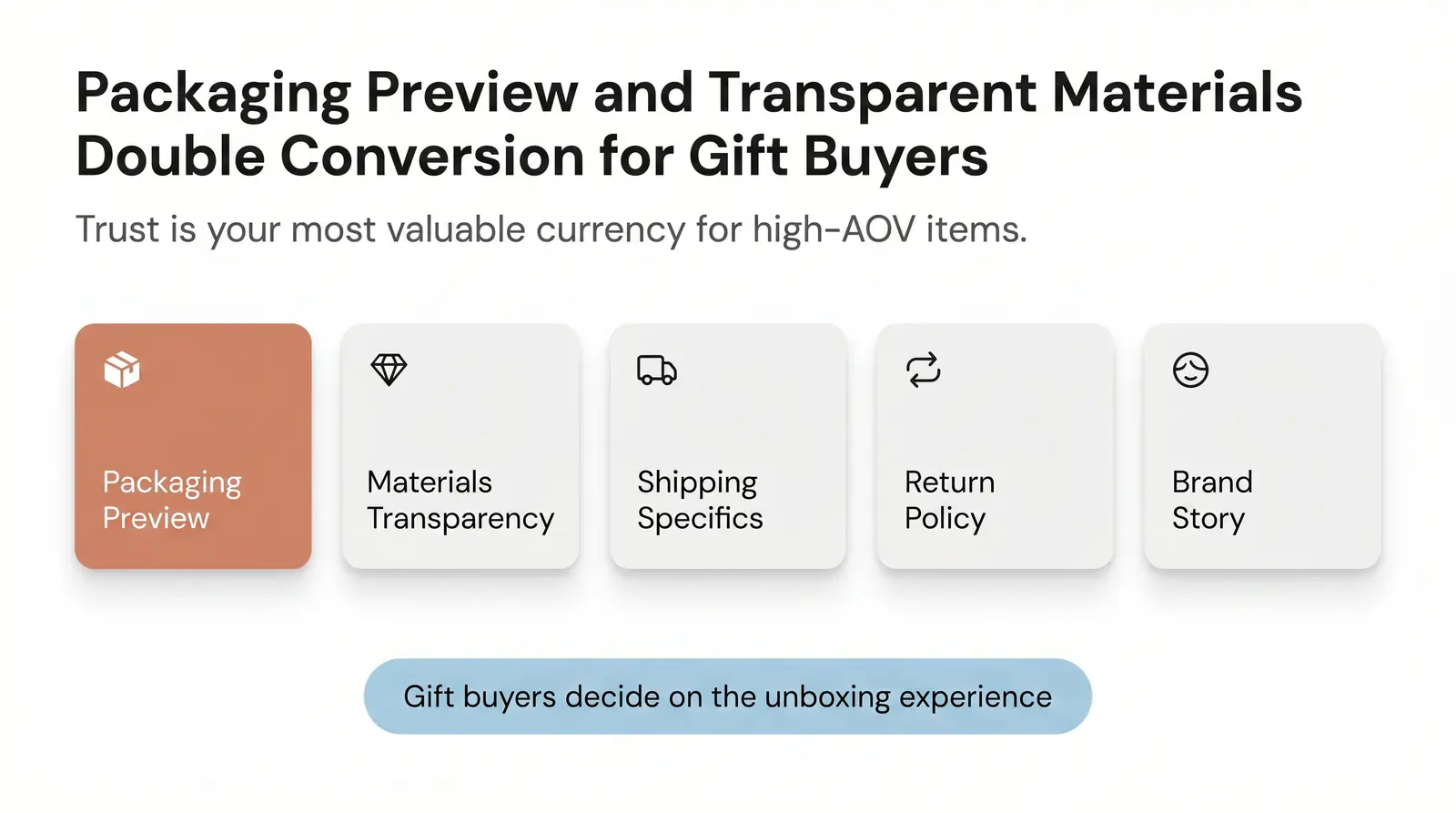
When selling high-average-order-value (AOV) items, trust is your most valuable currency. We've seen stores double their conversion rate simply by adding a packaging preview image to the product page — buyers, especially gift purchasers, want to know the experience doesn't end at the product [4].
Packaging preview imagery: Show the unboxing experience. A beautiful box, a care card, and a branded pouch signal that the product is premium and ready for gifting. It removes the anxiety of "Will this look cheap when it arrives?"
Materials transparency: Dedicate a page or a robust section on your product pages to explain your materials. (See branvas.com/catalog as an example of material-level transparency done well). Educating your customer builds authority.
Shipping policy specifics: Jewelry buyers are often buying for specific dates (birthdays, anniversaries). Clearly state your handling time, provide tracked shipping options, and offer gift messaging at checkout.
Return/exchange policy: Use language that reduces anxiety without encouraging frivolous returns. "We want you to love your piece. If it's not a perfect fit, return it unworn within 30 days for a full refund."
Brand story and founder presence: Independent jewelry brands thrive on connection. Show the face behind the brand. A compelling "About Us" page detailing why you started the company creates an emotional bond that generic dropshippers cannot replicate.
If you're still figuring out where your jewelry is coming from — sourcing, branding, fulfillment — that's where Branvas comes in. Branvas is a private-label Brand-as-a-Service built specifically for Shopify jewelry sellers: you pick products from the catalog, add your brand and packaging, and Branvas ships blind directly to your customers. It's designed so you can focus entirely on your store, marketing, and community — not logistics. Learn how it works →
Before you push your store live, ensure you have checked every box on this launch-ready list:

A jewelry store has specific design needs that most general Shopify themes fail at. Getting the details right — zoomable product images, clean product grids, and robust trust signals — is the difference between a visitor browsing and a customer buying. By implementing the CRAFT framework, choosing the right theme, and optimizing your product pages for high-consideration purchases, you build the trust necessary to succeed in the competitive jewelry market.
Ready to launch your Shopify jewelry store with a real product line behind it? Explore Branvas's private-label jewelry catalog and brand-in-a-box fulfillment — built for Shopify sellers from day one. Start building your jewelry brand →
What is the best Shopify theme for a jewelry store?
The best theme depends on your budget and brand aesthetic. For luxury brands needing editorial layouts, Prestige is the industry standard. For stores focused on video and movement, Motion is excellent. If you are just starting and need a fast, free, and reliable option, Dawn is highly recommended.
Do I need a paid theme to run a successful Shopify jewelry store?
No, you do not need a paid theme to be successful. Shopify's free Dawn theme is fast, mobile-optimized, and includes essential features like image zoom and clean product grids. However, as you scale, a paid theme like Prestige or Impulse offers advanced merchandising tools and a more premium feel out-of-the-box.
What apps do I need for a jewelry store on Shopify?
Essential apps for a jewelry store include a visual review app (like Judge.me or Loox) to build trust, a wishlist app for high-consideration browsing, a sizing guide app (especially if you sell rings), and an email marketing platform like Klaviyo to recover abandoned carts and send back-in-stock alerts.
How do I add a ring size guide to my Shopify store?
You can add a ring size guide by installing a dedicated app like Ring Sizer from the Shopify App Store, which provides interactive sizing tools directly on your product pages. Alternatively, you can create a custom page with a printable sizing chart and link to it from your product descriptions.
Can I sell private-label jewelry on Shopify without holding inventory?
Yes, you can sell private-label jewelry without holding inventory by using a Brand-as-a-Service platform like Branvas. You select products from their catalog, apply your custom branding and packaging, and they handle the blind dropshipping directly to your customers, allowing you to focus on marketing.