



Learn how to rank your Shopify jewelry store on Google using long-tail keywords, Product Schema, technical SEO, and Generative Engine Optimization tactics.
Published:
April 9, 2026
Author:
Yi Cui
Stop hiding on page 2. High-intent jewelry buyers — people actively searching "gold vermeil huggie earrings under $50" or "custom name necklace sterling silver" — are ready to purchase right now. If your Shopify store isn't appearing in front of them, you're leaving real revenue on the table.
Jewelry ecommerce is one of the most fiercely competitive verticals on the internet. Independent Shopify stores are constantly battling against massive marketplaces like Etsy and Amazon, alongside legacy giants like Kay Jewelers and Zales. The structural challenges of jewelry SEO make this fight even harder. Many stores suffer from thin product descriptions, duplicate content pulled directly from manufacturer catalogs, and a visual-first merchandising approach that completely ignores the text signals search engines need to understand the page.
Most jewelry store owners optimize for broad terms like "gold necklace" or "diamond ring" — which is exactly why they never rank. The real opportunity is in specificity at scale: the long tail is not a consolation prize; it is the primary battleground for independent sellers. Research shows that while one-word keywords convert at a dismal 0.17%, four-word keywords hit 1.61%, and six-word queries peak at 1.94% [1]. We often see founders struggle with this at Branvas — they've built a beautiful store, but their product titles are so generic that Google has no idea who they're for.
When you rely on head terms, you are competing against domains with massive authority and multi-million dollar marketing budgets. A search for "diamond ring" is dominated by informational intent and massive retailers. The user might be looking for a picture, a definition, or a $10,000 engagement ring. However, a search for "14k solid gold minimalist stacking ring size 6" is highly transactional. The user knows exactly what they want, and if your product page matches that query, the likelihood of a conversion skyrockets. This is why specificity is the key to unlocking organic revenue for independent jewelry brands.
Furthermore, the jewelry industry is highly visual. Store owners often prioritize high-resolution images and sleek design over text. While aesthetics are crucial for conversion, search engines still rely heavily on text to understand the context and relevance of a page. If your product page only features a beautiful image and a one-sentence description like "A stunning gold ring," Google has very little information to index. This lack of textual context is a primary reason why many visually stunning jewelry stores fail to generate organic traffic.

At Branvas, we walk brand founders through this hierarchy before they write a single product description — because fixing the foundation before content is always faster and cheaper.

Understanding buyer-intent signals is the secret to capturing traffic that actually converts. When a shopper searches for jewelry, their query often reveals exactly where they are in the buying journey. Material specificity ("sterling silver," "14k gold fill"), style preferences ("minimalist," "vintage-inspired"), occasion markers ("bridesmaid gift," "push present jewelry"), and price anchors ("under $100") all indicate a high readiness to purchase.
Let's look at a worked example starting with the seed keyword "layered necklace." A broad search for "layered necklace" is highly competitive and often informational. However, by expanding this seed using tools like Google Autocomplete, People Also Ask, and keyword research platforms, we can uncover highly specific, transactional variants. "Layered gold necklace set" targets a specific material and product type. "Dainty layered necklace sterling silver" adds style and material modifiers. "Layered necklace gift for her" captures occasion-based intent. "How to layer necklaces without tangling" serves as an excellent informational query to build topical authority.
| Keyword Type | Example Query | Search Intent | Best Page Type |
|---|---|---|---|
| Material-specific | "sterling silver hoop earrings" | Transactional | Collection or Product Page |
| Occasion-based | "jewelry gift for new mom" | Transactional | Gift Guide / Blog Post |
| Style-based | "minimalist gold rings stack" | Transactional | Collection Page |
| How-to / Educational | "how to clean gold vermeil jewelry" | Informational | Blog Post |
| Comparison | "gold fill vs gold plated jewelry" | Informational | Blog Post / FAQ |
| Brand + product | "[Brand] pearl drop earrings" | Navigational | Product Page |
You can uncover these opportunities using tools like Google Search Console, Ahrefs, Semrush, Ubersuggest, and even Reddit or Etsy search bars as free research vectors. By analyzing the language your target audience uses to describe the jewelry they want, you can align your product titles, descriptions, and collection pages with their exact search queries. If you're launching a jewelry brand and need a product catalog worth building SEO around, explore Branvas's ready-to-brand catalog.
It is also important to consider the search volume versus conversion rate tradeoff. While a long-tail keyword might only have 50 searches per month, those 50 searches are highly targeted. If you rank number one for that query, you might capture 20 of those clicks. Because the intent is so strong, a significant percentage of those visitors are likely to convert. In contrast, ranking on page two for a broad term with 10,000 searches will yield almost zero traffic, as the vast majority of clicks go to the top three results on page one.

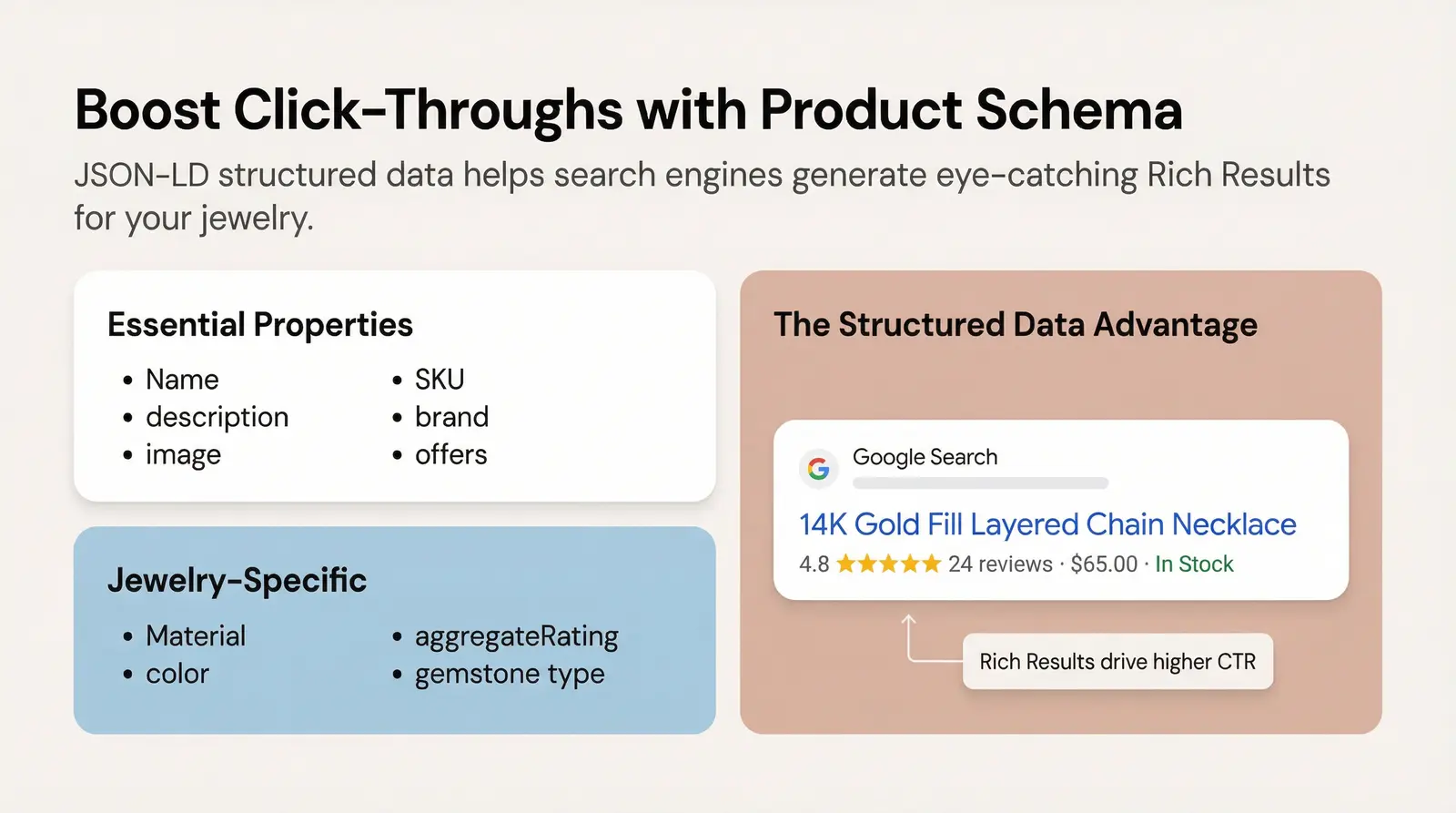
Product Schema, formatted as JSON-LD, is a standardized vocabulary that helps search engines understand the specific details of your products. Google uses this structured data to generate Rich Results — those eye-catching search listings that display price, availability, and review ratings directly in the SERPs. Implementing Product Schema is critical because these enhanced listings significantly improve click-through rates.
For jewelry specifically, certain Schema.org properties are essential. You must include name, description, image, sku, brand, and offers (which contains price, priceCurrency, availability, and url). Furthermore, jewelry sellers should leverage material, color, aggregateRating, and review. You can also use the additionalProperty field to specify crucial details like gemstone type, metal purity, and ring size [2].
{
  "@context": "https://schema.org/",
  "@type": "Product",
  "name": "14K Gold Fill Layered Chain Necklace",
  "image": [
    "https://example.com/photos/1x1/photo.jpg",
    "https://example.com/photos/4x3/photo.jpg",
    "https://example.com/photos/16x9/photo.jpg"
  ],
  "description": "A dainty, minimalist 14K gold fill layered chain necklace featuring two distinct chains. Perfect for everyday wear and resistant to tarnishing.",
  "sku": "NL-GF-042",
  "brand": {
    "@type": "Brand",
    "name": "Branvas Example Brand"
  },
  "material": "14K Gold Fill",
  "color": "Gold",
  "offers": {
    "@type": "Offer",
    "url": "https://example.com/products/14k-gold-fill-layered-chain-necklace",
    "priceCurrency": "USD",
    "price": "65.00",
    "priceValidUntil": "2026-12-31",
    "itemCondition": "https://schema.org/NewCondition",
    "availability": "https://schema.org/InStock"
  },
  "aggregateRating": {
    "@type": "AggregateRating",
    "ratingValue": "4.8",
    "reviewCount": "24"
  }
}
To implement this in Shopify, you can edit your theme's product.liquid file, create a custom snippet, or use a reliable third-party app like "JSON-LD for SEO." While Shopify does add some basic Schema automatically, it is often incomplete for the nuanced attributes required by jewelry products, making manual customization necessary [3]. Interestingly, Google's AI Overviews increasingly pull structured product data directly — making Product Schema a GEO signal, not just a traditional SEO signal.
When search engines can easily parse the structured data on your product pages, they are more likely to feature your products in rich snippets, image carousels, and AI-generated summaries. This increased visibility is a direct result of providing clear, machine-readable information about your inventory.
Generative Engine Optimization (GEO) is the practice of optimizing your content so that AI-powered search engines — like Google AI Overviews, Bing Copilot, Perplexity, and ChatGPT search — surface your store and products in their generated answers [4].
GEO differs fundamentally from classic SEO. While traditional SEO focuses on keyword density and backlinks to rank blue links, GEO rewards semantic completeness, authoritative prose, structured answers to specific questions, and trustworthy brand signals. AI systems extract specific passages to construct answers, meaning your content must be factual, clear, and capable of standing alone.
Here are 5 concrete GEO tactics for jewelry Shopify stores:
In our experience at Branvas, founders who invest in content depth — not just product pages — see faster traction in AI-generated search results, because GEO rewards brands that genuinely educate their buyer. Ready to launch a jewelry brand with an SEO-ready foundation? See how Branvas works — from sourcing to branded packaging to fulfillment, we help you build something Google (and your customers) can actually find.
The shift towards AI-driven search means that users are increasingly looking for direct answers rather than a list of links. By structuring your content to provide clear, concise, and authoritative answers to common questions about jewelry, you position your brand as a trusted resource. This not only improves your chances of being featured in AI overviews but also builds trust with potential customers.

yourstore.com/sitemap.xml)/collections/ and /products/ paths — ensure canonical points to preferred URL)<title> tags for every product and collection page (include primary keyword + brand)
SEO is a long-term strategy, typically taking 3 to 6 months to show measurable results for a new jewelry store. The timeline depends on your site's technical health, the competitiveness of your target keywords, and how consistently you publish high-quality content. Focusing on low-competition, long-tail keywords can yield faster initial traction.
The best keywords are specific, long-tail phrases that indicate high purchase intent. Instead of targeting broad terms like "gold rings," focus on descriptive queries like "14k solid gold minimalist stacking ring." These specific keywords have lower search volume but significantly higher conversion rates because they match exactly what the buyer wants.
Shopify provides a solid technical foundation by automatically generating sitemaps, robots.txt files, and basic canonical tags. However, it does not automatically optimize your content. You must manually write unique title tags, meta descriptions, image alt text, and implement comprehensive Product Schema to truly compete in search results.
You can add Product Schema by editing your Shopify theme's product.liquid file to include custom JSON-LD code. Alternatively, you can use a dedicated third-party app like "JSON-LD for SEO" from the Shopify App Store. These apps automatically inject the necessary structured data, ensuring your products are eligible for Google Rich Results.
Generative Engine Optimization (GEO) is the process of structuring your content so it is cited by AI search tools like Google AI Overviews and ChatGPT. It matters immensely for jewelry sellers because AI increasingly answers complex shopping queries. Providing clear, factual details about materials, care, and styling helps AI confidently recommend your products.


