


Is dropshipping dead? Not for jewelry. Discover exactly how to start a jewelry dropshipping business in 2026, from understanding the business model to building a brand that builds trust.
Published:
January 29, 2026
Author:
Yi Cui
Let's address the elephant in the room: you've probably heard that dropshipping is dead, saturated, or a race to the bottom. And for generic, low-quality product stores, that assessment is largely correct. Over 90% of dropshipping businesses fail within their first few months, often due to a lack of research, poor supplier choices, and a fundamental misunderstanding of what it takes to build a real brand [1].
But jewelry is different. It is not a commodity; it is an emotional purchase. It is not about speed; it is about trust. And for the entrepreneur who understands these nuances, how to start a jewelry dropshipping business in 2026 is not a question of "if it can work," but "how to make it work correctly."
The global jewelry market reached USD 366.79 billion in 2024 and is projected to grow to nearly USD 578 billion by 2033 [2]. More importantly, the online jewelry segment is growing at a faster rate (7.9% CAGR) than the overall market, signaling a massive shift in consumer behavior [2]. Jewelry is now the fastest-growing category in fashion by unit sales, outpacing clothing by a factor of four [3].
This guide is not a get-rich-quick scheme. It is a comprehensive, data-driven roadmap designed for serious beginners who want to build a sustainable, brand-first jewelry business. We will cover:
If you're ready to build something real, let's begin.

Understanding how does jewelry dropshipping work is the first step to building a successful business. At its core, the model is simple: you sell jewelry on your online store, and a third-party supplier handles inventory, packaging, and shipping directly to your customer. You never touch the product.
|
Function |
Your Responsibility |
Supplier's Responsibility |
|---|---|---|
|
Sourcing & Inventory |
Curating products, selecting suppliers |
Holding stock, managing inventory |
|
Branding & Marketing |
Building the brand, running ads, content |
Providing product images (often) |
|
Order Processing |
Receiving orders, forwarding to supplier |
Packing and shipping the order |
|
Customer Service |
Handling inquiries, complaints, returns |
Processing returns (varies by supplier) |
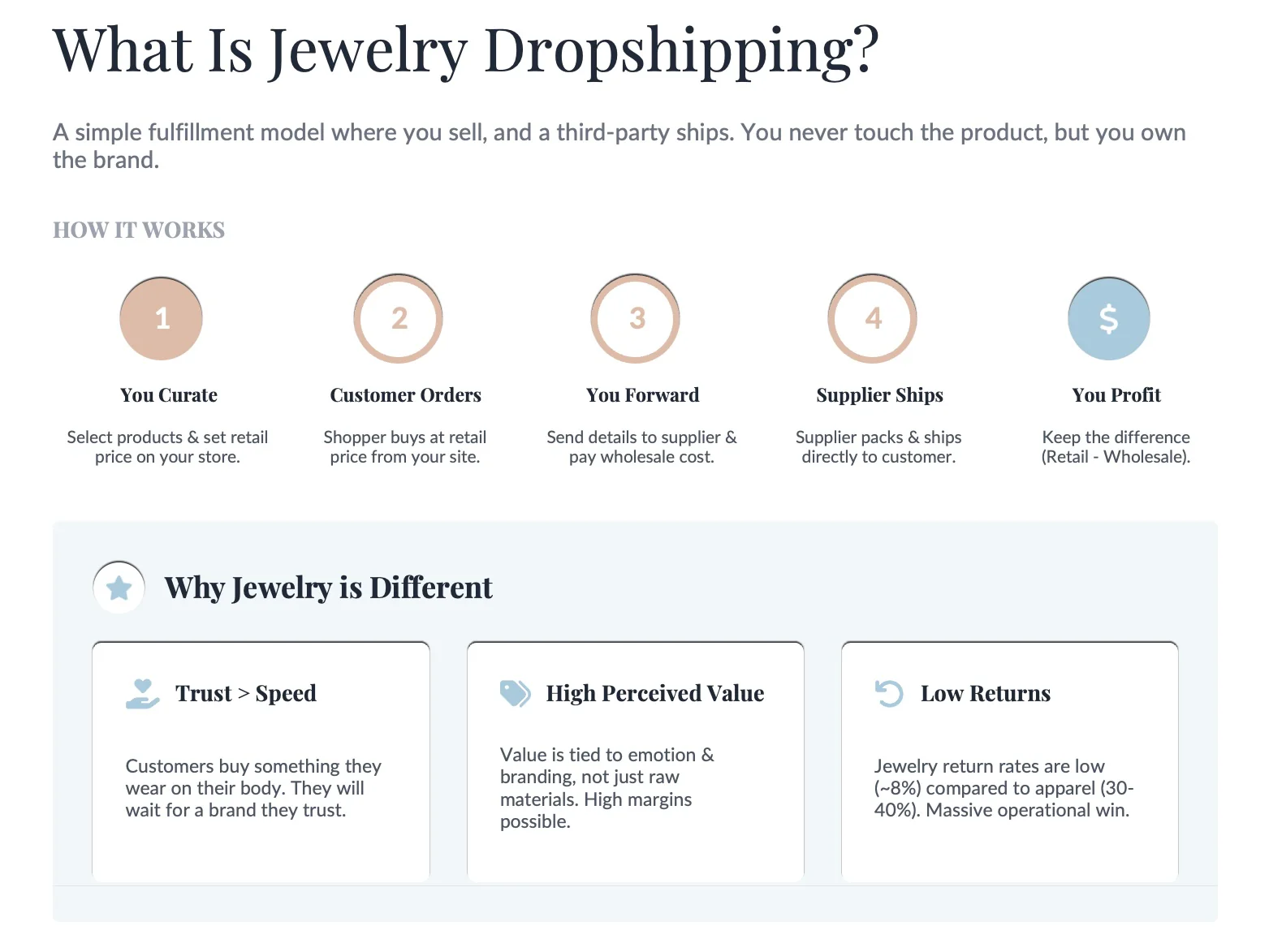
Jewelry is not a phone case or a kitchen gadget. The key differences that make it a unique niche include:
The most common mistake is treating dropshipping as a purely transactional business. Beginners often focus on finding "winning products" and running ads, while neglecting the brand, the customer experience, and the trust signals that are essential for selling jewelry. In this niche, your brand is your product.
To succeed, you must understand the jewelry dropshipping business model from a financial perspective. This section breaks down the revenue flow, cost structure, and realistic margin expectations.
Your revenue comes from the retail price you charge customers. Your profit is calculated as:
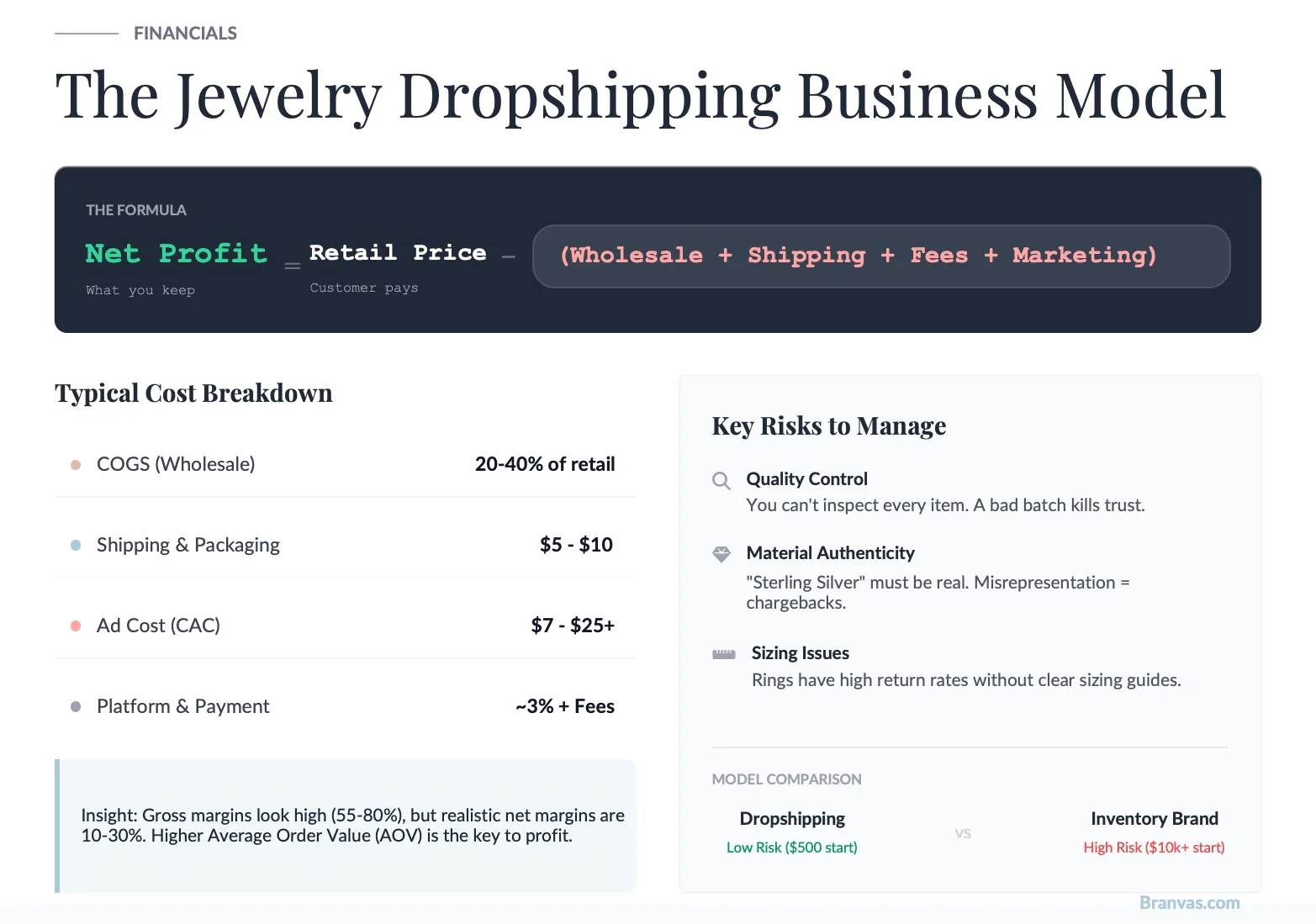
Net Profit = Retail Price - (Wholesale Cost + Shipping + Platform Fees + Payment Fees + Marketing Costs)
A realistic breakdown of costs for a typical jewelry dropshipping order might look like this:
|
Cost Category |
Typical Range |
Notes |
|---|---|---|
|
Cost of Goods Sold (COGS) |
20-40% of retail price |
The wholesale price paid to your supplier. |
|
Shipping |
$5.00 - $10.00 per order |
Varies based on supplier location and speed. |
|
Packaging |
$0.50 - $3.00 per order |
Higher for branded or custom packaging. |
|
Platform Fees (e.g., Shopify) |
~$30-$80/month |
Plus app subscription costs. |
|
Payment Processing |
~2.9% + $0.30 per transaction |
Standard for Stripe/PayPal. |
|
Customer Acquisition Cost (CAC) |
$7 - $25+ per customer |
The cost of ads to acquire one paying customer [5]. |
While gross margins in jewelry can appear high (55-80%), the reality after all costs is more nuanced. Data suggests that realistic net margins for a well-run jewelry dropshipping store are between 10% and 30% [5].
The key insight is that higher Average Order Values (AOVs) lead to better net margins. A $10 necklace with a $7 ad cost leaves almost no profit. A $95 bracelet with a $25 ad cost can yield a 30%+ net margin [5].
|
Factor |
Dropshipping |
Inventory-Based |
|---|---|---|
|
Startup Cost |
Low ($500 - $2,000) [1] |
High ($10,000+) |
|
Inventory Risk |
None |
Significant |
|
Profit Margins |
Lower (10-30% net) |
Higher (40-60%+ net) |
|
Quality Control |
Indirect |
Direct |
|
Customization |
Limited |
Full control |
|
Scalability |
High (supplier handles fulfillment) |
Requires operational investment |
Jewelry is not for the faint of heart. It rewards those who invest in branding and punishes those who cut corners. Here's why it's a uniquely powerful, yet demanding, niche.
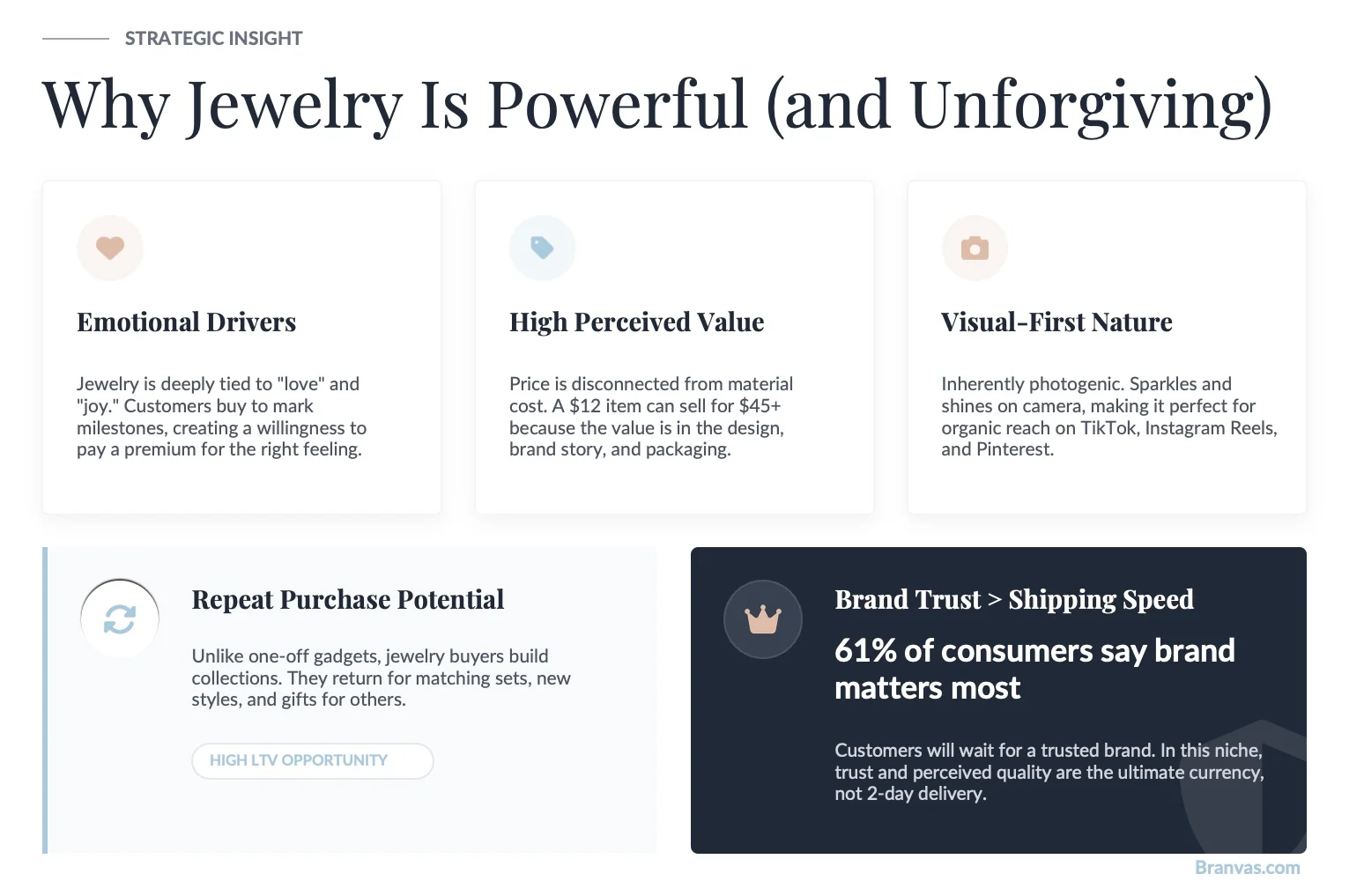
Jewelry is deeply tied to emotion. A 2024 study by Jewelers Mutual found that "love" is the strongest emotion associated with buying or receiving jewelry, followed by "joy" [4]. People buy jewelry to mark milestones—engagements, anniversaries, graduations, and personal achievements. This emotional connection creates a willingness to pay a premium for the right piece from the right brand.
The perceived value of jewelry is largely disconnected from its material cost. A gold-plated necklace might cost $12 from a supplier but can be sold for $45 because the customer is buying the design, the brand story, and the feeling it evokes. This is the foundation of healthy margins in this niche.
Jewelry is inherently photogenic. It shines, sparkles, and looks beautiful on camera. This makes it perfectly suited for visual-first platforms like Instagram, TikTok, and Pinterest. Short-form video content showcasing jewelry can generate massive organic reach, reducing reliance on paid advertising.
Unlike a one-time gadget purchase, jewelry customers often become repeat buyers. They build collections, buy gifts for others, and return for new pieces that match their evolving style. Building a loyal customer base is more valuable than chasing one-off sales.
In most dropshipping niches, fast shipping is a key competitive advantage. In jewelry, brand trust and perceived quality matter more. A customer will wait an extra few days for a piece from a brand they trust over a no-name store that promises two-day shipping. According to the McKinsey State of Fashion 2026 report, 61% of consumers say jewelry is a category where brand matters most [3].
This is your complete roadmap. Follow these steps to go from zero to your first sale.
The riches are in the niches. Trying to sell "women's jewelry" puts you in direct competition with thousands of stores. Instead, find a specific angle.
Profitable Niches to Consider:
Oversaturated Niches to Avoid:
Fast Validation Methods:
Your supplier is your most important partner. A bad supplier will sink your business.
What to Look For:
Red Flags:
Quality Control Basics:
Checklist: Supplier Evaluation
☐ Ordered and inspected samples
☐ Verified shipping times to target market
☐ Confirmed branding/packaging options
☐ Checked reviews from other sellers
☐ Tested customer support responsiveness
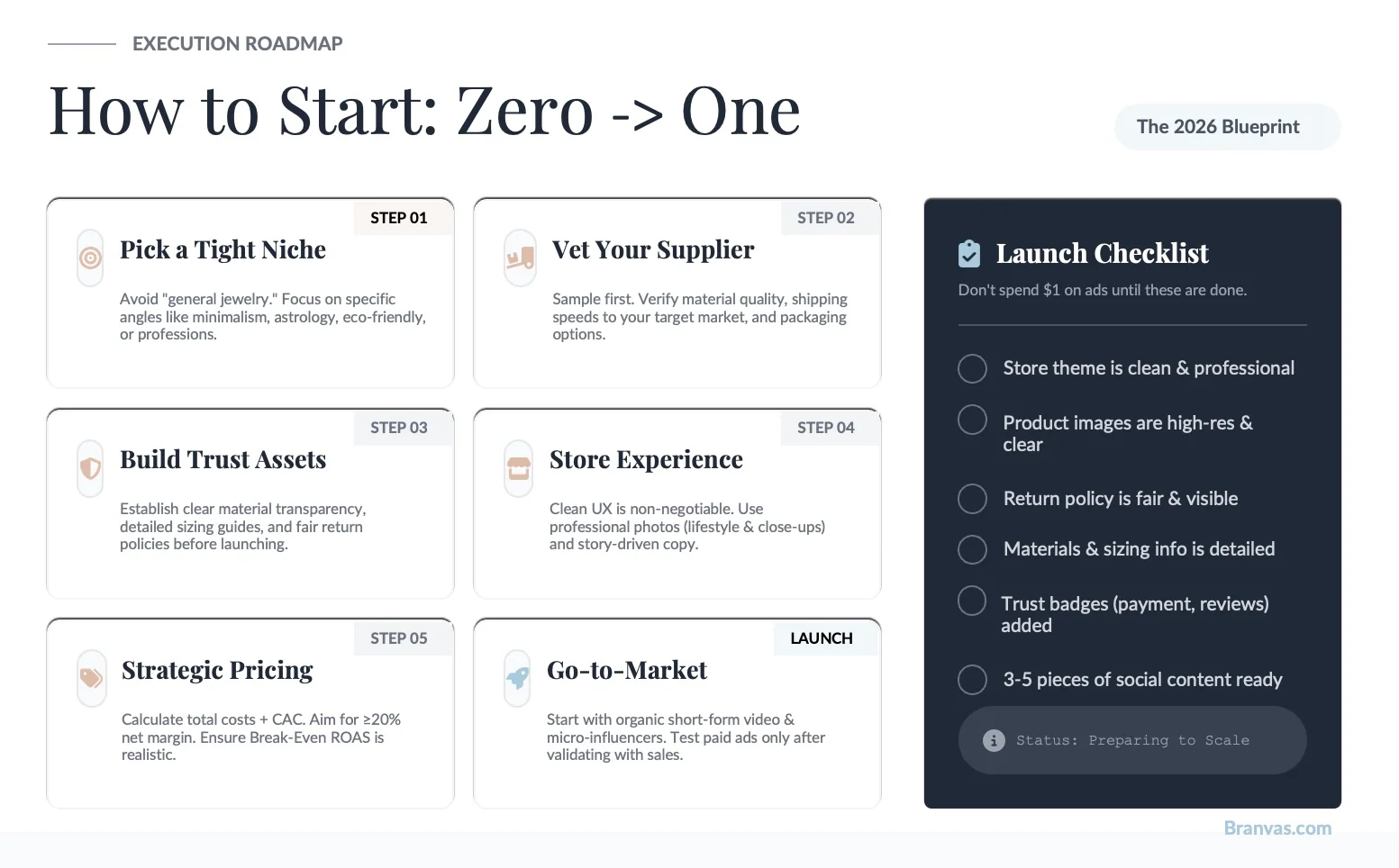
Before you spend a dollar on ads, your store must be built to convert. For jewelry, this means establishing trust at every touchpoint.
Jewelry buyers have high expectations for the online shopping experience.
Use this simple framework to price your products:
Entry vs. Premium Strategies:
Organic Content:
UGC & Influencers:
Social Commerce:
When to Use Ads (and When Not To):
Checklist: Pre-Launch Readiness
☐ Store theme is clean and professional
☐ All product pages have high-quality images and compelling copy
☐ Materials and sizing information is clear
☐ Return policy is fair and visible
☐ Trust badges (secure payment, reviews) are displayed
☐ At least 3-5 pieces of social content are ready to post
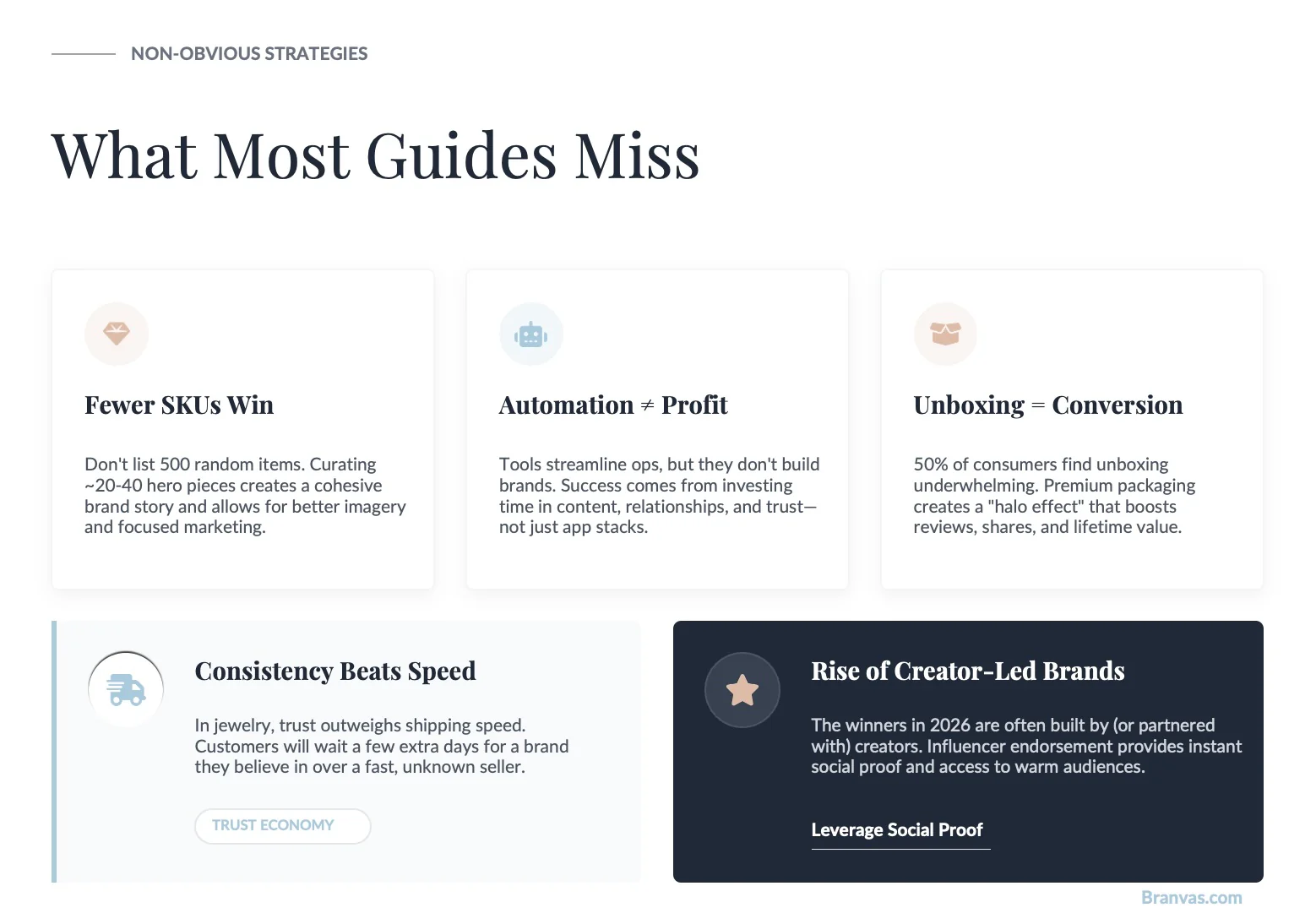
Most guides focus on the mechanics. Here are the non-obvious insights that separate successful jewelry brands from the rest.
A store with 500 random jewelry pieces looks like a generic dropshipping operation. A store with 30 carefully curated pieces that tell a cohesive story looks like a brand. Fewer SKUs mean you can invest more in high-quality images, better descriptions, and focused marketing for each piece.
Automation tools can streamline order processing, but they don't build a brand or create customer loyalty. The most successful jewelry dropshippers invest their time in branding, content creation, and customer relationships—not just finding the next app to automate a task.
A 2025 survey found that 50% of consumers found their unboxing experience to be underwhelming [9]. For jewelry, the unboxing moment is critical. Premium packaging creates a "halo effect," making the product inside feel more valuable [10]. This leads to better reviews, more social shares, and higher customer lifetime value. Investing in branded packaging can have a higher ROI than increasing your ad budget.
In most ecommerce, fast shipping is king. In jewelry, customers prioritize trust and brand perception over speed. They would rather wait an extra few days for a piece from a brand they believe in than receive a fast shipment from an unknown seller. Focus on building a consistent, trustworthy brand identity across all touchpoints.
The most successful new jewelry brands in 2026 are often built by creators—influencers, stylists, and content creators who have an existing audience. If you don't have an audience, consider partnering with creators who do. Their endorsement provides instant social proof and access to a warm audience.
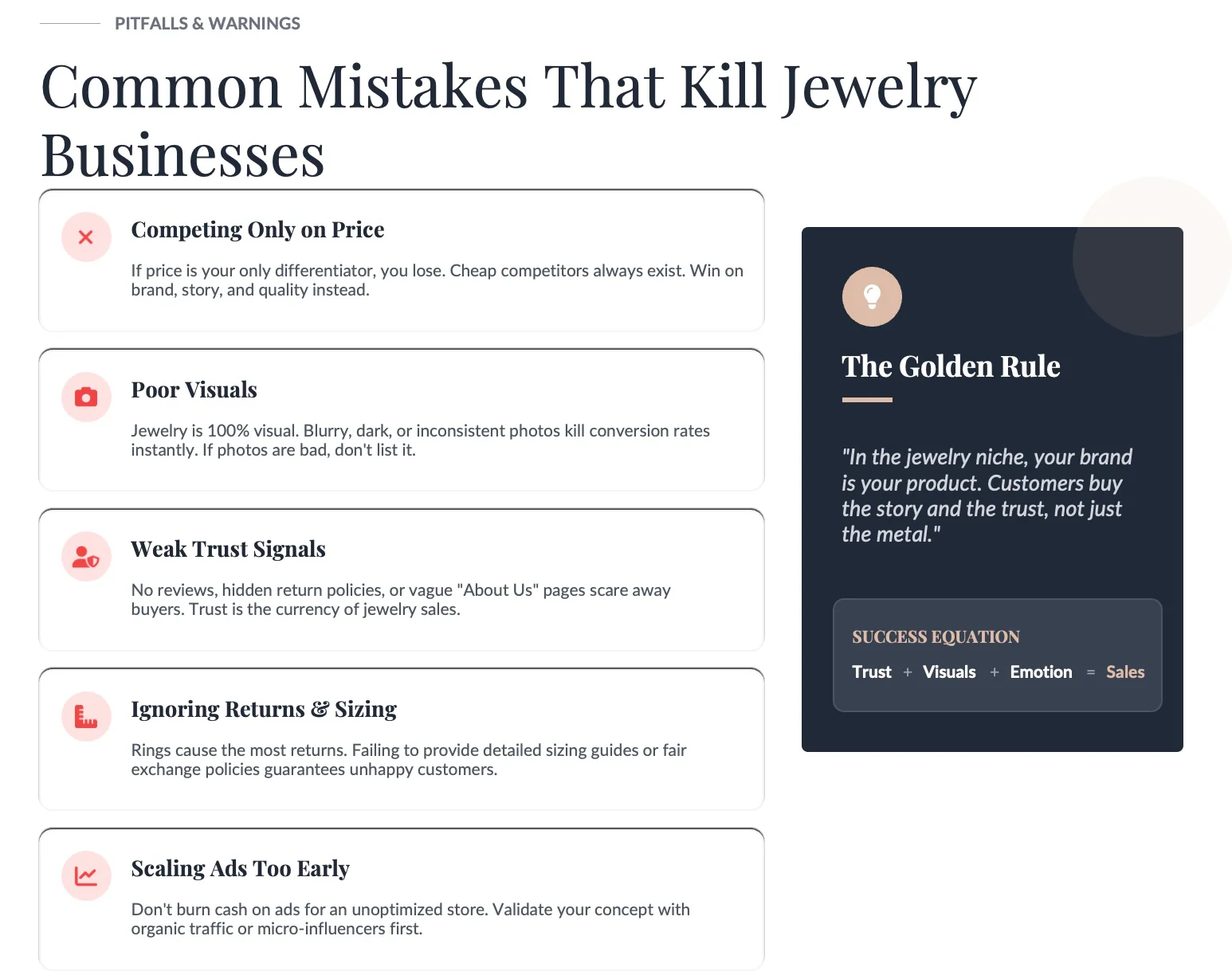
Avoid these pitfalls to give your business the best chance of success.
If your only selling point is being cheaper than the competition, you will lose. There will always be someone willing to sell for less. Compete on brand, quality, and customer experience instead.
Jewelry is a visual product. Blurry, poorly lit, or inconsistent product photos will kill your conversion rate. If you can't get high-quality images from your supplier, don't sell the product.
A new store with no reviews, no clear return policy, and no information about the brand will not convert jewelry buyers. Invest in building trust from day one: collect reviews, be transparent about your policies, and tell your brand story.
Ring sizing is a common source of returns and complaints. Provide detailed, accurate sizing guides. Have a clear and fair exchange policy for sizing issues. Ignoring this will lead to negative reviews and chargebacks.
Don't pour money into ads before your store is optimized and you have proof of concept. A bad store with a big ad budget will just lose money faster. Get your first few organic or low-budget sales, gather feedback, and optimize before scaling.
Here is a high-level overview of the ecosystem of tools that can support your business.
|
Category |
Purpose |
Examples |
|---|---|---|
|
Storefront |
Build and host your online store |
Shopify, WooCommerce |
|
Payments |
Process customer payments securely |
Shopify Payments, Stripe, PayPal |
|
Supplier Platforms |
Find and connect with jewelry suppliers |
Shopify Collective, Syncee, DropCommerce, AliExpress |
|
Automation |
Automate order forwarding and inventory sync |
DSers, AutoDS, Branvas |
|
Branding & Design |
Create logos, graphics, and marketing materials |
Canva, Looka |
|
Email Marketing |
Build customer relationships and drive repeat sales |
Klaviyo, Mailchimp |
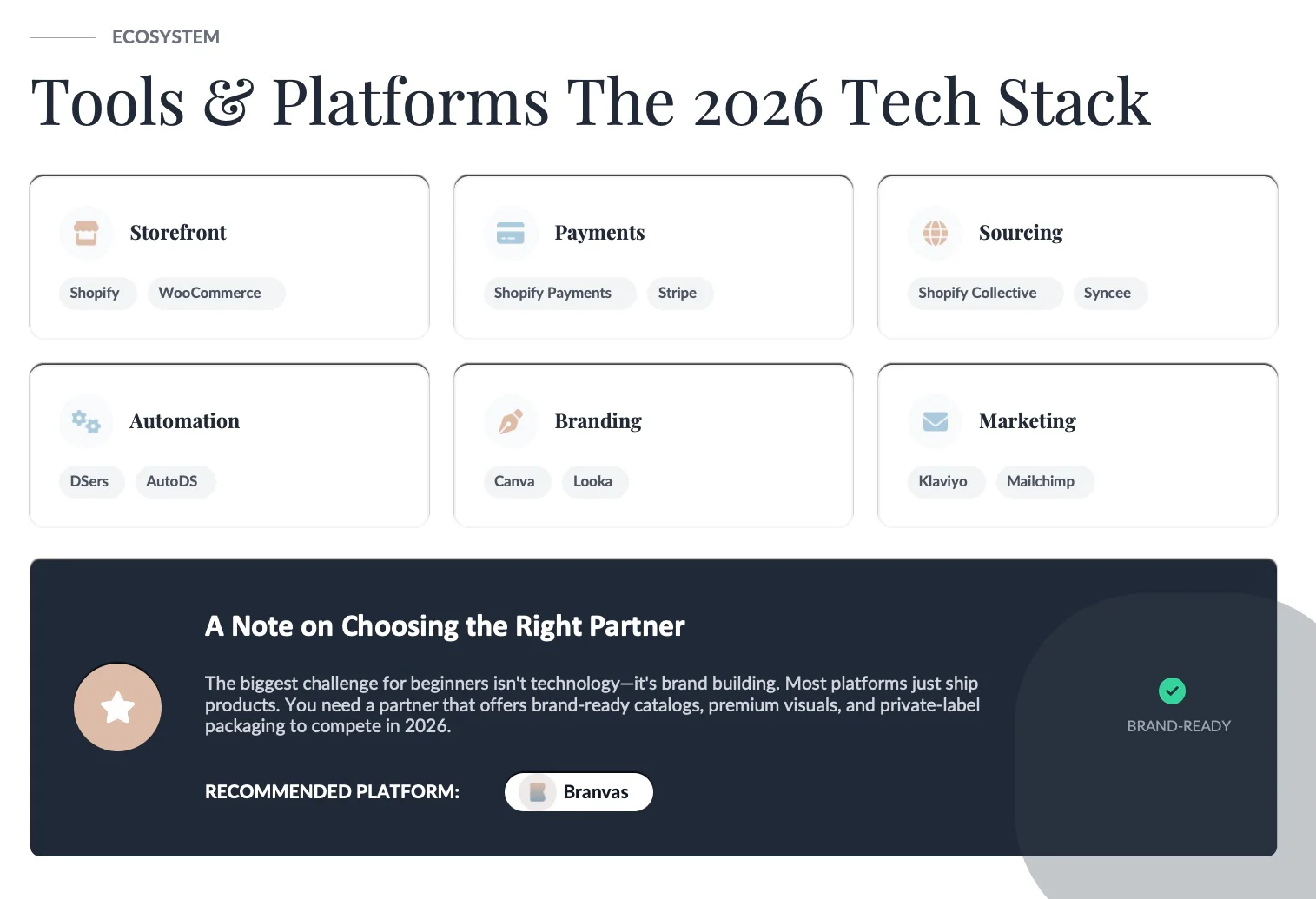
For beginners, one of the biggest challenges is finding a supplier that offers not just products, but a complete brand-building solution. Platforms that provide brand-ready catalogs, high-quality product visuals, private-label packaging options, and seamless Shopify integration can significantly reduce the complexity of getting started. This allows you to focus on what matters most: building your brand and connecting with your customers. Branvas is one such platform designed to empower jewelry entrepreneurs with these capabilities.
Jewelry dropshipping can be profitable, with realistic net margins ranging from 10% to 30% after all costs. Profitability depends heavily on your Average Order Value (AOV), branding, and customer acquisition costs. Higher-priced, well-branded pieces tend to yield better margins than cheap, generic items [5].
For beginners, jewelry dropshipping works by partnering with a supplier who holds inventory and ships products directly to your customers. You create an online store, list the supplier's products at a markup, and handle marketing and customer service. The supplier handles fulfillment, so you never need to hold stock [11].
No, you do not need to hold inventory. This is the core advantage of the dropshipping model. Your supplier stores the products and ships them on your behalf when you receive an order. This significantly lowers your startup costs and financial risk [11].
The market is competitive, but not oversaturated for those who differentiate. Generic stores selling cheap, unbranded jewelry struggle. However, stores with a clear niche, strong branding, and a focus on quality can still thrive. The key is to build a brand, not just a store [1].
The biggest mistake is neglecting branding and trust. New dropshippers often focus on finding "winning products" and running ads, while ignoring the brand identity, product quality, and customer experience that are essential for selling jewelry. In this niche, customers buy from brands they trust, not just stores with low prices [1] [4].
[1] AppScenic. (n.d.). Why Over 90% Of Dropshippers Fail (Dropshipping Success Rate). Retrieved from https://appscenic.com/blog/why-more-than-90-of-dropshippers-fail/
[2] Grand View Research. (2024). Jewelry Market Size, Share & Trends Analysis Report, 2025-2033. Retrieved from https://www.grandviewresearch.com/industry-analysis/jewelry-market
[3] The Business of Fashion & McKinsey & Company. (2025). The State of Fashion 2026: Why the Shine Isn't Fading on Jewellery Sales. Retrieved from https://www.businessoffashion.com/articles/luxury/the-state-of-fashion-2026-report-jewellery-category-sales/
[4] Jewelers Mutual. (2024). Jewelry Buying Behaviors: A Consumer Study. Retrieved from https://www.jewelersmutual.com/resources/individuals/how-buy/jewelry-buying-behaviors-consumer-study
[5] ScaleOrder. (2025). Is Dropshipping Jewelry Profitable? A Complete Data-Driven Guide to Margins, Branding, Social Media, and Real-World Profit Strategies. Retrieved from https://scaleorder.com/blogs/is-dropshipping-jewelry-profitable-a-complete-data-driven-guide-to-margins-branding-social-media-and-real-world-profit-strategies/
[6] Loop Returns. (2025). Return policy strategies for jewelry brands in 2025. Retrieved from https://www.loopreturns.com/blog/return-policy-strategies-for-jewelry-brands/
[7] SellersCommerce. (2025). Social Commerce Statistics Of 2025 (Demographics And Trends). Retrieved from https://www.sellerscommerce.com/blog/social-commerce-statistics/
[8] Jewel360. (2026). 7 Trends in Jewelry Retail That Will Define 2026. Retrieved from https://jewel360.com/blog/trends-in-jewelry-retail
[9] GWP Group. (2025). Unboxing trends and how consumers view eCommerce packaging. Retrieved from https://www.gwp.co.uk/guides/unboxing-trends/
[10] CaratX. (2025). The Power of Packaging: How Luxury Presentation Improve Jewelry Sales and Customer Experience. Retrieved from https://caratx.com/blog-post/the-power-of-packaging-how-luxury-presentation-improve-jewelry-sales-and-customer-experience
[11] Shopify. (2025). Jewelry Dropshipping: How To Get Started in 2026. Retrieved from https://www.shopify.com/blog/dropshipping-jewelry
[12] Grand View Research. (2024). Dropshipping Market Size, Share & Trends Analysis Report, 2025-2030. Retrieved from https://www.grandviewresearch.com/industry-analysis/dropshipping-market
[13] Shopify. (2025). The Future of Ecommerce Report 2026: Global Ecommerce Sales Growth. Retrieved from https://www.shopify.com/blog/global-ecommerce-sales
[14] Dynamic Yield. (2026). eCommerce conversion rate benchmarks by industry. Retrieved from https://marketing.dynamicyield.com/benchmarks/conversion-rate/
[15] Nakassi. (2025). Gen Z Jewelry Trends 2025 – Insights for Retailers. Retrieved from https://nakassi.com/blog/gen-z-jewelry-shopping-trends-and-what-retailers-can-learn/