


Migrate from Etsy to Shopify by exporting listings, choosing the right import method, reconciling your catalog, and testing checkout before launch.
Published:
November 24, 2026
Author:
Yi Cui
You can migrate to Shopify from Etsy by exporting your active listings, importing them into Shopify, and rebuilding the settings that make your store work. Products are the starting point, not the whole migration. Customer records, orders, reviews, shipping rules, and search visibility need separate attention.1 2
On a marketplace, you rent the storefront and work within its rules for the customer relationship. Shopify gives you more control over your brand and storefront, but it does not bring Etsy's audience with it or turn past buyers into newsletter subscribers.1 3
The useful question is not whether Shopify offers more freedom. It is whether that freedom solves a business problem you can afford to solve.
A standalone store lets you build your own navigation, product presentation, and checkout experience. But a storefront is not a source of demand. You still need people to find it.1
Use this decision guide as a planning tool, not a validated scorecard or a universal revenue threshold.
| Choice | When it makes sense | What to prove before changing course |
|---|---|---|
| Stay on Etsy for now | Marketplace discovery is doing most of the selling, and you lack time or budget to build another channel. | Identify a realistic traffic source and enough operating capacity to test it. |
| Run Etsy and Shopify together | You want more brand control without immediately removing a working sales channel. | Confirm stock accuracy, reliable fulfillment, and acceptable returns after acquisition costs. |
| Move fully to Shopify | Your own channels produce sustainable demand, or your business needs no longer fit Etsy. | Verify checkout and operations, preserve required records, and finish outstanding Etsy obligations.3 |
Before choosing, write down where your next Shopify customers will come from: your existing consented email audience, social following, search content, offline community, or a budgeted advertising test.
“People already buy my products on Etsy” is evidence of product demand. It is not evidence that those people will find a new domain.

Think in three categories: data you can export, data you can import through a supported method, and things you must rebuild or earn again.
| Store asset | What is transferable | What needs separate work |
|---|---|---|
| Active listings and descriptions | Etsy's CSV includes titles, descriptions, prices, quantities, tags, materials, image URLs, and optional SKUs.2 | Import and inspect the destination fields. The documented export is not a complete backup of inactive listings or your storefront. |
| Product images | Publicly accessible image URLs can support Shopify CSV imports. Shopify downloads and rehosts the images.6 | Keep original files. Check every image and confirm you have the necessary rights. A CSV is not a photo archive. |
| Variants and stock | Supported variants can be mapped into Shopify products.1 | Check option combinations, variant prices, SKUs, and locations. The Etsy app route imports listings with 101 or more variation combinations without variants.1 |
| Reviews and social proof | Shopify documents downloading Etsy reviews and using a separate review-import app.1 | Verify reuse permissions and product matching. A download is not blanket permission to republish buyer content, and CSV-uploaded reviews are not eligible to display in Shop.5 9 |
| Customer details | Shopify supports customer CSV imports and other migration methods.7 | Inspect what your actual Etsy export contains and whether the transfer fits your privacy commitments. Passwords and order history do not come through customer CSV import.7 |
| Email subscribers | A separately maintained list with valid permission can be moved through an appropriate email tool. | Do not convert Etsy order contacts into subscribers. Preserve consent and suppression records.3 7 |
| Historical orders | Etsy offers sold-transaction CSV downloads.4 | Historical-order migration is a separate task: use a suitable migration app rather than the product import. Keep source records and treat unfulfilled Etsy orders separately.1 8 |
| URLs and search visibility | Content can be reused where you hold the rights. Seller-controlled old website paths can be redirected.5 13 | You cannot redirect Etsy-hosted listing URLs from Shopify or transfer Etsy search placement to a new domain.13 14 |
| Theme, navigation, shipping, and policies | Existing information can guide the new setup. | Rebuild and test these parts of the store. Store Migration does not recreate your full storefront or integrations.8 |
For reviews, preserve the original product and transaction context. Do not present an Etsy-origin review as a new Shopify purchase or invent a verification badge.9

Download your active listings from Shop Manager > Settings > Options > Download Data. Save an untouched copy, then use a duplicate for any spreadsheet work.2
Download sold-transaction records for the periods you need. Etsy offers several CSV types and lets you select a month and year, or omit the month for a whole year.4
Keep original product photos, current shipping promises, policies, open-order details, and a list of tools your shop depends on.
Choose which records actually need to live in Shopify. Moving every historical record is not necessary for every seller, and retaining a business archive is different from enrolling contacts in marketing.
For a straightforward catalog, Shopify's current Shopify Store Migration app is a first-party, free starting option. On desktop, upload the Etsy listings CSV without editing it, then review the import results.1 10
Older tutorials may tell you to install Store Importer. Its official listing currently says it is unavailable. These are different apps.11
The current Etsy app route imports products as drafts and places inventory at your default location. Listings with 101 or more variation combinations import without variants, so examine complex products before choosing this route.1
Alternatively, use Shopify's native product CSV import. Work from its current template and restructure variant data as required. Do not confuse this with the app's unedited-file workflow.1 6
For native CSV, each variant needs its own row, with the same product URL handle and the correct option values, SKU, price, and quantity. For example, two colors and three sizes require six correctly mapped variants, not one row with six SKUs squeezed into a cell.1
If personalization, digital delivery, bundles, or made-to-order production are central to your business, verify the destination workflow before launch. Do not assume importing a description recreates those functions.
Compare your source records with Shopify product by product. Check:
These checks address documented migration gaps, including missing images, incorrect variants, and location handling.1 8
Keep an exception list with the affected SKU, the problem, and the fix. Resolve purchase-blocking errors before publishing.
Avoid overwriting an existing Shopify catalog casually. Shopify warns that matching-handle imports can replace information and that blank cells in included columns can erase existing values.6
Configure shipping zones and rates, delivery expectations, taxes, payment capture, contact information, and store policies. Review your actual tax obligations rather than treating a software setting as legal advice.1
Connect your branded domain when the store is ready. Connecting a domain does not require transferring its registration to Shopify, and DNS changes can take up to 48 hours to become fully live.14
Check HTTPS, your primary domain, and business email after the change. Keep unrelated email DNS records intact.
Customer and historical-order migrations are separate tasks. Preserve marketing-consent status in any customer import. Shopify customer CSVs do not import passwords or order history.7
Shopify recommends placing a test order to check checkout, inventory, shipping, taxes, notifications, and processing. You must select a paid plan before testing a payment gateway.12
Test a successful checkout, a failed payment, cancellation or refund handling, and fulfillment. Check the emails and the stock change, not only the checkout confirmation.1 12
Before launch, confirm that payment test mode is off and that the products you intend to sell are published.1
Hold the launch if a customer can buy an unavailable variant, receive the wrong shipping charge, or place an order you cannot fulfill. An import deadline is not a reason to accept broken orders.
If you keep Etsy open, assign matching SKUs where appropriate and choose one inventory source of truth. Decide how each sale, return, and cancellation updates available stock.
For a tiny catalog, deliberate manual reconciliation may be workable. For shared stock or frequent orders, evaluate a supported synchronization tool and test it before relying on it.
Do not follow outdated advice to make a new Etsy connection through Shopify Marketplace Connect. Shopify currently says new Etsy connections are unavailable through that app; existing Etsy connections can continue.26
Set a fallback rule: if stock sync fails, pause the affected listings or reduce their available quantities until you reconcile them. Keep order support and returns tied to the channel where the customer purchased.
Finish existing Etsy orders through the agreed Etsy transaction. Moving your backend does not remove your fulfillment and customer-service obligations.3

A customer's email address in an order is not the same thing as permission to send a launch promotion. Etsy prohibits adding members to mailing lists or using their identities for marketing without consent.3
Do not message buyers to complete purchases on your new site, offer off-site discounts to steer an Etsy transaction away, or cancel and rebook an Etsy sale elsewhere. Etsy's current off-platform policy prohibits these transaction-diversion practices.15
Build your new audience through channels you control and people who have actually subscribed. Keep order-status messages focused on the existing transaction, rather than disguising an advertisement as fulfillment communication.
US CAN-SPAM generally does not impose a blanket opt-in requirement, but it requires truthful headers and subject lines, a postal address, a working opt-out, and honoring opt-outs within 10 business days. That federal framework does not override Etsy's stricter data rules or other applicable obligations.16 17
Shopify redirects handle requests reaching your store. They cannot take control of URLs on Etsy's domain.13 14
Update links you control, such as your social profiles and existing website. Build useful product and collection pages on the new domain, review their search titles, and submit Shopify's sitemap through Google Search Console.1
Do not promise yourself that copying listings will preserve marketplace visibility or Google rankings. The site needs its own discovery plan.
If you are migrating an existing website you own, keep its domain where practical and map changed product, category, and information-page paths to their relevant Shopify destinations. Shopify redirects apply to broken paths, not pages that still resolve normally.13

It can, but a lower platform fee is not the same as a more profitable business.
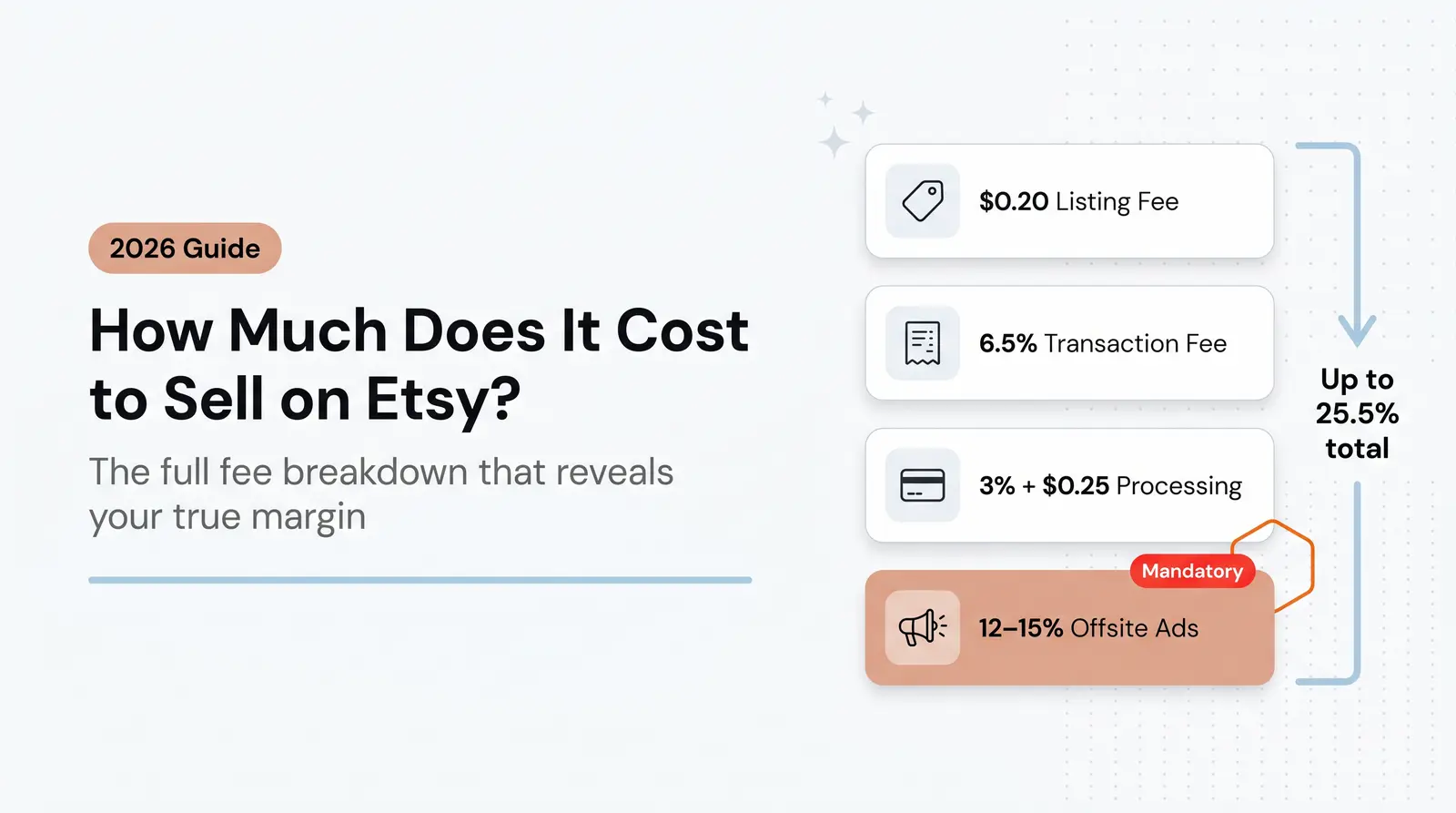
As checked on November 9, 2026, Etsy's core US fees include a $0.20 listing or renewal fee, a 6.5% transaction fee, and US Etsy Payments processing of 3% plus $0.25 per order. Their fee bases differ, and advertising or other charges can add to the total.18 19
Shopify Basic's US pricing is $39 per month with monthly billing, or $29 per month equivalent billed yearly. The yearly option is paid upfront. Its standard US online Shopify Payments card rate is 2.9% plus $0.30; premium and international cards can cost more.20 21
This illustration assumes the same $5,000 revenue, $2,000 product and packaging cost, and $500 shipping cost on either channel.
It assumes no sales tax or separately charged shipping in the payment total, one Etsy listing charge per order, standard US Shopify Payments cards, and no additional Etsy advertising spend. Shopify uses monthly Basic billing, plus hypothetical $20 monthly apps and $2 monthly domain allocation.
| Monthly cost | Etsy | Shopify |
|---|---|---|
| Listing charges | $20 | $0 |
| Marketplace transaction fee | $325 | $0 |
| Payment processing | $175 | $175 |
| Store subscription | $0 | $39 |
| Assumed apps and domain allocation | $0 | $22 |
| Total before additional customer acquisition | $520 | $236 |
The Shopify column is $284 lower, or $2.84 per order, before additional acquisition spending. That is the extra acquisition budget available before its fee advantage disappears in this example.
If acquiring those 100 Shopify orders costs $4 per order, add $400. The amount remaining after the listed product, shipping, channel, and acquisition costs becomes $1,864 on Shopify, versus $1,980 on Etsy.
These figures are not net profit. They exclude refunds, chargebacks, owner labor, income tax, setup work, and other overhead. They also omit extra charges for unsold Etsy listings, Offsite Ads, premium cards, or external payment providers.
Use your own costs and order mix. At low volume, fixed subscriptions weigh more heavily; at higher volume, acquisition cost and operational efficiency can dominate.
For a broader startup checklist, Branvas's Shopify store budget guide covers expenses beyond the platform subscription. Treat its examples as planning scenarios, not a required budget.

Start with the products that already fit your customers. Changing platforms and changing the entire assortment at once makes it harder to tell what is working.
You might later add complementary products, expand your own designs, or test a supplier-fulfilled line. Private-label jewelry dropshipping is one option for a brand whose audience would genuinely buy jewelry, not a default migration strategy.
Branvas sources and holds jewelry inventory, provides branded packaging, and fulfills customer orders. The seller chooses products and retail prices and remains responsible for the storefront, marketing, and customer relationships. If that model fits your plans, learn how Branvas works.22
The tradeoffs matter. You rely on a supplier's catalog and fulfillment terms, need differentiation beyond a logo, and must calculate margins after product cost, shipping, subscriptions, returns, and marketing. Branvas does not supply customer demand or migrate your existing Etsy store data.23
Its Shopify integration publishes Branvas products and routes paid orders for fulfillment. Automatic synchronization requires an eligible paid plan. Check current destination-specific shipping terms and sample the products before making customer promises.23
Keep Etsy's rules separate. Etsy permits qualifying seller-designed products made by disclosed production partners, but generic ready-made jewelry does not become eligible simply because you add your brand. Etsy's partner guidance specifically excludes white-label manufacturers without significant seller design input.24 25
For a jewelry-focused store, the existing Shopify jewelry SEO guide can help plan discovery after launch.
Before choosing that sourcing model, review Branvas's Shopify integration and seller-fit requirements. Compare its current plan, fulfillment, and product terms with your brand's needs.

The sequence stays useful: back up, choose your data, import, rebuild, test, and launch. The source platform changes the details.
For another marketplace, check its own export permissions, customer-data rules, and selling policies. Do not assume the Etsy CSV workflow applies to Amazon or eBay.
For a website you own, use Shopify's current import format or a supported migration method, and give URL mapping more attention. You control the previous domain, so redirects can preserve working routes to replacement pages. That is different from trying to redirect an Etsy listing.6 13 14
Passwords, order history, reviews, payment arrangements, and custom integrations each need a compatibility check. Replatforming is more than moving product rows.7 8

Review failed payments, missing images, shipping errors, stock discrepancies, support requests, and unfulfilled orders daily at first.
Compare traffic sources, conversion, acquisition spend, returns, and time spent operating each channel. Decide in advance what acceptable performance looks like for your business, rather than copying someone else's sales threshold.
Reduce Etsy activity only when your own store can support the business reliably. If the test is not working, keep the functioning channel and fix the bottleneck before making the move permanent.

When the additional control solves a real need and you can support the marketing and operating work. If independent demand is untested, running both may be a safer experiment than closing Etsy immediately.
Yes. Shopify's Etsy guidance includes running both channels. The practical requirement is reliable inventory and order handling, not simply having two live storefronts.1
Export your active listings. Use Shopify Store Migration with the unedited CSV, or prepare a compatible file for native product import. Inspect variants, images, prices, quantities, and publication status afterward.1
There is no ranking guarantee either way. Treat the stores separately: the Shopify site does not inherit Etsy placement, and changes to your Etsy listings or activity need their own monitoring.
Not by itself. Your independent store needs an acquisition strategy. Test whether your own channels bring sustainable sales before relying on them to replace marketplace discovery.
All sources were accessed November 9, 2026. Publication or update dates are included where available; undated entries did not display a date in the consulted material.
Validated intent and primary cluster. The article serves Etsy sellers deciding whether to add or switch to Shopify and then carrying out the migration. The chosen cluster is “migrate to shopify from etsy,” “switch from etsy to shopify,” and “etsy to shopify migration.” “Move store to shopify” is supporting language, not a promise to cover every platform pair.
Queries for separate content. “Leaving etsy” merits a platform-neutral exit or alternatives guide. “Platform migration ecommerce” has broader replatforming intent involving architecture, integrations, and implementation. “Own your store” is a marketplace-versus-owned-store business-model theme. These ideas appear where helpful but do not dictate separate keyword headings here.
Search observations. Nine representative US-English query variants were researched in three search calls. Six distinct underlying results were read: Shopify's Etsy help guide, Shopify's migration story, Craftybase's Etsy-to-Shopify guide, an EtsySellers Reddit discussion, EverBee's owned-site transition guide, and Shopify's enterprise replatforming guide. The prevailing useful format was decision support followed by migration steps and FAQs.
The inspected questions concerned when to switch, operating both stores, importing products, Etsy SEO, and replacing marketplace traffic. The five FAQs draw on those article/forum observations, not People Also Ask data. Competitor editorial pages informed intent and depth only; the article does not recommend their products or rely on their promotional outcomes.
Search access limitations. Direct Google results, verified organic-versus-sponsored status, ranks, and Google SERP features were not available. Search surfaced documentation, articles, forums, apps, and videos as result types, but this is not evidence of Google carousels or other features. Browser access was disabled for discovery; the six result bodies were accessible through fetch. US-English wording did not establish a definitive US-only results filter. Some discovery dates appeared future-dated and were not used as freshness evidence.
Overlap and recommendation. The returned Branvas sitemap contained 452 URLs, including 373 blog URLs, with no migration-named slug. Site searches and the sitemap were checked. The closest readable articles, “How to Sell Jewelry on Etsy Without Inventory” and “Private-Label Jewelry on Shopify: Ultimate Launch Guide,” cover adjacent startup and supplier-selection intent, not migration mechanics.
Provisionally recommend a new article at /blogs/news/migrating-to-shopify-from-etsy. Its distinct scope is migration decisions, data portability, operating continuity, launch testing, and post-launch economics. However, the sitemap-listed pages at https://branvas.com/blogs/news/diversify-etsy-shop-beyond-handmade and https://branvas.com/blogs/news/how-to-dropship-jewelry-without-etsy-or-amazon returned diagnostic responses rather than readable bodies. Blog listing extraction also omitted useful titles/navigation. Check those two CMS bodies before publication. If either substantially serves migration intent, use this draft as its proposed replacement and preserve that existing slug. Absence of overlap is not fully verified.
Title and hook changes. Revised “Migrating to Shopify From Etsy or Another Platform” to “Migrating to Shopify From Etsy: A Practical Guide.” Etsy dominates the validated seller intent, while general replatforming is a different scope. A short other-platform section preserves the broader editorial purpose without promising equal operational coverage. Rephrased the hook as renting a marketplace storefront and working within its customer-relationship rules, rather than literally renting or owning customers.
Original contribution. The article combines a move/run-both/stay decision table, a source-backed portability matrix, launch acceptance checks and sync-failure rules, and an arithmetic-checked fee/acquisition example. These are editorial planning aids, not validated frameworks, firsthand tests, or Branvas internal practices.
Hypothetical assumptions. The cost example uses 100 orders at $50, no sales tax or separately collected shipping, $2,000 product/packaging cost, $500 shipping cost, one Etsy listing charge per order, no extra Etsy ads, monthly Shopify Basic, standard US Shopify Payments cards, and assumed $20 apps plus $2 domain allocation. The $4 acquisition cost per Shopify order is illustrative. Calculations exclude unsold-listing charges, Offsite Ads, premium/international cards, external processors, refunds, chargebacks, owner labor, setup costs, and tax. Revenue and the amount remaining after listed costs are not presented as net profit, gross margin, or markup.
Verification limits and unresolved issues. No merchant account, actual export, installed app, checkout, or domain migration was tested. Etsy's public sold-transaction documentation does not provide a complete current customer-field schema; readers must inspect their own files. Review download capability is verified, but no blanket off-site reuse license was found. Rights and destination-tool compatibility need case-specific checking.
Shopify's current English Etsy guide was used because its canonical URL initially returned older instructions. The Store Importer unavailability, active Store Migration listing, Etsy variant-import limit, and Marketplace Connect restriction were verified separately. Some important official notes required full-page HTML or Help Center payloads because ordinary extraction omitted them.
US Shopify pricing extracts supported the figures used; direct sandbox HTTP retrieval localized to a different region, which was excluded. Recheck the US pricing display at publication. Branvas catalog counts, dispatch/delivery figures, and free-plan packaging entitlements were inconsistent across current pages, so they were omitted. The article verifies paid Shopify synchronization and uses no promotion, catalog-size, earnings, or delivery-speed promise. The two linked Branvas blog articles were read before selection.