

Compare marketplace fees for jewelry sellers across Etsy, Amazon Handmade, eBay, TikTok Shop, Walmart, and Shopify using exact published fee formulas and take-home calculations.
Published:
October 21, 2026
Author:
Yi Cui
For a $50 US jewelry order with free shipping, no tax, and no ads, Shopify Payments has the lowest modeled per-sale fee in this comparison: $1.75. TikTok Shop comes next at $2.50 or $3.00, depending on the jewelry taxonomy. Etsy is $5.20, Amazon Handmade $7.50, eBay $7.90, and Walmart $10.00. Those figures apply the published fee rules to the stated assumptions. 1 2 4 6 9 11 13 That does not make Shopify the cheapest marketplace. Shopify is a store platform, so this model excludes the cost of attracting the customer. Use this marketplace fee calculator to compare platform fees, then add your own costs before you price.
The calculator uses one US domestic, USD, one-order model. It starts with an item price, buyer-paid shipping, cost of goods, and your shipping or fulfillment cost.
It then applies the published core fee rules that can be calculated from those inputs. The default view excludes tax, gift wrap, ads, return costs, refunds, currency conversion, international charges, platform-label logistics, and subscription allocation. Those are not assumed to be zero in real life. They are simply not universal enough to prefill responsibly.
Three outputs stay separate:
For this article, gross revenue means item price plus buyer-paid shipping. Buyer tax is excluded because it is generally a liability, not earnings. Gross profit before platform fees is gross revenue minus cost of goods and seller-paid shipping. Net profit in this model subtracts platform fees and any other actual costs you add. Margin is net profit divided by gross revenue. Markup is the increase over cost, usually (item price − cost of goods) ÷ cost of goods. Markup can look healthy while net profit is not.
| Input | Why it matters |
|---|---|
| Item price | The starting point for nearly every percentage fee. |
| Buyer-paid shipping | Often enters the platform fee base. Free shipping sets this to $0, but it does not erase your own shipping cost. |
| Cost of goods and your shipping cost | These turn a fee comparison into a profit calculation. |
| Category | It changes published rates on eBay, TikTok Shop, and Walmart Marketplace. Etsy and Shopify have no verified jewelry-specific fee tier in the reviewed schedules. |
| Ads and promotions | Etsy Offsite Ads has a published attributed-order formula. Most other ad products are variable, so use your actual allocated cost. |
| Monthly plan and expected monthly orders | If a plan applies, divide the recurring cost by the orders it supports. The result is an allocation, not a transaction fee. |
| Buyer tax | Keep it at $0 for the core comparison. Tax can enter some fee bases but does not belong in comparable proceeds. |

Here is the static comparison table for a hypothetical sale. Assumptions: a $50 jewelry item, $0 buyer-paid shipping, $15 cost of goods, $6 seller-paid shipping, no tax, no gift wrap, no ads, and no recurring-plan allocation. Amazon is an approved Handmade seller after its first month. eBay is a Non-Store or Starter seller with a free insertion listing available. TikTok uses a listed 5% precious-jewelry category. Shopify uses Shopify Payments with a standard US domestic online card.
| Platform and configured case | Core fee calculation | Platform fees | Comparable proceeds | Optional profit after $21 direct costs |
|---|---|---|---|---|
| Etsy | $0.20 + 6.5% of $50 + 3% of $50 + $0.25 | $5.20 | $44.80 | $23.80 |
| Amazon Handmade | 15% of $50 | $7.50 | $42.50 | $21.50 |
| eBay, Non-Store or Starter jewelry | 15% of $50 + $0.40 order fee | $7.90 | $42.10 | $21.10 |
| TikTok Shop, listed 5% jewelry category | 5% of $50 | $2.50 | $47.50 | $26.50 |
| TikTok Shop, listed 6% jewelry category | 6% of $50 | $3.00 | $47.00 | $26.00 |
| Walmart Marketplace jewelry | 20% of $50 | $10.00 | $40.00 | $19.00 |
| Shopify Payments, standard domestic card | 2.9% of $50 + $0.30 | $1.75 | $48.25 | $27.25 |
The Etsy, Amazon Handmade, eBay, TikTok Shop, Walmart, and Shopify rules behind this table are sourced from the platforms' seller or pricing documentation. 1 2 4 5 6 9 11 13
The table is a fee calculation, not a recommendation to sell on one channel only. Shopify appears lowest because it does not charge a marketplace referral fee in this stated payment scenario. It also does not provide marketplace discovery as part of that $1.75 fee.

For a US seller using Etsy Payments, the core calculation for one listing and no tax is:
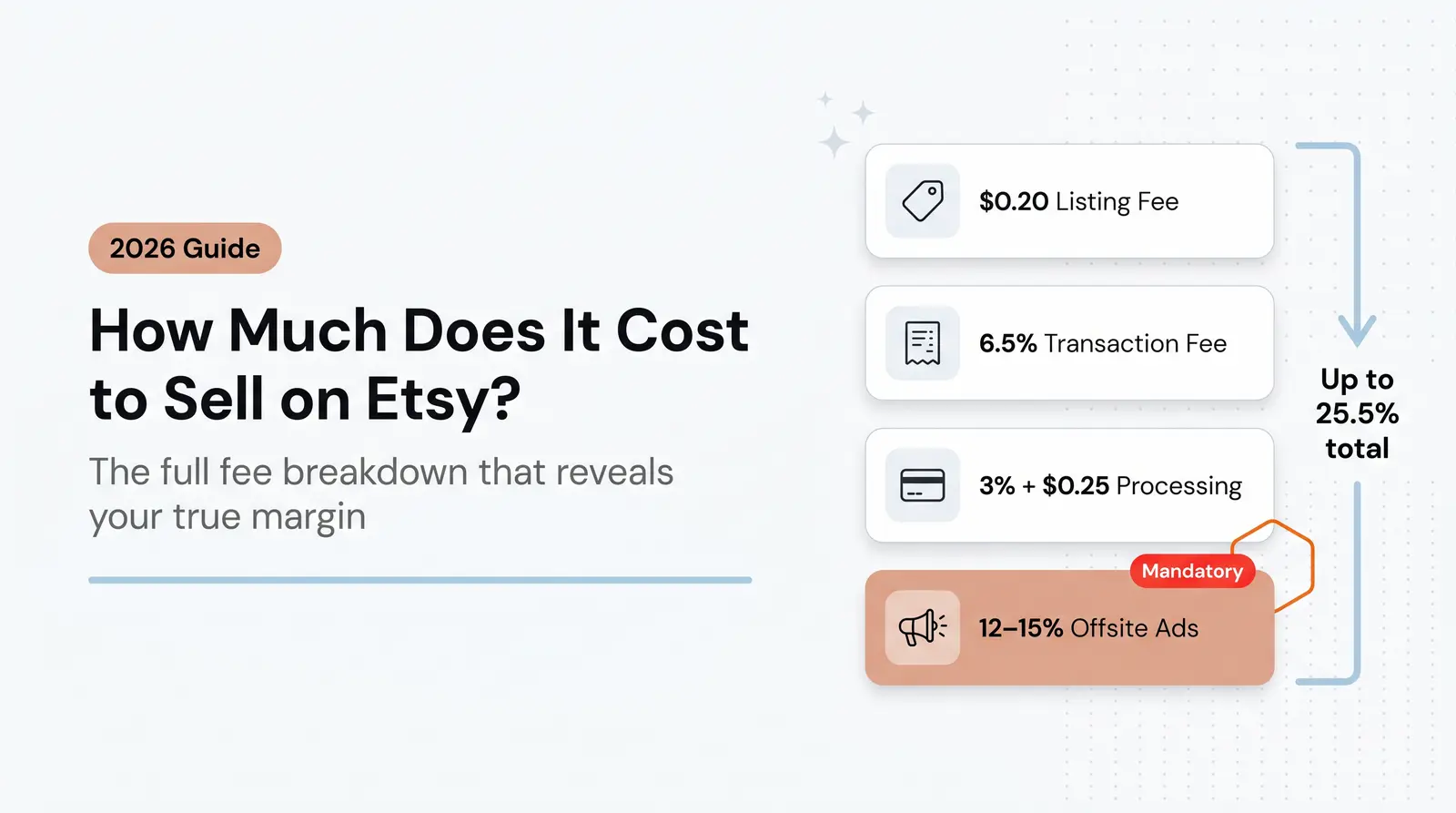
Etsy platform fees = $0.20 listing fee
                   + 6.5% × (item price + buyer-paid shipping)
                   + 3% × (item price + buyer-paid shipping + applicable sales tax)
                   + $0.25
Etsy's 6.5% transaction fee includes buyer-paid shipping and gift wrap. US payment processing is 3% + $0.25 and can include applicable sales tax in its fee base. 1 2
Offsite Ads do not belong in every Etsy order. If an order is attributed to an Offsite Ad, the fee is 15% for shops below the stated $10,000 trailing-365-day threshold or 12% after that threshold, with a $100 per-order cap. Shops below the threshold can opt out; participation is mandatory after the threshold under Etsy's policy. 3
There is no verified Etsy jewelry fee tier in the reviewed schedule. Etsy product eligibility matters separately. Before listing a jewelry product, check Etsy's current rules on what may be sold and any applicable production-partner disclosure. 15
For a fuller Etsy-only walkthrough, see Branvas's Etsy fees 2026 breakdown.
The calculator uses the Amazon Handmade rule, not the ordinary Amazon Jewelry referral table. An approved Handmade seller pays 15% of the applicable sales price or $0.30 per unit shipped, whichever is greater. The stated fee base includes item price and buyer delivery charges, while Amazon-calculated tax is excluded. 4 5
Amazon Handmade platform fees = max(15% × (item price + buyer-paid shipping), $0.30)
                              + any actual ad allocation
                              + any applicable plan allocation
Amazon says Handmade storefront creation and listing are free. Approved Handmade sellers need Professional-plan access, and the normal $39.99 monthly charge is waived after the first month. 4
This is a meaningful eligibility condition. A general Amazon jewelry listing can use a different ordinary referral structure, but that is not the formula for a correctly classified Handmade item. Do not use the ordinary Jewelry rate to make a Handmade comparison look better or worse.
For most Jewelry & Watches other than Watches, Parts & Accessories, eBay's current Non-Store or Starter fee is 15% of the total amount of sale up to $5,000 and 9% on the portion above. A $0.30 per-order fee applies when the sale total is $10 or less; otherwise it is $0.40. eBay says the total amount of sale includes item price, buyer-paid shipping, sales tax, and other applicable fees. 6
eBay platform fees = insertion fee
                   + final value fee on the total amount of sale
                   + $0.30 or $0.40 per-order fee
                   + any actual promotion, upgrade, or plan allocation
Most casual sellers receive 250 zero-insertion-fee listings per month. Once the applicable allowance is exhausted, eBay states a $0.35 insertion fee for additional non-Store listings, subject to category exclusions. 6
A Basic or higher Store can change both the final value fee and the free-listing allowance. Use the exact account type in the calculator rather than assuming a subscription helps. For example, eBay lists a Basic Store at $27.95 monthly or $21.95 with yearly renewal billing. 7
Promoted Listings General uses a seller-chosen ad rate after an attributed click and sale. Promoted Listings Priority is CPC. Both require your actual program data rather than a made-up universal ad percentage. 8
TikTok Shop's documented category schedule distinguishes jewelry types. Diamond, Gold, Jade, Platinum or Carat Gold, and Ruby, Sapphire, or Emerald are listed at 5%. Listed Amber, Artificial Gemstones, Mellite, Natural Crystal, Non-natural Crystal, Pearl, Semiprecious Stones, and Silver categories are listed at 6%. The published category schedule carries an October 31, 2024 effective date. 9
TikTok Shop referral fee = category rate × (customer payment + platform discount − tax)
The calculator's tax-free default simplifies this to the item price plus buyer-paid shipping. It does not add the historical $0.30-plus-percentage transaction fee, because TikTok's settlement guidance says that charge does not apply to orders after April 3, 2023. 10
Affiliate commissions, Shop Ads, campaign service fees, Smart Promotion, shipping, and refunds are separate cases. Smart Promotion's documented store-GMV fees are 3.5% outside campaign periods and 4.5% in campaign periods, so an order-level estimate needs a seller-supplied allocation. 12
Walmart Marketplace states that Jewelry and Precious Metals carry a 20% referral fee on the portion of total sales price up to $250, then 5% on the portion above $250. Its total sales price includes the item price, shipping and handling, gift wrap, and other charges. 11
Walmart jewelry referral fee = 20% × first $250 of item price + buyer-paid shipping
                              + 5% × the amount above $250
Walmart says Marketplace has no setup, monthly, or hidden fees in its standard pricing. It does not publish one universal payment-processing rate because sellers connect their preferred third-party processor. Sponsored Search is also a seller-budgeted, pay-per-click program. Those costs remain editable inputs. 11 19
Do not assume the 2026 New-Seller Savings promotion applies. It has stated dates and eligibility requirements, including qualifying sellers who go live after February 1, 2026 and opt in. 16
Shopify is a store platform, not a marketplace. For the checked-date US scenario of Shopify Payments with a standard domestic online card, Shopify's public pricing page displays 2.9% + $0.30. The same page displays $39 per month for its shown monthly plan and $29 effective monthly with annual billing. 13
Shopify platform fees = 2.9% × (item price + buyer-paid shipping + tax) + $0.30
                      + plan cost ÷ expected monthly orders
                      + any optional tax, campaign, app, or other actual cost
The $39 monthly plan costs $0.39 per order at 100 orders per month. Add that only when comparing an operating case, not when isolating variable checkout fees.
If you use a third-party payment processor, do not use the Shopify Payments card formula. Shopify's third-party transaction fee is separate from the processor charge and is plan-dependent. The checked-date public price display shows 2% for the displayed plan, while Shopify's help documentation gives the fee-base formula and tells merchants that rates vary by plan. 13 14
For a plan-by-plan explanation, read Branvas's Shopify pricing guide.

A threshold check prevents a low-price example from hiding tiered rules. Assume a $300 jewelry item, $10 buyer-paid shipping, $100 cost of goods, $10 seller-paid shipping, no tax, no ads, and no plan allocation. This is hypothetical arithmetic, not an all-in seller quote.
| Platform and configured case | Hand check of platform fee | Platform fees | Comparable proceeds | Optional profit after $110 direct costs |
|---|---|---|---|---|
| Etsy | $0.20 + 6.5% of $310 + 3% of $310 + $0.25 | $29.90 | $280.10 | $170.10 |
| Amazon Handmade | 15% of $310 | $46.50 | $263.50 | $153.50 |
| eBay, Non-Store or Starter jewelry | 15% of $310 + $0.40 order fee | $46.90 | $263.10 | $153.10 |
| TikTok Shop, listed 5% jewelry category | 5% of $310 | $15.50 | $294.50 | $184.50 |
| TikTok Shop, listed 6% jewelry category | 6% of $310 | $18.60 | $291.40 | $181.40 |
| Walmart Marketplace jewelry | 20% of first $250 + 5% of next $60 | $53.00 | $257.00 | $147.00 |
| Shopify Payments, standard domestic card | 2.9% of $310 + $0.30 | $9.29 | $300.71 | $190.71 |
This example illustrates why a category selector matters. Walmart's jewelry fee is marginal, not 20% of the entire $310. On the same example, eBay's jewelry rate is not the most-categories rate, and TikTok Shop's two jewelry groups do not share one rate. 6 9 11
A second, less obvious point appears on low-priced Handmade products. On a hypothetical $7 free-shipping sale with no tax or ads, Etsy's core formula is $0.20 + $0.455 + $0.46 = $1.115. Amazon Handmade's fee is $1.05. Amazon's 15% headline rate is higher than Etsy's 6.5% transaction fee, yet its total modeled core fee is lower by $0.065 because Etsy also has a listing fee and payment-processing component. That result follows the published formulas, not an assumption that Amazon Handmade is generally cheaper. 1 2 4

There is no honest all-purpose winner. The answer changes with the price, category, account type, whether buyer shipping is charged, the order's tax treatment, and the costs the platform does not standardize.
For the $50 example, Shopify Payments has the smallest modeled variable checkout fee. TikTok Shop is also low in the listed 5% or 6% jewelry categories. Neither result includes the cost to produce content, run ads, or acquire the customer. That is why Shopify should never be presented as a direct like-for-like marketplace substitute based on processing alone.
Etsy can be a lower core-fee option than Amazon Handmade at some prices, but the comparison changes if an order is attributed to Offsite Ads. eBay's jewelry rate is higher than its most-categories rate for a Non-Store seller. Walmart's jewelry fee is especially heavy below $250, then its marginal rate drops above that threshold. 3 6 11
The practical decision is usually not "which platform has the smallest percentage?" It is "which eligible channel produces a profitable order after the costs I actually incur, and what does it cost me to get that order?"

A marketplace can give a seller existing discovery, category rules, and a built-in checkout flow. An owned Shopify store gives the seller a brand destination and control over its storefront, but the seller must fund and manage demand generation. The payment-processing advantage only matters if marketing, fulfillment, returns, and operational costs still leave room for profit.
If the owned-store route is the right next step, Branvas says it connects private-label jewelry products to Shopify, WooCommerce, and Wix, while handling sourcing, branded packaging, and fulfillment. That changes the product-cost and fulfillment inputs in this calculator. It does not remove Shopify payment fees or customer-acquisition costs. Learn how Branvas works, or browse the current jewelry catalog to evaluate the cost side of an owned-store model. 17 18

Use the calculator to begin a decision, not to close it. The following factors are deliberately outside the core result unless you enter an actual value:

The calculator labels each platform with a checked-on date. A checked live page is not the same as a fee schedule proven to apply for every day of 2026.
| Platform | Fee schedule verified on | What changed or needs qualification | Source |
|---|---|---|---|
| Etsy | October 21, 2026 | Live fee pages checked. Etsy Seller Policy is effective July 9, 2026. Do not describe the live base rates as a separately dated full-year 2026 card. | 1 15 |
| Amazon Handmade | October 21, 2026 | Live Handmade rules checked. No separately dated Handmade 2026 effective card was located in the reviewed official material. | 4 |
| eBay | October 21, 2026 | Current Seller Center table checked. The latest located dated US fee-change notice took effect February 14, 2025, not 2026. | 6 7 |
| TikTok Shop | October 21, 2026 | The category schedule used here is effective October 31, 2024. Do not call it a newly issued 2026 referral schedule. | 9 10 |
| Walmart Marketplace | October 21, 2026 | The standard pricing table was current when checked but undated. New-Seller Savings has a stated February 2, 2026 to January 31, 2027 promotion period. | 11 16 |
| Shopify | October 21, 2026 | Public pricing and help pages checked. Actual plan, card, payment route, Shopify Tax eligibility, and future fee notices can change the seller's result. | 13 14 |
Recheck the official schedule and your seller dashboard before changing prices. The calculator is designed to make that recheck easier by showing the formula and each assumption rather than hiding them behind one percentage.

Yes. Etsy's 6.5% transaction fee applies to the item price plus buyer-paid shipping and gift wrap. US payment processing also includes shipping and applicable sales tax in its documented base. 1 2
Sometimes, but not always. Amazon Handmade's approved-seller rule is 15% or $0.30 per unit, while Etsy uses a smaller transaction percentage plus listing and processing charges. On a low-priced hypothetical $7 sale, the published formulas make Amazon Handmade slightly lower. An Etsy order attributed to Offsite Ads can be materially different again. Eligibility and actual demand still matter. 1 2 3 4
Shopify is not a marketplace. The stated Shopify figure is a payment-processing calculation plus any plan allocation you choose to add. It excludes the cost of bringing a shopper to your store, which is often one of the largest parts of an owned-store model. 13
It removes buyer-paid shipping from the fee base in the calculator, but it does not make your shipping cost disappear. If you pay $6 to ship an order, enter that cost even when the buyer sees free shipping.
No. A fee model cannot establish marketplace eligibility. Etsy and Amazon Handmade have product and seller rules that must be met before a listing is valid. Confirm the current eligibility requirements, classification, and any required disclosures before treating a fee result as a go-to-market plan. 4 15