


This guide breaks down 2026 Shopify pricing plans, transaction fees, and break-even order volumes so new store owners pick the most cost-effective plan for their stage.
Published:
July 31, 2026
Author:
Yi Cui
Choosing a Shopify plan feels like an administrative checkbox, but it is actually one of the first major financial decisions you make for your store. The "wrong" plan either bleeds money via transaction fees or locks you out of features that drive revenue, like advanced reporting and shipping discounts [1] [2].
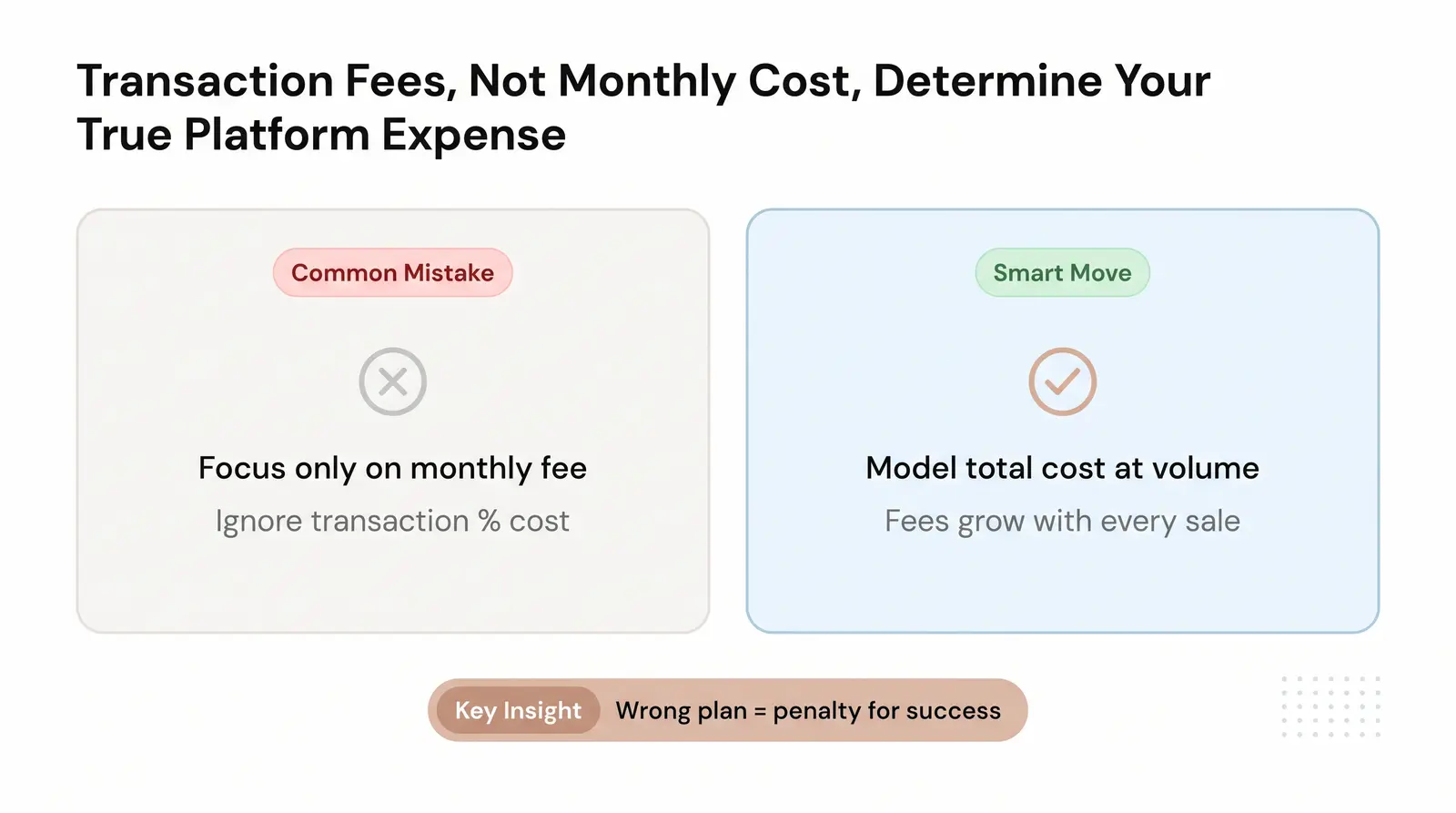
Many new sellers fixate on the monthly subscription cost and ignore the per-transaction fees. But as your order volume grows, those transaction fees become your largest platform expense. If you choose a plan with a low monthly fee but high transaction rates, you are effectively penalizing yourself for success.
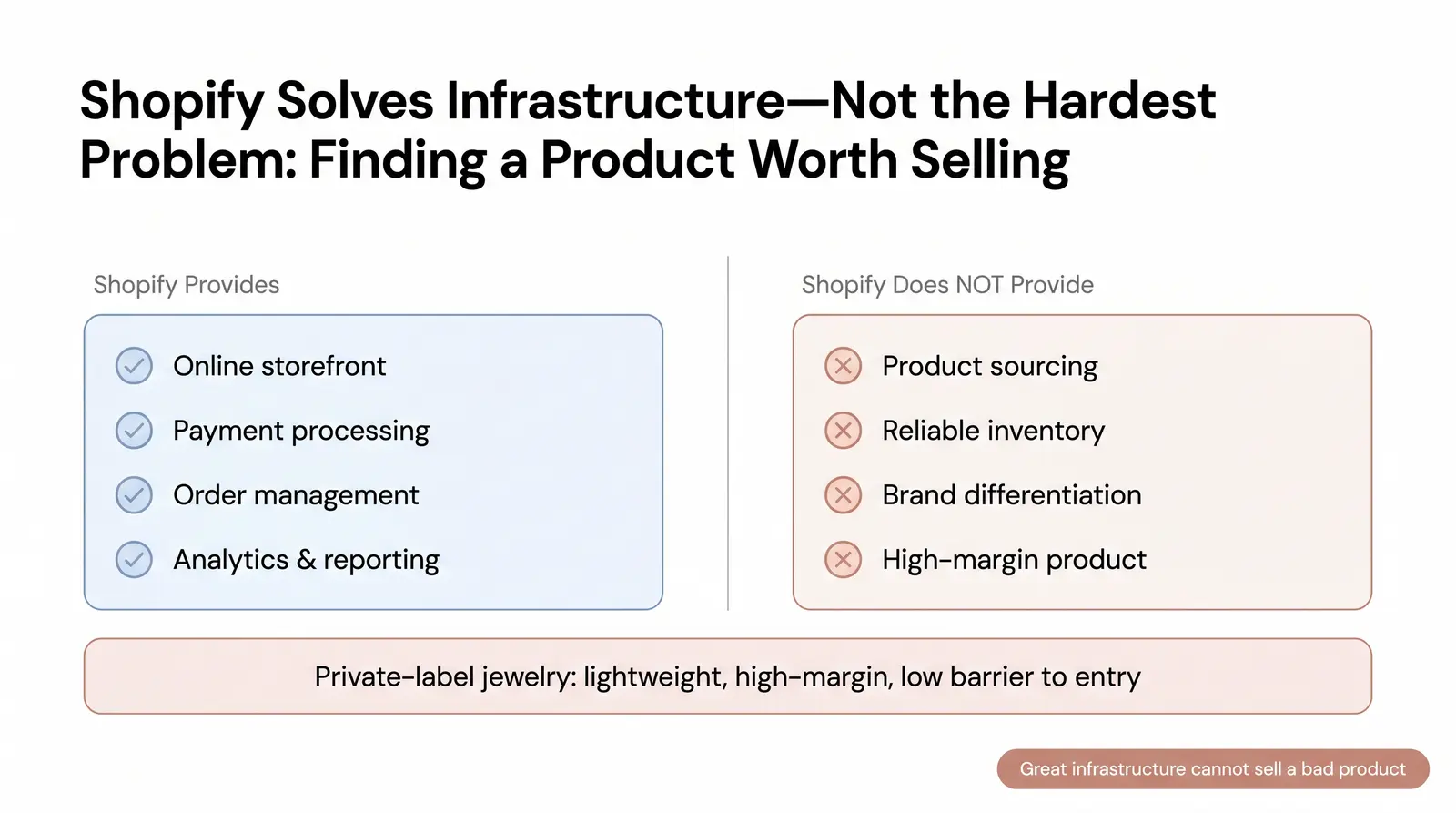
It is also crucial to remember that your Shopify plan is only one piece of the puzzle. The best ecommerce infrastructure in the world cannot sell a product nobody wants. Finding a reliable, high-margin product source is just as important as optimizing your software stack.
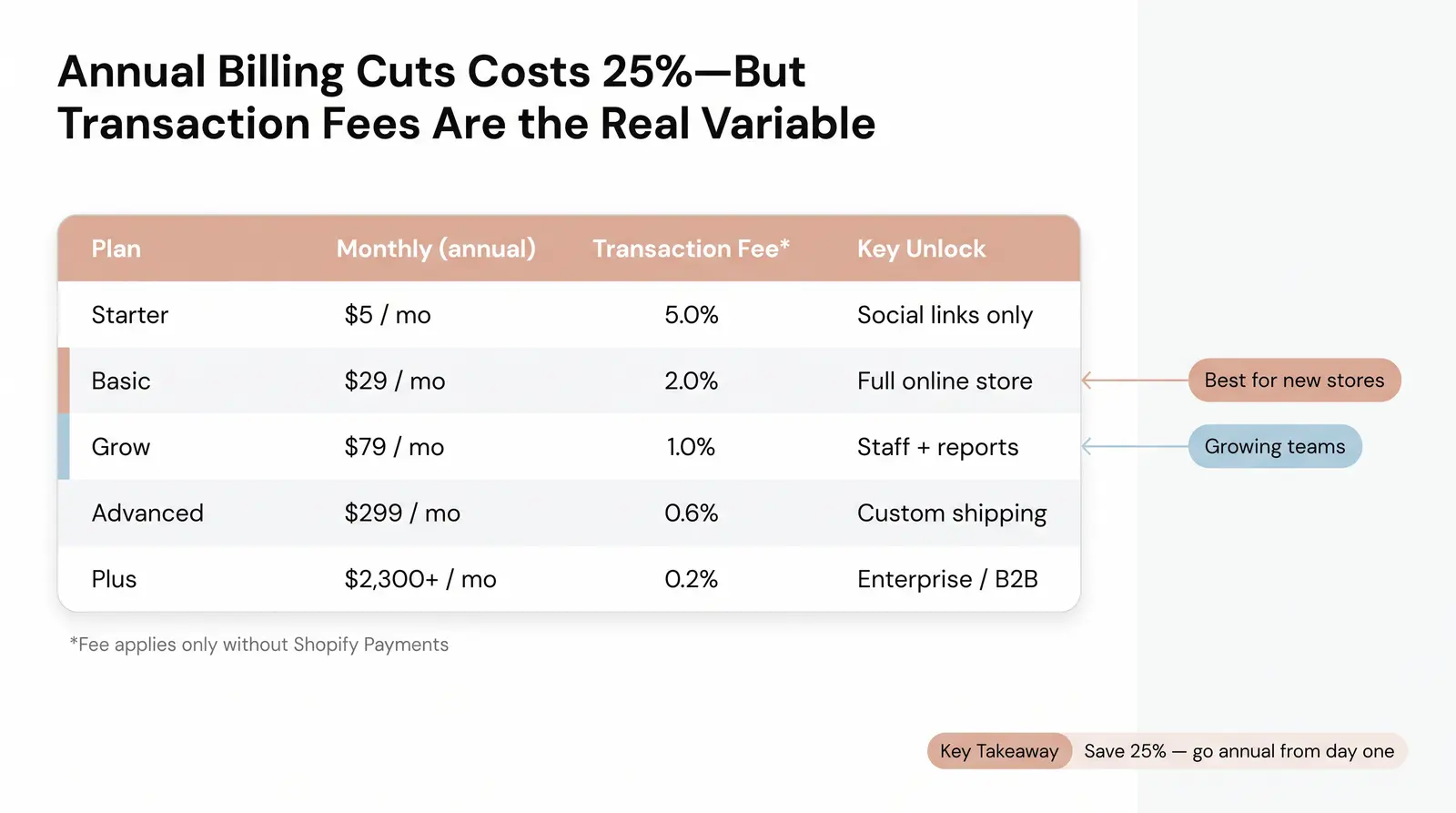
Here is a breakdown of the core Shopify plans available in 2026. Note that annual billing offers a 25% discount over month-to-month pricing [1] [3].
| Plan | Monthly Price (monthly billing) | Monthly Price (annual billing) | Transaction Fee (non-Shopify Payments) | Staff Accounts | Key Feature Unlock |
|---|---|---|---|---|---|
| Starter | $5 | N/A | 5.0% | 0 | Social media selling links |
| Basic | $39 | $29 | 2.0% | 0 | Full online store, 24/7 chat |
| Grow | $105 | $79 | 1.0% | 5 | Professional reports, staff accounts |
| Advanced | $399 | $299 | 0.6% | 15 | Third-party calculated shipping rates |
| Plus | $2,300+ | $2,300+ | 0.2% | Unlimited | Checkout customization, B2B |
Note: Transaction fees apply only if you do not use Shopify Payments. Shopify Payments availability varies by country.
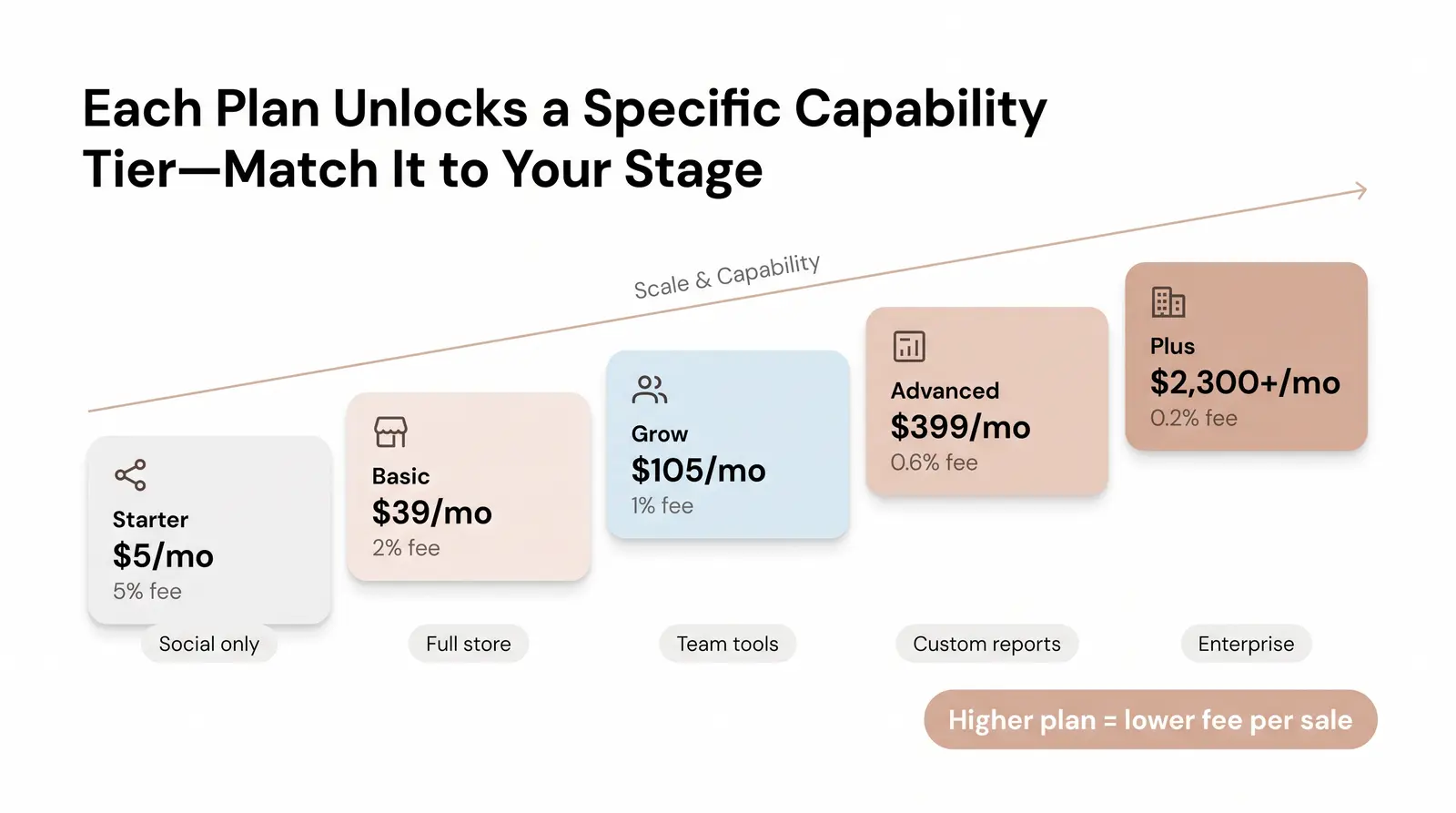
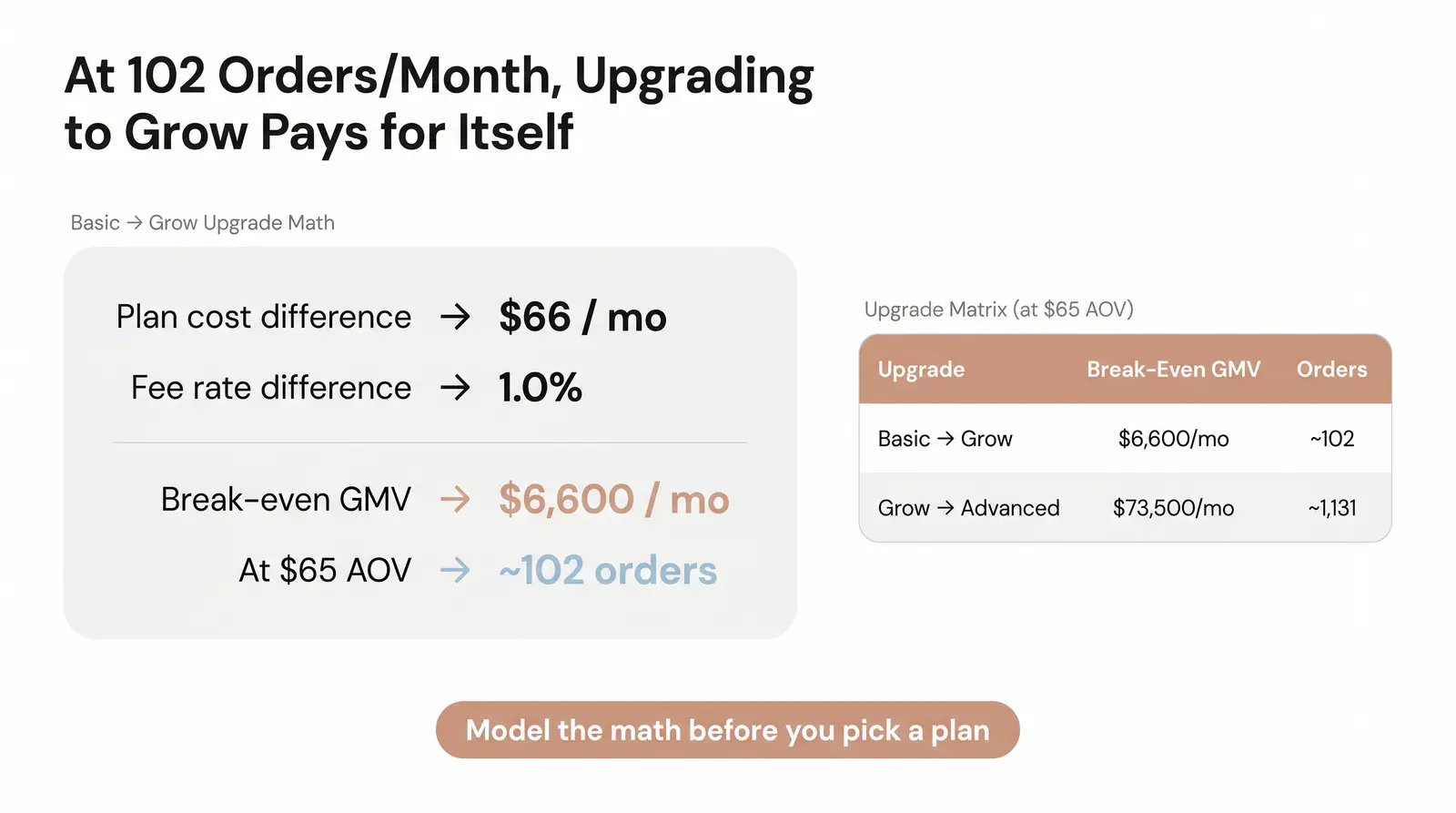
The difference in transaction fees between plans means that at a certain order volume, upgrading pays for itself. We call this The Branvas Plan Break-Even Matrix.
If you use a third-party payment gateway (like Stripe or PayPal) instead of Shopify Payments, Shopify charges an additional fee: 2.0% on Basic, 1.0% on Grow, and 0.6% on Advanced [1].
Let's look at a worked example. Assume a seller processing orders via a third-party gateway with an Average Order Value (AOV) of $65 (a realistic figure for jewelry and accessories) [5].
To find the break-even point between Basic ($39/mo) and Grow ($105/mo):
Here is the matrix applied to the core upgrades:
| Upgrade Path | Monthly Plan Cost Difference | Fee Rate Difference | Break-Even Monthly GMV | Break-Even Order Count (at $65 AOV) |
|---|---|---|---|---|
| Basic to Grow | $66 | 1.0% | $6,600 | ~102 orders |
| Grow to Advanced | $294 | 0.4% | $73,500 | ~1,131 orders |
In our experience at Branvas, sellers who plan to use third-party payment gateways almost always underestimate how quickly transaction fees erode their margins — this matrix makes it impossible to ignore.
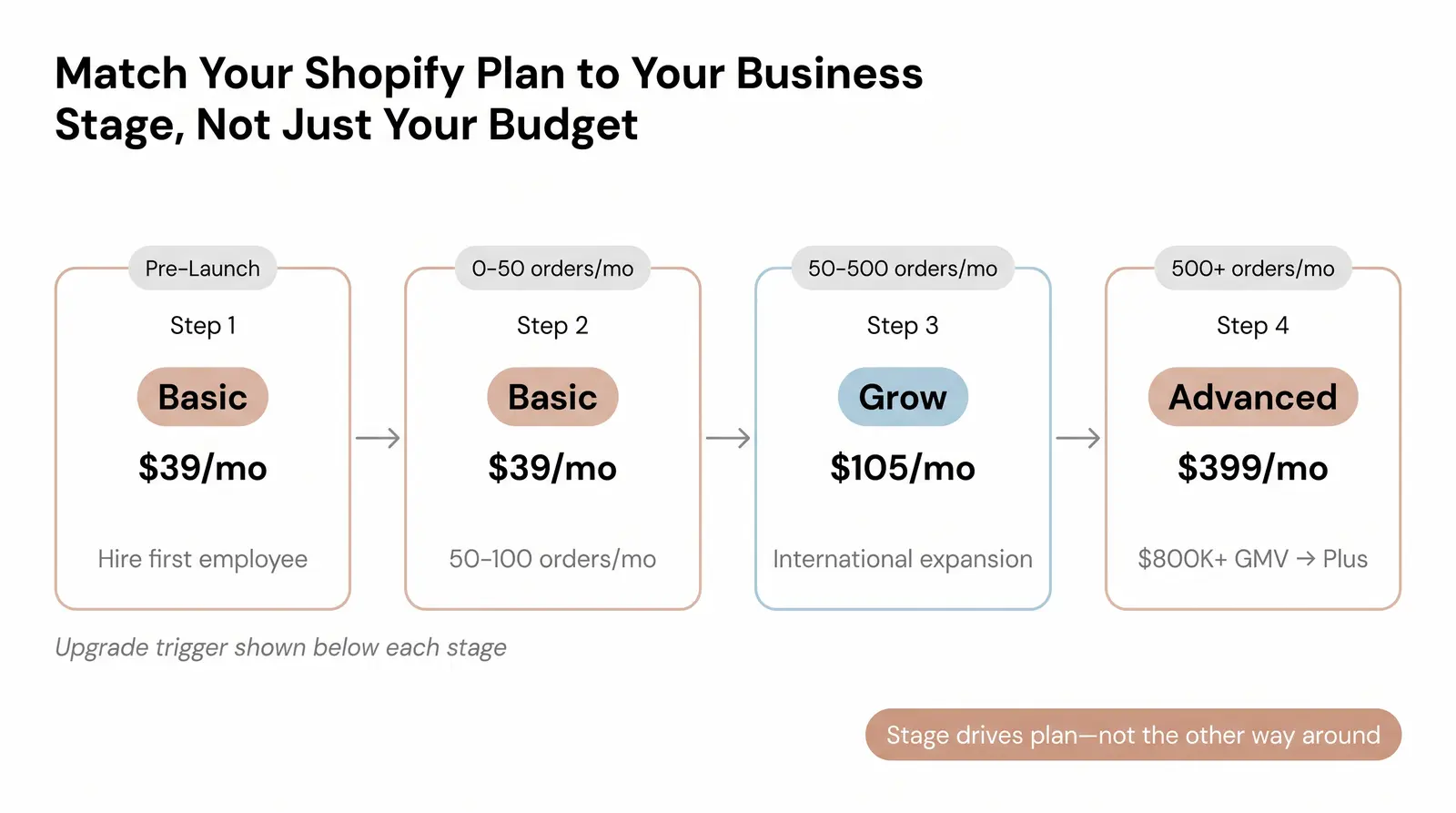
Choosing a plan based purely on features can be overwhelming. Instead, use the Branvas Store Stage Ladder to align your software with your business maturity.
One variable that changes this calculus: your product margins. High-margin products like private-label jewelry mean you hit break-even order volumes faster, making upgrades worthwhile sooner.
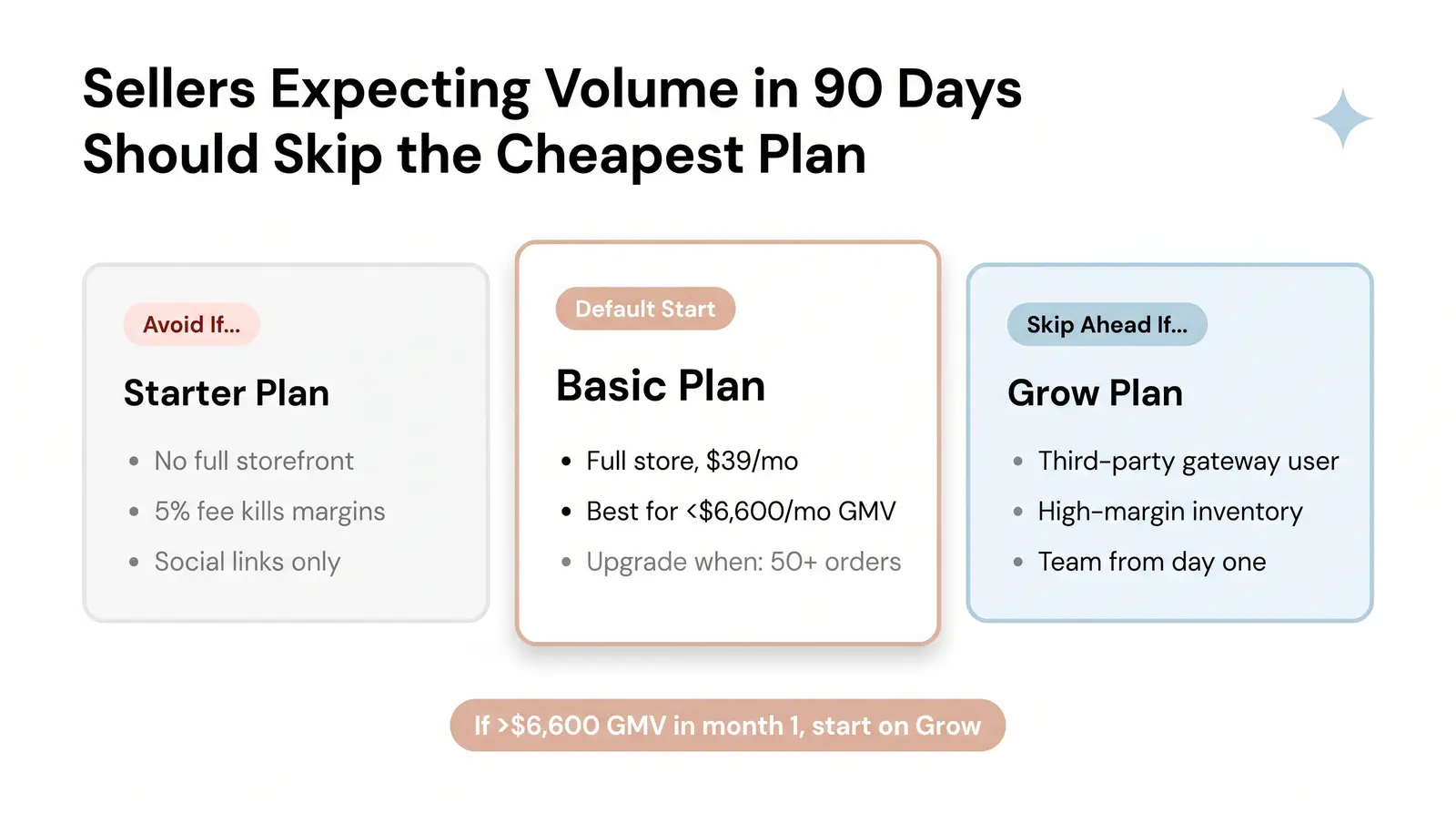
Conventional wisdom says new sellers should always start on the cheapest available plan to minimize risk. However, defaulting to the Starter or Basic plan is often the wrong move for sellers who expect meaningful volume within 90 days, or those operating in regions where Shopify Payments is unavailable.
If you are forced to use a third-party payment gateway, the 2.0% surcharge on the Basic plan acts as a massive tax on your early growth [4]. As the Branvas Plan Break-Even Matrix shows, if you expect to process more than $6,600 in your first month, the Grow plan is actually cheaper overall.
Furthermore, we often see founders at Branvas launch on Basic, then switch plans within 60 days after realizing the fee math doesn't work in their favor — the mid-cycle plan switch is a workflow disruption that's easy to avoid. If you have a solid marketing budget and high-margin inventory, starting on the Grow plan gives you the staff accounts and reporting you need to scale quickly, without the friction of an early upgrade.
Shopify provides incredible infrastructure, but it does not solve the hardest problem in ecommerce: sourcing a product worth selling.
New sellers often spend weeks agonizing over their plan choice and store design, only to stall out because they lack reliable inventory. Building a brand requires high-quality products, dependable fulfillment, and healthy margins.
Private-label jewelry and accessories are among the lowest-barrier, highest-margin product categories for new Shopify stores. Unlike electronics or bulky home goods, jewelry is lightweight (keeping shipping costs low) and commands premium pricing [5].
This is where Branvas bridges the gap. Branvas handles product sourcing, branding, custom packaging, and blind fulfillment. You get the benefits of a premium private-label brand without the inventory risk, allowing you to focus your energy on marketing and sales.
If you're still figuring out what to sell, explore how Branvas works — it's built for exactly this stage.
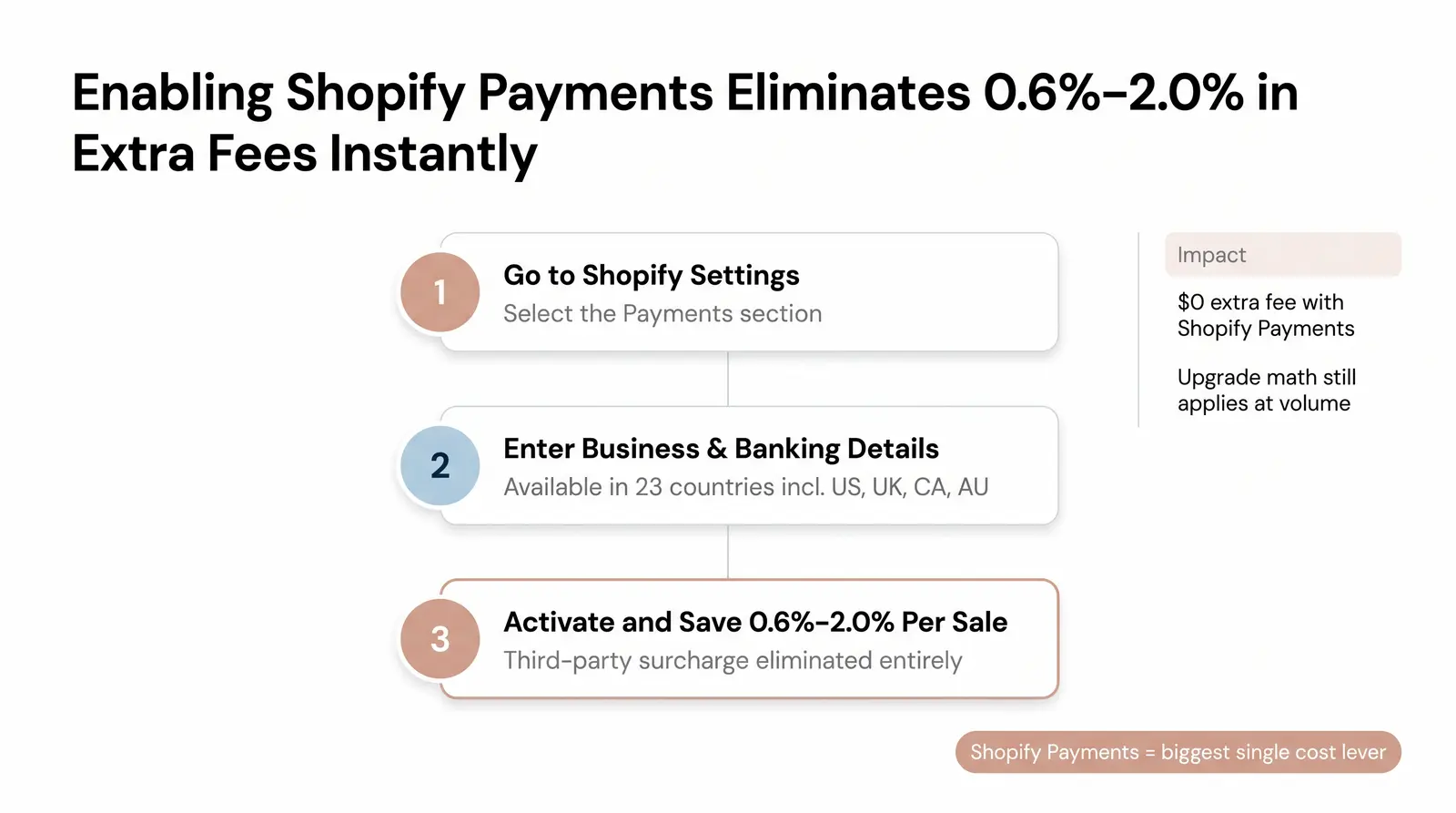
Enabling Shopify Payments is the single most effective way to reduce your monthly ecommerce costs. By using Shopify's native gateway, you eliminate the third-party transaction fee entirely (saving 0.6% to 2.0% per sale, depending on your plan) [1].
Shopify Payments is currently available in 23 countries, including the US, UK, Canada, Australia, and most of Europe [6]. If your business is located in a supported country, setting it up is straightforward: navigate to your Shopify settings, select "Payments," and provide your business and banking details.
If Shopify Payments is available to you, the break-even math changes. You no longer need to upgrade just to escape the third-party surcharge. However, the upgrade calculus still matters: the lower credit card processing rates, advanced analytics, and shipping discounts on higher plans still have real, measurable dollar value as your volume grows.
Is Shopify free to start?
Shopify offers a free 3-day trial, followed by a promotional period (currently $1 per month for the first three months). After that, you must choose a paid plan starting at $39/month (or $29/month billed annually) for a standard store [1].
What is the cheapest Shopify plan?
The absolute cheapest option is the Starter plan at $5/month, but it only provides social media links, not a full website. The cheapest plan for a complete online store is the Basic plan at $39/month (or $29/month billed annually) [1].
Does Shopify take a percentage of sales?
Yes. If you use Shopify Payments, you pay credit card processing fees (starting at 2.9% + 30¢ online). If you use a third-party payment gateway, Shopify takes an additional transaction fee ranging from 0.6% to 2.0%, depending on your plan [1].
Which Shopify plan is best for beginners?
For most beginners building a dedicated ecommerce website, the Basic plan is the best starting point. It provides all the essential features needed to launch and validate a brand without overcommitting on monthly fixed costs.
Can I change my Shopify plan later?
Yes, you can upgrade or downgrade your Shopify plan at any time. If you upgrade mid-billing cycle, Shopify will prorate the charges based on the time remaining in that cycle.
Choosing the right Shopify plan comes down to understanding your transaction volume and your team size. Start on Basic to validate your concept, but watch your metrics closely—once you cross $6,600 in monthly sales on a third-party gateway, or need to give staff access to your backend, upgrading to Grow is the financially responsible move.
Ready to pair your Shopify store with a product line that's already built for you? Launch your private-label jewelry brand with Branvas — no inventory, no minimums, fully branded and shipped for you.