


Break down every recurring Shopify cost—plan fees, payment processing, app creep, and operational drag—to calculate your true monthly overhead and protect margins.
Published:
July 30, 2026
Author:
Yi Cui
The margin math no one shows you upfront.
Shopify is often pitched as the $39-a-month gateway to ecommerce freedom. But if you have ever run a store, you know that advertised price is just the entry point. The real cost is a stack of recurring line items that compound quietly. Between payment processing, app subscriptions, and operational drag, what looks like a low monthly overhead can quickly consume your profits.
In this guide, we break down the ongoing operating costs of running a Shopify store. This is not about startup capital or how to launch. This is a transparent look at the true monthly cost structure. We cover plan fees, payment processing realities, and the app subscription creep that quietly eats into your margins, so you can price your products correctly and protect your bottom line. If you are already running a store or seriously considering one, this is the breakdown you need before you set a single price.
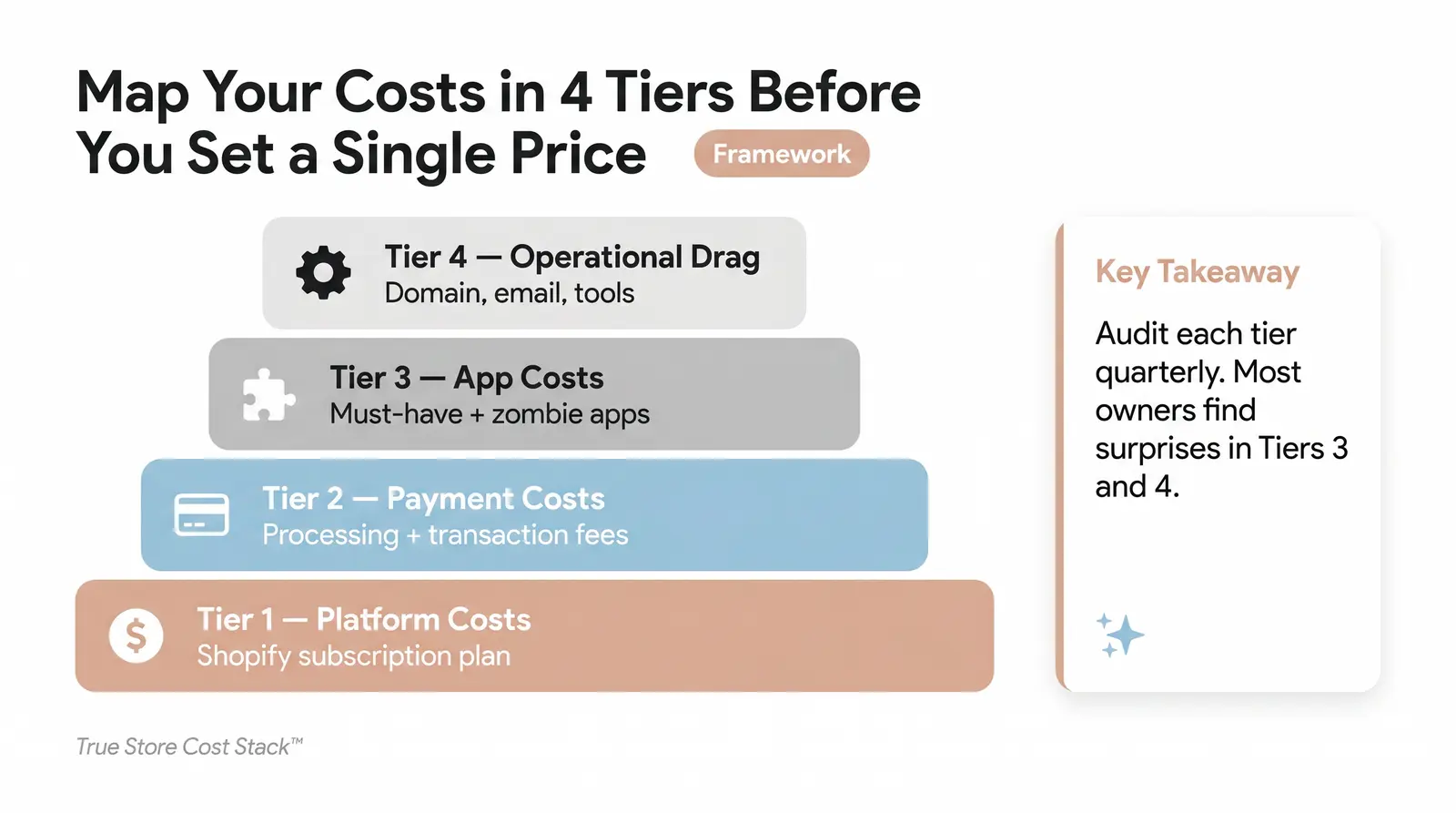
To understand what you are actually paying, we use a framework at Branvas called the True Store Cost Stack™. This is a layered model that categorizes every recurring Shopify cost into four distinct tiers:
This framework is about recurring operating cost, not startup costs. It is not about what you paid to build your store. It is about what you pay every single month to keep it running.
By breaking your expenses down into the True Store Cost Stack™, you can move away from guessing your overhead and start managing your costs with precision. We recommend auditing each tier quarterly. Most store owners who do this for the first time are surprised by how much they find in Tiers 3 and 4.
Your base platform cost is the most straightforward part of the stack. Shopify offers three main plans for standard ecommerce operators [1]:
There is also the Starter plan at $5/month for selling via social links, and Shopify Plus starting at $2,300/month for enterprise operations [1]. For context, Shopify Plus includes the most competitive payment rates and unlimited staff accounts, but it is designed for merchants doing serious volume.
The annual billing discount of up to 25% is worth taking if you are committed to the platform. Paying $29/month instead of $39/month on Basic saves you $120 per year. That is not nothing, but the base plan fee is rarely where the real financial pressure lies. The pressure lives in Tiers 2 and 3.

Payment processing is the most important section of your cost stack because it scales directly with your revenue. Every time you make a sale, a percentage comes off the top before you see a dollar.
If you use Shopify Payments, the rates vary by plan [1]:
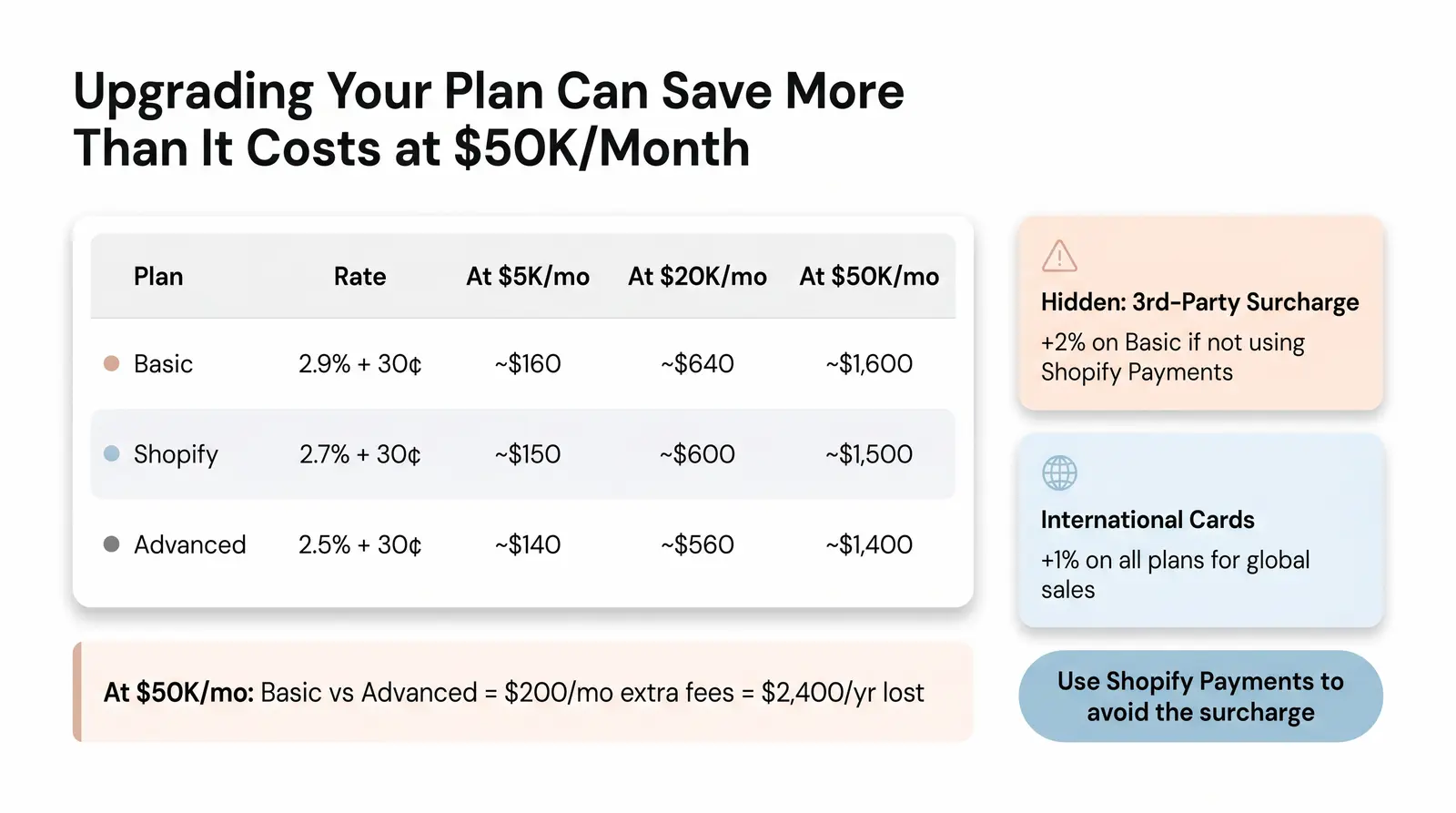
If you choose a third-party payment gateway, Shopify adds an additional surcharge on top of whatever your processor charges: 2% on Basic, 1% on Shopify, and 0.6% on Advanced [1]. This is a significant hidden cost if you cannot use Shopify Payments in your region or prefer another processor. At $20,000/month in revenue, a 2% surcharge on Basic is an extra $400 per month going straight to Shopify, on top of your processor's own fees.
In our experience at Branvas, most new sellers underestimate their effective payment processing rate by at least 0.5 to 1%. They see "2.9%" and assume that is the number. They forget the 30¢ per transaction, which adds up fast on low-ticket items, and they forget about international card surcharges (an additional 1% on all plans) if they sell globally.
Here is a non-obvious insight that most guides skip over: upgrading your Shopify plan can actually save you money at scale. The Advanced plan costs $399/month but drops your credit card rate to 2.5%. On the Basic plan at 2.9%, that 0.4% difference on $50,000 in monthly revenue equals $200 in extra fees every month. Over a year, that is $2,400 in savings, far more than the $360 extra you pay annually to be on Advanced instead of Basic. The math gets even more compelling when you factor in third-party transaction fee reductions.
| Plan Name | Monthly Plan Fee | Online Credit Card Rate | Transaction Fee (if not using Shopify Payments) | Est. Payment Cost at $5K/mo | Est. Payment Cost at $20K/mo | Est. Payment Cost at $50K/mo | True Monthly Overhead (Plan + Payments + $150 Apps)* |
|---|---|---|---|---|---|---|---|
| Basic | $39 | 2.9% + 30¢ | 2.0% | ~$160 | ~$640 | ~$1,600 | $349 (at $5K) |
| Shopify | $105 | 2.7% + 30¢ | 1.0% | ~$150 | ~$600 | ~$1,500 | $405 (at $5K) |
| Advanced | $399 | 2.5% + 30¢ | 0.6% | ~$140 | ~$560 | ~$1,400 | $689 (at $5K) |
*Assumes using Shopify Payments. Payment cost estimates assume an average order value of $50 (meaning 100 orders for $5K, 400 for $20K, 1000 for $50K) to calculate the 30¢ per-transaction fee.
Shopify's app ecosystem is one of its greatest strengths and one of its biggest cost traps. We call this "app creep." You start with a free reviews app, add a $15/month upsell tool, then a $20/month email marketing integration, then a popup builder, then a shipping tracker. Suddenly, your monthly app bill is higher than your platform fee.
Here is a realistic breakdown of common app categories and what they actually cost:
| App Category | Example App | Typical Monthly Cost |
|---|---|---|
| Email Marketing | Klaviyo | Free to $30+ (scales with list size) |
| Product Reviews | Judge.me | Free or $15/month |
| Upsells and Cross-sells | ReConvert | $5 to $50+/month |
| Returns Management | Loop Returns | $155+/month |
| Loyalty Programs | Smile.io | $15 to $79+/month |
| Subscriptions | Bold or Recharge | $25 to $99+/month |
| Customer Support | Gorgias | $10 to $60+/month |
| Inventory Management | Various | $20 to $50+/month |
A store with even a modest set of tools from the list above can easily hit $200 to $300 per month in app fees alone [2] [3] [4] [5] [6].
We often see founders hit $5K/month in revenue before realizing their app stack is quietly eating 12% of it. This often includes "zombie apps," subscriptions you are paying for but barely using. Even "free" apps carry indirect costs: slower page load times, integration failures, and data gaps that cost you in conversions and decision-making.
The smartest operators audit their app stack every 30 days. If an app cannot show a direct line to revenue or time saved, it gets cut. For ecommerce and boutique store owners, keeping your app stack lean is one of the highest-leverage moves you can make. Branvas works with brands to help them identify which tools actually move the needle and which are just burning margin.

Beyond the platform and apps, there is a layer of operational drag that every store must maintain. These are the unglamorous but necessary tools to run a business professionally. Most operators forget to include these when calculating their monthly overhead.
Typical operational drag includes:
For a typical small store, budget an additional $50 to $150 per month for these baseline operational tools. They are easy to undercount because none of them feel like "Shopify costs," but they are all part of the cost of running your store.

Let's make this concrete. Here is a realistic worked example: a jewelry and accessories brand doing $15,000/month in Gross Merchandise Value (GMV) on the Basic Shopify plan, using Shopify Payments, with an average order value of $50 (300 orders per month) and a lean but functional app stack.
| Line Item | Monthly Cost |
|---|---|
| Shopify Basic Plan | $39 |
| Payment Processing (2.9% x $15K) | $435 |
| Per-transaction fees (300 orders x $0.30) | $90 |
| Klaviyo Email Marketing (~2,500 contacts) | $30 |
| Judge.me Reviews (Premium) | $15 |
| ReConvert Upsells | $25 |
| Smile.io Loyalty (Starter) | $15 |
| Google Workspace (Professional Email) | $7 |
| Canva Pro (Product Images and Creative) | $13 |
| Total Monthly Operating Cost | $669 |
This store is paying an effective platform tax of 4.46% on its $15,000 in revenue. That might not sound alarming until you look at the margin impact. If the brand's gross product margin is 45%, that 4.46% operating overhead reduces their actual net margin by roughly 10 percentage points relative to gross. A product priced at $50 with a $22.50 gross margin is really netting closer to $15 to $17 after platform costs.
This is why pricing from COGS alone is a mistake. You need to build your True Store Cost Stack™ into your pricing model from day one. If you want to calculate your own margin after platform costs, the Branvas Profit Calculator is a useful tool for running these numbers for your specific product and revenue level.

You cannot avoid operating costs entirely, but you can manage them. Here are the most impactful steps to keep your stack lean and your margins protected.
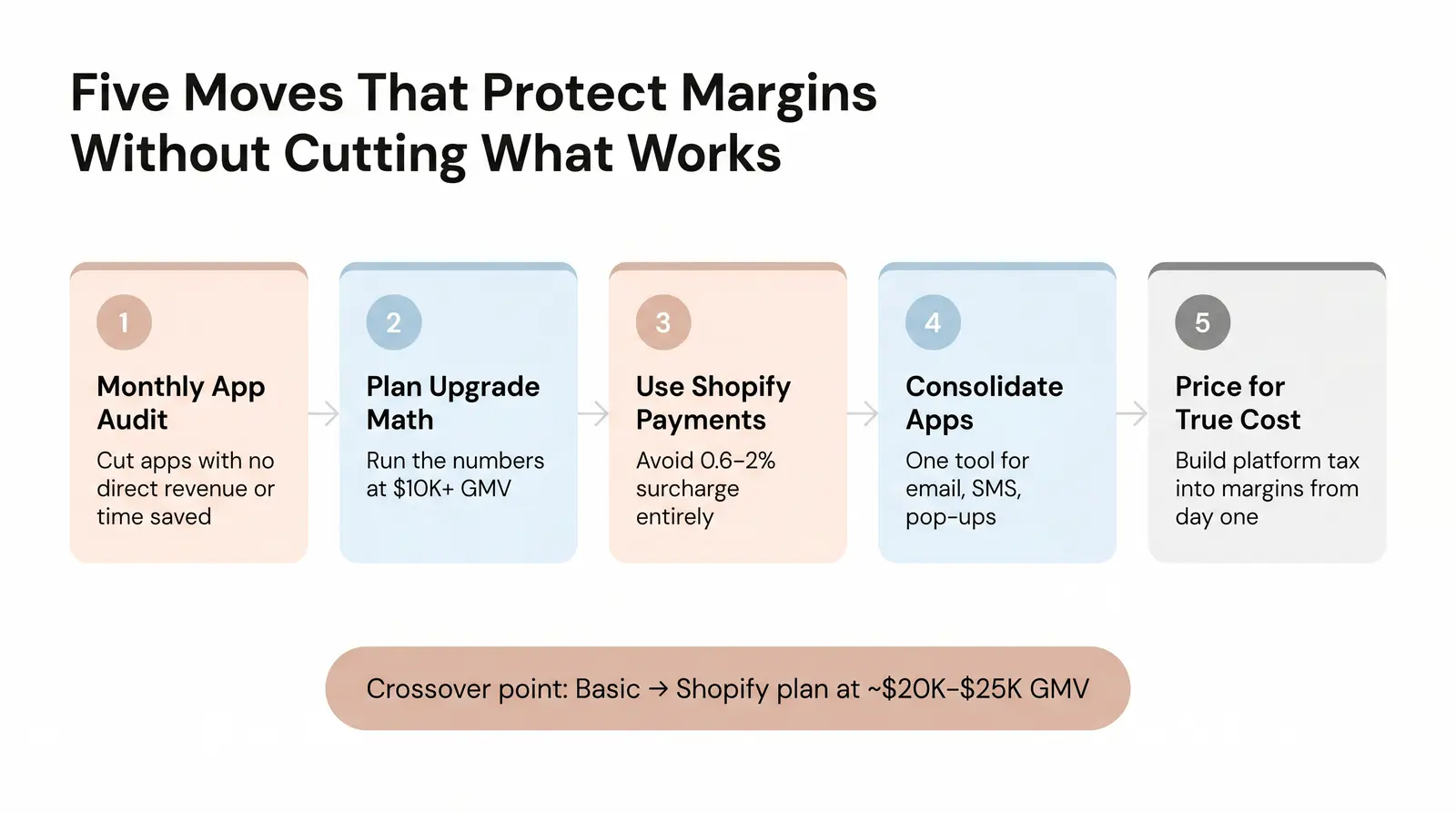
Run a monthly app audit. Pull up your Shopify billing statement and go line by line. For each app, ask: did this directly generate revenue or save me meaningful time this month? If the answer is no, cancel it. Zombie apps are surprisingly common, and they add up fast.
Evaluate plan upgrade math at $10K+ GMV. Once you cross $10,000 to $15,000 in monthly revenue, run the numbers on upgrading your plan. The savings in credit card rates on the Shopify or Advanced plan often outweigh the higher subscription cost. Use the table in Tier 2 as your starting point.
Use Shopify Payments wherever possible. The 0.6% to 2% third-party transaction surcharge is avoidable. If Shopify Payments is available in your country, use it. The savings compound quickly at volume.
Consolidate app functions. Instead of paying for three separate tools for email, SMS, and pop-ups, find one platform that handles all three. Klaviyo, for example, covers email, SMS, and pop-ups in a single subscription. That consolidation alone can eliminate $40 to $80 per month in redundant app fees.
Factor your true cost into product pricing from day one. Never price based solely on COGS and shipping. Build your effective platform tax into your margins before you launch. The Branvas Profit Calculator can help you run this math for your specific product and revenue profile.
If you are launching or scaling a product-based brand, particularly in jewelry or accessories, one of the most effective ways to reduce operational drag is to work with a partner that handles sourcing, branding, and fulfillment. When you remove those costs from your Shopify overhead, your stack stays lean and your margins stay healthy. Explore how Branvas works →
How much does Shopify really cost per month, all in?
While the Basic subscription is $39/month, the true all-in cost for a typical small store is usually between $200 and $500 per month once you add payment processing, essential apps, and operational tools. At $15,000 in monthly revenue, a lean store on the Basic plan can expect to pay around $650 to $700 per month in total platform-related costs. That works out to roughly 4 to 5% of revenue before you factor in COGS, shipping, or marketing spend.
What are Shopify's transaction fees and how do I avoid them?
Shopify charges a transaction fee of 0.6% to 2% (depending on your plan) if you use a third-party payment gateway instead of Shopify Payments. The only way to avoid this specific surcharge is to use Shopify Payments as your primary processor. You will still pay standard credit card processing rates regardless of which gateway you use, but eliminating the Shopify surcharge alone can save hundreds of dollars per month at meaningful revenue levels.
What Shopify apps do I actually need (and which are a waste of money)?
Most new stores only need a solid email marketing tool (like Klaviyo), a reviews app (like Judge.me), and a simple upsell tool. Apps that promise guaranteed traffic, complex countdown timers, or elaborate loyalty programs before you have an established customer base are often a waste of money and slow down your site. Start lean and add tools only when a specific revenue problem justifies the cost.
Is Shopify Basic enough, or should I upgrade to a higher plan?
Shopify Basic is sufficient for stores doing under $10,000 a month in revenue. Once you cross that threshold, the math on upgrading shifts. The lower credit card processing rates on the Shopify ($105/mo) and Advanced ($399/mo) plans will eventually save you more than the higher subscription cost. Run the numbers at your specific revenue level before deciding. The crossover point for Basic to Shopify is typically around $20,000 to $25,000 in monthly GMV.
What is the cheapest way to run a Shopify store without sacrificing performance?
The leanest effective setup is the Basic plan paid annually ($29/mo), a free optimized theme like Dawn, Shopify Payments as your processor, and free tiers of essential apps like Klaviyo and Judge.me until your revenue justifies upgrades. This approach can keep your fixed monthly overhead under $60, with payment processing as your only variable cost. You can learn more about building a lean, profitable ecommerce operation at Branvas Academy.
Shopify is a powerful platform. But the real cost of running an online store is a stack, and if you do not map it before you set your prices, you will discover it painfully in your margin reports.
The True Store Cost Stack™ is a simple tool to bring that clarity. Tier 1 is your base. Tier 2 scales with your revenue. Tier 3 is where most operators lose control. Tier 4 is what everyone forgets. Together, they define your true monthly overhead, and your true overhead defines your real margin.
Audit your stack quarterly. Cut the zombie apps. Run the plan upgrade math when you hit $10K in monthly GMV. And always price for profit, not just for sales.
Thinking about launching a product brand on Shopify without the overhead of sourcing, warehousing, and fulfillment? Branvas is a Brand-as-a-Service platform built for influencers and ecommerce sellers. We handle private-label product sourcing, branding, packaging, and blind shipping, so you can keep your Shopify stack lean and your margins healthy. See how it works at Branvas →