


Estimate your total ecommerce tech stack costs across seven layers and benchmark spending against revenue to protect margins and optimize profitability.
Published:
May 19, 2026
Author:
Yi Cui
Pick your stack. See your monthly cost benchmarked against revenue. Free tool, no email required.
Most merchants underestimate their true Shopify costs because the platform fee is just the starting point. Apps, fulfillment, email marketing, fraud prevention, and support tools stack up fast, quietly draining your margins before you ever notice. If you want to build a profitable ecommerce business, you need the full picture of your tech stack costs, not just the number on Shopify's pricing page.
This guide walks you through every layer of a typical Shopify-based ecommerce stack, gives you real pricing ranges for the tools most merchants use, and shows you how to benchmark your total spend against your revenue. Use it as a manual cost calculator or as a starting point for your next quarterly audit.
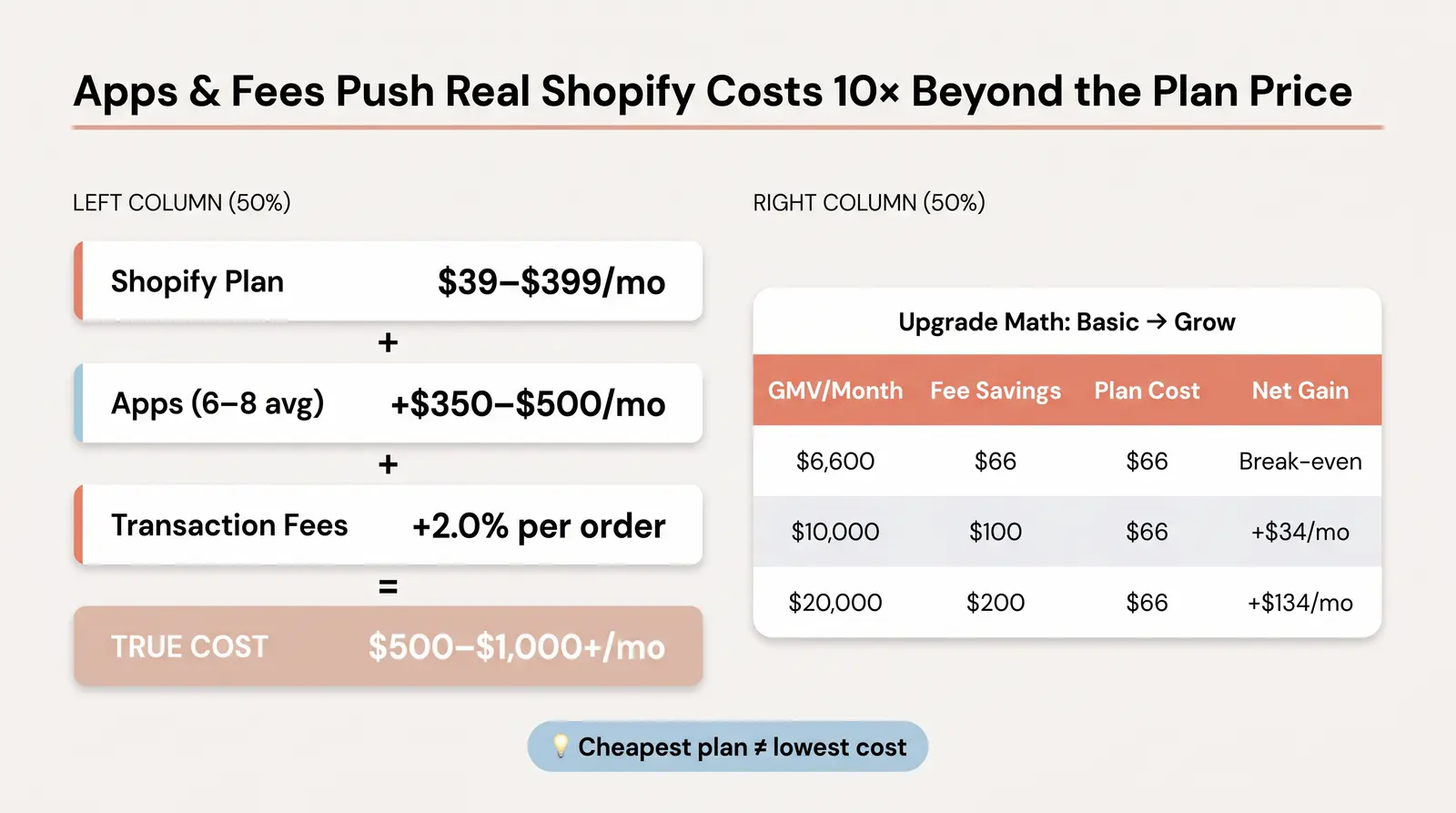
Shopify's advertised tiers are the floor, not the ceiling. The current plans are $39 per month for Basic, $105 for Grow (formerly called the Shopify plan), $399 for Advanced, and $2,300 or more for Shopify Plus [1]. Those numbers look manageable. The problem is that they represent only the platform subscription. The real cost of running a Shopify store includes every app, integration, and service you layer on top.
The average Shopify merchant installs between six and eight apps to run their store, and the average monthly cost per app runs between $58 and $67 [2]. That means a typical merchant is spending an additional $350 to $500 per month on third-party software alone, before factoring in email marketing platforms, customer support tools, or fulfillment costs. One LinkedIn post from a well-known Shopify educator put it plainly: the average Shopify store now costs over $400 per month, even though Shopify's own pricing page never changed.
The contrarian insight most merchants miss: Most founders optimize for the lowest Shopify plan, assuming cheaper is always better. But upgrading from Basic to Grow often saves money once you factor in the transaction fee reduction on volume.
Here is the math. If you use a third-party payment gateway (not Shopify Payments), the Basic plan charges a 2% transaction fee on every order. The Grow plan charges 1%. The difference in monthly subscription cost is $66 ($105 minus $39). At $6,600 per month in Gross Merchandise Value, the $66 upgrade pays for itself entirely in transaction fee savings. At $10,000 per month in GMV, you save $100 in fees against a $66 plan increase, netting $34 per month. At $20,000 per month, you save $200 in fees, netting $134 per month.
If you use Shopify Payments, the calculation shifts. The card rate difference between Basic (2.9% + 30 cents) and Grow (2.7% + 30 cents) is 0.2%. The break-even GMV in that case is $33,000 per month. But even then, the Grow plan adds five staff accounts and enhanced shipping discounts, which have real value for growing teams.
In our experience at Branvas, the founders who launch leanest aren't those on the cheapest plan. They're the ones who audited their app stack before month three.
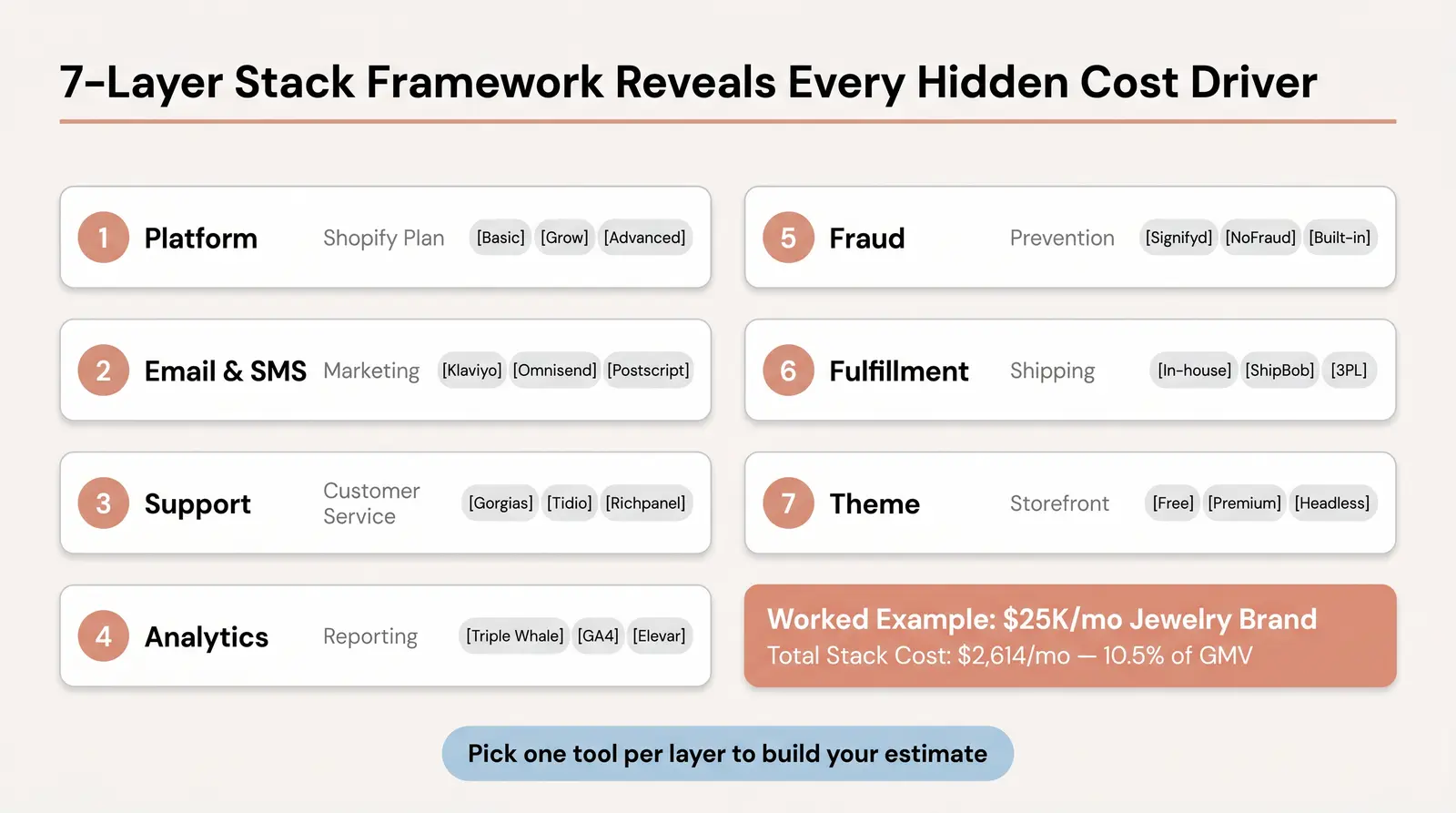
To help you calculate your true monthly costs, we developed The Branvas Stack Cost Framework™. This proprietary model breaks down your ecommerce operations into seven essential layers, each of which contributes to your total monthly spend. Walk through each layer, pick your current or planned tool, and use the cost lookup table to build your estimate.
| Layer | Category | What to Pick |
|---|---|---|
| 1 | Platform (Shopify Plan) | Basic / Grow / Advanced / Plus |
| 2 | Email & SMS Marketing | Klaviyo / Omnisend / Mailchimp / Postscript |
| 3 | Customer Support | Gorgias / Tidio / Richpanel / None |
| 4 | Analytics & Reporting | Triple Whale / Northbeam / GA4 (free) / Elevar |
| 5 | Fraud Prevention | Signifyd / NoFraud / Shopify built-in |
| 6 | Fulfillment & Shipping | In-house / 3PL / ShipBob / Branvas (for product brands) |
| 7 | Theme & Storefront | Free Shopify theme / Premium theme (one-time) / Headless |
Your Shopify plan is the foundation. The right plan depends on your GMV, whether you use Shopify Payments, and how many staff accounts you need. Basic ($39/mo) is fine for solo operators just getting started. Grow ($105/mo) makes sense once you hit $7,000 to $10,000 per month in GMV and need additional staff accounts. Advanced ($399/mo) is for stores doing $50,000 or more per month that need advanced reporting and lower card rates.
Email and SMS are typically the highest-ROI tools in your stack, which makes it tempting to over-invest early. Klaviyo is the industry standard for Shopify brands, with paid plans starting at $45 per month for up to 1,500 active profiles [3]. For a store with 2,500 contacts, expect to pay around $60 to $80 per month. Omnisend is a strong budget alternative, with paid plans starting at $16 per month, making it ideal for early-stage stores. Postscript is purpose-built for SMS and starts at $100 per month for its Growth plan [7].
Customer support tools range from free to several hundred dollars per month depending on ticket volume. Tidio offers a free plan and a Growth plan starting at $49 per month, making it the best entry-level option [6]. Gorgias is the premium choice for Shopify merchants, with plans starting at $10 per month for 50 tickets and scaling to $300 or more per month for 2,000 tickets [4]. Richpanel starts at $89 per month and is well-suited for mid-stage brands.
Google Analytics 4 is free and covers the basics for most early-stage stores. Triple Whale is the go-to analytics platform for DTC brands, with pricing based on GMV. Brands under $1 million in annual GMV can access a Pro plan around $199 per month [5]. Northbeam is a more advanced attribution platform typically used by brands doing $5 million or more per year. Elevar provides server-side tracking and conversion accuracy for Shopify, with plans typically in the $150 to $500 per month range.
Shopify's built-in fraud analysis is free with Shopify Payments and covers basic risk flags. For stores with higher order volumes or higher-risk product categories, dedicated fraud tools like NoFraud or Signifyd provide chargeback guarantees. Signifyd's standard plan is listed at $1,500 per month for enterprise-level coverage, though most small to mid-stage merchants use percentage-based pricing. NoFraud offers starter plans for stores processing under $50,000 per month in revenue.
Fulfillment is often the largest cost layer and the most variable. In-house fulfillment keeps software costs low but adds labor and packaging costs. Third-party logistics (3PL) providers like ShipBob typically charge a per-order fee ranging from $5 to $15 depending on volume and product weight. For product brands, a Brand-as-a-Service model like Branvas bundles sourcing, branding, and blind fulfillment into a single relationship, which can significantly reduce the operational overhead of managing multiple vendors.
Free Shopify themes like Dawn are capable and well-optimized. Premium themes from the Shopify Theme Store range from $100 to $400 as a one-time purchase, with popular options like Pesto at $260 and San Francisco at $380. Headless storefronts are a significant investment, typically requiring $10,000 or more in development costs and ongoing hosting expenses, and are only appropriate for stores doing $1 million or more per year.
Here are realistic monthly cost ranges for each layer based on your business stage, using current pricing data [1] [3] [4] [5] [6] [7].
| Layer | Small ($0–$30K GMV/mo) | Mid ($30K–$150K GMV/mo) | Scale ($150K+ GMV/mo) | Budget Pick | Pro Pick |
|---|---|---|---|---|---|
| 1. Platform | $39 | $105 | $399+ | Shopify Basic | Shopify Advanced |
| 2. Email & SMS | $0–$45 | $100–$300 | $500+ | Omnisend | Klaviyo |
| 3. Support | $0–$25 | $50–$300 | $750+ | Tidio | Gorgias |
| 4. Analytics | $0 | $150–$500 | $1,000+ | GA4 | Triple Whale |
| 5. Fraud | $0 | $100–$300 | $1,500+ | Shopify Built-in | Signifyd |
| 6. Fulfillment | Variable (in-house) | $5–$15 per order | Custom 3PL rates | In-house | Branvas |
| 7. Theme | $0 | $180–$400 (one-time) | $10,000+ (headless) | Free Theme | Premium Theme |
Let's say you're running a jewelry brand doing $25,000 per month in GMV. Here is what your stack might actually cost:
Total Monthly Software and Fulfillment Cost: $2,614
Cost as Percentage of Revenue: 10.5%
At this stage, 10.5% is sitting right at the edge of the Yellow zone for a Growth-stage brand. The biggest lever is fulfillment. If you can reduce your per-order cost or consolidate your sourcing and packaging, you can bring this number into the Green zone without touching your software stack.
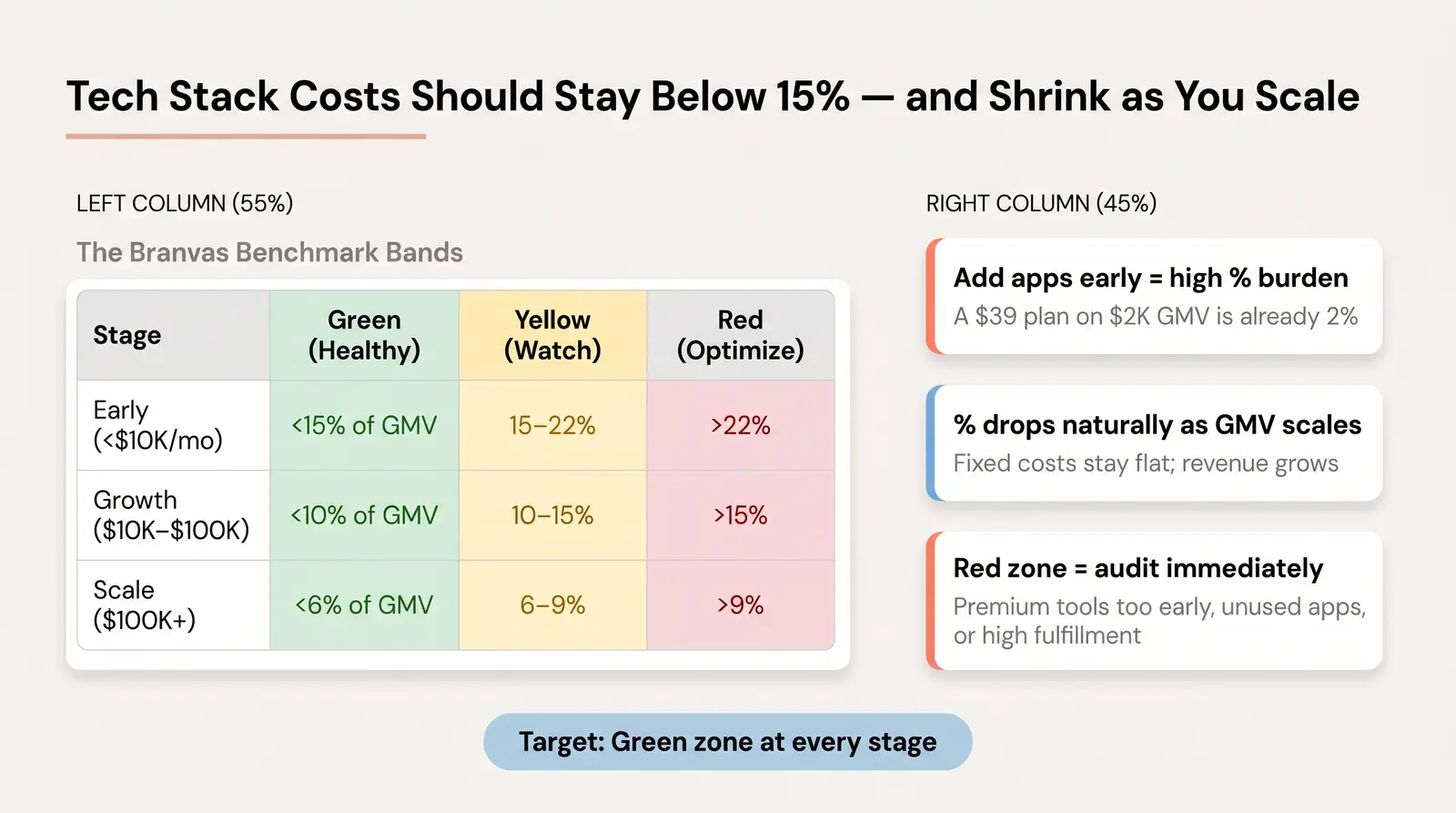
Understanding your total cost is only half the battle. You also need to know whether that spend is healthy relative to your revenue. The percentage of revenue you spend on your tech stack should decrease as your GMV grows, because most software costs are fixed or semi-fixed while revenue scales.
We use The Branvas Benchmark Bands to evaluate tech stack efficiency at each stage of growth.
| Stage | Green (Healthy) | Yellow (Watch) | Red (Optimize Now) |
|---|---|---|---|
| Early (<$10K GMV/mo) | <15% of GMV | 15–22% | >22% |
| Growth ($10K–$100K/mo) | <10% of GMV | 10–15% | >15% |
| Scale ($100K+/mo) | <6% of GMV | 6–9% | >9% |
These bands are designed to account for the reality that early-stage stores carry a higher fixed cost burden relative to revenue. A $39 Shopify plan on a $2,000/month store is already 2% of GMV before you add a single app. That is fine. The goal is to keep total tech stack costs below 15% at that stage, then drive that percentage down as revenue grows.
Merchants typically fall into the Red zone for one of three reasons. First, they add premium tools too early, before the revenue is there to justify the cost. Second, they accumulate apps over time without auditing which ones are still being used. Third, they underestimate fulfillment costs when scaling order volume. If you find yourself in the Red zone, the next section shows you exactly where to cut.
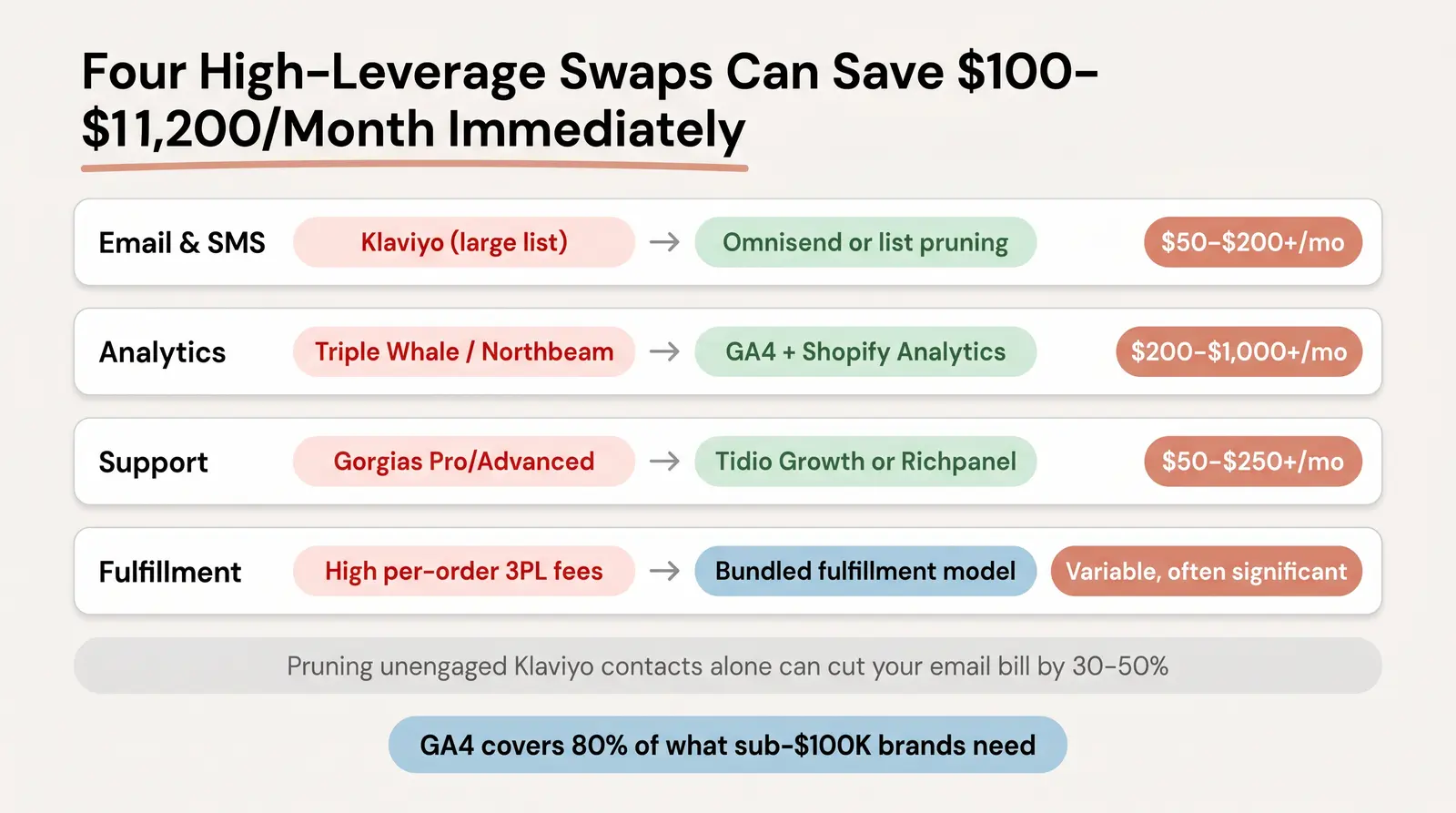
If your tech stack costs are eating into your margins, the following swap table shows you where to look first. These are not hypothetical suggestions. They are the most common optimization moves we see ecommerce founders make when they get serious about profitability.
| Category | Current Tool (High Cost) | Suggested Swap | Potential Monthly Savings |
|---|---|---|---|
| Email & SMS | Klaviyo (large list, low engagement) | Omnisend or list pruning | $50–$200+ |
| Analytics | Triple Whale or Northbeam | GA4 + Shopify Analytics | $200–$1,000+ |
| Support | Gorgias Pro or Advanced | Tidio Growth or Richpanel | $50–$250+ |
| Fulfillment | Traditional 3PL with high per-order fees | Branvas (for product brands) | Variable, often significant |
A few notes on these swaps. On email, the most common waste is paying for a large Klaviyo list that includes thousands of unengaged contacts. Cleaning your list regularly can drop your monthly bill by 30 to 50% without losing any real revenue. On analytics, GA4 combined with Shopify's native reporting covers 80% of what most sub-$100K brands actually need. Triple Whale and Northbeam are excellent tools, but they are best justified once you are running significant paid media spend and need multi-touch attribution.
One of the highest-leverage swaps we see at Branvas is on the product and fulfillment layer. Merchants building a product brand who are managing their own sourcing, packaging, and 3PL relationships are often spending 20 to 35% of revenue on this layer alone. A model like Branvas's Brand-as-a-Service, where sourcing, branding, and blind fulfillment are bundled, can compress that meaningfully, especially at early to mid-stage volumes.
Curious what a leaner fulfillment model looks like? Explore how Branvas handles sourcing, branding, and fulfillment.
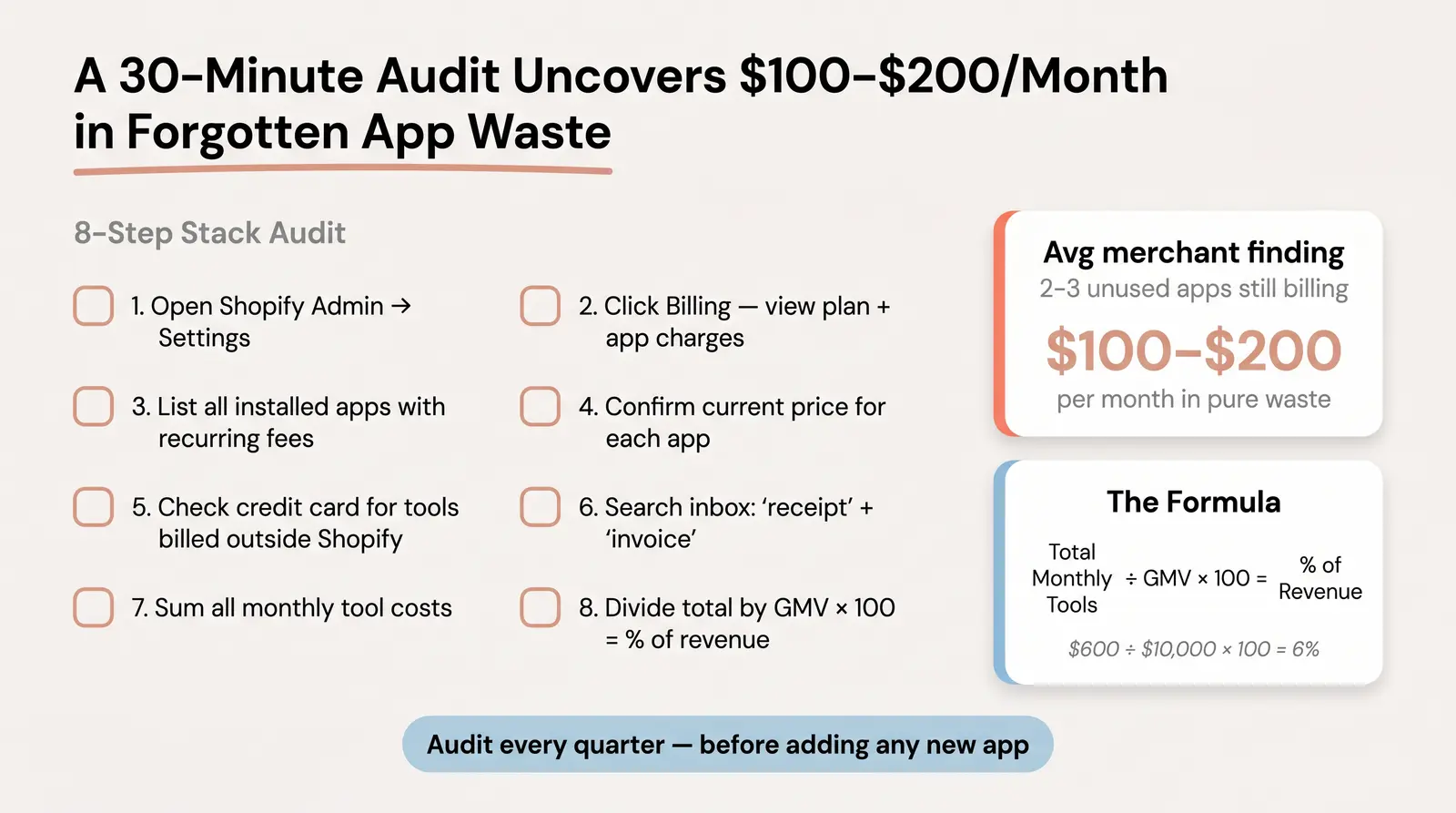
You cannot optimize what you do not measure. Most merchants have a rough sense of their Shopify plan cost but no clear picture of their total monthly spend across all tools. This audit takes about 30 minutes and will give you the full number.
We recommend doing this audit every quarter, especially before adding a new app. In our experience at Branvas, the average merchant we onboard is paying for two to three apps they no longer actively use. That is $100 to $200 per month in pure waste.
If you're just starting out and building your first product brand, our Academy has a free guide on budgeting your first ecommerce stack.
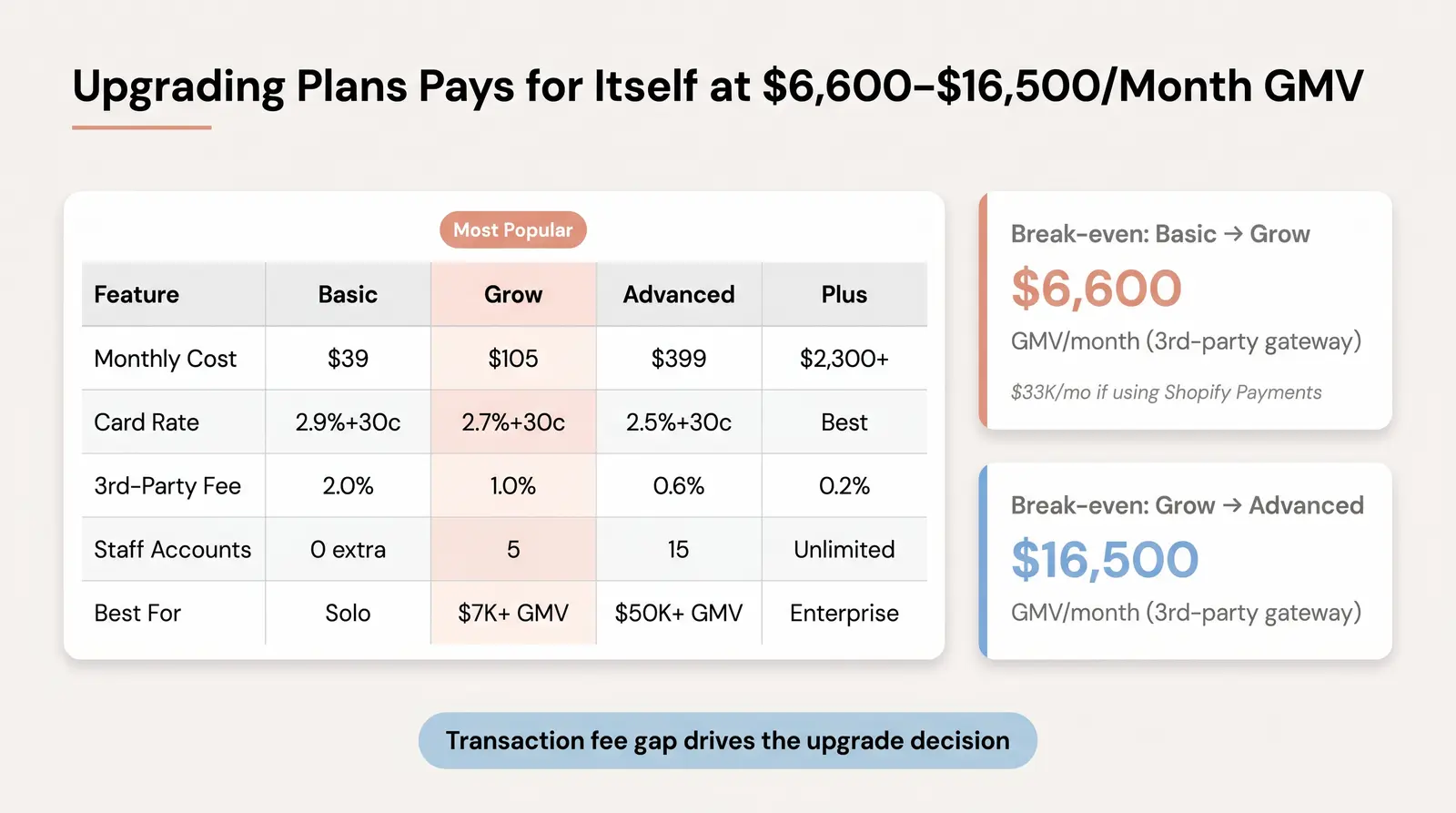
Choosing the right Shopify plan is the single most important decision in your tech stack because it affects your transaction fees, your card rates, and your staff account limits. Here is how the current tiers compare based on 2025 pricing [1].
| Feature | Basic | Grow | Advanced | Plus |
|---|---|---|---|---|
| Monthly Cost (billed monthly) | $39 | $105 | $399 | From $2,300 |
| Monthly Cost (billed yearly) | $29 | $79 | $299 | Custom |
| Online Card Rates (Shopify Payments) | 2.9% + 30c | 2.7% + 30c | 2.5% + 30c | Most competitive |
| Third-Party Transaction Fees | 2.0% | 1.0% | 0.6% | 0.2% |
| Staff Accounts | 0 additional | 5 | 15 | Unlimited |
| Reporting | Basic | Standard | Advanced | Custom |
| Best For | Solo founders, early stage | Growing teams, $7K+ GMV/mo | High-volume, global reach | Complex, enterprise |
The break-even analysis for upgrading plans is straightforward. If you use a third-party payment gateway, upgrading from Basic to Grow pays for itself at $6,600 per month in GMV. Upgrading from Grow to Advanced pays for itself at approximately $16,500 per month in GMV (the $294 plan difference divided by the 1.4% fee reduction from 1% to 0.6% on third-party transactions).
If you use Shopify Payments exclusively, the card rate differences are smaller, and the break-even points are higher. In that case, the decision to upgrade should be driven by your need for staff accounts, advanced reporting, or better shipping rates rather than transaction fee savings alone.
One note on Shopify's recent pricing changes: Shopify renamed its mid-tier "Shopify" plan to "Grow" in 2025. If you see references to the "$79/month Shopify plan" in older articles, that is now the Grow plan billed annually. The monthly price is $105.
If you're building a jewelry or accessories brand and want to launch lean without managing sourcing, packaging, or fulfillment yourself, see how Branvas works or check pricing.
A: The Shopify Basic plan starts at $39 per month, but the true all-in cost is significantly higher. The average merchant uses six to eight apps, spending an additional $350 to $500 per month on third-party software [2]. When you factor in email marketing, customer support tools, analytics, and fulfillment, a typical small store doing $10,000 to $30,000 per month in GMV spends between $500 and $1,000 per month in total tech stack costs, not including advertising.
A: A lean, high-performing stack for under $500 per month is absolutely achievable. Start with Shopify Basic ($39), use a free theme from the Shopify Theme Store, add Omnisend for email marketing (starting at $16 per month), use Tidio's Growth plan for customer support (starting at $49 per month), and rely on GA4 for analytics at no cost. That puts you at roughly $104 per month in software, leaving ample budget for fulfillment and a few additional apps as your store grows.
A: The calculation is simple. Add up all your monthly software expenses, including your Shopify plan, every app subscription, and any external tools like Klaviyo or Gorgias that bill outside of Shopify. Divide that total by your Gross Merchandise Value for the month, then multiply by 100. For example, $600 in monthly software costs divided by $10,000 in GMV equals 6%. Use The Branvas Benchmark Bands in this article to evaluate whether that percentage is healthy for your stage.
A: The clearest signal is transaction fee savings. If you use a third-party payment gateway, the upgrade from Basic to Grow pays for itself at $6,600 per month in GMV. If you use Shopify Payments, the break-even is around $33,000 per month. Beyond the math, consider upgrading when you need more than one staff account, when you want access to better shipping discounts, or when you need more detailed reporting to make data-driven decisions.
A: Keep it lean at launch. You need three things: a reliable email capture and marketing tool (Klaviyo or Omnisend), a basic customer support widget so shoppers can ask questions before buying (Tidio's free plan works well), and Google Analytics 4 for traffic tracking. That is it. Avoid adding loyalty programs, advanced analytics, or upsell tools until you have consistent monthly sales. Every app you add before you have revenue is a fixed cost you are paying to serve zero customers.