


Master six essential ecommerce unit economics metrics and use the MARGIN-FIRST framework to confirm profitability before spending a single dollar on ads.
Published:
July 3, 2026
Author:
Yi Cui
Most ad problems are math problems discovered too late. You launch a beautiful store, turn on Meta or TikTok ads, watch the first few sales roll in, and feel like you're winning. Then you check your bank account and realize you're losing money on every single order. This is the quiet reality for thousands of new ecommerce sellers who treat paid acquisition as a growth lever before confirming their business can actually survive the cost of acquiring a customer.
This guide will not overwhelm you with spreadsheets. It will give you the six numbers you need to understand, a clear framework for working through them, and the confidence to know exactly when you are ready to run ads.
The core problem for most beginners is that they view ads as a magic switch for growth. They assume that if they just drive enough traffic, the profits will sort themselves out at scale. The math tells a different story.
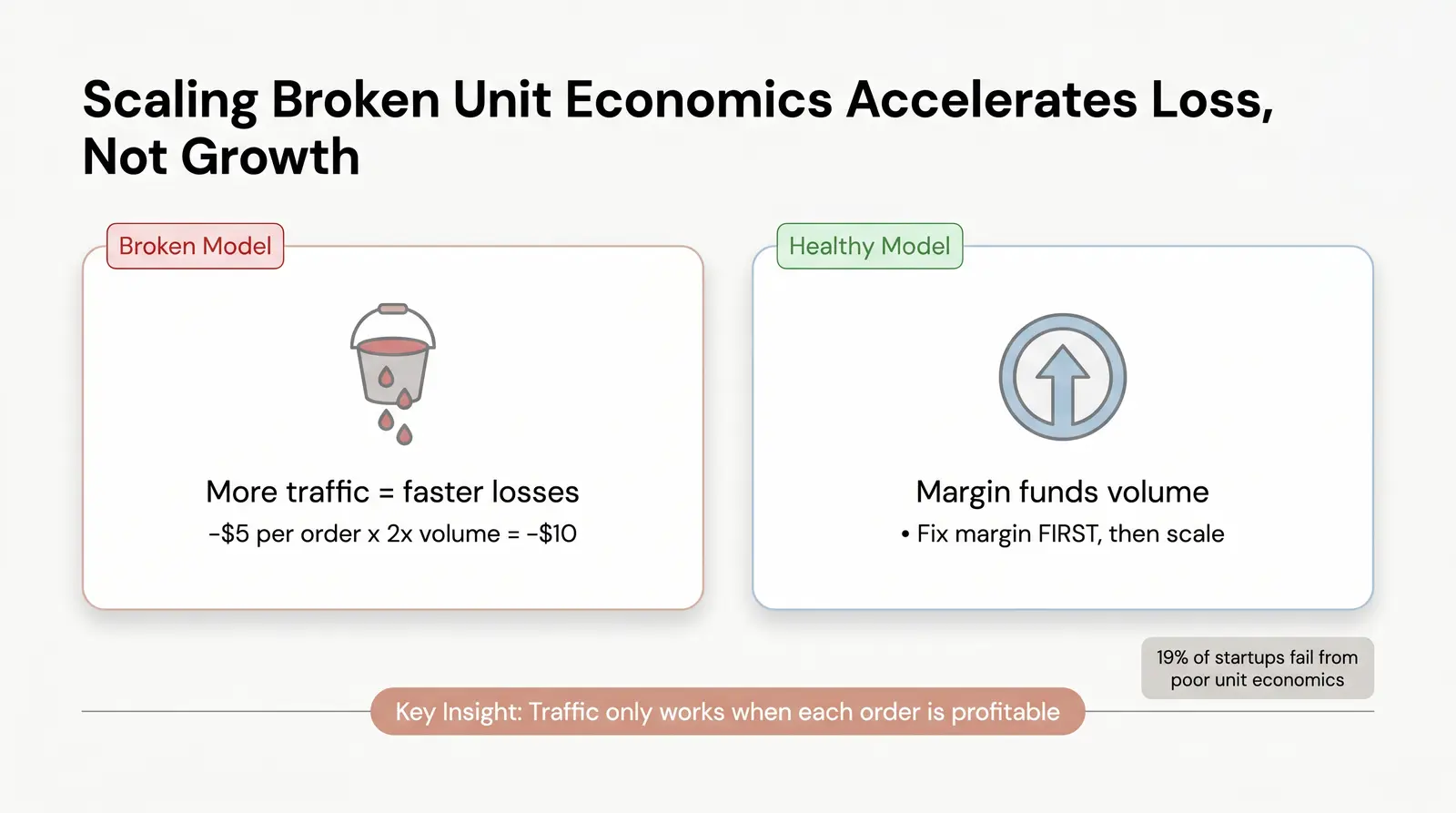
According to CB Insights, unsustainable unit economics is a primary reason 19% of startups fail, often because founders scale ad spend before their margins can support it [1]. The more telling insight is this: more traffic to a broken unit economics model does not accelerate growth. It accelerates loss. If you lose $5 on every order because your shipping and product costs are too high, doubling your sales volume means you lose money twice as fast. That is a structural problem, not a marketing problem.
The common belief is that you just need more traffic to make an ecommerce business work. That belief is wrong. Traffic is only valuable if each order it generates is profitable. Scaling a business with negative contribution margin is like filling a leaking bucket faster. You feel productive, but the result is the same.
We often see first-time brand founders come to Branvas excited to run Meta ads on day one, before they have confirmed their margin can survive a single paid customer. They believe that volume will fix their margin. In reality, margin is the only thing that funds volume.
Before you spend a single dollar on ads, you need to understand the numbers that dictate whether your business is profitable. These are the core metrics, explained in plain English. Every example below uses the same $45 necklace so you can follow the math in one clean scenario.
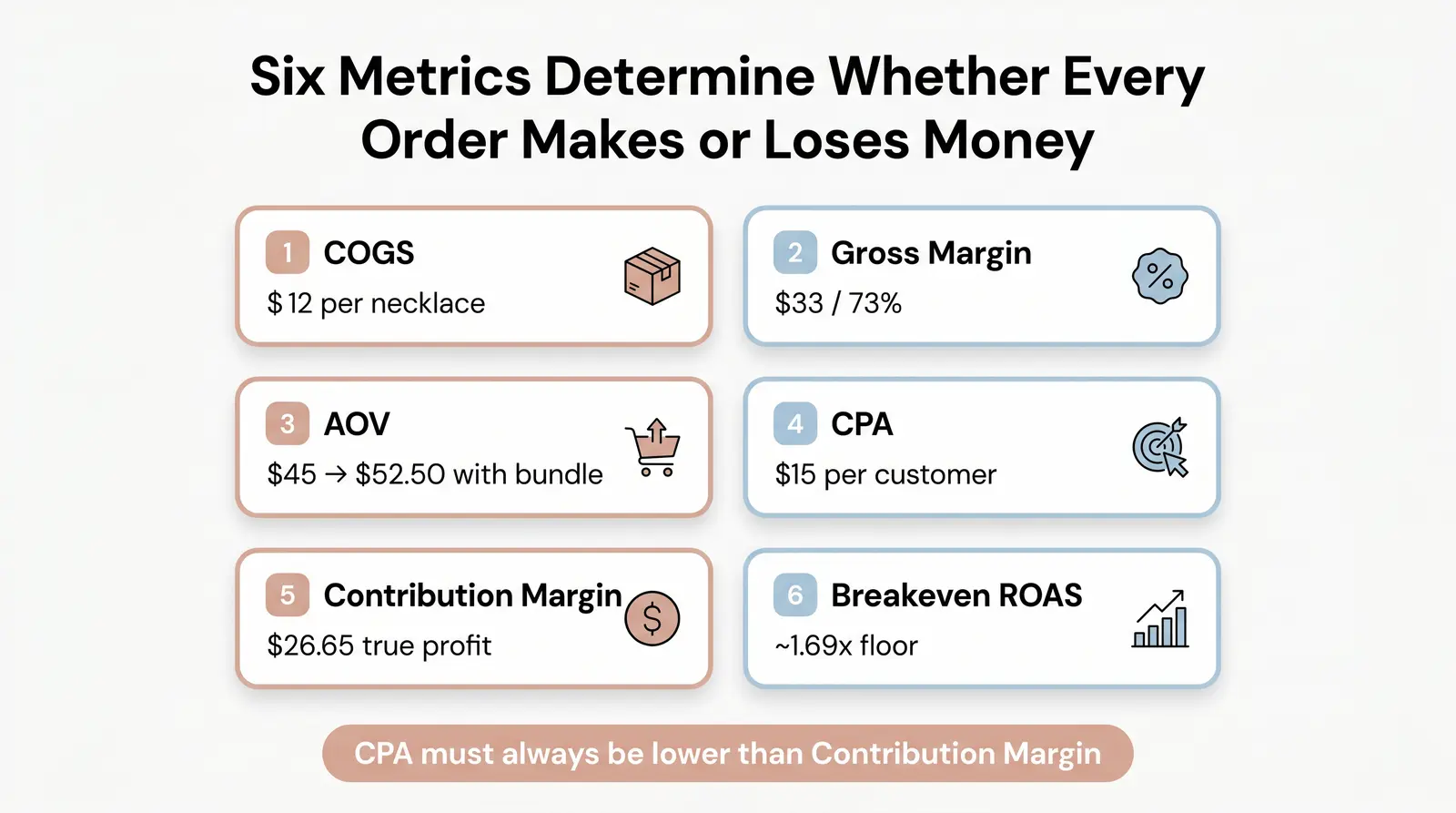
1. COGS (Cost of Goods Sold)
COGS is the total cost to produce your product and get it ready to sell, including manufacturing, inbound freight, and packaging materials.
Example: Your $45 necklace costs $10 to manufacture, $1 for the branded box, and $1 in inbound freight from the factory. Your COGS is $12.
Why it matters: COGS is the foundation of everything. Every other number in this guide flows from it. If you get COGS wrong, every calculation that follows is wrong too.
2. Gross Margin
Gross margin is what is left of your revenue after you subtract your COGS. It is expressed as both a dollar amount and a percentage.
Example: $45 retail price minus $12 COGS equals $33 gross margin, or 73%.
Benchmark: For private-label jewelry and accessories, a healthy gross margin typically sits between 60% and 80% [2]. Apparel and accessories broadly run 40% to 60%, while consumer electronics often fall as low as 15% to 25% [3].
3. AOV (Average Order Value)
AOV is the average amount a customer spends in a single transaction on your store. It is calculated by dividing total revenue by total number of orders.
Example: If a customer buys the $45 necklace and nothing else, your AOV is $45. If you add a $15 earring bundle and half your customers take it, your AOV climbs toward $52.50.
Why it matters: A higher AOV means you can afford a higher CPA and still stay profitable.
4. CPA (Cost Per Acquisition)
CPA is the amount of money you spend on advertising to win one new paying customer. It is calculated by dividing your total ad spend by the number of new customers generated.
Example: You spend $150 on Facebook ads and acquire 10 new customers. Your CPA is $15.
Why it matters: Your CPA must always be lower than your contribution margin. If it is not, you are paying to lose money.
5. Contribution Margin
Contribution margin is your gross margin minus all other variable costs per order: outbound shipping, fulfillment fees, and payment processing. This is your true profit per order before any ad spend is counted.
Example: From your $33 gross margin on the $45 necklace, subtract $5 for outbound shipping and $1.35 for payment processing (3% of $45). Your contribution margin is $26.65.
Benchmark: Healthy DTC brands aim for a contribution margin above 35% [4]. Below 30%, scaling profitably becomes very difficult.
6. ROAS and Breakeven ROAS
ROAS (Return on Ad Spend) measures how much revenue you generate for every dollar spent on ads. Breakeven ROAS is the specific ROAS you need to hit just to avoid losing money on a sale.
Example: Your contribution margin on the $45 necklace is $26.65. Your Breakeven ROAS is your AOV ($45) divided by your contribution margin ($26.65), which equals approximately 1.69x. Any ROAS above 1.69x means you are making money. Below it, you are not [5].
The formula: Breakeven ROAS = 1 divided by your gross margin percentage. A 50% gross margin means a Breakeven ROAS of 2.0. A 73% gross margin means a Breakeven ROAS of 1.37.
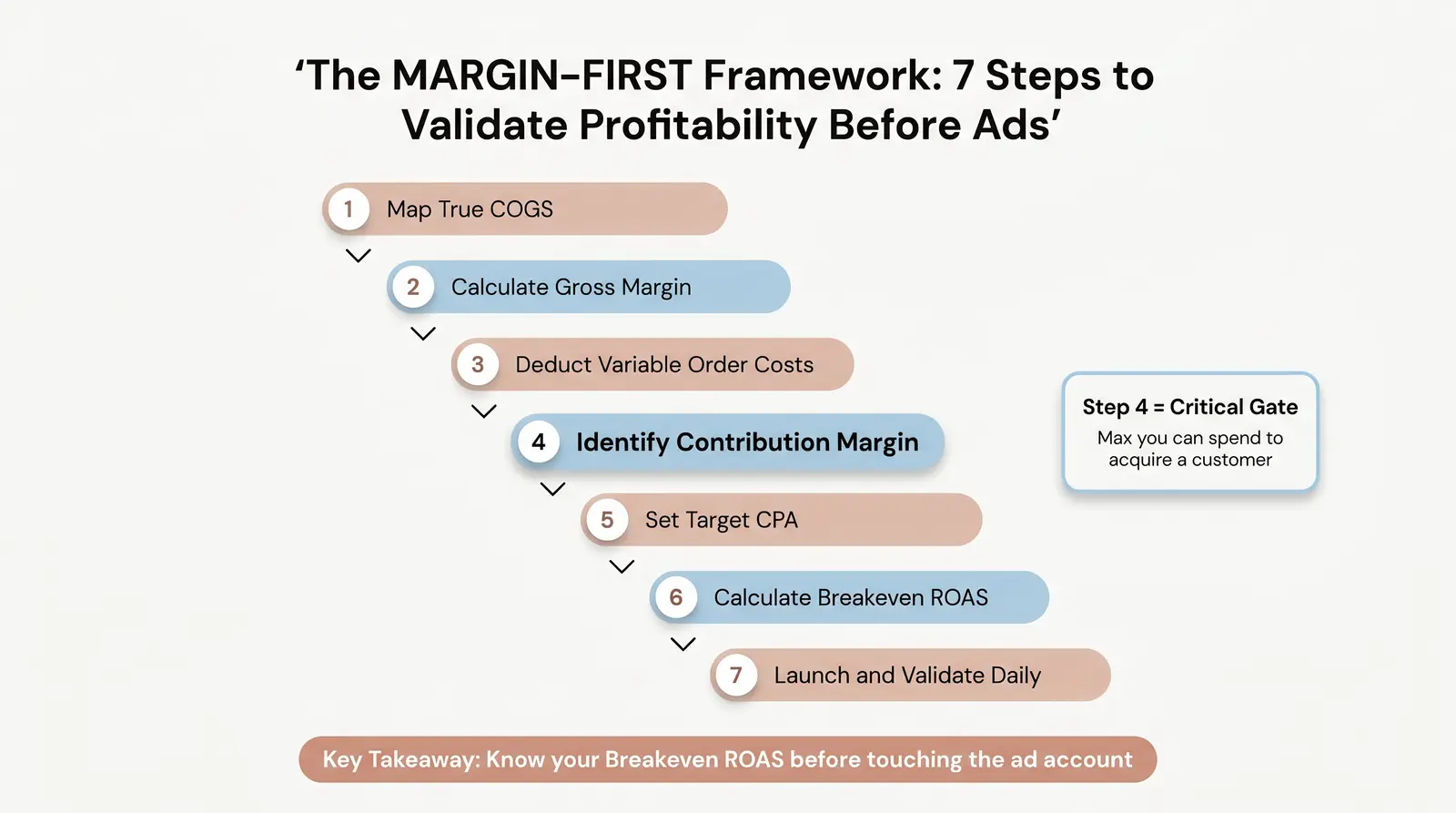
At Branvas, before we help a new brand go live, we walk them through what we call the MARGIN-FIRST Framework. It is a sequenced set of checkpoints to confirm the math works before a dollar of ad spend is committed.
Step 1: Map Your True COGS. Document every cost it takes to create the product, package it, and land it in your fulfillment center. Include manufacturing, inbound freight, and packaging. Do not estimate. Get exact quotes from your supplier.
Step 2: Calculate Gross Margin. Subtract your COGS from your retail price. If this number is below 60% for jewelry or accessories, you need to either raise your price or lower your product costs before proceeding.
Step 3: Deduct Variable Order Costs. Subtract your outbound shipping cost, fulfillment pick-and-pack fees, and payment processing fees (typically 2.9% plus $0.30 per transaction on Shopify's standard plan) from your gross margin.
Step 4: Identify Your Contribution Margin. The number remaining is your true profit per order before any marketing spend. This is the absolute maximum you can spend to acquire a customer without losing money.
Step 5: Set Your Target CPA. Decide how much profit you want to keep per order. Subtract that target profit from your contribution margin to find your maximum allowable CPA.
Step 6: Calculate Breakeven ROAS. Divide your AOV by your contribution margin. This is the floor your ads must perform above. Print it out and put it next to your screen.
Step 7: Launch and Validate. Only turn on ads once you know your Breakeven ROAS. Monitor your actual CPA daily for the first two weeks. If your CPA creeps above your contribution margin, pause and diagnose before spending more.
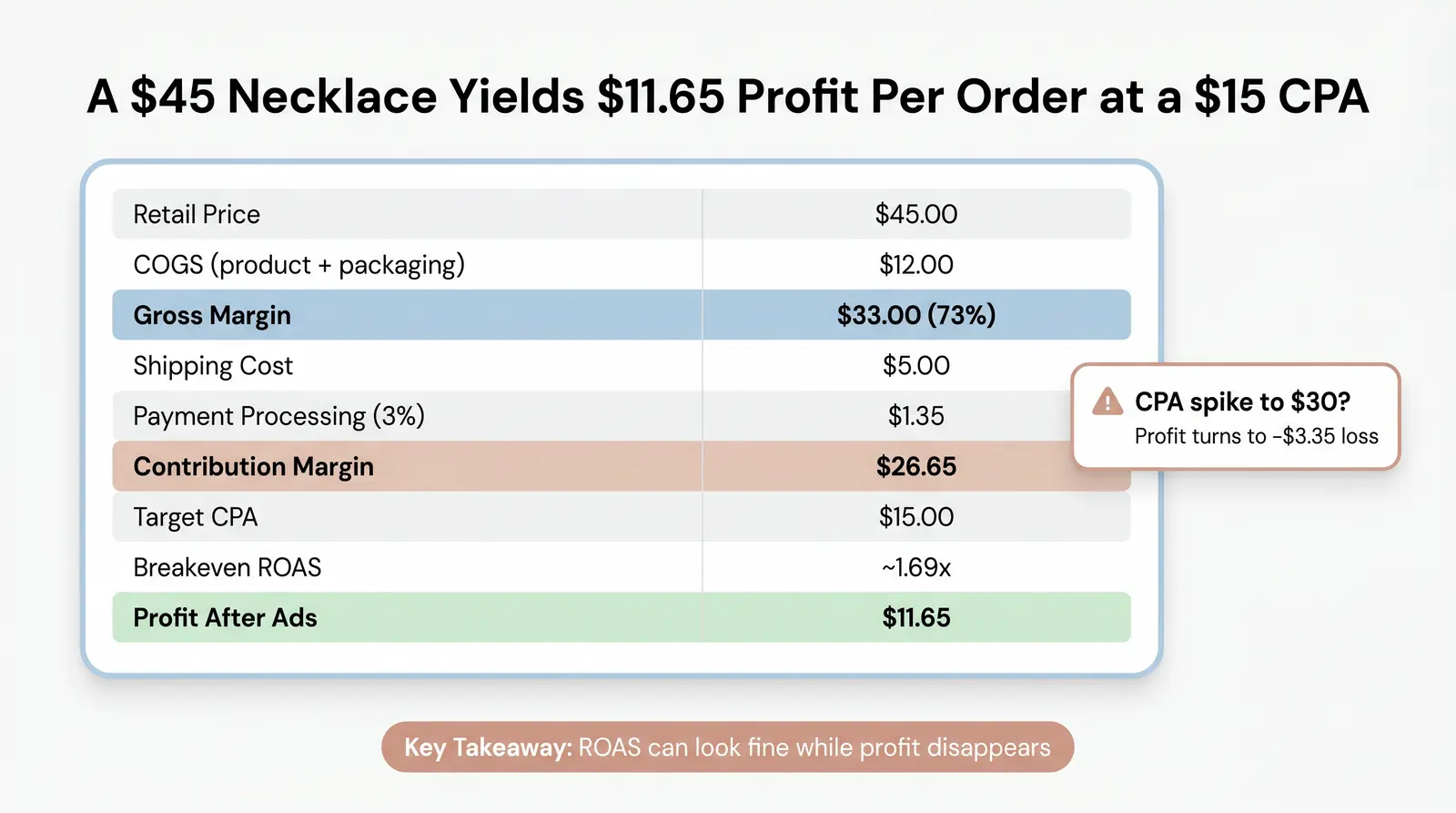
Here is how the MARGIN-FIRST Framework looks in practice for a hypothetical jewelry brand selling a $45 necklace.
| Metric | Value |
|---|---|
| Retail Price | $45.00 |
| COGS (product + packaging) | $12.00 |
| Gross Margin | $33.00 (73%) |
| Shipping Cost | $5.00 |
| Payment Processing Fee (3%) | $1.35 |
| Contribution Margin (before ads) | $26.65 |
| Target CPA (max to stay profitable) | $15.00 |
| Breakeven ROAS | ~1.69x |
| Contribution Margin After Ads | $11.65 |
In this scenario, the founder has $26.65 of margin to work with before running a single ad. By setting a Target CPA of $15.00, they keep $11.65 in profit on every order. That is a healthy, scalable business. However, if ad costs spike and the CPA rises to $30.00, the founder is suddenly losing $3.35 per order, even though revenue is flowing in. The ROAS might still look acceptable in the dashboard, but the profit is gone.
This is also where a common trap hides. A "successful" ROAS can mask a margin problem if COGS is too high. If COGS were $20 instead of $12 in this example, the contribution margin would drop to $18.65. A CPA of $15 would still be profitable, but the margin for error shrinks dramatically. In our experience at Branvas, founders are often shocked to discover their Breakeven ROAS is lower than they feared, because they have underestimated their own margin.
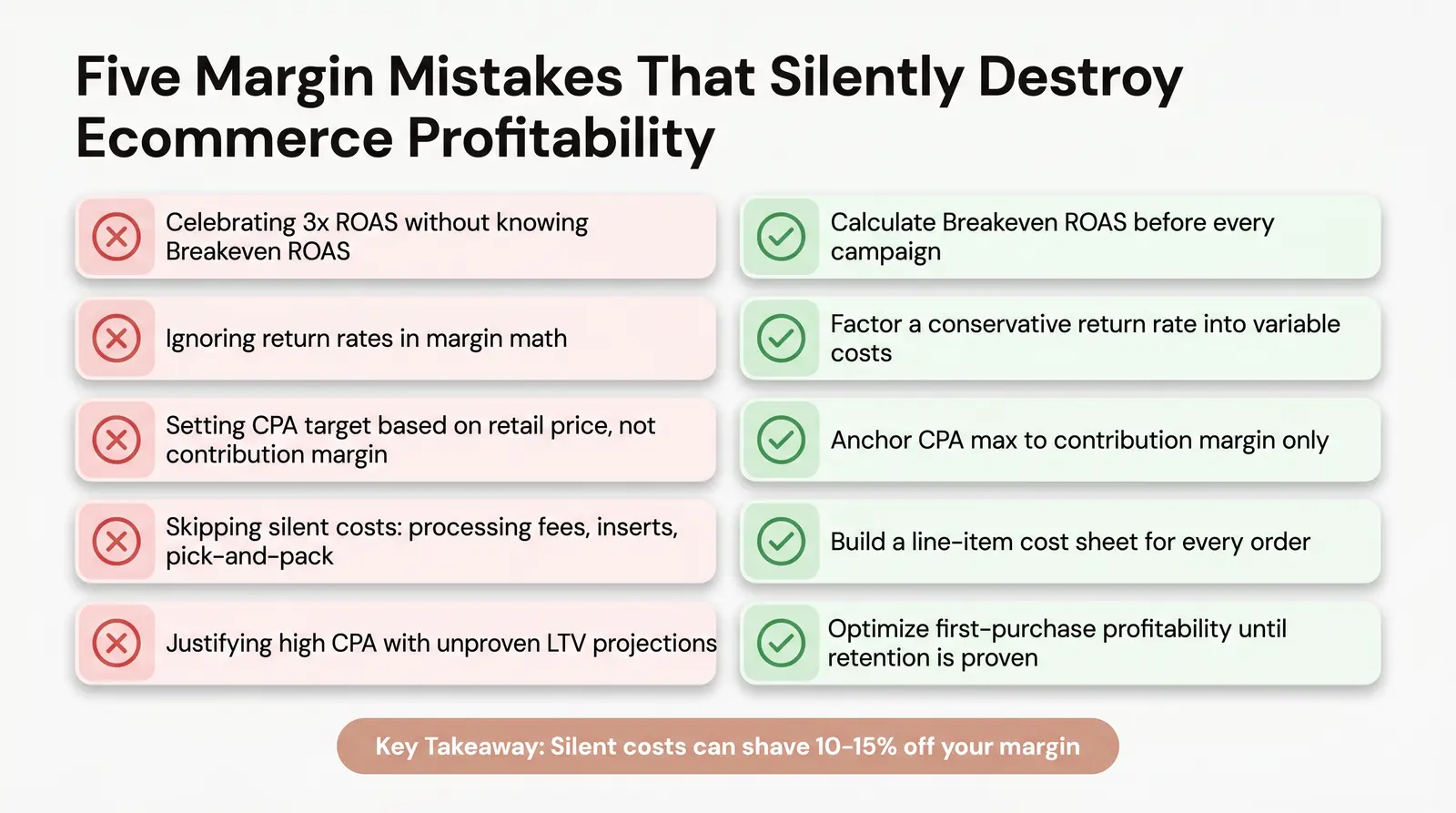
Confusing revenue-based ROAS with profit-based ROAS.
Many beginners celebrate a 3x ROAS because it looks strong in the Facebook dashboard. But if your gross margin is only 25%, a 3x ROAS means you are still losing money. ROAS is a revenue metric, not a profit metric. It only becomes meaningful when you know your Breakeven ROAS. Fix this by calculating your Breakeven ROAS before launching any campaign, and use it as your minimum performance threshold.
Ignoring return and refund rates when calculating true margin.
If you sell apparel and have a 20% return rate, your actual revenue and margin are significantly lower than your dashboard shows. Returns carry hidden costs: return shipping, processing time, and inventory that may not be resellable. Always factor a conservative return rate into your variable cost calculations, even if you have not experienced returns yet.
Setting a CPA target based on AOV instead of contribution margin.
Founders often reason: "My product sells for $100, so I can afford a $40 CPA." But if COGS and shipping consume $70 of that order, your contribution margin is only $30. A $40 CPA means you lose $10 on every sale. Your CPA target must always be anchored to your contribution margin, not your retail price.
Not accounting for the "silent costs."
Payment processing fees (typically 2.9% plus $0.30), packaging inserts, and fulfillment pick-and-pack fees seem trivial in isolation. Together, they can shave 10% to 15% off your margin. Build a line-item cost sheet that captures every micro-cost per order. The founders who skip this step are always the ones who cannot figure out where their margin went.
Treating LTV as real without enough repeat purchase data to validate it.
Many brands justify a high initial CPA by projecting that customers will buy again (Lifetime Value). But if you are a new store with fewer than 90 days of data, you do not have the evidence to support that projection. Until you have proven retention metrics, optimize for profitability on the first purchase. LTV is a reward for building a great brand. It is not a license to lose money upfront.
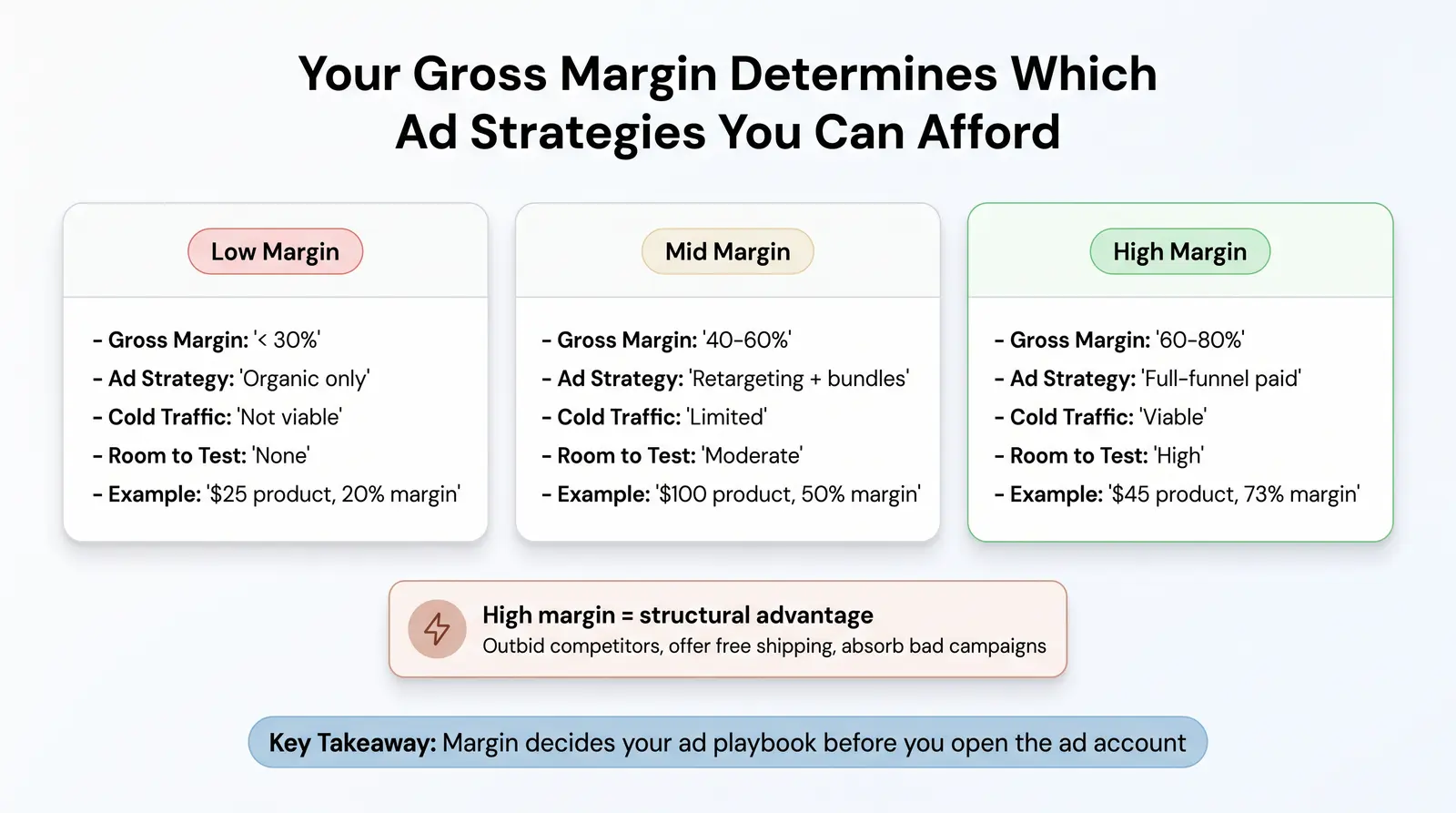
Your unit economics do not just tell you whether you are profitable. They dictate the specific marketing strategies you are allowed to use.
Low-margin products cannot afford to buy cold traffic on platforms like Meta or Google. The CPA for cold prospecting audiences will almost always exceed the contribution margin on a thin-margin product. These businesses must rely on organic traffic, viral social content, or aggressive bundling to raise their AOV before paid ads become viable.
High-AOV products have the margin to absorb higher CPAs. They can invest in longer, more expensive creative funnels, run video ads that educate before they sell, and afford to test and iterate without going broke in the process. A $200 product with a 70% gross margin can survive a $50 CPA. A $25 product with a 20% margin cannot.
Products with strong gross margins have the ultimate structural advantage: room to test, fail, and learn. When you have a 73% gross margin, you can outbid competitors in the ad auction, offer free shipping without destroying your economics, and absorb the occasional bad campaign without it threatening the business.
This is one reason private-label jewelry, the model Branvas is built around, tends to have structurally stronger unit economics than many dropshipping categories. A dropshipper reselling a product at a 20% markup has almost no room to acquire customers via paid ads. A private-label brand with a 70% margin has enormous room to grow. Explore Branvas's catalog to see how the economics are built into the product model from day one.
If you want to understand how your specific numbers stack up before you build, see how Branvas works and how we structure the margin for new brands.
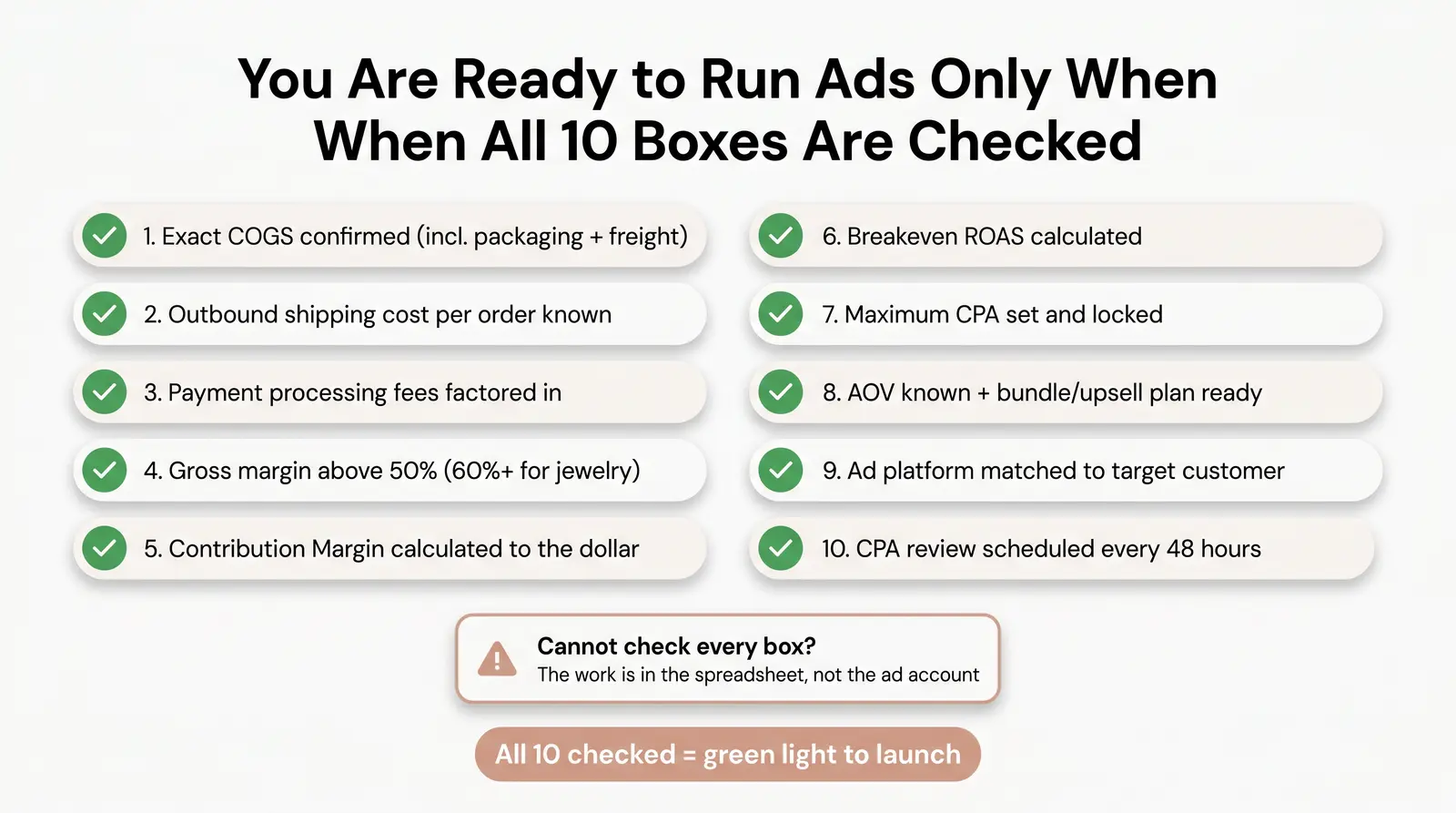
Do not touch the "Publish Campaign" button until you can check every box on this list.
If you can check every box, you are ready. If you cannot, the work to do is not in the ad account. It is in the spreadsheet.
If you are building a jewelry or accessories brand and want unit economics that are built to survive paid traffic from day one, Branvas handles sourcing, branding, and fulfillment so your margin is protected before your first ad goes live. See how Branvas works
There is no universal "good" ROAS because the right number depends entirely on your specific profit margins. A 2x ROAS is highly profitable for a brand with 80% gross margins. A 4x ROAS can still be unprofitable for a dropshipper operating on 15% margins. The only ROAS that matters is one that is consistently higher than your Breakeven ROAS. Calculate that number first, then use it as your minimum acceptable threshold for every campaign you run.
The simplest formula is 1 divided by your gross margin percentage. If your gross margin is 50% (expressed as 0.50), your Breakeven ROAS is 1 divided by 0.50, which equals 2.0. That means you need to generate $2 in revenue for every $1 spent on ads just to break even on the product cost. For a more precise number that accounts for shipping and processing fees, use your contribution margin instead of gross margin in the same formula [5].
A gross margin of at least 50% is generally the minimum before paid ads become viable. For categories like jewelry, beauty, and supplements, you should aim for 60% to 80% to comfortably absorb customer acquisition costs, shipping, and processing fees while still generating meaningful profit per order [2]. Below 50%, your Breakeven ROAS becomes very high and leaves almost no room for error in your campaigns.
ROAS measures the gross revenue generated by your advertising dollars. It tells you how much money came in relative to what you spent on ads. Profit margin measures what is actually left in your account after all expenses, including COGS, shipping, processing fees, and ad spend, are paid. You can have a high ROAS and a negative profit margin at the same time, which is exactly why ROAS alone is a misleading metric for new sellers.
It is extremely difficult and rarely sustainable. Low margins mean your Breakeven ROAS is very high, which leaves almost no room to acquire customers profitably through paid channels. To make it work, you typically need to significantly increase your AOV through aggressive bundling, find a product with very high organic demand, or shift to a private-label model that gives you control over your COGS and margin structure.