



Master jewelry store profit margins with markup formulas, net margin benchmarks by product type, and a layer-by-layer pricing stack that ensures every cost is covered.
Published:
January 29, 2026
Author:
Yi Cui
Jewelry can have strong gross margins. But gross margin is not profit. The real pricing question is whether your retail price covers product cost, payment fees, packaging, shipping, returns, discounts, ads, and enough margin left over to actually grow. Most brands price from the bottom up and wonder why there is no cash at the end of the month. This article fixes that.

These two metrics are not interchangeable, but they get treated like they are.
Gross margin is revenue minus the direct cost of the product (materials, labor, and the COGS line). The formula is: Gross Margin % = (Revenue - COGS) / Revenue.
Net margin is what remains after every operating expense is paid: marketing, shipping, packaging, platform fees, returns, and software. The formula is: Net Margin % = Net Profit / Revenue.
Jewelry looks like a high-margin business because COGS is low relative to the retail price. A $12 pendant selling for $60 shows a 80% gross margin. That number is real, but it is also misleading. The net margins for DTC ecommerce brands are often 10% to 20% or lower, because the cost of acquiring a jewelry customer and fulfilling the order is structurally high [1] [2].
Here is a worked example. Take a $40 COGS item priced at $120. The gross margin is 67%. Now model the net margin for a DTC brand:
That is not a bad business, but it is a long way from the 67% gross margin the headline number suggested.
Gross margin is what you tell investors. Net margin is what pays your rent.
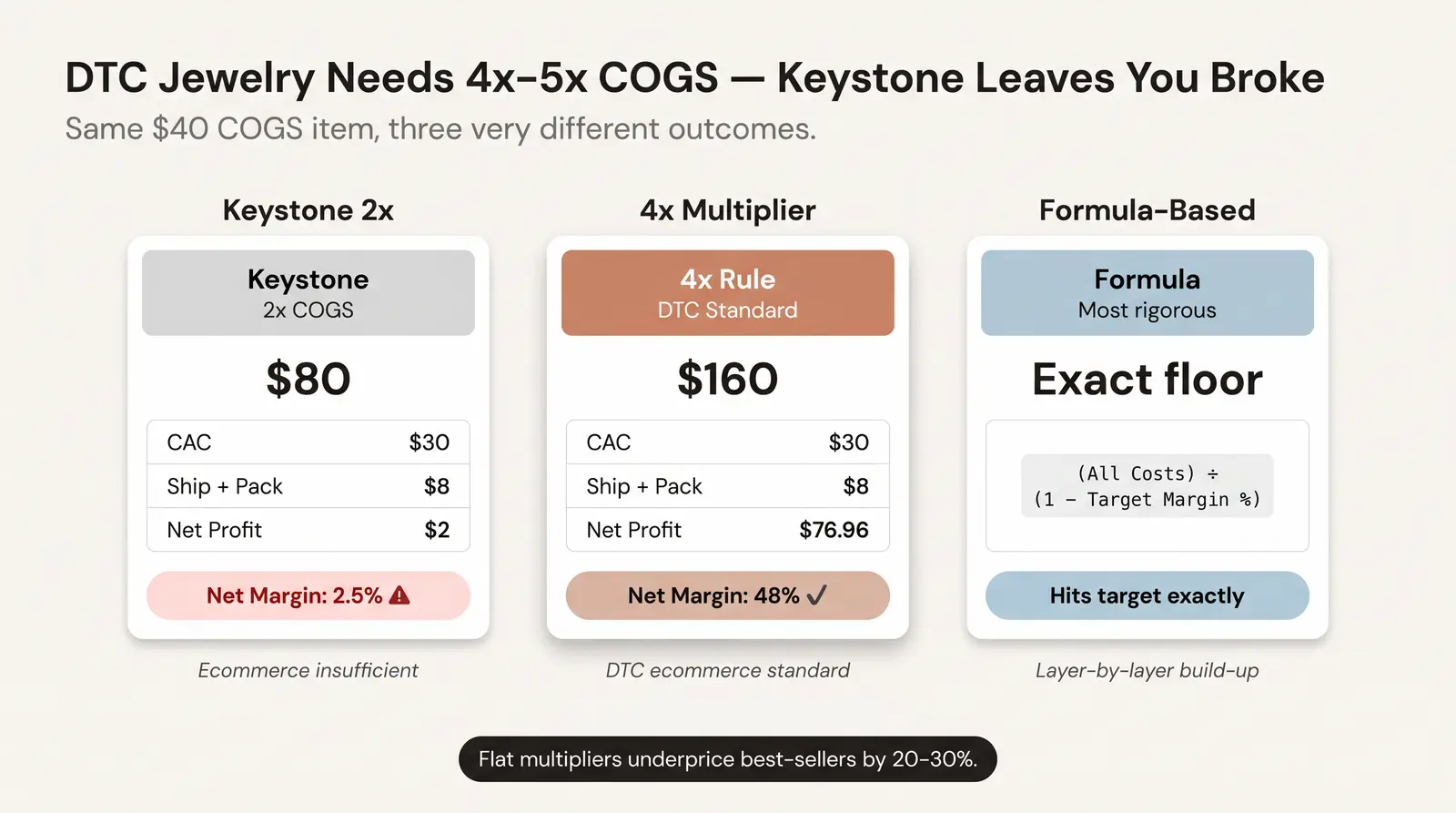
There are three markup approaches used in jewelry. Each has a different use case, and each produces a very different outcome.
Keystone markup means doubling the COGS to arrive at a retail price (2x COGS = retail). It is the traditional retail standard, and it made sense when overhead was fixed and predictable. For ecommerce, it is almost always insufficient. It leaves no room for digital advertising, free shipping, or return processing [5].
The 4x to 5x rule is the de facto standard for DTC jewelry ecommerce. The multiplier exists specifically to absorb high CAC, return rates, and platform fees while still leaving a viable net profit. A brand with a $20 COGS item pricing at $80 to $100 is following this logic [5] [6].
Custom/formula-based pricing is the most rigorous approach. Instead of guessing a multiplier, you build the price layer by layer from your actual operational costs. This is the method formalized in the Branvas Pricing Stack below.
Here is a direct comparison using the same $40 COGS item:
In our experience at Branvas, operators who use a flat multiplier without accounting for channel costs routinely underprice their best-sellers by 20% to 30%.
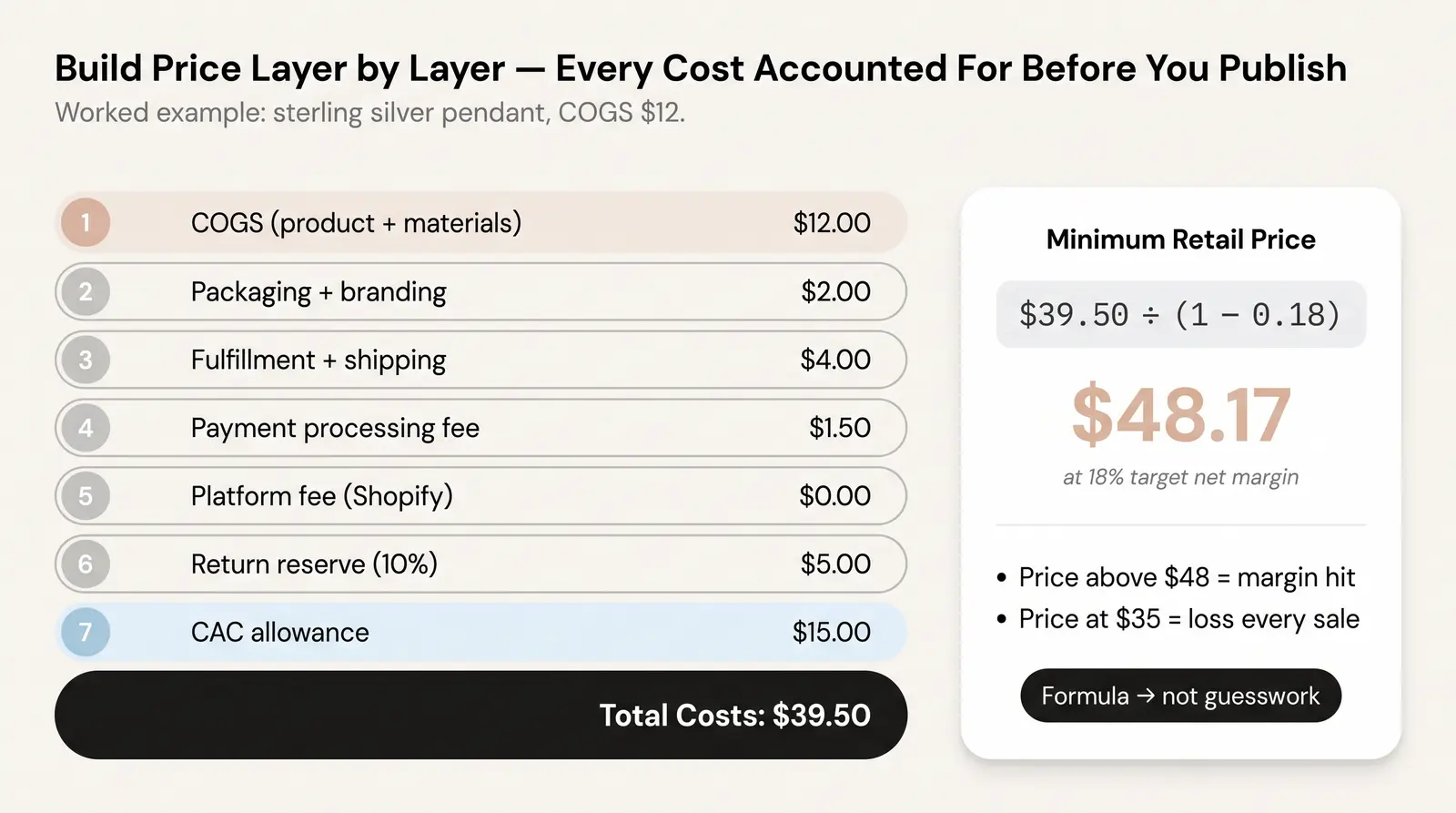
To stop guessing and start pricing for profit, we use The Branvas Pricing Stack™. It is a layer-by-layer pricing build-up formula that ensures every cost is accounted for before a retail price is set. Think of it as building a price from the ground up, one cost at a time.
| Layer | Cost Component | Typical Range / Notes |
|---|---|---|
| 1 | COGS (product + materials) | Varies by product type |
| 2 | Packaging + branding | $1–$5/unit |
| 3 | Fulfillment + shipping | $3–$8/unit (DTC) |
| 4 | Payment processing fee | 2.9% + $0.30 (Shopify/Stripe) [7] |
| 5 | Platform/marketplace fee | 0% (own store) to 15–20% (Amazon/Etsy) [8] [9] |
| 6 | Return reserve (% of revenue) | 5–20% depending on category [3] [4] |
| 7 | CAC allowance (paid ads budget per order) | $5–$40+ depending on channel [10] |
The formula is: Minimum Retail Price = (Sum of Layers 1–7) ÷ (1 - Target Net Margin %)
Let's run a full worked example for a sterling silver pendant (COGS: $12):
To hit an 18% net margin: $39.50 ÷ (1 - 0.18) = $48.17 minimum retail price.
Pricing this pendant at $48 or above means you hit your margin target. Pricing it at $35 because a competitor does means you lose money on every sale.
This is the mental model we walk every new Branvas brand through before they publish their first product listing.
If you want to run these numbers for your own catalog, Branvas's Profit Calculator does this automatically — just plug in your COGS and channel.

Not all jewelry is created equal from a margin perspective. Here are realistic benchmarks by product type, based on industry data and ecommerce operator experience [1] [2] [5] [6].
| Product Type | Typical COGS Range | Common Retail Range | Gross Margin % | Realistic Net Margin (DTC ecomm) |
|---|---|---|---|---|
| Fashion/costume jewelry | $2–$10 | $20–$50 | 70%–80% | 10%–15% |
| Sterling silver jewelry | $10–$30 | $40–$120 | 65%–75% | 15%–20% |
| Gold vermeil jewelry | $15–$40 | $60–$180 | 65%–75% | 15%–20% |
| Fine gold/diamond jewelry | $100–$500+ | $250–$1,500+ | 50%–60% | 10%–15% |
| Handmade/artisan jewelry | $15–$50 (incl. labor) | $50–$150 | 60%–70% | 15%–25% |
| Branded private-label jewelry | $8–$25 | $40–$100 | 70%–80% | 20%–30% |
Fashion jewelry often boasts the highest gross margins, but the low Average Order Value (AOV) means that fixed costs like shipping and CAC consume most of the profit. A $25 sale with a $5 shipping cost and a $15 CAC leaves almost nothing.
Branded private-label jewelry offers the best structural balance: low COGS from consolidated sourcing, combined with the pricing power of a strong brand identity. That is why the net margin range is wider and higher.
Here is the contrarian insight most brands miss: fine jewelry does not necessarily produce better net margins than fashion jewelry for DTC brands. The higher AOV is offset by higher return rates, more customer service overhead, and slower inventory turns. Public fine jewelry companies like Brilliant Earth report operating margins of -1.2%, despite gross margins of 57.5%, because the cost of acquiring and serving a fine jewelry customer is brutal [2]. The gross margin wins. The operating margin does not.
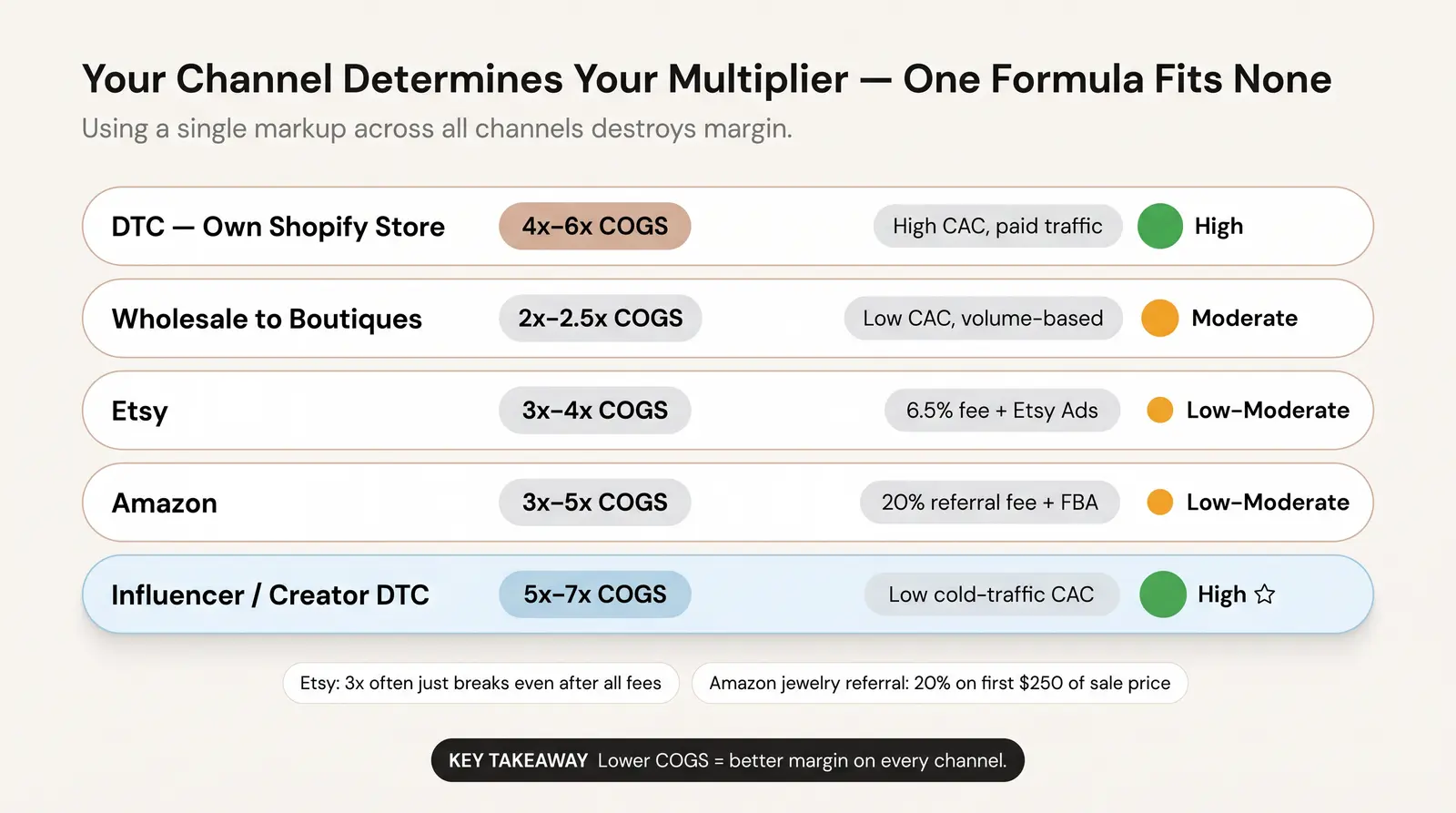
The correct multiplier changes entirely depending on how you sell. Using a single formula across all channels is one of the most common mistakes in the industry.
| Channel | Typical Multiplier | Key Cost Driver | Net Margin Potential |
|---|---|---|---|
| DTC (own Shopify store) | 4x–6x COGS | High CAC, paid traffic | High (if CAC is controlled) |
| Wholesale to boutiques | 2x–2.5x COGS (your price to them) | Low CAC, volume-based | Moderate |
| Etsy | 3x–4x COGS | Platform fees + Etsy Ads | Low to moderate |
| Amazon | 3x–5x COGS | 15–20% referral fee + FBA | Low to moderate |
| Influencer/creator-led DTC | 5x–7x COGS | Low cold-traffic CAC | High |
For wholesale, the math works differently. You sell to a boutique at 2x to 2.5x your COGS. They then mark it up another 2x to 2.5x to reach the final retail price. Your margin is lower per unit, but your CAC is near zero.
For Etsy, the platform takes 6.5% on the transaction, plus payment processing fees, plus a $0.20 listing fee per item [8]. If you also run Etsy Ads, your effective cost per sale climbs quickly. A 3x multiplier on COGS often just breaks even.
For Amazon, jewelry referral fees are 20% on the first $250 of the sale price and 5% above that [9]. That is a significant cost that must be baked into the retail price from the start.
One of the structural advantages of launching via a private-label model is that your COGS is lower to begin with, because of consolidated sourcing. That means the same retail price produces better margin across every channel. branvas.com/how-it-works
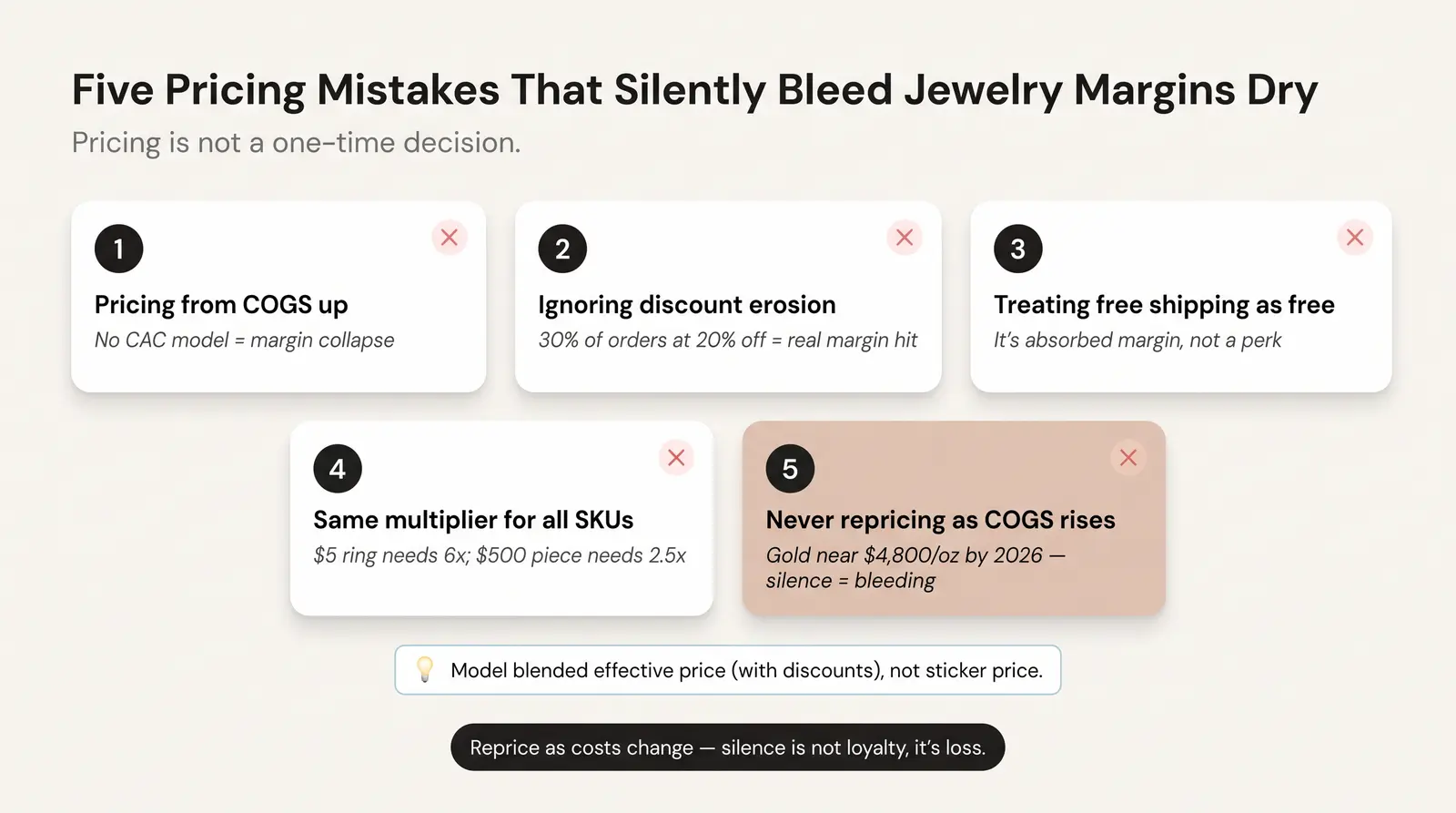
We often see founders lock in prices at launch and never revisit them, even after their ad costs double or their supplier raises prices. Pricing is not a one-time decision. Here are the five mistakes that kill margins most reliably:
1. Pricing from COGS up without modeling net margin. Applying a 3x multiplier without calculating your actual CAC and shipping costs is a guess, not a strategy. It works until it doesn't.
2. Ignoring discount erosion. If 30% of your orders use a 20% off welcome code, your effective margin is significantly lower than your listed price suggests. Model the blended effective price, not the sticker price.
3. Treating free shipping as "free." Free shipping is a cost you absorb into your margin. If you offer it to compete, the shipping cost must be built into the retail price. It is not free; it is just invisible.
4. Using the same multiplier for all SKUs regardless of price tier. A $5 fashion ring might need a 6x markup to cover shipping and CAC. A $500 fine jewelry piece might only support a 2.5x markup due to market price expectations. One formula does not fit all.
5. Failing to reprice as COGS changes. Metal prices fluctuate. Gold hit record highs in 2025, with Morgan Stanley forecasting potential prices near $4,800 per ounce by late 2026 [11]. Most brands absorb supplier increases silently, slowly bleeding their margins dry. Repricing is not a betrayal of customers. It is basic business hygiene.

A pricing calculator is one of the most valuable tools a jewelry brand can have. Here is the exact logic to build one in a spreadsheet:
Inputs needed:
Output formula:
Minimum Retail Price = (COGS + Packaging + Shipping + CAC) / (1 - Payment Fee % - Platform Fee % - Return Reserve % - Target Net Margin %)
Outputs to display:
For example, using the silver pendant from the Branvas Pricing Stack worked example: (12 + 2 + 4 + 15) / (1 - 0.029 - 0 - 0.10 - 0.18) = $48.17. That is your floor. Price above it to build in buffer for discounts.
If you don't want to build this yourself, Branvas has a free profit calculator that handles this logic specifically for jewelry SKUs, including channel-specific fee structures.
Ready to build a jewelry brand with margins that actually work? Branvas handles sourcing, branding, and fulfillment so your pricing starts from a structurally lower COGS. See how it works
A good gross profit margin for a jewelry store is typically between 42% and 47%, with high-performing DTC brands reaching 60% to 70%. However, net profit margin is the more meaningful metric. A healthy target for an ecommerce jewelry brand is 10% to 20% net margin after all costs, including advertising, shipping, and returns.
The standard markup depends on the channel. Traditional brick-and-mortar retail often uses a keystone markup of 2x the wholesale cost. DTC ecommerce brands typically apply a 4x to 5x markup on COGS to absorb customer acquisition costs, shipping, and platform fees. Wholesale pricing to boutiques uses a 2x to 2.5x multiplier.
Start with your full cost stack, not just COGS. Add packaging, shipping, and your target CAC. Then divide that total by (1 minus your target net margin percentage, minus payment fees, minus platform fees, minus return reserve). The result is your minimum viable retail price. The Branvas Pricing Stack formula in this article walks through this step by step.
Gross margin is revenue minus the direct cost of the product (COGS). Net margin is revenue minus every operating expense: COGS, advertising, shipping, packaging, platform fees, and returns. A jewelry brand can have a 70% gross margin and a 12% net margin. Gross margin measures product profitability. Net margin measures business profitability.
For handmade jewelry, include your hourly labor rate in the COGS calculation. Once you have your true cost (materials plus labor), apply a 3x to 4x multiplier for Etsy to absorb their 6.5% transaction fee, payment processing, and ad spend. For Shopify, aim for 4x to 5x to cover your independent marketing costs. Always model the net margin before publishing, not after.
[1] The Online Jewelry Founder's Salary and Profit Report: 2026 Benchmarks — Branvas, 2026
[2] Jewelry Brand Financial Benchmarks 2026 — Eightx, 2026
[3] NRF and Happy Returns Report: 2024 Retail Returns to Total $890 Billion — National Retail Federation, 2024
[4] Ecommerce Return Rates in 2026: The Metric That Actually Matters — Richpanel, 2026
[5] Smart Pricing Strategies for Retail Jewelry Brands — Wholesale Jewelry Website, 2026
[6] Jewelry Markup from Wholesale to Retail: Understanding the Pricing Journey — 925 Silver Jewelry, 2025
[7] Types of Merchant Fees Explained — Shopify, 2025
[8] Fees and Payments Policy — Etsy, 2024
[9] Standard Selling Fees — Amazon, 2024
[10] Average Customer Acquisition Cost for eCommerce — Rivo, 2024
[11] 2025 Was a 'Price Up, Units Down' Year, Here's What That Signals for 2026 — National Jeweler, 2026


