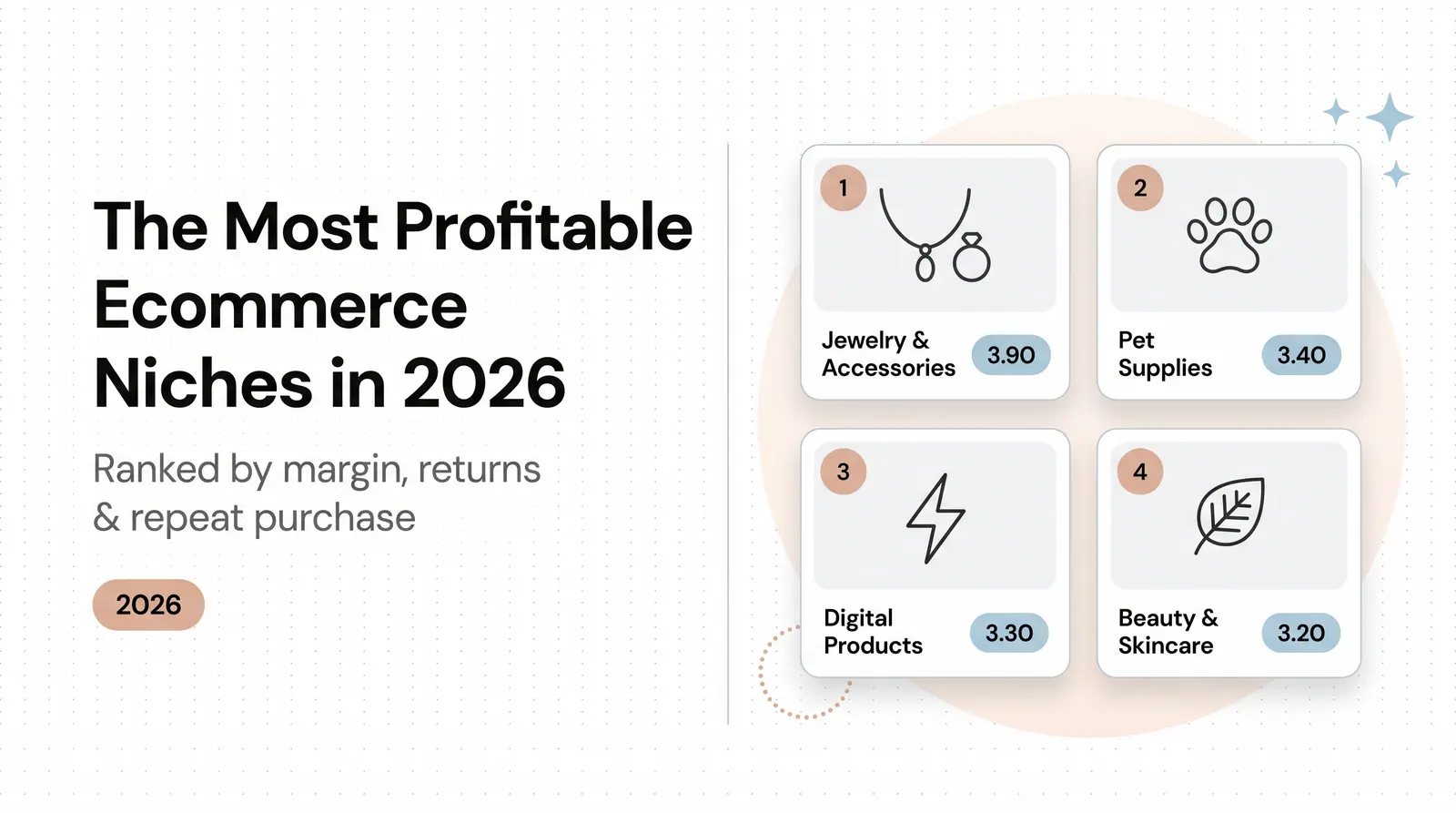



Ranks the 9 best high-margin product categories for 2026 using a 7-factor viability score that evaluates true contribution margin beyond gross margin alone.
Published:
January 29, 2026
Author:
Yi Cui

A high-margin product is not just cheap to source and expensive to sell. The best ecommerce products combine healthy gross margin, low shipping cost, low return risk, high perceived value, and enough demand to acquire customers profitably.
Most "high-margin product" lists fail the reader at the first step. They rank categories by gross margin percentage and stop there. The result is a list that looks compelling on a spreadsheet and falls apart the moment a real order ships.
The core failure is that sellers confuse gross margin with contribution margin. Gross margin only tells you how much is left after subtracting the cost of the product itself. It ignores shipping weight, return rates, creative fatigue, and trust barriers. Consider a $5 sourced item selling at $30. On paper, that is an 83% gross margin. But after a $12 shipping cost, a $6 return cost per order, and a $15 customer acquisition cost, the unit economics collapse completely. The seller is losing money on every order while believing they have a high-margin product.
Here is the contrarian insight most lists miss: high perceived value matters more than high gross margin. A product that feels premium commands a lower customer acquisition cost because creative conversion rates are higher [1]. When a product's packaging and presentation elevate its perceived value, consumers are willing to pay a premium, and that premium improves every other metric in the business [2]. Research by behavioral economists confirms that consumers routinely use price and presentation as heuristics to judge quality, meaning the same physical product can command dramatically different prices depending on how it is positioned [3].
This is why a $9 necklace in a branded box with tissue paper and a handwritten note can sell for $65, while the same necklace in a poly mailer struggles to sell for $18. The product did not change. The perceived value did. And that gap is where real margin lives.

The Branvas Product Viability Score (BVS) is a 7-factor scoring rubric that any ecommerce seller can use to evaluate a product category before investing. At Branvas, we use this framework internally when advising brand founders on which categories to build in. It is designed to surface the full picture of a product's economics, not just the headline gross margin.
Score each factor on a scale of 1 to 5, where 5 is best.
| Factor | What to Measure | Why It Matters |
|---|---|---|
| 1. Gross Margin % | (Retail - COGS) / Retail | Core unit economics floor |
| 2. Shipping Economics | Weight (oz) + dimensional weight; typical landed shipping cost | Destroys margin if ignored |
| 3. Return Risk | Category average return rate; return cost as % of AOV | Hidden margin killer |
| 4. Perceived Value Index | Price-to-weight or price-to-size ratio; premium feel | Drives conversion + lower CAC |
| 5. Repeat Purchase Potential | Consumable vs. durable; LTV multiplier | Determines if CAC is recoverable |
| 6. Creative Potential | Visual/video-friendly; UGC-able; trend-adaptable | Affects paid social efficiency |
| 7. Trust Barrier | Perceived purchase risk; sizing complexity; brand-dependency | Affects cold conversion rate |
Factor 1: Gross Margin % is the starting point, not the destination. A product with less than 50% gross margin leaves almost no room to cover advertising, returns, and operational overhead. Products with 70% or higher gross margin give you the headroom to build a real brand.
Factor 2: Shipping Economics is where most sellers get surprised. Carriers charge based on whichever is greater: actual weight or dimensional weight. A ceramic vase that weighs 2 pounds but ships in a 12x12x12 box has a dimensional weight of over 7 pounds, which means the seller pays for 7 pounds of shipping on a 2-pound product [4]. Jewelry ships in a bubble mailer for under $4. That difference can be worth 20 to 30 points of contribution margin.
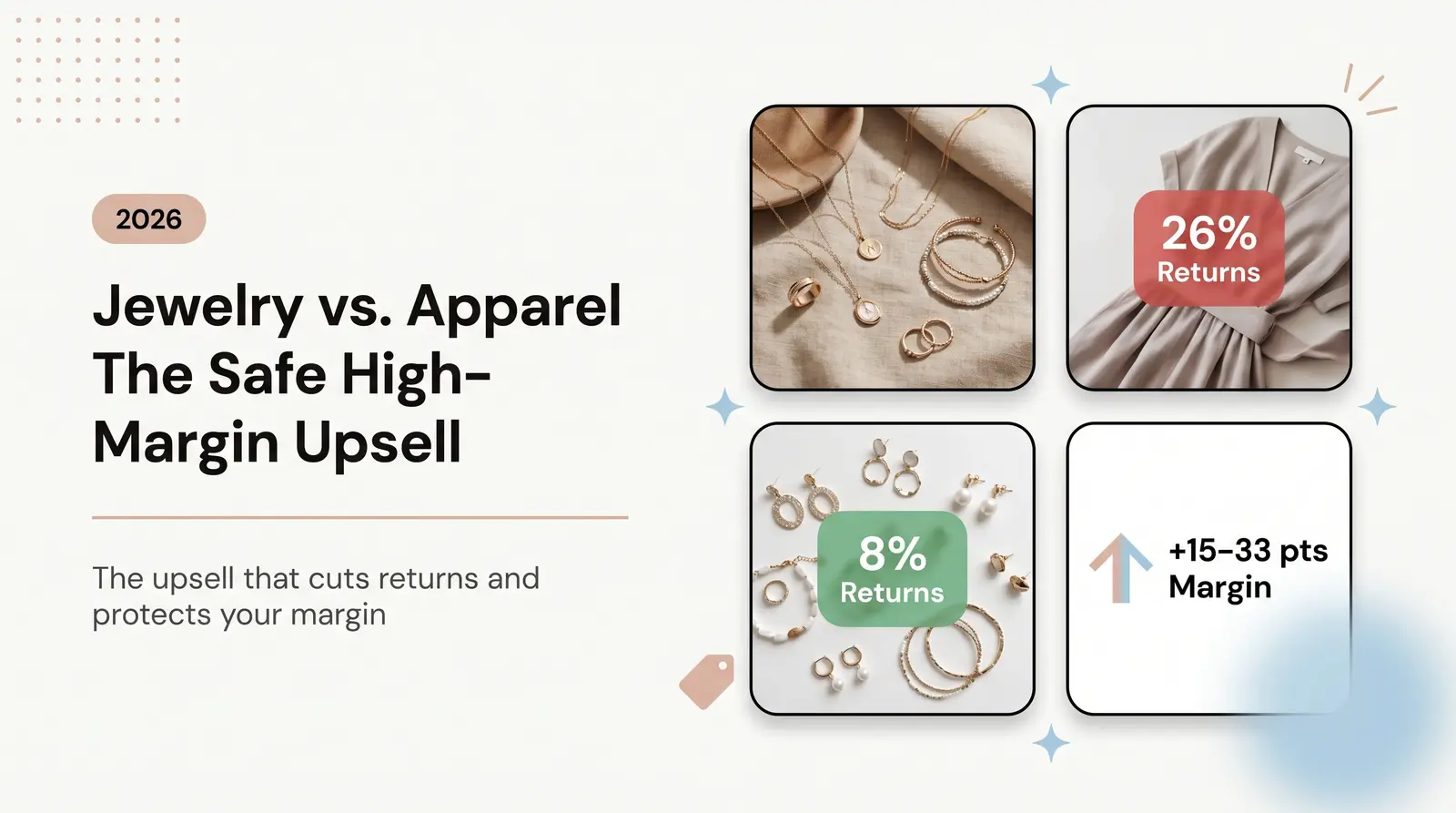
Factor 3: Return Risk is the silent margin killer. The average ecommerce return rate is 20.8% in 2026, but apparel runs 20 to 30% and accessories run around 12% [5]. Each return costs between $10 and $65 to process, and over 30% of returned items cannot be resold as new [5]. A product with a 70% gross margin and a 25% return rate is far less profitable than it appears.
Factor 4: Perceived Value Index measures how much value a customer perceives relative to the product's physical size and cost. Jewelry scores extremely high here: a $65 necklace weighs under an ounce and costs $8 to produce. The price-to-weight ratio is extraordinary. This high perceived value also reduces the trust barrier for cold buyers and improves creative performance on paid social.
Factor 5: Repeat Purchase Potential determines whether your customer acquisition cost is a one-time expense or an investment in a long-term customer. Jewelry has strong repeat purchase potential because of gifting occasions, collection-building behavior, and seasonal demand spikes. Digital products and consumables score even higher here.
Factor 6: Creative Potential matters more than ever in 2026. TikTok CPMs climbed 16% year-over-year to $13.26 in 2025, and high-performing creative loses 40% of its efficiency within 7 to 10 days [6]. Products that are visually compelling, UGC-friendly, and adaptable to new creative angles give sellers a structural advantage in paid social.
Factor 7: Trust Barrier measures how difficult it is to convert a cold buyer. Products with sizing complexity, high perceived risk, or strong brand dependency are harder to sell to new customers. Jewelry has a moderate trust barrier that is easily overcome with strong branding and clear photography.
BVS Scoring Formula: Sum all 7 scores (maximum 35) and map to action tiers:
In our experience at Branvas, founders who evaluate products on gross margin alone are 3x more likely to face a cash-flow squeeze within 90 days of launch. The BVS gives you the full picture before you spend a dollar on inventory or ads.

Let's walk through two product categories side by side using the BVS framework.
Category A: Private-Label Jewelry (e.g., a gold-plated pendant necklace, COGS $4 to $8, retail $35 to $65)
Category B: Decorative Home Decor Item (e.g., a ceramic vase, COGS $12 to $18, retail $45 to $60)
| Factor | Jewelry Score | Home Decor Score | Justification |
|---|---|---|---|
| 1. Gross Margin % | 5 | 4 | Jewelry hits 70%+ gross margin; home decor sits at 45 to 55% [7]. |
| 2. Shipping Economics | 5 | 2 | Jewelry ships in a bubble mailer for under $4. Vases trigger DIM weight surcharges [4]. |
| 3. Return Risk | 5 | 3 | Jewelry returns are low (no fit issues, not fragile). Home decor returns run 15 to 20% due to breakage and size mismatch [5]. |
| 4. Perceived Value Index | 5 | 3 | Jewelry has extraordinary perceived value per gram. A vase is often commoditized and easily price-compared. |
| 5. Repeat Purchase Potential | 4 | 2 | Jewelry drives repeat gifting, collections, and seasonal purchases. Vases are typically one-time purchases. |
| 6. Creative Potential | 5 | 3 | Jewelry performs exceptionally well in UGC and aesthetic video content. Vases are static and difficult to make compelling. |
| 7. Trust Barrier | 4 | 4 | Both require trust, but jewelry branding overcomes it faster. Vases carry fragility risk that increases purchase hesitation. |
| Total BVS | 33 | 21 | Jewelry is top-tier. Home decor is viable but requires careful optimization. |
The key finding is that jewelry wins not primarily on gross margin percentage (though it is high) but on the combination of shipping economics, near-zero return rates, extraordinary perceived value per gram, strong creative potential on video platforms, and the ability to build a brand that earns repeat purchases. Home decor can be a viable category, but only when the seller focuses strictly on lightweight, flat items and accepts a lower contribution margin.

For each category below, the data reflects real COGS and retail benchmarks sourced from industry reports, platform data, and supply chain research. Contribution margin estimates account for typical shipping, returns, and payment processing costs.
BVS Score: 33/35
| Metric | Range |
|---|---|
| Typical COGS | $4 to $15 |
| Typical Retail | $35 to $150 |
| Gross Margin | 70 to 85% |
| Contribution Margin | 40 to 55% |
Jewelry is the standout category in 2026 by every meaningful metric. The gross margin is exceptional, shipping costs are minimal (a pendant necklace ships in a bubble mailer for under $4), and return rates for accessories run around 12%, compared to 20 to 30% for apparel [5]. The perceived value per gram is extraordinary: a $65 necklace weighs under an ounce and costs $8 to produce. That ratio is nearly impossible to find in any other physical product category.
The key risk is competition. Jewelry is a crowded market, and undifferentiated dropshipping of generic pieces leads to price wars. The solution is private-label branding: custom packaging, a brand story, and a curated aesthetic that makes the product feel exclusive. When that branding is in place, the same physical product commands a 40 to 60% higher price point.
This is the category Branvas was purpose-built for. Private-label jewelry brands launched without MOQs, with branding, packaging, and fulfillment handled end-to-end. See how it works at branvas.com/how-it-works.
BVS Score: 31/35
| Metric | Range |
|---|---|
| Typical COGS | $3 to $10 |
| Typical Retail | $25 to $60 |
| Gross Margin | 65 to 80% |
| Contribution Margin | 35 to 45% |
Beauty accessories (gua sha tools, facial rollers, silicone brushes, lash kits) sit just below jewelry in the BVS rankings. The gross margins are exceptional, with publicly traded beauty brands like e.l.f. Beauty posting 71.2% gross margins and the category median sitting at 69.4% [8]. Shipping is lightweight, and return rates for beauty and skincare run just 4 to 10% due to hygiene restrictions [5].
The key risk is customer acquisition cost. Beauty brands on Meta averaged $42 CAC in 2025, and creative fatigue hits the category fast [6]. Sellers who can build a content engine around tutorials, before-and-after content, and influencer partnerships will outperform those relying solely on paid ads.
BVS Score: 28/35
| Metric | Range |
|---|---|
| Typical COGS | $2 to $8 |
| Typical Retail | $20 to $45 |
| Gross Margin | 60 to 80% |
| Contribution Margin | 30 to 40% |
Phone cases, cables, stands, and MagSafe accessories are lightweight, high-margin, and benefit from a constant stream of new buyers as phone models refresh annually. The gross margin on accessories can reach 80% when sourced directly, and shipping costs are minimal.
The key risk is commoditization. Phone accessories are among the most competitive categories on Amazon and Shopify, and the barrier to entry is extremely low. Sellers who differentiate through design, bundling, or a specific lifestyle aesthetic can maintain strong margins, but generic resellers face relentless price pressure.
BVS Score: 27/35
| Metric | Range |
|---|---|
| Typical COGS | $0 |
| Typical Retail | $15 to $200 |
| Gross Margin | 100% |
| Contribution Margin | 40 to 60% |
Digital products (templates, presets, courses, ebooks) have a 100% gross margin because there is no physical product to source or ship. That number is genuinely extraordinary. The catch is that contribution margin drops significantly once customer acquisition costs are factored in. Without an existing audience, the CAC for digital products can be extremely high because buyers need to trust the creator before purchasing an intangible product.
Digital products work best as a complement to a physical product brand or as a revenue stream for creators with an established following. Launching a digital product store from scratch with paid ads is a difficult and expensive path.
BVS Score: 26/35
| Metric | Range |
|---|---|
| Typical COGS | $5 to $15 |
| Typical Retail | $25 to $65 |
| Gross Margin | 60 to 75% |
| Contribution Margin | 25 to 35% |
Resistance bands, massage tools, posture correctors, and acupressure mats benefit from the ongoing consumer trend toward at-home wellness. The gross margins are strong, and the "problem-solving" angle makes for compelling creative content. Products like gua sha sets cost $3 to $6 to source and retail for $22 to $35, representing a 70 to 85% gross margin [9].
The key risks are liability concerns (some products make health claims that require careful compliance) and trend fatigue. The wellness category saw significant search volume spikes in 2025, which means competition is intensifying. Sellers who niche down to a specific wellness persona (e.g., desk workers, new mothers, athletes) will outperform those targeting a broad wellness audience.
BVS Score: 25/35
| Metric | Range |
|---|---|
| Typical COGS | $3 to $12 |
| Typical Retail | $20 to $50 |
| Gross Margin | 50 to 70% |
| Contribution Margin | 20 to 30% |
Pet accessories (bandanas, collars, toys, grooming tools) benefit from one of the most emotionally driven purchase behaviors in ecommerce. Pet owners spend freely on their animals, and the category has the lowest CAC of any DTC vertical at around $23 per customer [6]. The gross margins are solid, and repeat purchase potential is high.
The key risk is shipping cost for bulkier items. Pet beds, crates, and large toys have high dimensional weight that compresses margins significantly. Sellers should focus on lightweight accessories (bandanas, collars, small toys) to maintain healthy contribution margins.
BVS Score: 23/35
| Metric | Range |
|---|---|
| Typical COGS | $8 to $20 |
| Typical Retail | $30 to $75 |
| Gross Margin | 45 to 60% |
| Contribution Margin | 15 to 25% |
Lightweight home decor (wall art, prints, small decorative items) can be a viable category, but only when the seller is disciplined about product selection. The home goods category saw significant margin pressure in 2024 and 2025 as the pandemic-era home improvement boom faded [7]. Return rates for home goods run 15 to 20%, and dimensional weight fees are a constant threat for anything bulkier than a flat print.
The path to profitability in this category is strict: focus on flat, lightweight items that ship in standard mailers, build a strong aesthetic brand that commands premium pricing, and avoid anything fragile or oversized.
BVS Score: 20/35
| Metric | Range |
|---|---|
| Typical COGS | $12 to $20 |
| Typical Retail | $25 to $45 |
| Gross Margin | 20 to 40% |
| Contribution Margin | 5 to 15% |
Print-on-demand apparel is often marketed as a high-margin business model, but the reality is more complicated. The gross margin on a typical POD t-shirt runs 20 to 40% after the print provider's base cost [10]. Apparel return rates run 20 to 30%, and each return costs $10 to $65 to process [5]. After shipping, returns, and payment fees, the contribution margin on a $35 t-shirt can be as low as $3 to $5.
POD apparel works for creators with large existing audiences who can sell without paid advertising. For sellers starting from scratch with paid ads, the math is very difficult to make work. The category scores 20 on the BVS, which puts it in the "proceed with caution" tier.
BVS Score: 22/35
| Metric | Range |
|---|---|
| Typical COGS | $5 to $15 |
| Typical Retail | $25 to $50 |
| Gross Margin | 50 to 65% |
| Contribution Margin | 15 to 25% |
Kitchen gadgets, desk organizers, and niche tools benefit from strong "problem-solving" creative angles and can perform well on TikTok and YouTube. The gross margins are reasonable, and the products are often lightweight enough to keep shipping costs manageable.
The key risk is product lifecycle. Niche tools often have a short window of peak demand before the market saturates. Sellers who can identify emerging tools before they go mainstream and exit before saturation can generate strong returns, but building a long-term brand in this category is difficult.

Understanding your true profitability requires looking past gross margin. Here is the formula every ecommerce seller needs to know:
Contribution Margin =
  Retail Price
  - COGS
  - Shipping Cost (to customer)
  - Payment Processing Fee (~2.9% + $0.30)
  - Returns Cost (avg return rate x avg cost to process)
  - Packaging Cost
Then express it as a percentage:
Contribution Margin % = Contribution Margin / Retail Price x 100
Real Jewelry Example (Private-Label Pendant Necklace):
| Line Item | Amount |
|---|---|
| Retail Price | $48.00 |
| COGS | -$8.00 |
| Shipping Cost | -$4.00 |
| Payment Processing Fee | -$1.69 |
| Returns Cost (3% rate x $20 avg) | -$0.60 |
| Packaging | -$2.00 |
| Contribution Margin | $31.71 (66.1%) |
Bulky Home Decor Example (Ceramic Vase):
| Line Item | Amount |
|---|---|
| Retail Price | $60.00 |
| COGS | -$15.00 |
| Shipping Cost (DIM weight) | -$18.00 |
| Payment Processing Fee | -$2.04 |
| Returns Cost (17% rate x $25 avg) | -$4.25 |
| Packaging | -$4.00 |
| Contribution Margin | $16.71 (27.9%) |
The vase has a 75% gross margin. But after real-world costs, the contribution margin collapses to 27.9%. The necklace has a lower gross margin in absolute dollars but delivers more than double the contribution margin percentage.
| Category | Gross Margin % | Contribution Margin % |
|---|---|---|
| Jewelry | 83.3% | 66.1% |
| Beauty Accessories | 75.0% | 45.0% |
| Home Decor (Bulky) | 75.0% | 27.9% |
| POD Apparel | 40.0% | 12.0% |
Want to run the numbers for your own product idea? Use the Branvas Profit Calculator to model your margin before you commit.

Perceived value is the multiplier that improves every other metric in your business. It raises average order value, lowers CAC because creative performs better, reduces return rates because buyers feel they received a premium product, and enables premium pricing that competitors cannot easily undercut.
The mechanism is well-documented in consumer psychology. Consumers routinely use price and presentation as heuristics to judge quality [3]. When a product arrives in premium packaging, the buyer's perception of its value increases, which reduces buyer's remorse, reduces return rates, and increases the likelihood of repeat purchase and referral. A 2024 PwC survey found that consumers are willing to pay a 9.7% premium for products they perceive as sustainably or premium-produced [2]. That is not a small number. On a $65 necklace, that is $6.30 of additional margin captured purely through presentation.
Jewelry benefits from deeply ingrained cultural associations with value, gifting, and personal identity. Research on consumer behavior in jewelry markets confirms that buyers derive satisfaction not just from the physical product but from the symbolic meaning it carries: occasions, relationships, and self-expression [11]. This symbolic dimension makes jewelry uniquely resistant to commoditization when branded correctly.
We often see founders underestimate packaging as a lever. At Branvas, we've watched the same product command a 40 to 60% higher price point simply because the unboxing experience signals premium quality. That's not markup. That's margin architecture. Custom packaging, a logo, a brand story, and a tissue-wrapped reveal transform a physical product into a high-value experience that justifies a premium price and earns repeat customers.

Not every product with a high gross margin percentage is actually a good business to build. These are the most common margin traps in ecommerce:
High gross margin combined with high shipping weight is the most common trap. A product that costs $10 to source and retails for $50 looks like an 80% gross margin. But if it ships in a large box and triggers dimensional weight fees, the shipping cost alone can be $18 to $25, leaving almost nothing after returns and payment fees.
High return rate categories destroy contribution margin silently. Apparel returns run 20 to 30%, and footwear runs 17 to 30% [5]. A product with a 55% gross margin and a 25% return rate, where each return costs $20 to process, is effectively operating at a much lower real margin than the headline number suggests.
Commoditized products with low trust barriers lead to price wars. When any seller can source the same product from the same supplier and list it on the same platforms, the only competitive lever is price. Margins compress until the category is barely profitable for anyone.
Trend-dependent products have a short creative shelf life. A product that goes viral on TikTok in January can be saturated by March. Sellers who build a business around a single viral product often find themselves with dead inventory and no repeat customers.
| Looks High-Margin | Reality |
|---|---|
| Large ceramic vases | DIM weight shipping costs eat 30%+ of revenue |
| Fast fashion dresses | 30% return rate destroys net profit |
| Generic phone cables | Price wars drive retail price to $8 |
| Viral TikTok gadgets | 3-week shelf life before market saturation |
| Amazon-only products | 15% referral fee + FBA fees compress net margin to 5 to 8% |

Building a profitable ecommerce brand in 2026 requires a disciplined, sequential approach. Here is the framework that works.
Validate the category using the BVS before sourcing anything. Run the numbers on shipping weight, return rates, and perceived value before you spend a dollar on inventory or ads. If the category scores below 21, move on.
Choose a niche and a specific customer avatar. "Jewelry" is not a niche. "Minimalist gold jewelry for women who work in professional environments" is a niche. The more specific your avatar, the more efficient your creative will be and the lower your CAC.
Source or white-label with branding built in, not generic dropshipping. For jewelry and accessories specifically, Branvas's Brand-as-a-Service model lets you skip the sourcing and logistics maze entirely. You bring the brand vision; Branvas handles product, packaging, and blind fulfillment. Explore the catalog or see how it works.
Build perceived value through packaging and brand story. Invest in the unboxing experience before you invest in ads. A $3 branded box and a $0.50 handwritten note card can add $10 to $15 of perceived value to a product.
Test with paid creative on a small budget and measure contribution margin per acquisition, not ROAS. ROAS tells you how much revenue your ads generated. Contribution margin per acquisition tells you whether that revenue was actually profitable. These are very different numbers, and optimizing for the wrong one is a common and expensive mistake.
Scale what works and kill what doesn't within 60 days. Be ruthless. If a product is not hitting contribution margin targets after 60 days of testing, move on. The opportunity cost of staying with a marginal product is enormous.
For more guidance on building a brand from scratch, visit our resources for aspiring entrepreneurs or ecommerce and boutique store owners.
A good gross profit margin for ecommerce typically falls between 60% and 70%, meaning you keep $60 to $70 of every $100 in revenue after subtracting the cost of the product. However, gross margin is only the starting point. The net profit margin, what remains after marketing, shipping, returns, and operational costs, is the true indicator of business health. A healthy net margin for a Shopify DTC brand is generally considered to be between 10% and 20%. Anything below 10% leaves very little room for growth investment or unexpected costs.
Jewelry is genuinely one of the highest-margin product categories in ecommerce, and the economics hold up under scrutiny. Gross margins routinely exceed 70%, shipping costs are minimal (under $4 for most pieces), and return rates for accessories run around 12%, well below the 20 to 30% seen in apparel [5]. The contribution margin on a well-priced private-label necklace can reach 60 to 65%, which is exceptional for a physical product. The key is branding: generic jewelry faces price competition, but branded private-label jewelry commands premium pricing that protects margins.
The best high-margin products for Shopify in 2026 are private-label jewelry, beauty and skincare accessories, and phone accessories. These categories offer strong gross margins, favorable shipping economics, and low return rates that protect contribution margin. Digital products have a 100% gross margin but require an existing audience to be profitable. POD apparel is accessible but difficult to scale profitably due to high return rates and compressed margins.
Gross margin only subtracts the cost of goods sold (COGS) from the retail price. It tells you how much is left after paying for the product itself. Contribution margin subtracts all variable costs, including shipping, payment processing fees, returns costs, and packaging. It tells you how much is actually left after fulfilling and delivering the order. You should always use contribution margin to evaluate true product profitability. Gross margin is a useful starting filter, but making business decisions based on gross margin alone is one of the most common and costly mistakes in ecommerce.
Yes. Print-on-demand and dropshipping models allow you to sell without holding inventory, which eliminates the risk of dead stock and reduces upfront capital requirements. However, generic dropshipping typically compresses margins because you are competing with other sellers carrying the same products. To maintain high margins without inventory, consider private-label services like Branvas, which offer branded fulfillment without MOQs. You get the margin benefits of private-label branding without the capital requirements of traditional inventory ownership.