


Jewelry is the most effective upsell for women’s apparel stores, delivering 50-75% margins and 8.2% AOV lift with minimal operational complexity or returns.
Published:
February 26, 2026
Author:
Yi Cui
Most women's apparel stores chase growth by buying more traffic. But the fastest path to higher revenue is already in the cart. Jewelry is lightweight, emotionally driven, and margin-friendly, making it the simplest way to increase average order value in clothing stores without complicating inventory, sizing, or logistics.
The challenge isn't finding new customers. It's getting more value from the ones already buying. And that's exactly where jewelry earns its place: not as a separate product line, but as a strategic revenue layer that improves AOV, customer satisfaction, and brand cohesion at the same time.
This article covers why jewelry outperforms every other upsell category in women's apparel retail, the psychology behind why it converts, and a step-by-step system for implementing it in your store.
When apparel retailers think about adding accessories, they often consider handbags, shoes, or scarves. All of these can work. But none of them match jewelry's combination of high margins and low operational friction. That distinction matters more than most retailers realize.
At Branvas, we evaluate upsell categories using a framework called the Margin-Friction Matrix. It maps gross margin potential against operational complexity, which includes factors like SKU management, sizing requirements, return rates, and shipping costs.
| Low Operational Friction | High Operational Friction | |
|---|---|---|
| High Margin | Jewelry, Digital Products | Shoes, Handbags |
| Low Margin | Scarves, Hats | Outerwear, Denim |
Jewelry sits in the ideal quadrant: high margin, low friction. Here's how it compares across the most common upsell categories:
| Category | Avg. Gross Margin | Avg. Return Rate | Sizing Issues | Shipping Complexity |
|---|---|---|---|---|
| Jewelry | 50-75% [1] | 8-10% [1] | None | Low |
| Handbags | 40-60% | 15-20% | None | Medium-High |
| Shoes | 40-55% | 31.4% [2] | High | High |
| Scarves/Hats | 30-50% | 12-15% | Low | Low |
The contrarian insight here is this: jewelry is not the highest-margin accessory category in isolation. But it is the only one that requires zero sizing, generates minimal returns, and ships inside existing apparel packaging. That combination makes its effective margin unmatched across any upsell category.
McKinsey's State of Fashion 2026 report confirms the trend: jewelry's unit sales growth is outpacing all other fashion categories, with the report noting that "jewelry's bright moment is set to continue into 2026" as consumers seek self-expression and long-lasting investments [8]. The US jewelry market grew 5.6% in 2025, driven by higher average spending per item [7].
Key Takeaway: The operational simplicity of jewelry is what makes it so powerful. A $30 necklace ships in the same box as a $90 dress. A $45 bracelet set has no size chart, no fit issues, and a return rate of around 8-10%. That's the real competitive advantage.

Jewelry converts well not because it's cheap, but because it's emotionally resonant. Understanding that psychology is what separates stores that see 5% attachment rates from those that see 25%.
A 2026 ASU News report on fashion merchandising put it plainly: consumers are not just buying clothes or earrings. They are buying "emotional meaning, romantic symbolism and participation in a shared cultural ritual" [3]. This is the concept of hedonic consumption: shoppers seeking pleasure, fantasy, and emotional gratification over pure utility.
Jewelry triggers this response in three specific ways.
It completes the look. When a customer buys a dress, the purchase feels unfinished. A necklace or pair of earrings transforms a piece of clothing into a curated outfit. This taps into the shopper's desire for cohesion and reduces decision fatigue by providing a clear, obvious next step.
It fits the "micro-luxury" mindset. In 2025, a clear consumer trend emerged around small, meaningful self-rewards. Shopify's impulse buying research describes this as the "micro-luxury" effect: consumers treating themselves to items like a $25-$60 accessory that delivers an emotional lift without guilt [4]. A $28 pair of earrings is the perfect micro-luxury alongside a $90 apparel purchase.
It is a low-risk, high-reward impulse. A 2024 Provoke Insights study found that 92% of US adults have made an impulse purchase, with 29% doing so at least weekly [4]. Jewelry, with its visual appeal, low price relative to apparel, and zero sizing friction, is purpose-built for impulse conversion.
In our work with boutique retailers at Branvas, we've consistently seen jewelry upsells increase AOV by 18-30%, even with minimal merchandising changes. The shift is less about the product and more about reframing the sale: from "Do you want to buy this?" to "Do you want to complete your outfit?"

The numbers are straightforward. Here is a realistic worked example to show the impact.
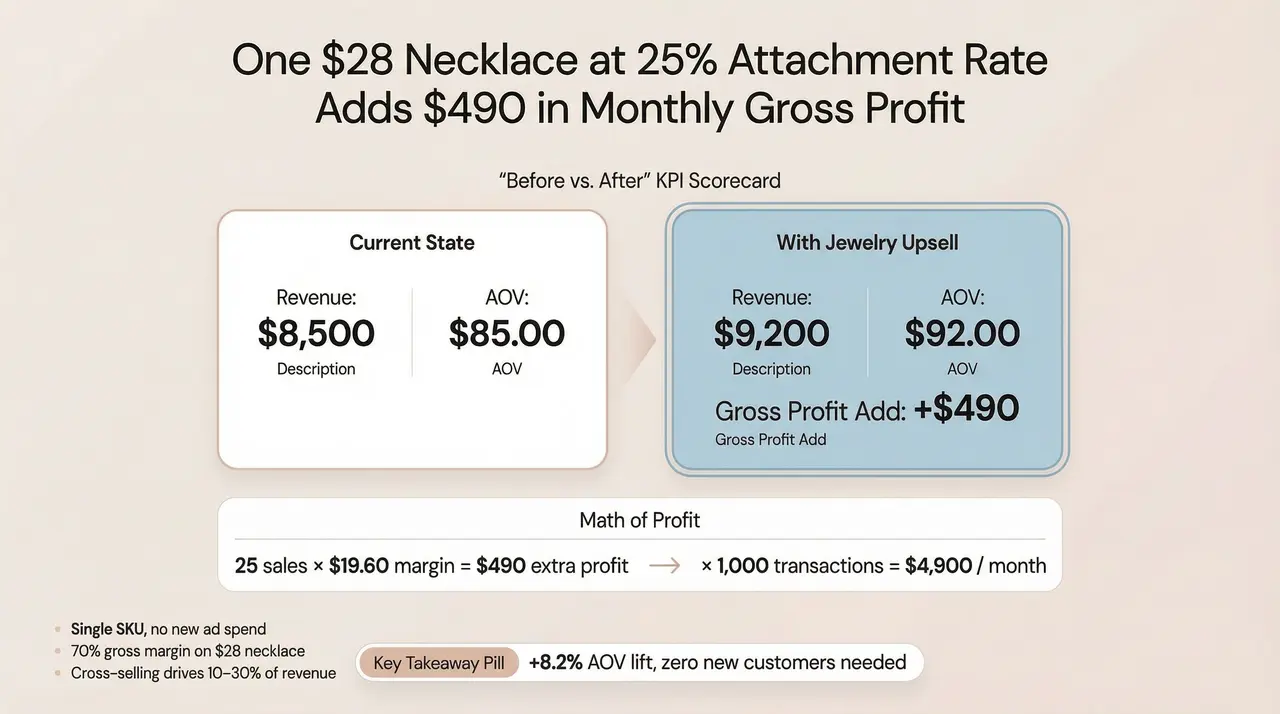
A women's apparel store has a current AOV of $85. The owner introduces a single curated necklace, priced at $28, with a landed cost of $8.40 (70% gross margin). After implementing a "Complete the Look" bundle on the product page and a checkout counter display in-store, the jewelry attachment rate reaches 25%.
| Metric | Before Jewelry | After Jewelry |
|---|---|---|
| Customers (per 100) | 100 | 100 |
| Revenue from Apparel | $8,500 | $8,500 |
| Revenue from Jewelry | $0 | $700 (25 x $28) |
| Total Revenue | $8,500 | $9,200 |
| Average Order Value | $85.00 | $92.00 |
| AOV Lift | +8.2% | |
| Additional Gross Profit | $490 (25 x $19.60) |
That $490 in additional gross profit comes from a single SKU, with no new customers, no new ad spend, and no sizing or logistics overhead. Scaled to 1,000 monthly transactions, this represents $4,900 in incremental gross profit per month from one jewelry piece.
A 2025 Shopify benchmark report found that adding just two well-placed upsells can deliver over $93,000 in extra annual revenue for a typical brand [5]. Cross-selling alone contributes 10-30% of total ecommerce revenues, according to Forrester Research [6].
Key Takeaway: The math is simple. A 25% attachment rate on a $28 jewelry piece adds $7 to your AOV. That's an 8.2% lift on an $85 baseline, with no additional customer acquisition cost.
Effective upselling is about timing and framing. At Branvas, we advise clients to use the 3-Touch Upsell Framework to integrate jewelry at three key moments in the customer journey.
Touch 1: The Product Page Bundle. On the product detail page for any apparel item, display a "Complete the Look" section featuring 1-2 complementary jewelry pieces. Offer a small bundle incentive, such as 10% off the jewelry when purchased together. This captures the customer at their highest-intent moment, when they are actively evaluating the apparel item.
Touch 2: The In-Cart Recommendation. When a customer adds an apparel item to their cart without jewelry, trigger an in-cart upsell prompt. The messaging should feel helpful, not transactional. Something like "Customers who bought this dress also loved these earrings" is far more effective than a generic "You might also like" widget.
Touch 3: The Post-Purchase Offer. Immediately after checkout, present a one-click post-purchase upsell for a matching jewelry piece at a time-limited price. Because the customer has already entered payment information, the friction is near zero. Research cited by Envive shows that one-click checkout experiences increase spending by 28.5% [6].

For brick-and-mortar stores, the same principles apply, but the execution is physical. Visual merchandising is the engine of successful cross-selling jewelry in boutiques.
Placement near the checkout counter is the single highest-impact change a physical boutique can make. Customers waiting in line have high dwell time and are already in a buying mindset. A well-lit, curated jewelry display at the point of sale captures impulse decisions that would otherwise be lost.
Mannequin styling is the second most effective tactic. Do not relegate jewelry to a separate display case. Style your mannequins with complete outfits, including jewelry. This shows customers how the pieces work together and reinforces the outfit completion concept without requiring any verbal selling.
Pricing as accessible luxury is critical for conversion. A price point between $25 and $50 is the sweet spot for an impulse upsell alongside a larger apparel purchase. This range feels affordable relative to the apparel item but is still priced high enough to maintain a healthy margin. According to Branvas pricing guidelines, a target gross margin of 60-70% for a scaling brand is the right benchmark [1].

Jewelry is a powerful tool, but it doesn't sell itself. These are the most common mistakes that prevent retailers from seeing results.
Over-curating with too many SKUs. One founder we advised was hesitant to introduce jewelry because of perceived inventory complexity. After running a 30-day test with just five curated pieces, she saw a 22% lift in average order value with zero sizing or return issues. A large, unfocused jewelry assortment creates decision fatigue for customers and inventory headaches for the retailer. Start with 3-5 hero pieces and expand only when data supports it.
Under-pricing jewelry. Treating jewelry as a loss leader is a mistake. It is a high-margin category and should be priced accordingly. Aim for a 2.5x-3x markup over landed cost as a baseline. Pricing it too low signals low quality and undermines the perceived value of both the jewelry and your apparel brand.
Poor placement. Hiding jewelry in a separate, low-traffic section of your store or website is the fastest way to ensure it doesn't sell. Jewelry must be integrated with your apparel at key decision points: on product pages, in the cart, and at the checkout counter.
No storytelling. Jewelry is an emotional purchase. A necklace described as "gold-plated chain" is a commodity. The same necklace described as "handcrafted and ethically sourced, designed to layer with your everyday look" is a brand statement. The story adds perceived value and creates a connection that drives conversion.

Here is a practical five-step framework for getting started.
Step 1: Select 3-5 hero pieces. Choose a small, curated collection of necklaces, earrings, and bracelets that align with your brand aesthetic. Focus on timeless, versatile designs that work across multiple apparel categories in your store.
Step 2: Price for profitability. Calculate your landed cost (product cost plus inbound shipping, packaging, and duties) and apply a 2.5x-3x markup. This should deliver a gross margin of 60-70% [1]. Do not price based on what competitors charge. Price based on your costs and your brand's perceived value.
Step 3: Implement the 3-Touch Framework. Set up product page bundles, in-cart upsell prompts, and post-purchase offers on your e-commerce store. For physical boutiques, place jewelry at the checkout counter and style it on mannequins throughout the floor.
Step 4: Train your staff on outfit completion language. Replace "Is there anything else?" with "This necklace was designed to go perfectly with that top." The language shift is small, but the conversion impact is significant.
Step 5: Track attachment rate and AOV lift weekly. Monitor how many customers add jewelry to their order (attachment rate) and the resulting impact on your AOV. Test different pieces, price points, and placements. Let the data guide your next expansion.
Recommended Tools:
For Shopify stores, apps like ReConvert and Bold Upsell make it straightforward to implement in-cart and post-purchase upsell flows. For physical boutiques, a dedicated countertop display stand and consistent staff training are the two most important investments.
If you're looking to refine your merchandising strategy or explore how jewelry upsells fit into your broader brand positioning, Branvas works with fashion retailers to optimize revenue layers without adding complexity. Explore Branvas Services

What is the average margin on jewelry for apparel stores?
A good gross margin for jewelry in a retail setting is between 50% and 75%. New brands should target 50-60%, while scaling brands should aim for 60-70%, and established brands with strong equity can command 65-75% or higher [1]. This is significantly higher than the typical 40-55% gross margin on apparel, which is why jewelry is such a powerful tool for improving overall store profitability.
How do I choose jewelry that matches my clothing brand aesthetic?
Focus on coherence over variety. If your brand is minimalist and modern, choose simple geometric pieces in gold or silver. If you sell bohemian-style clothing, opt for natural stones and layered, delicate chains. The jewelry should feel like a natural extension of your existing apparel line. A useful test: if you styled a mannequin with your apparel and the jewelry, would it look like it was planned that way? If yes, the pairing works.
Does adding jewelry increase return rates?
No. Jewelry has one of the lowest return rates in ecommerce, averaging around 8-10% [1]. This compares favorably to women's fashion, which has a return rate of 27.8% [2]. By increasing the proportion of jewelry in your average order, you are actually lowering your store's blended return rate, which reduces operational costs and improves net margins.
What's the best way to display jewelry in a boutique?
Use two placements simultaneously. First, create a dedicated, well-lit display at the checkout counter to capture impulse buys from customers who are already committed to a purchase. Second, integrate jewelry into your apparel displays by styling it on mannequins. This shows customers how to wear the pieces and makes the upsell feel like a styling suggestion rather than a sales pitch.
How much should I price jewelry to maximize upsells?
Price your upsell jewelry at 20-40% of your average order value. For a store with an $85 AOV, jewelry priced between $17 and $34 sits in the ideal range for a frictionless add-to-cart decision. Below $17, the margin impact is too small to be meaningful. Above $40, the purchase requires more deliberation and conversion rates drop. The goal is to make the decision feel easy, not significant.
For women's apparel stores, the path to higher revenue does not require more ad spend or a larger product catalog. It requires a smarter cart. Jewelry is the most efficient and profitable tool for the job. Its combination of high margins, low operational complexity, and strong emotional appeal makes it the easiest and most effective upsell category available to fashion retailers today.
The US jewelry market grew 5.6% in 2025 [7], and McKinsey projects that jewelry's growth will continue to outpace all other fashion categories in 2026 [8]. The market is moving in this direction. The retailers who act now, with a focused strategy and the right execution, will capture the most value.
Ready to implement jewelry upsells strategically? Explore how Branvas can help you identify high-margin opportunities tailored to your brand.
[1] Branvas, February 4, 2026, "How to Price Jewelry for Profit: Simple Formula for Beginners", Branvas Blog.
[2] Trisha Mae, July 13, 2025, "Ecommerce Return Rates 2025: Complete Industry Analysis + Benchmarks by Category", Rocket Returns Blog.
[3] Meenah Rincon, February 3, 2026, "Selling romance: How fashion merchandising shapes the way we shop", ASU News.
[4] Shopify Staff, December 17, 2025, "Spontaneous Shopping: The Psychology of Impulse Buys and How To Inspire Them (2025)", Shopify Blog.
[5] Shopify Staff, August 6, 2025, "Upselling: 7 Proven Strategies to Boost AOV in 2026", Shopify Blog.
[6] Envive.ai, September 9, 2025, "39 Average Order Value (AOV) Boost Statistics: The Data-Driven Playbook for Ecommerce Growth in 2026", Envive Insights.
[7] Edahn Golan, January 9, 2026, "The US Jewelry Market in 2025: Shining with 5.6% Sales Growth", Tenoris Industry Insights.
[8] Anita Balchandani, Felix Rolkens, Gemma D'Auria, November 17, 2025, "The State of Fashion 2026: When the rules change", McKinsey and Company.
[9] Sherry Smith, January 13, 2026, "2025 Was a 'Price Up, Units Down' Year, Here's What That Signals for 2026", National Jeweler.
[10] JCK Online, January 9, 2026, "Mom-and-Pop Jewelers Enjoyed a (Mostly) Strong 2025", JCK Online.