



This guide delivers a 7-part jewelry business plan template with profit models, marketing frameworks, and operational strategies to launch and scale your brand.
Published:
March 31, 2026
Author:
Yi Cui
"Don't guess your growth; blueprint it."
Don't guess your growth; blueprint it.
This simple rule separates the jewelry brands that scale rapidly from the ones that stall out in their first year.
Whether you are an influencer launching a dedicated merch line, an established ecommerce seller adding high-margin accessories to your store, or an aspiring founder looking to start jewelry brand operations from scratch, you need a concrete roadmap.
This guide delivers exactly that.
We are giving you a complete, step-by-step jewelry business plan template designed specifically for the realities of the 2026 market.
Inside, you will find actionable frameworks, realistic financial benchmarks, and a concrete jewelry profit model that you can implement immediately.
Most jewelry business plans fail before the brand even launches.
Founders routinely spend months perfecting their product designs, agonizing over clasp types and metal finishes, but completely ignore their customer acquisition strategy.
They over-plan the product and under-plan the customer.
This guide flips that script entirely.
We will show you how to build a business that actually makes money selling jewelry, focusing on the operational and financial levers that drive real growth.
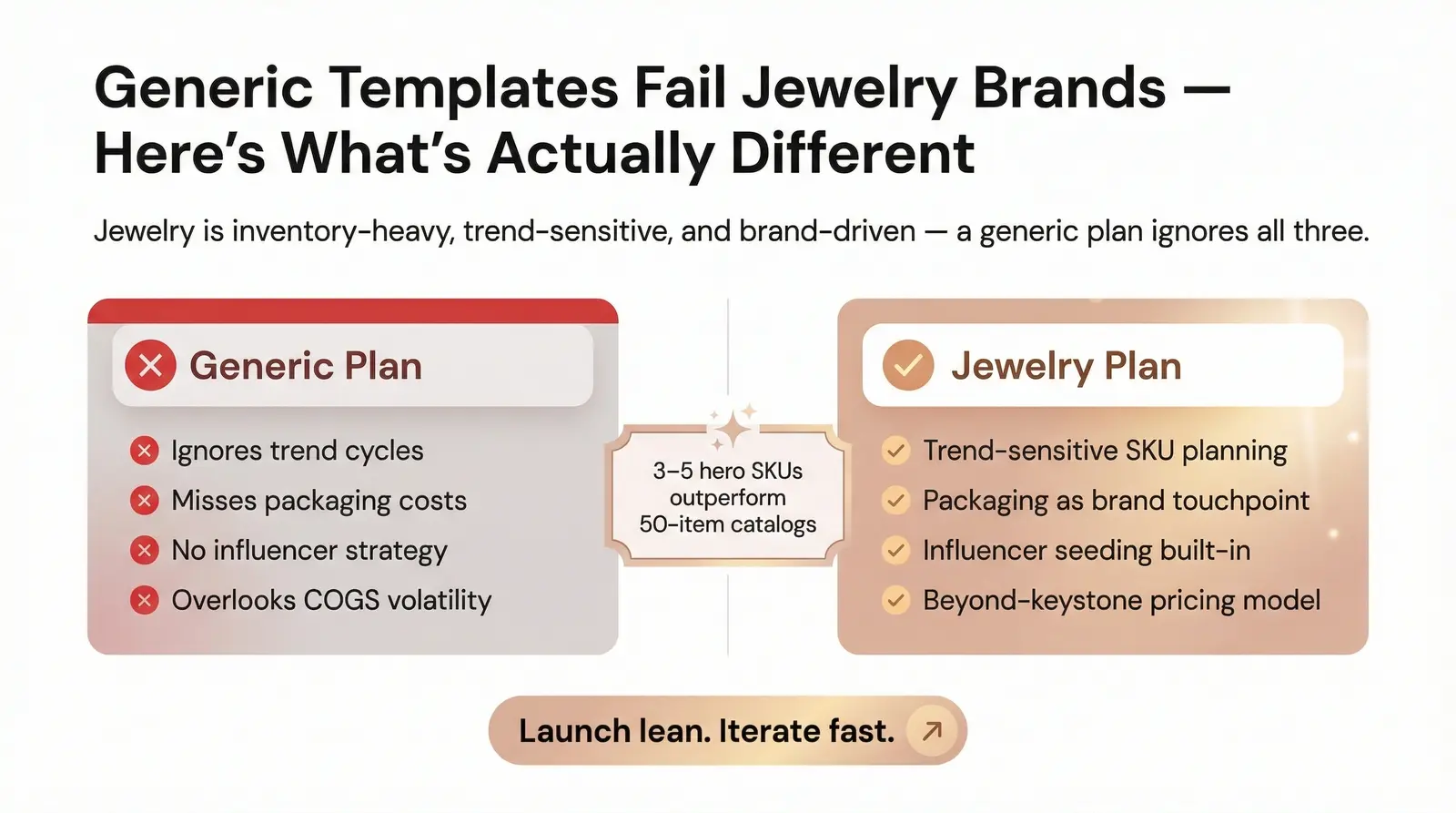
You cannot download a generic business school template, swap out the word "software" for "necklaces," and expect it to work for a jewelry startup.
The jewelry industry operates on entirely different mechanics than almost any other retail sector.
It is incredibly inventory-heavy, highly trend-sensitive, and heavily driven by brand identity rather than pure utility.
Your margins will fluctuate wildly based on raw material costs, packaging choices, and shipping fees.
A standard business plan will not account for the nuances of private label jewelry manufacturing or the logistics of blind fulfillment.
It will not help you navigate the complexities of product sourcing, quality control, or influencer seeding campaigns.
Here is a contrarian insight that surprises most new founders when they first enter the market.
Jewelry brands that launch with fewer SKUs consistently outperform those with broad, expansive catalogs [1].
Data shows that a focused launch of three to five hero products converts significantly better than a store cluttered with fifty random items.
A tight product line is easier to photograph, simpler to market, and requires far less upfront capital to get off the ground.
In our experience at Branvas, the founders who scale fastest are the ones who launch lean and iterate based on real customer data.
They do not try to be everything to everyone.
They focus on a specific aesthetic, define a narrow target audience, and dominate that niche before expanding their offerings.
To build a sustainable brand in today's competitive landscape, you need a framework built specifically for this industry.
Enter The Branvas Blueprint™.
This is our proprietary 7-part jewelry business plan framework, developed after analyzing hundreds of successful brand launches.
It strips away the corporate fluff and focuses entirely on what drives revenue, operational efficiency, and long-term brand equity.
Your executive summary is the heartbeat of your jewelry business plan template.
It must clearly define your brand vision, your core mission, and your one-line brand promise.
Do not write a novel here; investors and partners want clarity, not verbosity.
Keep it punchy and focused on the exact value you bring to the market.
If you cannot explain why your brand exists in one sentence, you are not ready to launch.
Define exactly what makes your jewelry different from the thousands of other options available to consumers right now.
Are you offering sustainable materials, unique personalization, or an unmatched unboxing experience?
State it clearly and confidently right at the beginning.
You must know exactly who is buying your jewelry before you spend a single dollar on inventory.
Define your niche with absolute precision.
Build an Ideal Customer Profile (ICP) that goes far beyond basic demographics like age and location.
Understand their buying habits, their aesthetic preferences, their disposable income, and the specific social media platforms they use daily.
Analyze your competitive landscape to find glaring gaps in the market that you can exploit.
If your competitors are ignoring TikTok and focusing only on legacy Instagram strategies, that is your opportunity to capture market share quickly.
Look at what established brands are doing poorly, whether it is slow shipping, terrible customer service, or boring packaging, and make that your competitive advantage.
Your product line must tell a cohesive, compelling story.
Document your SKU selection rationale and explain exactly why each piece belongs in your initial collection.
Define your brand identity comprehensively, including your color palette, typography, visual tone, and the specific emotions you want your brand to evoke.
Your packaging philosophy is just as important as the jewelry itself.
Unboxing is a critical touchpoint that drives repeat purchases, builds brand loyalty, and encourages organic social sharing.
Make sure your brand strategy reflects a premium experience from the moment they see an ad to the moment they open the box.
Every detail, from the custom tissue paper to the thank-you card, must align with your core brand identity.
A great product will not sell itself, no matter how beautiful the design is.
Your jewelry marketing plan must outline your exact channel strategy for acquiring customers profitably.
Decide how you will leverage organic social media, paid advertising, influencer partnerships, email marketing, and SEO for your product pages.
Establish clear content pillars to guide your daily posting schedule and ensure your messaging remains consistent.
Map out a detailed launch sequence that builds massive anticipation before your store even opens its virtual doors.
Consistency, visual appeal, and authentic storytelling are your strongest assets here.
You must plan how you will capture email addresses early and nurture those leads until they are ready to buy.
Operations will make or break your jewelry startup faster than any marketing campaign.
You must decide between self-sourcing your inventory, which requires significant capital and storage space, or using a private-label Brand-as-a-Service model.
Outline your inventory strategy to avoid tying up all your cash in unsold stock that gathers dust.
Detail your supplier vetting process to ensure consistent quality, ethical sourcing, and reliable shipping times.
If you are using blind shipping, document exactly how that workflow integrates with your ecommerce platform to ensure a seamless customer experience.
Smooth operations lead to happy customers, positive reviews, and a lower return rate.
You must have a plan for handling returns, exchanges, and customer service inquiries efficiently.
You must understand your numbers inside and out if you want to survive your first year.
Define your pricing formula clearly, factoring in product costs, packaging, shipping, platform fees, and marketing expenses.
Set strict gross margin targets to ensure you actually make money on every single sale.
Run a detailed break-even analysis so you know exactly how many units you need to sell each month just to keep the lights on.
Build a realistic 12-month revenue model based on industry benchmarks, accounting for seasonal dips and holiday spikes.
Hope is not a financial strategy; you need hard data and conservative estimates.
Plan for unexpected costs, because they will inevitably arise as you scale your operations.
You need a systematic way to measure your progress and hold yourself accountable.
Set clear, achievable 90-day, 6-month, and 12-month targets for your brand's growth.
Identify the key metrics you will track weekly, such as Customer Acquisition Cost (CAC), Average Order Value (AOV), and Customer Lifetime Value (LTV).
Create a simple but effective dashboard to monitor your website conversion rate and your repeat customer rate.
Tracking these KPIs allows you to pivot quickly when a marketing campaign is failing or a product is not resonating with your audience.
What gets measured gets managed, and what gets managed grows.
Do not wait until the end of the quarter to realize you are losing money on ad spend.

A SWOT analysis is not just a corporate exercise designed to fill space in a business plan.
It is a vital, strategic tool for navigating the specific, unique challenges of the jewelry industry.
Trend cycles move incredibly fast, often driven by viral TikTok videos or celebrity endorsements.
Competitive saturation is exceptionally high, with new brands launching every single day.
Identity differentiation is your only true moat against competitors who can easily copy your designs.
A proper SWOT analysis helps you anticipate threats before they derail your business and identify opportunities before your competitors do.
Below is a filled-in worked example for a hypothetical brand called "Lumi & Co."
Lumi & Co. is a minimalist gold-plated jewelry brand specifically targeting Gen Z women who value sustainable packaging and affordable luxury.
Table 1: SWOT Analysis for Lumi & Co.
| Strengths | Weaknesses |
|---|---|
| Low COGS via private-label sourcing. Strong visual brand identity tailored to Gen Z. No minimum order quantities required. Trend-aligned minimalist aesthetic. |
Zero brand awareness at launch. Gold-plated items perceived as lower quality than solid gold. Limited initial marketing budget. Highly competitive product niche. |
| Opportunities | Threats |
| Gen Z jewelry market is growing rapidly. High organic reach potential on TikTok. Strong gifting occasions year-round. Rising demand for personalized accessories. |
Gold price volatility affecting base costs. Fast fashion giants copying designs quickly. Shortening trend cycles. Rising digital advertising costs. |
Do not just fill out this table, pat yourself on the back, and forget about it.
Use the output to actively inform your daily business decisions and long-term strategy.
Leverage your strengths to maximize your opportunities aggressively.
For example, Lumi & Co. should use their strong visual identity to dominate TikTok organic reach, creating viral unboxing videos that appeal directly to Gen Z.
Simultaneously, build robust strategies to protect against your identified threats.
They should lock in supplier pricing contracts to mitigate gold price volatility and focus heavily on brand storytelling so that when fast fashion giants inevitably copy their designs, their loyal customers will still prefer the authentic Lumi & Co. experience.

Your jewelry profit model is the absolute engine of your business.
If your margins are wrong from day one, you will simply scale yourself into bankruptcy.
The industry average gross margin for jewelry generally falls between 42% and 47%, but lean, private label brands can often achieve 65% to 75% [2].
You must price your products using a strict, mathematical formula, not just guessing what people might pay.
The standard keystone markup is simply doubling your Cost of Goods Sold (COGS).
However, successful branded jewelry uses a beyond-keystone logic to ensure profitability.
This means marking up the product three to five times the COGS to account for marketing, premium packaging, shipping, and the perceived brand value you are building.
If your landed cost (the cost of the product plus shipping to your facility) is $10, your retail price should be between $35 and $50.
Here is a realistic look at how your numbers should scale as your business grows.
Table 2: Jewelry Profit Model Scenarios
| Metric | Starter (Months 1-3) | Growth (Months 4-8) | Scale (Months 9-12+) |
|---|---|---|---|
| Monthly Revenue | $2,500 | $10,000 | $30,000 |
| COGS (35%) | $875 | $3,500 | $10,500 |
| Gross Profit | $1,625 | $6,500 | $19,500 |
| Gross Margin % | 65% | 65% | 65% |
| Marketing Spend | $800 | $2,500 | $6,000 |
| Fixed Costs | $1,000 | $1,500 | $2,500 |
| Net Profit | -$175 | $2,500 | $11,000 |
You must also deeply understand your break-even point before you launch.
Let us look at a specific worked example to make this concrete.
Assume your fixed monthly costs for your ecommerce platform (like Shopify), essential apps, email marketing software, and basic overhead total $1,500.
Your average gross margin across your product line is 65%.
To find your break-even revenue, divide your fixed costs by your gross margin percentage ($1,500 / 0.65).
Your break-even revenue is $2,307 per month.
This means you must sell $2,307 worth of jewelry every single month just to cover your baseline expenses.
Every dollar you make above $2,307 starts contributing to your actual net profit.
We built our Profit Calculator because we kept seeing founders price their jewelry based on gut feel instead of hard math.
Use it to model these exact numbers for your specific product mix and ensure your business is viable before you invest heavily.

A brilliant product line is completely useless if nobody knows it exists.
Your jewelry marketing plan must be aggressive, consistent, and highly visual.
Instagram and TikTok are your primary top-of-funnel channels for acquiring new customers.
You need a visual strategy that stops users from scrolling and forces them to pay attention to your pieces.
Influencer seeding is absolutely critical for building early social proof and trust.
Send your best pieces to micro-influencers (creators with 10k to 50k highly engaged followers) who align perfectly with your brand aesthetic.
Do not ignore your backend marketing; it is where the real profit is made.
Email flows drive a massive percentage of revenue for successful jewelry brands, often accounting for 30% to 50% of total sales [3].
You must have a welcome series, an abandoned cart flow, and a post-purchase nurture sequence active on day one.
To keep your social media consistent and engaging, use a structured content pillar framework.
We recommend these four pillars for jewelry brands to ensure a balanced feed.
First is Aspiration.
Post lifestyle imagery and mood boards that show the exact lifestyle your customer wants to live while wearing your pieces.
Second is Education.
Teach your audience how to layer necklaces properly, how to care for gold-plated items, or how to style statement earrings for different occasions.
Third is Social Proof.
Share user-generated customer photos, glowing reviews, unboxing videos, and influencer tags to build immediate trust.
Fourth is Behind-the-Brand.
Show your packaging process, share the founder's story, and document the highs and lows of building the business to create a deep emotional connection.
Your launch sequence dictates your early momentum and sets the tone for your first quarter.
In the 30 days before launch, focus entirely on building an email list, teasing the product designs, and securing commitments from influencer partners.
During launch week, post daily across all platforms, activate your influencer partners simultaneously to create a sense of ubiquity, and run a compelling welcome offer to drive immediate conversions.
In the 30 days after launch, analyze your data ruthlessly, double down on your best-selling SKUs, and optimize your ad spend based on what is actually working.
For a deeper dive into marketing specifically as a creator-brand, see Branvas Academy at branvas.com/academy.

When you start jewelry brand development from scratch, the process is incredibly complex and time-consuming.
Sourcing reliable suppliers, managing physical inventory, dealing with quality control issues, and handling daily shipments will drain your energy and distract you from growing the business.
This is exactly where Branvas changes the game for modern founders.
We replace 80% of your operational plan so you can focus entirely on marketing, content creation, and community building.
Branvas handles premium private-label product sourcing for you, ensuring you get high-quality pieces without the headache of negotiating with overseas factories.
We provide custom branding and packaging that makes your products look like a million bucks, elevating the perceived value of every order.
We manage the entire fulfillment process with blind shipping directly to your customers, meaning they never know Branvas was involved.
Crucially, there are no minimum order quantities to worry about, allowing you to test new designs without massive upfront inventory risk.
This platform is built specifically for modern brand builders who want to move fast and stay lean.
It is perfect for influencers and creators who want to monetize their audience with high-margin physical products rather than relying solely on brand deals.
It is designed for ecommerce and boutique owners looking to expand their catalogs and increase their Average Order Value without taking on additional inventory risk.
It is the ultimate tool for aspiring entrepreneurs launching their very first brand, providing the infrastructure of a massive company on day one.
We often see new sellers drastically underestimate the sheer volume of operational work required to ship physical products consistently.
Let us handle the logistics, the sourcing, and the shipping while you handle the growth, the marketing, and the vision.
Ready to skip the operational maze and launch your brand the smart way?
See exactly how Branvas works at branvas.com/how-it-works and build your brand in days, not months.

What should a jewelry business plan include?
A comprehensive jewelry business plan template must include an executive summary, detailed market analysis, and a clear brand strategy. It should thoroughly detail your product line, outline a specific jewelry marketing plan tailored to visual platforms, and define your operations and fulfillment model. Crucially, it must feature a realistic jewelry profit model with 12-month financial projections and a KPI dashboard to track growth and profitability.
How do I write a jewelry marketing plan?
Start by defining your ideal customer profile and choosing highly visual platforms like Instagram, TikTok, and Pinterest. Build a robust content strategy around four core pillars: aspiration, education, social proof, and behind-the-brand stories. Implement automated email flows for abandoned carts and a welcome series to capture lost revenue. Finally, map out a strict 30-day pre-launch hype campaign and a post-launch optimization sequence.
What is a realistic profit margin for a jewelry business?
The industry average gross margin typically ranges from 42% to 47%. However, lean private-label and direct-to-consumer jewelry brands should aggressively target gross margins between 65% and 75%. To achieve this, use a beyond-keystone pricing strategy, marking up your landed product costs by three to five times to adequately cover marketing, premium packaging, and operational expenses while remaining profitable.
How much does it cost to start a jewelry brand?
Traditional brick-and-mortar jewelry stores can cost between $5,000 and $25,000 to launch due to heavy inventory requirements, display cases, and equipment needs. However, starting a lean, online-only jewelry brand using a private-label or Brand-as-a-Service model can cost as little as $3,000 to $10,000. This streamlined budget primarily covers custom branding, website setup, sample ordering, and initial marketing campaigns.
Can I start a jewelry brand without making the products myself?
Yes, absolutely. You can use a private-label or Brand-as-a-Service platform like Branvas to handle all product sourcing and manufacturing. This allows you to sell high-quality, custom-branded jewelry without needing technical metalsmithing skills or expensive production equipment. You focus entirely on marketing, brand identity, and customer acquisition while the platform handles the complex logistics and fulfillment.