


Back to Blog

Is Dropshipping Still Profitable in 2026? (The Honest Truth)

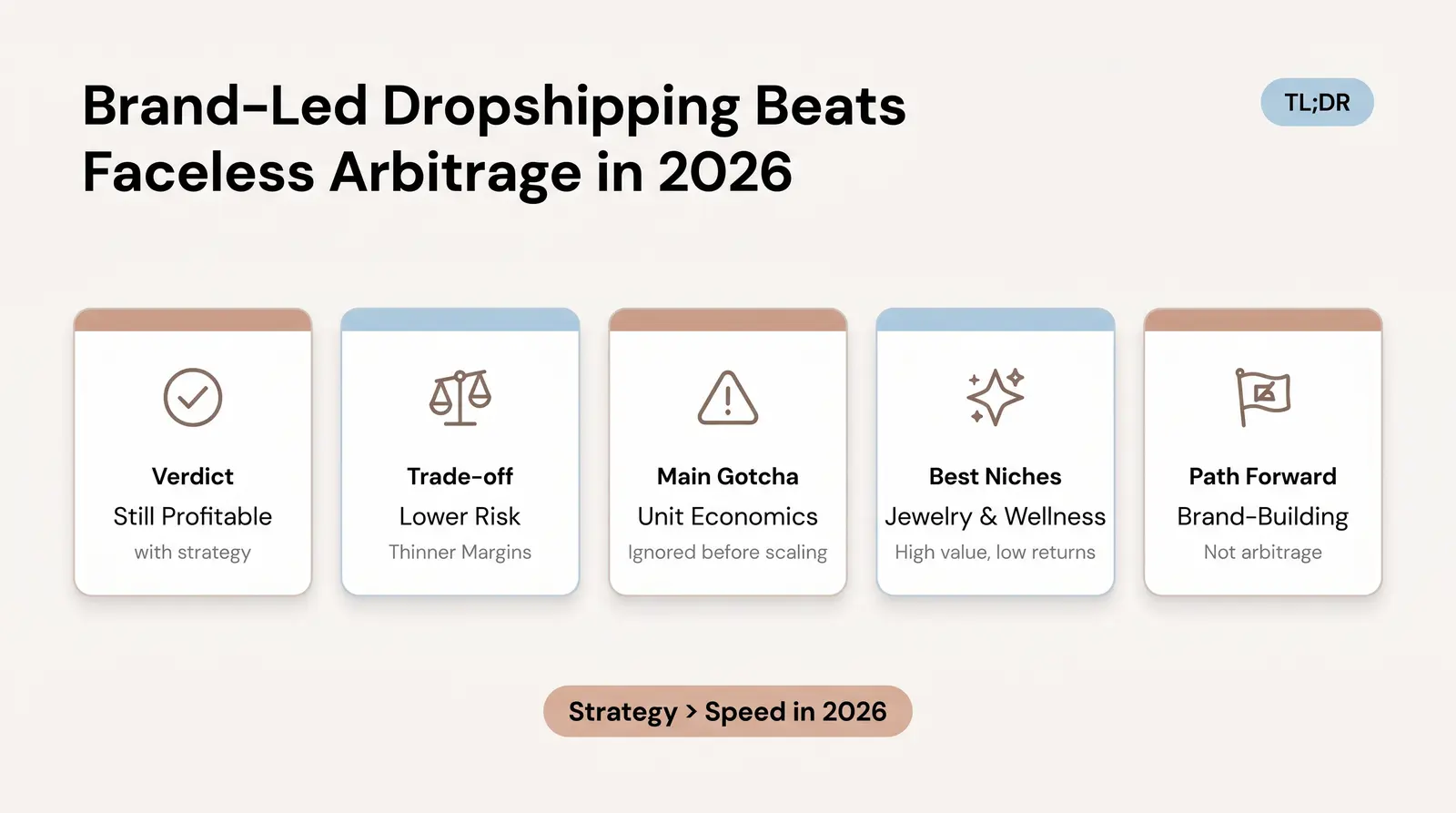
The era of "easy" dropshipping is over, but the model isn't dead. Our 2026 analysis reveals the data, failure rates, and the brand-first strategy required to be profitable today.

Updated:

February 4, 2026

Author:

Yi Cui

How Branvas works

1

Select products

Browse our catalog and choose the products that align with your brand vision.

2

Uplaod logo

Upload your labels, logos, and packaging designs to make the products truly yours.

3

Make sales

List products on your store and set your profit margins, we take care of fulfillment.

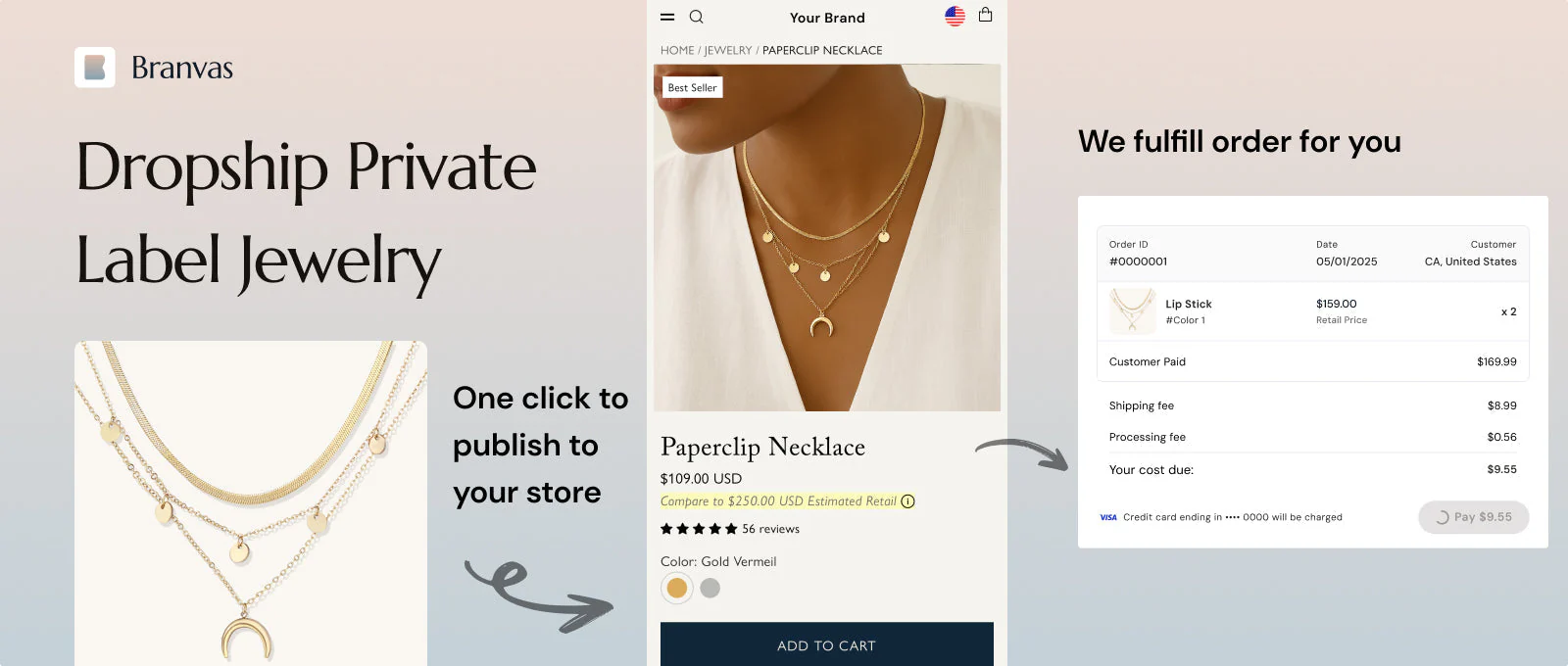
Join Branvas to explore our private label jewelry.

Table of Contents

Introduction: Why Everyone Thinks Dropshipping Is Dead

If you've spent any time researching online business models lately, you've probably encountered a barrage of headlines declaring dropshipping "dead," "oversaturated," or "a waste of time." YouTube videos promise to reveal "the truth" about why dropshipping doesn't work anymore. Reddit threads overflow with stories of failed stores and wasted ad budgets. The skepticism is real, and frankly, it's justified.

The era of copying a product from AliExpress, slapping it on a generic Shopify store, and watching the money roll in is definitively over. That version of dropshipping—the one that relied on information asymmetry, tolerance for poor customer experience, and a less sophisticated consumer—has indeed died. And good riddance.

death of dropshipping

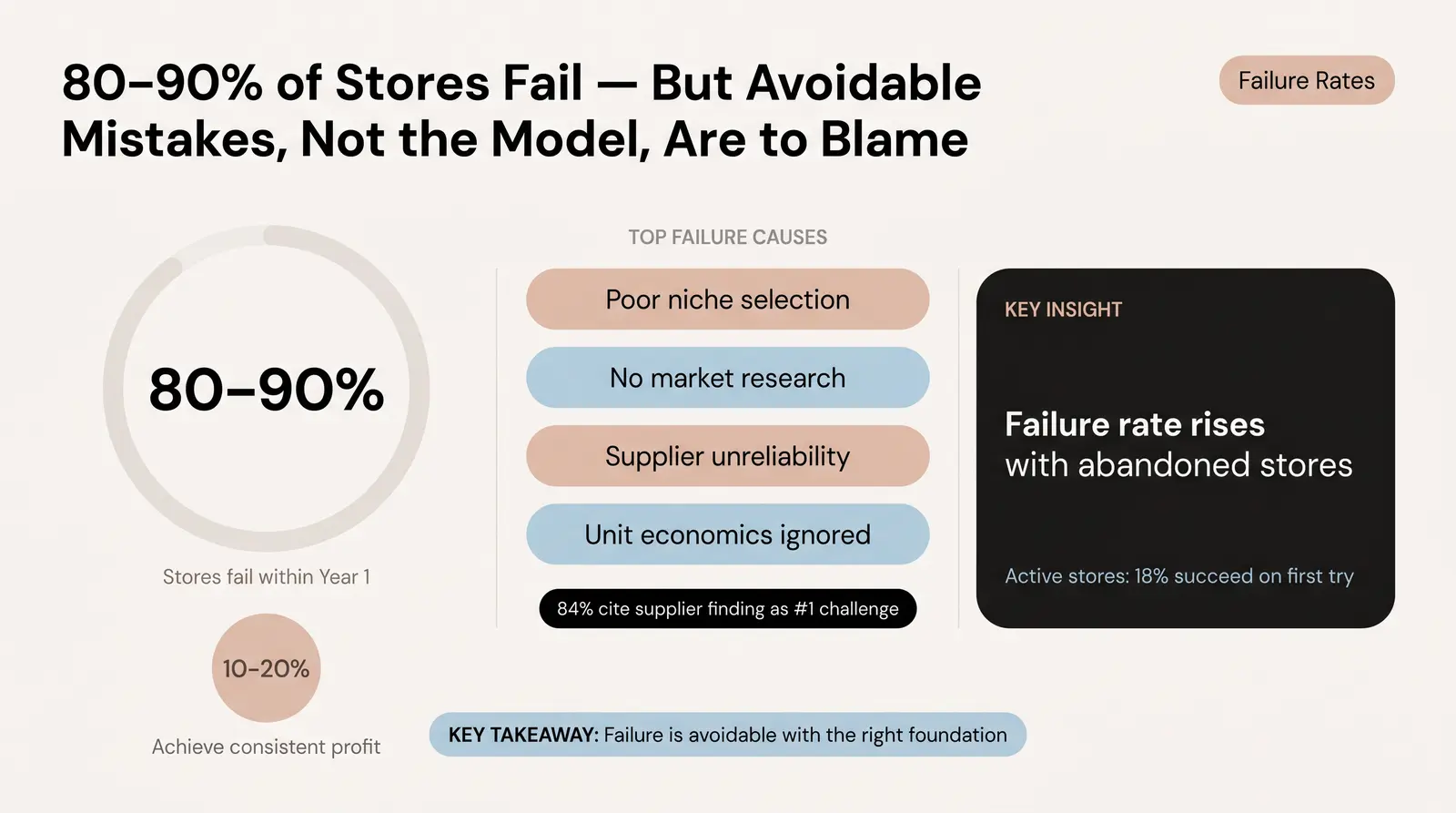
But here's what the doom-and-gloom narratives miss: the dropshipping business model itself hasn't failed. The bar has simply risen. The question isn't whether dropshipping is profitable in 2026—it's whether you're willing to meet the new standards that separate winners from the 90% who fail within their first few months [1]. In this article, we'll examine the real data, explain why old-school dropshipping stopped working, and reveal what's actually thriving in its place. This isn't hype. This isn't doom. This is reality, strategy, and brand economics.

Is Dropshipping Profitable in 2026? (Short Answer vs Real Answer)

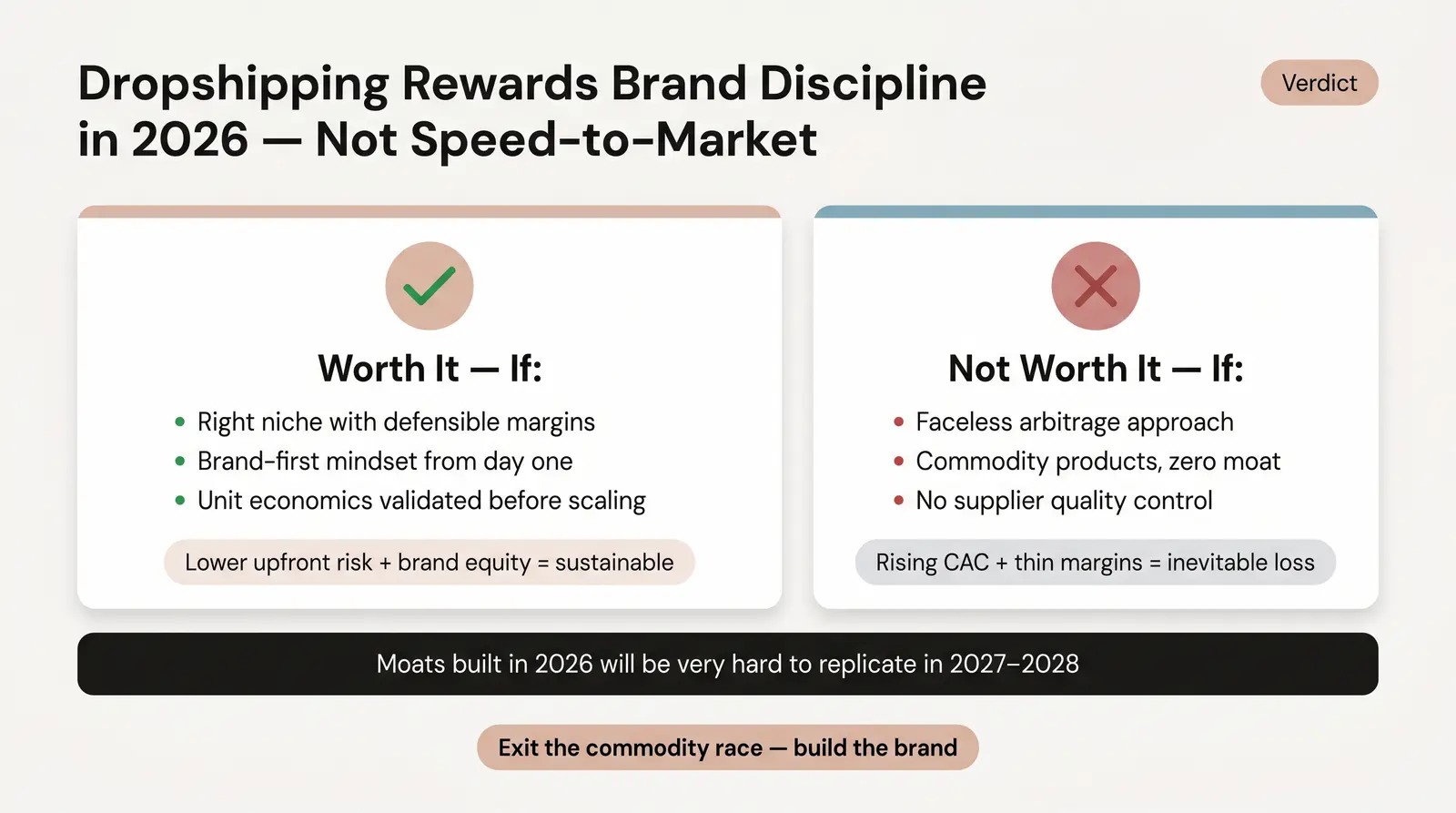
Short answer: Yes, dropshipping is still profitable in 2026—but only if you approach it as a real brand, not a get-rich-quick scheme.

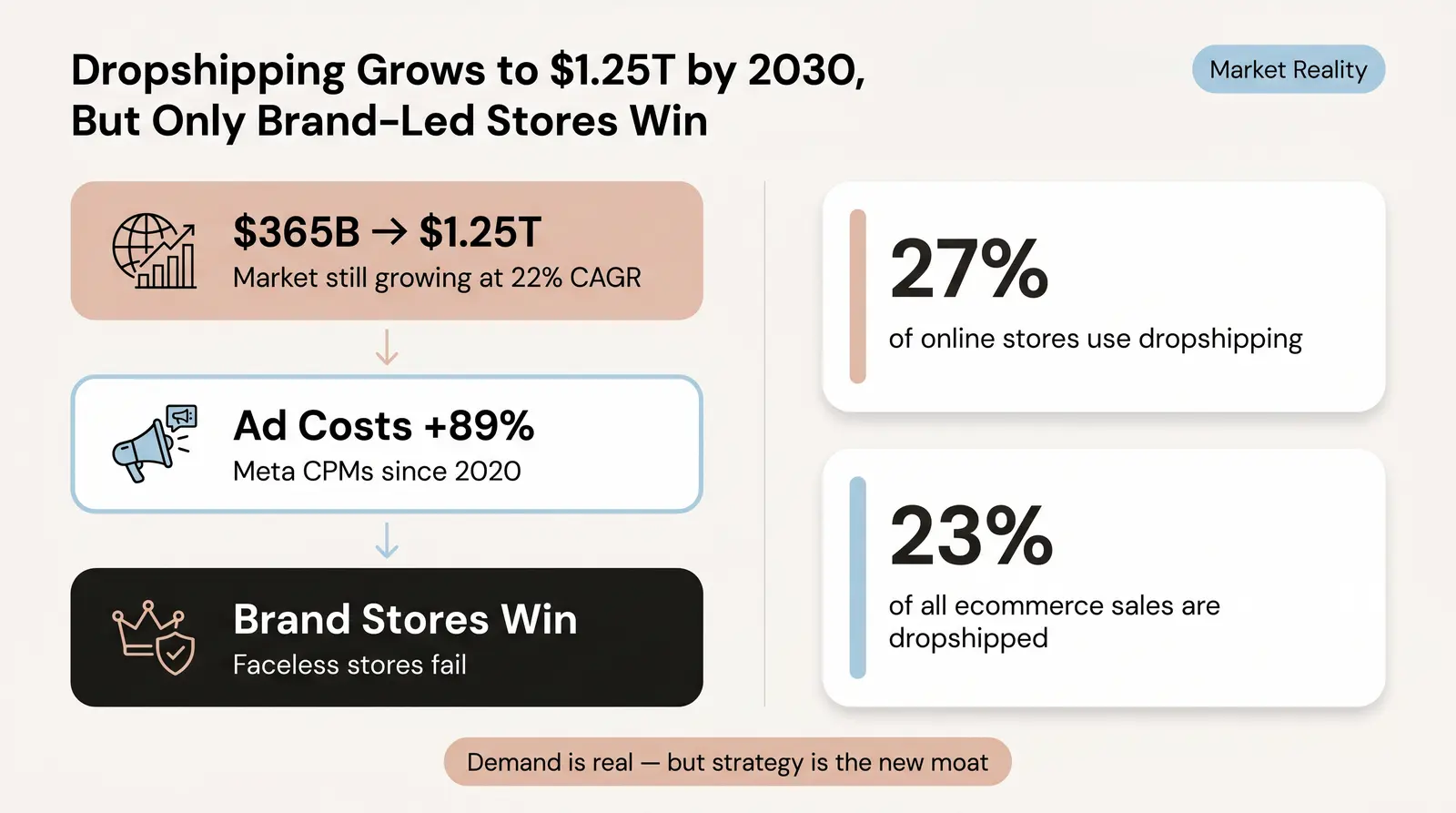
Real answer: The global dropshipping market was valued at $365.67 billion in 2024 and is projected to reach $1,253.79 billion by 2030, growing at a compound annual growth rate (CAGR) of 22.0% [2]. These aren't the numbers of a dying industry. In fact, the U.S. dropshipping market alone is expected to grow at a CAGR of 20.2% through 2030 [2]. The market isn't shrinking—it's evolving rapidly and rewarding those who adapt.

dropshipping market size

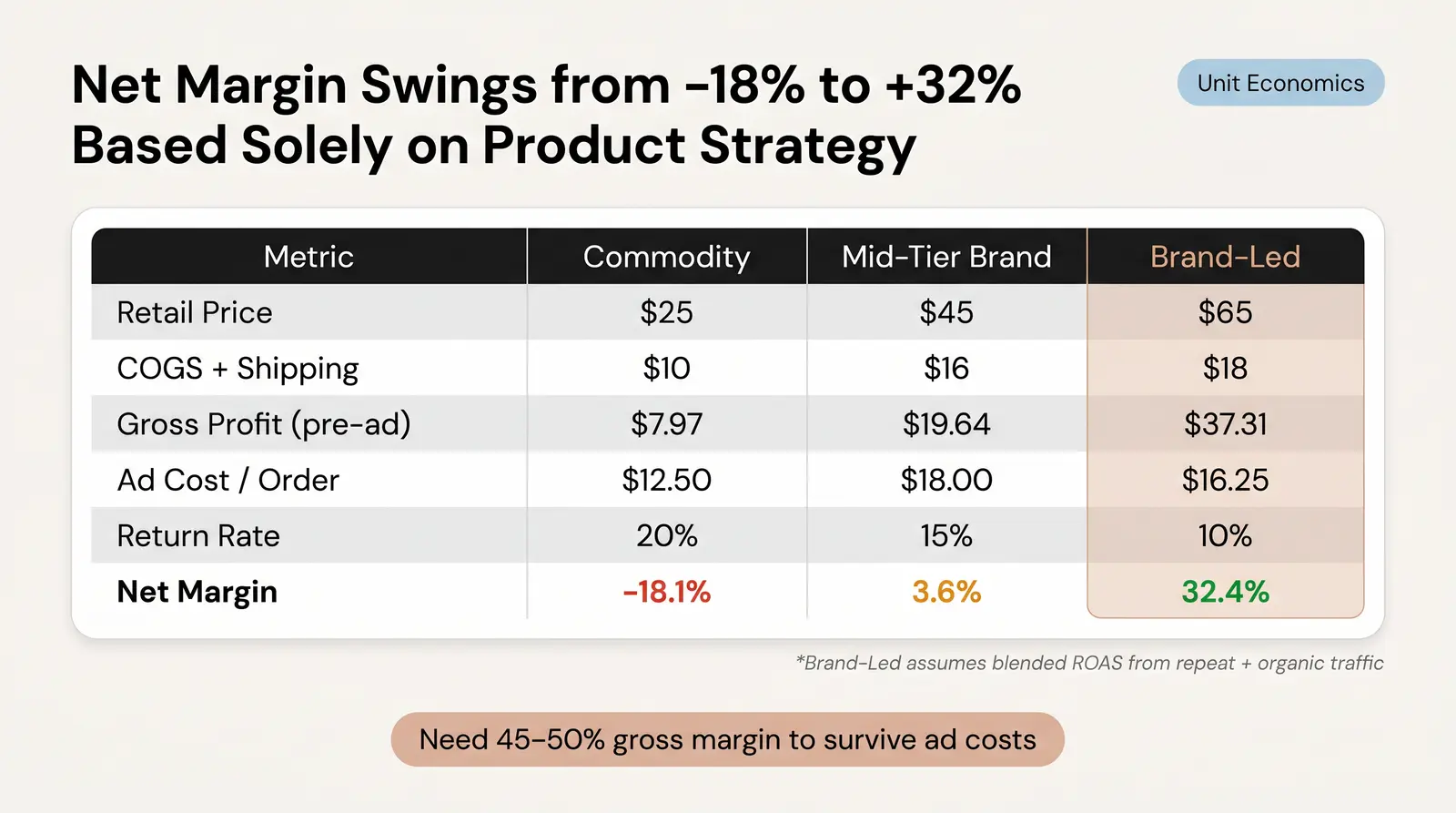
However, profitability is highly uneven. Most dropshippers operate with net profit margins between 15% and 20% after accounting for product costs, shipping, advertising, and platform fees [3]. But this average masks a critical divide: low-quality, transactional dropshipping stores struggle to break even, while brand-driven dropshipping businesses achieve sustainable margins and repeat purchase rates that can be 340% higher in customer lifetime value [4].

The difference isn't in the business model itself. It's in execution, positioning, and understanding what modern consumers actually value. Is dropshipping profitable? Yes—but the long answer is what determines whether your store will be among the profitable minority or the failed majority.

The Dropshipping Success Rate (What the Numbers Actually Say)

Let's address the elephant in the room: the often-cited statistic that over 90% of dropshipping businesses fail within their first few months [5]. This number gets thrown around as evidence that dropshipping is a fundamentally flawed model. But context matters.

First, consider that approximately 80-90% of all new ecommerce startups fail within the first 120 days [6], and roughly 70% of ecommerce businesses fail in their first year—a rate significantly higher than businesses outside the ecommerce sector [7]. By the fifth year, nearly 50% of all new businesses have closed [8]. In other words, high failure rates aren't unique to dropshipping—they're characteristic of entrepreneurship in general, and ecommerce in particular.

The real question isn't "why do so many dropshipping stores fail?" but rather "what separates the 10% that succeed from the 90% that don't?" In our experience at Branvas, the answer has less to do with the logistics model and everything to do with how founders approach branding, customer experience, and value creation.

dropshipping failures

The dropshipping stores that fail typically share common characteristics: they sell generic products with no differentiation, compete solely on price, offer poor customer service, ignore the importance of trust signals, and treat the business as passive income rather than a real company [9]. Meanwhile, successful dropshipping businesses focus on curated product selection, clear brand identity, reliable fulfillment, pricing power through perceived value, and building relationships that generate repeat customers [10].

Understanding these distinctions is crucial. The "success rate" statistic isn't a verdict on the business model—it's a reflection of how many people enter dropshipping with unrealistic expectations and inadequate preparation. The model works for those who treat it seriously.

Why Old-School Dropshipping Stopped Working

To understand why dropshipping has such a bad reputation, we need to examine what changed between 2016 and 2026. The dropshipping playbook that worked a decade ago has become not just ineffective but actively harmful to profitability.

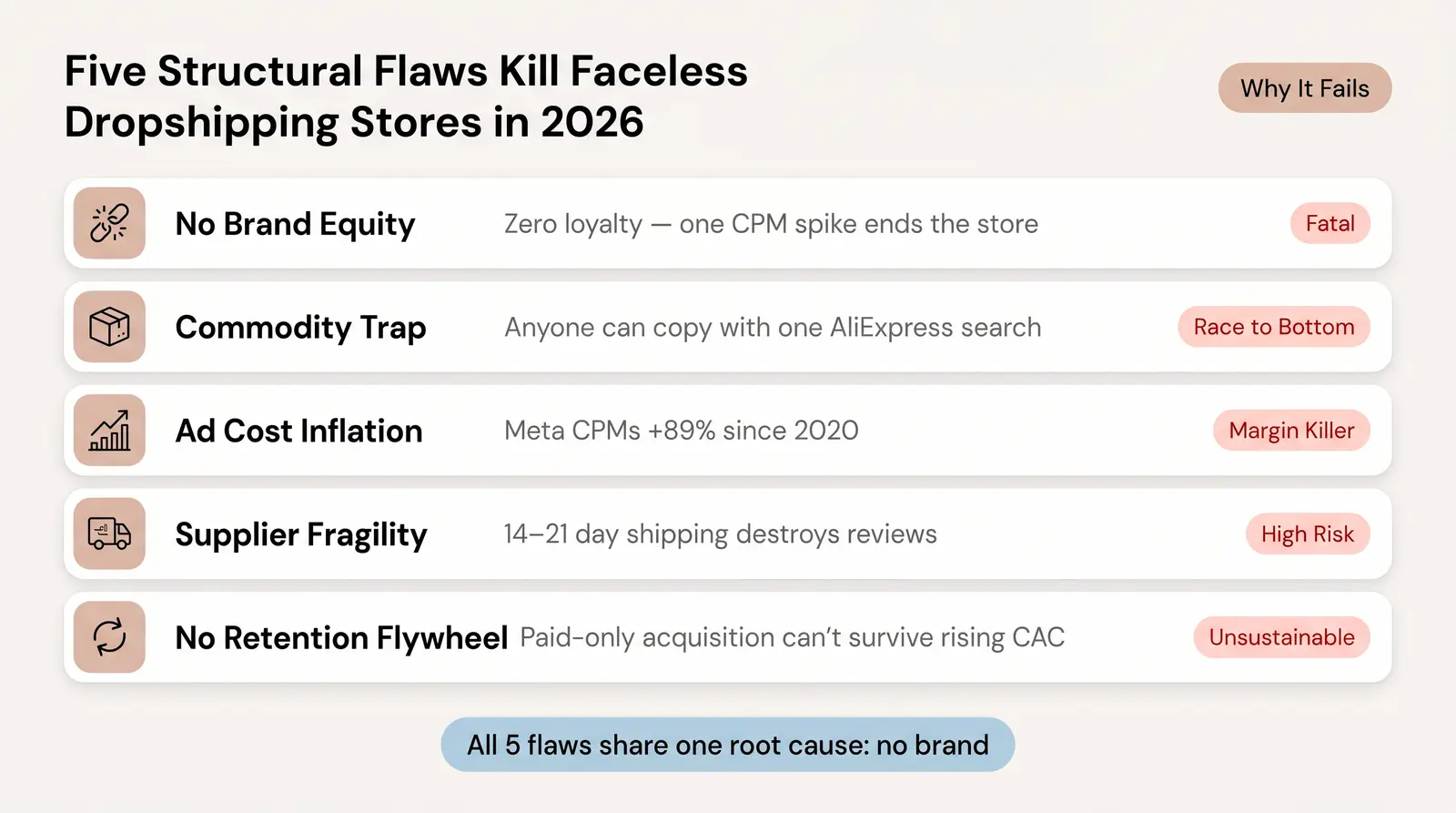
Market saturation hit hard. When dropshipping became popularized through YouTube courses and "passive income" gurus, thousands of entrepreneurs flooded into the space selling identical products from the same suppliers. Consumers began seeing the same generic products advertised across multiple stores, eroding any sense of uniqueness or value.

Price wars became inevitable. With no product differentiation and minimal brand equity, the only competitive lever left was price. Stores undercut each other in a race to the bottom, compressing margins to unsustainable levels. When your only value proposition is "cheapest," you've already lost.

forces killing dropshipping

Ad cost inflation destroyed unit economics. Facebook ad costs have risen dramatically—the average CPM (cost per thousand impressions) for ecommerce reached $20.48 in the U.S. by 2024 [11], while the average CPC (cost per click) sits around $1.37 for ecommerce advertisers [12]. Google Ads CPCs have increased approximately 25% since summer 2025 for ecommerce businesses [13], with over half of industries experiencing CPC growth faster than the consumer inflation rate [14]. What once cost $10 to acquire a customer now costs $30 or more—and if your product offers no differentiation, that customer won't return.

Low trust became a deal-breaker. As consumers grew more sophisticated, they learned to recognize the hallmarks of low-quality dropshipping: stock photos, vague product descriptions, 3-6 week shipping times from China, and no brand presence. Today, 80% of consumers trust the brands they use more than they trust business, media, government, or NGOs [15]. Without trust, there's no conversion. Without conversion, there's no business.

Poor customer experience created a negative feedback loop. Long shipping times (typically 15-45 days from AliExpress) [16], inconsistent product quality, and inadequate customer service led to complaints, refunds, and negative reviews. In an era where 79% of consumers trust online reviews as much as personal recommendations [17], a few bad reviews can sink a store before it gains traction.

This isn't to say that dropshipping died—it's that the low-effort, low-quality version of it stopped being viable. The market didn't reject the fulfillment model; it rejected the lack of value.

The Dropshipping Quality Divide (Proprietary Framework)

In our work with modern dropshipping brands at Branvas, we've observed a clear dividing line between stores that struggle and those that thrive. We call this The Dropshipping Quality Divide, and it explains why some dropshippers achieve sustainable profitability while others burn through ad budgets with nothing to show for it.

Low-Quality Dropshipping

High-Quality Brand Dropshipping

Generic products anyone can source

Curated products with clear positioning

No brand identity or story

Strong brand identity and values

15-45 day shipping from overseas

Reliable fulfillment (7-14 days or less)

Race-to-bottom pricing

Pricing power through perceived value

One-time transactional buyers

Repeat customers and brand loyalty

Stock photos and thin content

Professional imagery and detailed descriptions

Reactive customer service

Proactive customer experience design

Ad-dependent acquisition

Multi-channel brand building

No trust signals

Reviews, guarantees, and transparency

Treats business as passive income

Treats business as real company

Profitability lives on the right side of this table. The fundamental insight is that modern consumers don't reject dropshipping as a fulfillment method—they reject poor experiences, lack of trust, and absence of value. When you position your dropshipping business as a brand-first operation that happens to use dropshipping logistics, rather than a logistics operation trying to become a brand, everything changes.

The stores on the left side of this divide compete in a red ocean where the only differentiation is price. The stores on the right side create blue ocean opportunities where brand, trust, and customer experience become defensible moats. This is why brand-driven dropshipping businesses see customer lifetime values that are 340% higher than transaction-focused operations [4].

quality divide framework

Why High-Quality Brand Dropshipping Is Growing

While low-quality dropshipping stores continue to fail at alarming rates, a different category of dropshipping business is not just surviving but thriving. The data tells a compelling story about why brand-first dropshipping is actually growing in 2026.

Consumer expectations have fundamentally shifted. McKinsey research shows that consumers now have three additional hours of free time per week compared to 2019, but they allocate 90% of that time to solo activities, with decreased tolerance for friction and inconvenience [18]. Over 90% of U.S. and Chinese consumers shopped at an online-only retailer in the previous month [19], and food delivery's share of global food service spending jumped from 9% in 2019 to 21% in 2024 [20]. Consumers expect speed, convenience, and quality—and they're willing to pay for it when trust is established.

Trust and perceived value drive conversion. The relationship between consumer sentiment and spending has weakened, meaning consumers are making unexpected trade-offs: trading down in one category while simultaneously splurging in another [21]. What determines where they spend? Trust. Research shows that 87% of shoppers will pay more for trusted brands despite price sensitivity [22], and 91% of consumers say that video quality impacts brand trust [23]. The brands that invest in trust signals—professional content, transparent policies, responsive service, authentic reviews—win the conversion battle.

brand dropshipping wins

Branding and packaging create differentiation. In a world where over one-third of consumers across major markets identify Amazon or Taobao as their go-to shopping destination [24], standing out requires more than just listing products. It requires a cohesive brand identity, a clear value proposition, and attention to details like packaging and unboxing experience. These elements transform a transaction into a brand interaction, which is the foundation for repeat purchases.

Repeat purchase economics change everything. The average repeat customer rate in ecommerce ranges from 15-30% [25], but this varies dramatically by business model. Fashion and apparel brands see approximately 25-26% repeat rates [26], while consumables achieve even higher rates. In our experience at Branvas, the biggest difference between profitable and unprofitable stores isn't traffic—it's trust. A store that converts at 2% with a 10% repeat rate has fundamentally different unit economics than one that converts at 1% with a 5% repeat rate. The former can afford higher customer acquisition costs, invest in better products, and build sustainable growth. The latter is trapped in a cycle of unprofitability.

The market isn't rejecting dropshipping—it's rewarding the dropshippers who understand that modern ecommerce is a brand game, not a logistics game.

Is Dropshipping Worth It for New Founders in 2026?

This is the question we hear most often, and the honest answer is: it depends entirely on your expectations, skills, and willingness to do the work.

Who should start dropshipping in 2026:

Founders who view dropshipping as a way to test product-market fit without inventory risk. If you're willing to invest time in market research, brand building, and customer experience design, dropshipping offers a legitimate path to building a real ecommerce business. It's worth it for those who understand that the low barrier to entry doesn't mean low effort—it means you can focus your effort on branding and marketing rather than manufacturing and warehousing.

Entrepreneurs who have skills in digital marketing, content creation, or community building. The modern dropshipping landscape rewards those who can build trust at scale through social proof, content marketing, and authentic brand storytelling. If you can create content that resonates, build an audience, and convert that audience into customers, dropshipping provides the infrastructure to monetize those skills.

Those who are prepared to treat it as a real business, not passive income. If you're willing to provide excellent customer service, continuously optimize your store, test and iterate on products, and invest in long-term brand equity, dropshipping can be highly profitable.

who should start dropshipping

Who should not start dropshipping in 2026:

Anyone looking for passive income or a "set-and-forget" business. That model is dead. Dropshipping in 2026 requires active management, continuous optimization, and genuine customer care.

Founders who want to compete solely on price. If your only strategy is finding the cheapest product and undercutting competitors, you'll be trapped in a race to the bottom with unsustainable margins.

Those unwilling to invest in branding, trust signals, and customer experience. The market has moved beyond generic stores. Without differentiation, you won't survive the customer acquisition cost environment of 2026.

The mindset shift that's required: Dropshipping has evolved from a "hack" to a legitimate business model that requires fundamentals. The effort has shifted from finding "winning products" to building winning brands. Success now comes from understanding your target customer deeply, curating products that solve real problems, communicating value effectively, and delivering experiences that generate trust and repeat purchases.

Is it worth it? Absolutely—if you're willing to meet the market where it is, not where it was five years ago.

Where Branvas Fits (Subtle, Educational Promotion)

At Branvas, we've built our model around a simple observation: the biggest barriers to dropshipping profitability aren't about the business model itself—they're about execution quality.

Most dropshippers fail not because dropshipping doesn't work, but because they get stuck managing supplier relationships, dealing with quality inconsistencies, navigating long shipping times, and struggling to create a cohesive brand experience. These operational challenges consume time and energy that should be spent on marketing, customer acquisition, and brand building.

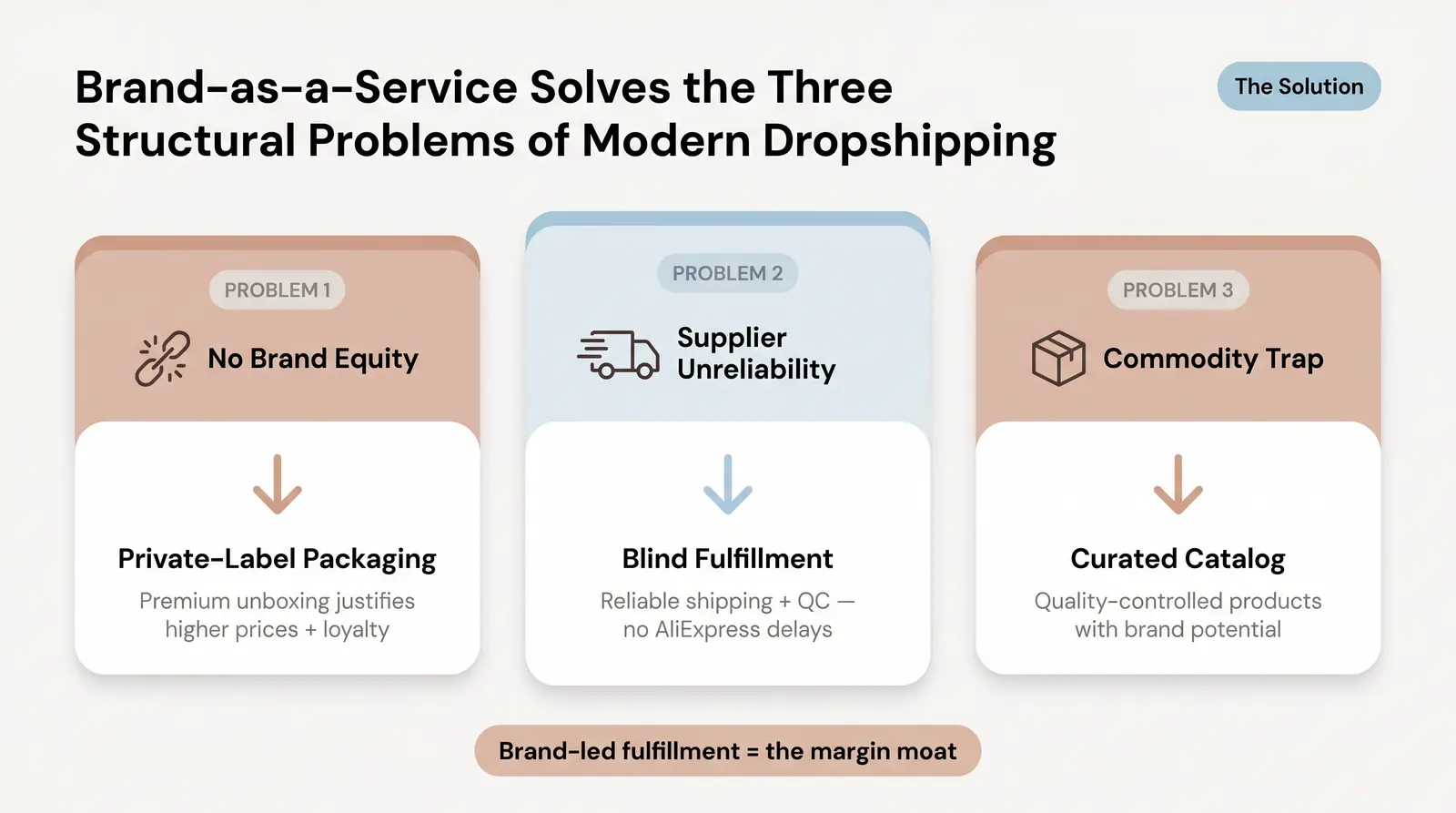
Branvas was designed to remove these barriers. We provide a modern, brand-first dropshipping infrastructure that enables founders to focus on what actually drives profitability: positioning, messaging, and customer relationships. Our approach emphasizes curated product selection, reliable fulfillment, quality control, and brand-ready packaging—the elements on the right side of the Quality Divide.

branvas value

We often see founders struggle with the gap between their brand vision and their operational reality. They want to build a premium brand but are constrained by suppliers who ship in generic packaging with 30-day delivery times. They want to provide excellent customer service but spend their days chasing down order tracking numbers and managing quality complaints.

In our experience, the stores that succeed are those that treat dropshipping as a strategic advantage—a way to test products, scale quickly, and maintain capital efficiency—while never compromising on the brand experience. That's the philosophy behind Branvas: enabling high-quality dropshipping that customers trust and founders can scale.

Common Mistakes That Kill Profitability (We See This Often)

Even among founders who understand the importance of quality and branding, we often see recurring mistakes that undermine profitability. These aren't theoretical pitfalls—they're patterns we observe repeatedly in our work with dropshipping brands.

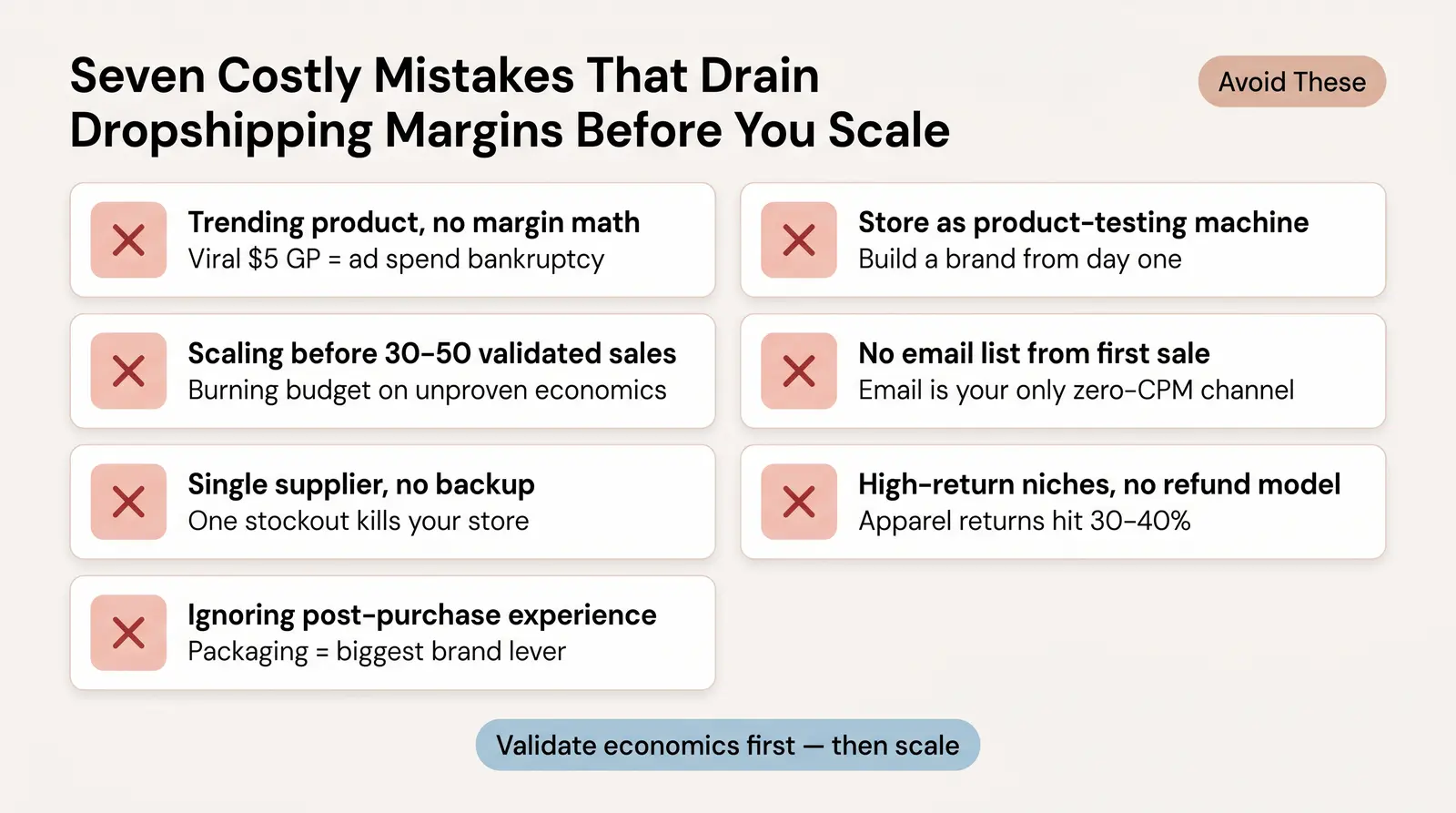
Copying competitors instead of finding differentiation. When founders see a successful store, the temptation is to replicate it. But by the time you've identified a "winning product," dozens of others have too. We often see founders launch stores that are nearly identical to existing competitors, then wonder why their ads don't convert. The market rewards differentiation, not imitation.

Competing only on price. This is perhaps the most common trap. When you position your product as "cheaper than the competition," you attract price-sensitive customers who will never become loyal, and you compress your margins to the point where customer acquisition costs become unsustainable. Price competition is a race to the bottom that nobody wins.

Ignoring packaging and trust signals. Many founders focus exclusively on the product and the website, forgetting that the unboxing experience is a critical brand touchpoint. Generic packaging, lack of branded inserts, and absence of trust signals (reviews, guarantees, clear policies) all contribute to one-time buyers rather than repeat customers.

dropshipping profitability killers

Scaling ads too early. We often see founders who get a few sales and immediately try to scale their ad spend from $50/day to $500/day. Without sufficient data, optimized conversion funnels, and proven unit economics, scaling prematurely burns cash and yields diminishing returns. Profitability comes from optimizing before scaling, not the reverse.

Treating dropshipping as passive. This might be the most damaging misconception. Founders who expect to "set up a store and let it run" are inevitably disappointed. Profitable dropshipping requires active management: responding to customer inquiries promptly, monitoring supplier performance, testing new products, optimizing ad creative, and continuously improving the customer experience.

The difference between profitable and unprofitable dropshipping often comes down to avoiding these mistakes and maintaining discipline around the fundamentals: know your customer, deliver real value, build trust systematically, and optimize relentlessly.

profitable dropshipping

Frequently Asked Questions

Is dropshipping still profitable in 2026?

Yes, dropshipping remains profitable in 2026, but profitability is concentrated among businesses that prioritize brand building, customer experience, and quality over quick wins. The global dropshipping market is growing at 22% annually and is projected to exceed $1.25 trillion by 2030 [2]. However, success requires treating dropshipping as a real business with professional standards, not a passive income scheme.

Is dropshipping worth it for beginners?

Dropshipping can be worth it for beginners who are willing to invest time in learning digital marketing, understanding customer psychology, and building a genuine brand. It offers low startup costs and minimal inventory risk, making it accessible for new entrepreneurs. However, beginners should expect a learning curve and be prepared to invest in advertising, tools, and continuous optimization. It's not "easy money," but it is a legitimate path to building an ecommerce business if approached with realistic expectations.

What is the average dropshipping success rate?

Approximately 10% of dropshipping businesses succeed beyond the first few months, meaning about 90% fail early [5]. However, this statistic reflects the high number of people who enter dropshipping with inadequate preparation, unrealistic expectations, or poor execution. The success rate is comparable to ecommerce businesses generally, where 80-90% fail within 120 days [6]. The key differentiator is whether founders treat dropshipping as a serious business requiring branding, marketing skills, and customer service excellence.

Why do most dropshipping stores fail?

Most dropshipping stores fail due to a combination of poor supplier selection, lack of brand differentiation, inadequate marketing, insufficient customer service, and unrealistic expectations about passive income [9]. Specifically, stores that sell generic products, compete only on price, ignore trust signals, and provide poor customer experiences cannot sustain profitability in the current market environment where ad costs are high and consumer expectations are elevated. Success requires differentiation, trust-building, and genuine value creation.

How do I increase profitability in dropshipping?

Increase profitability by focusing on three key areas: (1) Brand differentiation – curate unique products, develop a clear brand identity, and create content that builds trust; (2) Customer lifetime value – invest in customer experience, implement retention strategies, and build repeat purchase rates through quality and service; (3) Unit economics optimization – improve conversion rates through better website design and trust signals, reduce customer acquisition costs through organic channels and community building, and maintain healthy margins by competing on value rather than price. Profitability comes from building a brand that customers trust and return to, not from finding the cheapest products.

References

[1] Appscenic. "Why Over 90% Of Dropshippers Fail (Dropshipping Success Rate)." https://appscenic.com/blog/why-more-than-90-of-dropshippers-fail/

[2] Grand View Research. "Dropshipping Market Size, Share | Industry Report, 2030." https://www.grandviewresearch.com/industry-analysis/dropshipping-market

[3] SellersCommerce. "Detailed Dropshipping Statistics In 2025." November 26, 2025. https://www.sellerscommerce.com/blog/dropshipping-statistics/

[4] Dropship Spy. "Dropshipping Success Blueprint: Essential Resources, Strategies and Common Mistakes to Avoid in 2025." https://dropship-spy.com/blog/dropshipping-success-blueprint-essential-resources-strategies-and-common-mistakes-to-avoid-in-2025

[5] Artisan Furniture. "How Many Dropshipping Stores Fail?" https://www.artisanfurniture.net/news/how-many-dropshipping-stores-fail/

[6] Global Work Digital. "What Percentage of E-commerce Businesses Fail And Why So Many?" https://globalworkdigital.com/what-percentage-of-e-commerce-businesses-fail/

[7] SME News Digital. "7 in 10 E-commerce Businesses Fail in Their First Year." February 11, 2025. https://smenews.digital/7-in-10-e-commerce-businesses-fail-in-their-first-year-more-than-double-the-average-rate-of-business-failure/

[8] Shopify. "Percentage of Businesses That Fail [Updated Jan 2024]." January 10, 2024. https://www.shopify.com/blog/percentage-of-businesses-that-fail

[9] Forbes. "Five Reasons Why Dropshippers Fail (And What To Do Instead)." November 2, 2021. https://www.forbes.com/councils/forbesbusinesscouncil/2021/11/02/five-reasons-why-dropshippers-fail-and-what-to-do-instead/

[10] Eprolo. "Dropshipping in 2026: Is It Still Profitable | The Ultimate Guide." January 4, 2026. https://eprolo.com/de/dropshipping-in-2026-is-it-still-profitable-the-ultimate-guide

[11] Lebesgue. "Facebook Ads CPM by Country - Data from 2025." https://lebesgue.io/facebook-ads/facebook-cpm-by-country

[12] Madgicx. "E-commerce Budget Guide: Facebook Ads Cost in 2025." August 4, 2025. https://madgicx.com/blog/facebook-ads-cost

[13] Reddit r/googleads. "Have Google Ads CPCs in e-commerce increased 25%?" 2025. https://www.reddit.com/r/googleads/comments/1nu2vrb/have_google_ads_cpcs_in_ecommerce_increased_25/

[14] PPC Hero. "Why are Google Ads CPCs increasing?" July 7, 2025. https://ppchero.com/why-are-google-ads-cpcs-increasing/

[15] Edelman. "Special Report - Brand Trust, From We to Me." 2025 Trust Barometer. https://www.edelman.com/trust/2025/trust-barometer/special-report-brands

[16] AliDropship. "The Solution To The AliExpress Shipping Time Problem." February 6, 2024. https://alidropship.com/aliexpress-shipping-time/

[17] Envive. "44 Brand Trust Building Metrics in 2025." https://www.envive.ai/post/brand-trust-building-metrics-for-ecommerce

[18] McKinsey & Company. "State of the Consumer 2025: When disruption becomes permanent." June 9, 2025. https://www.mckinsey.com/industries/consumer-packaged-goods/our-insights/state-of-consumer

[19] McKinsey & Company. "State of the Consumer 2025: When disruption becomes permanent." June 9, 2025. https://www.mckinsey.com/industries/consumer-packaged-goods/our-insights/state-of-consumer

[20] McKinsey & Company. "State of the Consumer 2025: When disruption becomes permanent." June 9, 2025. https://www.mckinsey.com/industries/consumer-packaged-goods/our-insights/state-of-consumer

[21] McKinsey & Company. "State of the Consumer 2025: When disruption becomes permanent." June 9, 2025. https://www.mckinsey.com/industries/consumer-packaged-goods/our-insights/state-of-consumer

[22] Salsify. "Why 87% of Shoppers Will Pay More When Brand Trust Is Strong." October 30, 2025. https://www.salsify.com/blog/why-shoppers-pay-more-when-brand-trust-strong

[23] Envive. "44 Brand Trust Building Metrics in 2025." https://www.envive.ai/post/brand-trust-building-metrics-for-ecommerce

[24] McKinsey & Company. "State of the Consumer 2025: When disruption becomes permanent." June 9, 2025. https://www.mckinsey.com/industries/consumer-packaged-goods/our-insights/state-of-consumer

[25] OpenSend. "7 Repeat Purchase Rate Statistics For eCommerce Stores." April 19, 2025. https://opensend.com/post/repeat-purchase-rate-ecommerce

[26] Rivo. "27 VIP Customer Repeat Rate Statistics Every Ecommerce Business Should Know." December 8, 2025. https://www.rivo.io/blog/vip-customer-repeat-rate-statistics