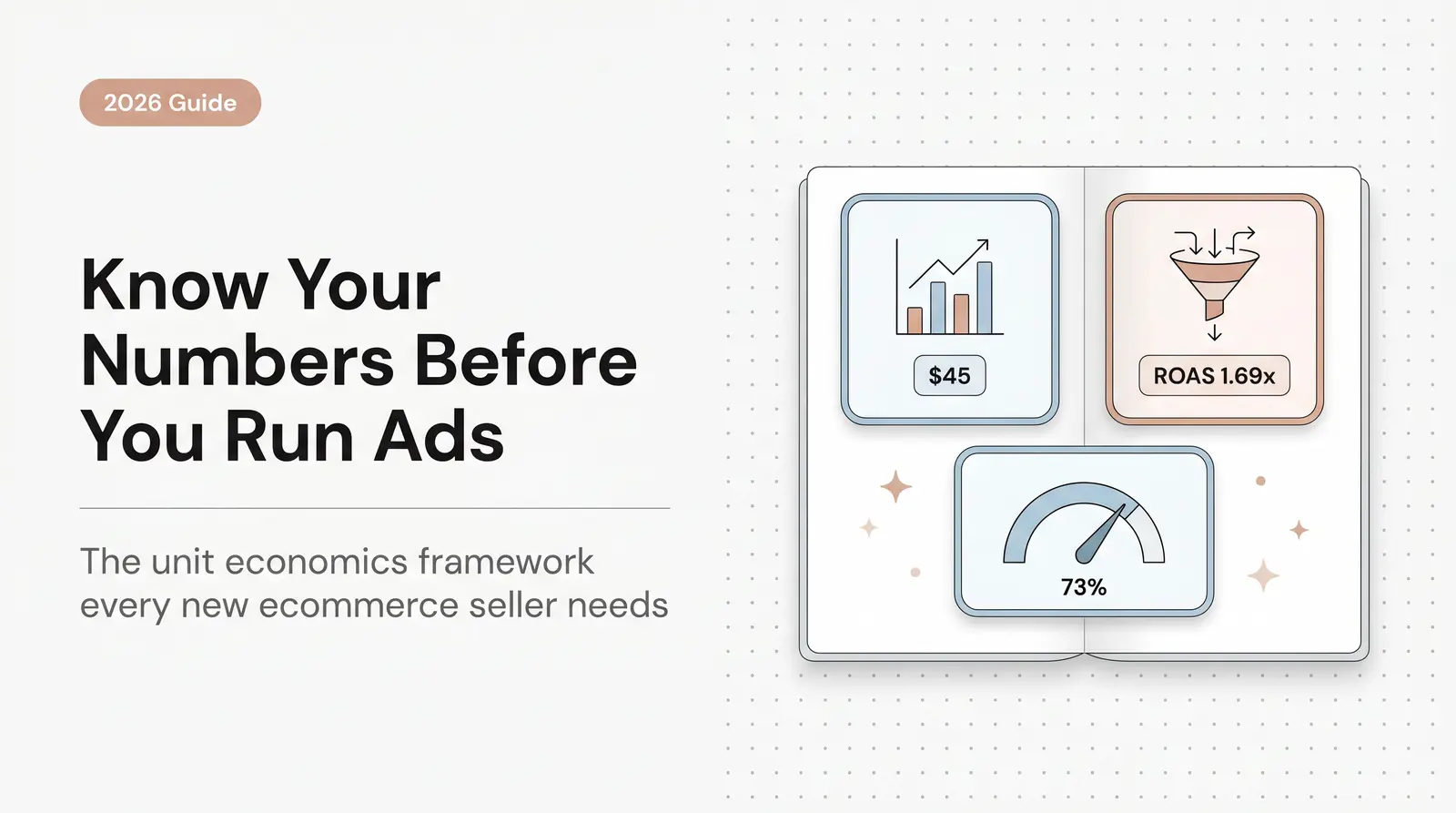



Use the 5-category Pre-Ad Readiness Score to evaluate your Shopify store’s trust, product pages, tracking, margins, and organic baseline before launching paid ads.
Published:
July 15, 2026
Author:
Yi Cui
Paid traffic makes weak fundamentals more expensive.
Most new Shopify store owners waste their first ad budget. It is not because the ads do not work, or because the algorithm is broken. It is because the store itself is not ready to convert the traffic it receives. Driving paid traffic to an unoptimized store is like pouring water into a leaky bucket. You will see clicks and impressions, but you will not see sales.
At Branvas, we work with dozens of new brand founders each month, and the pattern is consistent. The stores that burn through ad budgets fastest are almost never running a targeting problem. They are running a store problem. This article will help you run through a pre-ad readiness framework before you spend a single dollar on Meta, TikTok, or Google.
Paid traffic amplifies what is already there. If you have a good store that converts organically, ads will bring more sales. If you have a broken store with friction points, ads will bring more bounces and wasted spend.
Running ads before organic validation is not a growth strategy. It is a diagnostic expense. But most founders treat it like growth. The average ecommerce conversion rate for Shopify stores is around 1.4% to 1.8% [1]. If your store is not converting organic or referral traffic at all, throwing paid traffic at it will not magically fix the underlying issues.
This creates a false hope trap. You launch a campaign, see hundreds of clicks, and feel like you are making progress. But clicks without conversions drain your budget fast. You need to ensure your store is actually ready to handle the traffic.

To help you decide if you are ready to spend on ads, we use the Branvas Pre-Ad Readiness Score (PARS). This is a 5-category scoring rubric that helps store owners self-assess whether they are ready to run paid ads profitably.
Each of the 5 categories is scored 0–4 points. Total score = max 20 points.
| Category | What It Measures | Max Points |
|---|---|---|
| 1. Store Trust & Credibility | SSL, About page, reviews, policies | 4 |
| 2. Product Page Quality | Photos, copy, CTA, mobile UX | 4 |
| 3. Tracking & Pixel Setup | Meta Pixel/CAPI, TikTok Pixel, GA4 | 4 |
| 4. Margin & Unit Economics | Gross margin, AOV, CPA headroom | 4 |
| 5. Organic Baseline | Any organic/social proof of conversion | 4 |
Score Interpretation:
Trust is the foundation of conversion. If a visitor does not trust your store, they will not enter their credit card information.
Research from the Baymard Institute shows that 19% of users abandon carts because they do not trust the site with their credit card information, and 15% abandon because the returns policy is not satisfactory [2]. We have seen stores with beautiful product photos lose conversions simply because they did not have a return policy linked. Buyers assume the worst when policies are absent.
Your product page is your salesperson. It needs to look good and answer all objections.
With over 70% of global ecommerce traffic coming from mobile devices [3], your mobile layout is critical.
Consider this example for a gold vermeil necklace:
Weak Page: A single flat-lay photo. Copy: "14k gold vermeil necklace. 18 inches."
Strong Page: 5 photos including lifestyle shots showing the necklace worn. Copy: "Elevate your everyday look with our 14k Gold Vermeil Layering Necklace. Hypoallergenic, water-resistant, and designed to never tarnish. Perfect for stacking or wearing solo." Clear variant selector for lengths, and a "Free 60-Day Returns" badge near the Add-to-Cart button.
If you cannot track conversions accurately, you cannot optimize your ads.
Most new store owners think the Pixel "just works" once installed. In reality, without the Conversions API (CAPI), you may be losing 20–40% of conversion signals. This makes your ad algorithm optimize on incomplete data from day one. Apple's iOS 14 update severely limited browser-based tracking [4]. CAPI sends data directly from your server to Meta, bypassing browser restrictions and improving your event match quality.
That is where NestAds, a server-side tracking app for Shopify, comes in. It simplifies your CAPI setup without requiring custom code and tracks return on ad spend (ROAS) across Google, TikTok, and Facebook. With NestAds, you can recover the conversion signals you would otherwise lose and optimize campaigns on complete data.
Ads cost money. If your margins are too thin, you cannot afford to acquire customers profitably.
If your gross margin is below 40–50%, paid ads likely will not be profitable at realistic Cost Per Acquisition (CPA) levels for new stores.
Maximum Allowable CPA = AOV × Gross Margin % − Overhead per order
| Scenario | AOV | Gross Margin | Max CPA | Viable for Ads? |
|---|---|---|---|---|
| Low-margin store | $35 | 30% | $10.50 | ❌ Very difficult |
| Mid-margin store | $65 | 55% | $35.75 | ✅ Possible |
| High-margin store | $120 | 65% | $78.00 | ✅ Strong headroom |
If you are selling private-label jewelry through Branvas, your margin structure is built in. Wholesale costs are designed to leave room for profitable paid traffic. See how Branvas pricing works →
You need proof that people actually want what you are selling before you pay to show it to them.
An organic sale is proof the product-market fit exists. An ad sale is rented proof. The moment you stop paying, the signal disappears. Founders who skip organic validation use ad spend as a product-market fit test. This is an expensive and inconclusive way to do it.

Run through this checklist before turning on your campaigns.

To exit the learning phase, Meta requires about 50 optimization events within a 7-day period [5]. Set a daily budget that allows for enough conversions to exit learning. You also need a Business Manager account and domain verification set up properly. For new stores, start with broad targeting and let the algorithm learn who your buyers are.
TikTok requires a Business Center setup. It is a creative-first platform. Creative quality matters more here than on Meta for new stores. You can use Spark Ads to boost organic posts, or In-Feed Ads for direct response [6]. TikTok often has lower CPMs, but ad creatives burn out much faster and need to be replaced frequently.
We do not recommend Performance Max as the first channel for most new stores. Performance Max relies heavily on existing conversion data to optimize effectively. Without historical data, it struggles to find buyers. It is better used as a second channel after Meta proves demand and you have a steady stream of conversions.

If your store scores below 14 on the PARS framework, pause. Do not run ads yet.
Instead, prioritize organic social content on TikTok and Instagram Reels to gather early proof. You can run a very small brand awareness campaign with no conversion objective just to test creatives, but do not expect sales. Fix the store issues using the checklist above. Consider whether the product itself needs validation before committing ad spend.
If you are building a jewelry or accessories brand and want to start with a store that is already set up to convert, with professional packaging, real product photography assets, and a margin structure built for DTC, explore how Branvas works →.

How many sales should I have before running paid ads on my Shopify store?
You should aim for at least 1 to 3 organic or referral sales before running paid ads. This proves that real people are willing to pay for your product without being forced through a paid funnel. It validates your product-market fit and ensures your checkout process actually works.
What is a good conversion rate for a Shopify store before running ads?
A good baseline conversion rate for a Shopify store is between 1.4% and 1.8%. If your store converts below 1% organically, running paid ads will likely be unprofitable because paid traffic usually converts at a lower rate than warm organic traffic.
Do I need the Meta Pixel set up before running Facebook ads?
Yes, absolutely. You need both the Meta Pixel and the Conversions API (CAPI) set up before running ads. Without them, Facebook cannot track who buys your products, which means the algorithm cannot optimize your campaigns to find more buyers.
How much should I budget for my first Shopify paid ad campaign?
You need enough budget to exit the learning phase, which requires about 50 conversions a week. A common starting budget is $30 to $50 per day per ad set, but you must be prepared to spend at least $500 to $1,000 to gather meaningful data before expecting profitable returns.
Why am I getting traffic from ads but no sales on my Shopify store?
If you are getting traffic but no sales, you have a store problem, not a traffic problem. Common culprits include a lack of trust signals, confusing product pages, high shipping costs revealed late in checkout, or a broken mobile experience.