



Use the free Branvas ecommerce pricing calculator to calculate your true product cost, set profitable retail prices, and stop guessing your margins.
Published:
May 13, 2026
Author:
Yi Cui
Try Branvas's free pricing calculator—the tool that finally takes the guesswork out of your margins. Most ecommerce sellers guess at their retail price, slowly erode their margin, and never realize why they are not profitable until it is too late. If you want to stop guessing and start building a sustainable business, use the free Branvas Profit Calculator to find your perfect price point today.
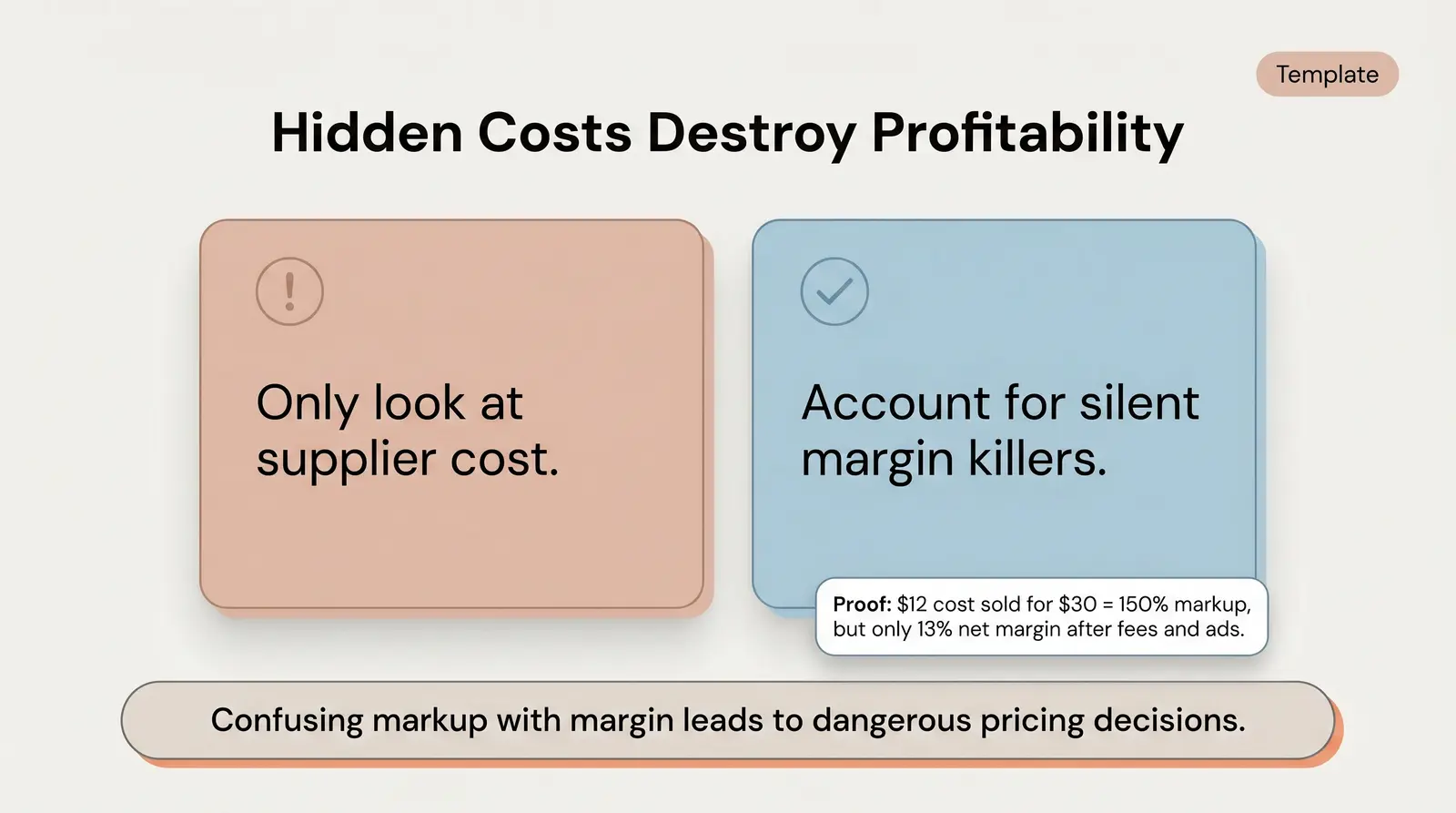
The most common pricing mistake isn't charging too little. It is calculating the cost of goods correctly but ignoring the "silent margin killers" that destroy profitability. These silent killers include return processing costs, payment processing fees, packaging, and the blended ad cost per unit sold. When you only look at what you paid your supplier, you are setting yourself up for failure. Many new founders assume that if they buy a product for $10 and sell it for $30, they are making a $20 profit. This fundamental misunderstanding of unit economics is why so many ecommerce businesses fail within their first year.
Many sellers confuse markup with margin, which leads to dangerous pricing decisions. Markup is the percentage added to your product cost to determine the selling price, while margin is the percentage of the selling price that remains after you subtract the product cost [1]. For example, a product that costs $12 and is sold for $30 has a 150% markup but only a 60% gross margin. After $8 in shipping and fees, plus $6 in blended ad cost, the actual net margin collapses to roughly 13%. This is a critical distinction because you pay your bills with margin dollars, not markup percentages. If you optimize for markup without understanding your true margin, you will eventually run out of cash.
In our experience at Branvas, the sellers who struggle most with profitability aren't the ones who price too low intentionally—they're the ones who don't know their true landed cost. They look at their bank account at the end of the month and wonder where all the money went, completely unaware that their pricing model was broken from day one. They often try to fix the problem by spending more on ads to drive volume, which only accelerates their cash burn. The only way to fix a broken pricing model is to rebuild it from the ground up, accounting for every single cost associated with acquiring and fulfilling an order.
To solve this problem, we developed the Branvas Margin Stack™—a layered cost model that builds your retail price from the ground up. This proprietary framework ensures that every single cost is accounted for before you set your final price. It is a repeatable system that protects your profitability. Unlike traditional cost-plus pricing, which often misses hidden expenses, the Margin Stack forces you to confront the reality of your unit economics. By breaking down your costs into distinct layers, you can easily identify where your margin is leaking and make data-driven adjustments to your pricing strategy.
The Branvas Margin Stack™ has 6 layers:
| Layer | Cost Component | Example (Jewelry) | Example (Apparel) |
|---|---|---|---|
| 1 | Product COGS (landed) | $8.00 | $14.00 |
| 2 | Packaging & branding | $1.50 | $1.00 |
| 3 | Shipping to customer | $4.50 | $5.50 |
| 4 | Platform & payment fees | $2.80 (9.3%) | $4.50 (9%) |
| 5 | Blended ad cost per unit | $6.00 | $9.00 |
| 6 | Return reserve (% of revenue) | $1.50 (5%) | $4.50 (9%) |
| Total True Cost | $24.30 | $38.50 | |
| Recommended Retail (50% net margin) | $48.60 | $77.00 |
Layer 1 covers your landed cost of goods, which includes the product itself, inbound freight, and any customs duties or tariffs. Layer 2 accounts for the unboxing experience, including custom boxes, tissue paper, inserts, and stickers. Layer 3 is your outbound shipping cost, which can vary wildly depending on the weight and dimensions of your product. Layer 4 includes the fees taken by Shopify, Amazon, or Etsy, as well as payment processing fees from Stripe or PayPal [2]. Layer 5 is the blended ad cost per unit, which is the layer sellers most frequently omit. Layer 6 is your return reserve, which protects you against the inevitable cost of refunds, restocking, and unsellable inventory [3].
To calculate your blended ad cost per unit, simply take your total ad spend and divide it by the total units sold in the same period. For example, if you spend $5,000 on Facebook ads in a month and sell 500 units, your blended ad cost is $10 per unit. This number will fluctuate based on your marketing efficiency, so it is crucial to monitor it closely. Once you have all six layers calculated, you can find your ideal price using this formula: Retail Price = Total True Cost ÷ (1 − Target Net Margin %). This formula ensures that your target margin is preserved regardless of your total true cost.

You can do the math manually, or you can use our free tool to do it for you. Access the Branvas Profit Calculator right now to find your perfect retail price. This tool is designed to save you time and prevent costly mathematical errors. It is the exact same calculator our internal team uses when evaluating new product launches for our Brand-as-a-Service partners.
The calculator is incredibly simple to use. You input your product cost, packaging cost, shipping cost, platform fees, ad spend, return rate assumption, and target margin tier. The tool then outputs your recommended retail price at three margin tiers (30%, 40%, and 50% net margin), along with a total cost breakdown and your markup percentage. We even included niche presets for Jewelry, Apparel, Home Goods, and Beauty. Each preset pre-fills typical ad cost percentages and return rate assumptions based on current industry benchmarks. This means you don't have to guess what a "normal" return rate is for your category—the calculator already knows.
Let's look at a worked example using the Jewelry preset. Imagine your product cost is $9, packaging is $1.50, shipping is $4.50, platform fees are 9%, ad spend is $6, and your return rate is 5%. The calculator shows that your recommended retail price at a 40% net margin is $36.67. This represents a markup of 307% and a total true cost of $22.00. If you wanted to push for a 50% net margin, the calculator would recommend a retail price of $44.00. This flexibility allows you to model different pricing scenarios and see exactly how they impact your bottom line before you ever launch a product.
Want to skip the math entirely? Branvas's private-label jewelry program gives you pre-negotiated product costs, built-in packaging, and blind fulfillment—so your margin math starts from a better position. Explore how it works →

When you are setting your prices, it helps to know what the rest of the industry is doing. Operating in a vacuum is dangerous because you might set a price that is completely disconnected from market realities. We compiled an original benchmarks table with realistic industry data sourced from our research [4]. This table will give you a clear picture of what "good" looks like in your specific category.
| Niche | Typical Keystone Markup | Industry Gross Margin Target | Average Return Rate | Typical Blended Ad Cost (% of Revenue) |
|---|---|---|---|---|
| Jewelry & Accessories | 300–500% | 60–75% | 4–8% | 15–25% |
| Apparel & Fashion | 150–250% | 50–65% | 20–30% | 20–30% |
| Home & Décor | 100–200% | 45–60% | 10–15% | 15–22% |
| Beauty & Skincare | 200–400% | 60–72% | 5–10% | 20–28% |
Jewelry has one of the highest margin profiles of any ecommerce category, which is why it is one of the best niches for new brand launches. The combination of low shipping costs, high perceived value, and low return rates creates a perfect storm for profitability. Apparel and fashion have lower margins and much higher return rates, making them more difficult to scale profitably [5]. When a customer returns a piece of clothing, you not only lose the sale, but you also incur the cost of processing the return and potentially discounting the item if it is no longer in pristine condition. Home and décor items often have lower markups due to higher shipping costs and lower perceived value relative to their size. Beauty and skincare products have excellent margins and low return rates, but they require significant ad spend to acquire customers in a highly saturated market.
We often see aspiring brand founders underestimate jewelry's margin potential. A $9 landed cost piece can legitimately retail for $45 to $65 and feel premium, not overpriced, when the branding and packaging are right. This is the power of perceived value. When you sell jewelry, you are not just selling metal and stones; you are selling an emotion, a status symbol, or a meaningful gift. This emotional connection allows you to command a higher markup than you could with a purely functional product.

There are three core ecommerce pricing strategies you should consider when launching your brand. The first is Cost-Plus or Margin Stack Pricing, which is the Branvas Margin Stack™ approach. This is best for new sellers who need predictable profitability and want to ensure every cost is covered. It removes the emotion from pricing and relies purely on math to guarantee a positive return on investment.
The second strategy is Competitive or Market-Referenced Pricing. This is useful once you have data and understand your market positioning, but the risk is a race to the bottom if you try to undercut everyone else. If your only competitive advantage is price, you will eventually be beaten by someone with deeper pockets or lower overhead. The third strategy is Value-Based Pricing, which offers the highest upside. This requires strong brand positioning and perceived value signals like premium packaging, high-quality imagery, and a compelling brand story. Value-based pricing allows you to decouple your retail price from your cost of goods, unlocking massive margin potential.
We recommend that new sellers start with Margin Stack Pricing to establish a profitable floor. Once you have a baseline, you can adjust upward using value signals. You should never adjust downward to match cheap competitors, as this will destroy your margins and devalue your brand. If you find that your Margin Stack price is significantly higher than your competitors, you need to either lower your costs or increase your perceived value. Lowering your price to match them is a recipe for disaster.

Jewelry is a uniquely high-margin category for several reasons. It has a low weight, which means low shipping costs. You can ship a necklace across the country for a fraction of what it costs to ship a pair of shoes or a home décor item. It also has a high perceived value relative to its cost of goods sold. Furthermore, strong gift-purchase behavior reduces price sensitivity, allowing you to charge a premium for the right piece. When someone is buying a gift for a loved one, they are less concerned with finding the absolute lowest price and more concerned with finding something meaningful and beautifully presented.
The platform you choose to sell on will also affect your net margin. Etsy charges a 6.5% transaction fee plus a 3% payment processing fee, while Amazon charges a 20% referral fee for jewelry items up to $250 [6]. These high fees can quickly eat into your profits if you are not careful. Shopify offers the lowest fees, typically around 2.9% plus $0.30 per transaction, making it the most profitable platform for independent brands [7]. However, Shopify requires you to drive your own traffic, which means your blended ad cost will likely be higher than it would be on a marketplace like Amazon or Etsy.
Private-label or white-label jewelry gives sellers a structural cost advantage versus buying wholesale at standard minimum order quantities. When you buy wholesale, you are paying for the wholesaler's markup, which reduces your potential margin. At Branvas, founders launching their jewelry line through our platform start with pre-negotiated landed costs that often come in 20% to 35% below standard wholesale. This means the margin math works from day one. You don't have to worry about negotiating with overseas suppliers or managing complex supply chains. We handle all of that for you, so you can focus on building your brand and marketing your products.
Ready to launch a jewelry brand with margins already built in? See Branvas's catalog and pricing → or learn how Branvas works →.

What is a good profit margin for ecommerce?
A good gross profit margin for ecommerce typically ranges from 40% to 60%, depending on the niche. Net profit margins are usually much lower, often falling between 10% and 20% after accounting for ad spend, platform fees, and operating expenses. Jewelry and beauty brands tend to target the higher end of these ranges.
How do I calculate the retail price of a product?
To calculate the retail price, you must first determine your total true cost, which includes the product cost, packaging, shipping, platform fees, blended ad cost, and return reserve. Once you have your total true cost, divide it by one minus your target net margin percentage. For example, if your total cost is $20 and you want a 50% margin, your retail price is $40.
What is the difference between markup and margin?
Markup is the percentage added to your product cost to determine the selling price, while margin is the percentage of the selling price that remains after you subtract the product cost. A product that costs $10 and sells for $20 has a 100% markup but only a 50% gross margin. Sellers must focus on margin, not markup, to ensure profitability.
What profit margin should jewelry have?
Jewelry should have a gross profit margin of 60% to 75%, which translates to a keystone markup of 300% to 500%. This high margin is necessary to cover the costs of premium packaging, customer acquisition, and platform fees while still leaving a healthy net profit. Jewelry's high perceived value and low shipping costs make these margins achievable.
How do I account for ad spend in my pricing?
You must calculate your blended ad cost per unit and include it in your total true cost before setting your retail price. To find this number, divide your total ad spend by the total number of units sold in the same period. If you spend $1,000 on ads and sell 100 units, your blended ad cost is $10 per unit, which must be factored into your pricing model.


