


Learn how to create a jewelry lookbook that elevates perceived value and drives high-ticket sales through editorial styling, shoppable tools, and strategic distribution.
Published:
July 28, 2026
Author:
Yi Cui
Sell an aesthetic, not just an item. When a customer lands on your jewelry website, they are not simply looking for a piece of metal or a gemstone. They are looking for a reflection of who they want to be. Yet the vast majority of jewelry sellers continue to post sterile, product-on-white-background photos and wonder why their conversion rates remain stagnant. They treat their collections like inventory catalogs rather than curated brand experiences.
A jewelry lookbook changes this dynamic entirely. It is the bridge between a static product and an aspirational lifestyle. By placing your pieces in a styled, editorial context, you elevate the perceived value of your brand and give customers the visual permission they need to make a high-ticket purchase. The difference between a $45 necklace and a $145 necklace is often not the materials. It is the story being told around it.
By the end of this guide, you will know exactly how to concept, shoot, design, and distribute a digital jewelry lookbook that commands premium prices. We will cover the psychology of visual commerce, the styling trends defining 2026, a proprietary readiness framework, a step-by-step production process, the best digital tools available today, and the distribution strategies that actually drive sales.
The psychology of aspirational buying is deeply rooted in visual storytelling. A lookbook is not about your jewelry. It is about the life your customer wants to live. When a shopper sees a gold cuff styled with a crisp linen shirt in golden-hour lighting, they are not just evaluating the bracelet's clasp. They are buying into the effortless elegance of that moment. This is the fundamental principle that separates brands commanding $200 average order values from those stuck at $40.
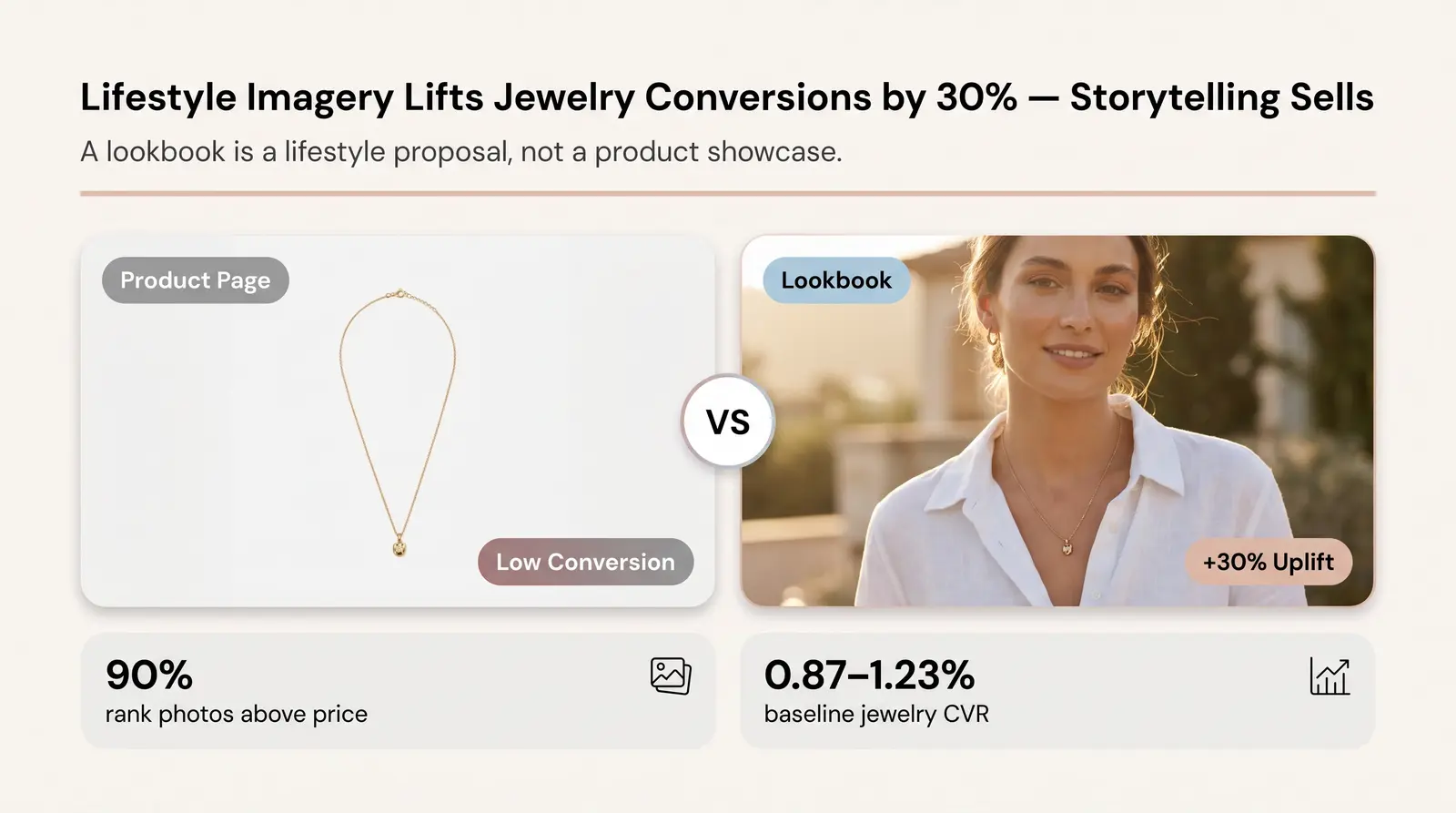
This emotional connection translates directly into revenue. According to eMarketer, ecommerce product pages that employ both lifestyle and studio photography see an average 30% uplift in conversion rates [1]. Research from Etsy reveals that 90% of online shoppers consider the quality of product photos to be "extremely important" or "very important" to their purchase decision, ranking higher than shipping costs or even the price of the item itself [2]. This is not a minor variable. It is the single most influential factor in whether a browser becomes a buyer.
At Branvas, we consistently see that sellers who invest in editorial imagery, even a single cohesive lookbook, report meaningfully higher average order values than those relying solely on product shots. The luxury and jewelry sector historically suffers from some of the lowest baseline conversion rates in ecommerce, hovering around 0.87% to 1.23% [3]. That gap between a jewelry brand's traffic and its revenue is almost always a visual storytelling problem. A lookbook disrupts this pattern by providing the visual context necessary to justify premium pricing. It transforms a commodity into a must-have accessory.
The contrarian insight here is worth sitting with: a lookbook is not primarily a product showcase. It is a lifestyle proposal. The most effective jewelry lookbooks barely feature the jewelry as the subject. Instead, they use the jewelry as the final, essential detail that completes a world the customer desperately wants to inhabit. When you internalize this, every creative decision, from the model's expression to the texture of the backdrop, becomes a conversion decision.
Before you book a photographer or select a digital publishing tool, you need to ensure your brand is actually ready for a lookbook. Launching a lookbook before you have the foundational elements in place is a common and expensive mistake. A poorly conceived lookbook does not just fail to convert; it actively undermines the premium positioning you are trying to build.
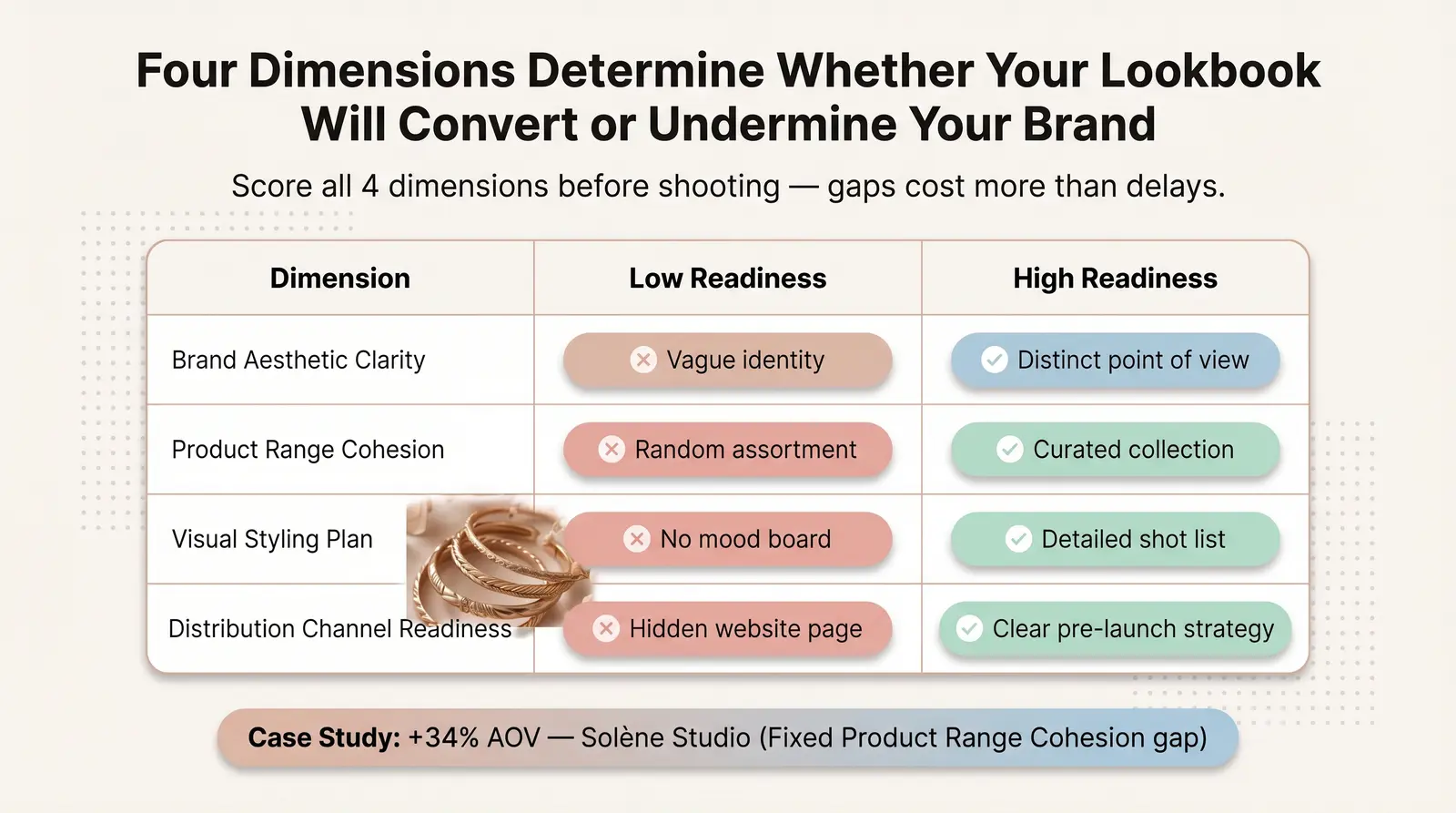
We use a proprietary framework called The Branvas Lookbook Readiness Matrix to evaluate whether a seller has the foundational elements in place to create a high-converting visual asset. This matrix assesses four critical dimensions: Brand Aesthetic Clarity, Product Range Cohesion, Visual Styling Plan, and Distribution Channel Readiness.
| Dimension | Low Readiness | High Readiness | Recommended Action |
|---|---|---|---|
| Brand Aesthetic Clarity | Vague identity; "jewelry for everyone." | Distinct point of view; clear target persona (e.g., "minimalist architect, 32, shops Arket and Net-a-Porter"). | Define your core customer and the specific mood your brand evokes before shooting a single frame. |
| Product Range Cohesion | Random assortment of unrelated styles and metals with no unifying thread. | Curated collection tied together by a central theme, material, or narrative arc. | Group your pieces into a cohesive "drop" or seasonal collection of 8 to 15 items. |
| Visual Styling Plan | No mood board; relying entirely on the photographer to figure it out on set. | Detailed shot list, defined lighting style, specific wardrobe and prop pairings, and confirmed model casting. | Create a comprehensive mood board with 20 to 30 reference images before the shoot. |
| Distribution Channel Readiness | Planning to upload a PDF to a hidden website page and hope people find it. | Clear pre-launch strategy for email integration, social media slicing, and shoppable hotspot setup. | Map out exactly how the lookbook will be shared and shopped before production begins. |
Consider a fictional influencer brand, "Solène Studio." Solène had a highly engaged Instagram following of 85,000 and a genuine eye for aesthetics, but she scored critically low on Product Range Cohesion. Her shop offered a chaotic mix of chunky resin rings, delicate silver chains, and turquoise statement earrings with no unifying thread. Before shooting her lookbook, she used the matrix to identify this gap. She paused her launch, curated a tight 12-piece collection focused exclusively on sculptural gold demi-fine jewelry, and developed a Visual Styling Plan centered around warm Mediterranean lighting and sun-bleached linen textures. She also mapped out a full distribution strategy before the shoot, including an email teaser sequence and a set of Instagram Reels using behind-the-scenes footage. The resulting lookbook felt intentional, premium, and immediately drove high-ticket sales. Her average order value increased by 34% in the first month after launch.
If you are working with a private-label supplier like Branvas, the Readiness Matrix becomes even more powerful because you can align your product selection directly with your lookbook concept from the start. Explore how Branvas works for ecommerce and boutique store owners to see how this kind of brand-first approach is built into the platform.
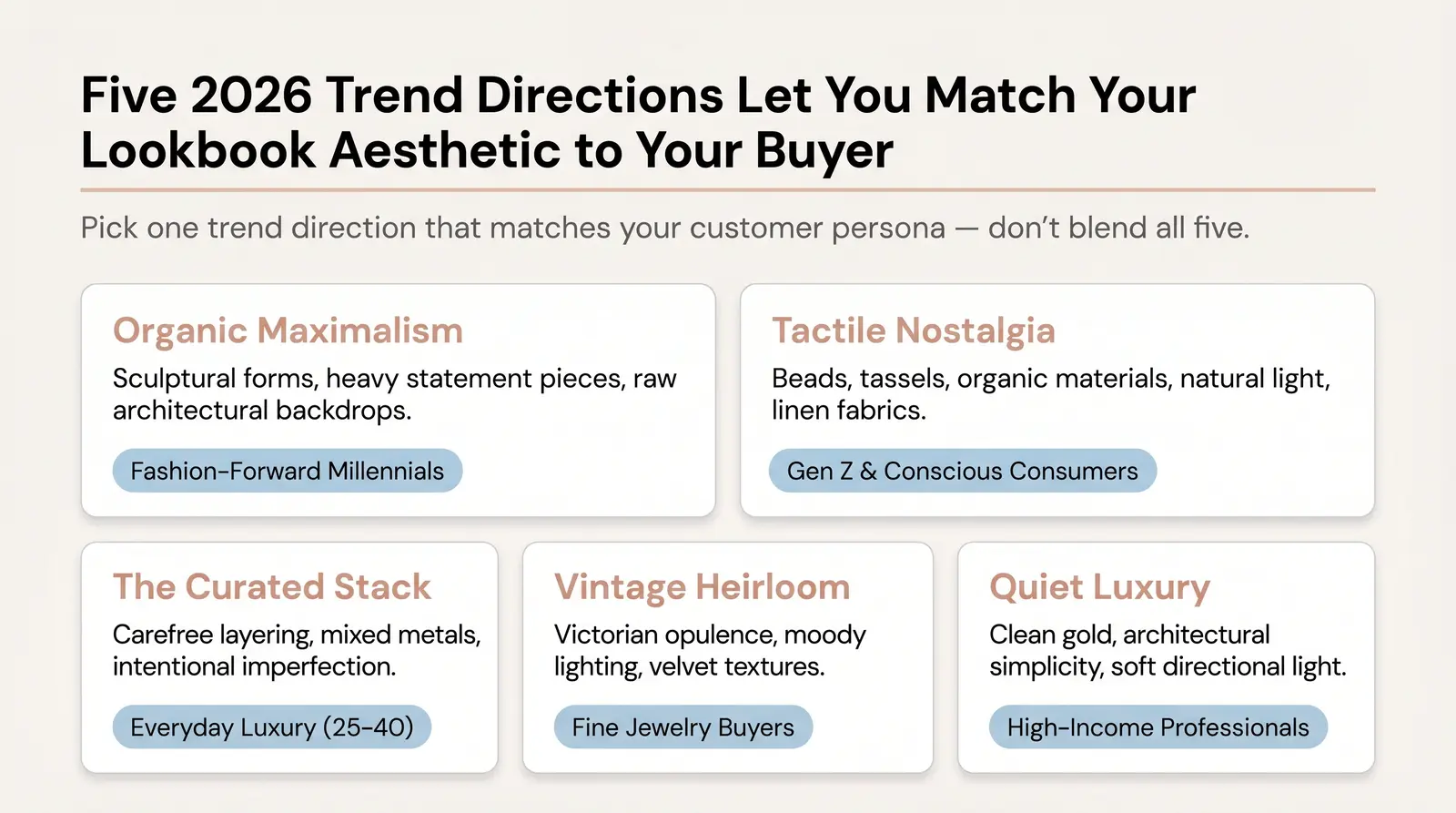
To create a lookbook that feels urgent and desirable, your styling must reflect current cultural movements. The jewelry landscape in 2026 is defined by a decisive shift away from extreme minimalism toward expressive, tactile, and highly personal aesthetics [4]. Understanding which trend direction aligns with your brand identity is the first creative decision you will make.
Organic Maximalism and Sculptural Forms
The era of quiet luxury is making room for bold, sculptural statement pieces. Think abstract, fluid, and melted-looking gold cuffs, oversized dome rings, and earrings that read as wearable sculpture [5]. Jillian Sassone, founder of Marrow Fine Jewelry, describes the shift clearly: "Jewelry in 2026 feels sculptural, statement-making and personal. People want pieces that feel collected, expressive and a little unexpected" [4]. The mood is unapologetic and confident. To style this for a lookbook, pair heavy statement pieces with understated, structured clothing, like a tailored oversized blazer or a simple ribbed tank, to let the jewelry command the frame. Backdrops should be raw and architectural: concrete walls, marble surfaces, or industrial settings. This aesthetic speaks directly to fashion-forward millennials and confident dressers who view jewelry as wearable art.
Tactile Nostalgia: Beads, Tassels, and Organic Materials
Driven by a desire for physical connection in an increasingly digital world, tactile materials like wood, ceramic, glass beads, and corded tassels are dominating 2026 [4]. Ashley Moubayed, founder of Don't Let Disco, captures the emotional driver: "Wearing beads feels both nostalgic and personal, like carrying your own talisman. In a culture of speed and simulation, beads bring you back to something tactile and grounded." Lookbook styling should lean into this earthy, grounded mood. Utilize natural light, linen fabrics, and outdoor or textured backdrops like raw stone, terracotta, or dried botanicals to appeal to Gen Z and conscious consumers looking for talismanic, meaningful pieces.
The Curated Stack (Carefree Layering)
Matching sets are out. The "collected over time" look is in. This involves artfully layering necklaces of varying lengths and mixing metals (gold with silver) in a way that feels effortless and slightly undone [5]. The styling cue here is casual elegance. Think an unbuttoned white poplin shirt catching the afternoon sun, or a simple slip dress with four mismatched necklaces layered at different depths. The key is intentional imperfection. This direction is ideal for demi-fine brands targeting the everyday luxury segment, particularly buyers aged 25 to 40 who want to look put-together without appearing to try too hard.
Vintage-Inspired Heirloom Elegance
There is a strong resurgence of Victorian-inspired opulence and Art Deco geometry, including intaglio pendants, cocktail rings, and brooches [5]. This trend is driven by a broader cultural appetite for pieces that feel inherited rather than purchased. The mood is timeless and sophisticated. For your lookbook, utilize rich, moody lighting (think candlelight-adjacent warmth), velvet textures, and antique props like aged mirrors or leather-bound books to create a sense of history. This direction appeals to fine jewelry buyers, gift purchasers, and those seeking investment pieces that will appreciate in meaning over time.
Quiet Luxury Minimalism (Still Relevant)
While maximalism is ascendant, the quiet luxury aesthetic retains a strong following, particularly among high-income professional buyers. Clean gold, understated diamond pieces, and architectural simplicity remain powerful in the premium segment. For lookbooks targeting this customer, use clean white or cream backgrounds, soft directional natural light, and a model whose expression conveys calm confidence rather than drama. This approach is particularly effective for brands positioning themselves as investment jewelry rather than trend-driven accessories.
Not sure which jewelry styles fit your brand aesthetic? Browse the Branvas catalog to explore curated collections you can private-label and build a lookbook around.
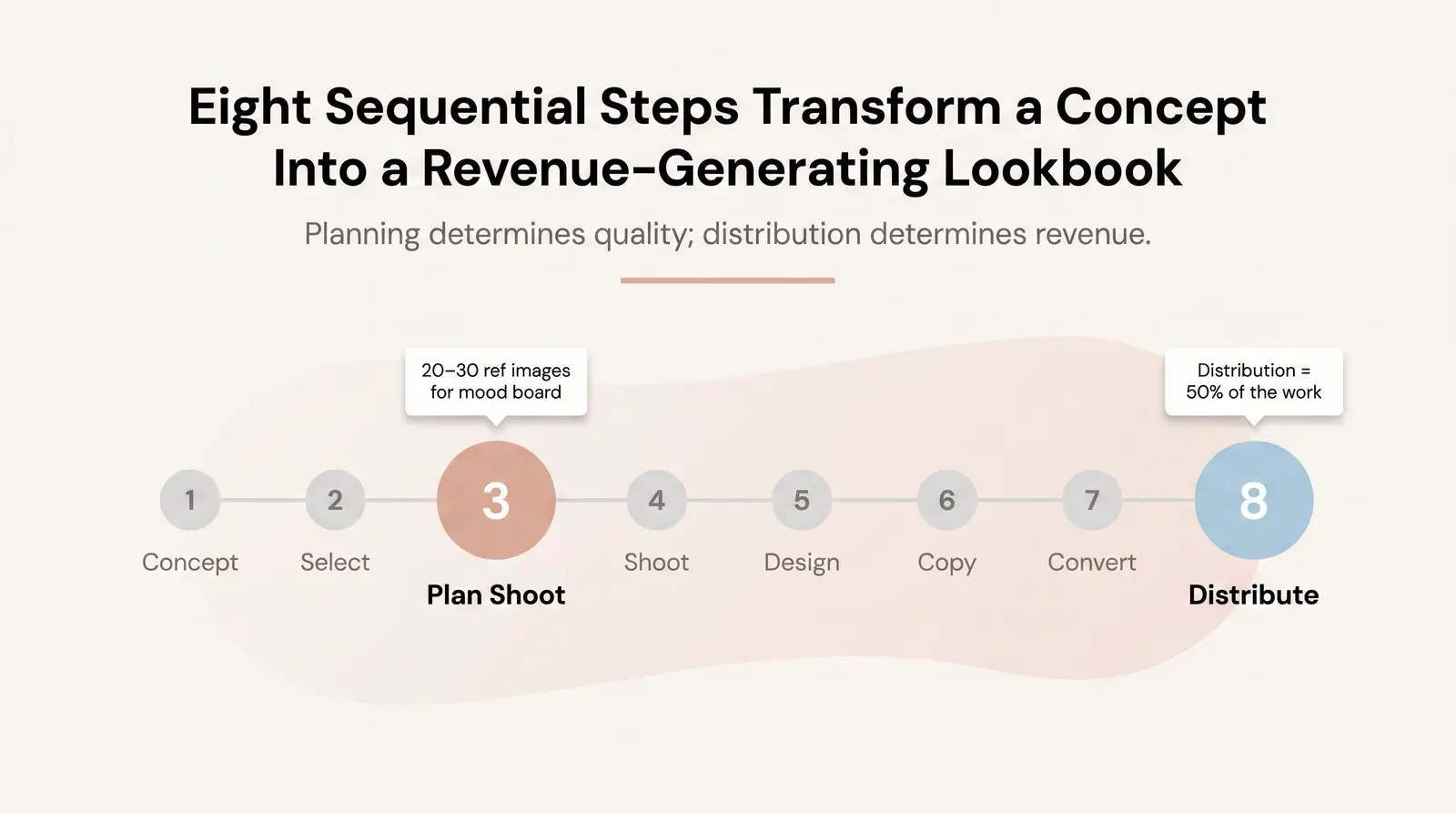
Creating a premium lookbook requires meticulous planning at every stage. The production process spans concept development, photography, design, and distribution. Here is the step-by-step process we recommend.
Step 1: Define your lookbook's concept and customer persona. Start with a clear, specific narrative. "Mediterranean summer escapes for the effortlessly chic woman" is a concept. "Jewelry" is not. Every visual decision, from the model's skin tone to the color of the linen, must serve this central concept and speak directly to a specific customer persona.
Step 2: Select your jewelry collection. Do not photograph your entire inventory. Select 8 to 15 pieces that tell a unified story. A lookbook is a curated edit, not a comprehensive catalog. The pieces should feel like they belong to the same world, even if they span different product categories (necklaces, earrings, rings).
Step 3: Plan your editorial shoot. This is the most underestimated step. Develop a detailed mood board with 20 to 30 reference images covering lighting style, model casting, wardrobe, makeup, locations, and props. Write a shot list that specifies each look: which pieces are featured, what the model is wearing, what the backdrop is, and what the intended crop is (full body, three-quarter, close-up detail). The more specific your brief, the more efficient and consistent your shoot will be.
Step 4: Execute the photography. Mix wide lifestyle shots (to establish the mood and context) with tight macro shots (to show product detail and craftsmanship). Here is a non-obvious jewelry photography tip that separates amateur shots from editorial-quality images: to make translucent gemstones or pearls look truly premium, use a small, diffused light positioned at a 45-degree angle behind the piece. This backlighting creates an internal luminosity, making the stones appear to glow from within. It is a hallmark of high-end editorial photography that most sellers never attempt. For metallic pieces, use a large, soft diffusion source (a window with a white curtain works well) to eliminate harsh reflections while preserving the natural sheen of gold and silver.
Step 5: Choose your layout and design tool. Select a digital platform that supports interactive, shoppable elements. Your layout should breathe. Use generous negative space, consistent typography, and a restrained color palette that complements your jewelry rather than competing with it. Avoid cluttered layouts that feel like a catalog page.
Step 6: Write conversion-focused micro-copy. Keep text minimal but impactful. Include evocative style notes ("The piece you reach for first, every morning"), clear product names, and subtle lifestyle cues. Avoid generic descriptions like "beautiful gold necklace." Instead, write copy that speaks to the feeling the piece creates.
Step 7: Add conversion elements. A beautiful PDF is a dead end. Add clickable hotspots, direct add-to-cart links, and clear pricing to remove all friction between inspiration and purchase. Every product featured must have a clear, immediate path to purchase.
Step 8: Distribute with intention. Slice the lookbook into dozens of micro-assets for Instagram Stories, embed it on your homepage hero, and send it as a VIP early-access link to your email subscribers. Distribution is not an afterthought; it is half the work.
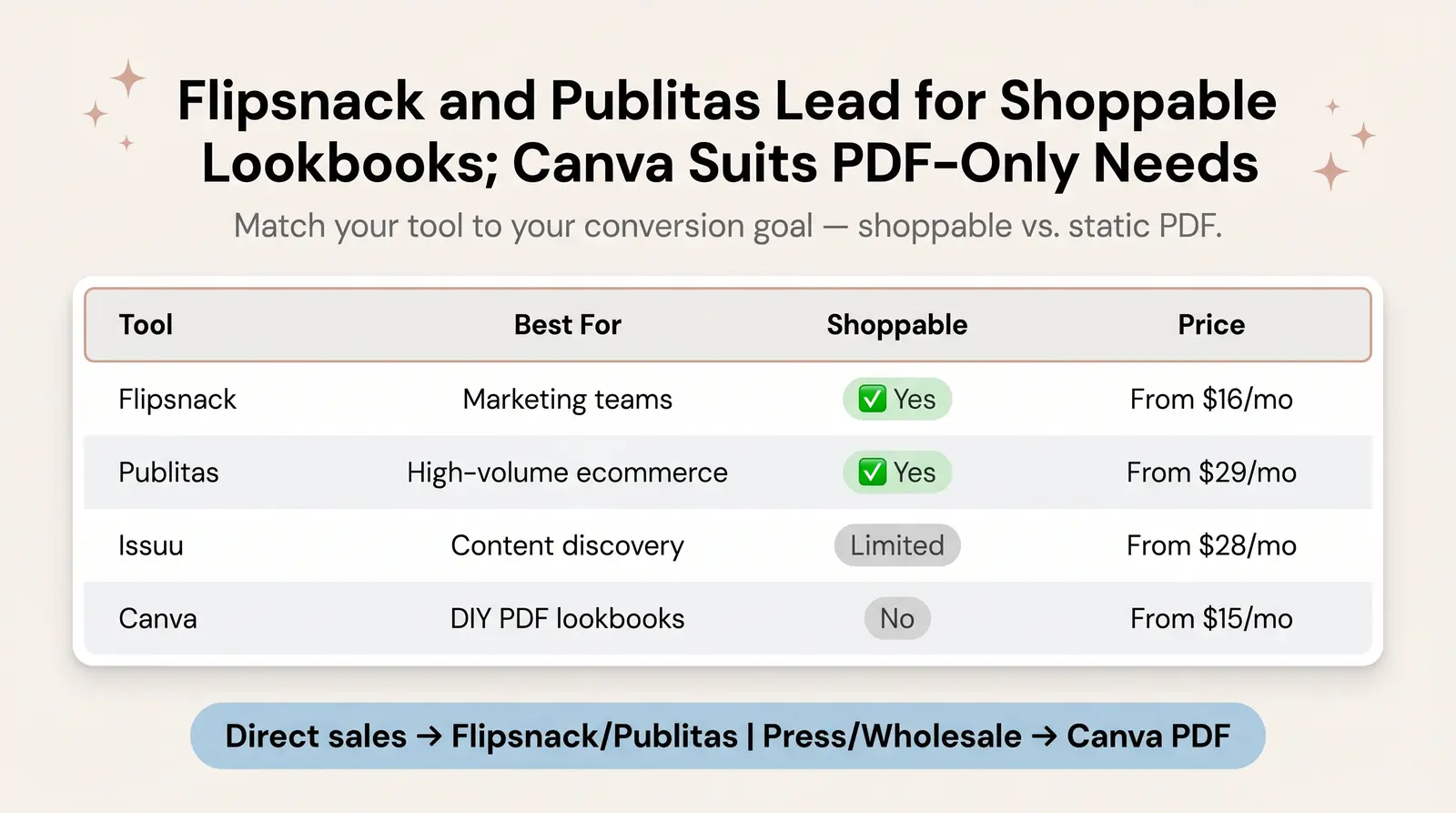
The platform you use to publish your lookbook is just as important as the photos inside it. You need a tool that supports high-resolution imagery, seamless ecommerce integration, and analytics so you can measure what is actually converting. Here is a comparison of the leading options available in 2026.
| Tool Name | Best For | Key Feature for Jewelry Sellers | Shoppable Capability | Pricing Tier |
|---|---|---|---|---|
| Flipsnack | Marketing teams scaling digital catalogs | Drag-and-drop design studio with animated "living visuals" and shopping tags [6]. | Yes (Shopping tags) | Free plan; Paid from $16/mo |
| Publitas | High-volume ecommerce brands | Advanced product hotspots with Google Shopping integration and analytics [7]. | Yes (Product hotspots) | Paid plans from ~$29/mo |
| Issuu | Content discovery and social reach | Built-in content marketplace and auto-generation of social-ready GIF assets [6]. | Limited (Links only) | Free plan; Paid from $28/mo |
| Canva | DIY designers and small brands building PDF lookbooks | Massive template library with brand kit enforcement and easy export [6]. | No (Design tool only) | Free plan; Pro from $15/mo |
Each tool serves a different purpose. Flipsnack and Publitas are the strongest choices for sellers who want a fully interactive, shoppable digital lookbook that lives on their website and drives direct revenue. Both platforms allow you to upload your designed spreads and overlay interactive hotspots that link directly to product pages or add-to-cart functions. Issuu is better suited for brands focused on building editorial credibility and organic discovery, as its built-in content network gives your lookbook visibility beyond your own audience. Canva is the right choice when you need to produce a polished PDF lookbook quickly for wholesale outreach or press kits, but it is not a publishing platform in the shoppable sense.
The format decision matters too. Use a digital, shoppable lookbook for your direct-to-consumer website and social media channels, where immediate conversion is the goal. Reserve static PDF lookbooks for wholesale outreach, press kits, and B2B communications where buyers need to download and review line sheets offline. The two formats are not in competition; they serve different stages of the sales funnel.
If you are an influencer or creator building a jewelry brand from scratch, the Branvas solutions for influencers and creators page outlines exactly how to combine private-label product sourcing with a lookbook-first launch strategy.
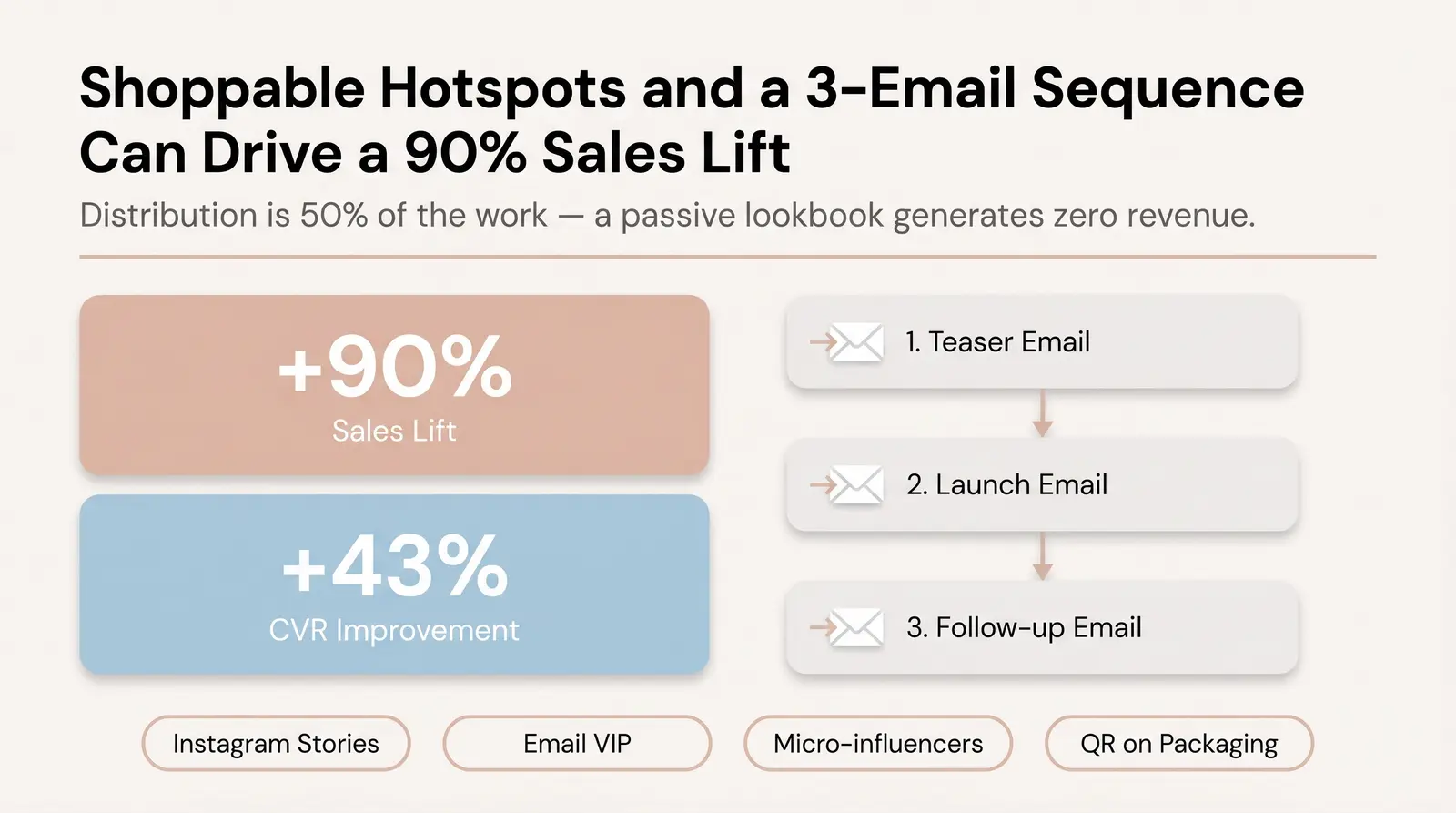
Most sellers build a beautiful lookbook and then do nothing with it. Distribution is 50% of the work. A lookbook sitting passively on a hidden webpage will not generate revenue, regardless of how stunning the photography is. You must actively engineer it for conversion at every stage.
Industry data indicates that interactive, shoppable lookbooks can drive up to a 90% sales lift and a 43% improvement in conversion rates compared to traditional static product grids [7]. To achieve this, every product featured in your lookbook must be instantly purchasable. Use digital publishing tools to overlay interactive hotspots on your jewelry. When a customer taps the necklace on the model, a quick-shop modal should appear, allowing them to add the item to their cart without ever leaving the lookbook experience. Removing this friction is the single most impactful conversion optimization you can make.
Beyond the website, your lookbook should be actively distributed across multiple channels simultaneously. Turn vertical spreads into Instagram Stories with link stickers that drive directly to the shoppable lookbook. Use the cover image as a lead-capture gate, offering "VIP Early Access to the Spring Collection" in exchange for an email address. Send the full interactive link to micro-influencers in your niche as a digital styling guide, giving them a ready-made asset to share with their audiences. Include a QR code in any physical packaging that links to the lookbook, turning every order into a re-engagement opportunity.
For email marketing, a lookbook launch sequence is one of the highest-performing campaign types in jewelry ecommerce. A three-email sequence works well: a teaser email with a single editorial image and a "coming soon" message, a launch email with the full lookbook link and a clear CTA, and a follow-up email featuring the top three best-selling pieces from the lookbook with direct product links. This sequence keeps the lookbook working for weeks after the initial launch.
If you're ready to build a private-label jewelry brand worth putting in a lookbook, see how Branvas works. From sourcing to branded packaging to blind fulfillment, we handle the infrastructure so you can focus on the aesthetic. You can also explore Branvas pricing to find the right plan for your brand stage.
A jewelry lookbook should include a mix of wide lifestyle shots that establish the brand's mood and tight macro shots that highlight product details and craftsmanship. It must feature cohesive styling across all images, minimal but evocative micro-copy, clear product names and pricing, and, most importantly, interactive shoppable links or clear product identifiers that facilitate immediate purchasing. A strong lookbook also includes a consistent color palette and a defined editorial narrative that runs through every spread.
Focus on a curated edit rather than your entire inventory. Featuring 8 to 15 cohesive pieces allows you to tell a compelling visual story without overwhelming the buyer. Each piece should earn its place in the lookbook by contributing to the overall narrative. Quality and thematic consistency are far more important than sheer volume. If you have a larger collection, consider creating multiple smaller lookbooks organized by aesthetic direction or customer persona rather than one sprawling catalog.
A professional photographer is highly recommended for high-ticket items, but it is not strictly mandatory if you have the right skills and equipment. If shooting yourself, you must invest in a macro lens (85mm to 105mm range), master diffused lighting to handle metallic reflections without harsh glare, and ensure your styling and post-production are flawless. The non-negotiable requirement is that the final images must look premium. If your photography looks amateur, no amount of good design or clever copy will compensate for it.
For ecommerce sellers focused on direct conversion, Flipsnack and Publitas are currently the strongest options. Both platforms allow you to upload your designed spreads and overlay interactive shopping hotspots, enabling customers to add items to their cart directly from the lookbook pages. Flipsnack is slightly more accessible for smaller brands due to its lower entry price point, while Publitas offers more advanced ecommerce integrations for high-volume sellers.
A lookbook justifies higher price points by elevating the perceived value of the jewelry through aspirational context. When a piece is photographed on a professional model in a premium setting with impeccable lighting and intentional styling, the customer's reference point shifts from "what does this cost to make" to "what does this say about who I am." The practical mechanics include using high-quality paper or high-resolution digital formats, writing micro-copy that speaks to the emotional value of the piece rather than its specifications, and ensuring every touchpoint of the brand experience, from the lookbook design to the packaging, signals the same level of quality. For deeper guidance on building a premium jewelry brand from the ground up, the Branvas Academy covers brand positioning, visual identity, and ecommerce growth strategies specifically for private-label jewelry sellers.
[1] Lifestyle vs. Studio Product Photography: Which Drives More Conversions? — Skywall Photography, 2025
[2] Why Product Photography Is Important — Etsy Seller Handbook, 2022
[3] eCommerce conversion rate benchmarks by industry — Dynamic Yield, 2024
[4] A New Era of Maximalist Jewelry Is Upon Us — Fashionista, February 2026
[5] Top Jewelry Trends for 2026 to Update Your Collection — Blue Nile, January 2026
[6] Best Digital Publishing Platforms in 2026 — Flipsnack Blog, March 2026
[7] How To Create A Lookbook For Ecommerce: Strategy and UX — Publitas, 2025