


Build luxury brand perception on a tight budget using five compounding signals: visual identity, packaging, photography, pricing psychology, and brand storytelling.
Published:
August 28, 2026
Author:
Yi Cui
High-end perception doesn't require a high-end investment.
Most people believe luxury branding is gatekept behind massive budgets, agency retainers, and expensive product lines. They assume that without a six-figure launch campaign, a premium product line, or a warehouse full of inventory, they simply can't compete with established names. That assumption is wrong.
Perception is engineered, not purchased. Legacy luxury brands like early Hermès built their identity as a harness workshop in Paris before expanding into the iconic accessories house it became. Glossier launched in 2014 with just four products and a blog community, building cult-level perceived prestige through deliberate signals and community trust before any significant ad spend. Neither brand started with a massive capital base. Both understood that luxury is a feeling, and feelings are created through consistency, craft, and story.
This article gives you a step-by-step system for building luxury-level brand perception on a constrained budget. You will learn specific, actionable tactics around visual identity, packaging, photography, pricing, and positioning so you can launch or reposition your product business credibly, without draining your bank account.
Luxury perception is a cognitive construct, not a price tag. When consumers evaluate a brand, they rely on a series of psychological signals to judge quality before they ever touch the product. According to Aaker's Brand Equity model, perceived quality is one of the five core dimensions of brand equity, and it allows brands to charge premium prices based on how consumers perceive their offerings rather than the objective quality of the product itself [1]. In other words, perception drives price tolerance, not the other way around.
The key signals consumers use to judge quality before purchase include visual coherence, material cues, scarcity language, brand confidence, and tactile or sensory anticipation. Even through a digital screen, these signals register. A beautifully styled product photo on a marble surface communicates something entirely different from the same product photographed on a kitchen counter, even if the product is identical.
Contrarian Insight: Most founders chase expensive inputs (premium materials, big ad budgets) when the actual driver of luxury perception is consistency of signals. A $0.10 tissue paper insert with the right typeface and brand color outperforms a $5 unbranded box every time. Research published in the Journal of Business Research confirms that visually simple and consistent packaging designs lead to higher perceptions of brand authenticity and value compared to complex, disjointed designs [2]. The signal matters more than the cost.

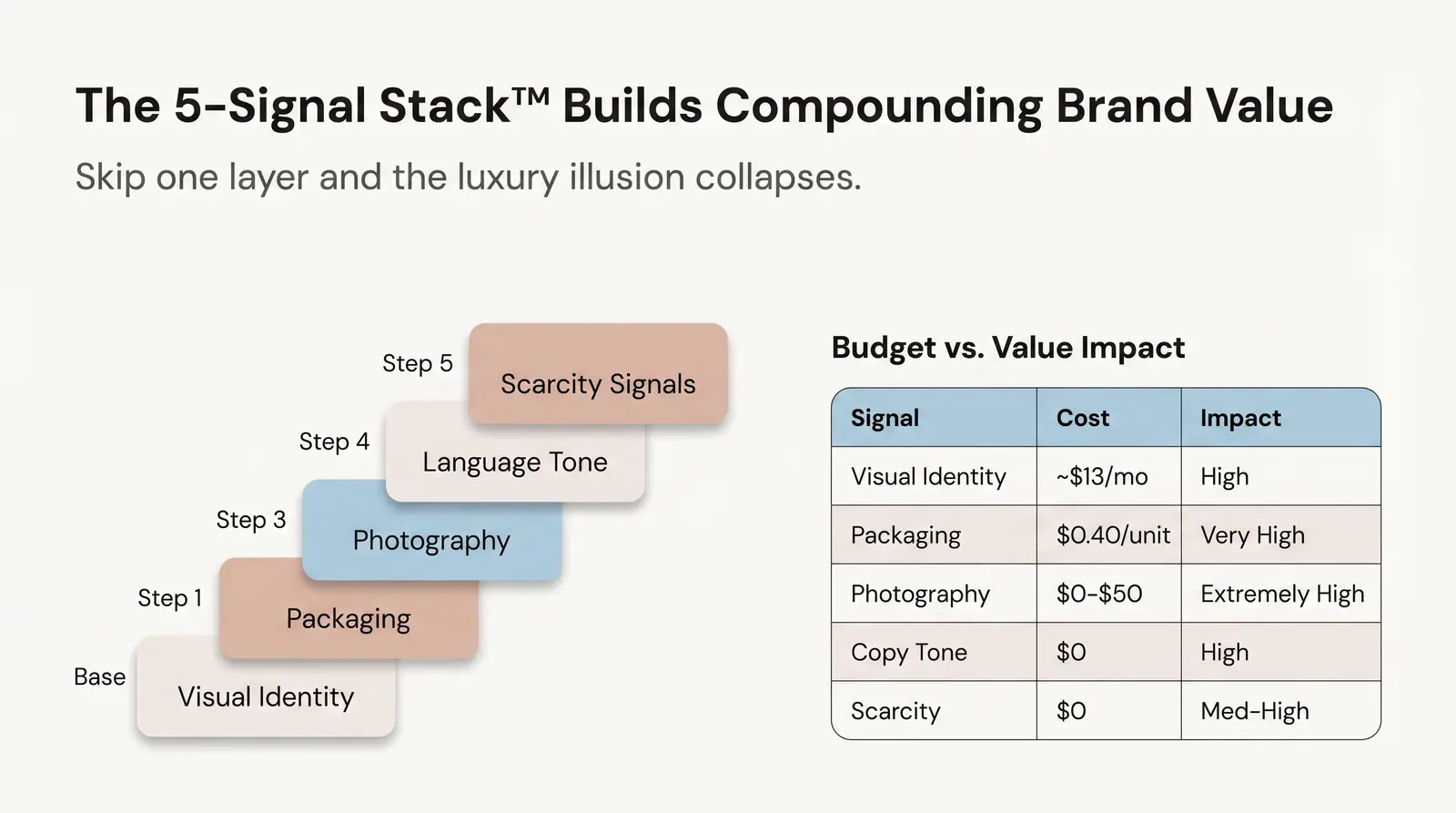
At Branvas, we've distilled luxury brand perception into five compounding signals we call The 5-Signal Stack™. Each layer builds on the last. Skip one and the illusion collapses.
1. Visual Identity Coherence
Logo, color palette, and typography must be ruthlessly consistent across every touchpoint: your website, packaging, social media, email footer, and even your order confirmation page. Inconsistency reads as "cheap" to the subconscious, even when individual elements are high quality. A brand that uses three different fonts across its touchpoints signals that no one is paying attention to detail. Luxury brands pay attention to everything, and that attention is what customers feel.
2. Packaging as Product
The unboxing experience is part of the product. Not a nice-to-have. Part of the product. Elements like custom tissue paper, ribbon, branded stickers, thank-you cards, and scent inserts elevate the perceived value of what's inside. You can achieve this at a low unit cost using MOQ-friendly suppliers on Alibaba or platforms like Sticker Mule, turning a simple delivery into a memorable, shareable moment.
3. Photography and Mockup Quality
This is the single highest-leverage investment for a bootstrapped luxury brand. High-quality imagery instantly communicates premium status and builds trust, often serving as the primary deciding factor for online shoppers who cannot physically handle the product. More on this in the dedicated section below.
4. Language and Tone Discipline
Luxury brands don't "sell." They invite, present, and offer. Your copywriting must reflect confidence and exclusivity at every level. A low-end brand says "Buy now before we run out!" A luxury-coded brand says "Discover the limited collection." The difference is not just tone; it signals an entirely different relationship between brand and customer.
5. Scarcity and Selectivity Signals
Limited drops, waitlists, selective brand partnerships, and "by application" language create a sense of exclusivity. These tactics can be implemented even with zero inventory using pre-order or made-to-order models, driving desire through perceived rarity rather than actual scarcity.
Here is how each signal maps to a budget execution:
| Signal | Budget Execution | What It Costs | Perceived Value Impact |
|---|---|---|---|
| Visual Identity | Canva Pro + free font pairing guides | ~$13/mo | High |
| Packaging | Branded tissue + sticker + card via Alibaba/Sticker Mule | $0.40-$1.20/unit | Very High |
| Photography | Styled flatlay with phone + free editing apps | $0-$50 | Extremely High |
| Copy Tone | Rewrite product descriptions using luxury language rules | $0 | High |
| Scarcity Signals | Limited-drop language + pre-order model | $0 | Medium-High |
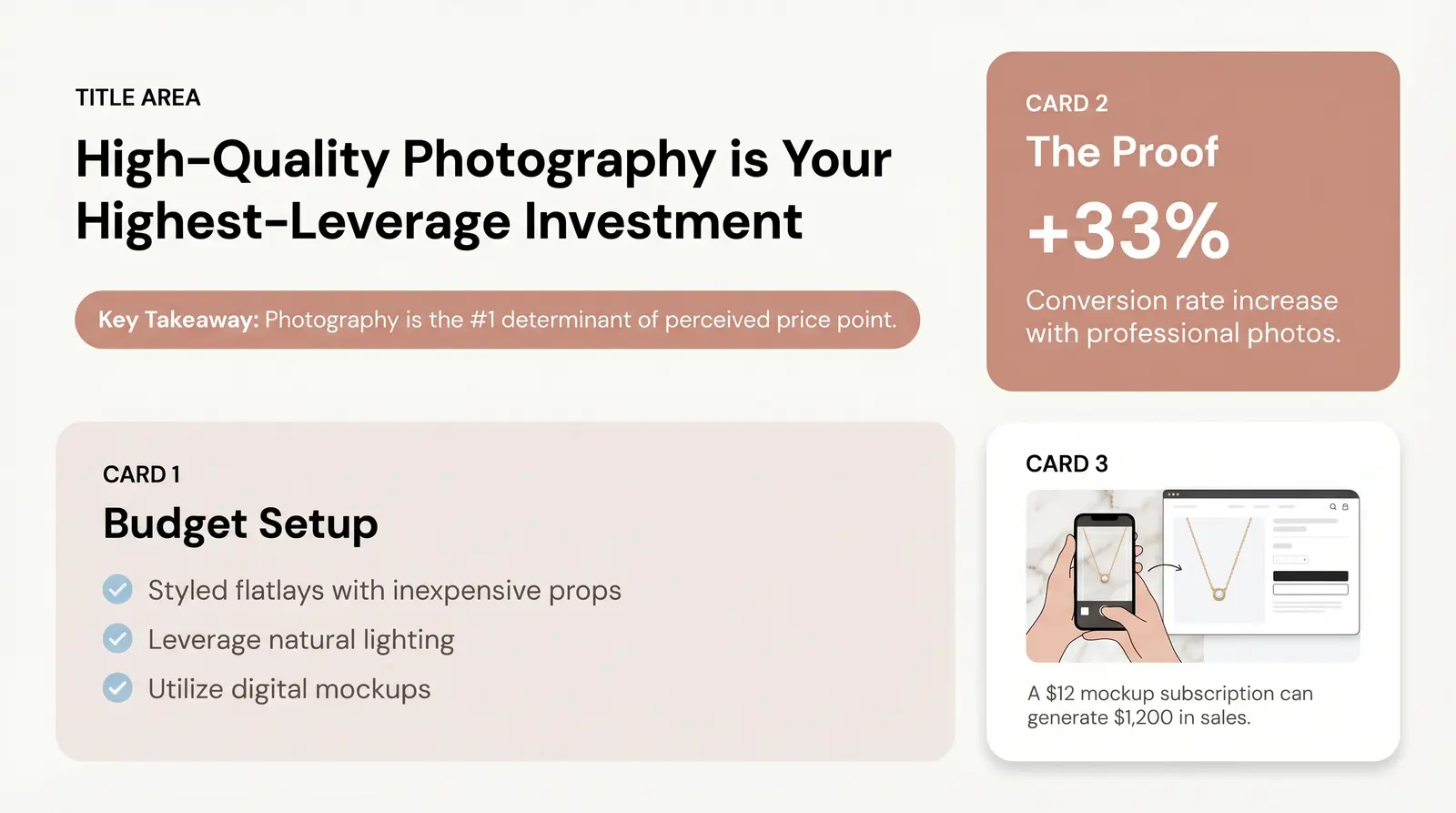
Photography is the number one determinant of perceived price point in ecommerce. A Cornell University study found that buyers in online marketplaces are significantly more likely to trust sellers who use high-quality photos in their listings, with items featuring better imagery being measurably more likely to sell [3]. A separate analysis found that products with professional-quality photos see up to a 33% higher conversion rate compared to those with low-quality images.
The good news: you don't need a professional photographer to achieve this.
Styled flatlay photography on a budget. The setup matters more than the equipment. Use inexpensive props like marble vinyl contact paper (available on Amazon for under $15), neutral linen fabric, dried botanicals, or raw ceramic dishes. For lighting, natural north-facing window light is your best free resource. A $30 ring light works well when natural light isn't available. Use your phone camera's portrait mode and manual focus to create depth and sharpness. Then refine the images with free tools like Lightroom Mobile presets or VSCO to achieve a consistent, editorial look.
Digital mockups. Tools like Placeit, Creative Market mockup templates, and Canva mockups allow you to produce studio-quality brand imagery without a single photoshoot. You can place your logo on packaging, show your product in lifestyle settings, or generate images of your jewelry being worn by a model, all from your laptop.
Worked Example: A founder launches a gold-filled necklace line. She has one physical sample. Using a $12 Placeit subscription, she generates 8 lifestyle mockup images showing the necklace worn by a model, placed in a jewelry dish, and gift-wrapped in a branded box, all without a photoshoot. Her Shopify store launches looking like a brand with a $50K photography budget. She closes her first $1,200 in sales before her physical inventory arrives.
Before spending anything on props or tools, create a brand moodboard and define your visual direction. Spend an afternoon on Pinterest collecting reference images from brands whose aesthetic aligns with your vision. This exercise costs nothing and prevents expensive creative mistakes later.
For video content on zero budget, an iPhone, a tripod, and a slow zoom over a styled flatlay can produce luxury unboxing content that performs well on TikTok and Reels. Trending formats like "silent unboxing" and "aesthetic product reveal" are well-suited to this approach and require no voiceover or editing expertise.
In our experience at Branvas, the single thing that separates a brand that converts at 3% from one that converts at 0.8% isn't the product. It's the photography. We see this pattern repeatedly across the brands we work with.
Packaging is where the luxury illusion is either confirmed or shattered. Specific low-cost upgrades disproportionately shift perceived value.
Custom tissue paper can cost as low as $0.08 per sheet at volume. Wax seals add approximately $0.25 per unit and create an immediate sense of ceremony. Branded ribbon from MOQ-friendly suppliers adds a tactile premium feel. Handwritten-style thank-you inserts, which can be printed rather than actually handwritten, add a personal touch that customers associate with boutique, high-end brands.
The psychology of the "reveal moment" is well-documented. A study by Package InSight found that the perceived value of a package, product, and brand were all rated significantly higher when tissue paper was used in packaging compared to standard void-fill materials. Participants who received tissue-wrapped items valued the package 24% higher when asked how much they would pay to send it as a gift [4]. That's a 24% perceived value lift from a material that costs less than a dime.
The reveal moment also drives social sharing. When customers feel like they're opening something special, they film it. That organic content is worth more than paid advertising.
If you'd rather skip the sourcing headache entirely, Branvas handles branded packaging and fulfillment out of the box.

Pricing is a signal, not just a number. The way you display your price communicates your brand's self-perception before the customer reads a single word of copy.
Charm pricing (ending in .99 or .95) is effective for value-oriented products because it signals a deal. But for luxury brands, it works against you. Research confirms that round numbers (like $100 or $280) signal quality and exclusivity, while .99 endings activate associations with discounting and low-price positioning [5]. If you want to be perceived as premium, price like it.
Anchoring is another essential tactic. Always show a higher-priced option first. When a customer sees a $380 piece before a $180 piece, the $180 feels accessible rather than cheap. This is how luxury brands create entry-level products that still feel elevated.
The Veblen goods principle is also worth understanding. For certain categories, a higher price actually increases desirability by signaling status and exclusivity [6]. This is why a $300 candle sells better than the same candle at $40 in a luxury retail context. The price is part of the product's meaning.
We often see founders underprice their products out of insecurity about their brand's stage. This ironically destroys the luxury positioning they've worked hard to build. Price with confidence.

A compelling origin story is free and is one of the most powerful luxury brand assets available to you. Heritage brands like Tiffany and Cartier use narrative to build deep emotional connections and justify their premium positioning across generations [7]. Their stories are not just marketing. They are the product.
New founders can craft a values-driven or aesthetic-driven origin story even without decades of history. You don't need a 150-year-old atelier in Paris. You need a genuine tension, a clear conviction, and a sensory brand promise.
Use this template to establish your narrative:
The Origin Signal Formula™: [Founder name/we] started [Brand] because [genuine tension or gap in the market]. We believed [core conviction]. Every [product type] we make is [brand promise in sensory or emotional language].
For example: "We started Aurore because fine jewelry shouldn't require a fine jewelry budget. We believed that the woman who knows what she wants shouldn't have to compromise. Every piece we make is designed to feel like a secret worth keeping."
That kind of statement costs nothing to write and communicates more about a brand's positioning than a $5,000 brand strategy deck.
Ensure your brand voice is consistent across three must-nail touchpoints: your Instagram bio, your About page, and your packaging inserts. These are the moments where customers decide whether to trust you, follow you, and tell their friends about you.

The private-label, print-on-demand, or dropship model allows you to keep startup costs near zero while maintaining full brand control. You don't need to own inventory to own a brand.
Blind fulfillment is critical for maintaining the brand illusion. When a customer receives a package with a generic poly mailer and a third-party return address, the luxury perception collapses instantly. Every physical touchpoint must reinforce the brand, from the outer packaging to the insert card inside.
This is exactly what Branvas was built for: helping influencers, boutique owners, and first-time founders launch a private-label jewelry or accessories brand that looks and feels luxury from day one, without sourcing factories, managing inventory, or packing boxes.
Ready to launch your luxury brand without the overhead? Explore how Branvas works.
Browse our product catalog to see what's available for private labeling at branvas.com/catalog.

Building a luxury brand perception can cost very little if you focus on the right signals. With tools like Canva for design, Placeit for mockups, and low-MOQ packaging suppliers, you can establish a premium look for under $100. The true investment is in consistency, high-quality photography, and disciplined brand messaging rather than massive capital outlay. Many successful luxury-positioned brands have launched for less than $500 in total brand infrastructure costs.
High-end perception is driven by the consistency of signals surrounding the product, not the product's cost of goods. This includes a cohesive visual identity, a premium unboxing experience (custom tissue paper, heavy cardstock inserts, branded ribbon), prestige pricing with round numbers, and styled, high-resolution photography. These elements collectively elevate the perceived value far beyond the manufacturing cost. The packaging and presentation often do more work than the product itself.
Yes. Luxury is about exclusivity and desirability, not mass reach. You can build a luxury brand by focusing on a niche audience, using scarcity tactics like limited drops or waitlists, and ensuring every touchpoint from your website to your packaging exudes premium quality. A small, highly engaged community of 500 loyal customers is often more commercially valuable than 50,000 passive followers. Luxury brands like Aesop and Loro Piana built significant equity with minimal social media presence by prioritizing experience over exposure.
A premium brand justifies a higher price through superior performance, better materials, or enhanced features. It's a logical purchase. A luxury brand transcends utility entirely. It sells an identity, a story, and a sense of belonging to a select group. Luxury purchases are emotional and often aspirational, driven by the brand's heritage, exclusivity, and the psychological signals it projects. Premium says "this is worth more." Luxury says "this is not for everyone."
Use prestige pricing with round numbers (for example, $150 instead of $149.99) to signal quality. Employ price anchoring by displaying a higher-priced halo product first, making your core offerings feel accessible rather than cheap. Introduce an entry-level product that maintains brand integrity while lowering the barrier to first purchase. In the luxury space, a higher price often increases desirability by signaling exclusivity and superior value. The goal is not to be affordable. The goal is to be worth it.