


Build a luxury jewelry unboxing experience using the 5-Layer Method, with POD-friendly sourcing and a $3-$5 per-order budget that drives UGC and repeat purchases.
Published:
April 8, 2026
Author:
Yi Cui
First impressions start before the box is even opened. For jewelry sellers, the moment a customer receives their package is the most critical physical touchpoint in the entire customer journey. It is the bridge between the digital promise made on a website and the physical reality of the product. When a customer holds a package, their brain is already making subconscious judgments about the value of what is inside.
The psychology of anticipation plays a massive role in this experience. The act of unwrapping triggers the brain's reward system, releasing dopamine and creating a sense of excitement and satisfaction [1]. This tactile perception (the weight of the box, the texture of the materials, the sound of tissue paper) sets the stage for how the jewelry itself will be perceived. A premium unboxing experience can elevate a simple piece of jewelry into a luxury item, while poor packaging can make even fine jewelry feel cheap.
By the end of this guide, you will know exactly how to build a luxury unboxing experience that rivals top brands, even if you have no warehouse, a lean budget, and require low or no minimum order quantities (MOQ).
Packaging is often viewed as an operational expense, but it is actually one of the most powerful marketing investments a brand can make. A well-designed unboxing experience influences perceived value, justifies price premiums, and drives user-generated content (UGC) and social sharing. In fact, 72 percent of consumers agree that packaging design can influence their purchasing decisions [2]. When a customer feels they are receiving a premium experience, they are far more likely to return; 52 percent of consumers are more likely to make repeat purchases if their orders arrive in premium packaging [3].
However, there is a contrarian truth that many new sellers miss: under-investing in packaging often costs more in the long run. Brands that ship delicate jewelry in generic, flimsy poly mailers frequently see higher return rates, lower customer lifetime value (LTV), and weaker word-of-mouth. Think of it like serving a gourmet meal on a paper plate: the presentation actively detracts from the quality of the product. A poor unboxing experience breaks the spell of luxury, making the customer question the value of their purchase and reducing the likelihood they will buy again or recommend the brand to a friend.
In our experience at Branvas, sellers who invest even modestly in their unboxing moment see a measurable lift in customer photo shares and repeat orders. It is not about spending exorbitant amounts of money; it is about intentional design and creating a cohesive brand narrative from the outside in.

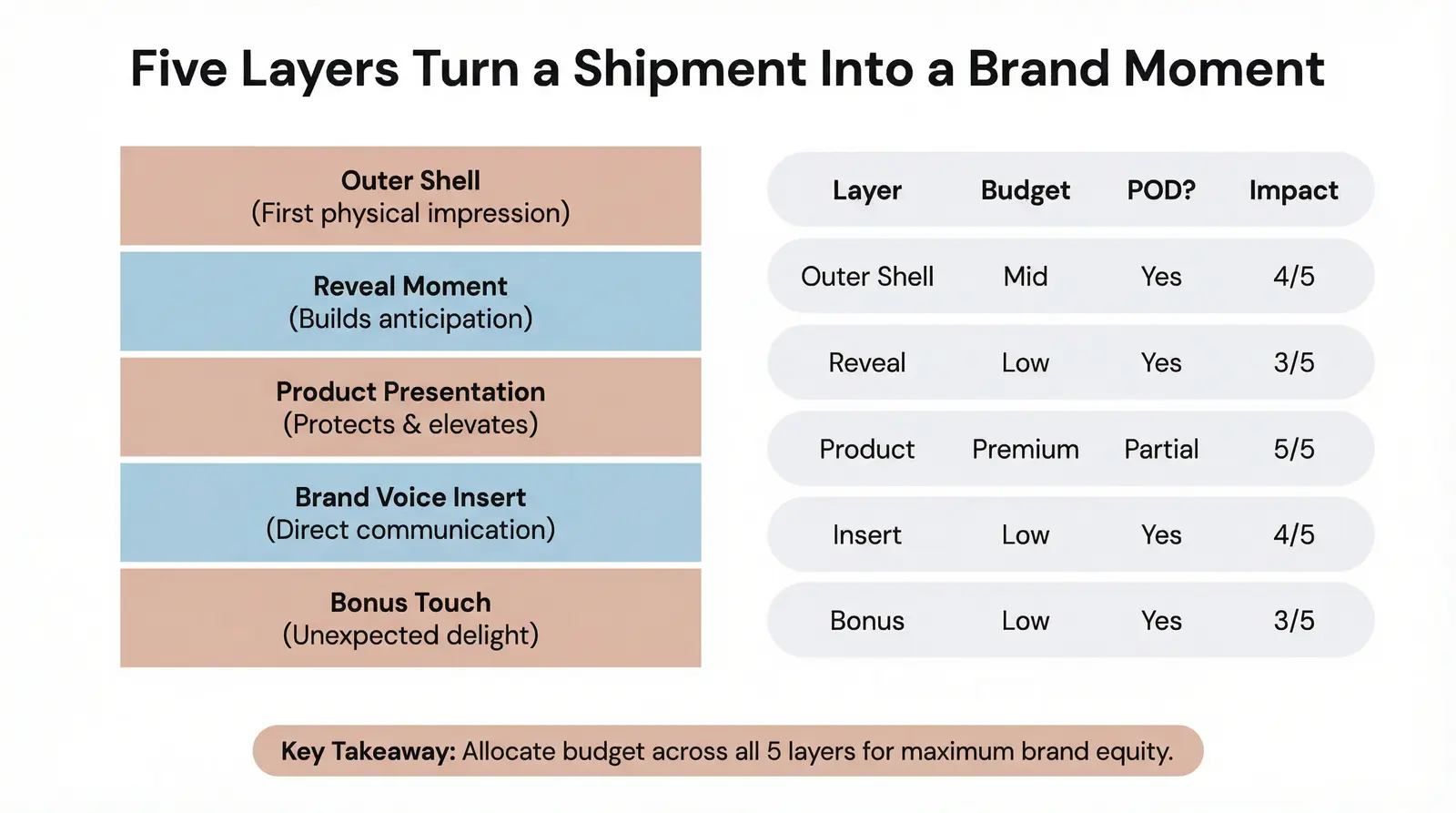
To help private-label jewelry brands systematically build a premium experience, we use The Branvas Unboxing Equity Framework™ (The 5-Layer Method). This structured system breaks down the unboxing process into five distinct touchpoints, allowing brands to allocate their budget effectively while maximizing impact.
| Layer | Budget Tier | POD/Low-MOQ Friendly? | Brand Impact Score | Example Options |
|---|---|---|---|---|
| 1. Outer Shell | Mid | Yes | 4 | Custom printed mailer box, branded eco-mailer |
| 2. Reveal Moment | Low | Yes | 3 | Custom tissue paper, branded sticker seal |
| 3. Product Presentation | Premium | Partial | 5 | Rigid box with foam insert, custom microfiber pouch |
| 4. Brand Voice Insert | Low | Yes | 4 | Heavy cardstock thank-you note, care guide |
| 5. Bonus Touch | Low | Yes | 3 | QR code card, branded polishing cloth |
Let’s look at a concrete, realistic example. Meet Lena, a fictional jewelry seller who offers gold-plated necklaces with an average order value (AOV) of $45.
Before: Lena was shipping her necklaces in a plain white bubble mailer. Inside, the necklace was placed in a generic plastic zip-top bag with a standard business card. The total packaging cost was around $0.50 per order. While cheap, the experience felt transactional and forgettable. Her repeat purchase rate was low, and customers rarely posted photos of their orders online.
After: Lena applied the 5-Layer Method to upgrade her packaging, keeping her budget between $3 and $5 per order using low-MOQ suppliers.
Total Cost: $3.80 per order.
The Impact: By investing an additional $3.30 per order, Lena transformed her brand perception. The unboxing experience now feels like a $100 purchase rather than a $45 one. The perceived value increase justifies her pricing, and the aesthetic presentation significantly boosts her UGC potential. Customers are now excited to share their "unboxing" on Instagram Stories, providing free social proof and driving new customer acquisition.

For small jewelry brands, sourcing custom packaging used to require ordering thousands of units at a time. Today, there are realistic options available that cater to lean budgets and low minimum order quantities.
Print-on-demand (POD) platforms like Packlane, noissue, and Arka have revolutionized the packaging industry. They offer custom mailer boxes, tissue paper, and stickers with very low minimums, sometimes as few as 25 to 50 units [4]. These platforms are incredibly user-friendly, allowing you to design your packaging online and receive it within a few weeks.
Alternatively, wholesale low-MOQ suppliers (often found on platforms like Alibaba or specialized jewelry box vendors) can provide rigid boxes and pouches at lower unit costs, though they may require minimums of 300 to 500 units and have longer lead times for international shipping [5]. The tradeoff is always unit cost versus minimum order size, customization depth, and lead times.
If you're launching a jewelry brand and want packaging built into your brand setup from day one, Branvas's how-it-works page walks through how this is handled end-to-end. Brand-as-a-Service solutions can manage the complexities of sourcing, branding, and fulfillment, allowing you to focus on marketing and growth.

Even with the best intentions, small jewelry brands often make packaging mistakes that undermine their brand equity. Here are the most common pitfalls and how to fix them:

Unboxing videos are a massive content category. In fact, over 90,000 people search for "unboxing" on YouTube every single month, and 40 percent of consumers say branded packaging makes them more likely to share a product image or video on social media [6]. Designing your unboxing experience specifically for UGC is a highly effective way to generate organic marketing.
To make your packaging "Instagrammable," focus on the visual hierarchy. When the box is opened, the layout should be clean and aesthetically pleasing. Use lighting-friendly colors: soft neutrals, pastels, or bold, high-contrast palettes work well on camera. Create intentional "moments" within the unboxing, such as a beautifully sealed tissue paper wrap or a striking insert card placed perfectly on top.
Encourage sharing directly. Include a clear call-to-action on your insert card, prompting customers to share their unboxing experience and tag your brand. You can also include a QR code that links to your social media profiles or a specific campaign hashtag. Top influencer brands excel at this, turning every customer into a micro-influencer by providing an experience that is simply too beautiful not to share.

Q: What is the most cost-effective way to create branded jewelry packaging with low MOQ?
A: The most cost-effective approach is to use a plain, high-quality stock box or mailer and customize it with low-cost branded elements like custom stickers, stamps, or branded tissue paper. Platforms like noissue or Packlane offer low minimums for these items, allowing you to create a cohesive look without a massive upfront investment.
Q: What should I include in a jewelry unboxing insert?
A: A strong insert should include a brief, genuine thank-you message, essential jewelry care instructions to ensure product longevity, and your social media handles or a specific hashtag to encourage UGC. You can also include a subtle discount code for their next purchase to drive repeat business.
Q: How do I make my jewelry packaging look luxury without a big budget?
A: Focus on texture and consistency. Use matte finishes instead of glossy ones, opt for heavy cardstock for any printed materials, and stick to a minimalist, cohesive color palette. A simple, well-made microfiber pouch inside a sturdy kraft box with a single branded sticker often looks more luxurious than a cheap, overly printed glossy box.
Q: What packaging formats work best for jewelry sold online vs. in-person?
A: For online sales, the outer packaging must prioritize protection and survive the shipping process, making sturdy mailer boxes or padded mailers essential. For in-person sales, the focus shifts entirely to presentation and immediate portability, making elegant shopping bags, rigid presentation boxes, and delicate ribbon ties more appropriate.
Q: Can I use print-on-demand packaging for jewelry if I'm dropshipping or using a fulfillment partner?
A: Yes, but it requires coordination. If you use a fulfillment partner or a Brand-as-a-Service platform, you can often supply them with your custom POD packaging materials to use when fulfilling your orders. Some platforms integrate this directly into their service, ensuring your branding remains consistent even if you never touch the product yourself.
Packaging is not just a vessel for delivering a product; it is one of the highest-ROI brand investments a jewelry seller can make, especially at the early stage. It sets the tone, justifies your pricing, and turns one-time buyers into loyal advocates. By implementing the 5-Layer Method, you can build a scalable, premium unboxing experience that grows with your business, regardless of your starting budget.
If you're ready to launch a jewelry brand with professional packaging, fulfillment, and branding built in from day one, explore Branvas's Brand-as-a-Service model or browse the product catalog to see what's possible. Whether you are looking for solutions for influencers and creators or tailored support for ecommerce and boutique store owners, building brand equity starts with the details.