


Sensory-optimized jewelry packaging leveraging weight, haptics, acoustics, and visual contrast triggers neurological reward cycles that drive repeat purchases and multiply customer lifetime value by 3x.
Published:
July 23, 2026
Author:
Yi Cui
The science behind the 'sparkle': How tactile branding triggers repeat purchases.
In the highly competitive world of ecommerce jewelry, the moment a customer receives their order is the moment of truth. It is the culmination of every marketing dollar spent, every Instagram ad viewed, and every brand promise made. Yet, we often see founders underestimate this critical touchpoint, treating packaging as a mere vessel for shipping rather than a strategic revenue driver. The reality is far more profound: packaging is not decoration. It is a neurological event that programs customer behavior.
When a customer opens a jewelry box, their brain is processing a complex array of sensory inputs—weight, texture, sound, and visual contrast—before they even consciously register the product inside. This multi-sensory experience dictates perceived value, brand trust, and ultimately, whether that customer will ever buy from you again. According to research from Dotcom Distribution, 61% of consumers say they are much more likely to repeat a purchase of a luxury product if it arrives in premium packaging [1]. The math is simple: sensory-optimized packaging is a direct lever for increasing Customer Lifetime Value (LTV).
Neuroaesthetics is the scientific study of the neural bases for the contemplation and creation of a work of art, and by extension, aesthetically pleasing objects. In the context of product packaging, it examines how the brain processes multi-sensory experiences—visual, tactile, acoustic, and olfactory—and how these inputs shape our perception of value and quality.
When a consumer interacts with packaging, it serves as the first physical brand touchpoint, initiating a cascade of neurological responses. Functional magnetic resonance imaging (fMRI) research has demonstrated that aesthetically pleasing packaging activates the nucleus accumbens—the brain's reward center—even before a purchase is made, effectively predicting buying behavior [2]. Furthermore, luxury packaging has been shown to activate the orbitofrontal cortex, a region associated with value assessment and reward processing.
The brain encodes memories based on the richness of the sensory experience. A multi-sensory packaging experience creates stronger, more resilient neural pathways, ensuring that the brand is remembered favorably. This is why packaging is not just about looking good on a shelf or in a photo; it is about creating a physical interaction that the brain categorizes as premium, trustworthy, and desirable.
Research using electroencephalography (EEG) has further confirmed that brain responses to packaging predict actual purchase behavior more accurately than self-reported consumer preferences. In other words, what people say they want and what their brains actually respond to are often different things. This is a critical insight for jewelry founders: the consumer who says they just want a simple box may still respond more powerfully to a weighted, soft-touch, magnetically closed box than they consciously realize.
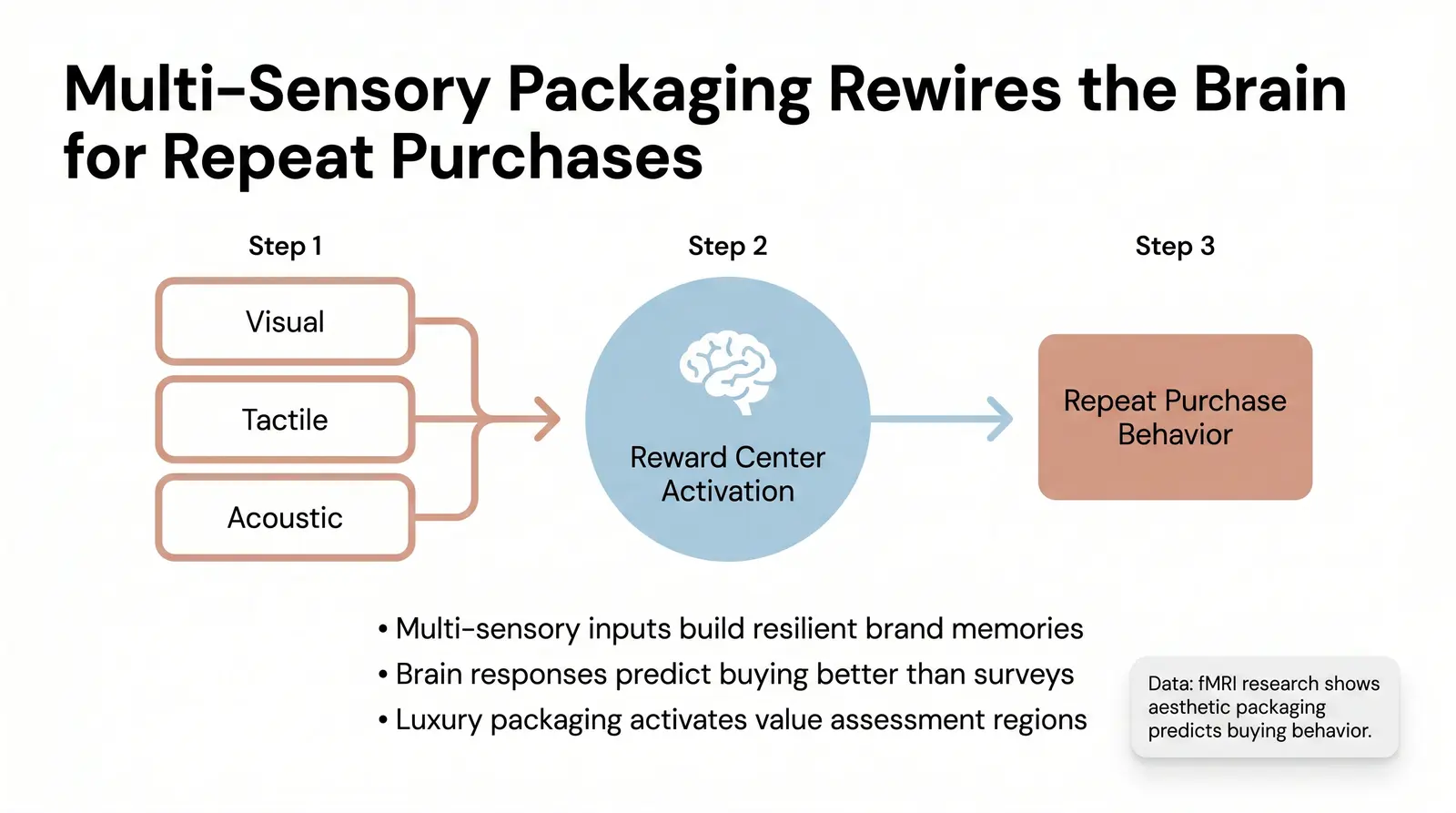
To understand how packaging influences behavior, we must break down the "sensory stack"—the individual sensory channels that collectively create the unboxing experience. Each channel plays a specific role in signaling quality to the brain.
Weight: The human brain has a well-documented "weight bias" when it comes to perceiving value. Heavier objects are subconsciously associated with higher quality, durability, and importance. Studies have demonstrated that an increase in packaging weight directly affects both the consumer's desire for the product and their willingness to pay [3]. In jewelry, a weighted base or a substantial, rigid box signals that the delicate item inside is precious and valuable.
Haptics: The sense of touch is perhaps the most intimate of the senses. The texture and surface finish of packaging—whether it is a matte soft-touch coating, a textured linen paper, or a smooth gloss—profoundly influence purchase intent and brand trust. Research indicates that consumers are 50% more likely to purchase a product after touching its premium packaging just twice, and this likelihood increases to 90% after four touches [4]. A velvet-like soft-touch coating, for example, signals elegance and indulgence, making the product feel premium in the hands of the consumer.
The distinction between matte and gloss finishes is more nuanced than it might appear. Matte surfaces have been shown to induce perceptions of naturalness, authenticity, and craftsmanship—qualities that are particularly valuable in jewelry, where the narrative of artisanal care matters deeply to the buyer [6]. Gloss, by contrast, signals modernity and cleanliness, but can feel clinical in a luxury context. For most jewelry brands, a matte or soft-touch exterior paired with a gloss or foil interior creates the ideal sensory contrast: understated on the outside, revealing on the inside.
Acoustics: The psychology of sound in packaging—often referred to as acoustic branding—is a subtle but powerful driver of perception. The "thud" of a heavy box closing, the crisp "snap" of a magnetic closure, or the gentle rustle of high-quality tissue paper all create micro-moments of delight. These sounds evoke a sense of precision, security, and anticipation. Consumers form expectations about a product's quality based on the sounds they associate with its packaging, and pleasing sounds subconsciously reinforce the idea of quality and enjoyment [5].
This is not a trivial effect. Acoustic branding in packaging operates through a principle called cross-modal correspondence: the brain links sounds to qualities in other sensory domains. A deep, resonant "thud" when a box closes maps to heaviness and solidity. A sharp, clean "snap" from a magnetic closure maps to precision engineering. A soft, papery rustle maps to delicacy and care. Each of these sounds tells a story about the brand before the product is even visible. Brands that ignore acoustic design are leaving a powerful sensory channel completely untapped.
Visual: While touch and sound are critical, visual hierarchy remains the foundation of the sensory stack. Color psychology plays a specific role in jewelry packaging. Black symbolizes timeless elegance, authority, and exclusivity. White represents purity, simplicity, and cleanliness. Blush or rose tones convey warmth and romance, while deep navy builds trust and reliability. The contrast between a matte background and a high-gloss foil logo creates a visual hierarchy that triggers dopamine release, guiding the eye and elevating the perceived value of the brand.
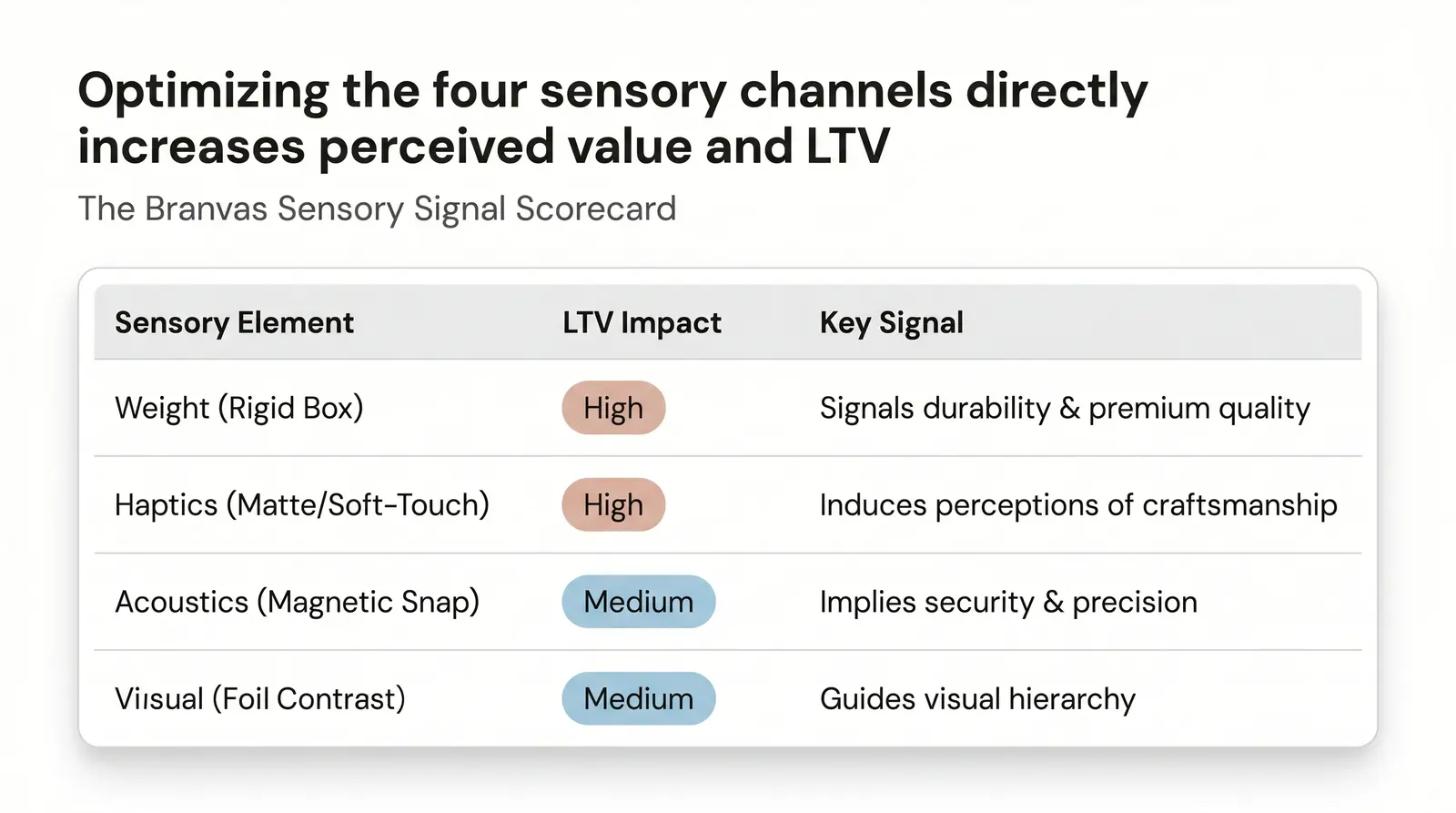
To help founders navigate these investments, we developed the Branvas Sensory Signal Scorecard™—a proprietary framework that scores packaging elements on their relative LTV impact.
| Sensory Element | LTV Impact | Rationale |
|---|---|---|
| Weight (Rigid Structure) | High | Triggers subconscious weight-value bias; signals durability and premium quality immediately upon lifting. |
| Haptics (Soft-Touch/Matte) | High | Encourages prolonged physical interaction; matte finishes induce perceptions of authenticity and craftsmanship. |
| Acoustics (Magnetic Closure) | Medium | The satisfying "snap" implies security and precision, creating a memorable micro-moment of delight. |
| Visual Contrast (Foil Stamping) | Medium | Guides visual hierarchy and creates a premium aesthetic, but must be paired with tactile elements to avoid sensory mismatch. |
| Scent Optionality | Low | Can create strong memory associations, but is highly subjective and risks alienating sensitive consumers if overused. |
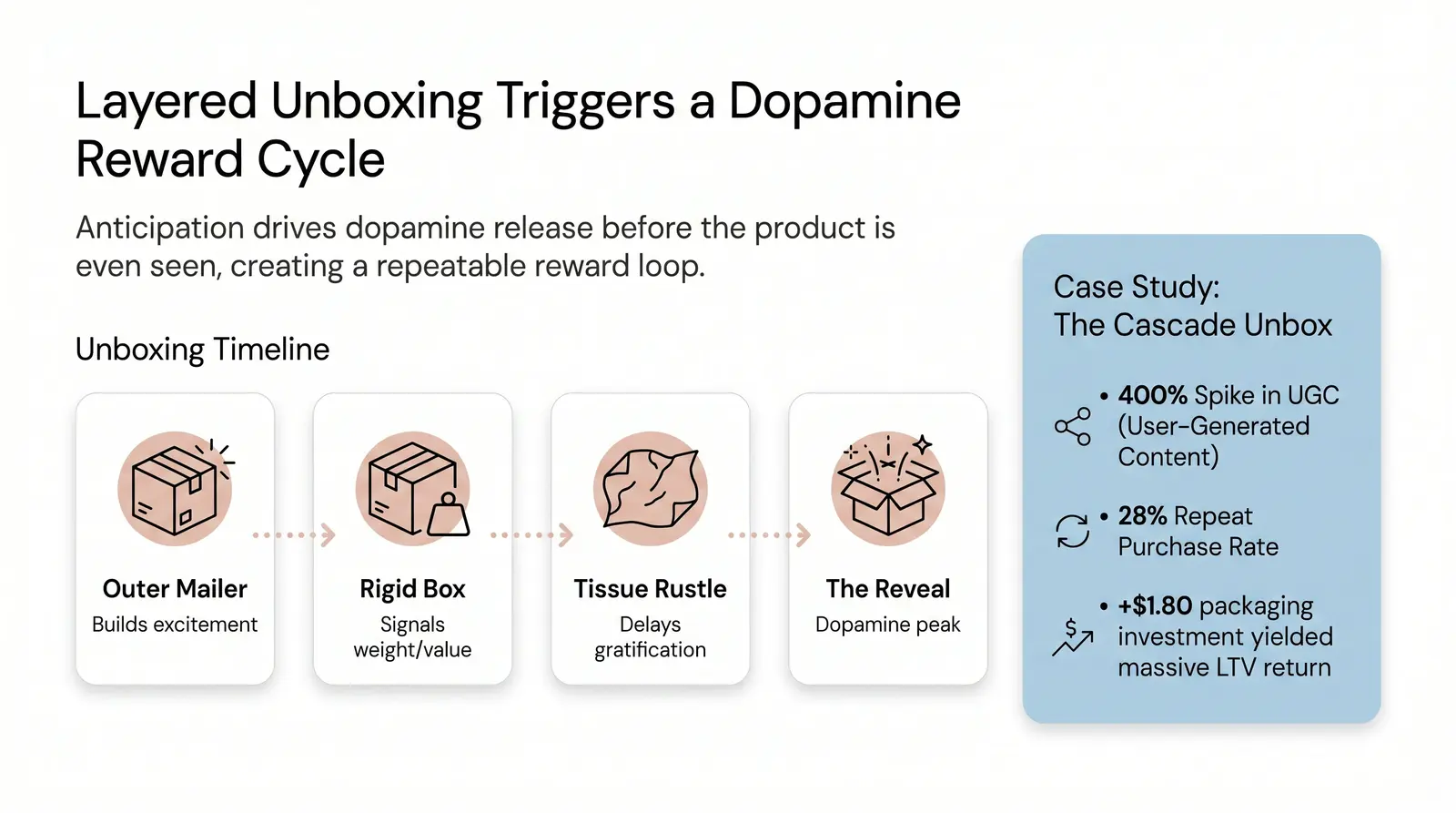
The neuroscience of anticipation reveals a fascinating truth: dopamine, the neurotransmitter associated with pleasure and reward, is released before the reward is actually received. It is the anticipation of the reward that drives the dopamine spike. This is why the ritual of unboxing is so powerful.
A well-designed unboxing experience creates a series of micro-anticipation beats. The customer sees the outer mailer, which builds initial excitement. They open it to reveal the branded rigid box. They lift the lid, encountering the crisp rustle of tissue paper. They pull a ribbon or slide open a drawer to finally reveal the inner tray and the jewelry itself. Each layer delays the final gratification just enough to maximize the dopamine release, creating a reward cycle that the brain wants to repeat.
This dopamine loop extends beyond the original buyer. The rise of unboxing videos on platforms like YouTube and TikTok—which garnered over 25 billion views in 2023 alone—demonstrates the social shareability of this experience. When a customer shares their unboxing ritual online, they are not just showing off a product; they are sharing the dopamine hit with their audience, effectively extending the brand's LTV through word-of-mouth amplification and social proof.
Worked Example — "The Cascade Unbox"
Consider Lune & Co., a fictional mid-tier demi-fine jewelry brand. Initially, they shipped their $85 necklaces in standard bubble mailers with a basic velvet pouch. Their repeat purchase rate hovered at a stagnant 12%, and organic social sharing was virtually non-existent.They redesigned their packaging using a "Cascade Unbox" strategy: a rigid, matte-black outer box (Weight + Haptics), a satisfying magnetic closure (Acoustics), and a custom-dyed blush tissue paper sealed with a gold foil sticker (Visual Contrast). The product cost increased by $1.80 per unit.
Within six months, Lune & Co. saw their repeat purchase rate climb to 28%. Their average order value (AOV) increased as customers began buying items as gifts, confident in the presentation. Most importantly, their user-generated content (UGC) rate spiked by 400%, as customers naturally wanted to film and share the premium unboxing experience. The $1.80 investment yielded a massive return in LTV and organic acquisition.
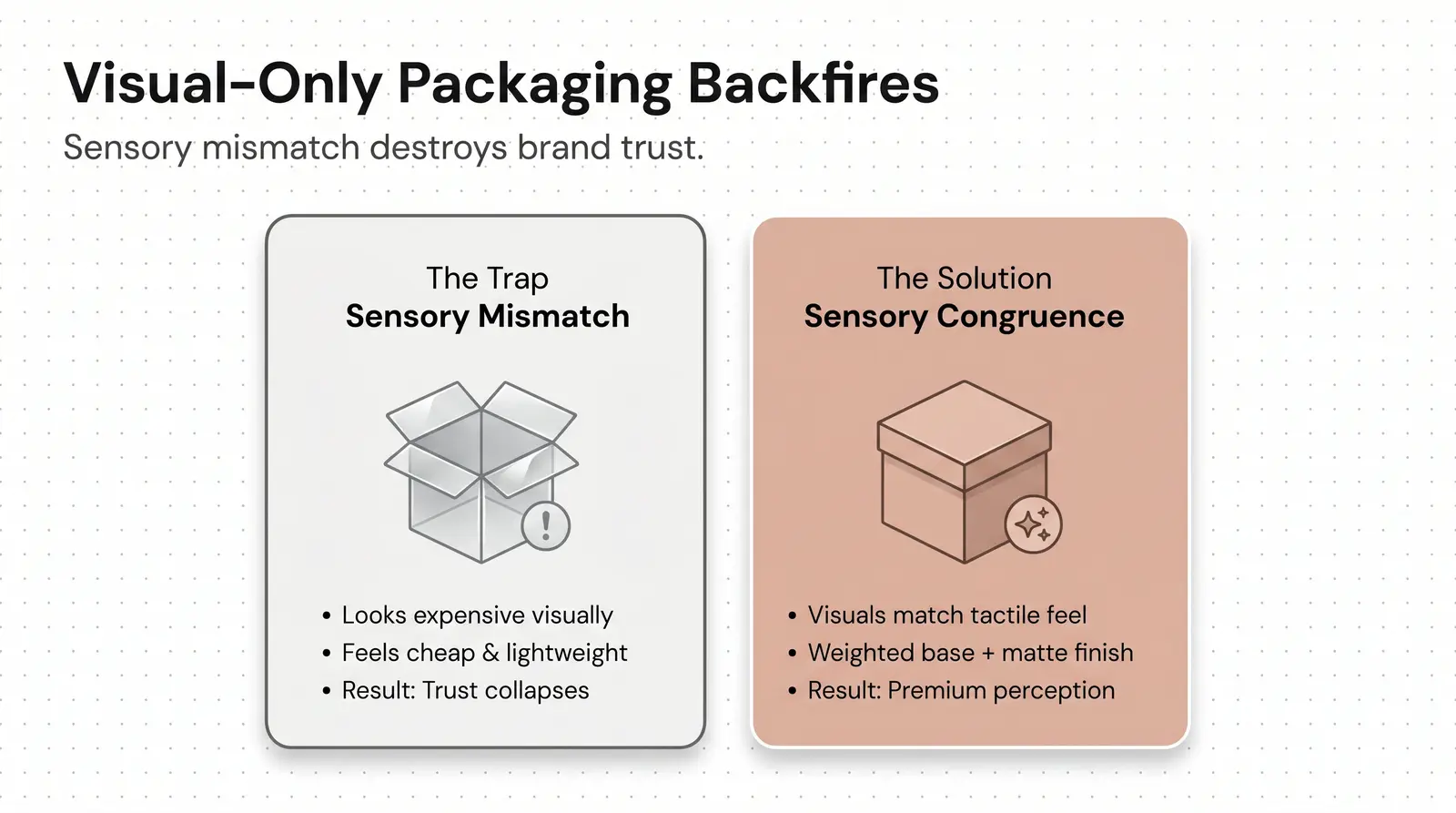
It is tempting to focus entirely on the visual aesthetics of packaging—the logo placement, the Pantone colors, the intricate patterns. However, investing solely in "pretty" packaging while ignoring the tactile and acoustic elements is a critical mistake. In fact, visual-only investments can actually backfire.
When a package looks expensive but feels cheap or flimsy, it creates a "sensory mismatch." The brain detects a discrepancy between the visual expectation of luxury and the tactile reality of low quality. This cognitive dissonance immediately reduces brand trust and perceived value. If a customer sees a beautiful, gold-foiled box but it feels like thin, easily crushed cardboard, the illusion of luxury is shattered. Research on sensory congruence in packaging confirms that when packaging texture is mismatched with consumer expectations, it provides false sensory information that actively reduces satisfaction and purchase confidence [6].
Most packaging vendors will not tell you this, because their incentive is to sell you the most visually impressive option. The reality is that a matte, weighted, structurally sound box with a simple logo will outperform a thin, glossy, elaborately printed box every single time in terms of perceived premium quality and repeat purchase intent.
In our experience at Branvas, we often see founders invest heavily in box printing but skip the tactile layer entirely—a matte soft-touch coating or a weighted base—and then wonder why their unboxing videos don't convert to follows or repeat orders. Sensory congruence is essential; the weight, texture, and sound must align perfectly with the visual promise of the brand.
Connecting sensory packaging investments to hard business outcomes requires looking at the math of Customer Lifetime Value. What does a 3x LTV claim actually mean in practice?
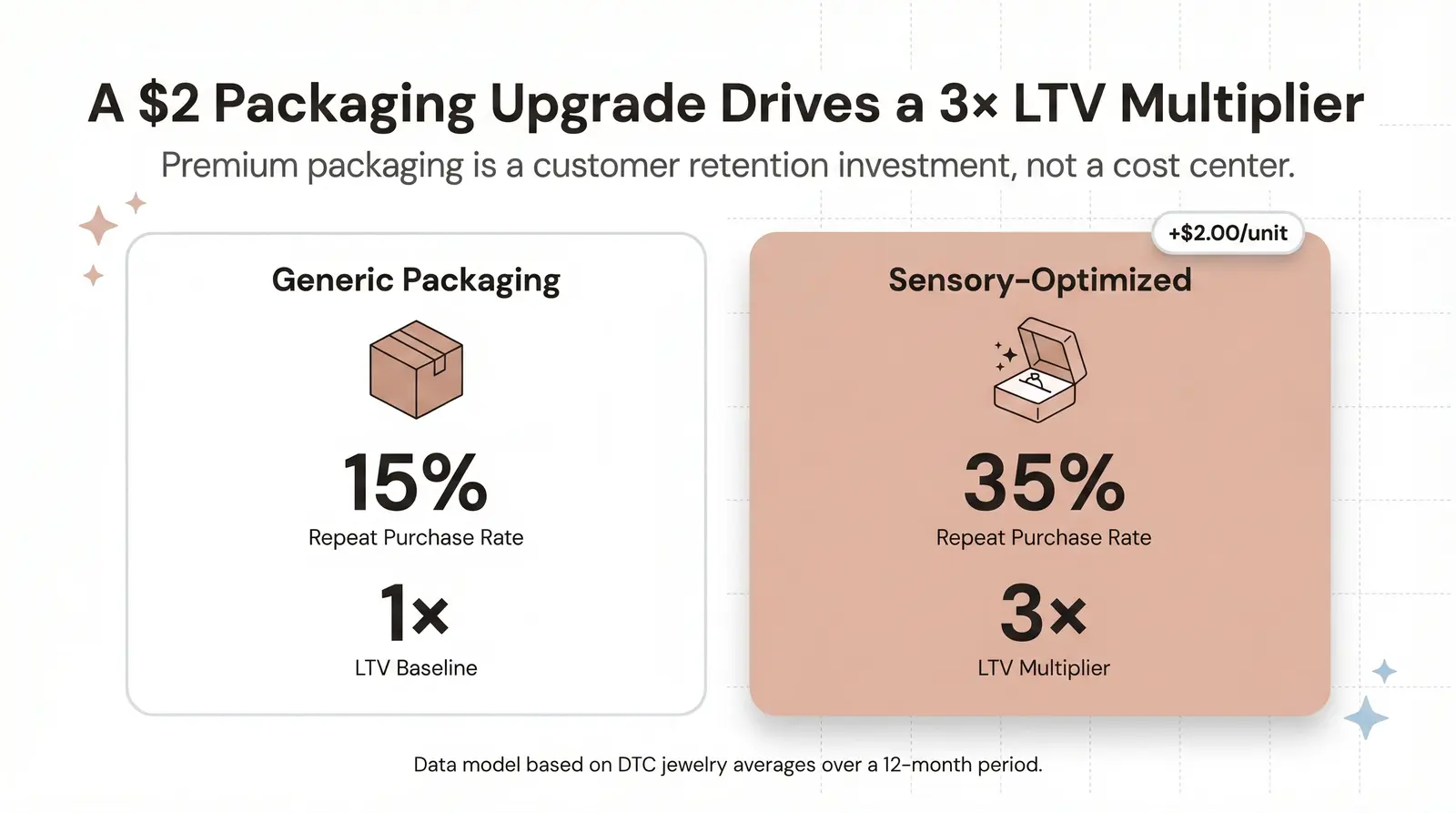
Let us model a typical DTC jewelry scenario. Assume your Customer Acquisition Cost (CAC) is $18, and your Average Order Value (AOV) is $55. If your packaging is generic, your repeat purchase rate might sit at a standard 15%. Over 12 months, that customer might be worth approximately $63 in revenue—barely enough to justify the cost of acquiring them.
Now, introduce a premium, sensory-optimized unboxing experience that costs an additional $2.00 per unit. Based on industry data, premium packaging can lift repeat purchase rates by 20% or more. If that same customer now has a 35% repeat purchase rate, and they are so delighted by the presentation that they buy a second item as a gift (increasing AOV to $110 for that second purchase), their 12-month revenue contribution increases substantially. Factor in the organic referrals generated by their social sharing—research shows that 94% of consumers are likely to share a positive unboxing experience—and the LTV multiplier quickly approaches 3x.
The $2.00 per unit packaging upgrade is not a cost. It is a customer retention investment with a measurable return. Brands that frame it as a cost will always under-invest. Brands that frame it as a revenue lever will optimize it relentlessly.
For jewelry specifically, gifting occasions—Valentine's Day, Mother's Day, birthdays, and self-gifting milestones—make packaging a direct conversion variable. A customer will not send a gift directly to a loved one if they do not trust the unboxing presentation. Premium packaging removes that friction, turning a single-purchase customer into a loyal, multi-occasion buyer.
At Branvas, we approach packaging as a comprehensive brand system, not an afterthought or a line-item expense. We understand that for private-label jewelry and accessories, the unboxing experience is the physical manifestation of your brand's promise.
Founders using Branvas get access to curated packaging options designed with sensory coherence in mind. We do not just offer boxes; we offer weighted bases, soft-touch matte finishes, satisfying magnetic closures, and elegant inner presentations. Every element is selected to ensure that the visual, tactile, and acoustic signals align perfectly to communicate premium quality.
Because Branvas handles blind fulfillment, every customer touchpoint—including that critical unboxed moment—reflects the founder's brand, not ours. We ensure that the dopamine loop is triggered flawlessly, every single time, so you can focus on growing your audience while we deliver the sensory experience that keeps them coming back.
If you're still thinking of packaging as a cost center, it might be time to rethink the math. Explore how Branvas structures packaging inside your brand system → branvas.com/how-it-works
Ready to build a jewelry brand with packaging that converts browsers into loyalists? Start with Branvas →
What is jewelry packaging psychology and why does it matter for ecommerce?
Jewelry packaging psychology is the study of how the sensory elements of a package—its weight, texture, color, and sound—affect a consumer's perception of the product's value and the brand's trustworthiness. In ecommerce, where the customer cannot touch the product before buying, the unboxing experience is the first physical interaction with the brand. It matters because a positive, premium sensory experience triggers reward centers in the brain, directly influencing brand loyalty and repeat purchase behavior.
How does haptic packaging design affect perceived product value?
Haptic design focuses on the sense of touch. Research shows that consumers associate certain textures, like soft-touch matte coatings or heavy, rigid materials, with craftsmanship and luxury. When a package feels substantial and premium, the brain subconsciously transfers that perceived value to the jewelry inside, making the customer more willing to pay a premium price and more likely to trust the brand.
What are the most effective sensory elements to invest in for a small jewelry brand?
For a small jewelry brand, the most effective investments are in weight and texture. Upgrading to a rigid, weighted box immediately signals durability and value. Pairing this with a soft-touch matte finish encourages the customer to hold and interact with the box longer. These two elements provide the highest return on investment in terms of elevating the perceived luxury of the brand without requiring massive budgets.
How does unboxing experience influence customer lifetime value (LTV)?
A premium unboxing experience creates a dopamine-driven reward cycle. The anticipation of opening the layers of packaging releases dopamine, making the experience highly pleasurable. When customers enjoy this ritual, they are significantly more likely to purchase again (increasing repeat purchase rates) and to share their experience on social media or through word-of-mouth referrals. Both of these outcomes directly reduce the effective cost of acquiring new customers and increase the revenue generated per customer over their lifetime.
Can good packaging actually reduce return rates or increase repeat purchases?
Yes. Good packaging reduces return rates by preventing damage during transit and by reinforcing the customer's purchase decision through a premium presentation that validates the price paid. Furthermore, studies indicate that over 60% of consumers are more likely to make repeat purchases from brands that deliver their products in premium packaging, as it builds trust and creates a memorable, shareable brand experience.
[1] Dotcom Distribution, Attractive packaging might help lead to repeat purchases for online shopper, Retail Dive, 2013.
[2] Jarsking, Neuroaesthetics in Packaging: The Science Behind Designs That Sell, Jarsking Insights, 2025.
[3] Kampfer et al., Touch-flavor transference: Assessing the effect of packaging weight on gustatory evaluations, desire for food and beverages, and willingness to pay, PLOS One, 2017.
[4] Sappi North America, Sappi North America Releases Haptics Research Study Conducted in Collaboration with Clemson University, Sappi Insights, 2025.
[5] The ANSI Blog, How the Sound of Packaging Influences Consumer Perception, American National Standards Institute, 2025.
[6] Ferreira, B.M., Packaging texture influences product taste and consumer satisfaction, Journal of Sensory Studies, 2019.
[7] YouTube Official Blog, Taking a peek into the world of unboxing on YouTube, YouTube Culture and Trends, 2023.