


This retention playbook shows product brands how to drive repeat purchases using post-purchase emails, branded inserts, and loyalty mechanics across a 90-day sprint.
Published:
August 5, 2026
Author:
Yi Cui
Retention is the antidote to rising acquisition costs. When paid ads cost more every year, the most profitable lever left is making existing customers buy again.
Acquiring a new customer costs 5 to 7 times more than retaining an existing one. And increasing customer retention by just 5% can boost profits by 25% to 95% [1]. Those numbers have been cited for years, but they hit differently now that Meta CPMs are up 89% since 2020 and Google CPCs rose another 12.88% year-over-year in 2025 [2].
This article delivers a practical retention playbook covering the key levers any product brand can implement: post-purchase email flows, physical inserts, outreach cadence, loyalty mechanics, and win-back campaigns. In our experience at Branvas, we see a consistent pattern: founders obsess over the first sale and almost entirely neglect the second.
The average blended customer acquisition cost (CAC) for ecommerce brands now sits between $68 and $84, up roughly 60% over the past five years [3]. For jewelry and accessories brands specifically, the picture is even tighter: a $65 average order value (AOV) with 35% COGS leaves very little room after you factor in shipping, fulfillment, and paid acquisition spend.
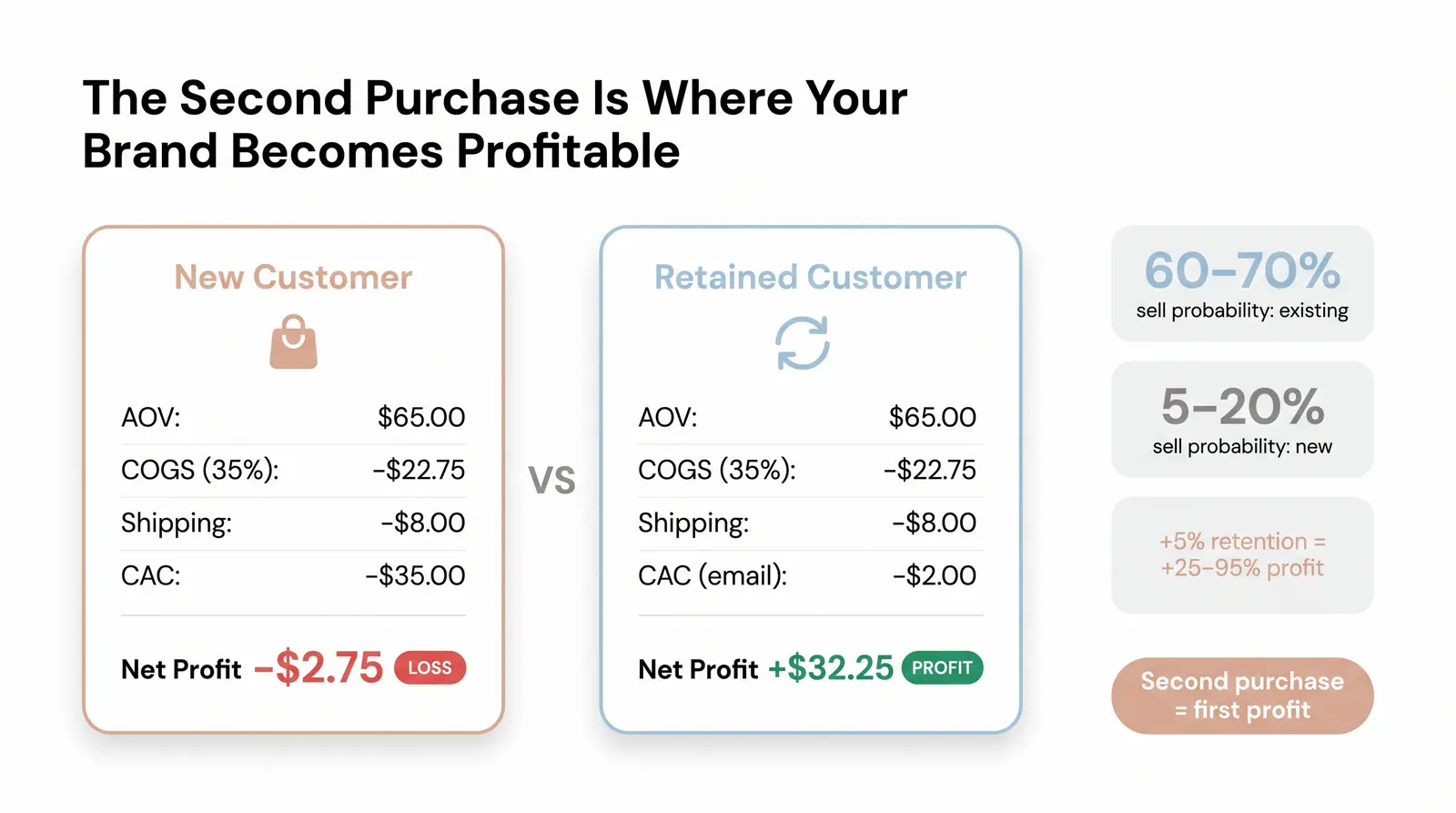
The table below shows a realistic worked example. These numbers are not hypothetical — they reflect the unit economics we see regularly among early-stage product brands, including those building on platforms like Branvas.
Table 1: First Purchase vs. Retained Customer — Profitability Comparison
| Metric | New Customer (First Purchase) | Retained Customer (Second Purchase) |
|---|---|---|
| Average Order Value (AOV) | $65.00 | $65.00 |
| Cost of Goods Sold (35%) | $22.75 | $22.75 |
| Shipping and Fulfillment | $8.00 | $8.00 |
| Customer Acquisition Cost | $35.00 | ~$2.00 (email/SMS cost) |
| Net Profit per Order | -$2.75 (loss) | $32.25 (profit) |
The second purchase is where the brand becomes profitable. That is not a minor operational detail — it is the entire business model for most DTC brands. A healthy ecommerce business needs a Customer Lifetime Value (LTV) to CAC ratio of at least 3:1 for sustainable growth [3]. You cannot achieve that ratio without a strong repeat purchase rate.
The probability of selling to an existing customer is 60% to 70%. For a new prospect, it drops to 5% to 20% [1]. That gap is the entire argument for retention.
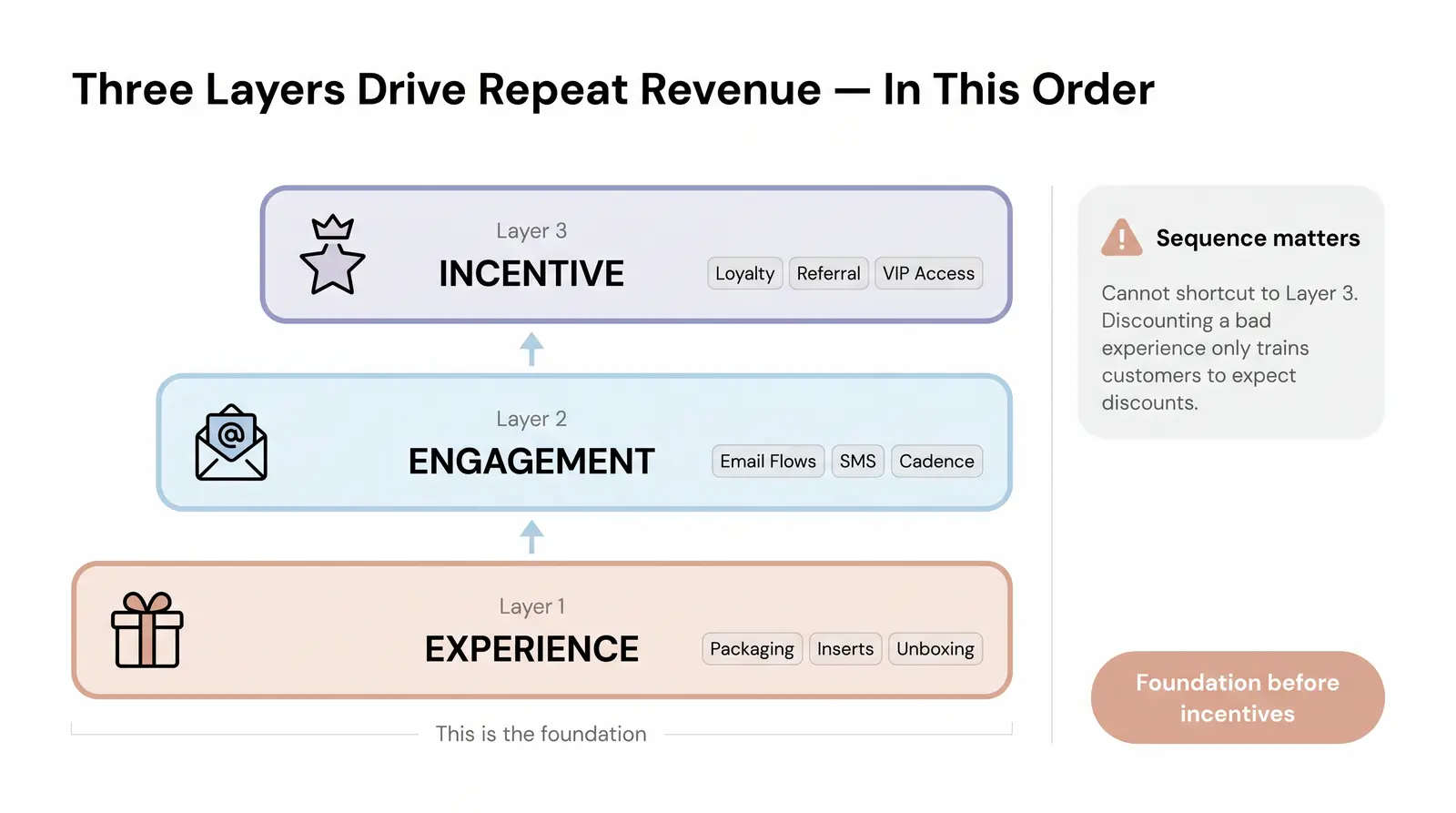
To systematically drive repeat purchases, we use a proprietary framework called The Retention Stack. This 3-layer model structures how we think about the levers that move customers from a single transaction to a lasting relationship.
Layer 1 — The Experience Layer covers packaging, physical inserts, and the unboxing moment. This is the physical and emotional touchpoint that creates brand memory. It happens once per order and its impact compounds over time.
Layer 2 — The Engagement Layer covers post-purchase email flows, SMS sequences, and timing cadence. This is the systematic follow-up that keeps the brand present in the customer's mind between purchases.
Layer 3 — The Incentive Layer covers loyalty mechanics, referral programs, exclusive drops, and VIP access. This is the pull that gives customers a concrete, tangible reason to return.
The order matters. You cannot shortcut to incentives if the experience and engagement layers are broken. Discounting a bad experience only trains customers to expect discounts, eroding margin and brand value simultaneously. Build the foundation first.
For physical product brands, especially in jewelry and accessories, the unboxing experience is a high-leverage retention tool. These products are tactile, giftable, and closely linked to personal identity. A customer who receives a beautifully packaged piece of jewelry is not just receiving a product. They are receiving a signal about the brand's values, quality, and attention to detail.
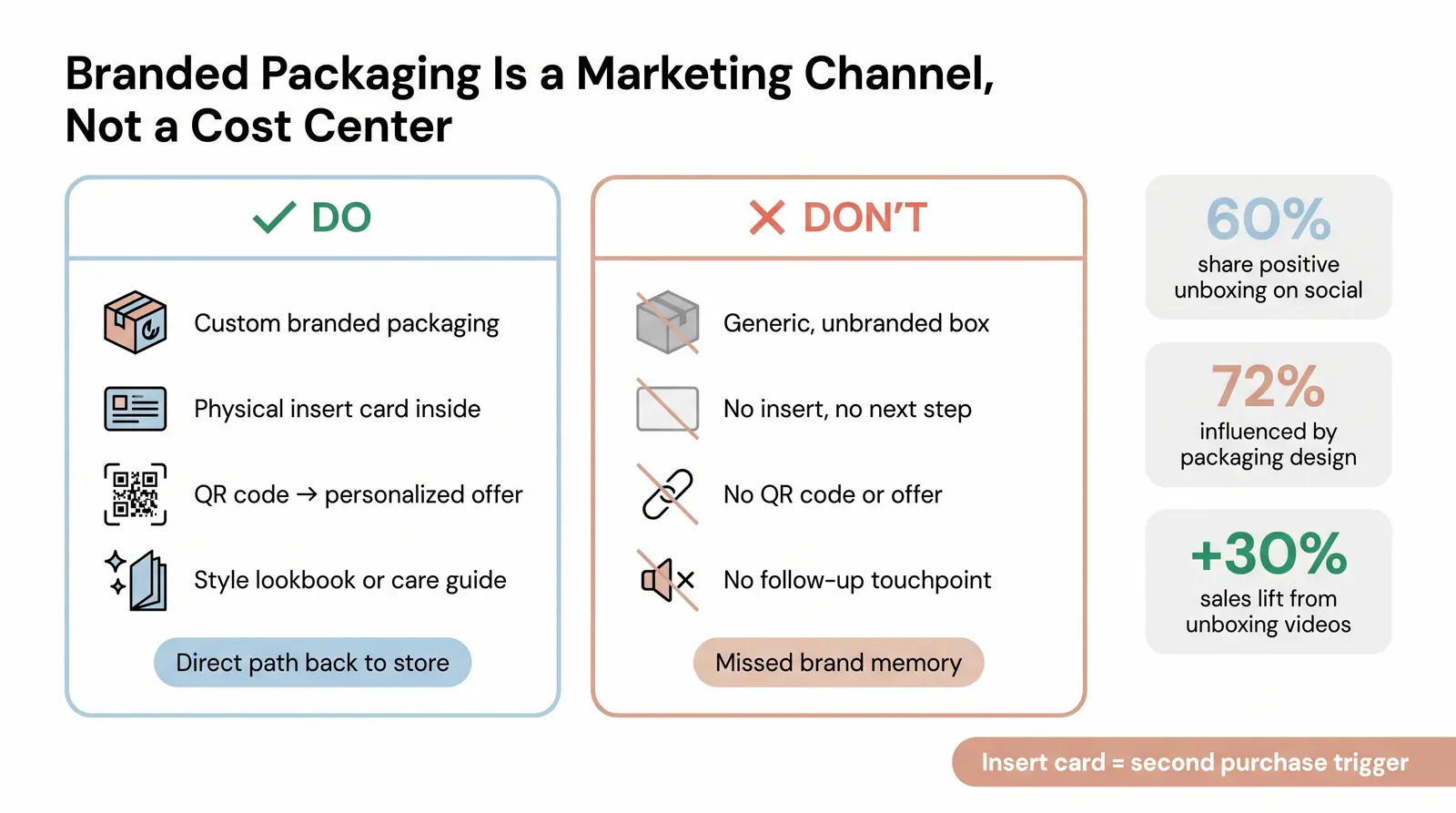
Most brands treat the package as a cost center. The brands with the highest repeat rates treat it as a marketing channel. The data supports this: 60% of consumers say they would share a positive unboxing experience on social media, and products generating more than 50 unboxing videos see sales increase by up to 30% [4]. Packaging design influences purchasing decisions for 72% of American consumers [5].
The most effective physical inserts combine a personal touch with a clear next step. A well-designed card with a QR code linking to a personalized offer, a care guide, or a style lookbook does three things at once: it extends the brand experience, it provides value, and it creates a direct path back to the store. We often see Branvas brand partners discover that adding a simple, well-designed insert card — with a QR code to a personalized offer — meaningfully lifts their second-purchase rate within 60 days.
This layer is especially important for jewelry and accessories because the product itself is often purchased as a gift. The recipient becomes a potential customer. A thoughtful insert card with a branded URL or QR code captures that audience at the moment of highest engagement.
Branvas's private-label model includes custom branded packaging as standard. You can learn more at branvas.com/how-it-works.
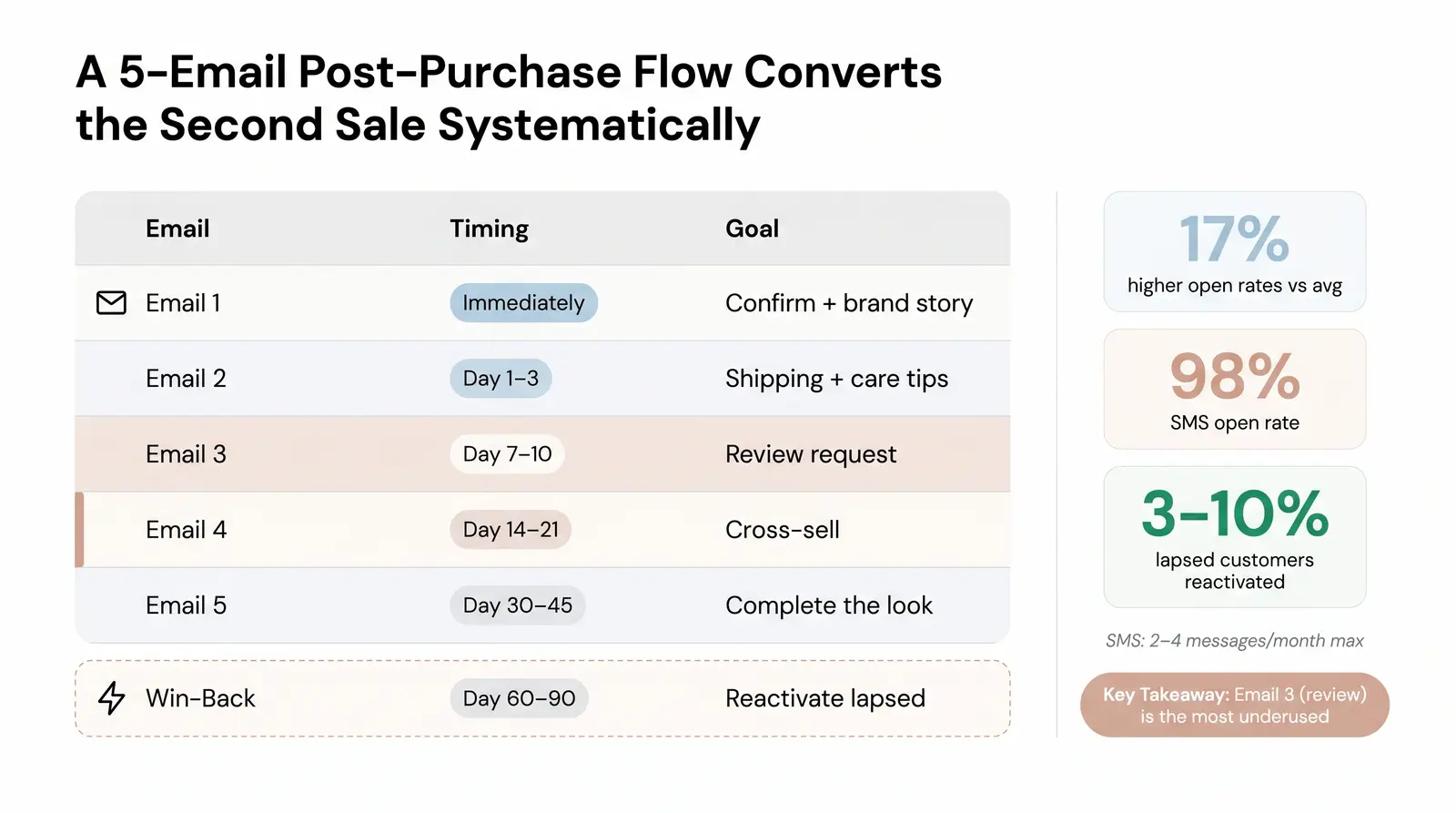
The post-purchase email sequence is the tactical core of retention. Post-purchase emails see open rates almost 17% higher than average email automations [6]. That elevated engagement exists because the customer is primed: they just made a purchase, they are expecting communication, and they are curious about their order.
The key is using that window to build a relationship, not just confirm a transaction. As Adam Kitchen, CEO of Magnet Monster, notes: "Most brands see the biggest drop-off from first to second purchase, normally because they bombard the user with such a high frequency of emails that they churn before you're able to convey value to them on the channel" [6].
Here is the anatomy of a high-performing post-purchase retention flow:
Table 2: Post-Purchase Flow Timing and Goal by Email
| Timing | Subject Line Direction | Primary Goal | Expected Open Rate | |
|---|---|---|---|---|
| Email 1 | Immediately | Order confirmation + brand story | Reassure and set expectations | 60%+ |
| Email 2 | Day 1–3 | Shipping update + care or style tips | Build excitement, educate | 45–50% |
| Email 3 | Day 7–10 | "How are you loving it?" | Gather reviews and feedback | 35–40% |
| Email 4 | Day 14–21 | Cross-sell or complementary product | Drive the second purchase | 25–30% |
| Email 5 | Day 30–45 | Replenishment or "complete the look" | Habituation and loyalty | 20–25% |
| Win-Back | Day 60–90 | Compelling offer to return | Reactivate lapsed customers | 15–25% |
On SMS: SMS should complement email, not replace it. SMS open rates reach up to 98%, with 90% of messages viewed within 3 minutes [7]. That makes it ideal for time-sensitive alerts like delivery notifications, flash sales, or win-back offers. For opted-in customers, SMS converts 2 to 3 times higher than email in win-back sequences [8]. The guardrail is frequency: 2 to 4 SMS messages per month is the ceiling for most product brands before opt-outs spike.
A contrarian insight: most brands send too many promotional emails and not enough relationship-building ones. The brands with the best retention treat email like a conversation, not a broadcast. Email 3 — the review request — is often the most underused. It opens a dialogue, generates social proof, and signals to the customer that you care about their experience, not just their wallet.
On win-back campaigns: If a customer has not purchased by day 60 to 90, trigger a 3-part win-back sequence. A good win-back program reactivates 3% to 10% of lapsed customers at a fraction of the cost of new acquisition [8]. The sequence should escalate: Email 1 is a soft reminder, Email 2 introduces an incentive, Email 3 creates urgency with an expiring offer.
Once the experience and engagement layers are working, the incentive layer amplifies everything. Loyalty programs, referral rewards, VIP early access, exclusive product drops, and birthday flows give customers a reason to choose you over a competitor at the moment of decision.
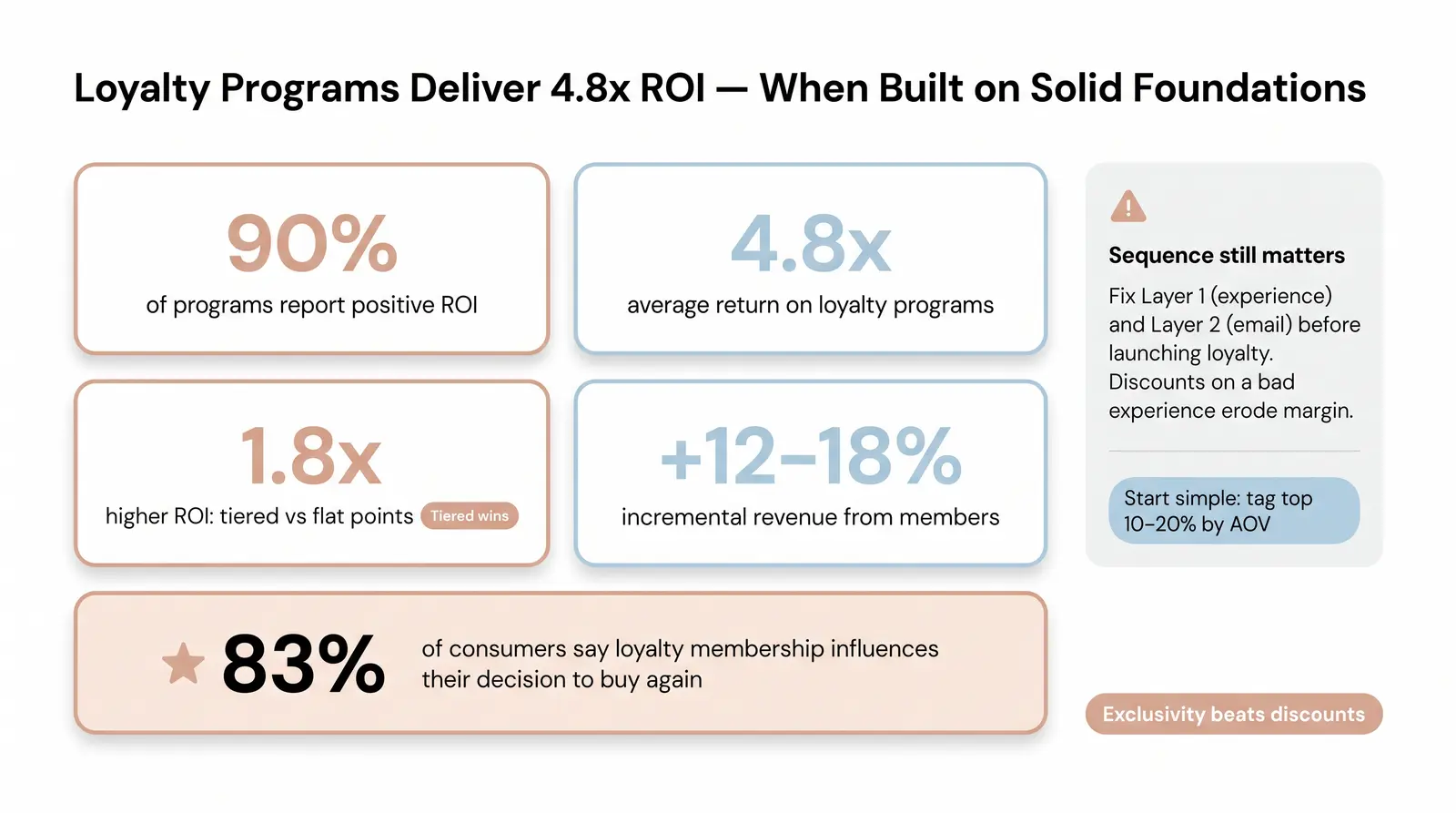
The data on loyalty programs is compelling. 90% of programs report positive ROI at an average of 4.8x returns [9]. Tiered loyalty structures deliver 1.8x higher ROI than flat point systems [9]. Loyalty members generate 12% to 18% more incremental revenue than non-members [9]. And 83% of consumers say belonging to a loyalty program influences their decision to buy again [9].
The critical caveat: incentives should come after experience and engagement are solid. Discounting to a bad experience just trains customers to expect discounts. The sequence matters.
Consider a small jewelry brand that introduces a "First Drop Access" list. Rather than offering a blanket discount, they give their best customers early access to new collections — 48 hours before the public launch. This creates exclusivity and status without eroding margin. The customers who join the list feel valued. They come back not because of a coupon but because of belonging. That is the difference between a loyalty mechanic and a loyalty strategy.
For early-stage brands, the simplest version of this is a VIP email segment. Tag your top 10% to 20% of customers by AOV or purchase frequency, and send them exclusive content, early access, or personalized recommendations. No app required.
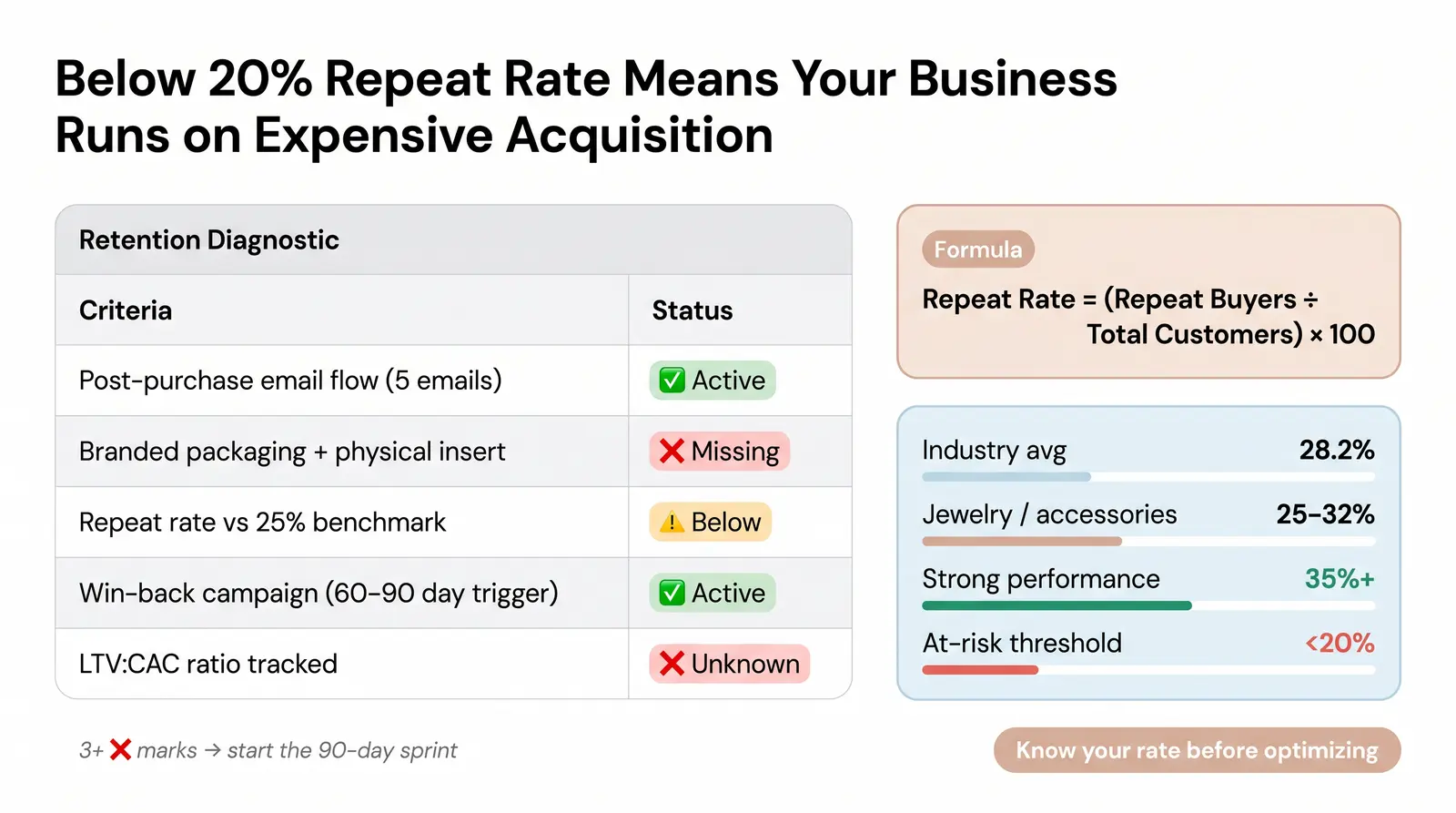
To know if your retention strategy is working, you need to track your repeat purchase rate. The formula is:
Repeat Purchase Rate = (Number of Customers Who Purchased More Than Once / Total Number of Customers) x 100
The average ecommerce repeat purchase rate sits around 28.2% [10]. For jewelry, apparel, and accessories, the typical range is 25% to 32% [11]. If your rate is below 20%, your business is over-indexed on acquisition and the post-purchase flow is the place to start.
Use the Branvas Retention Diagnostic below to assess your current position:
Table 3: Branvas Retention Diagnostic
| Criteria | Status | What It Means |
|---|---|---|
| Post-purchase email flow (5 emails) in place | ✅ Active / ❌ Missing | If missing, this is your highest-priority fix |
| Branded packaging and physical insert | ✅ Active / ❌ Missing | If missing, you are leaving brand memory on the table |
| Repeat purchase rate vs. 25% benchmark | ✅ Above / ⚠️ Below | Below 20% means acquisition dependency is a risk |
| Win-back campaign active (60–90 day trigger) | ✅ Active / ❌ Missing | If missing, you are permanently losing lapsed customers |
| LTV tracked and LTV:CAC ratio known | ✅ Tracked / ❌ Unknown | If unknown, you cannot make informed acquisition decisions |
This diagnostic is not exhaustive, but it covers the five highest-leverage criteria for a physical product brand. If you have three or more ❌ marks, the 90-day sprint below is your starting point.
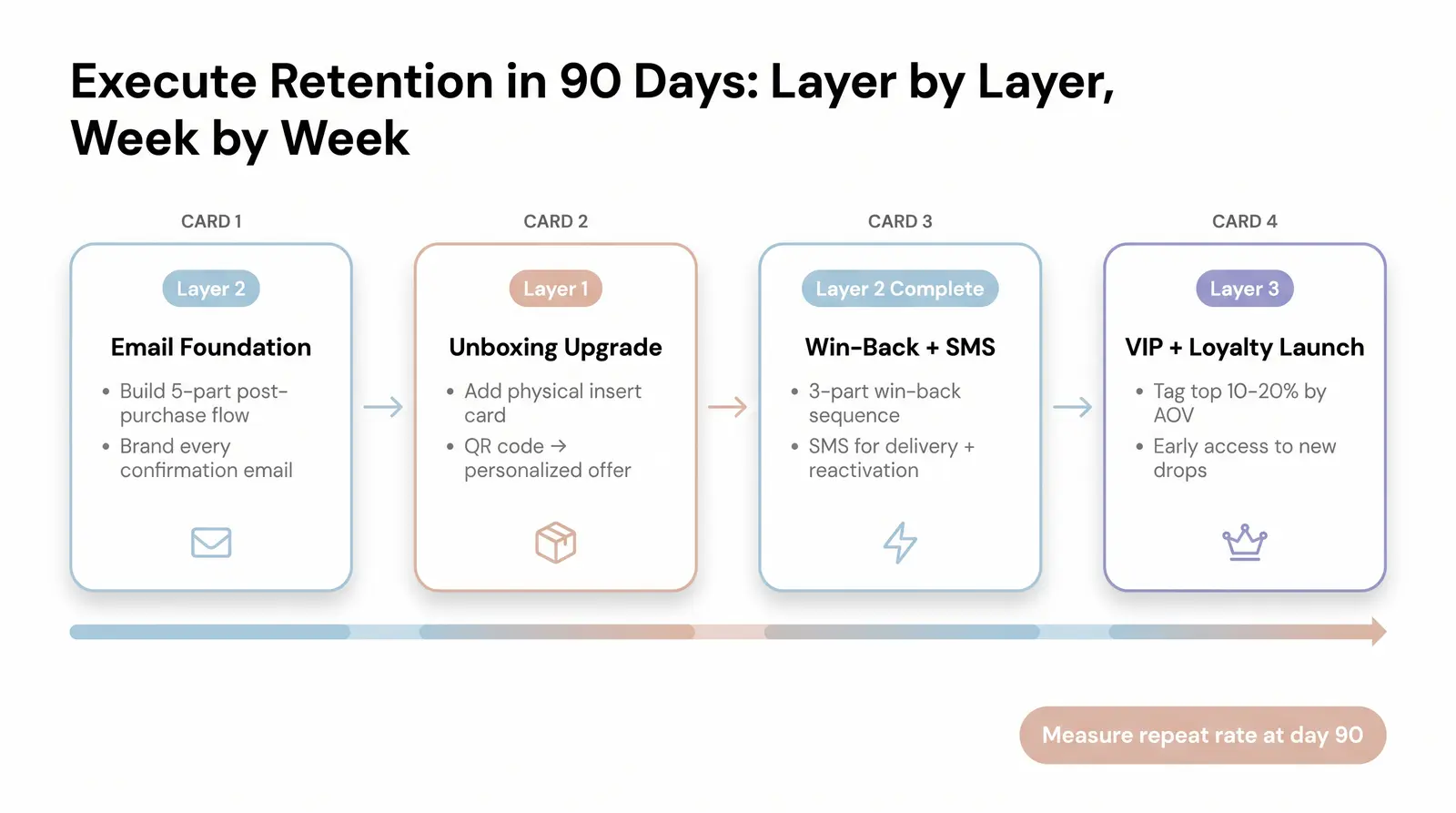
Building a retention engine does not require a large team or a large budget. It requires sequenced execution. Here is a practical 90-day sprint to implement The Retention Stack:
Week 1–2 (Layer 2 Foundation): Map out and build your 5-part post-purchase email flow. Start with the order confirmation and shipping update. Make sure both are branded, helpful, and human. Avoid generic transactional language.
Week 3–4 (Layer 1): Audit your unboxing experience. If you do not have a physical insert, design one. A simple card with a QR code linking to a specific offer or landing page is enough to start. Measure scan rates and second-purchase attribution over the following 60 days.
Month 2 (Win-Back and Layer 2 Completion): Set up your 3-part win-back email sequence for customers inactive at 60 to 90 days. Finish building out emails 4 and 5 of your post-purchase flow. Add SMS for delivery notifications and win-back offers if you have opted-in subscribers.
Month 3 (Layer 3): Launch a simple loyalty or VIP structure. This can be as lightweight as a tagged email segment with early access to new drops, or as formal as a points-based program. Measure the repeat purchase rate of members versus non-members at the 90-day mark.
At Branvas, we recommend new brand partners prioritize Layer 1 and Layer 2 before anything else. The experience and the follow-up sequence will do more for repeat revenue in 90 days than any loyalty app.
If you're launching or scaling a private-label jewelry or accessories brand and want retention built into your brand infrastructure from day one, explore how Branvas works at branvas.com/how-it-works — or check our profit calculator to model what a 20% lift in repeat purchase rate means for your margins.
The average ecommerce repeat purchase rate is around 28.2%, though it varies significantly by category. For jewelry, apparel, and accessories, a healthy benchmark is 25% to 32%. If your rate is below 20%, your business is over-reliant on expensive new customer acquisition and the post-purchase flow is the first thing to fix. Rates above 35% are strong and indicate a product and brand experience that is working.
The fastest lever is a structured post-purchase email flow. Brands that build a post-purchase email series see second-order rates 20% to 35% higher than brands sending only transactional emails [11]. Reaching out 14 to 21 days after delivery with a relevant cross-sell or complementary product recommendation is the single highest-impact, lowest-cost action most brands can take. Add a physical insert card with a QR code to your packaging for a compounding effect.
A high-performing flow includes five touchpoints: an immediate order confirmation with brand story, a shipping update with product care or style tips on day 1 to 3, a review request and satisfaction check on day 7 to 10, a cross-sell or complementary product recommendation on day 14 to 21, and a replenishment or "complete the look" nudge on day 30 to 45. If no second purchase occurs by day 60 to 90, trigger a win-back sequence with an escalating offer.
Customer Lifetime Value (LTV) is calculated as AOV multiplied by purchase frequency multiplied by customer lifespan. Retention directly increases all three variables. A 10-percentage-point lift in repeat purchase rate typically drives a 25% to 40% increase in average LTV [11]. The inflection point is the second purchase: customers who make a second purchase are 45% more likely to make a third, and customers who make a third are 54% more likely to make a fourth [11]. That is why the first-to-second conversion is the highest-impact retention move you can make.
Yes, when implemented correctly. 85% of consumers say loyalty programs make them more likely to continue shopping with a brand [9]. Tiered programs deliver 1.8x higher ROI than flat point systems, and loyalty members generate 12% to 18% more incremental revenue than non-members [9]. The key condition: the program needs to be built on a solid experience and engagement foundation. A loyalty program layered on top of a poor unboxing experience or no post-purchase follow-up will underperform. Fix Layers 1 and 2 first.
[1] The Value of Keeping the Right Customers — Amy Gallo, Harvard Business Review (2014). Link
[2] Average CAC by Ecommerce Vertical 2026 — Matt Putra, Eightx (2026). Link
[3] 45 Ecommerce Customer Acquisition Cost Statistics for 2026 — Ringly (2026). Link
[4] The Unboxing Experience: How Packaging Drives Customer Loyalty — Asiapack (2025). Link
[5] Unboxing Experiences: Designing Memorable Brand Moments — Ryan O'Donnell, Sprout Studios (2025). Link
[6] More Than Just a Confirmation: 9 Post-Purchase Email Ideas That Drive Engagement, Revenue, and Loyalty — Alexandra McPeak, Klaviyo (2025). Link
[7] SMS vs. Email Marketing in 2025 — Bloomreach (2025). Link
[8] Win-Back Email Campaign Guide: Templates, Timing, and ROI Benchmarks — Finsi (2026). Link
[9] Loyalty Program Statistics: 24 Data Points for Ecommerce — Team Rivo (2026). Link
[10] How to Improve Ecommerce Customer Retention — Elise Dopson, Shopify (2025). Link
[11] Repeat Purchase Rate: What It Is, How to Calculate It, and Benchmarks for E-commerce — Finsi (2026). Link