


Stop holding risky accessory stock. Discover the Lookbook Bundle Blueprint—a proprietary framework for fashion brands to create high-converting, inventory-free bundles using a Shopify bundles app.
Published:
January 29, 2026
Author:
Yi Cui
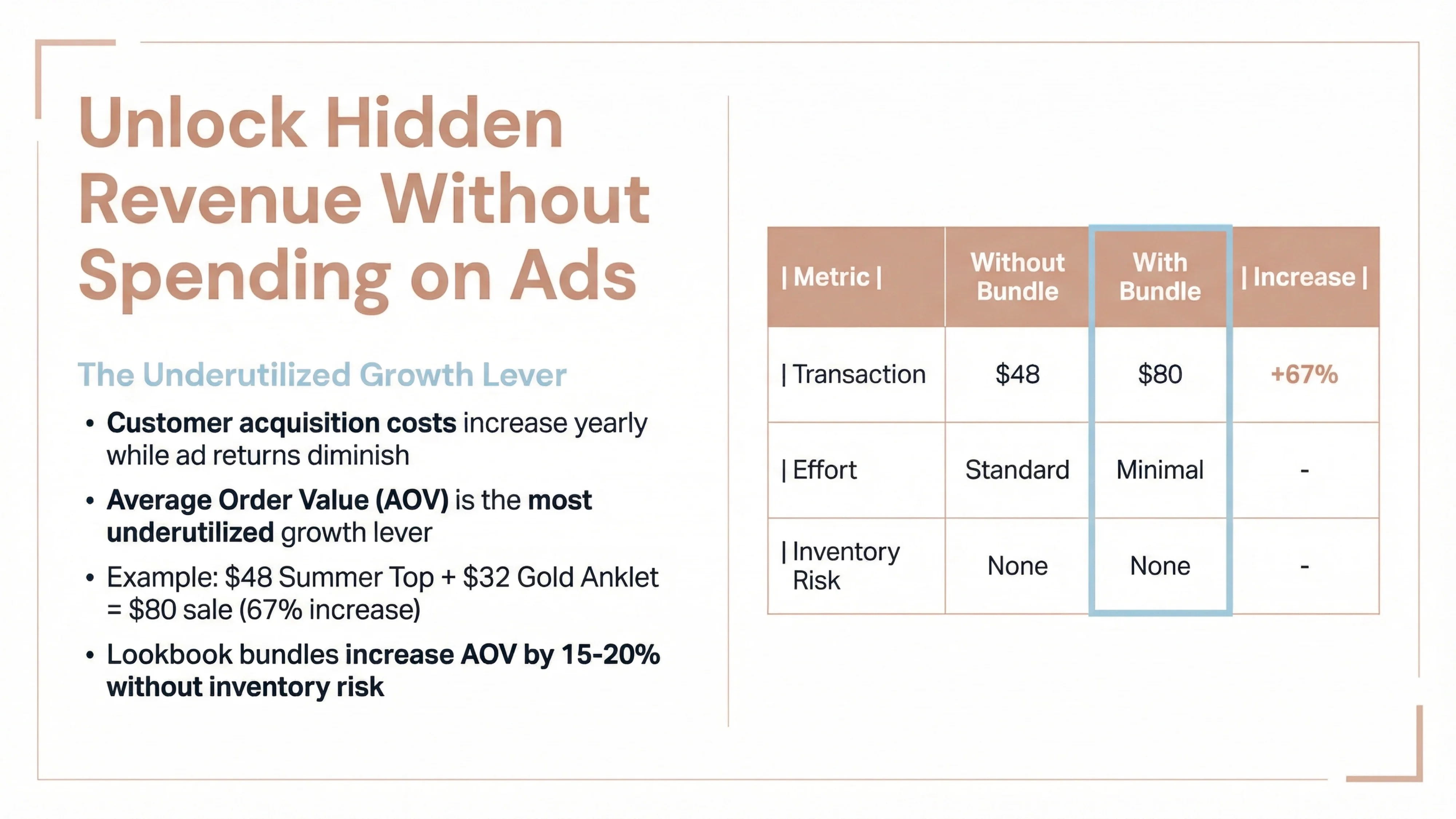
Traffic is expensive. Customer acquisition costs continue to rise, and paid advertising returns diminish year over year. The real profit opportunity for Shopify fashion and apparel stores lies not in attracting more visitors, but in earning more from the customers you already have. Average order value (AOV) remains one of the most underutilized levers for sustainable revenue growth.
Consider this practical example: A customer browsing your store discovers a Summer Top she loves. She adds it to her cart for $48. But what if, at that moment, she also saw a curated suggestion—a Gold Anklet that completes the look—for an additional $32? Suddenly, that $48 transaction becomes an $80 sale, with minimal additional effort. This is the power of lookbook-style bundling, and with the right Shopify bundles app, you can implement this strategy without holding a single piece of inventory.
In our experience at Branvas, we have seen premium fashion brands transform their economics by treating bundles not as discount mechanisms, but as styling guidance. This article provides a repeatable system for creating inventory-free lookbook bundles that increase AOV while maintaining your brand's premium positioning. You will learn how to select the right products, choose and configure a Shopify bundles app, and implement a complete bundling program that delivers measurable results within 30 days.
Product bundling strategies involve curating and selling multiple items together as a cohesive offering. In fashion ecommerce, effective bundling goes beyond simple discounting—it taps into the psychology of "complete the look" merchandising that has driven retail success for decades.
The mechanics are straightforward. When executed properly, bundles increase two critical metrics: AOV and attach rate. AOV measures the average dollar amount spent per transaction, while attach rate tracks the percentage of customers who add complementary items to their primary purchase. Research from Shopify shows that fashion brands implementing strategic bundles have achieved AOV increases ranging from 15% to 20%, with some brands like HiSmile seeing their average cart size grow by 4x after making bundled products their primary offering [1].
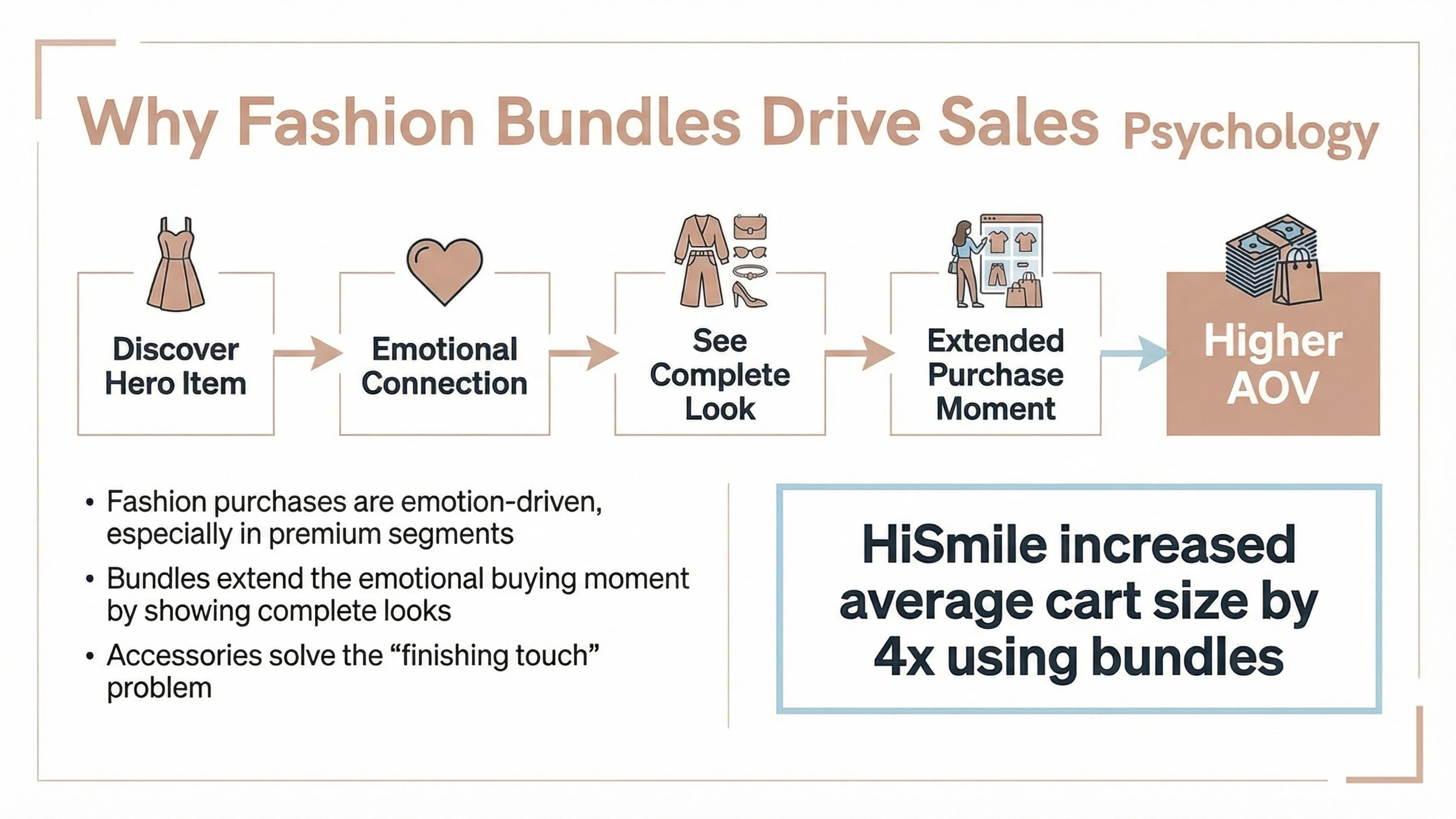
The psychology behind successful fashion bundles centers on reducing decision fatigue while increasing perceived value. Fashion purchases are driven more by emotion than need, particularly in the premium and luxury segments [2]. When a customer falls in love with a hero piece, they enter a heightened emotional state. A well-curated bundle extends that emotional moment by showing them how to complete the look, rather than forcing them to hunt for complementary pieces across your catalog or worse, on competing sites.
Accessories represent the easiest AOV lever in fashion bundling because they solve a fundamental challenge: most apparel brands excel at clothing but struggle with jewelry, bags, and other finishing touches. These items carry strong margins, ship easily, and transform an outfit from basic to editorial. However, the barrier has always been inventory risk. Holding stock in multiple styles, metals, and price points creates operational complexity that most apparel-focused brands prefer to avoid. This is precisely where inventory-free bundling through partner fulfillment becomes transformative.
After working with dozens of premium fashion brands, we have developed a systematic approach to bundle creation that consistently outperforms ad-hoc bundling attempts. We call this the Lookbook Bundle Blueprint (LBB), and it consists of five essential components:
1. Anchor: The hero apparel item that drives the initial purchase decision. This should be a product with proven conversion rates, strong visual appeal, and sufficient traffic. In our Summer Top example, this is the $48 top that customers already love.
2. Completer: The accessory that finishes the look. This must feel like a natural styling choice, not a random add-on. The Gold Anklet at $32 works because it complements the summer aesthetic without competing for attention.
3. Elevator: A premium touch point that adds sophistication. This could be earrings, a delicate necklace, or a second accessory that elevates the entire outfit from casual to curated. The Elevator is optional but significantly increases perceived value.
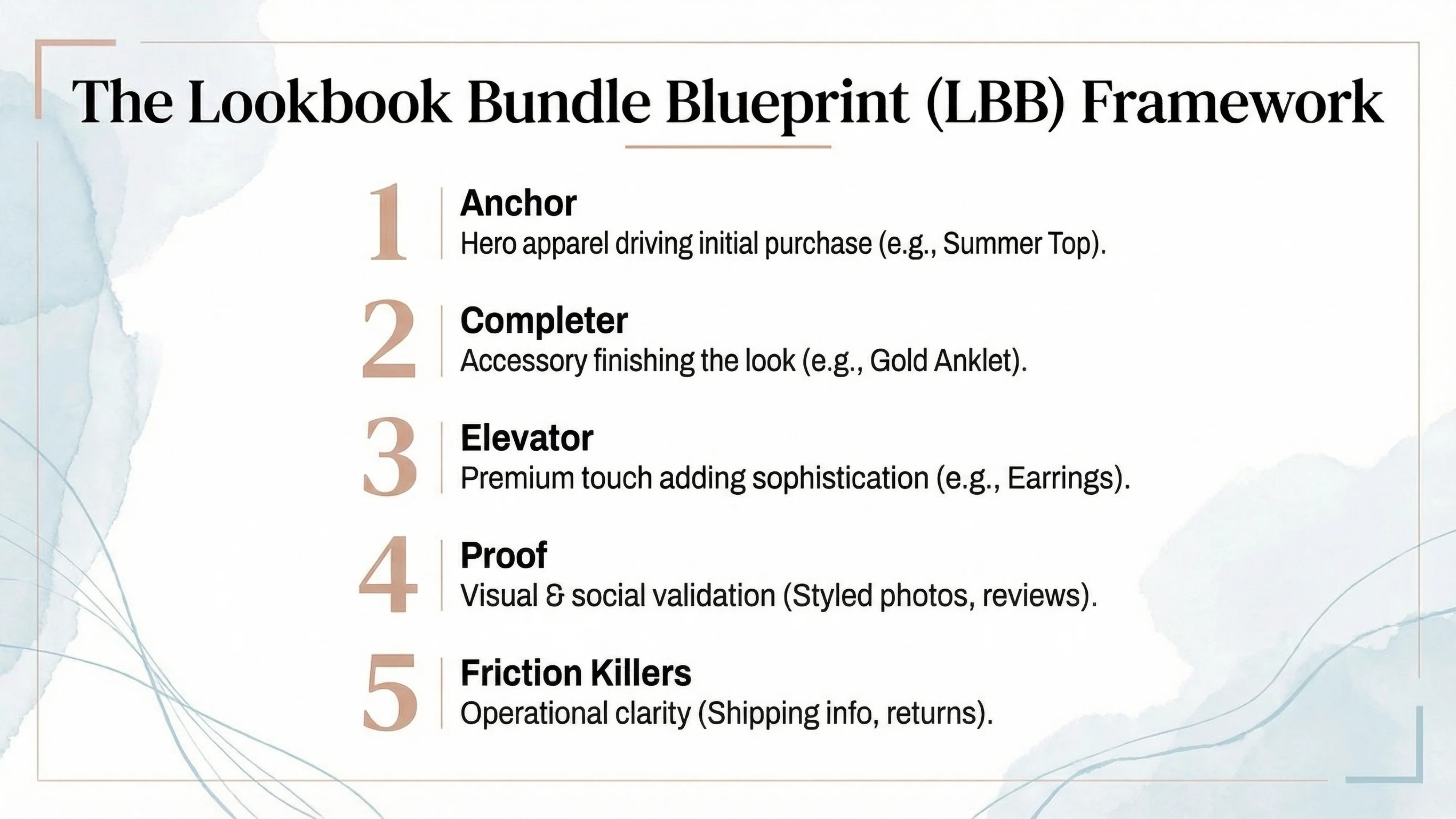
4. Proof: Visual and social validation that the bundle works as a complete look. This includes styled photography showing all items together, copy that frames the occasion ("Perfect for beach dinners" or "Your summer weekend uniform"), and social proof such as reviews or user-generated content.
5. Friction Killers: Operational clarity that removes purchase hesitation. This means transparent shipping timelines, clear return policies, and delivery date certainty. Baymard Institute research shows that 19% of shoppers abandon orders due to unclear shipping information, and 70% of ecommerce users abandon their carts after adding items [3]. Friction Killers address these concerns proactively.
Let's apply this framework to our running example. The Summer Top serves as the Anchor—it already has traffic and conversion data proving customer interest. The Gold Anklet becomes the Completer, chosen because gold jewelry pairs naturally with summer whites and pastels. For the Elevator, we might add small gold hoop earrings that echo the anklet's aesthetic.
The Proof component requires a lifestyle photo showing a model wearing all three pieces in a beach or outdoor summer setting, accompanied by copy like: "Complete your summer look—this breezy top pairs perfectly with delicate gold accents for effortless warm-weather style." Customer reviews highlighting how the pieces work together provide additional social proof.
Finally, Friction Killers ensure the customer knows exactly what to expect: "Ships within 2 business days. Free returns within 30 days. Jewelry ships separately from apparel—expect delivery within 5-7 business days." This clarity is essential when bundling products from different fulfillment sources.
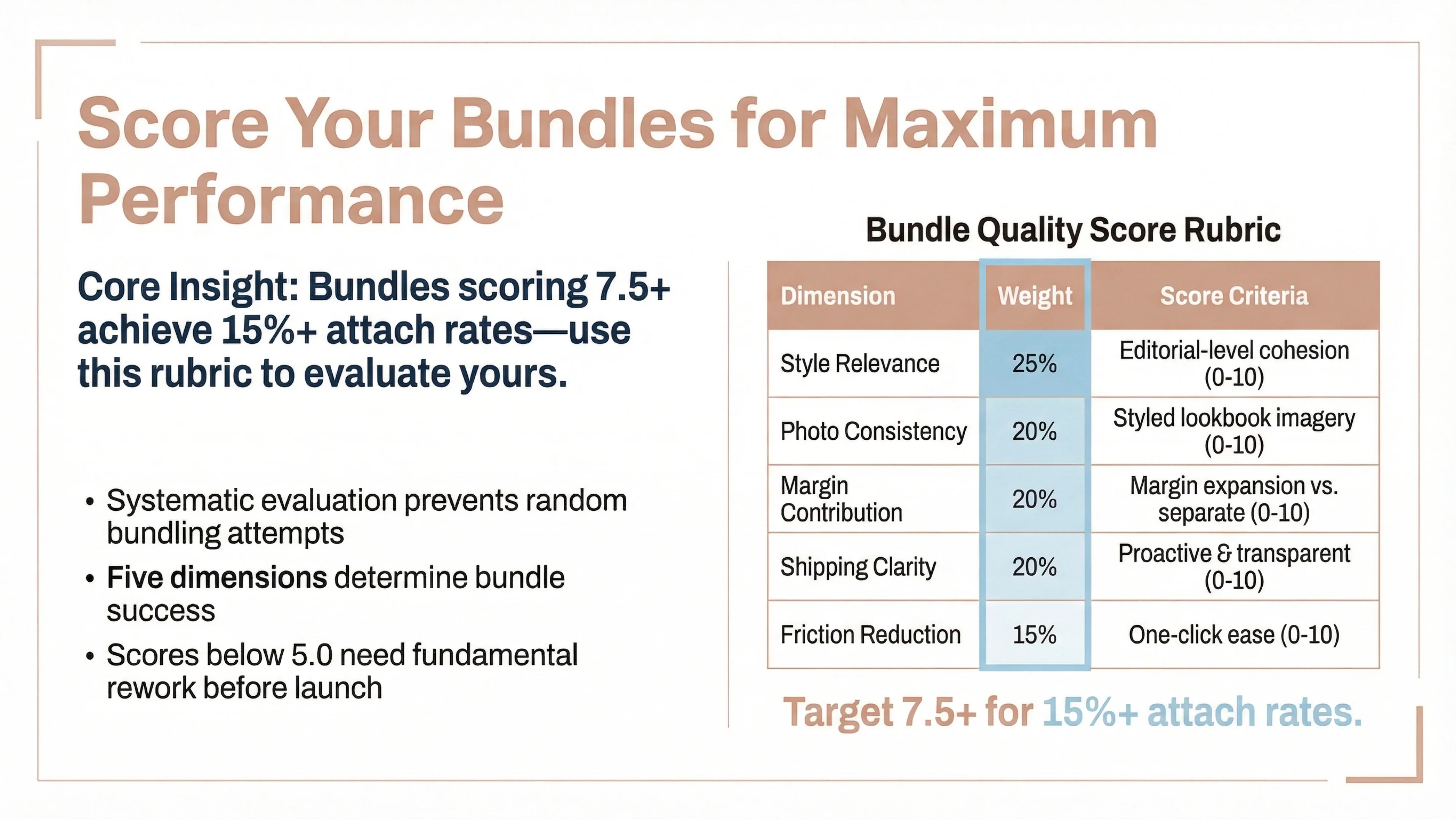
To create information gain and provide a systematic evaluation tool, we have developed a Bundle Quality Score rubric. Rate each bundle on a scale of 0-10 across five dimensions:
|
Dimension |
Score Criteria |
Weight |
|---|---|---|
|
Style Relevance |
Do the items genuinely belong together aesthetically? (0 = random, 10 = editorial-level cohesion) |
25% |
|
Photo Consistency |
Are all items photographed together in lifestyle context? (0 = separate product shots, 10 = styled lookbook imagery) |
20% |
|
Margin Contribution |
Does the bundle improve overall margin vs. selling items separately? (0 = margin dilution, 10 = significant margin expansion) |
20% |
|
Shipping Clarity |
Are fulfillment expectations crystal clear? (0 = confusing or hidden, 10 = proactive and transparent) |
20% |
|
Friction Reduction |
How easy is it for the customer to say yes? (0 = multiple obstacles, 10 = one-click add) |
15% |
A bundle scoring 7.5 or higher across these dimensions typically achieves attach rates above 15%. Scores below 5.0 indicate the bundle needs fundamental rework before launch.
The Shopify bundles app ecosystem has matured significantly, particularly with Shopify's 2025-2026 improvements to variant limits and native bundle functionality [4]. Choosing the right app determines whether your bundling strategy becomes a revenue driver or an operational headache.
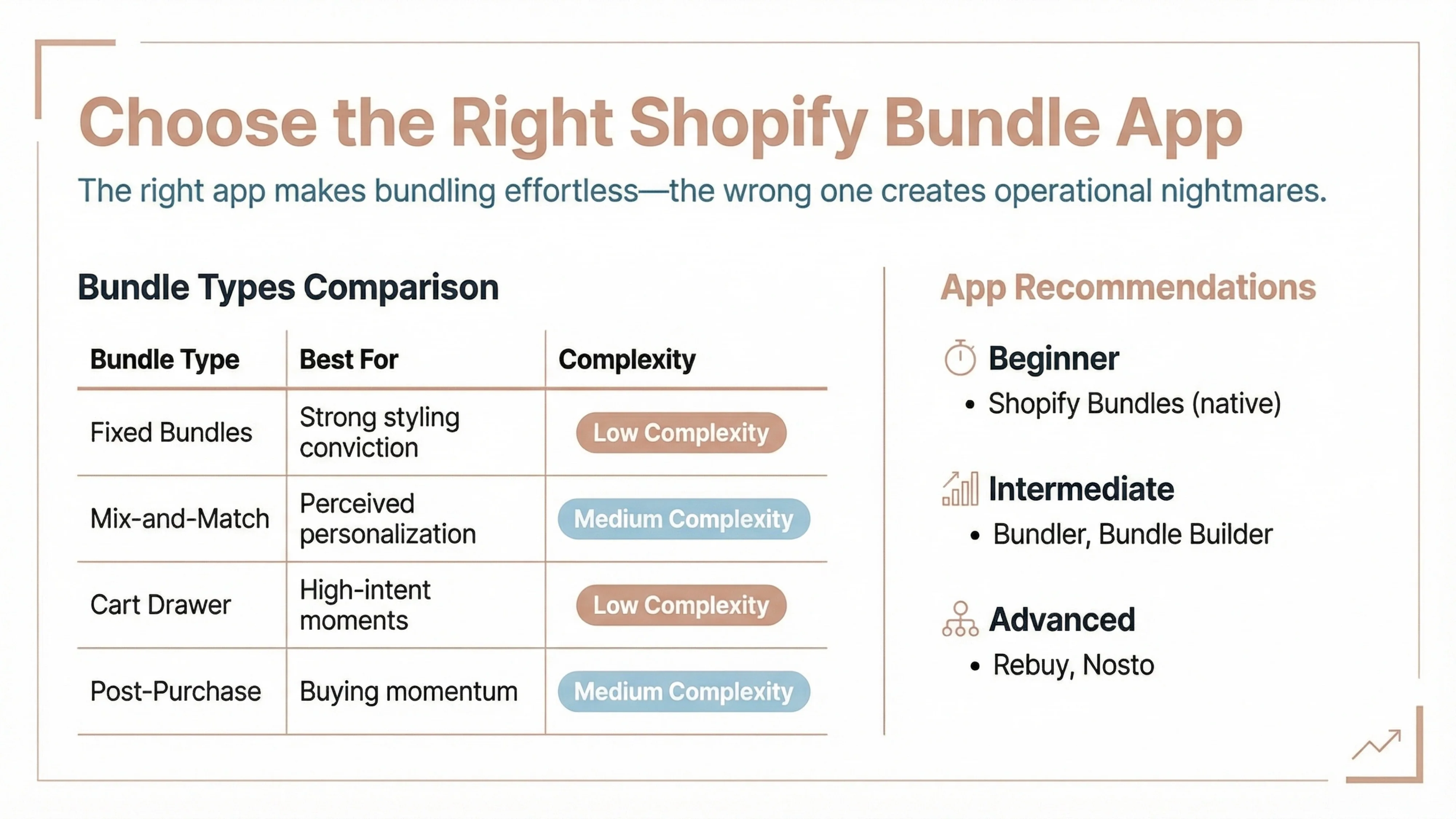
Modern bundle apps support several distinct bundle structures, each serving different merchandising goals:
Fixed bundles present a pre-curated set of items sold together as a single unit. Our Summer Top + Gold Anklet example would be a fixed bundle. These work best when you have strong styling conviction and want to guide customers toward a specific aesthetic.
Mix-and-match bundles allow customers to choose one item from each category (e.g., "Pick any top + any bottom + any accessory"). These increase perceived personalization but can overwhelm customers if not carefully constrained.
Frequently bought together bundles use purchase data to suggest combinations based on what other customers have purchased. These are algorithmically driven and work well for established catalogs with sufficient transaction history.
Cart drawer bundles appear when a customer adds an item to their cart, suggesting complementary products before checkout. These capture high-intent moments and typically see strong attach rates.
Post-purchase bundles present add-on offers immediately after the initial transaction is complete, capitalizing on the customer's buying momentum and reducing perceived friction since the primary purchase is already secured.
When evaluating apps, prioritize these capabilities:
Placement flexibility is critical. The app should allow you to display bundles on product detail pages (PDP), in the cart drawer, at checkout, and in post-purchase flows. Different placements serve different customer intents, and you will want to test multiple locations.
No-discount bundling capability is essential for premium brands. Many apps assume bundles must include discounts, but as we will discuss in the contrarian insight section, discount-driven bundles can actually damage perceived value. Your app must support bundles presented as curated styling without mandatory price reductions.
Inventory sync behavior determines operational complexity. The best apps explode bundles into component SKUs at checkout, so your warehouse and ERP only see individual items. This is what Shopify's native Bundles app does, and it eliminates the need to manage phantom bundle SKUs in your inventory system [4].
Analytics and reporting should track attach rate, AOV lift, and bundle-specific conversion rates. Without these metrics, you cannot optimize your bundle strategy over time.
Performance impact matters significantly for fashion sites, which are typically media-heavy. Shopify's 2025 emphasis on Interaction to Next Paint (INP) performance means any app that slows your site below 200 milliseconds can hurt both user experience and search rankings [2].
For beginners, Shopify Bundles (the native first-party app) provides a solid foundation for fixed bundles and multipacks with zero performance overhead. It integrates seamlessly with Shopify's inventory system and requires no technical setup.
For intermediate users seeking more flexibility, Bundler and Bundle Builder offer mix-and-match capabilities, quantity breaks, and more sophisticated pricing rules while maintaining reasonable performance profiles.
Advanced merchants needing post-purchase bundles, AI-driven recommendations, or complex conditional logic should evaluate Rebuy or Nosto, though these come with higher price points and implementation complexity.
The key is to start simple. Most brands overcomplicate their first bundle attempt by choosing feature-rich apps before validating the core strategy. Begin with fixed bundles on high-traffic PDPs, measure results, then expand functionality as needed.
Let's walk through the complete process of creating our example bundle using a systematic approach that any Shopify fashion merchant can follow.
Your anchor should meet three criteria. First, it must have sufficient traffic—aim for products in your top 20% by page views. Second, it should have proven conversion, meaning customers who view it are likely to purchase. Third, it must have strong aesthetic appeal that photographs well, since the bundle will live or die on its visual presentation.
For our example, the Summer Top qualifies because it receives 500+ monthly page views, converts at 3.2% (above the site average), and has a clean, versatile aesthetic that pairs well with accessories.
The completer must follow clear selection rules. Style match is paramount—the accessory should feel like it belongs in the same aesthetic universe as the anchor. Color coordination matters: gold jewelry pairs with warm tones, silver with cool tones. Price banding is also critical: the completer should typically be 30-50% of the anchor's price. A $48 top pairs naturally with a $25-35 accessory, but a $10 accessory feels cheap while a $60 accessory creates sticker shock.
The Gold Anklet at $32 hits all three criteria: it matches the summer aesthetic, gold complements the top's warm tones, and the price feels proportional.
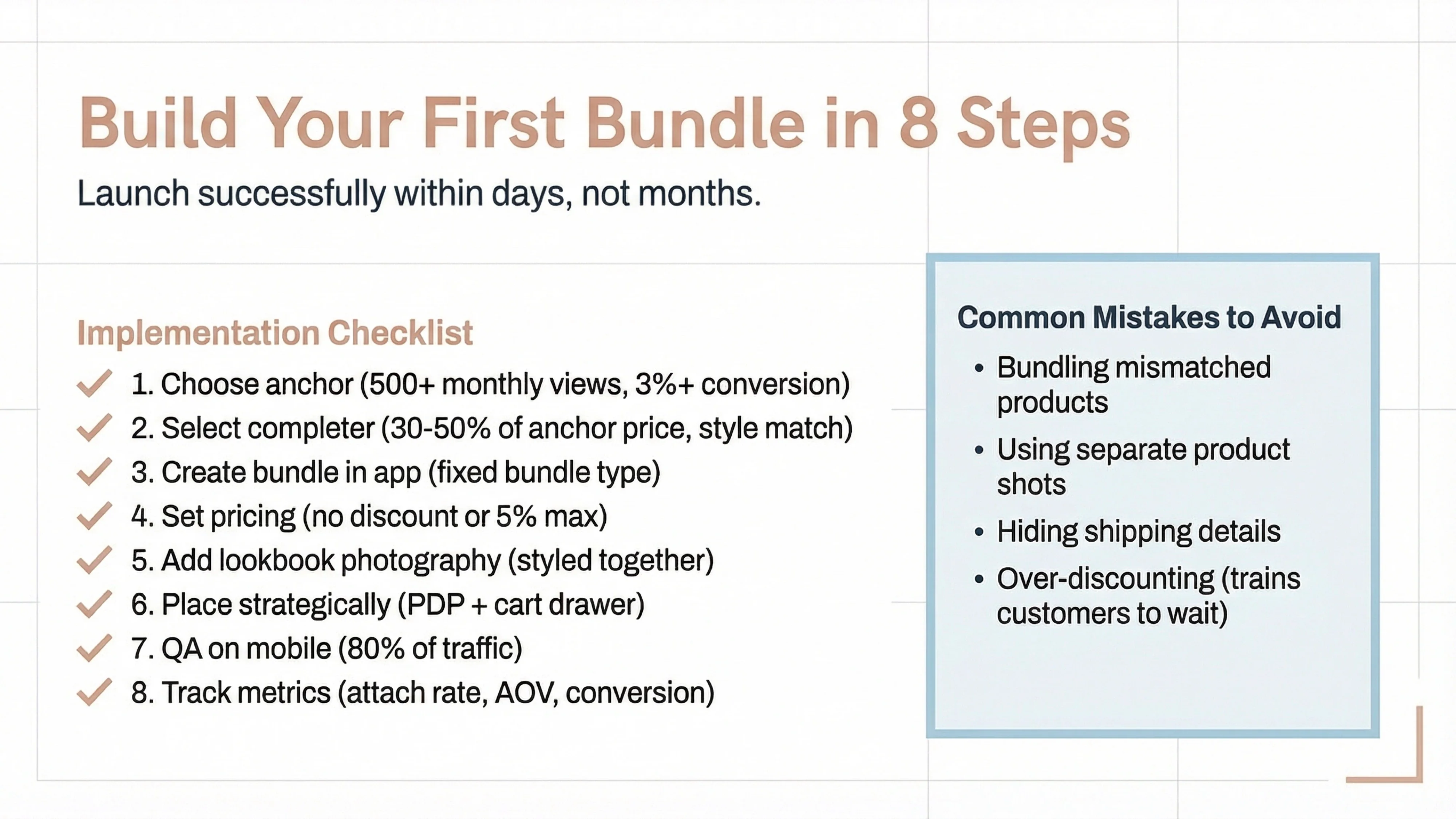
Install your chosen bundle app from the Shopify App Store. For this tutorial, we will use Shopify Bundles for its simplicity. Navigate to the app, click "Create bundle," and select "Fixed bundle." Add your Summer Top and Gold Anklet as components. Give the bundle a customer-facing name like "Summer Glow Set" that emphasizes the benefit rather than just listing the products.
This is where most brands make a critical mistake. The instinct is to discount the bundle to make it "feel like a deal." However, research shows that once customers see products as part of a cheaper package, their perceived value can drop, potentially diluting your profit margins [1].
Start with a no-discount baseline. Present the bundle at full price ($48 + $32 = $80) but frame it as curated styling guidance: "Style it together—save time, not money." This positions the bundle as convenience and expertise rather than a discount.
If you do choose to offer an incentive, keep it modest. For brands with 50%+ margins, a 10% bundle discount is sufficient. For lower-margin businesses, 5% maintains profitability while providing a gentle nudge [1]. In our example, a 5% discount would bring the bundle to $76, saving the customer $4—enough to feel acknowledged without training them to expect deep discounts.
This step separates mediocre bundles from high-converting ones. Commission or create a lifestyle photo showing both items styled together. The image should depict the complete look in context—a model wearing the Summer Top with the Gold Anklet visible, shot in a summer setting that evokes the desired lifestyle.
Write styling copy that frames the occasion and benefit: "Your new warm-weather uniform. This breezy top and delicate gold anklet create an effortlessly polished look for beach dinners, rooftop drinks, or weekend getaways. Pair with white denim and sandals for instant summer chic."
Add any available social proof. If customers have reviewed either product mentioning how they styled it, feature those quotes. User-generated content showing real customers wearing similar combinations provides powerful validation.
Start with PDP placement. When a customer views the Summer Top product page, the bundle should appear prominently—typically below the main product images and above the fold on mobile. Use language like "Complete the Look" or "Style It Together" rather than generic "You May Also Like."
Next, add the bundle to your cart drawer. When someone adds the Summer Top to their cart, trigger a slide-in or modal suggesting the Gold Anklet as a bundle add-on. This captures high-intent moments when the customer has already committed to the anchor purchase.
Fashion sites receive 80% of their traffic from mobile devices [2], so your bundle must work flawlessly on small screens. Test the bundle on actual mobile devices (not just desktop browser emulation) to ensure images load quickly, text is readable, and the "Add to cart" action is thumb-friendly.
Run a speed test using Google PageSpeed Insights or Shopify's built-in performance analyzer. Your bundle page should maintain INP below 200 milliseconds. If the bundle app significantly degrades performance, consider a lighter-weight alternative.
Set up tracking for four key metrics. Attach rate measures what percentage of customers who buy the anchor also add the completer. Target 15%+ for well-executed bundles. AOV should increase for transactions including the bundle compared to anchor-only purchases. Conversion rate on the bundle itself tells you if customers find the offer compelling. Finally, track refund and return rates for bundled items—if returns spike, it indicates a mismatch between customer expectations and reality.
Mistake: Bundling products that do not genuinely belong together aesthetically. Fix: Apply the LBB framework rigorously—every bundle needs style coherence.
Mistake: Using separate product shots instead of styled lookbook photography. Fix: Invest in lifestyle photography showing items together, even if it is a modest shoot.
Mistake: Hiding shipping and fulfillment details. Fix: Proactively state delivery timelines and any separate shipment expectations.
Mistake: Over-discounting to drive initial adoption. Fix: Start with no discount or minimal discount to avoid training customers to wait for deals.
Mistake: Launching bundles without tracking infrastructure. Fix: Set up proper analytics before launch so you can measure and optimize.
Let's quantify the revenue impact using realistic assumptions grounded in industry data. This model helps you forecast the financial benefit of a bundle program before investing significant resources.
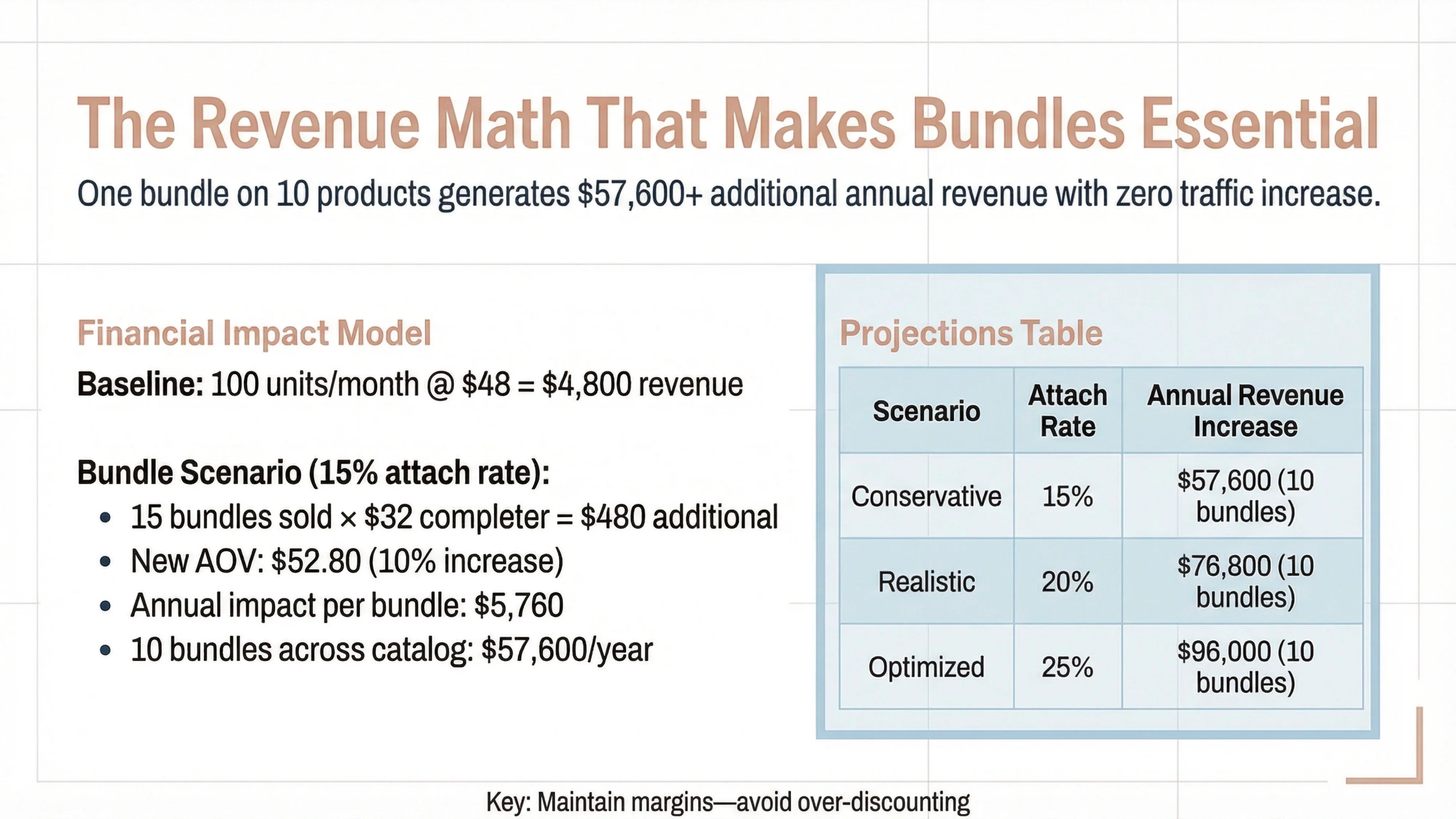
Baseline Scenario:
Bundle Scenario:
New AOV Calculation:
Annual Impact:
This is conservative math. Shopify data shows that brands like Coconu achieved 20% AOV increases and Maev saw 15% AOV lifts with 20% jumps in units per transaction [1]. If your attach rate reaches 20% instead of 15%, the annual impact from 10 bundles grows to $76,800.
The key insight is that bundle revenue compounds. Each additional bundle you create generates incremental revenue without proportional increases in traffic acquisition costs. This makes bundling one of the highest-ROI growth levers available to fashion merchants.
Important caveat: These projections assume you maintain healthy margins and do not over-discount. If you offer a 20% bundle discount to drive adoption, you may increase volume while actually decreasing profitability. Always model margin impact alongside revenue projections.
The conventional wisdom in ecommerce suggests that bundles succeed primarily through discounting—the "save 15% when you buy together" approach. However, our experience and emerging research point to a contrarian truth: discount-driven bundles can actually reduce perceived value and train customers to wait for deals rather than purchase at full price.
Research from Shopify indicates that once customers see a product as part of a cheaper package, their perceived value of that product can drop. This phenomenon, known as willingness-to-pay (WTP) dilution, means that aggressive bundle discounting can cannibalize your full-price sales and compress margins over time [1]. The customer who would have paid $48 for your Summer Top now waits for it to appear in a discounted bundle, effectively reducing your revenue per customer.
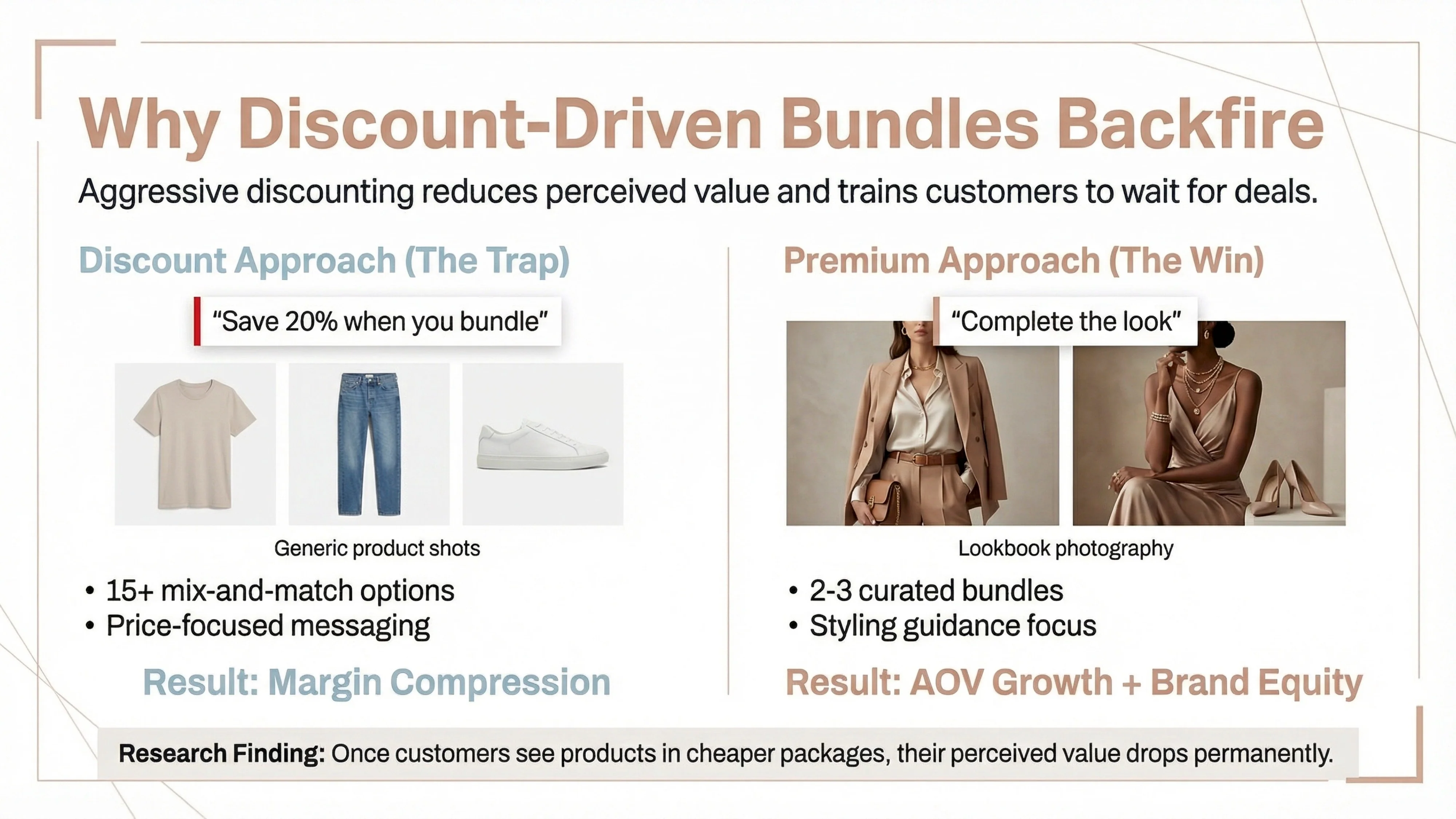
Premium bundles win through curation and visual storytelling, not price cuts. When you present a bundle as styling expertise—"We have paired these pieces to create a complete look"—you are selling convenience, taste, and editorial guidance. This approach maintains brand positioning and preserves margins while still increasing AOV.
The visual presentation is equally critical. Bundles that use mismatched photography or generic product shots create what we call "cheap vibes"—they signal that the bundle is a clearance mechanism rather than a curated offering. Baymard Institute research shows that high-quality product images and clear visual presentation are among the most important factors for fashion ecommerce conversion [3]. When your bundle looks like an afterthought, customers perceive it as one.
There is also a paradox of choice consideration. Research consistently shows that too many options decrease conversion rates. When you offer 15 different "build your own bundle" combinations, you create decision paralysis. In our experience, 2-3 carefully curated fixed bundles outperform endless customization options. The customer wants guidance, not homework.
This insight has profound implications for how you structure your bundle program. Instead of leading with "Save 20% when you bundle," lead with "Complete the look" or "Styled for you." Instead of offering every possible combination, curate 2-3 strong options per anchor product. Instead of using separate product shots, invest in lookbook photography that shows the complete outfit. These changes position bundles as premium offerings rather than discount mechanisms, protecting your brand equity while still driving AOV growth.
The single biggest barrier preventing apparel brands from bundling accessories is inventory risk. Holding stock in jewelry, bags, and other finishing touches requires capital investment, warehouse space, and the operational complexity of managing SKUs across multiple categories. For most fashion founders, this friction is enough to abandon bundling altogether.
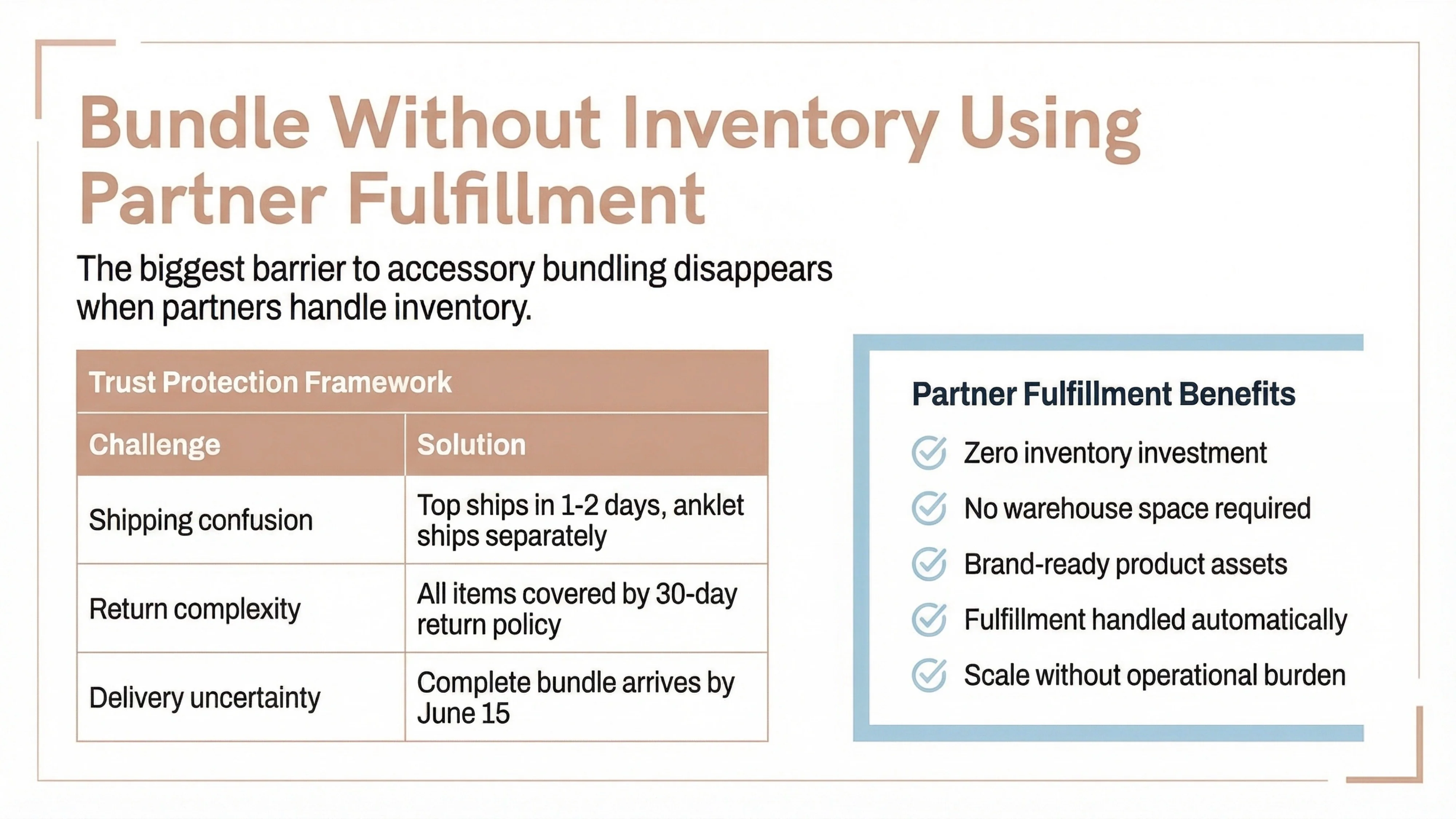
The solution is partner fulfillment—specifically, working with suppliers who maintain inventory, handle fulfillment, and provide brand-ready product assets that match your aesthetic. This model allows you to offer complete lookbook bundles without the operational burden of holding accessory inventory.
The key is finding partners whose product quality and photography standards align with your brand positioning. If you sell premium apparel at $80-150 price points, you cannot bundle with accessories that look cheap or arrive in generic packaging. The customer experience must feel cohesive, even if products ship from different locations.
When bundling products from different fulfillment sources, trust protection becomes paramount. Customers need three pieces of information upfront:
Shipping clarity: Proactively state that items may ship separately and provide expected delivery windows for each component. For example: "Your Summer Top ships from our warehouse within 1-2 business days. Your Gold Anklet ships separately from our jewelry partner within 3-5 business days. Both typically arrive within the same week."
Returns alignment: Ensure your return policy covers all bundle components, even if they ship from different sources. The customer should not have to navigate different return processes for different items. State clearly: "All items in this bundle are covered by our 30-day return policy. Return instructions will be included with each shipment."
Delivery expectations: Use delivery date estimates rather than shipping speed. Baymard Institute research shows that customers prefer to know "arrives by June 15" rather than "ships in 3-5 business days" [3]. When possible, provide specific delivery date ranges for the complete bundle.
This operational transparency reduces cart abandonment and post-purchase anxiety. The customer knows exactly what to expect, which builds trust and reduces support inquiries.
For Shopify apparel brands seeking to implement inventory-free lookbook bundles, Branvas offers a solution specifically designed to address the challenges we have discussed throughout this article.
Branvas provides high-quality jewelry photography that matches premium clothing brand aesthetics. The product imagery is shot in lifestyle contexts with styling that complements contemporary apparel, eliminating the visual mismatch that often undermines bundle credibility. When you pair your Summer Top with a Branvas Gold Anklet, the photography feels cohesive rather than cobbled together.
The platform offers bundled jewelry sets designed specifically to pair with apparel looks. Rather than forcing you to curate individual pieces, Branvas provides pre-styled sets (anklet + earrings, necklace + bracelet, etc.) that function as ready-made "completers" for your anchor products. This reduces the styling burden on your team while ensuring aesthetic coherence.
Branvas also features a bundle builder tool that allows your customers to create their own jewelry combinations from the catalog. This provides the personalization benefit of mix-and-match bundling while maintaining quality control through a curated product selection. Customers can choose their preferred metals, styles, and price points while staying within combinations that work aesthetically.
Most importantly, Branvas handles all inventory and fulfillment. You never purchase or warehouse jewelry—products ship directly from Branvas to your customers under your brand experience. This eliminates the capital risk and operational complexity that traditionally prevent apparel brands from offering complete lookbook bundles.
If you want to test lookbook bundles without buying inventory, Branvas can help you launch your first bundles within days rather than months. The platform integrates with Shopify, provides the product data and imagery you need, and handles the fulfillment logistics that often derail bundle programs before they start.
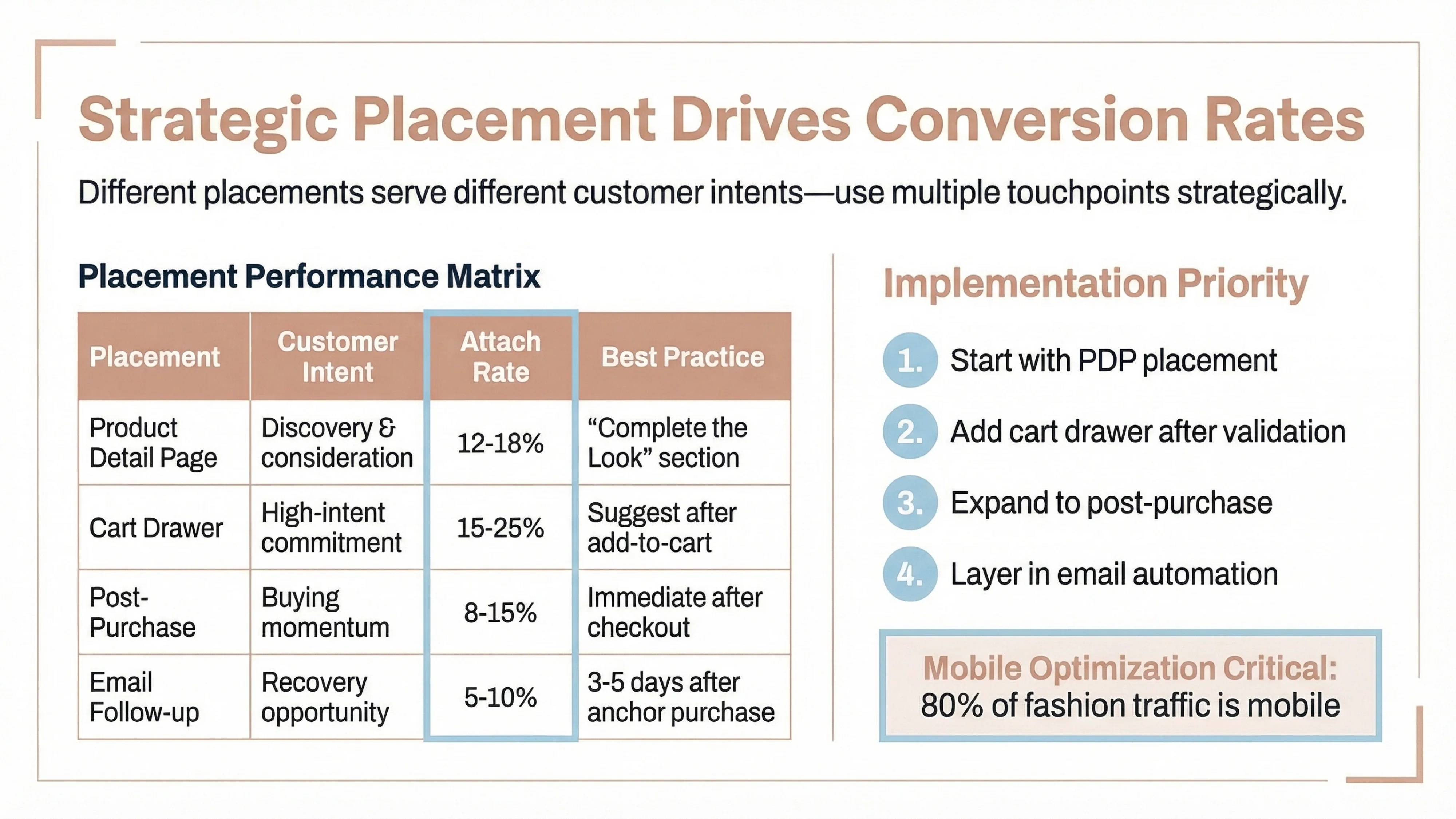
Bundle placement is not one-size-fits-all. Different locations in the customer journey serve different intents and convert at different rates. A sophisticated bundle strategy uses multiple placements strategically.
Product Detail Page (PDP) "Complete the Look" is your primary placement for lookbook bundles. When a customer is viewing your Summer Top, they are in discovery and consideration mode. Showing the Gold Anklet as part of a styled look provides styling inspiration at the exact moment they are visualizing themselves in the product. PDP bundles typically see attach rates of 12-18% when executed well.
Cart drawer cross-sell captures high-intent moments. Once a customer has added the Summer Top to their cart, they have crossed the commitment threshold. A cart drawer bundle suggestion—"Add the Gold Anklet to complete your look for just $32 more"—capitalizes on this momentum. Cart drawer placements often see attach rates of 15-25% because the customer has already decided to purchase.
Post-purchase add-on presents bundles immediately after the primary transaction is complete. The psychology here is powerful: the customer has just completed a purchase and is in a positive emotional state. The friction of "starting a new transaction" is removed since they have already checked out. Post-purchase bundles typically see attach rates of 8-15% but carry higher AOV since customers often add multiple items.
Email and SMS follow-up for completers is an advanced tactic. If a customer purchases your Summer Top but does not add the Gold Anklet, you can send a post-purchase email 3-5 days later with the subject line "Complete your look" featuring the bundle. This extends the bundle opportunity beyond the initial transaction and can recover 5-10% of missed bundle revenue.
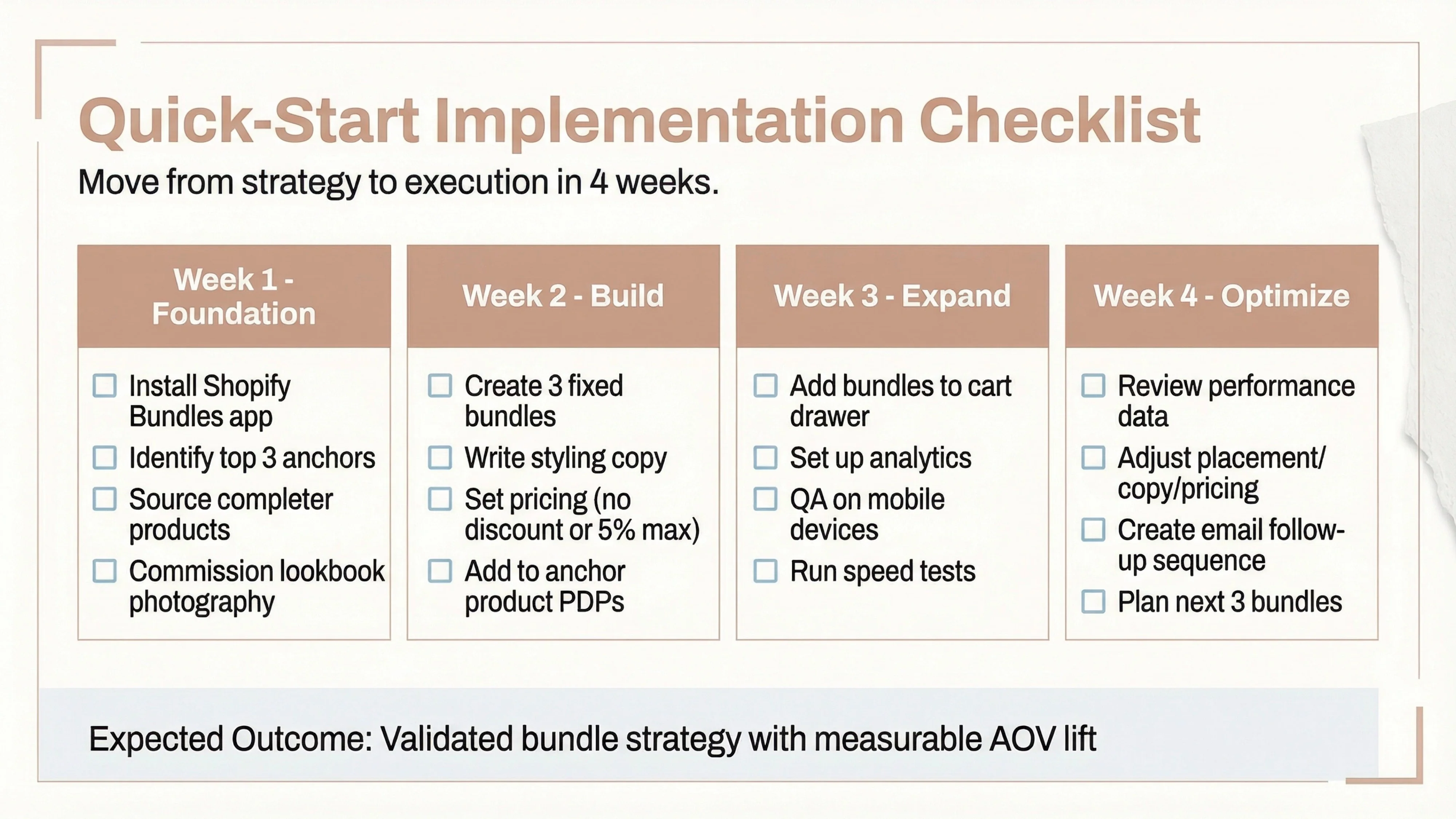
To help you move from strategy to execution quickly, here is a prioritized checklist:
Week 1 (Foundation):
Week 2 (Build):
Week 3 (Expand):
Week 4 (Optimize):
This checklist assumes you are starting from scratch. If you already have bundle infrastructure, you can compress this timeline significantly.
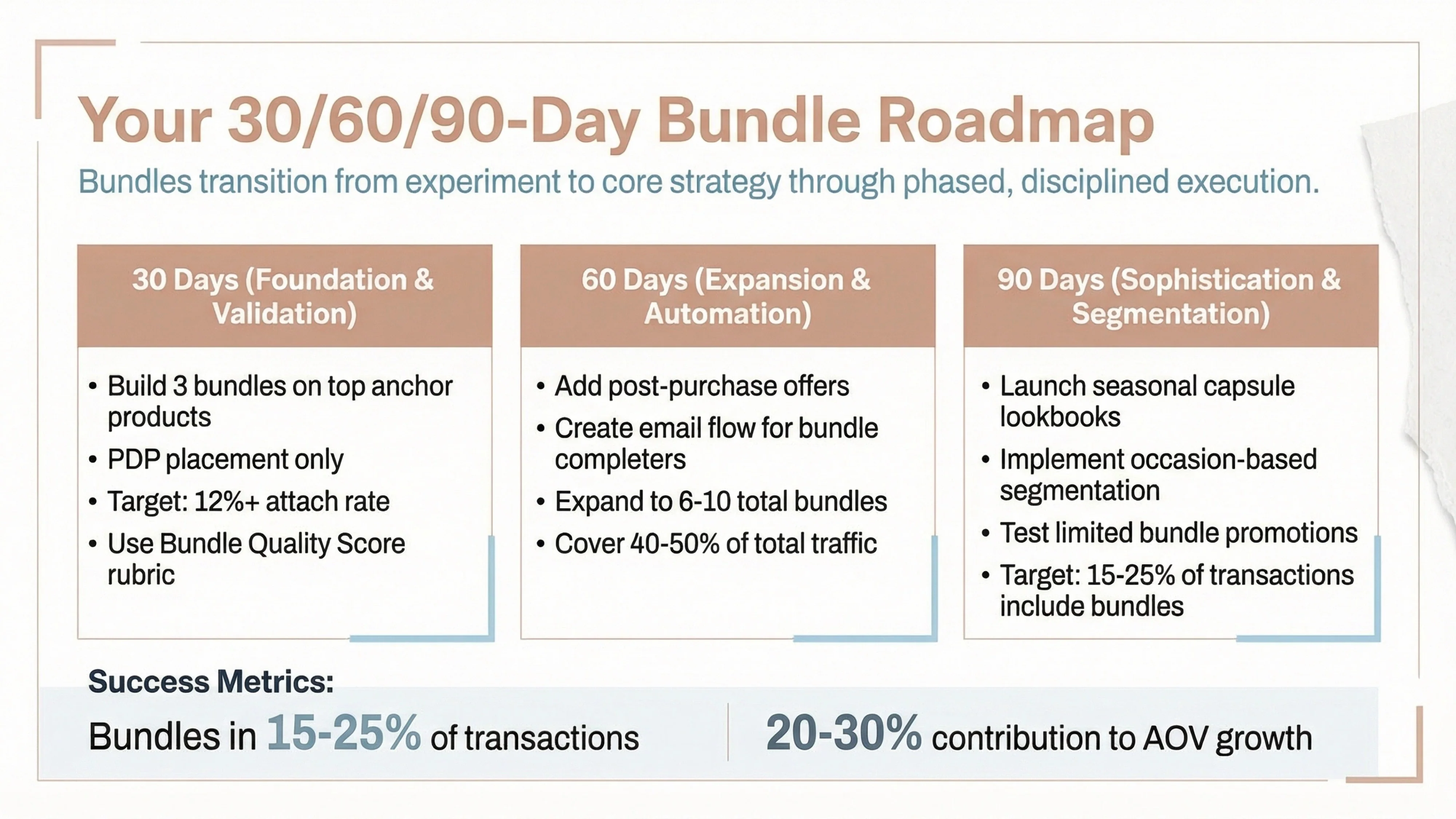
A successful bundle program is not a one-time project—it is an ongoing merchandising discipline. Here is a phased roadmap for building sustainable bundle revenue.
Your first month focuses on proving the concept with minimal investment. Build 3 bundles on your top 3 anchor products using the LBB framework. Place these bundles on PDPs only—do not expand to cart or post-purchase yet. Your goal is to validate that customers respond to lookbook-style bundling in your specific brand context.
Measure attach rate for each bundle. A well-executed bundle should achieve at least 12% attach rate. If you are seeing 5% or below, diagnose the issue: Is the completer poorly matched? Is the photography weak? Is the price point wrong? Use the Bundle Quality Score rubric to identify gaps.
By day 30, you should have clear data on which bundle performs best and why. This becomes your template for expansion.
Month two focuses on scaling what works and adding automation. Add post-purchase bundle offers using your app's post-purchase functionality. This captures additional revenue from customers who did not add the bundle during initial checkout.
Create an email flow for bundle completers. When someone purchases an anchor product without the completer, trigger an automated email 3-5 days later featuring the bundle with subject line "Complete your [Product Name] look." This recovers 5-10% of missed bundle opportunities.
Refine your visual assets based on performance data. If bundles with lifestyle photography are outperforming those with separate product shots, invest in additional styled photography for your entire bundle catalog.
Expand to 6-10 total bundles, covering your highest-traffic products. The goal is to have bundles available on products representing 40-50% of your total traffic.
Month three introduces advanced tactics. Create seasonal capsule lookbooks—curated collections of 3-5 bundles organized around a theme ("Summer Essentials," "Fall Layers," "Holiday Party Looks"). These can be promoted via dedicated landing pages, email campaigns, and social media.
Implement occasion-based segmentation. A customer who previously purchased beachwear should see different bundle recommendations than someone who bought workwear. Use Shopify's customer tagging and your bundle app's segmentation features to personalize bundle suggestions.
Test bundle-specific promotions carefully. If you have maintained no-discount positioning for 60 days, you can test a limited-time "Bundle Week" promotion offering 10% off all bundles. Measure whether this drives incremental volume or simply shifts existing purchases to discounted bundles.
By day 90, bundles should represent 15-25% of your total transactions and contribute 20-30% of your AOV growth. This is the point where bundling transitions from experiment to core merchandising strategy.
The best product bundling strategies for ecommerce focus on curation over discounting. Effective approaches include fixed bundles that pair hero products with complementary accessories, lookbook-style bundles that provide complete outfit solutions, and gift bundles that simplify purchase decisions during key shopping seasons. Research shows that bundles positioned as styling guidance rather than discount mechanisms maintain higher perceived value and protect brand positioning. The most successful strategies use high-quality lifestyle photography, clear shipping expectations, and modest or no discounts to drive AOV increases of 15-20% while preserving margins.
The best Shopify bundles app depends on your specific needs and technical capabilities. For beginners, Shopify's native Bundles app provides excellent fixed bundle functionality with zero performance impact and seamless inventory integration. For intermediate users needing mix-and-match capabilities, Bundler and Bundle Builder offer more flexibility while maintaining reasonable performance. Advanced merchants requiring post-purchase bundles, AI recommendations, or complex conditional logic should evaluate Rebuy or Nosto. The key is to start with simpler functionality, validate your bundle strategy, then expand to more sophisticated apps as your program matures. Prioritize apps that support no-discount bundling, explode bundles into component SKUs for inventory management, and provide robust analytics for attach rate and AOV tracking.
No, discounting is not required for successful bundles, and aggressive discounting can actually harm your brand by reducing perceived value. Research from Shopify shows that once customers see products as part of cheaper packages, their willingness to pay for those items individually can decrease, potentially cannibalizing full-price sales. Premium bundles succeed through curation, styling guidance, and visual storytelling rather than price cuts. Position bundles as "complete the look" solutions that save customers time and provide expert styling, not as discount mechanisms. If you do choose to offer a bundle incentive, keep it modest—5-10% is sufficient to acknowledge the bundle purchase without training customers to wait for deals. Many successful fashion brands maintain no-discount bundle positioning and still achieve 15%+ attach rates.
Creating bundles without holding inventory requires partnering with suppliers who maintain stock and handle fulfillment on your behalf. The key is finding partners whose product quality, photography standards, and packaging align with your brand positioning. For apparel brands, jewelry and accessories are ideal bundle partners because they ship easily, carry strong margins, and complete outfits without requiring you to hold inventory across multiple categories. When implementing inventory-free bundles, provide transparent shipping information (items may ship separately), ensure your return policy covers all components, and use delivery date estimates rather than shipping speeds to set clear expectations. Platforms like Branvas specialize in providing brand-ready jewelry with fulfillment services specifically designed for apparel brands seeking to offer complete lookbook bundles without inventory risk.
Bundles convert best when placed strategically across multiple touchpoints in the customer journey. Product detail pages (PDP) are your primary placement—showing bundles as "complete the look" suggestions when customers view anchor products typically achieves 12-18% attach rates. Cart drawer placements capture high-intent moments after customers add items to their cart, often seeing 15-25% attach rates. Post-purchase add-ons present bundles immediately after checkout completion, capitalizing on buying momentum for 8-15% attach rates. For advanced programs, email and SMS follow-ups to customers who purchased anchor products without completers can recover 5-10% of missed bundle opportunities. Start with PDP placement to validate your bundle strategy, then expand to cart and post-purchase as you scale. Always test bundle performance across mobile and desktop, as 80% of fashion traffic now comes from mobile devices.
[1] Keenan, M. (2025, October 3). Product Bundling: A Strategic Guide to Increase AOV (+ Examples). Shopify. https://www.shopify.com/blog/bundling-for-retail
[2] Gulati, B. (2025, December 9). Conversion Rate Optimization for Fashion Brands: 2026 Guide. Shopify. https://www.shopify.com/enterprise/blog/fashion-conversion-rate-optimization
[3] Reeves, K. (2025, November 25). Checkout UX Best Practices 2025. Baymard Institute. https://baymard.com/blog/current-state-of-checkout-ux
[4] Hodgson, L. (2026, January). How to run bundles in 2026. Commerce Thinking. https://www.commercethinking.com/p/how-to-run-bundles-in-2026
[5] Balchandani, A., Rölkens, F., & D'Auria, G. (2025, November 17). The State of Fashion 2026: When the rules change. McKinsey & Company. https://www.mckinsey.com/industries/retail/our-insights/state-of-fashion