
Compare the best dropshipping automation software for 2026 and use the BWAM framework to identify which workflow bottleneck to automate first for scalable, profitable operations.
Published:
August 5, 2026
Author:
Yi Cui
Dropshipping automation can save time, but the wrong tool stack can also automate a weak business model. The right starting point is not the longest feature list. It is knowing which workflow bottleneck to automate first.
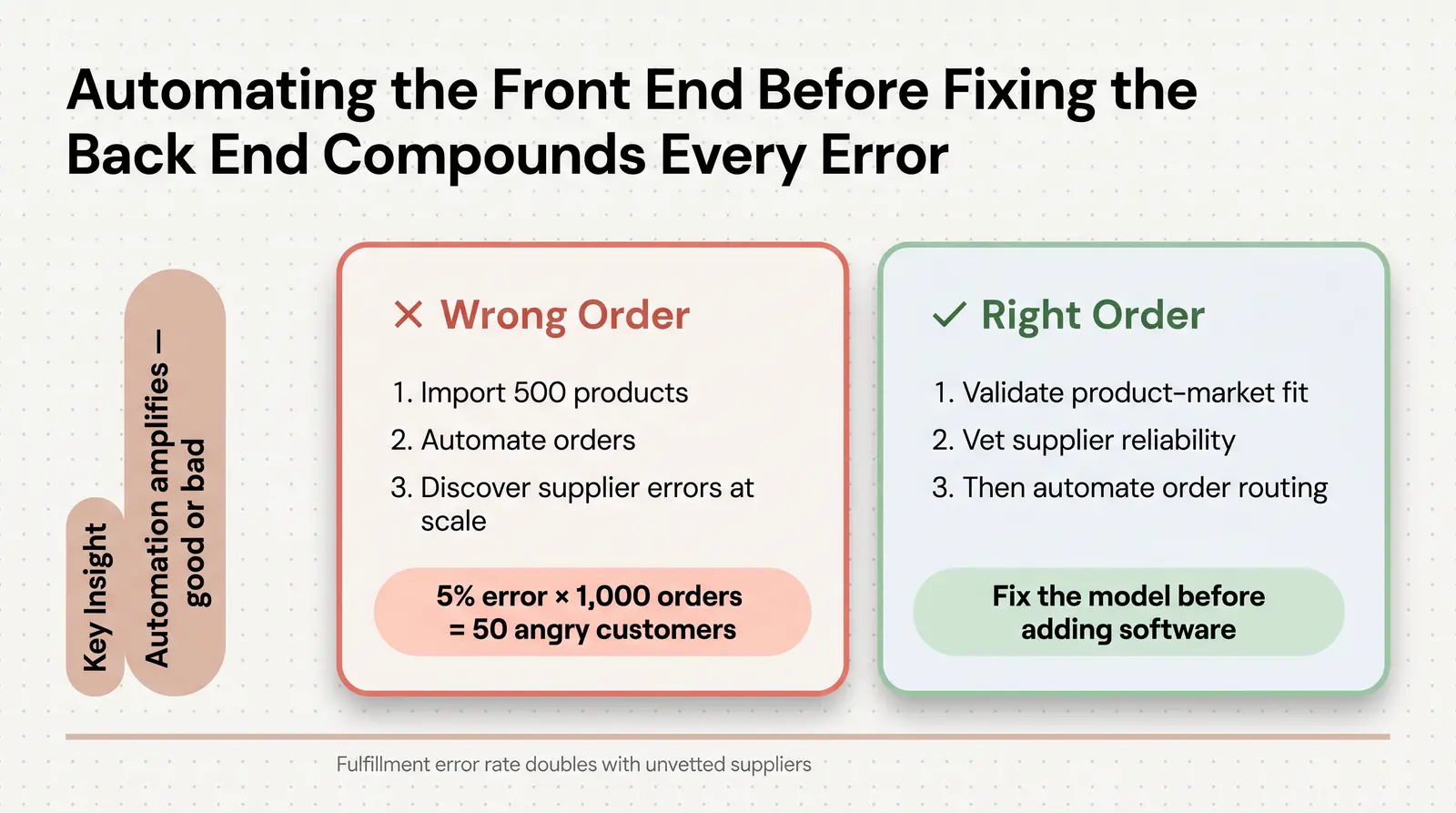
The common mistake is simple: sellers buy into AutoDS or DSers before they have validated product-market fit or established a reliable supplier relationship. They rush to automate the front end (importing hundreds of products) while ignoring the back end (fulfillment reliability and margin protection). When you automate order processing with an unreliable supplier, you aren't scaling success. You are scaling customer service nightmares.
This is where our proprietary framework, the Branvas Workflow Audit Matrix, comes in. In our experience at Branvas, the founders who scale fastest are not the ones with the most tools. They are the ones who automated one bottleneck at a time, starting with inventory sync.
Automating order volume before automating supplier reliability leads to a compounding error rate. The data on ecommerce return rates and fulfillment errors supports this. The typical fulfillment error rate in standard logistics ranges from 1% to 3% [1], but in dropshipping with unvetted suppliers, this rate can easily double. When you automate a system with a 5% error rate across 1,000 orders, you are guaranteeing 50 angry customers.
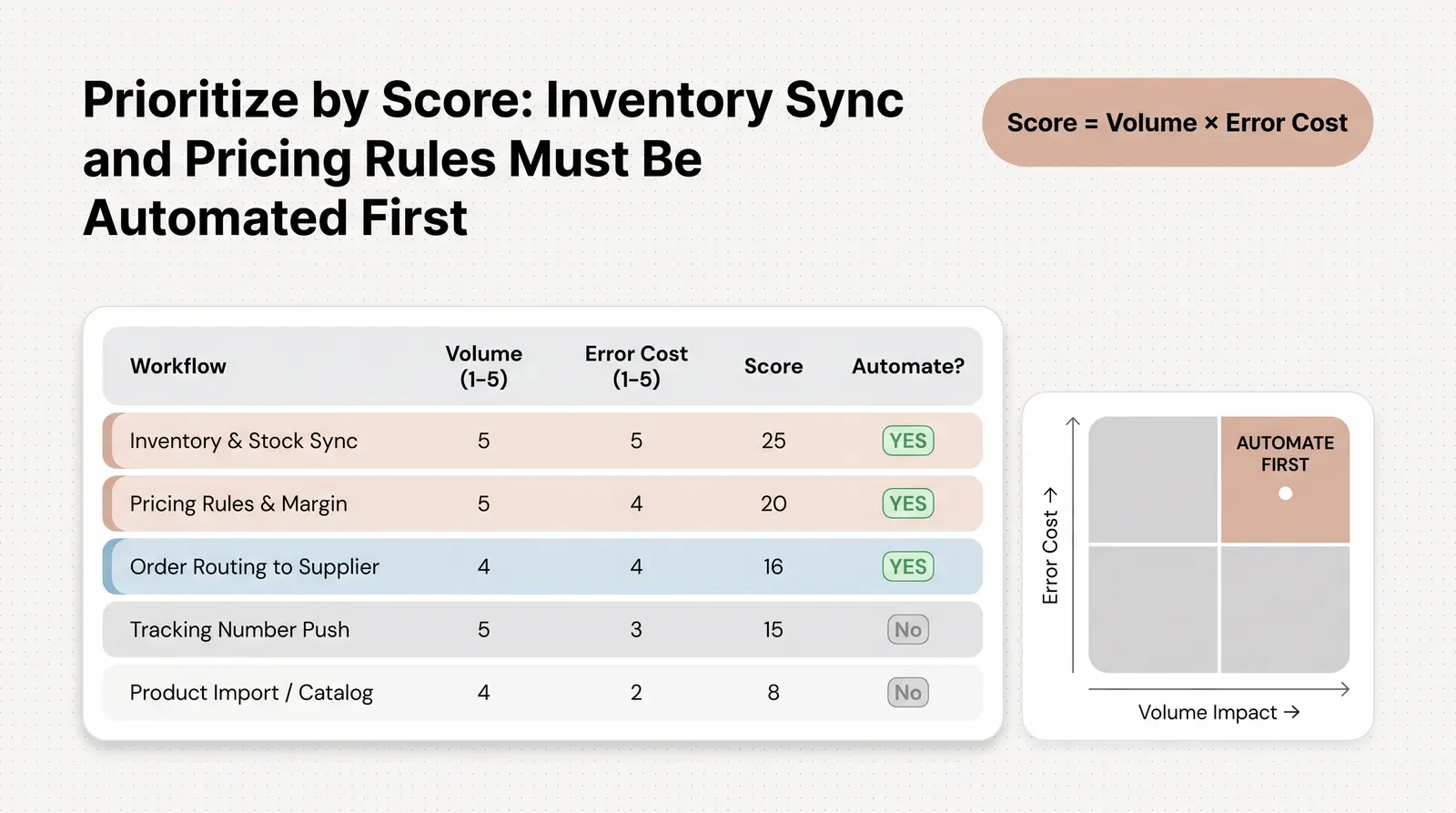
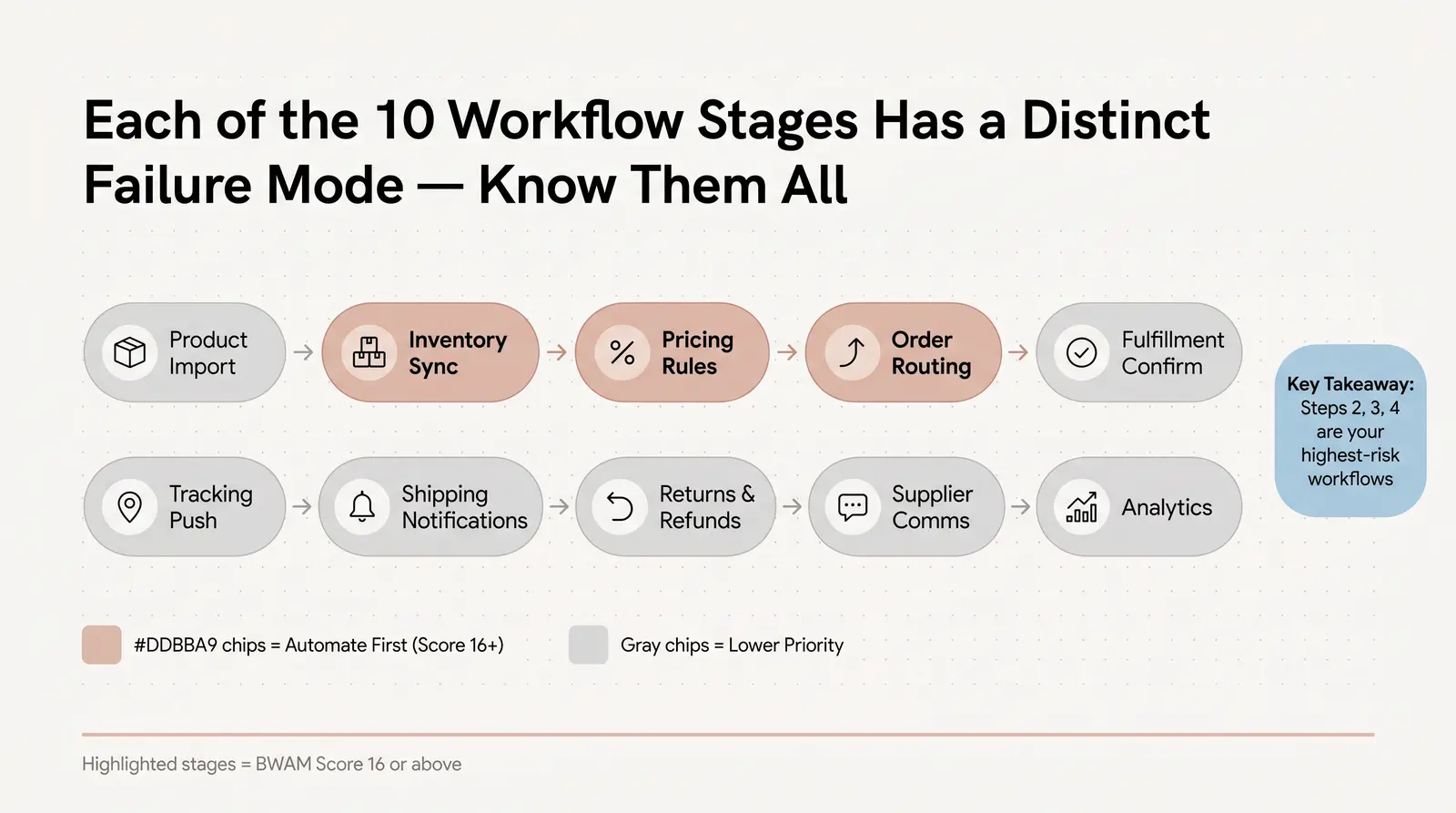
To help brand-led dropshippers decide which workflow to automate first, we developed the Branvas Workflow Audit Matrix (BWAM). This prioritization tool evaluates workflows based on two axes: Volume Impact (how many orders or SKUs this affects per week, scored 1–5) and Error Cost (how badly a mistake in this step hurts the customer or the business, scored 1–5).
The BWAM Priority Score is calculated simply: Volume Impact × Error Cost. The higher the score, the more urgent the need for automation.
| Workflow Stage | Volume Impact (1–5) | Error Cost (1–5) | BWAM Priority Score | Automate First? |
|---|---|---|---|---|
| 1. Product Import / Catalog Sync | 4 | 2 | 8 | No |
| 2. Inventory & Stock Level Sync | 5 | 5 | 25 | Yes |
| 3. Pricing Rules & Margin Protection | 5 | 4 | 20 | Yes |
| 4. Order Routing to Supplier | 4 | 4 | 16 | Yes |
| 5. Fulfillment Confirmation | 4 | 3 | 12 | No |
| 6. Tracking Number Push to Customer | 5 | 3 | 15 | No |
| 7. Customer Shipping Notifications | 5 | 2 | 10 | No |
| 8. Returns & Refund Processing | 2 | 5 | 10 | No |
| 9. Supplier Communication / Reorders | 3 | 4 | 12 | No |
| 10. Analytics & Performance Reporting | 3 | 2 | 6 | No |
For most standard dropshippers, the top three priorities are clear: Inventory & Stock Level Sync (25), Pricing Rules & Margin Protection (20), and Order Routing to Supplier (16).
However, for private-label and brand-led dropshippers, the priority order shifts. When you are building a real brand, product quality and customer experience matter more than sheer catalog size. Therefore, automating blind fulfillment and branded tracking becomes just as critical as inventory sync.
This is the process of pulling product titles, descriptions, and images from a supplier into your storefront. If this isn't automated, you spend hours copying and pasting data, leading to outdated catalogs. Good automation here means one-click imports that pull high-resolution images and format descriptions cleanly.
This workflow keeps your store's stock levels matched to your supplier's actual inventory. Without automation, you risk overselling products that are out of stock, leading to immediate refunds and damaged reputation. Good automation syncs inventory in real-time or multiple times a day to prevent stockouts.
This involves automatically adjusting your retail prices when supplier costs change. If ignored, a supplier price hike can instantly wipe out your profit margins. Good automation allows you to set global rules (e.g., always maintain a 30% margin) that adjust automatically.
This is the handoff where a customer's order on your site is sent to the supplier for fulfillment. Manual routing is slow and prone to data entry errors. Good automation instantly forwards the order details, shipping address, and payment to the correct supplier without human intervention.
This step verifies that the supplier has actually picked, packed, and shipped the order. Without it, orders can sit in limbo for days. Good automation provides a dashboard view confirming that the supplier has moved the order to "shipped" status.
Once shipped, the tracking number must move from the supplier back to your store. Manual updates lead to delays and "Where is my order?" emails. Good automation pulls the tracking number from the supplier and automatically updates the order status in your ecommerce platform.
This is the automated email or SMS sent to the customer with their tracking details. If this breaks, customer anxiety spikes. Good automation triggers branded, clear notifications the moment the tracking number is pushed to the store.
Handling items that customers send back or request refunds for. Manual processing is a logistical nightmare in dropshipping. Good automation provides a streamlined portal for customers to request returns and routes the request appropriately based on supplier policies.
This involves messaging suppliers about issues, custom requests, or bulk reorders. Without a system, emails get lost and delays happen. Good automation uses templated messages or direct API connections to handle routine supplier communications.
Tracking sales, margins, and supplier performance over time. Manual tracking in spreadsheets is tedious and often inaccurate. Good automation provides real-time dashboards showing exactly which products and suppliers are driving profit.
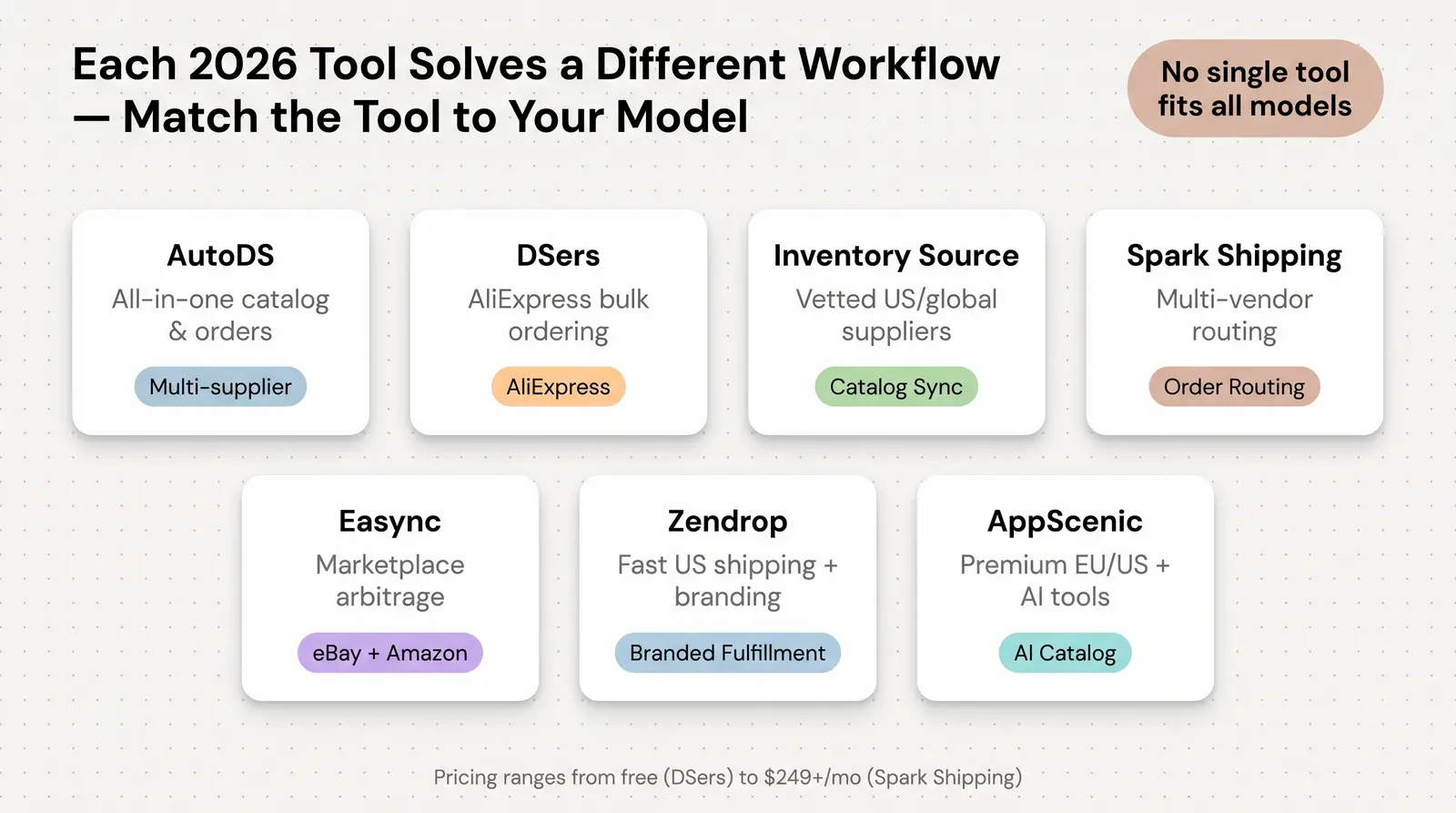
The landscape of dropshipping software has matured significantly by 2026. Here are the top tools, mapped to the workflows they handle best.
AutoDS is a comprehensive, all-in-one platform that handles almost everything from product research to fulfillment. It is best for sellers who want a single dashboard for their entire operation. It covers product import, inventory sync, pricing rules, and automated order routing. It is compatible with Shopify, eBay, Amazon, Wix, and WooCommerce. Pricing starts around $26.90 to $29.90 per month for the Starter plan [2]. The key risk is feature bloat; beginners can get overwhelmed, and the costs scale up quickly as order volume increases.
As the official AliExpress partner, DSers is built specifically for processing AliExpress orders at scale. It is best for high-volume AliExpress dropshippers. It excels at bulk order routing, tracking updates, and variant mapping. It integrates primarily with Shopify and WooCommerce. DSers offers a robust free plan, with the Advanced plan starting at $19.90 per month [3]. The main limitation is its strict reliance on AliExpress; it is not suitable for multi-supplier setups outside that ecosystem.
Inventory Source focuses heavily on its massive directory of vetted US and global suppliers, combined with inventory automation. It is best for sellers who want reliable, pre-vetted suppliers rather than open marketplaces. It covers catalog sync, inventory sync, and order routing (on higher tiers). It works with Shopify, BigCommerce, WooCommerce, Amazon, and eBay. Pricing starts at $99 per month for basic inventory automation, and $199 for full order automation [4]. The key risk is the higher starting price point compared to entry-level tools.
Spark Shipping is an enterprise-grade tool designed for complex, multi-vendor operations. It is best for established stores working with multiple independent suppliers, distributors, or warehouses. It handles intelligent order routing, real-time inventory sync across any vendor format (API, FTP, CSV), and tracking updates. It supports Shopify, BigCommerce, WooCommerce, and Magento. Pricing starts at $249 per month [5]. The key risk is the steep learning curve and high cost, making it unsuitable for beginners.
Easync is a popular tool for marketplace dropshippers, particularly those selling on eBay. It is best for arbitrage sellers moving products between Amazon, Walmart, and eBay. It covers pricing rules, inventory sync, and automated ordering. It integrates with Shopify and eBay. Pricing starts around $49.99 to $65.99 per month [6]. The key risk is platform compliance; automated arbitrage can sometimes trigger account suspensions on strict marketplaces like Amazon.
Zendrop positions itself as a premium alternative to AliExpress, offering faster shipping and US-based fulfillment. It is best for Shopify sellers who want better shipping times and custom branding options. It covers product import, automated fulfillment, and branded tracking. It is primarily built for Shopify. Pricing includes a free tier, with the Pro plan at $49 per month and Plus at $79 per month [7]. The key limitation is a smaller product catalog compared to massive aggregators like AutoDS.
AppScenic is an emerging powerhouse in 2026, focusing on premium products from US, UK, and EU suppliers with built-in AI tools. It is best for sellers wanting fast shipping and AI-assisted catalog management. It covers inventory sync, automated ordering, and AI product enhancement. It integrates with Shopify and WooCommerce. Pricing starts at $39 per month for the Standard plan, up to $99 for Elite [8]. The key risk is that it focuses heavily on premium markets, which may not suit low-ticket, high-volume arbitrage models.
Branvas is not just software; it is the automation layer for private-label jewelry and accessories brands. It is best for influencers, creators, and brand builders who want to sell premium products without holding inventory. Branvas handles sourcing, packaging, blind fulfillment, and tracking natively. It integrates seamlessly with Shopify. The key limitation is its niche focus: it is exclusively for jewelry and accessories, not general merchandise.
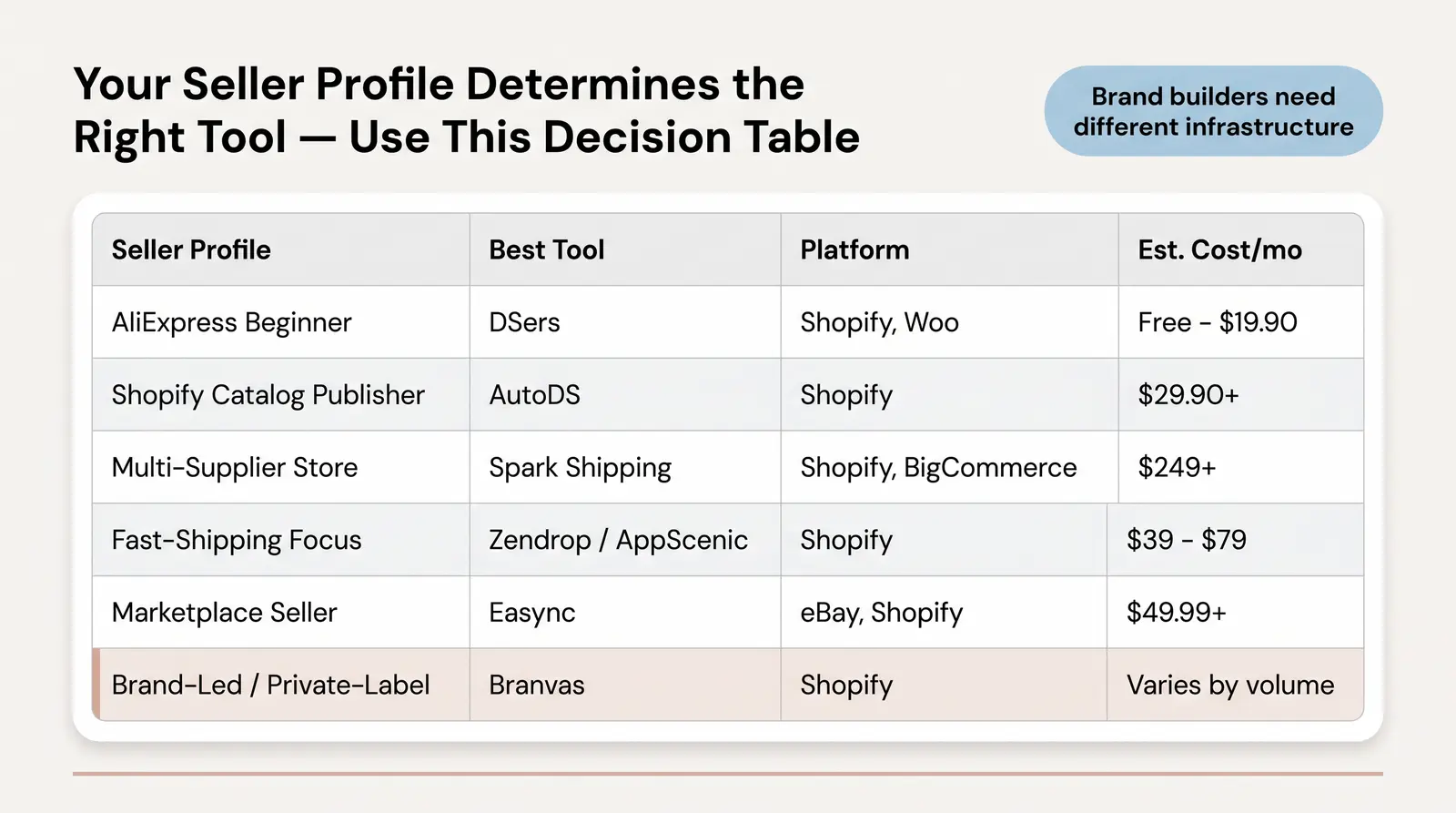
Choosing the right tool depends entirely on your business model, order volume, and supplier strategy. Use this decision table to find the best fit for your specific operational needs in 2026.
| Seller Profile | Primary Need | Best Tool(s) | Platform | Est. Monthly Cost | Key Risk |
|---|---|---|---|---|---|
| 1. AliExpress Beginner (first store, low volume) | Low cost, easy bulk ordering | DSers | Shopify, Woo | Free – $19.90 | Locked into AliExpress quality |
| 2. Shopify Catalog Publisher (100+ SKUs, single supplier) | All-in-one automation | AutoDS | Shopify | $29.90+ | Costs scale quickly with volume |
| 3. Multi-Supplier Store (3+ suppliers, mixed categories) | Intelligent order routing | Spark Shipping | Shopify, BigCommerce | $249+ | High starting cost, complex setup |
| 4. Fast-Shipping Focus (US/EU suppliers) | Premium products, fast delivery | Zendrop, AppScenic | Shopify | $39 – $79 | Smaller product catalogs |
| 5. Marketplace Seller (eBay + Amazon + Shopify) | Cross-platform arbitrage | Easync | eBay, Shopify | $49.99+ | Marketplace compliance issues |
| 6. Brand-Led Dropshipper / Private-Label | Sourcing, branding, blind fulfillment | Branvas | Shopify | Varies by volume | Niche specific (jewelry/accessories) |
For sellers in row 6 looking to build a real brand rather than just flip commodities, explore how it works with Branvas.
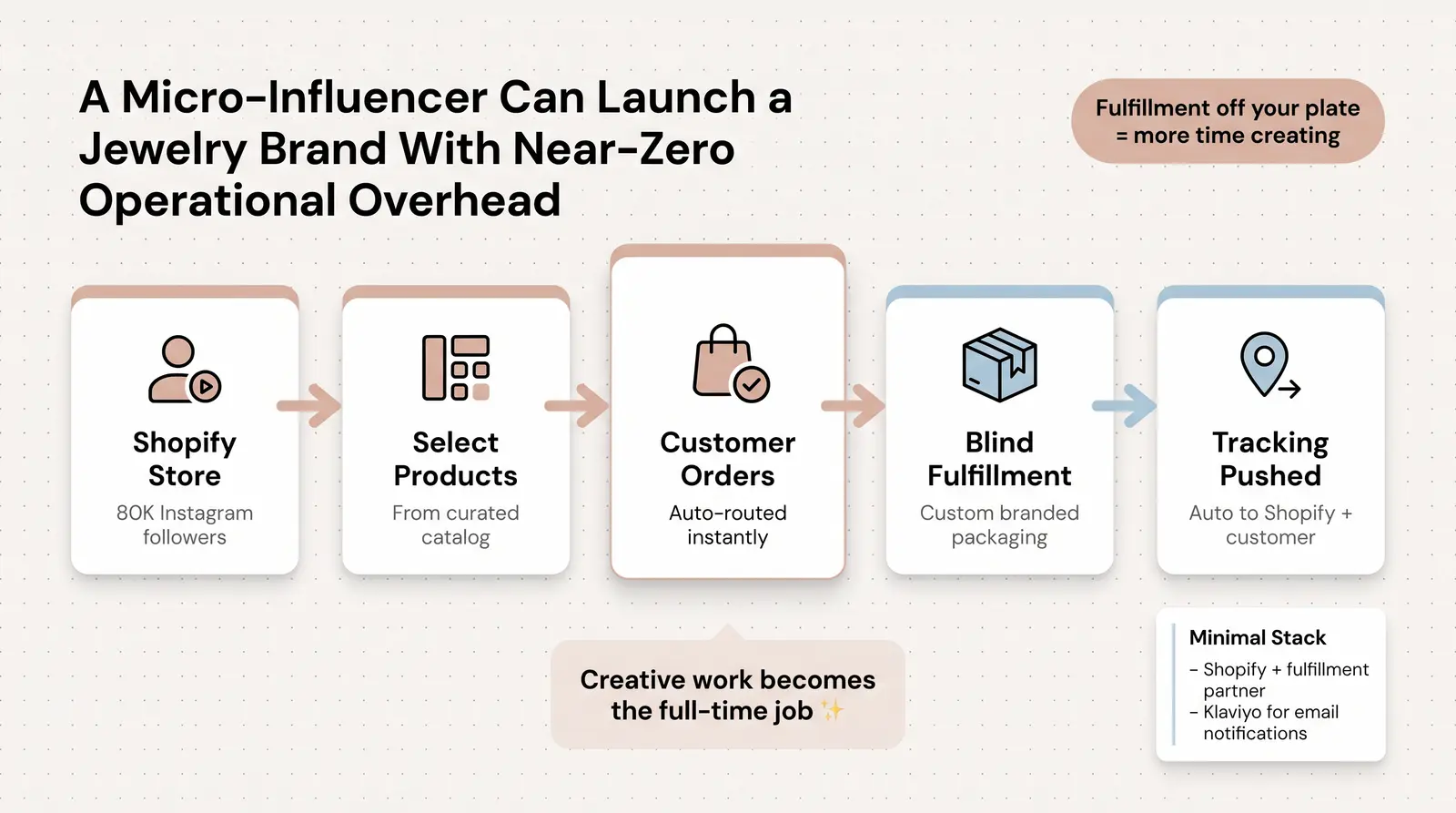
Let's look at a realistic scenario: A micro-influencer with 80,000 Instagram followers wants to launch a private-label jewelry brand and dropship orders without holding inventory.
First, they set up their Shopify store and connect it directly to Branvas. Instead of spending weeks negotiating with overseas factories, they select premium jewelry pieces from the Branvas catalog.
Branvas natively handles the heavy lifting. When a follower buys a necklace, the order routes automatically to Branvas. The team picks the item, packages it in the influencer's custom-branded packaging, and ships it via blind fulfillment (meaning the customer never sees Branvas on the label). The tracking number is automatically pushed back to Shopify.
For third-party tools, the influencer might only need a simple email automation app (like Klaviyo) to send the shipping notifications, and basic Shopify analytics to track sales.
We often see influencer founders surprised by how little operational overhead is left once fulfillment and tracking are off their plate. The creative work becomes the full-time job. Instead of managing spreadsheets and supplier disputes, they spend their time making TikToks and engaging with their community.
If you're building a jewelry or accessories brand and want to see how Branvas handles the fulfillment layer, explore how it works.
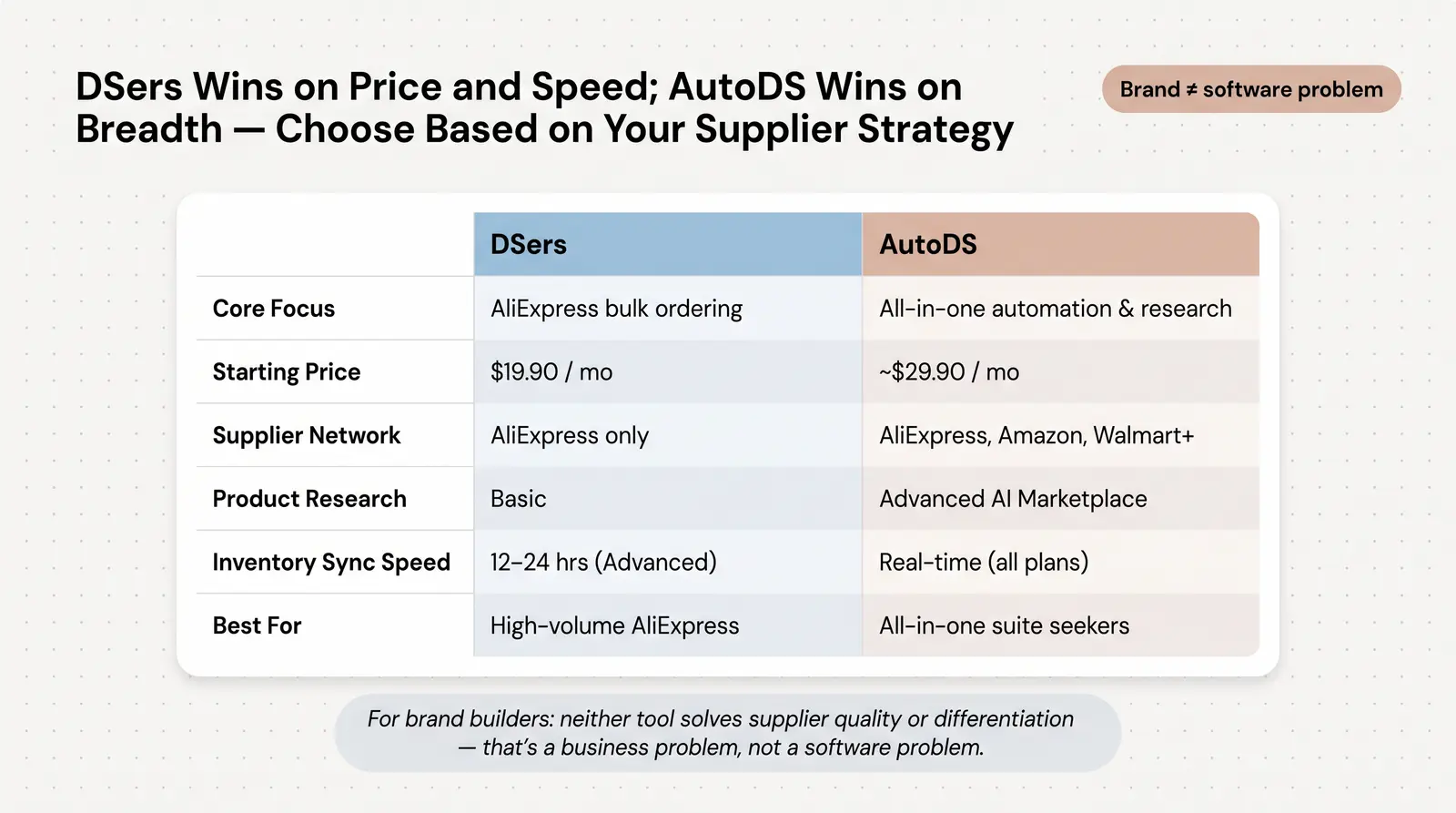
The most common debate in dropshipping software is DSers versus AutoDS. Both are excellent, but they serve different strategic goals.
DSers is the undisputed king of AliExpress bulk processing. Its core strength is speed; you can process hundreds of orders in seconds. It handles inventory sync and tracking updates reliably. In 2026, its Advanced plan sits at a highly competitive $19.90 per month. However, it is fundamentally tied to the AliExpress ecosystem.
AutoDS is a broader, all-in-one platform. It includes product research tools, supports multiple suppliers beyond AliExpress (like Amazon and Walmart), and offers dynamic pricing rules. Its Starter plan costs around $29.90 per month, making it slightly more expensive, but it replaces the need for separate product research software.
Who should choose which?
If you are strictly dropshipping from AliExpress and need fast, cheap order fulfillment, choose DSers. If you want an all-in-one dashboard that handles product discovery, multi-supplier monitoring, and pricing optimization, choose AutoDS.
However, here is the contrarian reality: For sellers trying to build a brand rather than arbitrage commodity products, neither tool solves the core problem. Supplier relationships and product differentiation still require a different infrastructure. Software cannot turn a cheap, commoditized product into a premium brand experience. Brand differentiation is a business problem, not a software problem.
| Feature | DSers | AutoDS |
|---|---|---|
| Core Focus | AliExpress bulk ordering | All-in-one automation and research |
| Starting Paid Price (2026) | $19.90 / month | ~$29.90 / month |
| Supplier Network | AliExpress exclusively | AliExpress, Amazon, Walmart, and more |
| Product Research Tools | Basic (Supplier Optimizer) | Advanced (AI Marketplace) |
| Platform Compatibility | Shopify, WooCommerce | Shopify, eBay, Amazon, Wix, WooCommerce |
| Inventory Sync Speed | 12 to 24 hours (Advanced plan) | Real-time (Starter and above) |
| Tracking Automation | Yes, on all paid plans | Yes, on all paid plans |
| Best For | High-volume AliExpress sellers | Sellers wanting an all-in-one suite |
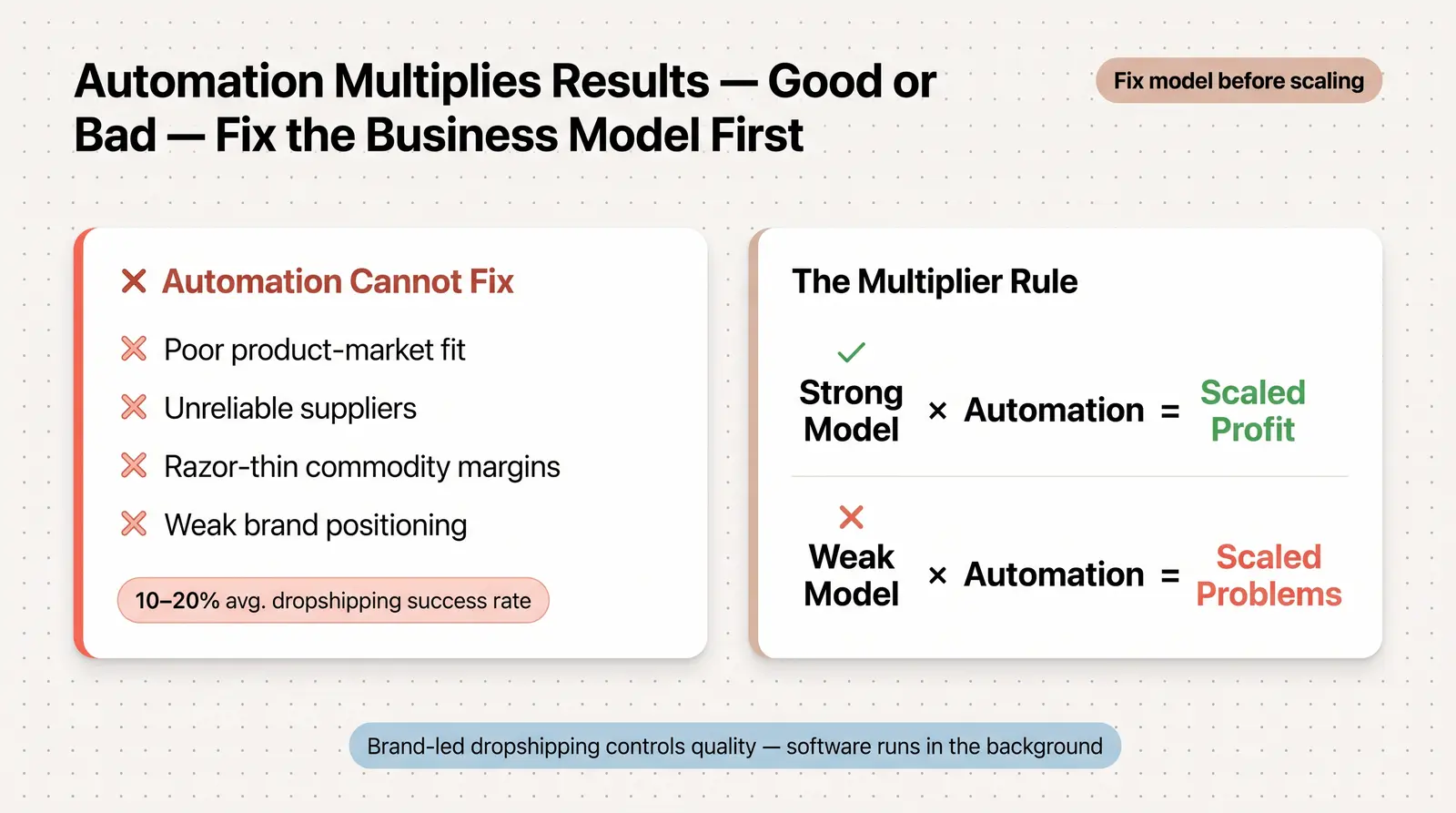
Automation is a multiplier. If your business model is strong, automation multiplies your profit. If your business model is weak, automation multiplies your problems.
Automation cannot fix poor product-market fit. It cannot fix unreliable suppliers who ship damaged goods. It cannot fix commoditized products with razor-thin margins, and it certainly cannot fix weak brand positioning. In fact, a recent report noted that the average success rate of a standard dropshipping business is only between 10% and 20% [9], largely because sellers rely on software to fix fundamental business flaws.
This is why brand-led dropshipping — building a real brand around curated products, with a reliable fulfillment partner — is growing as an alternative to commodity arbitrage. When you control the brand and the quality, the software simply runs in the background, doing what it does best: saving time.
Ready to move from commodity dropshipping to a real brand? See how Branvas works →
For sellers operating exclusively within the Shopify ecosystem, automation looks slightly different. Shopify has heavily invested in its native automation capabilities, most notably through Shopify Flow.
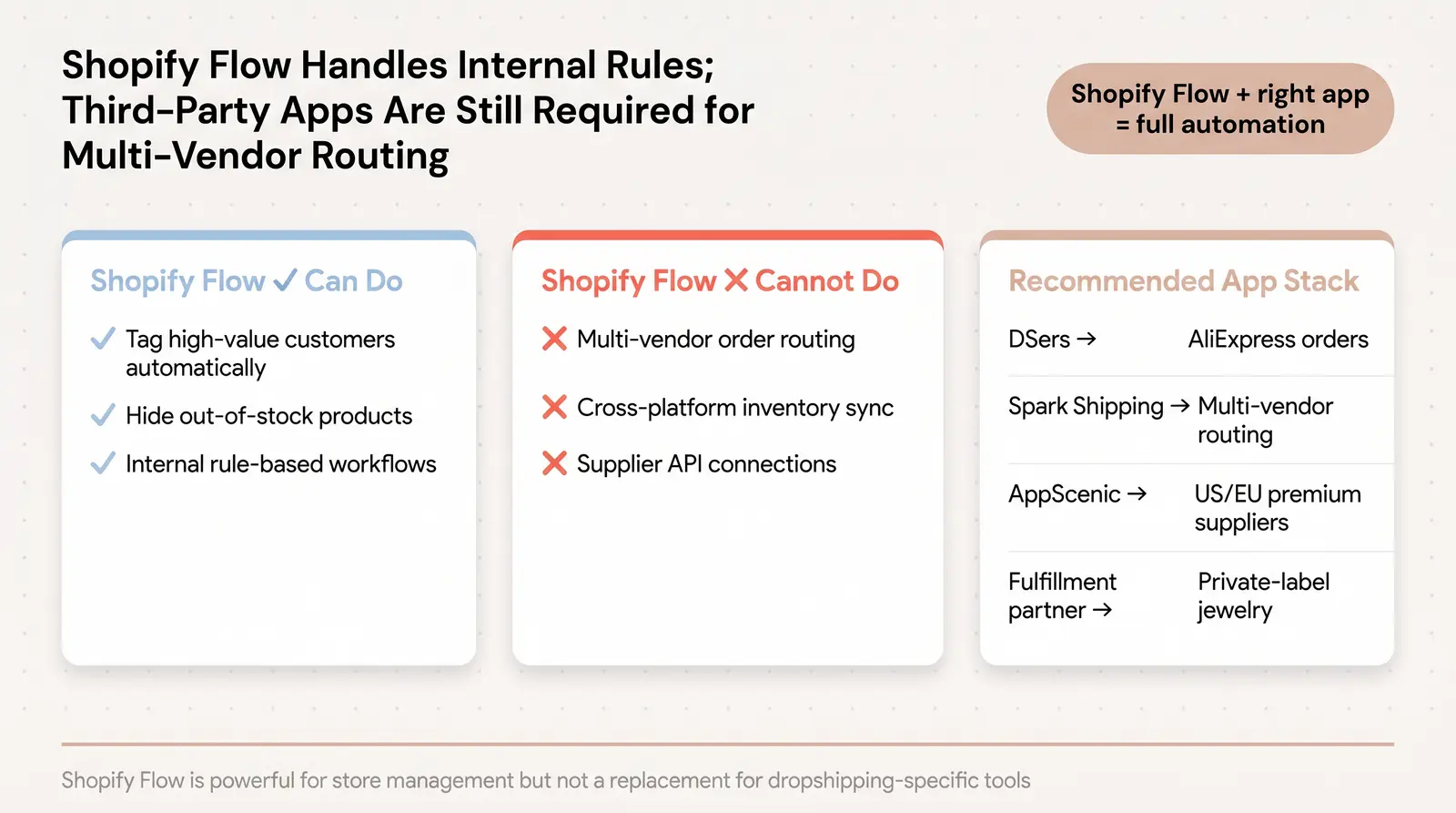
Shopify Flow allows store owners to build custom, rule-based workflows without coding. For example, you can set a trigger to automatically tag high-value customers, or hide products from your storefront when inventory drops below zero. While Flow is powerful for internal store management, it cannot natively handle complex dropshipping tasks like multi-vendor order routing or cross-platform inventory syncing.
For those specific tasks, Shopify dropshippers in 2026 rely on the apps mentioned above: DSers for AliExpress, Spark Shipping for complex routing, or AppScenic for premium US/EU suppliers. Branvas integrates directly into this ecosystem, allowing Shopify store owners to seamlessly manage their private-label jewelry inventory without leaving their dashboard.
For more tailored advice on setting up your store, check out our solutions for ecommerce and boutique store owners.
1. What is dropshipping automation software and how does it work?
Dropshipping automation software connects your ecommerce store to your suppliers. It automatically updates product prices, syncs inventory levels, routes customer orders directly to the supplier for fulfillment, and pushes tracking numbers back to your customers, eliminating manual data entry.
2. What should I automate first in my dropshipping business?
You should automate inventory and stock level syncing first. If you fail to automate this, you risk selling out-of-stock items, which leads to canceled orders, angry customers, and potential penalties from payment processors. Order routing is the second highest priority.
3. What is the best dropshipping automation software in 2026?
The best software depends on your model. AutoDS is best for all-in-one functionality, DSers is best for AliExpress sellers, Spark Shipping is best for multi-supplier setups, and Branvas is the top choice for private-label jewelry and accessories brands.
4. Is AutoDS or DSers better for Shopify?
Both integrate seamlessly with Shopify. DSers is better if you exclusively use AliExpress and want fast, cheap bulk order processing. AutoDS is better if you want built-in product research tools and plan to source from multiple different retail suppliers.
5. Can you fully automate a dropshipping business?
You can fully automate the operational backend—inventory, order routing, and tracking. However, you cannot fully automate customer service, brand building, or high-level product strategy. The goal of automation is to free up your time to focus on growth, not to run the business completely hands-off.