


Back to Blog

7 Best Dropshipping Automation Software Tools to Boost Business Benefits and Streamline Workflows

Tools alone won't save your business. Discover 2026’s top 7 dropshipping automation platforms and learn how to build a resilient system that prevents stockouts, speeds up shipping, and scales profit.

Updated:

February 4, 2026

Author:

Yi Cui

How Branvas works

1

Select products

Browse our catalog and choose the products that align with your brand vision.

2

Uplaod logo

Upload your labels, logos, and packaging designs to make the products truly yours.

3

Make sales

List products on your store and set your profit margins, we take care of fulfillment.

Join Branvas to explore our private label jewelry.

Table of Contents

Key Takeaways

  • Systems, Not Just Tools: Dropshipping success hinges on robust, automated systems, not just standalone software. The right tool should streamline your entire workflow, from sourcing to customer support.
  • Automation Solves Operational Pain: The primary benefit of automation is reducing manual work, minimizing errors in order processing and inventory management, and freeing up time to focus on growth and marketing.
  • Supplier Reliability is Crucial: Even the best automation software will fail if your supplier network is unreliable. An integrated supplier network with clear service-level agreements (SLAs) is more valuable than adding more apps to a broken process.
  • Choose Tools Based on Your Stage: The best tool for a beginner testing the waters is different from what a scaling brand needs. Evaluate software based on your specific business model, stage of growth, and branding goals.
  • Beyond Features: Look beyond a simple feature list. Evaluate tools on their workflow coverage, supplier dependency risk, branding control, and how they handle common failure modes like overselling.

It’s a common belief in the e-commerce world that more tools equal more success. Got a problem? There’s an app for that. Drowning in manual order entry? Find a new piece of software. While the right technology is a critical enabler, the hard truth is that tools don’t create profit; systems do. This is especially true in dropshipping, where margins are thin and operational efficiency is the key to survival and growth.

Many store owners invest in dropshipping automation software expecting a magic bullet, only to find themselves still dealing with stockouts, shipping delays, and unhappy customers. Why? Because they’ve tried to automate a broken process. They’ve added a high-tech engine to a car with flat tires. Before you can reap the rewards of automation—like more time, fewer errors, and a scalable business—you must first understand what a truly effective dropshipping workflow looks like and why so many automation efforts fall short.

This article cuts through the hype. We’ll dissect why generic dropshipping automation tools often fail to deliver real business benefits, present a framework for what “good” automation actually entails, and then provide a curated list of the 7 best dropshipping automation software tools, segmented by their ideal use case. Our goal is to equip you with the knowledge to build a resilient, brand-focused dropshipping system that truly works.

Why Dropshipping Automation Tools Often Don’t Deliver Business Benefits

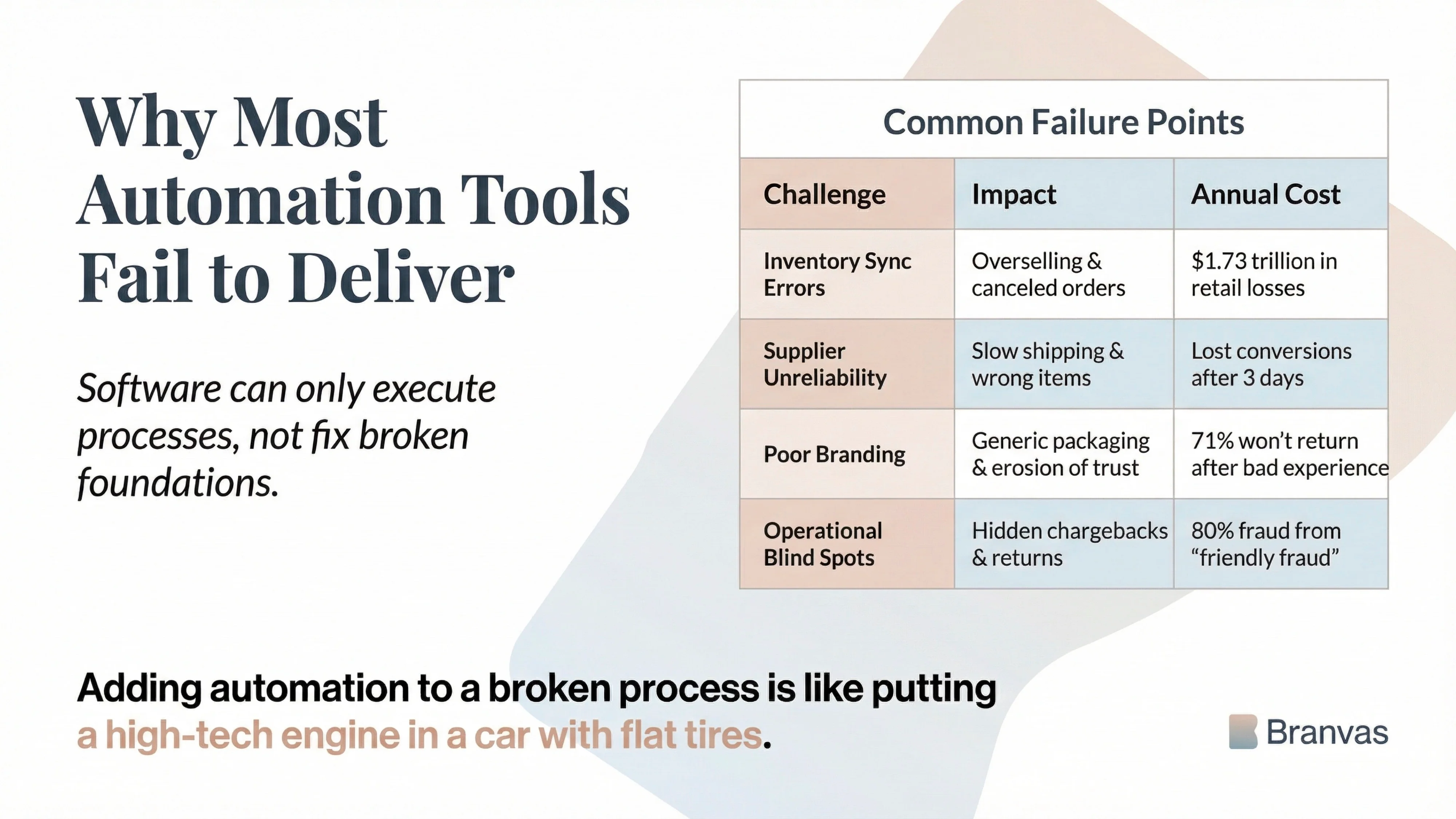
The promise of automated dropshipping is seductive: a hands-off business that generates revenue while you sleep. However, the reality for many entrepreneurs is a constant battle against operational fires. The core issue is that software can only execute the processes it’s given; it cannot fix a flawed foundation. Here are the most common challenges that prevent dropshipping automation tools from delivering their promised benefits.
why tools fail

Common Challenges Automating Dropshipping Workflows

  • Inaccurate Inventory and Overselling: The most frequent point of failure is inventory synchronization. When your store’s stock levels don’t match your supplier’s actual inventory, you inevitably sell products that are out of stock. This leads to canceled orders, disappointed customers, and a damaged brand reputation. Research shows that retailers lose a staggering $1.73 trillion annually due to inventory distortion, which includes both out-of-stocks and overstocks [1]. Even with automation, if the data sync is slow or the supplier’s inventory data is unreliable, overselling is guaranteed.
  • Supplier Unreliability and Slow Shipping: You can have the most advanced order routing system in the world, but it’s useless if your supplier takes days to process an order or ships the wrong item. Slow shipping is a major conversion killer. While 90% of consumers are willing to wait two to three days for delivery, patience wears thin quickly after that, especially if shipping isn’t free [2]. A tool can forward an order instantly, but it can’t force a supplier to pack and ship it any faster. This dependency is a critical risk that many new dropshippers underestimate.
  • Poor Branding and Customer Experience: Most basic automation tools are designed for efficiency, not for building a brand. They often leave you with generic packaging, no branding options, and a customer experience that feels transactional and cheap. A successful modern brand, however, is built on trust and a positive customer journey. When a customer receives a package with another company’s logo or a generic invoice, it erodes that trust. Furthermore, a difficult returns process can be fatal; 71% of consumers say they are less likely to shop with a retailer again after a poor returns experience [3].
  • Operational Blind Spots and Hidden Costs: Automation can sometimes create a false sense of security, leading to operational blind spots. Without clear visibility into the entire workflow, it’s easy to miss rising chargeback rates or an increase in returns. These issues are often symptoms of deeper problems, like poor product quality or misleading descriptions. “Friendly fraud” alone can account for up to 80% of all fraud losses for e-commerce merchants [4]. Each chargeback also comes with operational costs ranging from $15 to $70, regardless of the outcome [5]. An automation tool that doesn’t provide analytics on these failure points is only solving half the problem.
effective automation

What “Good Automation” Actually Means (A Workflow Map)

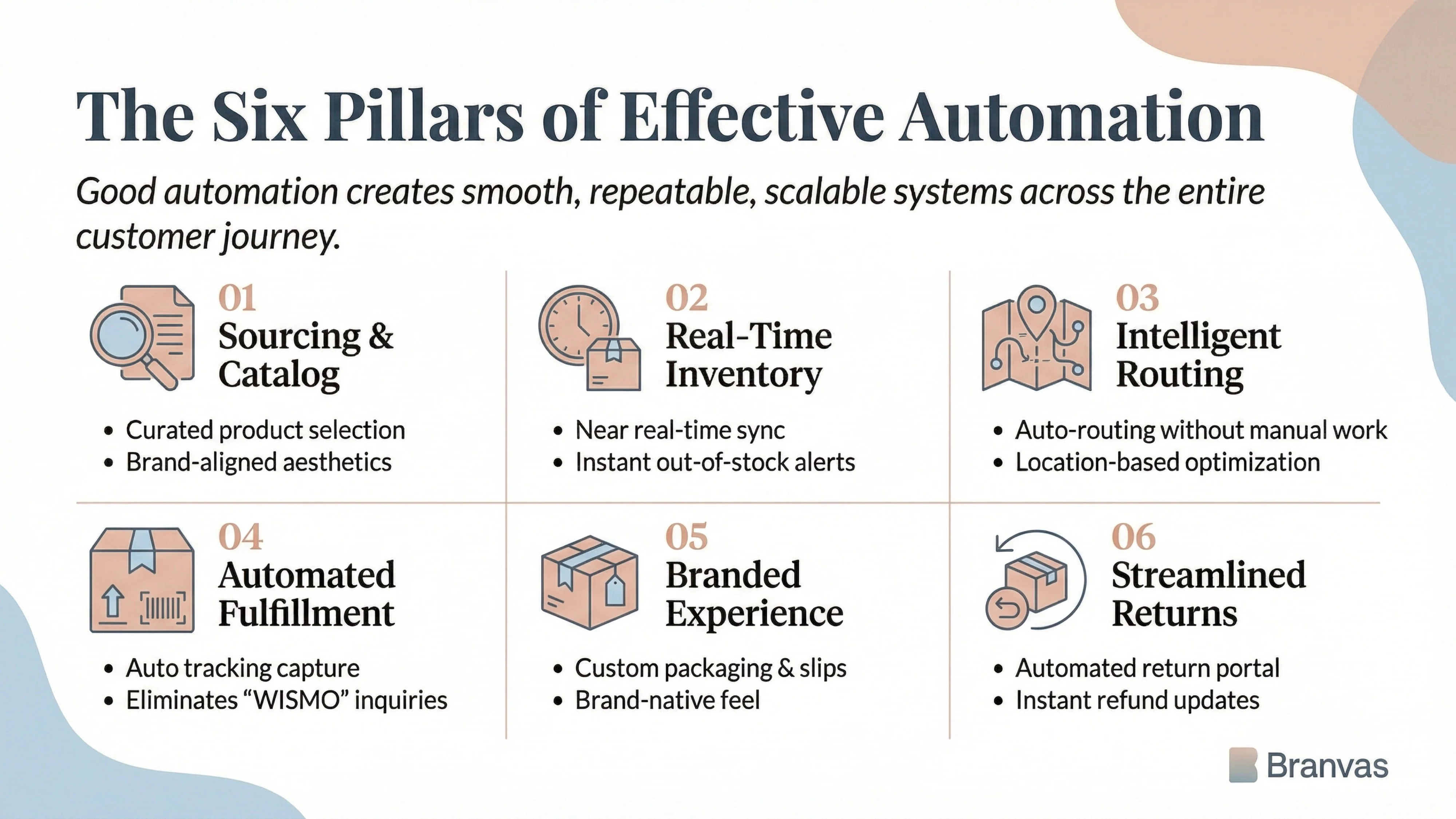
Effective automation isn’t about eliminating work; it’s about automating the right work to ensure a smooth, repeatable, and scalable system. It provides visibility across the entire customer journey, from initial product discovery to post-purchase support. A truly automated and resilient dropshipping workflow can be mapped across these key stages:

  1. Sourcing & Catalog Management: This involves more than just importing products. Good automation allows for curating a specific product catalog, ensuring high-quality images and descriptions, and easily managing product variants. It should provide tools to create a cohesive brand aesthetic, not just a random assortment of items.
  2. Real-Time Inventory Sync: This is non-negotiable. Inventory levels must be synchronized in near real-time between your supplier and your storefront. The system should have built-in buffers to prevent overselling during high-velocity sales periods and provide immediate notifications if a product goes out of stock.
  3. Intelligent Order Routing: Once an order is placed, it should be instantly and accurately routed to the correct supplier without any manual intervention. For businesses with multiple suppliers, the system should be able to route orders based on rules like customer location, stock availability, or shipping costs.
  4. Automated Fulfillment & Tracking: The moment an order is shipped, the tracking number should be automatically captured and sent to both your Shopify store and the customer. This single action prevents a flood of “Where is my order?” (WISMO) inquiries and builds customer trust through transparency.
  5. Branded Post-Purchase Experience: Good automation extends beyond the sale. This includes branded packing slips, customized packaging options, and automated follow-up emails. The goal is to make the customer feel like they purchased directly from your brand, not an anonymous third-party supplier.
  6. Streamlined Returns & Customer Support: The returns process should be just as automated as the ordering process. A customer should be able to initiate a return through a branded portal, receive a shipping label automatically, and get updates on their refund status. This reduces the support team’s workload and turns a potential negative experience into a positive one.

By viewing automation through this workflow lens, you can start to see why simply plugging in a tool to import products from AliExpress is often not enough to build a sustainable business.

A Quick Evaluation Framework (Choose the Right Tool for Your Stage)

With a clear understanding of what a robust dropshipping workflow entails, you can now evaluate potential software solutions more effectively. Instead of being swayed by flashy features, use this framework to assess whether a tool truly aligns with your business goals, particularly your stage of growth and brand aspirations. The right tool for a beginner testing product ideas will be vastly different from what a scaling brand with a strong identity requires.
criteria to choose dropshipping automation tools

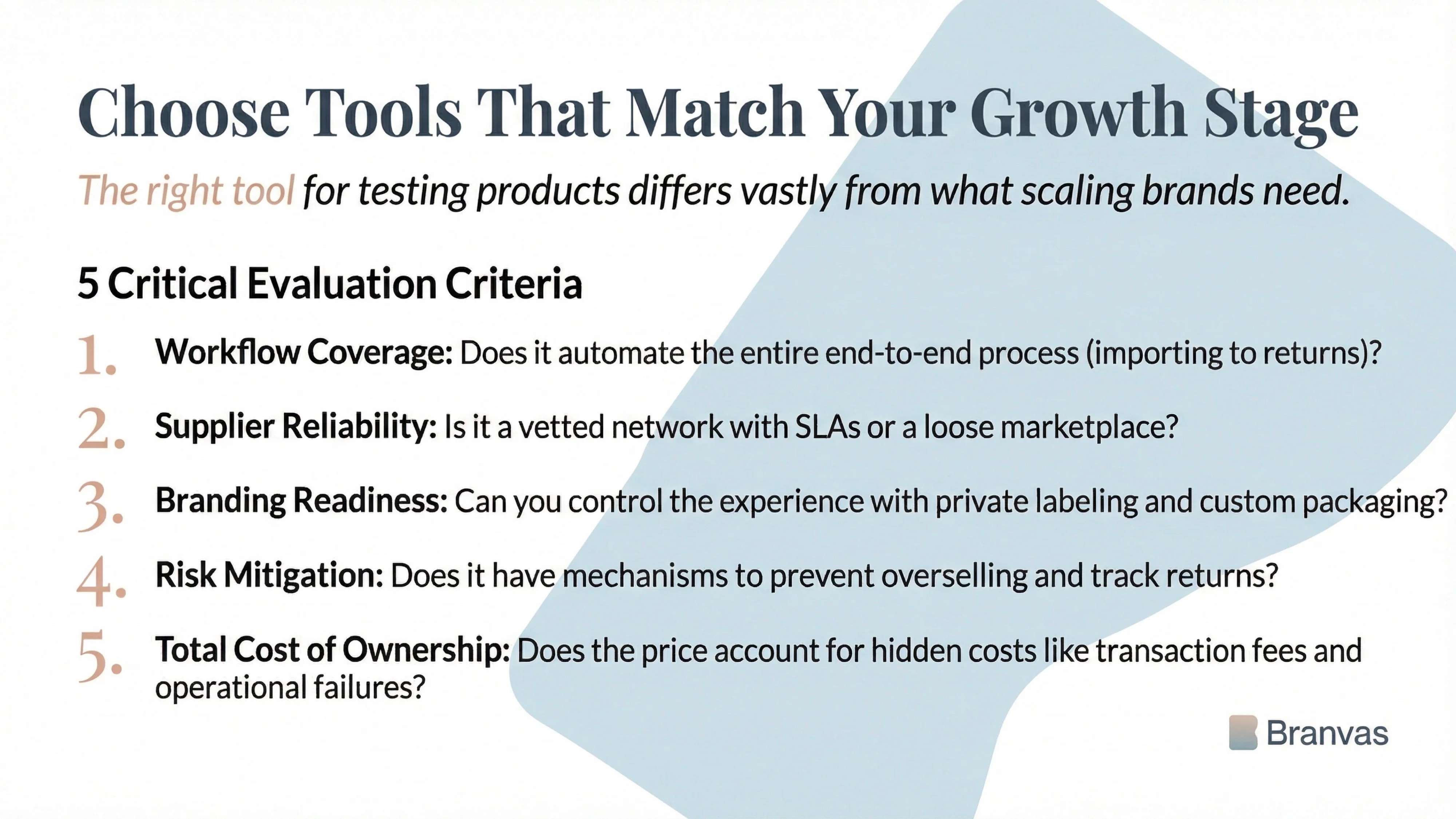
Here are the five key criteria to consider:

  • Workflow Coverage: How much of the end-to-end dropshipping workflow does the tool actually automate? Does it only handle product importing and order forwarding, or does it also manage inventory sync, tracking updates, and returns? A tool with high workflow coverage reduces the need for multiple apps and manual workarounds, creating a more streamlined and less error-prone operation.
  • Supplier Reliability & Integration: This is arguably the most critical factor. Does the tool connect to a curated, vetted network of suppliers, or does it simply provide access to a massive, unvetted marketplace like AliExpress? Look for platforms that offer transparency into supplier performance, shipping times, and service level agreements (SLAs). An integrated supplier network, where the platform and suppliers work in close partnership, is almost always superior to a loose marketplace integration.
  • Branding Readiness: Can you build a real brand with this tool? Evaluate its capabilities for private labeling, custom packaging, and branded tracking pages. A tool that is “brand-ready” allows you to control the customer experience from checkout to unboxing, which is essential for building loyalty and commanding higher prices.
  • Failure Modes & Risk Mitigation: How does the software handle common failure points? What happens when a supplier’s inventory is out of sync? How does it prevent overselling? Does it provide analytics on returns and chargebacks? A robust tool will have built-in mechanisms to mitigate these risks, such as inventory buffers, automated order status checks, and clear reporting on operational issues.
  • Total Cost of Ownership (TCO): The monthly subscription fee is only one part of the cost. Consider the TCO, which includes transaction fees, charges for additional features, and the hidden costs of operational failures. A cheaper tool that leads to frequent stockouts and chargebacks will ultimately be more expensive than a pricier platform that ensures operational stability.

Your Dropshipping Automation Checklist

Use this checklist to score potential dropshipping automation tools. A tool doesn’t need to be perfect in every category, but its strengths should align with your priorities.

Workflow Coverage:

☐ Automated Product Importing

☐ Real-Time Inventory Sync

☐ Automated Order Routing

☐ Automated Fulfillment & Tracking Updates

☐ Branded Post-Purchase Communication

☐ Integrated Returns Management

Supplier Reliability:

☐ Access to Vetted or Curated Suppliers

☐ Transparency on Supplier Performance Metrics

☐ Clear Shipping Times and SLAs

☐ Direct Integration vs. Loose Marketplace

Branding Readiness:

☐ Private Labeling / White-Labeling Options

☐ Custom Branded Packaging

☐ Branded Invoices or Packing Slips

☐ Branded Tracking Pages

Risk Mitigation:

☐ Mechanisms to Prevent Overselling

☐ Analytics on Returns and Chargebacks

☐ Automated Order Failure Alerts

Cost & Scalability:

☐ Transparent Pricing (Subscription + Fees)

☐ Ability to Handle High Order Volume

☐ Tiered Plans that Grow with Your Business

The 7 Best Dropshipping Automation Software Tools (Grouped by Use Case)

Here are seven of the best dropshipping automation tools, grouped by their primary use case and strengths. This is not a ranked list, but rather a curated selection to help you find the right fit for your specific business model and goals.
branvas

For Brand-Builders: Integrated Supplier Network & Private Labeling

This category is for entrepreneurs who want to build a real brand, not just a generic dropshipping store. These tools provide the infrastructure to control the customer experience through private labeling, branded packaging, and a reliable, integrated supply chain.
1. Branvas

  • Best for: Entrepreneurs and creators focused on building a premium jewelry brand with minimal operational overhead.
  • What it automates: The entire brand-building and fulfillment workflow, from product sourcing and branding to inventory sync, order fulfillment, and tracking. It is a prime example of an integrated supplier network model.
  • Key Strengths:
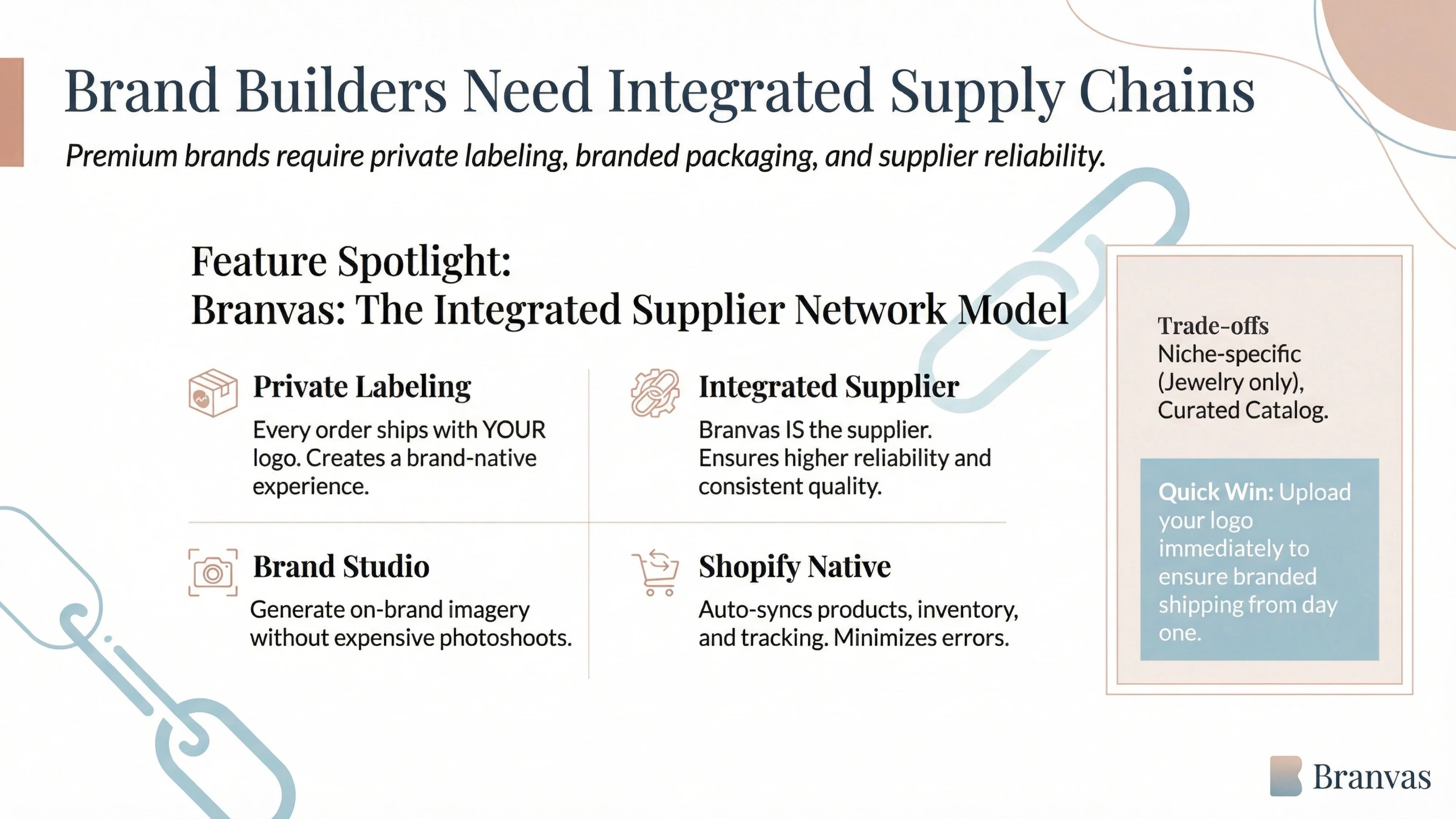
    • Private Labeling and Branding: Branvas excels at creating a brand-native customer experience. Every order ships with your logo on the packaging, and the platform’s “Brand Studio” allows you to generate high-quality, on-brand product imagery without expensive photoshoots. This directly addresses a major pain point of traditional dropshipping.
    • Integrated Supplier Network: Unlike tools that simply connect to a marketplace, Branvas is the supplier. This tight integration means higher reliability, consistent product quality, and faster, more predictable shipping times. It eliminates the “supplier chaos” that plagues many dropshipping businesses.
    • Shopify Native App: The seamless Shopify integration ensures that products, inventory, orders, and tracking are all synchronized automatically. This high level of workflow coverage minimizes manual work and reduces the risk of errors like overselling.
  • Limitations / Risks:
    • Niche-Specific: Branvas is exclusively focused on jewelry. If you plan to sell products in other categories, you will need a different solution.
    • Less Supplier Choice: The trade-off for a highly reliable, integrated network is a lack of supplier variety. You are working with Branvas’s curated catalog, which, while extensive, is not as vast as a marketplace like AliExpress.
  • Pricing Signal: Branvas offers a free trial and tiered monthly plans based on the number of products and features. The pricing is structured to be accessible for new entrepreneurs while scaling with growing brands.
  • Quick Setup Tips: Start by using the Brand Studio to create a cohesive visual identity for your products. Upload your logo immediately to ensure all orders are shipped with your branding from day one. Explore the curated collections to find a style that aligns with your target audience.
DSer and Spoket

For Marketplace Explorers: Accessing a Vast Supplier Network

This category is for dropshippers who prioritize product variety and want access to the massive catalogs of marketplaces like AliExpress. These tools are designed to streamline the process of finding and selling products from thousands of different suppliers.

2. DSers

  • Best for: Entrepreneurs who want to dropship from AliExpress at scale and need a powerful tool for bulk order processing.
  • What it automates: Bulk ordering, supplier management, and order syncing specifically for AliExpress. It is the official dropshipping partner of AliExpress.
  • Key Strengths:
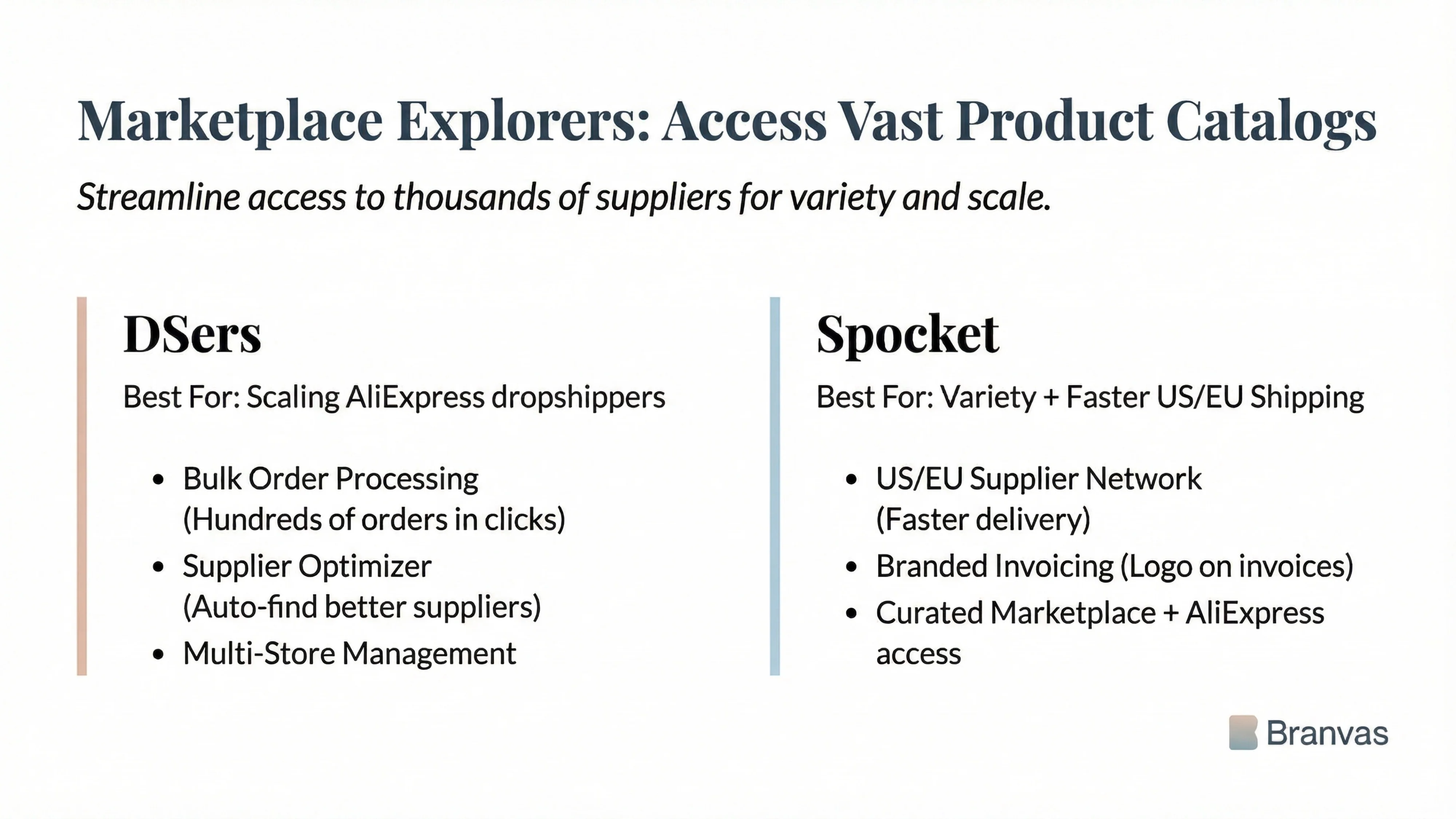
    • Bulk Order Processing: DSers allows you to place hundreds of orders on AliExpress in just a few clicks, which is a significant time-saver for high-volume stores.
    • Supplier Optimizer: You can use this feature to find better suppliers for your existing products, potentially improving your costs and shipping times without having to manually search for new options.
    • Multi-Store Management: On higher-tier plans, you can manage multiple Shopify stores from a single DSers account, which is ideal for sellers with diverse niches.
  • Limitations / Risks:
    • AliExpress Dependency: Your entire business is reliant on the AliExpress ecosystem. This means you are subject to the platform’s variable supplier quality, long shipping times, and inconsistent customer service.
    • Limited Branding: While DSers is efficient, it offers minimal branding capabilities. You won’t find options for custom packaging or a truly private-label experience.
  • Pricing Signal: DSers offers a free plan for beginners, with paid plans scaling from $19.90/month up to $499/month for enterprise-level features. This makes it accessible to start, with a clear path for growth.
  • Quick Setup Tips: Immediately use the Supplier Optimizer to scan your existing products for better alternatives. Configure your automated pricing rules to ensure your profit margins are protected as supplier costs change.

3. Spocket

  • Best for: Sellers who want a hybrid approach, combining the vastness of AliExpress with a curated marketplace of suppliers from the US and Europe.
  • What it automates: Product importing from multiple sources, order syncing, and inventory management.
  • Key Strengths:
    • US/EU Supplier Marketplace: Spocket’s main draw is its network of suppliers based in the US and Europe, which can lead to significantly faster shipping times and higher quality products compared to AliExpress.
    • Branded Invoicing: On paid plans, you can include a branded invoice with your store’s logo, which helps create a more professional customer experience.
    • Product Variety: With access to both its curated marketplace and AliExpress, Spocket offers a wide range of products to choose from.
  • Limitations / Risks:
    • Cost: Access to the best suppliers and features comes at a price. The most desirable US/EU suppliers are often only available on the higher-priced plans.
    • Supplier Vetting Still Required: While Spocket curates its marketplace, the onus is still on you to vet individual suppliers. It’s highly recommended to order samples to test product quality and shipping speed before committing to a supplier.
  • Pricing Signal: Spocket’s pricing starts at $39.99/month, with more expensive plans unlocking access to more premium suppliers and features.
  • Quick Setup Tips: When searching for products, immediately apply the “Ships from” filter to narrow down suppliers in your target customer’s region. Before importing a product, check the supplier’s reviews and average shipping time.
zendrop

For Speed & Quality Seekers: Vetted US/EU Suppliers

For businesses competing on customer experience, shipping speed and product quality are paramount. This category focuses on tools that provide access to pre-vetted suppliers in the US and Europe, enabling faster delivery and a more reliable supply chain.

4. Zendrop

  • Best for: Beginners and intermediate sellers looking for a user-friendly platform with faster shipping than AliExpress and accessible branding options.
  • What it automates: Order fulfillment, and on higher-tier plans, custom branding and fully automated fulfillment.
  • Key Strengths:
    • Faster Shipping: Zendrop was built to solve the slow shipping times of AliExpress. It works with a network of suppliers who can ship products faster, often from the US.
    • Custom Branding: Paid plans offer custom branding options, including branded thank-you cards, which can help improve the customer unboxing experience.
    • Subscription Boxes: Zendrop has a unique feature that allows you to easily create and sell subscription boxes, opening up a new recurring revenue model.
  • Limitations / Risks:
    • Feature Gating: The most valuable features, such as custom branding and automated fulfillment, are locked behind the more expensive paid plans.
    • Product Catalog: While large, the product catalog may not be as extensive as a massive marketplace like AliExpress.
  • Pricing Signal: Zendrop offers a free plan to get started, with paid plans required to unlock the features that provide the most value.
  • Quick Setup Tips: Start on the free plan to explore the product catalog and user interface. If you decide to upgrade, immediately set up the custom branding feature to differentiate your store.

For Multi-Channel Sellers: Centralized Operations

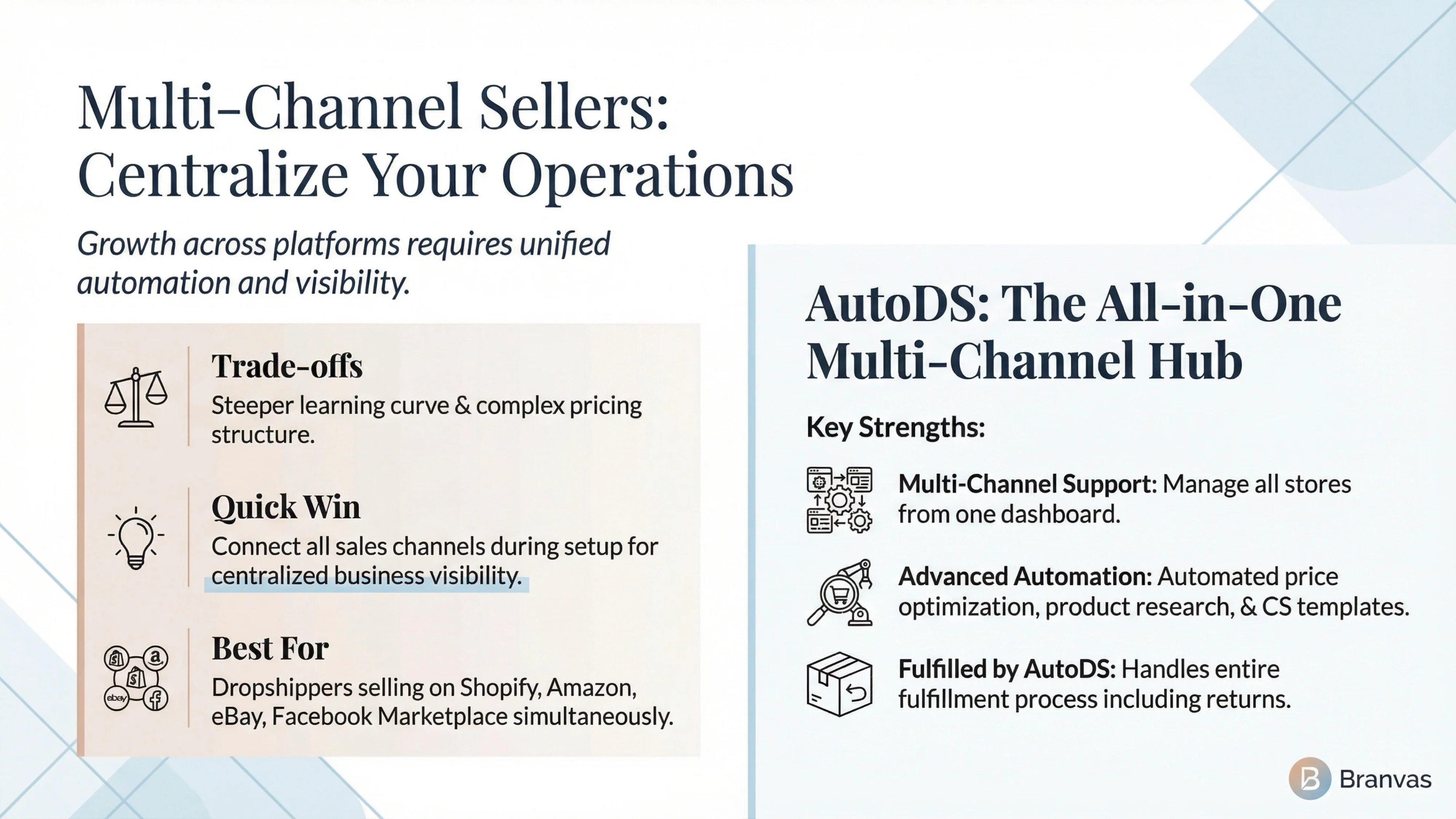
As a dropshipping business grows, it often expands to multiple sales channels (e.g., Shopify, Amazon, eBay). The tools in this category are designed to centralize operations and automate workflows across multiple platforms.
autods

5. AutoDS

  • Best for: Dropshippers who sell on multiple channels and need a powerful, all-in-one tool for automation and product research.
  • What it automates: The entire dropshipping lifecycle, from product research and importing to inventory management, order fulfillment, and customer support.
  • Key Strengths:
    • Multi-Channel Support: AutoDS integrates with a wide range of platforms, including Shopify, WooCommerce, Facebook Marketplace, and eBay, allowing you to manage all your stores from one dashboard.
    • Advanced Automation: It offers a rich set of automation features, including automated price optimization, a smart product research tool, and automated customer service message templates.
    • Fulfilled by AutoDS: This service handles the entire fulfillment process for you, including returns, which can significantly reduce your operational workload.
  • Limitations / Risks:
    • Complexity: With so many features, AutoDS can have a steeper learning curve than simpler tools. It may be overkill for a beginner with just one store.
    • Cost: The pricing can be complex, with different plans based on the number of products, sales channels, and features you need. The cost can add up quickly for multi-channel sellers.
  • Pricing Signal: AutoDS offers a range of plans starting from around $19.90/month, with costs increasing as you add more products, channels, and automation features.
  • Quick Setup Tips: Connect all your sales channels during the initial setup to get a centralized view of your business. Explore the product research tool to find trending items from various suppliers.
inventory source

6. Inventory Source

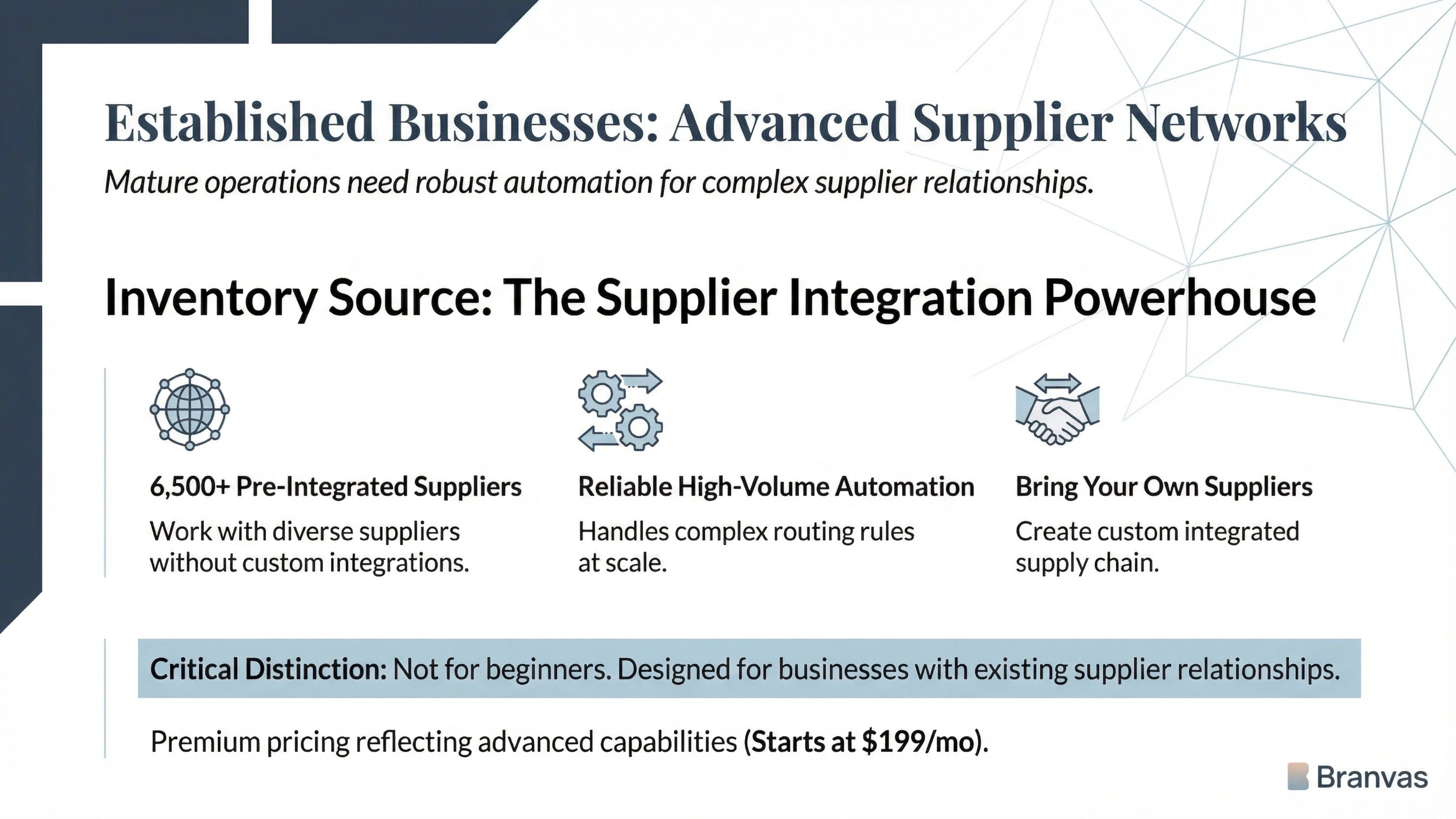
  • Best for: Established businesses that need to automate their inventory and order management across a large network of pre-integrated suppliers.
  • What it automates: Inventory synchronization and order routing. It is a pure automation tool, not a product marketplace.
  • Key Strengths:
    • Massive Supplier Network: Inventory Source has pre-built integrations with over 6,500 suppliers across various niches. This allows you to work with a wide range of suppliers without needing custom integrations.
    • Reliable Automation: It is a robust and reliable platform for inventory and order automation, designed to handle high volumes and complex routing rules.
    • Flexibility: You can bring your own suppliers to the platform (for a fee) and create a custom, integrated supply chain.
  • Limitations / Risks:
    • Not for Beginners: Inventory Source is an advanced tool designed for businesses that already have supplier relationships. It does not help you find products to sell.
    • Cost: The pricing is significantly higher than most other tools on this list, with plans starting at $199/month for full automation.
  • Pricing Signal: This is a premium tool for serious businesses. The pricing reflects its focus on robust, reliable automation for established sellers.
  • Quick Setup Tips: Before signing up, browse their free supplier directory to ensure they have integrations with the suppliers you want to work with. Be prepared to map your product SKUs to the supplier feeds.

For Enterprise-Level Scale: Advanced Dropship Operations

This category is for large-scale businesses, B2B operations, or complex marketplace sellers who require a fully customizable, end-to-end solution for their dropshipping and e-commerce operations.

flxpoint

7. Flxpoint

  • Best for: Enterprise-level businesses, multi-vendor marketplaces, and B2B companies that need a powerful, flexible platform to manage complex supply chains and order fulfillment workflows.
  • What it automates: The entire e-commerce operation, including inventory management, order routing, fulfillment, and invoicing across multiple suppliers and sales channels.
  • Key Strengths:
    • Extreme Flexibility: Flxpoint is designed to be customized to your exact workflow. You can integrate any supplier, set up complex order routing logic, and manage multiple fulfillment strategies (e.g., dropship, in-house, 3PL).
    • B2B and Marketplace Focus: It has strong features for B2B e-commerce, such as invoicing and payment terms, as well as tools for building and managing your own multi-vendor marketplace.
    • Scalability: The platform is built to handle high volumes and complex operations, making it a true enterprise-grade solution.
  • Limitations / Risks:
    • High Cost and Complexity: Flxpoint is the most expensive and complex tool on this list. It requires a significant investment in both time and money to set up and manage.
    • Not a Plug-and-Play Solution: This is not a tool for beginners. It is a powerful platform that requires technical expertise to configure and operate effectively.
  • Pricing Signal: With plans starting at $599/month and scaling up to $2,500+/month, Flxpoint is clearly positioned for large, established businesses with significant operational needs.
  • Quick Setup Tips: You will likely need to work with the Flxpoint team to get set up. Come prepared with a detailed map of your existing workflows, supplier relationships, and integration requirements.

Conclusion: From Tools to Systems

The journey to a successful dropshipping business is paved with systems, not just a collection of tools. While the software listed above can provide powerful automation capabilities, they are most effective when implemented as part of a well-thought-out workflow. The key is to shift your mindset from simply "finding a tool" to "building a system."

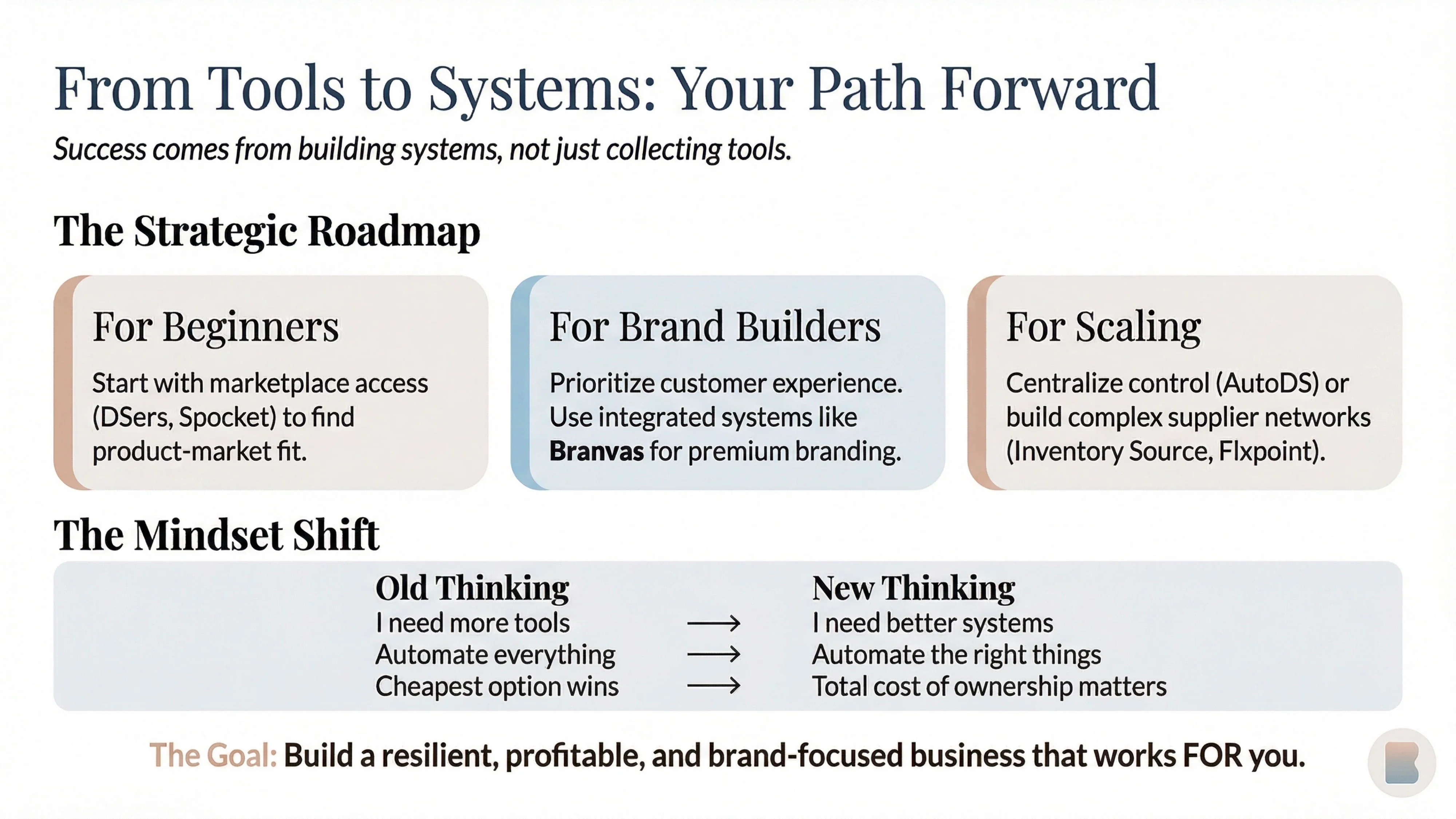
For entrepreneurs just starting, the allure of a massive product catalog from a marketplace like AliExpress is strong. Tools like DSers and Spocket provide an accessible entry point. However, the most successful, long-term brands are those that prioritize the customer experience, and that starts with a reliable supply chain and a branded presentation. This is where a platform like Branvas shines, offering a tightly integrated system for building a premium brand in a specific niche.
how to choose dropshipping automation software

As your business scales, your needs will evolve. You may expand to multiple sales channels, requiring the centralized control of a tool like AutoDS. Or you may build a complex network of suppliers, necessitating the robust automation of Inventory Source or the enterprise-level power of Flxpoint. The right tool is the one that best fits your current stage of growth and your future ambitions.

Ultimately, the goal of automation is not just to save time, but to build a more resilient, profitable, and brand-focused business. By using the framework in this article to evaluate your needs and choose the right software, you can move beyond the chaos of manual operations and build a dropshipping system that truly works for you.

Frequently Asked Questions

What is dropshipping automation software?

Dropshipping automation software is a category of tools designed to streamline and automate the repetitive tasks involved in running a dropshipping business. These tasks typically include importing products from suppliers to your online store, synchronizing inventory levels in real-time to prevent overselling, automatically forwarding customer orders to suppliers, and updating tracking information once orders ship. The goal of this software is to reduce manual work, minimize human error, and free up the store owner's time to focus on higher-value activities like marketing and brand building. The best automation tools go beyond basic order processing to include features like branded packaging, intelligent order routing, and analytics on operational performance.

How do I automate my dropshipping business?

Automating your dropshipping business involves a strategic, step-by-step approach rather than simply installing a single app. First, map out your entire workflow from product sourcing to customer support to identify the most time-consuming and error-prone manual tasks. Second, select an automation tool that aligns with your business model and stage of growth; a beginner testing products has different needs than a scaling brand. Third, integrate the tool with your e-commerce platform (like Shopify) and your supplier network. Fourth, configure automation rules for inventory sync, order routing, and pricing. Finally, continuously monitor the system's performance, paying close attention to metrics like order accuracy, shipping times, and customer satisfaction. True automation is an ongoing process of refinement, not a one-time setup.

What is the best dropshipping automation tool for Shopify?

The best dropshipping automation tool for Shopify depends entirely on your specific business goals and niche. For entrepreneurs focused on building a premium, branded jewelry business, Branvas offers a tightly integrated solution with private labeling, branded packaging, and a reliable supplier network built directly into the platform. For sellers who want access to a vast catalog of products from AliExpress, DSers is the official partner and excels at bulk order processing. If faster shipping from US and EU suppliers is a priority, Spocket or Zendrop are strong choices. For multi-channel sellers managing stores on Shopify, eBay, and Amazon, AutoDS provides a centralized dashboard. The key is to evaluate tools based on workflow coverage, supplier reliability, and branding capabilities, not just the number of features listed.

Is dropshipping automation worth the cost?

Yes, dropshipping automation is generally worth the cost, but the return on investment depends on how it's implemented. The value of automation comes from three primary areas: time savings, error reduction, and scalability. By automating tasks like order forwarding and inventory updates, you can save hours each week that can be reinvested in growth activities. Automation also drastically reduces costly errors like overselling out-of-stock items, which leads to canceled orders, refunds, and damaged customer relationships. Furthermore, a well-automated system can handle a surge in orders without requiring a proportional increase in manual labor. However, automation is not a magic bullet. If your underlying business processes are flawed—such as working with unreliable suppliers—automation will simply execute those flawed processes faster. The cost is worth it when automation is applied to a solid operational foundation.

Can I fully automate a dropshipping store?

While you can automate a significant portion of a dropshipping store's operations, achieving 100% automation is neither realistic nor advisable. Core operational tasks like product importing, inventory synchronization, order fulfillment, and tracking updates can be highly automated with the right software. However, certain aspects of the business still require human oversight and intervention. These include strategic decisions like product selection and pricing, creative work like marketing and brand building, and customer service for complex issues that require empathy and nuanced problem-solving. Additionally, even the most robust automation systems require regular monitoring to catch errors, adapt to supplier changes, and respond to unexpected issues. The goal should be to automate the repetitive, rule-based tasks so you can dedicate your time and energy to the strategic and creative work that truly grows your brand.

Related Articles

References

[1] IHL Group. (2025, September 10). Retail Inventory Crisis Persists Despite $172 Billion in Improvements. https://www.ihlservices.com/news/analyst-corner/2025/09/retail-inventory-crisis-persists-despite-172-billion-in-improvements/

[2] McKinsey & Company. (2025, February 13). What do US consumers want from e-commerce deliveries? https://www.mckinsey.com/industries/logistics/our-insights/what-do-us-consumers-want-from-e-commerce-deliveries

[3] National Retail Federation. (2025, October 15). Consumers Expected to Return Nearly $850 Billion in Merchandise in 2025. https://nrf.com/media-center/press-releases/consumers-expected-to-return-nearly-850-billion-in-merchandise-in-2025

[4] Mastercard. (n.d.). What Is a Chargeback? Retrieved January 14, 2026, from https://b2b.mastercard.com/news-and-insights/blog/what-is-a-chargeback/

[5] Baymard Institute. (2025, November 18). 49 Cart Abandonment Rate Statistics (2025) –– Baymard Institute. https://baymard.com/lists/cart-abandonment-rate