


Is your dropshipping store stuck in the past? Discover why 2026 demands a shift from “packet pushing” to Brand Automation, and how Branvas helps you build a high-margin asset.
Published:
January 29, 2026
Author:
Yi Cui
The golden era of dropshipping, characterized by a simple formula of finding a trending product on AliExpress, running some social media ads, and profiting from the logistical arbitrage, is officially over. As we move deeper into 2026, the landscape has irrevocably split into two distinct paths. Rising advertising costs, with Meta's Cost Per Lead (CPL) for leads campaigns jumping by over 20% in the last year alone, have rendered the low-margin model of generic dropshipping unsustainable [1]. The future, and indeed the present, of profitable ecommerce lies not in simply moving boxes, but in building a brand.
This article will provide a data-rich analysis of this evolution, contrasting the "Old Way" of logistics automation with the "New Way" of brand automation, and will demonstrate why the latter, pioneered by platforms like Branvas, is the only viable path to profitability in the current market. We will examine the hard data behind rising ad costs, the psychology of consumer trust, and the mathematical reality of profit margins to make an irrefutable case for the shift to brand-centric dropshipping.
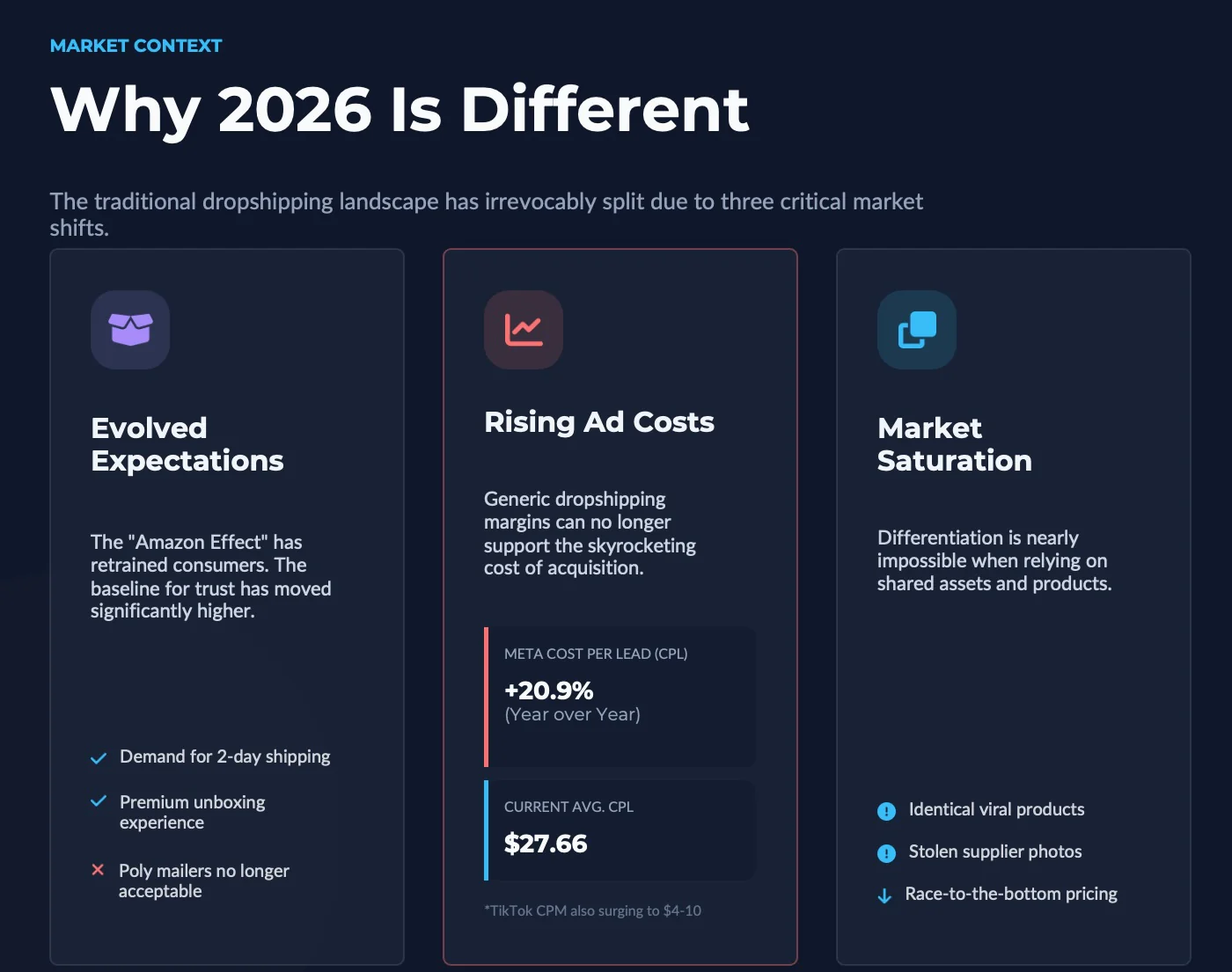
Before diving into the specifics of automation tools, it is essential to understand why 2026 represents a watershed moment for the dropshipping industry. The market has fundamentally changed in three critical ways.
First, consumer expectations have evolved dramatically. Today's online shoppers expect fast shipping, premium packaging, and a cohesive brand experience. They have been trained by giants like Amazon to expect two-day delivery and professional presentation. A generic product arriving in a poly mailer from China three weeks after ordering no longer meets the baseline expectation.
Second, advertising platforms have become significantly more expensive and competitive. As more businesses compete for the same eyeballs, the cost of reaching potential customers has risen sharply. The average CPM (cost per thousand impressions) on TikTok now ranges from $4 to $10 depending on targeting and creative quality [9]. On Meta platforms, while traffic campaign CPCs have remained relatively stable, the cost of acquiring actual leads and customers has increased substantially.
Third, and perhaps most importantly, the market has become saturated with generic products. The same viral products appear on dozens of stores, all using the same supplier photos, making differentiation nearly impossible without a strong brand identity.
For years, the dropshipping world has been dominated by tools focused on logistics automation. Platforms like DSers, AutoDS, and CJ Dropshipping became the backbone of a generation of e-commerce entrepreneurs. Their core function is to automate the tedious but necessary tasks of the dropshipping model: importing products from massive marketplaces like AliExpress, syncing inventory levels, placing orders in bulk, and tracking shipments. These tools are exceptionally good at what they do—they automate the work.
DSers, for instance, is the official AliExpress partner and excels at supplier optimization and bulk order processing. AutoDS offers 24/7 automation for monitoring stock and price changes. CJ Dropshipping provides its own warehousing and can handle sourcing and fulfillment. These are valuable services, and for a time, they were enough. The barrier to entry was low, and the potential for quick profits was high.
However, their fundamental limitation is that they do not solve the marketing problem. In a world where social media advertising spend is projected to exceed $268 billion globally by 2026, up from approximately $226 billion in 2023, simply having a product is not enough [2]. The logistics-focused model forces entrepreneurs into a brutal, global price war. When dozens or even hundreds of stores are selling the exact same generic product, sourced from the same supplier, with the same stock photos, the only competitive lever is price. This inevitably leads to a race to the bottom, eroding profit margins that are already slim, typically hovering between a meager 10-20% [3] [4].
The asset you are building with this model has little to no long-term value. It is a churn-and-burn operation entirely dependent on the next winning product and the whims of ad platform algorithms. If your ad account gets banned, or a competitor undercuts your price, your business can evaporate overnight. You are not building equity; you are renting a temporary position in a crowded marketplace.
The economics of the "Old Way" are becoming increasingly untenable. According to the latest Facebook Ads Benchmarks report from WordStream, the average cost per lead (CPL) for leads campaigns across all industries reached $27.66 in 2025, a significant 20.94% increase from the previous year's average of $22.87 [1]. While the average cost per click (CPC) for traffic campaigns remained relatively stable at $0.70, the cost of acquiring a customer who is ready to buy has skyrocketed.
For a generic dropshipper with a 15% profit margin, these rising costs are devastating. Consider a product sold for $30 with a cost of goods of $15. The gross profit is $15, but the net margin is only $4.50. If it costs $27 or more just to acquire a lead, the math simply does not work. The business is operating at a loss before it even factors in other operational costs. This is the trap of logistics automation: it optimizes for efficiency in a game that is no longer won by efficiency alone.
The "New Way" of dropshipping recognizes that the core challenge is no longer logistics, but brand building. The future belongs to tools that automate the creation of trust, perceived value, and a unique customer experience. This is the domain of Brand Automation, a new category of software pioneered by platforms like Branvas.
Branvas and similar tools are built on a fundamentally different premise. Instead of just automating the movement of generic products, they automate the creation of a unique brand. This is achieved through two key pillars: Visual Automation and Product Automation.
In the age of content fatigue, using the same stock supplier photos as everyone else is a recipe for failure. Consumers are bombarded with thousands of ads daily, and generic imagery simply blends into the noise. Branvas utilizes AI to generate original, high-quality marketing assets. This "Visual Automation" allows a brand to create a unique aesthetic, generate realistic model try-on images, and produce lifestyle visuals for ads and social media without the exorbitant cost and time of traditional photoshoots.
The impact of this capability cannot be overstated. Testimonials from Branvas users consistently highlight the power of AI-generated visuals. One user, Crystal Creations, reported that "the AI product images are incredible—they look so professional that my conversion rate has doubled since I started using them" [5]. This is not a marginal improvement; it is a transformative leap in marketing effectiveness. By creating unique, branded content at scale, entrepreneurs can stand out in a crowded marketplace and command higher prices.
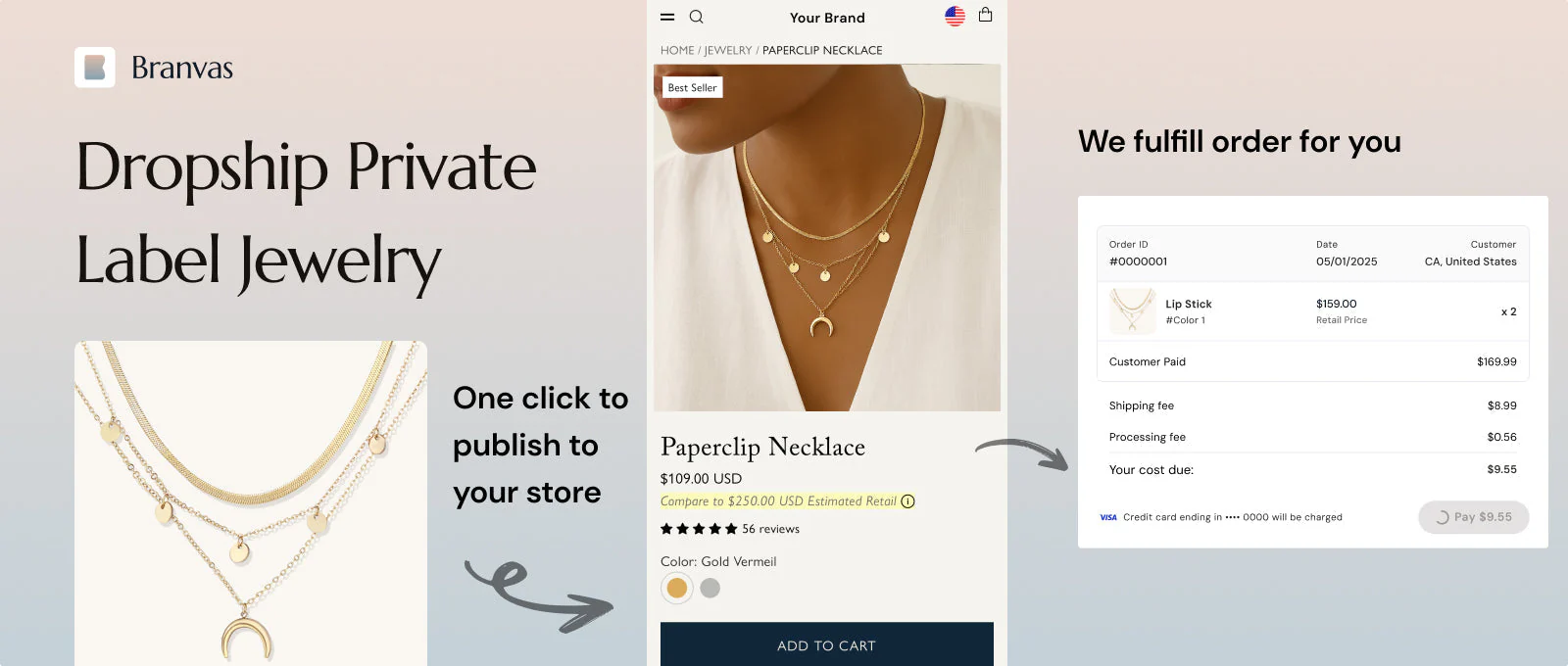
The second pillar is the automation of private labeling. Branvas, with its focus on the high-margin jewelry niche, automates the process of applying a brand's logo and custom packaging to every order. This transforms a generic product into a branded one, creating a premium unboxing experience that builds customer loyalty and justifies higher prices.
Research overwhelmingly shows that consumers are willing to pay a significant premium for branded products and premium packaging. According to a study cited by NielsenIQ, customers view products with premium packaging as being of higher quality, increasing their willingness to pay by up to 35% [6]. Another study found that 61% of consumers say branded packaging makes them more excited to open a parcel [7]. Furthermore, a full 90% of consumers are more likely to buy from brands with sustainable packaging, with 43% saying they are willing to pay more [8].
The unboxing experience has become a critical touchpoint in the customer journey. A generic, unbranded package from a Chinese supplier signals low quality and erodes trust. A beautifully branded package with a custom logo, tissue paper, and a thank-you card signals a premium product from a legitimate brand. This perception of quality directly translates into higher customer satisfaction, more repeat purchases, and a stronger brand reputation.
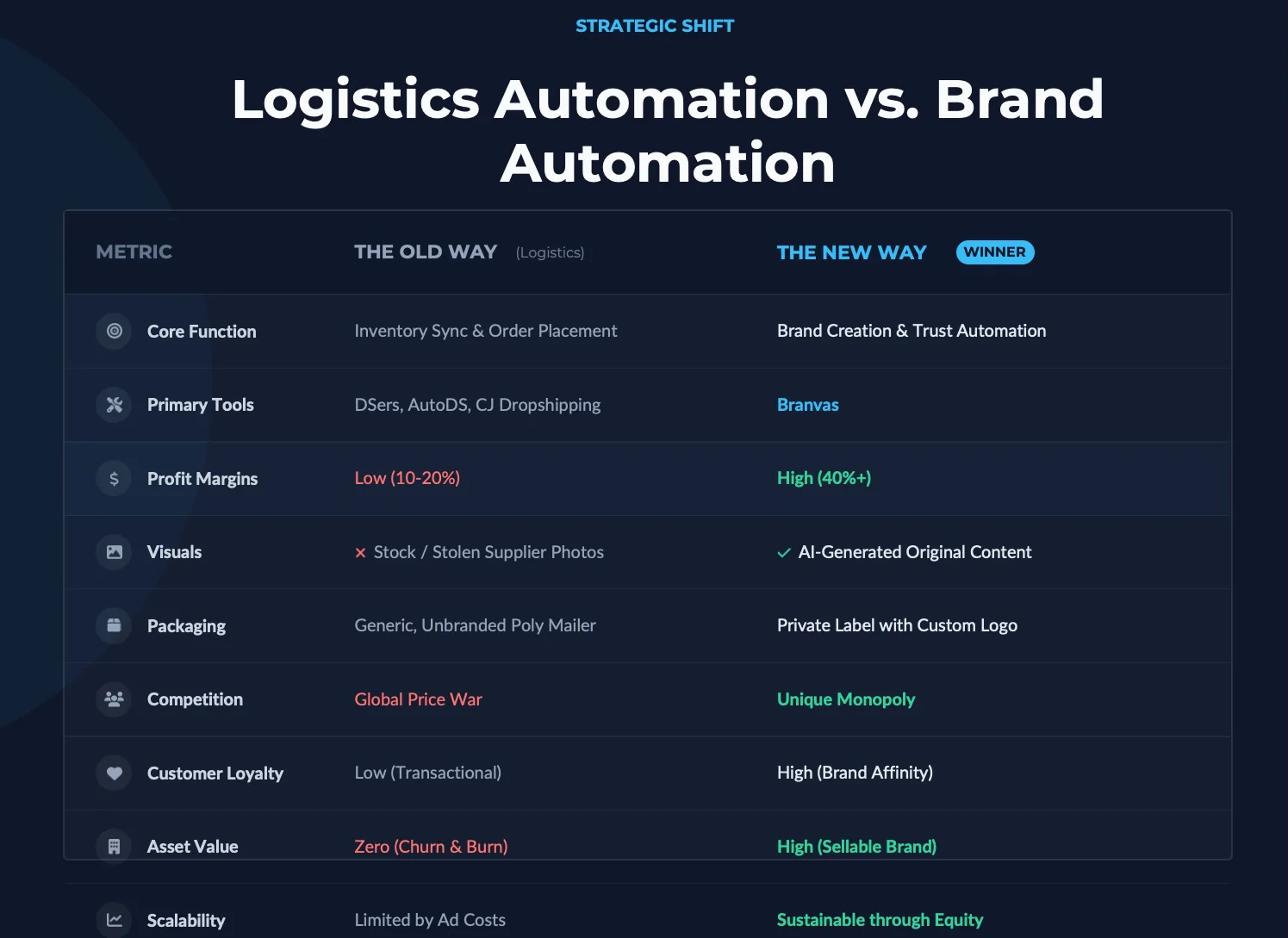
The following table provides a comprehensive comparison of the two approaches to dropshipping automation, highlighting the fundamental differences in their core functions, profit potential, and long-term value.
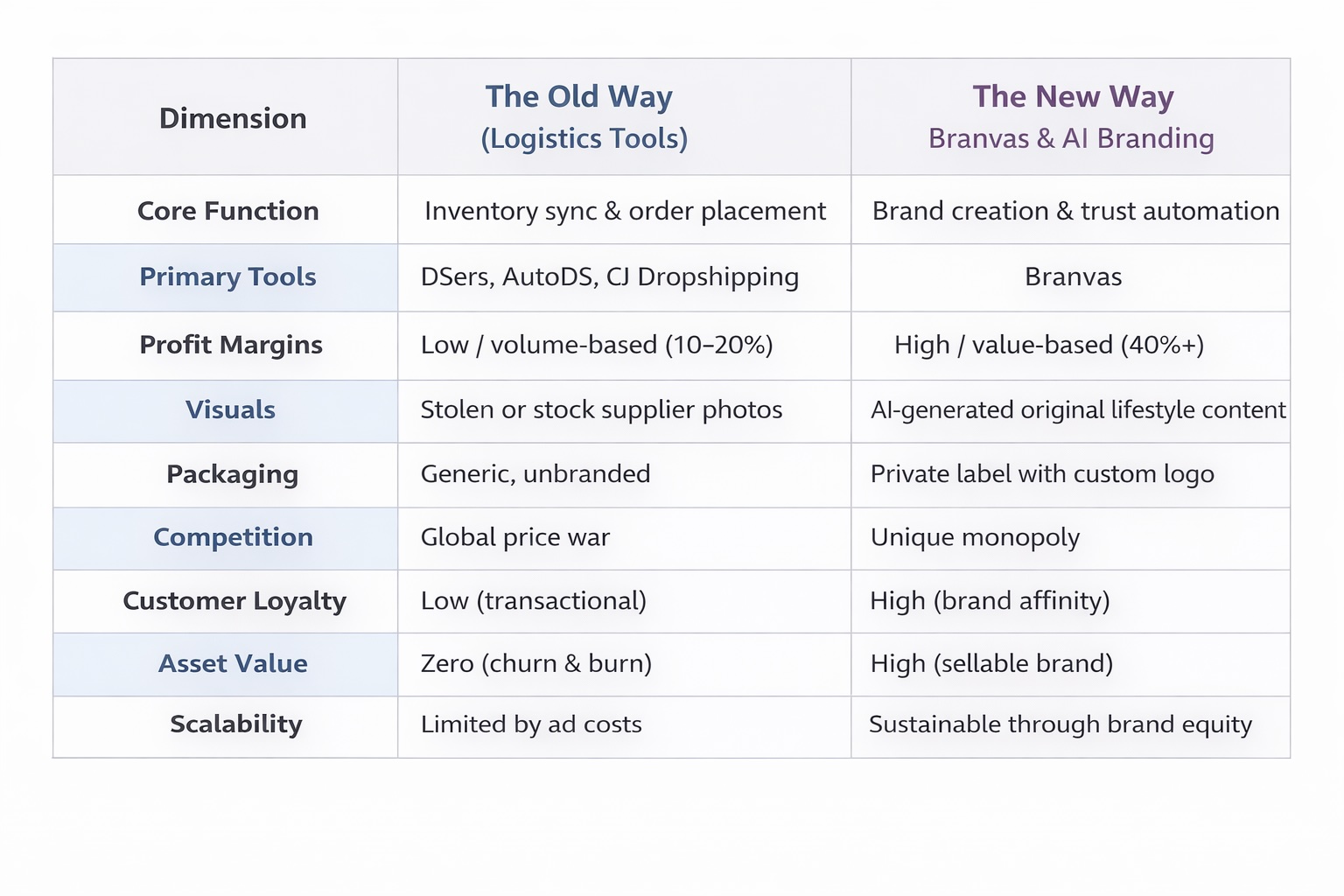
The data presents a clear and compelling financial case for embracing Brand Automation. Let's consider a hypothetical scenario to illustrate the stark difference in profitability.
Scenario 1: The "Old Way" Dropshipper
An entrepreneur using logistics automation tools sells a generic product for $30. The cost of goods from the supplier is $15, resulting in a gross profit of $15. After accounting for advertising, transaction fees, and other operational costs, the net profit margin is approximately 15%, or $4.50 per sale. To generate a monthly profit of $5,000, this entrepreneur needs to sell approximately 1,111 units, requiring $33,333 in revenue.
Scenario 2: The "New Way" Brand Builder
An entrepreneur using Branvas sells a private-labeled jewelry piece for $50. The cost of goods, including the premium packaging, is $20, resulting in a gross profit of $30. Because the branded product commands a higher price and has a better conversion rate due to unique AI-generated visuals, the net profit margin is approximately 40%, or $20 per sale. To generate the same monthly profit of $5,000, this entrepreneur needs to sell only 250 units, requiring $12,500 in revenue.
This difference becomes even more stark when we factor in rising advertising costs. The average CPC for a traffic campaign on Facebook is around $0.70, but for a more valuable leads campaign, it's $1.92, with the cost per lead itself being a substantial $27.66 [1]. In a low-margin environment, these costs are crippling. For the "Old Way" dropshipper, a significant portion of their revenue is immediately consumed by ad spend, leaving little room for error or profit.
The "New Way" brand builder, however, can afford to spend more to acquire a customer because the lifetime value of that customer is significantly higher. With a branded product and a premium experience, repeat purchase rates are much higher. Research shows that 52% of consumers make repeat purchases when they receive products in premium packaging [6]. This creates a sustainable business model that is not solely reliant on the constant, and increasingly expensive, acquisition of new customers. The brand itself becomes an asset, building equity over time that can eventually be sold for a significant multiple of its annual profit.
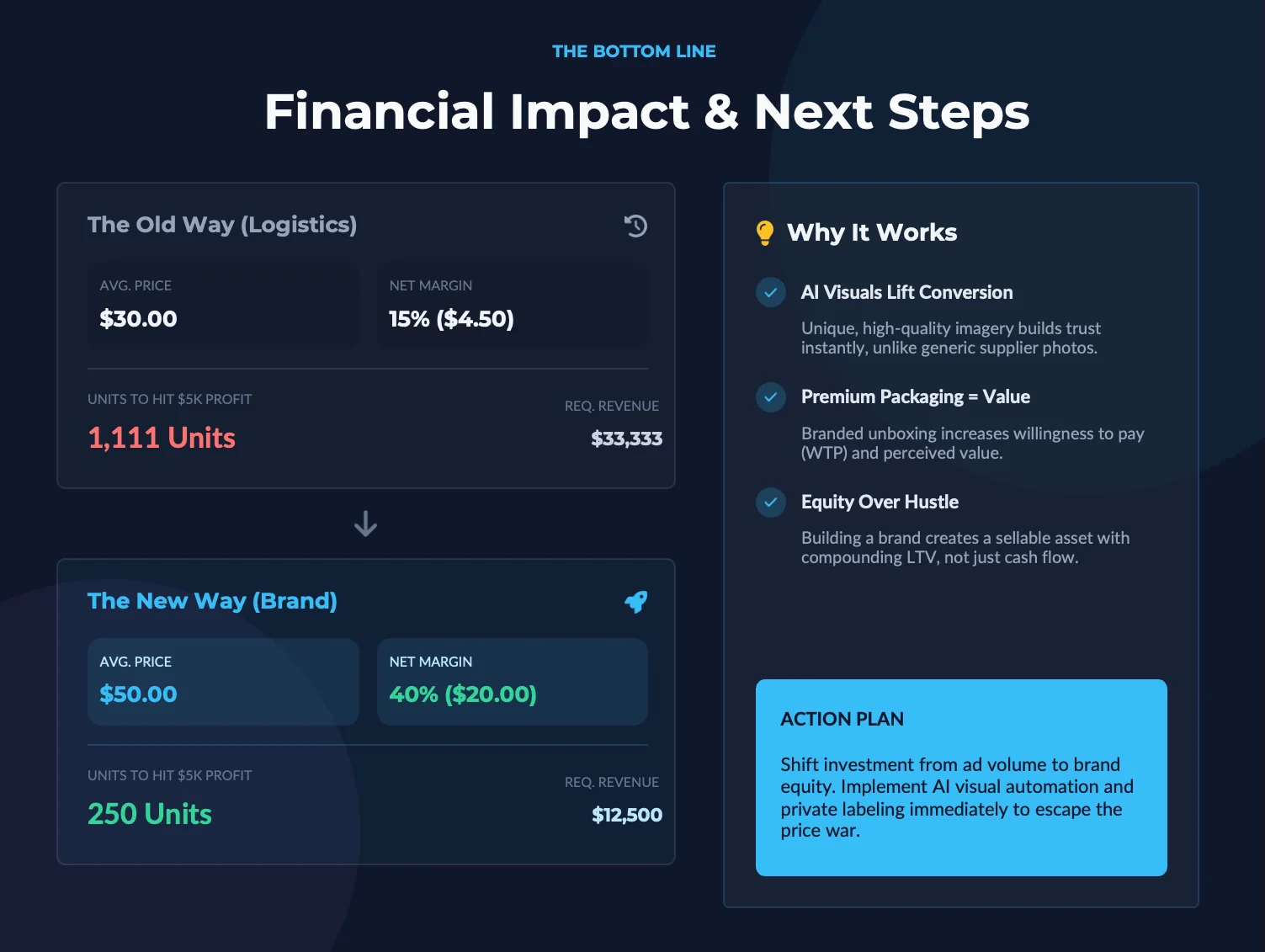
The dropshipping industry is at a critical inflection point. The path of logistics automation, the "Old Way," is a dead end leading to low margins, constant struggle, and businesses with no lasting value. The future of e-commerce belongs to those who embrace the "New Way" of Brand Automation.
By leveraging tools like Branvas to automate the creation of trust, perceived value, and a unique brand identity, entrepreneurs can build sustainable, high-margin businesses that are resilient to the pressures of a competitive market. The dropshipping automation tools business benefits from this shift are immense: higher profits, stronger customer loyalty, and a sellable asset.
The choice is clear: stop just moving boxes and start building a brand. The era of generic hustles is over. The era of brand-driven businesses has begun. The best dropshipping automation tool for 2025 and beyond is the one that helps you build a brand, not just a store. And in that category, Branvas stands as the pioneer, offering a complete suite of AI-powered tools to help you launch, grow, and scale a jewelry brand that customers will love and return to again and again.
What are the best dropshipping automation tools 2025?
The best dropshipping automation tools depend entirely on your strategic goals. For pure logistics automation with a focus on volume (the "Old Way"), tools like DSers, AutoDS, and CJ Dropshipping remain popular choices. They excel at inventory syncing, bulk order processing, and supplier management. However, for building a sustainable, high-margin brand (the "New Way"), the best dropshipping automation tools are those that focus on brand automation. Branvas is the clear leader in this emerging category, especially for niches like jewelry and fashion, with its AI-powered visual creation and automated private labeling capabilities. The best dropshipping automation software for you is the one that aligns with your long-term vision: are you building a business, or are you building a brand?
How does AI dropshipping automation work?
AI dropshipping automation, as exemplified by Branvas, goes beyond simple task automation. It uses artificial intelligence to solve complex marketing and branding challenges that were previously time-consuming and expensive. For example, Branvas's AI can generate unique, professional-grade product and lifestyle images in minutes, eliminating the need for costly photoshoots, models, and studios. It allows you to create a consistent and premium brand aesthetic across all your marketing channels, which is crucial for building trust and driving conversions. The AI analyzes your brand's colors and style to produce visuals that are cohesive and on-brand, giving your store a polished, professional look that builds credibility with potential customers.
Is dropshipping dead in 2026?
Generic dropshipping is dead. The model of selling unbranded, low-quality products with long shipping times and stock supplier photos is no longer viable due to rising ad costs, increased consumer expectations, and intense global competition. However, branded dropshipping is not only alive but thriving. The future of dropshipping is in building real brands, offering unique products with private labeling, and creating exceptional customer experiences. This is the model that will continue to be profitable in 2026 and beyond. The entrepreneurs who adapt to this new reality by leveraging AI dropshipping automation tools and focusing on brand building will be the ones who succeed.
[1] WordStream, "Facebook Ads Benchmarks 2025: NEW Data, Trends, & Insights for Your Industry"
[2] Cool Nerds Marketing, "19 Paid Social Media Trends for 2026"
[3] AutoDS, "Essential Dropshipping Statistics You Need To Know In 2025"
[4] Printful, "Top 11 Dropshipping Statistics You Need to Know in 2025"
[5] Branvas, "Branvas® | Private Label Jewelry Dropshipping for Shopify Brands"
[6] Meyers, "Custom Packaging Solutions: A Data-Driven Look at ROI and Value"
[7] Sendcloud, "Why the unboxing experience matters"
[8] Billerud, "Packaging and labels in 2025 and beyond: Relevance in motion"
[9] Quimby Digital, "TikTok Ad Costs 2025: Average CPM, CPC & ROI"