


Branded jewelry fundraisers deliver higher margins, fewer required sales, and lasting brand equity compared to traditional candy bar campaigns, using a simple 4-step pre-sale model.
Published:
August 4, 2026
Author:
Yi Cui
A higher-margin way to support your cause.
If you have ever organized a fundraiser, you know the drill. You rally the troops, distribute the order forms, and send everyone out to sell candy bars, coupon books, or candles. Weeks later, after hounding members to turn in their cash envelopes, you tally the results. The gross revenue looks decent, but the net profit is a fraction of what you expected. Traditional fundraiser products like candy bars often yield profit margins of just 40% to 50% [1]. This means your organization is doing all the heavy lifting to keep 50 cents on a dollar sale. Candy bars, coupon books, and candles generate thin margins, low perceived value, and zero lasting brand equity for the organization. There is a better way to raise money that actually builds your group's identity while delivering significantly higher returns per unit sold.
The fundamental flaw with legacy fundraiser products is the math. When you sell a $2 candy bar at a 50% margin, you net $1. To raise $1,000, your team has to sell 1,000 units. This high-volume, low-margin model inevitably leads to buyer fatigue and seller burnout. Your supporters are buying out of obligation, not desire. Furthermore, once the candy is eaten or the candle burns out, there is no brand recall and no repeat purchase behavior. The transaction is entirely transactional.
There is also a contrarian truth that most organizers overlook: the product your group sells is also a brand signal—and most organizations are accidentally signaling "we had no better ideas." When you peddle the same generic items year after year, you forfeit the opportunity to build brand equity. Research shows that branded merchandise significantly impacts consumer perception, with 85% of people more likely to choose a brand after receiving promotional items [2]. When you sell a generic product, you are missing out on a powerful marketing tool.
We often see sorority chapters and nonprofit teams come to us after a candy sale that netted less than $400 for the whole semester. The math is brutal. You need a product that people actually want to buy, keep, and wear—a product that signals quality and reinforces your organization's identity long after the fundraiser ends.

Branded jewelry sits at the perfect intersection of high perceived value, low cost of goods, emotional resonance, and brand identity. Unlike consumable goods, jewelry is a keepsake. It is a tangible reminder of the cause, the community, or the chapter. Because jewelry is valued for its design and emotional significance rather than its raw materials, it commands a premium retail price while maintaining a low cost of goods sold (COGS). This dynamic allows organizations to achieve margins that are simply impossible with traditional fundraiser products.
| Metric | Traditional Candy Bar | Custom Branded Jewelry |
|---|---|---|
| Typical Retail Price | $2.00 | $45.00 |
| Cost of Goods (COGS) | $1.00 | $12.00 |
| Profit Margin % | 50% | 73% |
| Net Profit per Unit | $1.00 | $33.00 |
| Units Needed to Raise $1,000 | 1,000 | 31 |
| Brand Recall | Zero (Consumable) | High (Daily Wear) |
| Repeat Buyer Potential | Low (Event-based) | High (Gifting/Collections) |
Consider this worked example: Alpha Chi Omega, Chapter XYZ orders 150 custom charm bracelets at $12 COGS. They retail the bracelets to members, alumnae, and family for $45 each. The chapter raises $4,950 net profit from just 150 sales. To match that same net profit with a candy bar sale, the chapter would have to sell nearly 5,000 units. The efficiency of high-margin merchandise transforms the fundraising experience from a grueling chore into a highly profitable brand event.

This strategy is ideal for sorority and fraternity chapters, high school booster clubs, nonprofit auxiliaries, dance studios, sports teams, and faith communities. Any group with a strong internal identity and a supportive community network can leverage branded jewelry to raise funds. The emotional connection supporters have with these organizations makes them eager buyers of meaningful merchandise.
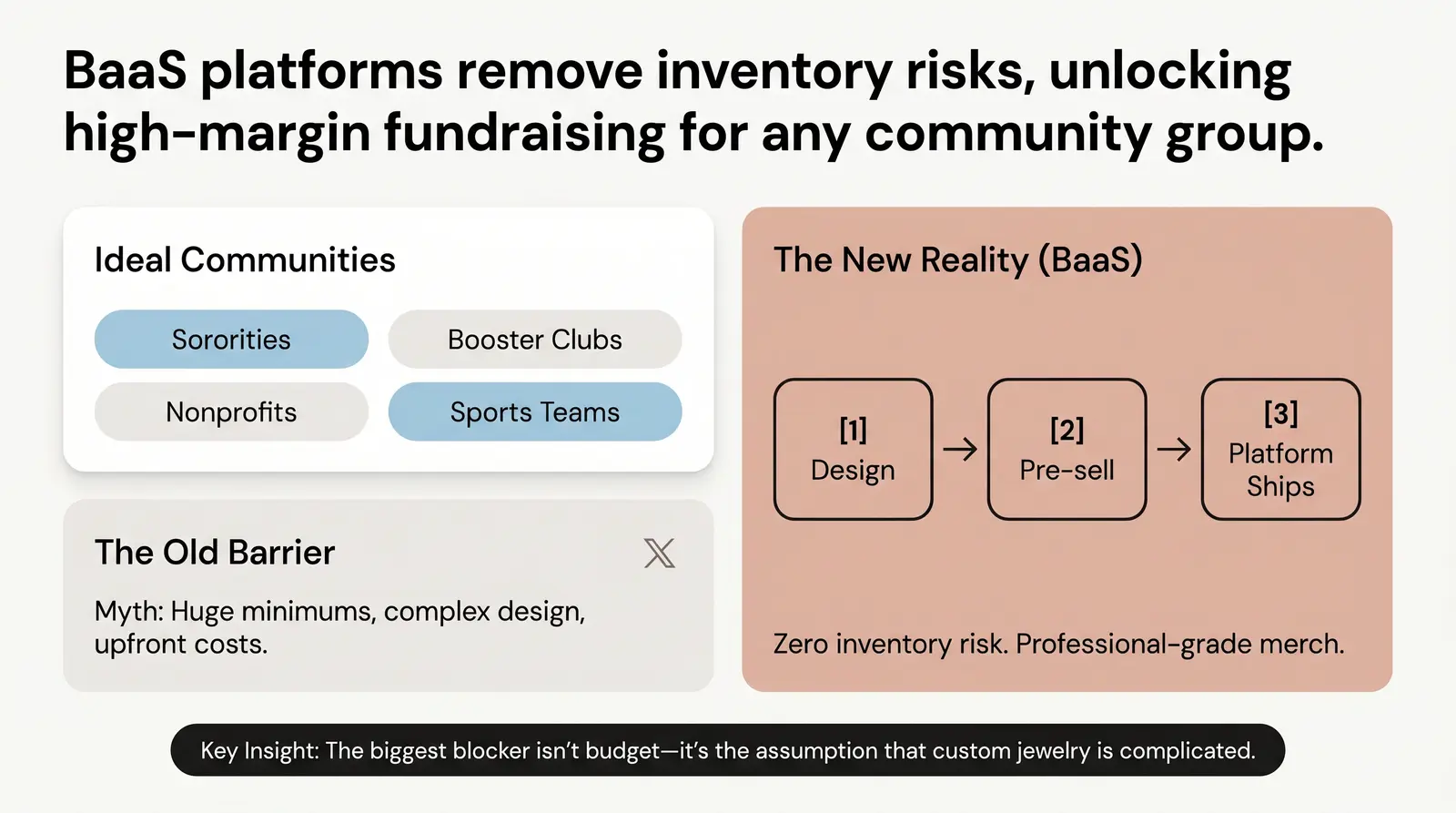
So why aren't more groups doing this? The primary barrier is a misconception about the process. Most organizers assume that creating custom products requires huge minimum order quantities, complex design skills, and significant upfront inventory costs. This was true five years ago. It is no longer true today, thanks to Brand-as-a-Service (BaaS) platforms.
In our experience at Branvas, the biggest blocker isn't budget—it's the assumption that this is complicated. It's not. Modern platforms handle the heavy lifting, allowing organizations to launch professional-grade merchandise without the traditional risks.
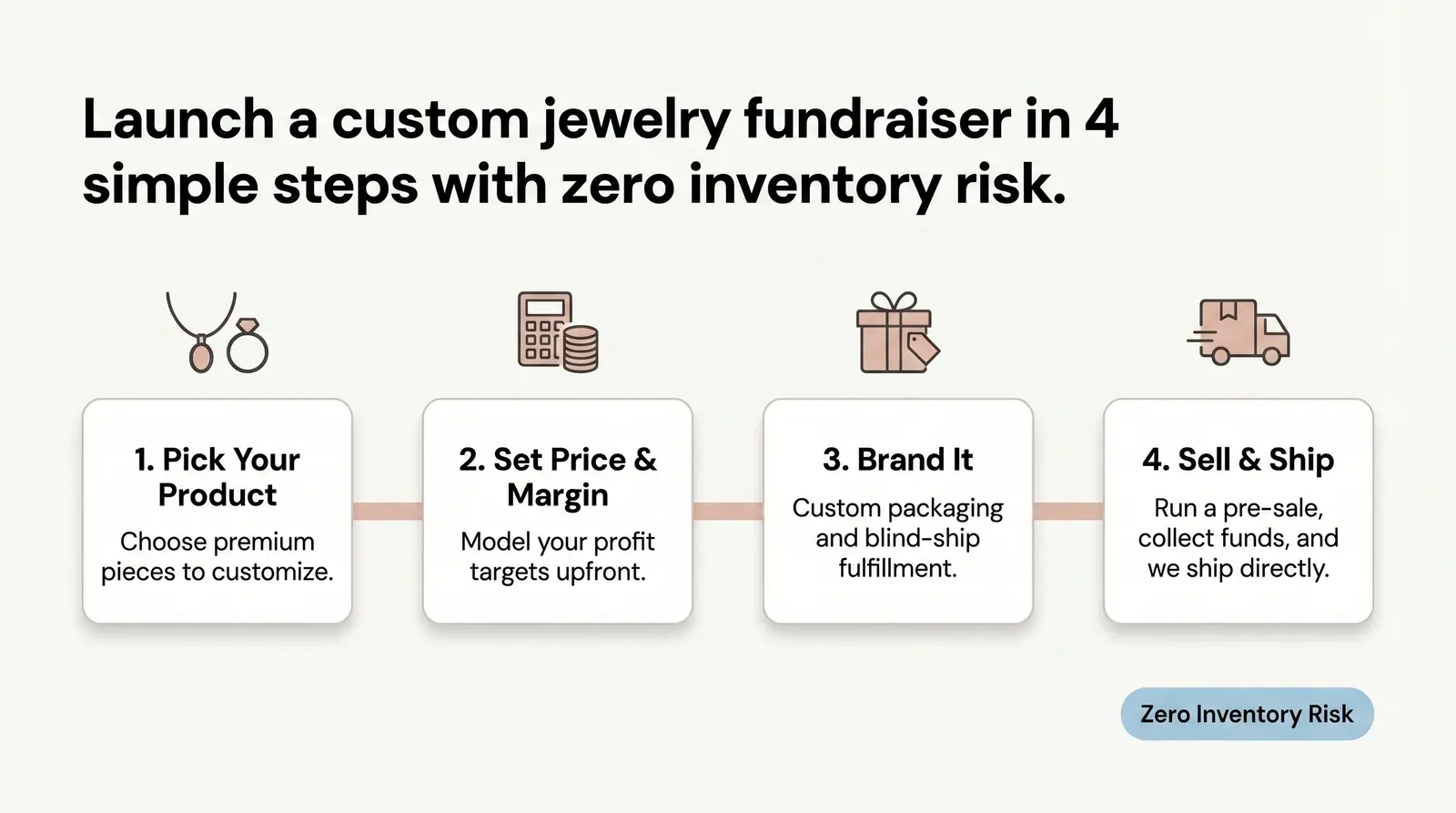
To make this process seamless, we developed the "Brand & Raise" Model. This proprietary 4-step system is exactly how Branvas helps organizations launch a branded jewelry fundraiser with zero inventory risk and maximum profitability.
Pick Your Product
Choose from the Branvas catalog of premium bracelets, necklaces, charms, and earrings. You can customize these pieces with your organization's colors, logo, or motto to create a unique item that resonates with your community.
Set Your Price & Margin Goal
Determine your financial targets before you sell a single item. Use the Branvas Profit Calculator to model your per-unit margin and total raise target. This ensures your pricing strategy aligns with your fundraising goals.
Brand It
Branvas handles the custom packaging, branded tags, and blind-ship fulfillment. Your supporters receive a product that looks and feels like it came from a high-end boutique, elevating the perceived value of their contribution.
Sell & Ship
Run a pre-sale campaign to your members and supporters. You collect the funds upfront, and Branvas fulfills the orders directly to the buyers. Your organization never has to touch inventory, pack boxes, or make trips to the post office.
Curious what your fundraiser could net? Try the Branvas Profit Calculator to model your margin in under 2 minutes.
Launching the product is only half the battle; how you market it determines your success. Here are practical strategies to maximize your jewelry fundraiser:
First, set a strict pre-sale window. Creating a sense of urgency, such as a two-week ordering period, compels supporters to act immediately rather than putting it off. Scarcity drives action, so consider marketing the piece as a "limited chapter edition" or an exclusive annual release.
Second, leverage social media for unboxing and styling content. For sororities and student groups, Instagram and TikTok are your best sales channels. Have chapter leaders wear the jewelry in their daily lives and post aesthetic photos that highlight the product's quality.
Third, co-design with your members. Involve your community in the product selection process by polling them on which charm or necklace style they prefer. When members feel ownership over the design, they are significantly more likely to purchase and promote the final product.
Finally, understand pricing psychology in a fundraising context. Supporters are not just buying a piece of jewelry; they are making a donation and receiving a gift in return. Price the item confidently to reflect both its quality and the charitable nature of the purchase. If you're new to selling physical products, the Branvas Academy has guides on pricing, packaging, and running a pre-sale.

What is the best product to sell for a fundraiser with high margins?
The best products for high-margin fundraising are custom branded merchandise items, specifically jewelry and accessories. Unlike consumable goods like candy or popcorn that typically offer 40% to 50% margins, private-label jewelry can easily yield gross margins of 70% to 80%. Because jewelry has a high perceived value and emotional resonance, organizations can raise significantly more money per unit sold while providing supporters with a lasting keepsake.
Can a sorority or student organization sell custom branded jewelry as a fundraiser?
Yes, sororities and student organizations are perfectly positioned to sell custom branded jewelry. These groups have strong internal identities and dedicated alumni networks eager to support the chapter. By partnering with a Brand-as-a-Service platform, student organizations can design custom pieces featuring their letters or colors and run pre-sale campaigns without needing upfront capital or storage space for inventory.
How many units do we need to sell to make branded jewelry fundraising worthwhile?
Because the profit margin on branded jewelry is so high, you need to sell far fewer units to reach your goals compared to traditional fundraisers. For example, if you net $30 per piece of jewelry, selling just 35 units will raise over $1,000. This low-volume requirement makes it highly worthwhile even for smaller organizations, clubs, or chapters that might struggle to sell hundreds of candy bars.
Do we need to hold inventory to run a jewelry fundraiser?
No, you do not need to hold inventory if you use a modern fulfillment model. Platforms like Branvas allow organizations to run pre-sales where supporters order and pay upfront. The platform then handles the product sourcing, custom packaging, and direct blind-shipping to the buyers. This eliminates the financial risk of unsold inventory and the logistical headache of distributing products yourself.
How does private-label jewelry work for nonprofits and fundraising groups?
Private-label jewelry allows a nonprofit to put its own branding, logo, and packaging on high-quality jewelry manufactured by a third party. The nonprofit selects the designs, sets the retail price to ensure a strong donation margin, and markets the pieces to its donor base. The fulfillment partner handles the production and shipping, allowing the nonprofit to offer premium donor gifts or merchandise that builds long-term brand equity without managing a supply chain.
Fundraising does not have to mean exhausting your members to sell low-margin consumables that end up in the trash. By shifting your strategy from candy bars to custom branded jewelry, you fundamentally change the math of your campaign. You raise more money with fewer sales, eliminate inventory risk, and provide your supporters with a beautiful product they will actually wear. More importantly, you transform a transactional obligation into a meaningful brand moment that keeps your organization top-of-mind long after the fundraiser ends.
Ready to turn your next fundraiser into a brand moment? See how Branvas works and launch your branded jewelry fundraiser in days, not months.