


Wedding planners can launch a branded bridesmaid jewelry line using private-label fulfillment, earning 70%+ margins by packaging curated gifts into existing client services.
Published:
June 10, 2026
Author:
Yi Cui
The bride isn't the only one who needs a gift.
Every weekend, wedding parties across the country exchange thousands of dollars in thank-you gifts, proposal boxes, and day-of accessories. Yet despite orchestrating every other detail of the celebration, most wedding planners leave this lucrative slice of the wedding economy entirely on the table. If you are searching for fresh wedding planner gift ideas to elevate your client experience, you are already looking in the right direction. The next step is realizing you don't just have to recommend gifts. You can supply them.
The U.S. wedding services market was valued at $64.93 billion in 2024 and is projected to reach $95.35 billion by 2030 [1]. Inside that economy, a quiet but growing revenue opportunity sits right in the middle of every wedding planner's existing workflow: the wedding party gift. Couples are spending an average of $30,500 per wedding in the U.S. [2], and a meaningful portion of that budget flows toward thanking the people who stood beside them. Planners who learn to capture even a fraction of that spend can build a scalable, branded revenue stream without taking on a single extra client.
This guide is a practical roadmap for doing exactly that. You will learn how to launch a branded jewelry line for bridesmaids and wedding parties, price it with healthy margins, and position it as a premium extension of your planning services.
As a wedding planner, you already hold the ultimate currency in the wedding industry: trust and taste authority. Your clients hired you because they believe in your aesthetic vision. When a bride asks for your recommendation on bridesmaid jewelry gifts, she isn't just looking for a link. She is looking for your curated stamp of approval.
That trust is a business asset most planners never fully monetize. The personalized gifts market in the U.S. was valued at $8.9 billion in 2024 and is projected to reach $15.2 billion by 2030, growing at a compound annual rate of 9.2% [3]. Within that market, jewelry and watches account for a significant share, driven by their emotional resonance and premium appeal. Couples are already spending between $75 and $150 per bridesmaid on thank-you gifts [4], and they are actively looking for someone to make that decision easier for them.
Most planners assume that selling products means becoming a retailer: managing inventory, packing boxes, and dealing with shipping logistics. The smarter model is curation-as-a-service. In this model, the planner never holds inventory, never ships a box, and never becomes a product company. They simply own the brand identity on top of a fulfillment infrastructure. The distinction is subtle but financially significant. By leveraging private-label jewelry, a planner can offer a premium product under their own brand name while a fulfillment partner handles everything downstream [5].

To understand the revenue potential, it helps to look at what couples are already spending. The tradition of gifting the wedding party is deeply ingrained in American wedding culture, and the budgets allocated for these gifts have remained resilient even as broader wedding costs fluctuate.
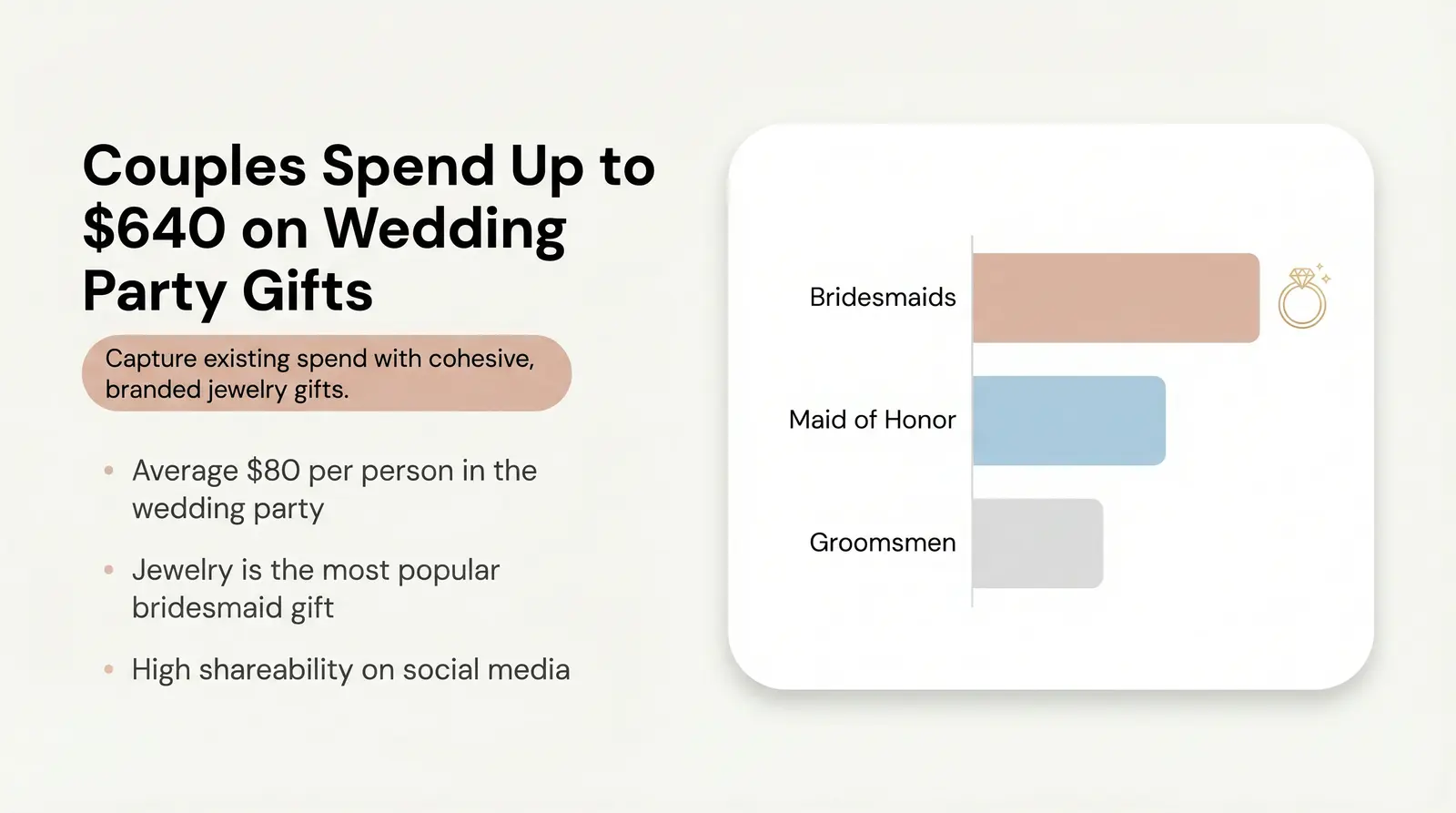
The Knot's research indicates that couples spend an average of $80 per person in the wedding party on thank-you gifts [4]. When you factor in a typical bridal party of five to eight people across both sides, that represents $400 to $640 in gift spend per wedding, often sourced from a dozen different retailers with no cohesion or brand identity.
Average Wedding Party Gift Spend by Role (U.S., 2024-2025 Estimates)
| Role | Average Gift Spend | Most Popular Gift Categories | Personalization Rate |
|---|---|---|---|
| Bridesmaids | $75 - $150 | Jewelry, Robes, Tote Bags | ~85% |
| Maid of Honor | $100 - $200 | Fine Jewelry, Spa Sets, Experiences | ~90% |
| Groomsmen | $50 - $150 | Watches, Flasks, Cufflinks | ~75% |
| Flower Girl / Ring Bearer | $30 - $50 | Keepsake Jewelry, Toys, Books | ~60% |
Data synthesized from industry averages [4] [6].
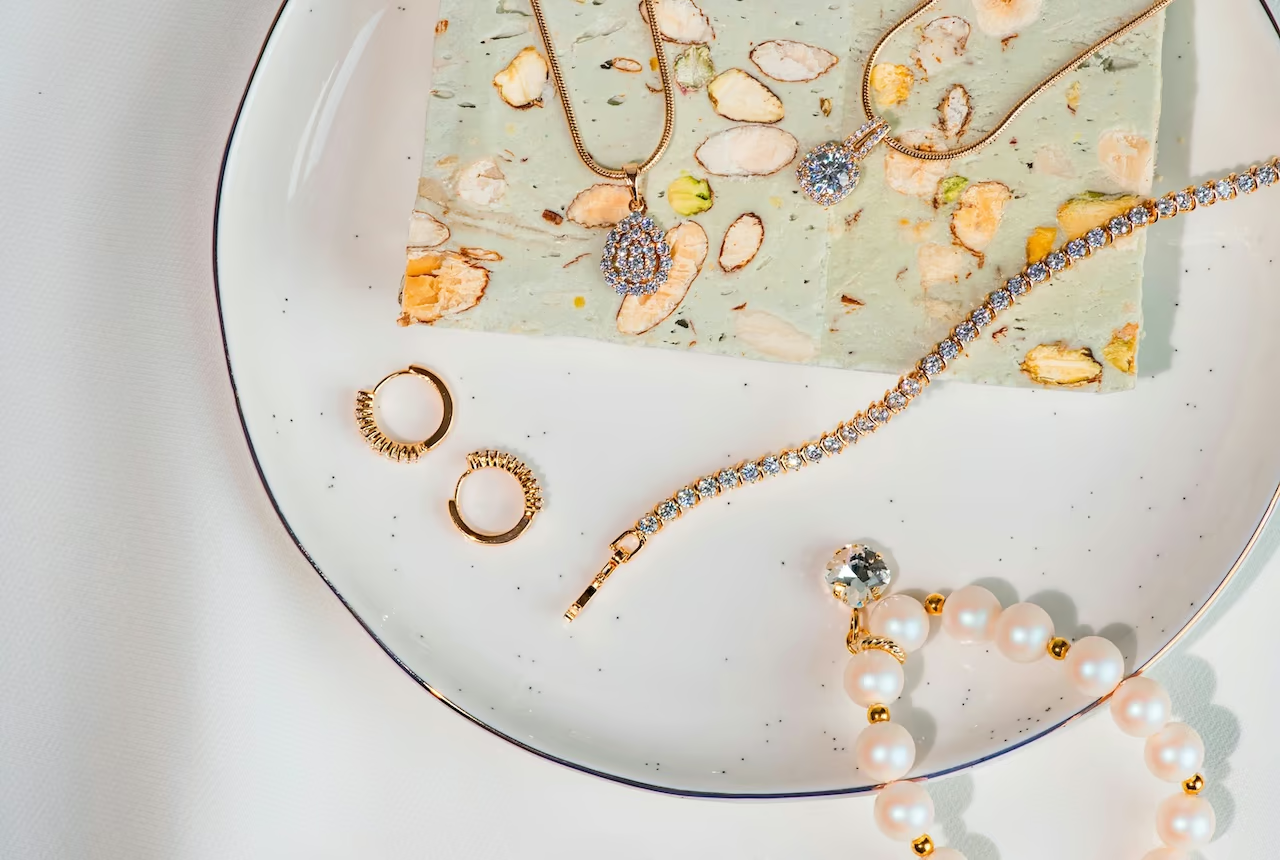
When it comes to bridesmaid jewelry gifts specifically, jewelry consistently outperforms other gift categories. Unlike a monogrammed robe that might only be worn once for getting-ready photos, jewelry offers emotional resonance and long-term wearability. It is also highly shareable on social media, making it a favorite for brides who want their wedding party to look cohesive and polished in every photo. Personalized jewelry, in particular, commands a premium price point and a high perceived value, which is exactly the kind of product a planner wants to attach their brand to.
In our experience at Branvas, wedding planners who add a product line often struggle with where to start. The fear of "becoming a product company" holds many of them back. That is why we developed The "I Do" Brand-Launch Model: a streamlined, three-stage framework designed specifically for service providers who want to add a product revenue stream without disrupting their core business.
The first step is defining your niche aesthetic. Your jewelry line should feel like a natural extension of your existing wedding planning brand, not a separate business bolted on the side.
Start by asking yourself what visual language already defines your work. Are you known for modern, minimalist city weddings? Your line might focus on sleek gold-fill hoops and delicate layering chains. Do you specialize in romantic, garden-party aesthetics? Pearl drops and vintage-inspired pendants might be your signature. Are your clients drawn to bold, editorial looks? Sculptural statement earrings could anchor your collection.
Planner Case Study: "The Champagne Edit"
Consider a fictional but realistic wedding planner whose brand is built around luxury and understated elegance. She decides her brand identity will feature champagne-toned, demi-fine jewelry. She names her line "The Champagne Edit," describing it to clients as "a curated collection of heirloom-quality pieces designed to complement the most refined celebrations." She uses the name consistently across her proposal documents, her Instagram captions, and the custom packaging she includes with every order. Within two seasons, the collection becomes a signature part of her full-service package, and brides begin requesting it by name.
The lesson here is that the name, the description, and the positioning matter as much as the jewelry itself. You are not selling a product. You are selling a story.
You do not need to be a metalsmith or a product designer to launch a jewelry line. Planners can curate from an existing catalog of private-label-ready products, select their branding elements (logo placement, packaging style, ribbon color, thank-you card copy), and create a coherent collection without ever touching a design tool.
Browse the Branvas catalog to see what's already available for private-label at branvas.com/catalog. You simply select the pieces that fit your aesthetic, configure your branding through the Brand Studio, and the fulfillment partner handles manufacturing, packaging, and shipping. The entire setup process can be completed in a single afternoon.
The key to making a curated collection feel cohesive is restraint. Rather than offering twenty different pieces, select four to six items that work together visually. A minimalist necklace, a pair of earrings, and a delicate bracelet in a consistent metal tone is more than enough to create a collection that feels intentional and premium.
The final stage is integrating the jewelry into your existing sales process. Instead of trying to drive cold traffic to a standalone e-commerce store, bundle your branded jewelry into your existing service packages.
For example, you can offer a "Full-Party Gift Package" as an upsell during the initial booking conversation or at the six-month planning milestone. Present it to brides as a curated, exclusive service that saves them hours of research and delivers a cohesive gifting experience, not a product sale.
A simple margin example: if your branded necklace retails at $65 and your unit cost through a private-label partner is $18, your gross margin on that single piece is $47. Multiply that across a bridal party of six bridesmaids, and a single upsell generates $282 in margin before you have done anything beyond selecting the product and placing the order.

One of the most important aspects of building new planner revenue streams is understanding the economics before you launch. Private-label jewelry is attractive precisely because the margin structure is favorable, even at modest price points.
Planner Pricing Model: From Cost to Profit
| Item | Unit Cost (Est.) | Branded Retail Price | Planner Margin | Notes |
|---|---|---|---|---|
| Minimalist Gold-Fill Necklace | $18.00 | $65.00 | 72% | High perceived value; ideal anchor piece for bridesmaid gifts. |
| Pearl Drop Earrings | $14.00 | $55.00 | 74% | Classic appeal; pairs well with most bridal aesthetics. |
| Personalized Initial Bracelet | $22.00 | $75.00 | 70% | Personalization commands a premium; easy upsell. |
| Custom Branded Gift Box | $3.50 | Included in retail price | N/A | Essential for the premium unboxing experience. |
| Full-Party Package (6 necklaces) | $108.00 | $390.00 | 72% | Bundled pricing simplifies the client conversation. |
Estimates based on standard private-label jewelry margins [5].
These margins compare favorably to most service-based revenue, where the primary cost is your own time. A product line, by contrast, scales without additional labor once the initial setup is complete.
Use the Branvas Profit Calculator at branvas.com/profit-calculator to model your own margins before you launch. Plug in your anticipated number of weddings per year and your average bridal party size, and you will quickly see how this revenue stream compounds over a full season.

A successful merch line is about more than the product itself. It is about the experience that surrounds it.
The elements that make a branded jewelry line feel premium are the naming, the logo placement, and the packaging. A beautifully designed rigid box, a soft velvet pouch, custom ribbon in your brand color, tissue paper with your logo, and a handwritten-style thank-you card transform a simple piece of jewelry into a luxury gift. Each of these details signals to the bride and her wedding party that they are receiving something curated, not something generic.
We often see planners underestimate how quickly a branded gift can become their signature offering. The unboxing moment at the bridal party reveal is itself a marketing event. When bridesmaids open a beautifully packaged gift that carries your brand's aesthetic, they are experiencing your attention to detail firsthand. That moment gets photographed, shared, and remembered. It becomes part of the story of the wedding.
Blind shipping is another critical piece of the puzzle. When your fulfillment partner ships orders under your brand name with no mention of the manufacturer, the package arrives looking like it came directly from your studio. This maintains the perception of an exclusive, in-house curation and reinforces the premium positioning of your service.
For inspiration and tools to build this brand experience, visit the Branvas Brand Studio at branvas.com/brand-studio.

You do not need to build a second brand from scratch to market your jewelry line. The most effective strategy is to leverage the audience and assets you already have.
Instagram and Pinterest as visual proof. Use these platforms to showcase your jewelry in real wedding settings. Flat lays of the invitation suite alongside your branded jewelry boxes, or close-up shots of bridesmaids wearing your pieces during the getting-ready hour, make for compelling, shareable content. These images do double duty: they market your jewelry line and they reinforce your overall brand as a planner with a distinctive aesthetic.
Including the jewelry in wedding photography. Coordinate with your photographers to capture detailed shots of the bridesmaids wearing the jewelry and of the gift boxes being opened. These images become evergreen marketing assets that you can use across your website, social media, and client proposals for years.
Getting bridesmaids to tag the brand. Encourage the bridal party to tag your brand when they post photos of their gifts. This turns every wedding party into a micro-influencer campaign for your business, reaching the social networks of people who are likely to be planning their own weddings in the near future.
Pitching the add-on in proposal documents. Include a dedicated section in your client proposals that introduces your curated jewelry collection as part of your full-service offering. Framing it as a time-saving, experience-elevating service, rather than a product for sale, makes it a natural part of the planning conversation.
This is exactly how many of our brand partners at Branvas, from influencers to boutique owners, started. They leveraged an existing audience and an existing client relationship to introduce a product line with minimal friction. You can learn more about how creators are using this model at branvas.com/solutions/influencers-creators.

Adding a product line is a strategic decision, and it is not the right move for every planner at every stage of their business. Use this quick assessment to determine whether you are ready to expand your offerings.
The Branvas Brand-Readiness Checklist for Wedding Planners
If you answered yes to 4 or more, you're ready. Here's how to get started with Branvas at branvas.com/how-it-works.

What are the best bridesmaid jewelry gift ideas that wedding planners can offer?
The best bridesmaid jewelry gifts balance elegance with everyday wearability. Minimalist gold-fill necklaces, pearl drop earrings, and personalized initial bracelets are consistently top sellers because they appeal to a wide range of personal styles and photograph beautifully. Birthstone pieces are another strong option, as they feel personal without requiring individual customization at scale. For planners building a branded collection, the goal is to select three to five pieces that work together cohesively, so the entire bridal party looks intentional and polished, rather than mismatched.
How do wedding planners add product revenue streams without becoming retailers?
Wedding planners can add product revenue streams by utilizing a private-label or white-label fulfillment model. Instead of purchasing inventory upfront and managing storage and shipping, planners curate a collection from a supplier's existing catalog. The supplier handles manufacturing, packaging, and blind shipping directly to the client. The planner earns a margin on each order while acting purely as the curator and brand face. This model requires no warehouse, no inventory risk, and no operational overhead beyond the initial brand setup.
What is private-label jewelry and can a small wedding planning business use it?
Private-label jewelry is jewelry manufactured by a third-party supplier but sold under your own brand name. It is highly accessible for small businesses because it requires zero inventory and minimal upfront investment. A wedding planner can select pre-designed pieces from a supplier's catalog, add their custom packaging and branding, and offer them to clients as an exclusive, in-house collection. Platforms like Branvas are built specifically for this use case, allowing small-business owners to launch a branded jewelry line without any product design or manufacturing experience.
How much do bridesmaids typically spend, or receive, on wedding party gifts?
According to research from The Knot, couples spend an average of $80 per person in the wedding party on thank-you gifts, with the range typically falling between $75 and $150 per bridesmaid [4]. Bridesmaids themselves spend an average of more than $1,600 just to participate in a wedding, not including their own gift to the couple [4]. This context matters for planners: the bride is already aware that her wedding party is spending significantly, which makes a thoughtful, curated gift feel like an important gesture. Jewelry in the $55 to $100 range hits the sweet spot of feeling generous without being extravagant.
How do I start my own jewelry brand as a wedding planner with no product experience?
You can start your own jewelry brand by partnering with a Brand-as-a-Service platform like Branvas. No product design or manufacturing experience is required. The process involves three steps: defining your brand aesthetic and choosing a name for your collection, selecting pieces from an existing catalog that match your style, and configuring your custom packaging and branding through the platform's brand studio. Once set up, you can begin offering the curated collection as an add-on package to your existing wedding planning clients immediately. The entire setup can be completed in a single session, and your first order can ship within days.