


Build a compelling jewelry brand identity using archetypes, the SPARK naming framework, visual identity principles, brand voice, and strategic positioning to command premium pricing.
Published:
May 20, 2026
Author:
Yi Cui
In jewelry, brand isn't decoration — it's the product. Same necklace, different brand, can sell for 3x the price. Here's how to build the brand that commands the premium.
In our experience at Branvas, the founders who build a strong brand before their first product drop consistently outperform those who bolt branding on after the fact. The jewelry market is saturated with beautiful products, but it is starved for compelling stories. When a customer buys a piece of jewelry, they are rarely just buying metal and stone. They are buying an identity, a feeling, and a signal to the world about who they are.
This guide provides a comprehensive framework for building a jewelry brand from scratch. We will cover how to name your brand, define your visual identity, establish your brand voice, and position yourself in the market. Whether you are an influencer launching your first collection or an ecommerce seller looking to rebrand, this guide will give you the clarity and conviction needed to build a brand that commands attention and premium pricing.
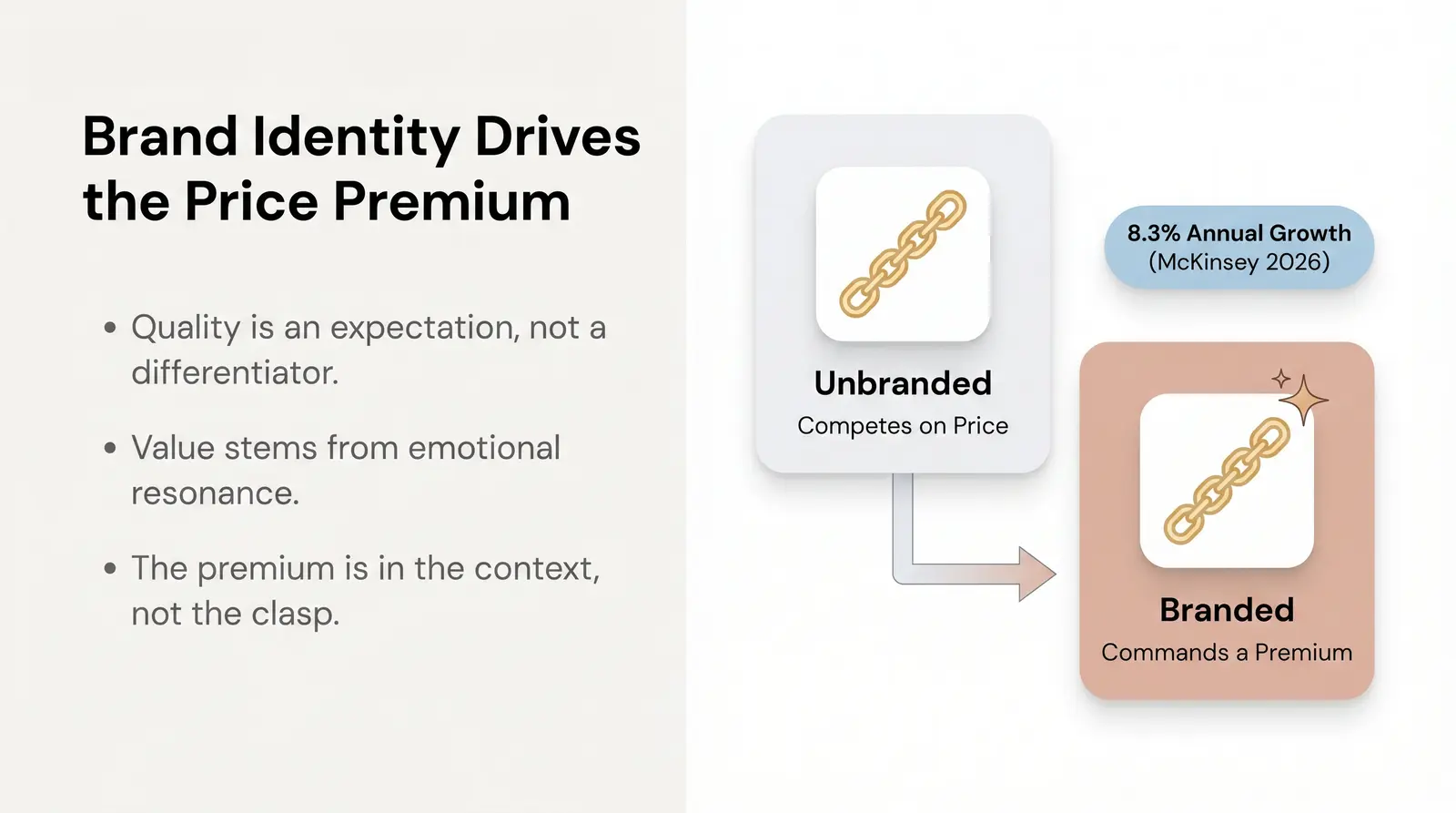
In many industries, the product is the primary value driver. In jewelry, the brand is the product. The physical item is simply the vessel through which the brand's meaning is delivered. This is why two visually identical gold chains can have vastly different price tags. The premium is not in the clasp; it is in the context.
We often see founders struggle with pricing confidence — and almost always, it traces back to a brand identity gap, not a product gap. A common misconception among new jewelry entrepreneurs is that "better quality" is a sufficient branding strategy. It is not. Quality is an expectation, not a differentiator. In fact, research shows that in the luxury and premium sectors, perceived value is driven more by emotional resonance and brand identity than by functional attributes [1]. According to a 2026 report by McKinsey & Company and The Business of Fashion, branded jewelry is the fastest-growing category in fashion, with sales growing at 8.3% annually, far outpacing unbranded jewelry [2]. Consumers are increasingly seeking recognizable codes and symbolic language that serve as a shorthand for their own identity.
Niching down is another area where founders hesitate. It feels counterintuitive to exclude potential customers by adopting a highly specific brand identity. However, trying to appeal to everyone usually results in appealing to no one. A hyper-focused brand identity creates a stronger emotional connection with a specific target audience, which translates to higher loyalty and a greater willingness to pay a premium. The goal is not to be acceptable to the masses, but to be irresistible to a few.
Before you can name your brand or design a logo, you need to understand your brand's fundamental character. We use brand archetypes as a strategic starting point. An archetype is a universally recognized persona that helps anchor your brand's identity and makes it instantly recognizable to your target audience. Here are the five most common and effective archetypes in the jewelry industry.
1. Minimalist
The Minimalist archetype is defined by clean lines, negative space, and quiet luxury. It appeals to the modern consumer who values simplicity, versatility, and understated elegance. The aesthetic is uncluttered, focusing on the essential form of the jewelry. The tone of voice is spare, confident, and direct, avoiding excessive adjectives. Packaging is typically sleek, using neutral colors and high-quality, unembellished materials. Brands like Mejuri and Aurate excel in this space.
2. Statement
The Statement archetype is bold, maximalist, and color-forward. It is designed to be a conversation starter. This brand appeals to individuals who use fashion as a form of self-expression and aren't afraid to stand out. The visual style is vibrant and eclectic, often featuring oversized pieces and unexpected material combinations. The tone of voice is energetic, playful, and unapologetic. Packaging is often as loud as the jewelry itself, utilizing bright colors and striking patterns.
3. Heritage
The Heritage archetype is built on a story of craftsmanship, provenance, and heirloom quality. It appeals to consumers who value tradition, longevity, and the artisanal process. The aesthetic often incorporates classic motifs, vintage-inspired designs, and a sense of timelessness. The tone of voice is authoritative, romantic, and focused on legacy. Packaging tends to be substantial and luxurious, often using materials like velvet, leather, or heavy textured paper to convey a sense of permanence. Cartier and Van Cleef & Arpels are classic examples.
4. Rebellious
The Rebellious archetype is anti-establishment, edgy, and rooted in subculture or alternative identity. It appeals to those who reject traditional luxury norms and seek jewelry with attitude. The visual style often incorporates darker metals, unconventional shapes, and motifs like spikes or chains. The tone of voice is provocative, raw, and challenging. Packaging is typically unconventional, perhaps using matte black finishes, industrial materials, or distressed textures.
5. Spiritual
The Spiritual archetype focuses on symbolism, intentionality, and meaning. It appeals to consumers who view jewelry as a talisman, a tool for ritual, or a connection to something larger than themselves. The aesthetic often features crystals, celestial motifs, and organic shapes. The tone of voice is warm, empathetic, and metaphor-rich. Packaging often includes elements that enhance the unboxing ritual, such as intention cards, natural materials, or earthy color palettes.
| Archetype | Core Emotion | Visual Style | Tone of Voice | Packaging Direction | Example Brand(s) |
|---|---|---|---|---|---|
| Minimalist | Calm, Clarity | Clean lines, negative space, quiet luxury | Spare, confident, direct | Sleek, neutral, unembellished | Mejuri, Aurate |
| Statement | Confidence, Joy | Bold, maximalist, color-forward | Energetic, playful, unapologetic | Vibrant, striking patterns | Alexis Bittar |
| Heritage | Trust, Nostalgia | Classic motifs, timeless, artisanal | Authoritative, romantic, legacy-focused | Velvet, leather, substantial | Cartier, Van Cleef & Arpels |
| Rebellious | Independence, Edge | Dark metals, unconventional shapes | Provocative, raw, challenging | Matte black, industrial, distressed | Hannah Martin |
| Spiritual | Connection, Peace | Symbolism, crystals, organic shapes | Warm, empathetic, metaphor-rich | Natural materials, intention cards | Satya Jewelry |

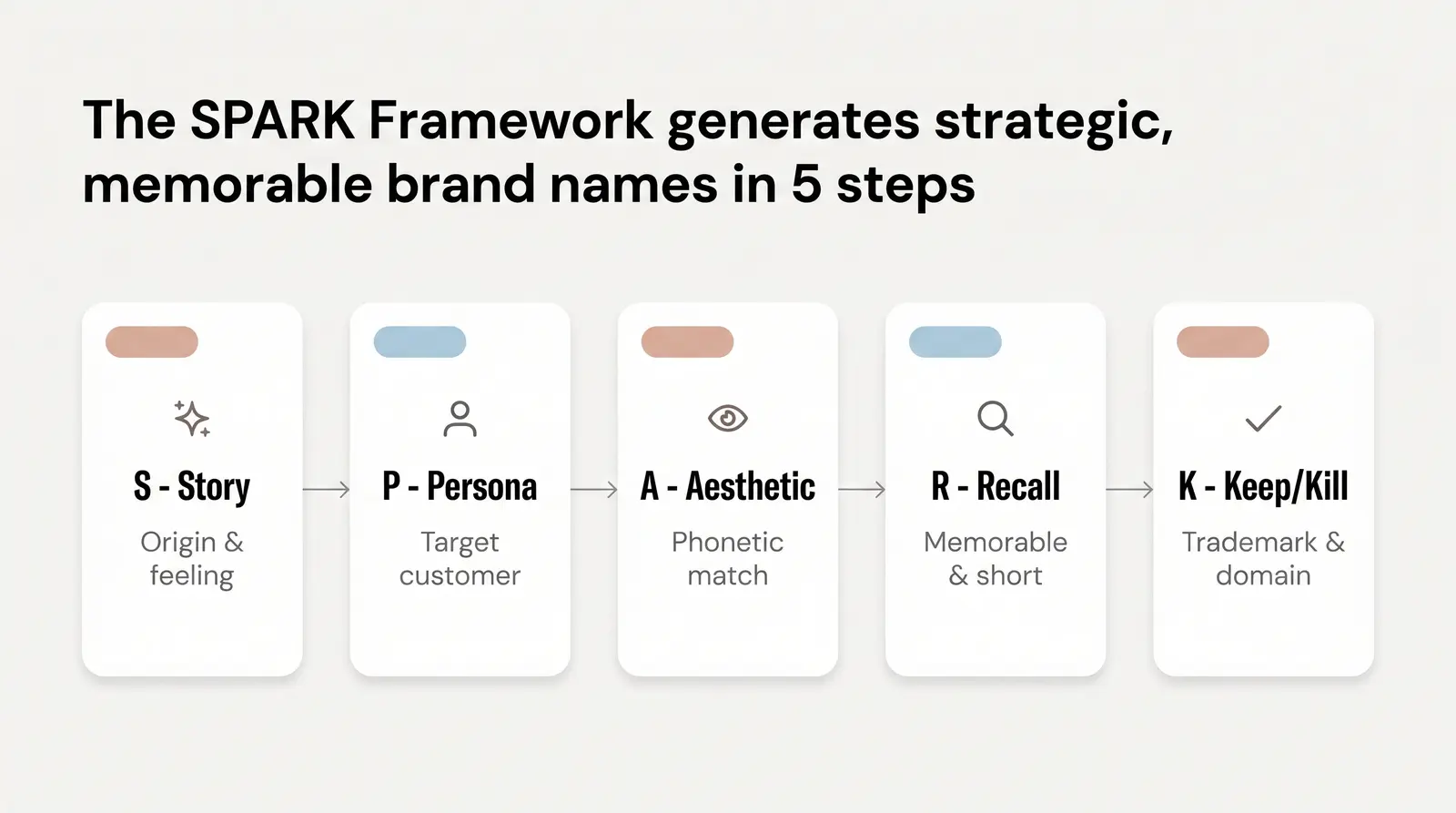
Naming a jewelry business is often the most paralyzing step for new founders. A great name should feel inevitable, but getting there requires a structured process. We developed the Branvas SPARK Framework — a 5-step system for generating and evaluating jewelry brand names.
Let's walk through naming a fictional jewelry brand. Our concept is a spiritual-minimalist brand targeting millennial women who want meaningful, everyday gold pieces.
Brainstorming inputs: Light, aura, soul, daily, thread, glow, essence.
Shortlist & Keep/Kill Test:
Final Decision: We choose Solara. It perfectly bridges the spiritual (light/sun) and the minimalist (simple, clean phonetics).
Use these ideas as creative springboards, not finished names. They are designed to spark your own brainstorming process.
Minimalist
Statement
Heritage
Rebellious
Spiritual
Need a name but want a second opinion? The Branvas Brand Studio can help you pressure-test your brand identity before you go to market. → Explore Brand Studio
Your visual identity is the physical manifestation of your brand archetype. It is how your brand looks and feels before a customer ever reads a word of copy. The three pillars of jewelry visual identity are color, logo, and packaging.
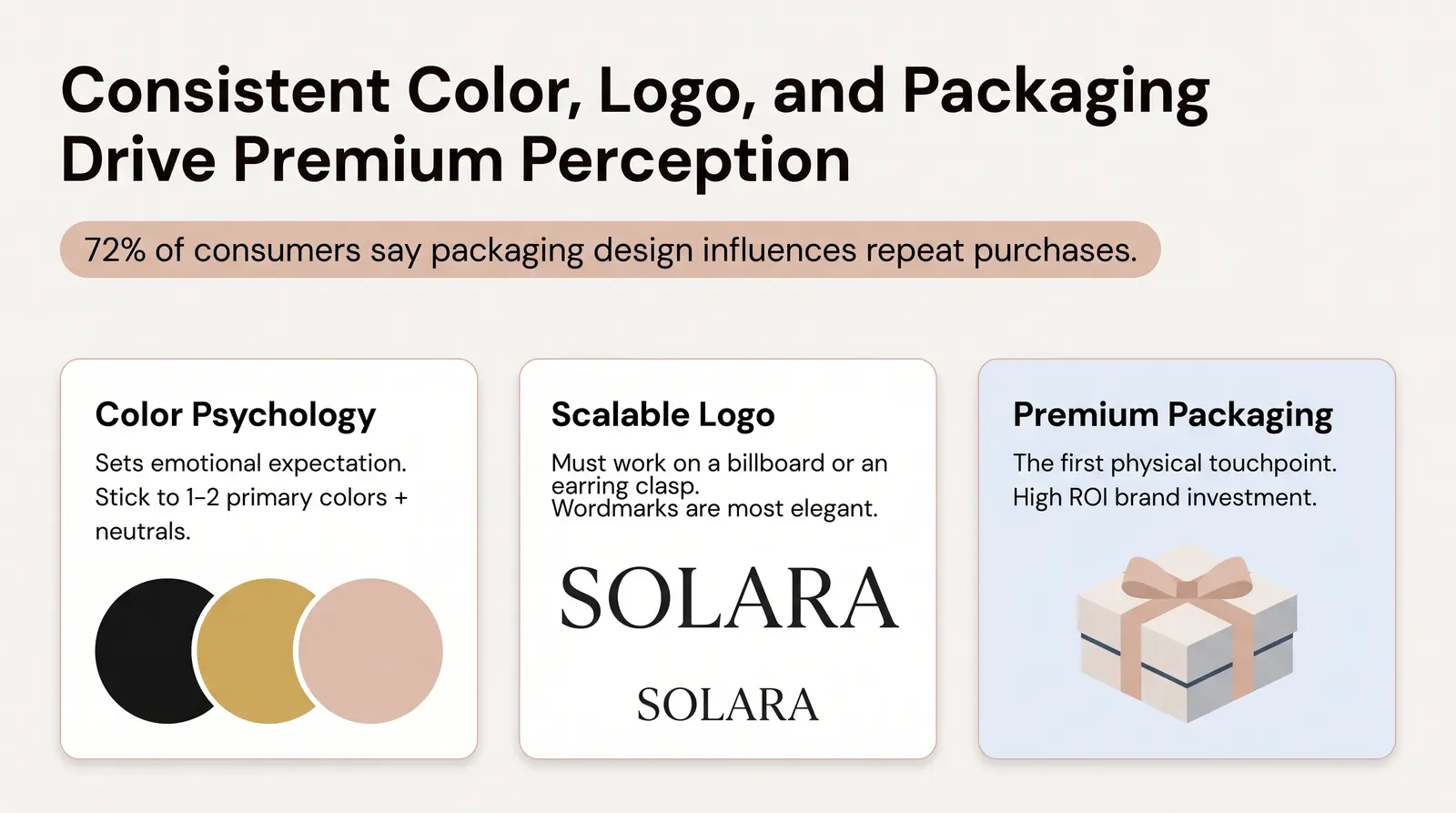
Color is the fastest way to communicate emotion. In jewelry branding, color psychology is paramount because it sets the expectation for the product's value and style.
When building a palette, stick to one or two primary colors and two to three neutral supporting colors. A common mistake is using too many colors, which dilutes the brand's impact and makes the visual identity feel chaotic.
Your logo needs to work as well stamped on a tiny earring clasp as it does on a billboard. This requires simplicity and scalability.
Typography is the foundation of a strong wordmark. Serif fonts (fonts with small lines at the ends of strokes) convey heritage, tradition, and luxury. Sans-serif fonts (clean, modern lines) communicate minimalism, approachability, and contemporary design. Script fonts can feel romantic or artisanal, but they must be highly legible. The most common mistake new jewelry brands make is choosing a complex, overly illustrative logo that becomes an illegible blob when printed on a small ring box.
For an ecommerce jewelry brand, packaging is often the first physical touchpoint a customer has with your brand. It is the moment the digital promise becomes a physical reality. According to industry data, 72% of consumers report that packaging design influences their purchasing decisions, and premium packaging significantly increases the likelihood of repeat purchases [3].
A comprehensive packaging suite includes the primary jewelry box, protective tissue paper or pouches, branded ribbon, and inserts like care instructions or thank-you cards. Sustainable options, such as recycled paper or reusable pouches, are increasingly important to modern consumers and can be a strong brand differentiator.
For a deep dive into packaging options and how to choose the right unboxing experience for your brand, see our guide: Jewelry Packaging Guide →
At Branvas, we've seen a well-designed jewelry box increase perceived product value by more than the cost of the box itself — it's one of the highest-ROI brand investments a new founder can make.
Brand voice is how your brand sounds. It is the personality that comes through in your social media captions, product descriptions, and email newsletters. A strong visual identity catches the eye, but a strong brand voice captures the heart.
Your voice must align with your archetype. A Minimalist brand should sound spare, confident, and direct, avoiding adjective stacking (e.g., "The Essential Gold Chain. 14k solid gold. Made to live in."). A Spiritual brand, conversely, should sound warm, intentional, and metaphor-rich (e.g., "A talisman for your daily journey. This luminous gold chain is designed to ground your energy and reflect your inner light.").
Here is how the same product—a simple gold chain necklace—might be described in three different brand voices:
| Archetype | Product Description Example |
|---|---|
| Minimalist | The Everyday Chain. 14k solid gold. Zero fuss. Wear it alone or layer it up. |
| Heritage | The Heirloom Link. Crafted by master artisans using techniques passed down through generations. A timeless investment in 18k gold. |
| Rebellious | The Heavy Metal Chain. Solid gold hardware built for the underground. Don't take it off. |
To maintain consistency, define three "voice pillars" (e.g., Confident, Educational, Warm) and three "voice anti-patterns" (e.g., Never arrogant, Never overly technical, Never overly familiar) before writing any copy.

Defining your audience goes beyond basic demographics (age, location, income). You need to understand their psychographics: their values, their buying triggers, and the occasions they are shopping for. Are they buying a gift to celebrate a milestone, or are they self-gifting as a form of retail therapy?
Positioning is the strategic act of defining why your brand is the best choice for that specific audience compared to every other option on the market. It is not just "who" you are for, but "why you vs. everyone else."
A simple positioning statement formula looks like this:
For [target audience], [Brand Name] is the [category] that [unique benefit] because [reason to believe].
Example: For millennial women seeking everyday luxury, Solara is the fine jewelry brand that offers meaningful, minimalist pieces without the traditional retail markup, because we source directly from ethical artisans.
A common, brand-killing mistake is stating, "My jewelry is for everyone who loves beautiful things." This is not a strategy; it is a hope. When you try to be for everyone, your messaging becomes generic, your visual identity becomes bland, and you lose the ability to command a premium. Specificity is the key to profitability.

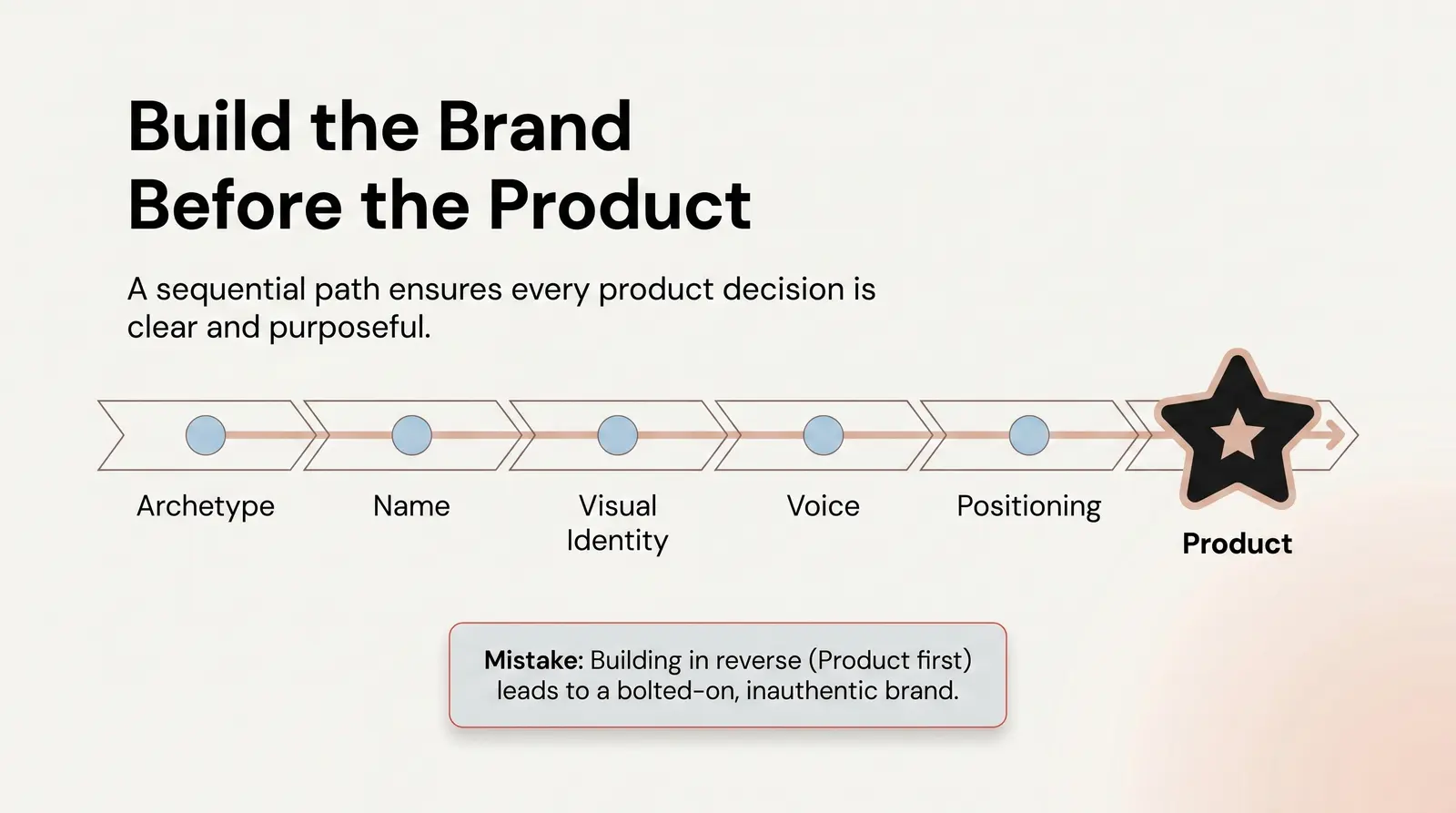
Building a jewelry brand is a sequential process. The most successful founders follow this path: Archetype → Name → Visual Identity → Voice → Positioning → Product.
The most common mistake is building in reverse: designing or sourcing a product first, and then trying to figure out what the brand is and who it is for. When you start with the product, the brand often feels bolted on and inauthentic. When you start with the brand, every product decision becomes clear and purposeful.
The brands we see succeed fastest at Branvas are the ones who spend time on this sequence before they ever place a product order. They know exactly who they are, who they are speaking to, and what value they are delivering beyond the metal and stone.
Ready to launch your jewelry brand? Branvas handles the hard parts — product sourcing, private-label branding, packaging, and fulfillment — so you can focus on building the brand you just mapped out. See How Branvas Works → or Explore Pricing →
1. How do I come up with a name for my jewelry business?
Start by defining your brand's core story and target persona. Use a structured approach like the Branvas SPARK Framework to brainstorm names that align with your aesthetic and are easy to remember. Always check for trademark availability and secure a viable domain name before finalizing your choice.
2. What makes a jewelry brand feel high-end or luxurious?
High-end perception is driven by consistency and restraint. It involves a cohesive visual identity (often utilizing minimalist logos and sophisticated color palettes like black and gold), high-quality packaging that enhances the unboxing experience, and a confident, authoritative brand voice that focuses on craftsmanship and emotional value rather than just product features.
3. Do I need a logo before I launch my jewelry brand?
Yes. Your logo is the visual anchor of your brand identity. It will appear on your website, social media, packaging, and potentially the jewelry itself. A professional, scalable logo (even a simple, well-chosen wordmark) is essential for establishing trust and credibility from day one.
4. How do I define my jewelry brand's target audience?
Move beyond basic demographics and focus on psychographics. Understand your ideal customer's lifestyle, values, and the emotional triggers that drive their purchases. Are they buying for status, self-expression, or sentimental reasons? Create a detailed customer persona to guide all your branding and marketing decisions.
5. What's the difference between a jewelry brand and a jewelry business?
A jewelry business sells products (metal and stones) based on features and price. A jewelry brand sells an identity, a feeling, and a story. A business competes on cost; a brand commands a premium because customers are buying into the meaning attached to the product, not just the physical item itself.