



A boutique is a curated, niche-focused brand. This guide defines the modern boutique, compares categories, and provides a 5-step framework to launch online.
Published:
September 21, 2026
Author:
Yi Cui
A boutique used to mean a physical storefront with racks of curated clothes. In 2026, it means a brand — online, niched, inventory-free, and more profitable than the physical version ever was.
A boutique is a small, specialized retail business that sells a highly curated selection of products (clothing, jewelry, home goods) to a specific target audience. A boutique store is defined not by its size, but by its intentionality: every product, every visual, every interaction reflects a deliberate point of view. Whether physical or digital, what makes a boutique a boutique is curation, identity, and niche focus.
If you are an aspiring brand-builder, that definition is your starting point. Everything else follows from it. Branvas is built specifically for entrepreneurs like you.
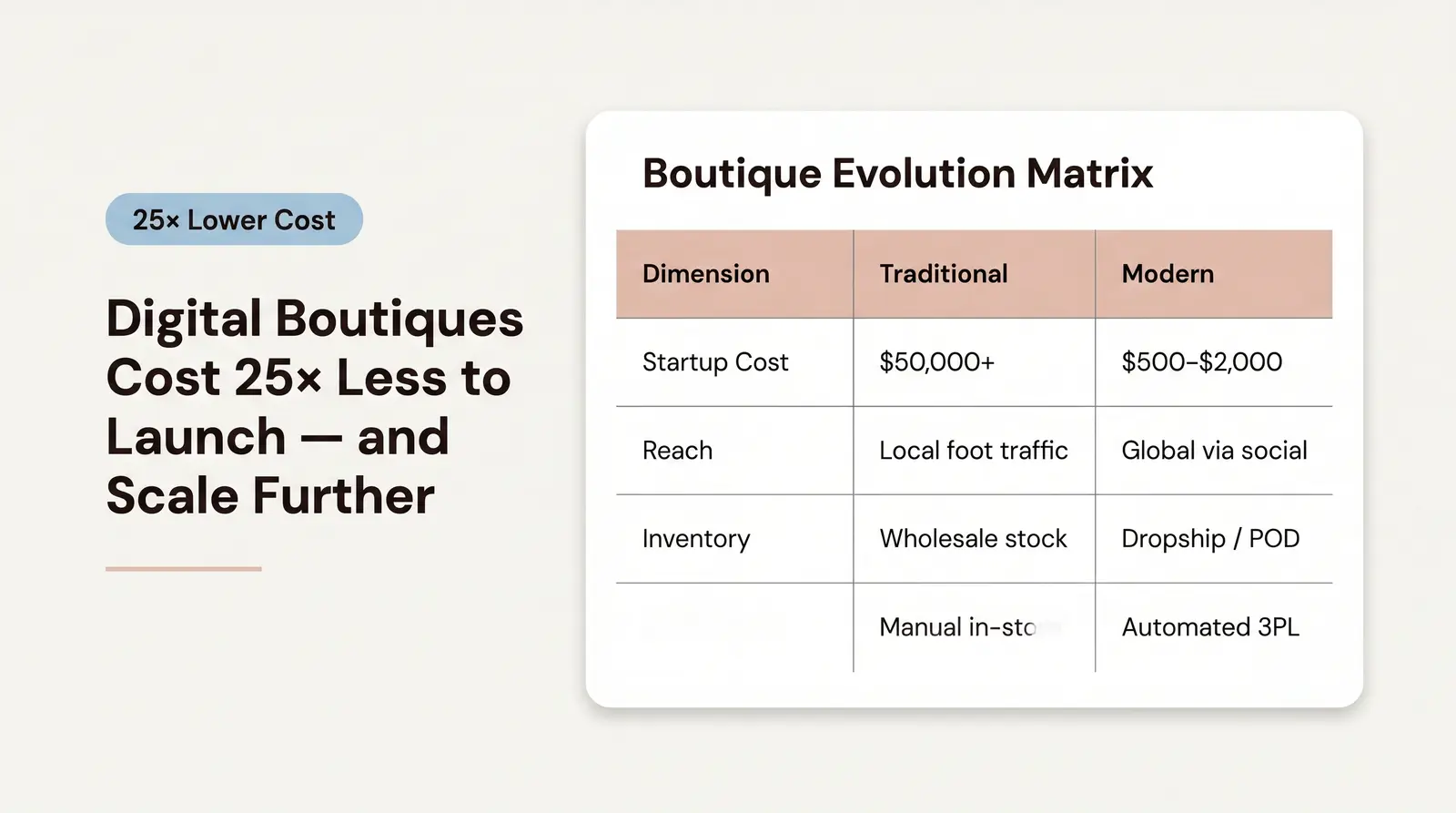
The retail landscape has fundamentally shifted. To understand what a boutique is today, it helps to see exactly how the model has evolved. We call this the Boutique Evolution Matrix.
| Dimension | Traditional Boutique | Modern Boutique |
|---|---|---|
| Location | Physical storefront, dependent on foot traffic | Online store (Shopify or similar) and social commerce |
| Inventory Model | Wholesale purchasing, holding physical stock | Dropshipping, print-on-demand, or private label |
| Startup Cost | High ($50,000+ for lease, buildout, inventory) | Low ($500 to $2,000 for platform, branding, and samples) |
| Customer Reach | Local community and walk-in traffic | Global audience via social media and organic search |
| Brand Identity | Reliant on store ambiance and window displays | Driven by digital aesthetics, packaging, and content |
| Fulfillment | In-store bagging and manual shipping | Automated third-party logistics (3PL) or blind dropshipping |
| Profitability Potential | Capped by square footage and local demand | Highly scalable with unlimited digital shelf space |
This shift did not happen by accident. Three forces converged to make the modern boutique possible.
First, ecommerce infrastructure became genuinely accessible. Platforms like Shopify reduced the technical and financial barrier to launching an online store to near zero. Second, social commerce turned every founder's Instagram or TikTok audience into a built-in distribution channel. U.S. social commerce reached an estimated $87.02 billion in 2025, growing 21.5% year over year [2]. Third, dropship and print-on-demand logistics matured to the point where a one-person brand can offer premium fulfillment without ever touching inventory.
The result is a new category of business: the digital boutique. Lean, branded, and built for scale.
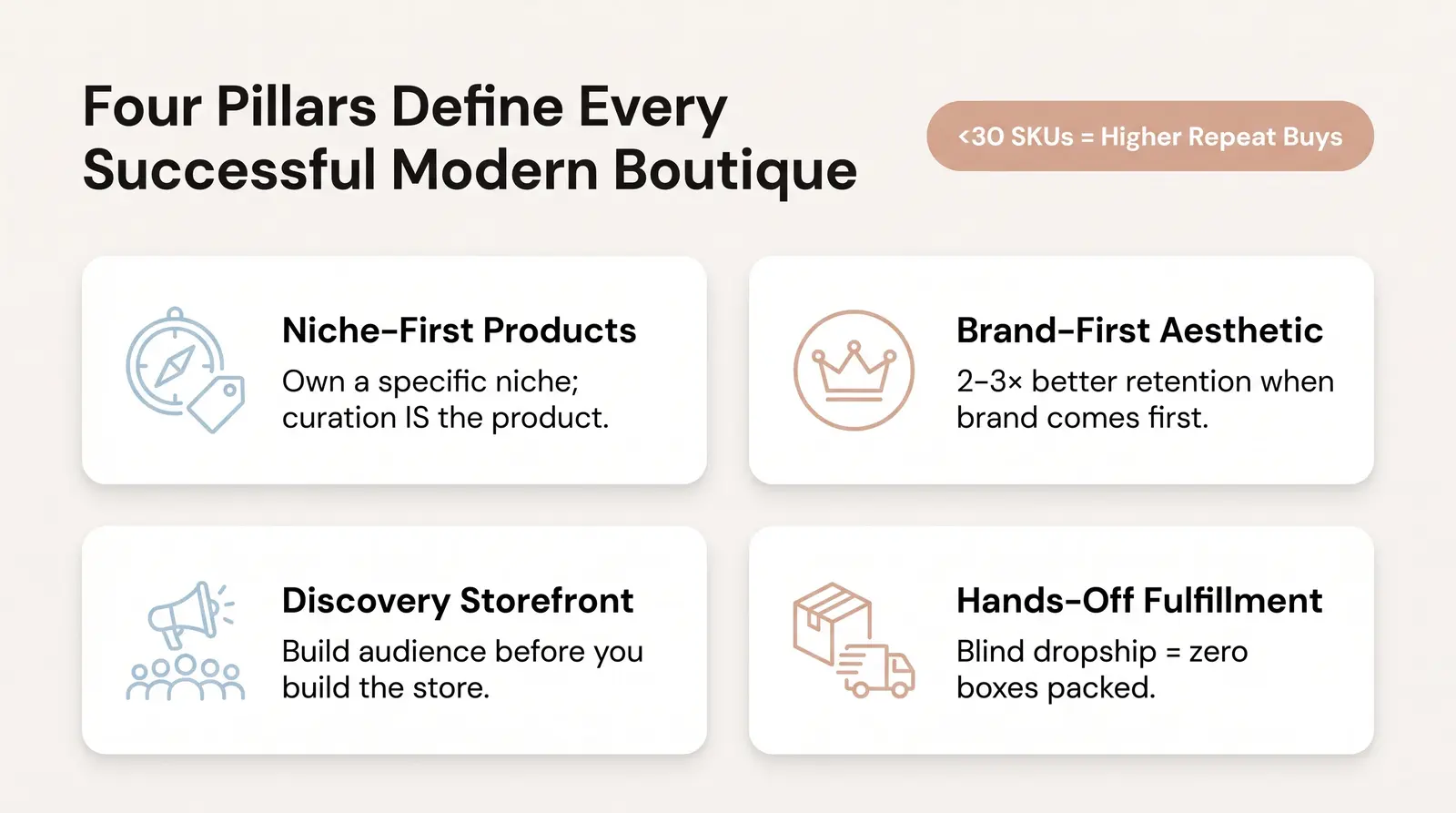
The modern online boutique business is less about physical space and entirely about the digital experience. It rests on four foundational pillars.
The best boutiques own a specific niche rather than trying to sell everything to everyone. In the modern boutique model, curation is the product. The taste, perspective, and editorial eye of the founder are what customers are really buying.
Most new boutique owners overbuy SKUs when they launch, assuming more options equal more sales. The opposite is true. Boutiques with the highest repeat purchase rates typically carry fewer than 30 hero SKUs. A focused catalog reduces decision fatigue for the buyer and allows the founder to market each piece with deeper storytelling. Ecommerce research consistently shows that customers who feel a strong brand connection have significantly higher lifetime value than those who simply find the cheapest option [5].
Brand identity is what separates a boutique from a generic dropshipping store. Your name, visual language, packaging, and tone of voice create an emotional connection that transcends the product itself.
In our experience at Branvas, the founders who nail their brand aesthetic before they launch their first product collection outperform those who treat branding as an afterthought, often by 2 to 3x in first-year retention. Customers want to feel like they are buying into a lifestyle, not just completing a transaction.
A modern boutique needs a digital home that builds trust instantly. That means a clean website built on a platform like Shopify, high-quality photography, clear social proof, and foundational SEO to capture organic search traffic.
Discovery often happens off-site, though. Boutiques born on Instagram or TikTok frequently convert existing audiences into buyers before the website even officially launches. This is not a workaround. It is a strategy. Building an audience before you build a store is one of the most powerful advantages a modern boutique founder has over a traditional retailer.
Modern boutiques use third-party fulfillment or private-label dropshipping to avoid the cash-flow trap of holding inventory. Blind shipping, often called dropshipping, is a fulfillment method where a supplier ships products directly to the customer on behalf of the boutique, without including any supplier branding. The customer receives a beautifully branded package. The founder never packs a box.
This operational model is what makes a one-person boutique genuinely scalable. It frees the founder to focus entirely on marketing, content, and community building.
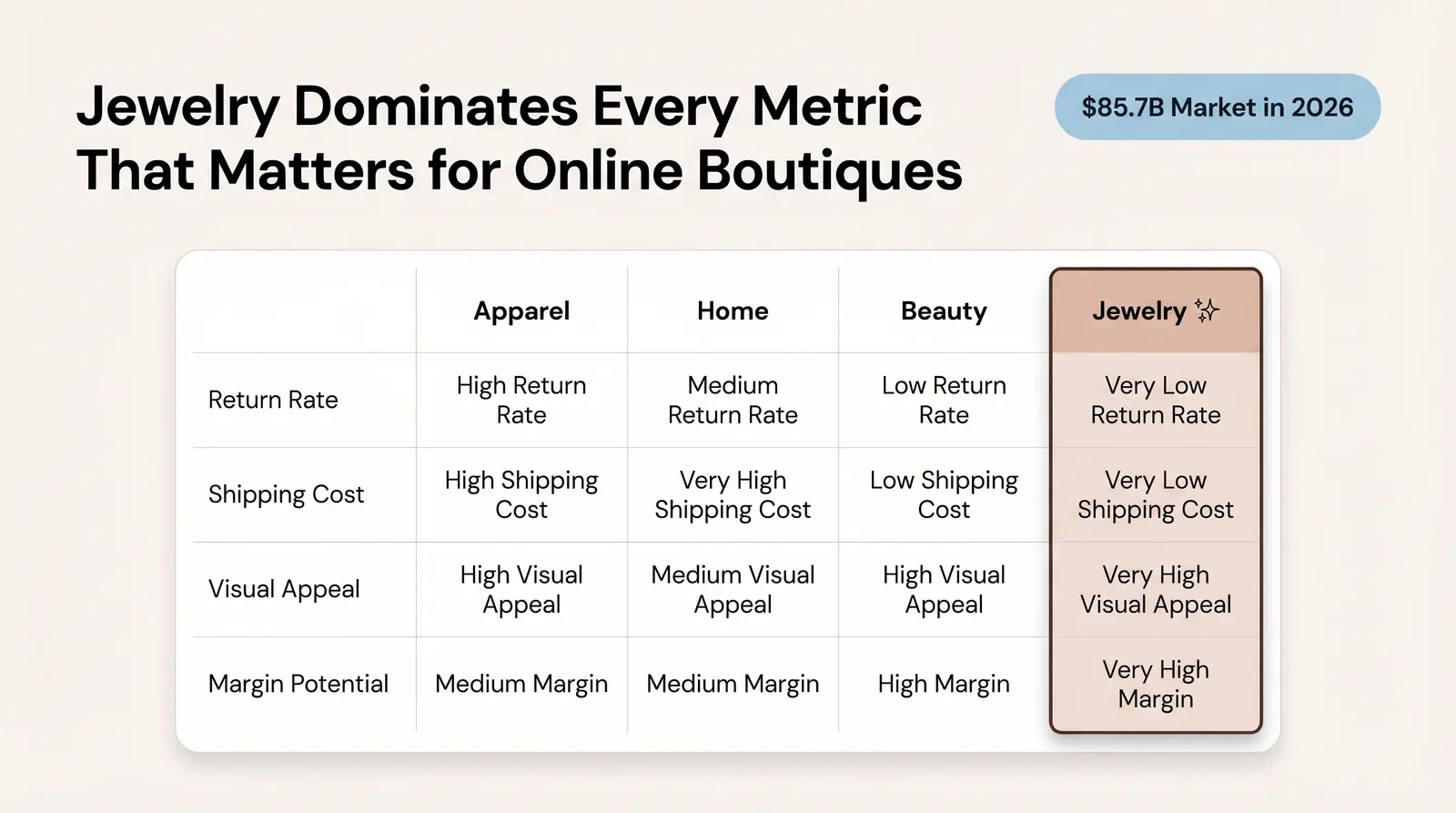
When deciding how to start a boutique, founders typically choose from four main categories. Each has real advantages and real tradeoffs.
1. Apparel Boutique
Apparel offers high demand and strong brand storytelling potential. However, it comes with significant operational friction. Sizing complexity, high return rates, and logistics challenges are real. The National Retail Federation estimated that 19.3% of all online sales would be returned in 2025, and apparel historically drives a disproportionate share of those returns [3]. For a first-time founder, that friction can be costly.
2. Home and Lifestyle Boutique
Home goods can command a strong average order value (AOV) and attract a design-conscious customer. However, heavy or fragile products drive up shipping costs and increase the risk of damage in transit, compressing margins on every order.
3. Beauty Boutique
Beauty products offer excellent recurring purchase potential and strong brand loyalty. Yet, regulatory complexity, including FDA compliance and strict ingredients labeling requirements, adds meaningful barriers to entry for new founders who want to create their own formulations.
4. Jewelry Boutique
Jewelry is the ideal online boutique category. Here is why it wins across every dimension that matters for a digital-first brand.
High perceived value. A piece of jewelry priced at $45 can feel like a $150 gift when it arrives in premium branded packaging. The perceived value-to-cost ratio is exceptional.
Low physical weight. A single piece of jewelry can ship for under $5. Compare that to a pair of jeans or a ceramic vase. The shipping economics are dramatically more favorable, which means higher net margins on every order.
Extreme visual appeal. Jewelry photographs beautifully. It performs on Instagram, TikTok, and Pinterest in a way that few other product categories can match. Content creation is easier, and organic reach is higher.
Giftability. Jewelry is one of the most gifted product categories in ecommerce. Every gift purchase is a potential new customer discovery. Giftability drives organic sharing, word-of-mouth, and repeat purchases around every major holiday and life event.
High margins at scale. The global jewelry market is projected to reach $578.45 billion by 2033, growing at a compound annual growth rate of 5.5% [4]. The online jewelry segment alone is projected to reach $85.7 billion in 2026 [6]. Founders entering this space now are building in a market with significant tailwinds.
The rise of the "jewelry brand" as a creator economy play has accelerated all of this. Influencers and micro-brands are increasingly launching private-label jewelry collections to monetize their audiences with high-margin physical products. The creator economy reached $205 billion in 2024 and is projected to hit $1.35 trillion by 2033 [7]. Jewelry is one of the clearest product-market fits within that ecosystem.
A Worked Example: Maya's Minimalist Jewelry Boutique
Maya has 12,000 Instagram followers. She posts about minimalist fashion, quiet luxury aesthetics, and everyday style. She wants to launch a boutique but does not want to risk $10,000 on wholesale inventory.
Instead, she sources 15 hero SKUs through Branvas, selecting pieces that fit her brand identity: "quiet luxury for everyday wear." She chooses a name, builds a simple visual identity, and sets up a Shopify store with custom-branded packaging handled by Branvas. Before she launches publicly, she posts three teaser videos to her Instagram. On launch day, she sends an email to her list of 800 subscribers.
In her first 30 days, Maya generates $8,000 in revenue. She has not packed a single box. Her cost of goods is covered by Branvas's fulfillment model, and her margin on each order is strong because jewelry ships light and her branding justifies a premium price point.
The numbers are realistic because the model is built for exactly this scenario.
Thinking about launching a jewelry boutique? Explore how Branvas works.
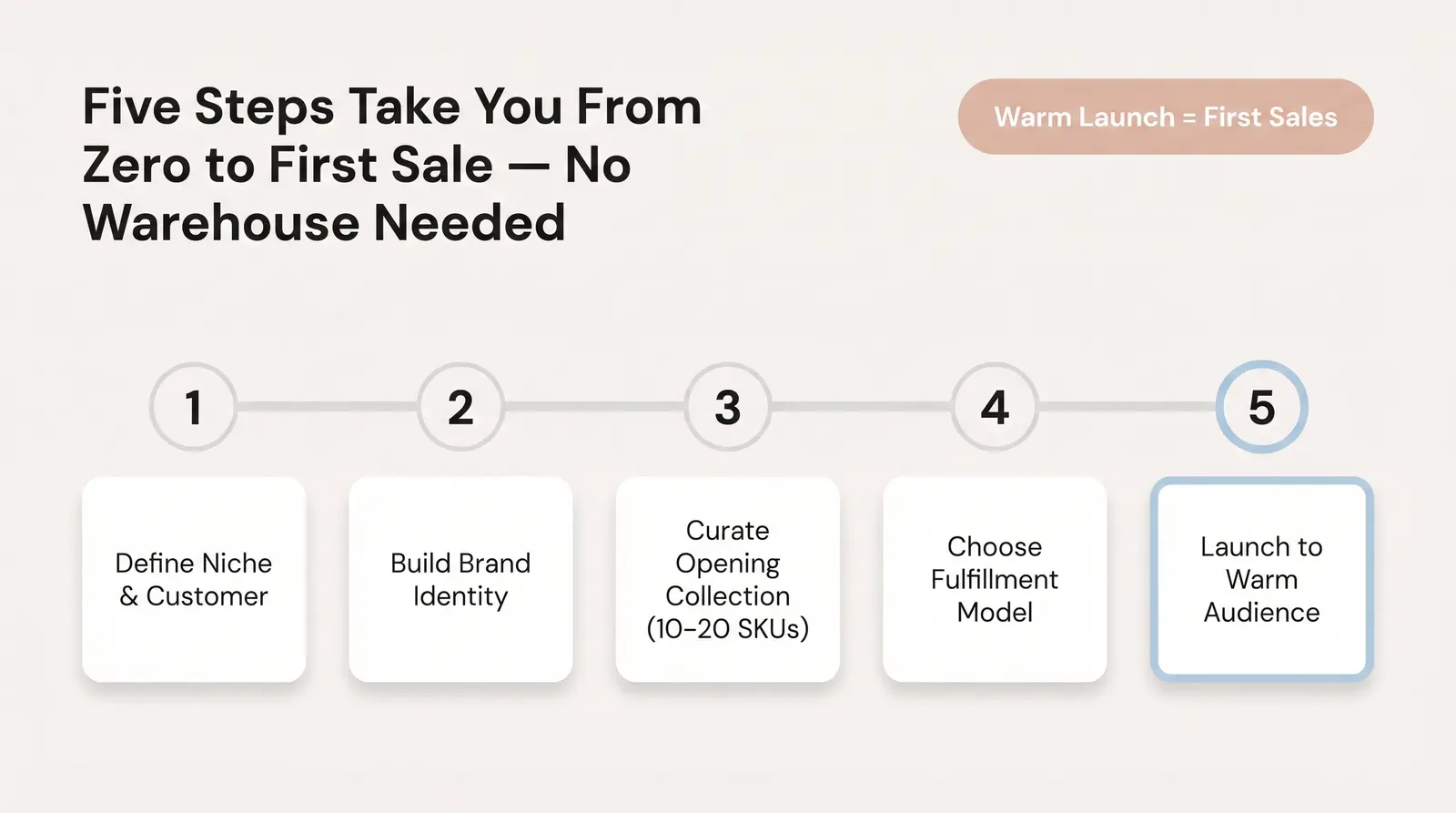
Starting an online boutique business does not require a business degree or a warehouse. It requires a clear system. We use the Branvas Boutique Launch System to guide new founders from concept to first sale.
Step 1: Define Your Niche and Customer
Who are you for? What is the unmet desire you are serving? Get specific. "Jewelry for minimalist millennial women who want everyday luxury" is a far stronger foundation than "women's accessories." The more precisely you define your customer, the more effectively you can market to them. Browse the Branvas catalog to see how specific collections align with distinct customer profiles and aesthetics.
Step 2: Build Your Brand Identity
Your name, visual style, packaging language, and tone of voice form the soul of your boutique. This identity must be cohesive across your website, your social media, and the physical unboxing experience your customer receives. Brand identity is not decoration. It is the primary reason a customer chooses you over a cheaper alternative.
Step 3: Curate Your Opening Collection
Start with 10 to 20 SKUs. Choose one hero product that perfectly embodies your brand. Resist the urge to launch with 100 items. A tight, curated collection looks more premium, is easier to photograph, and is far easier to market with depth and consistency.
Step 4: Choose Your Fulfillment Model
Decide how products will reach your customers. You can self-fulfill (packing boxes yourself), use a traditional 3PL (which requires buying inventory upfront), or use a private-label dropship solution like Branvas, which gives you the branding of a 3PL without the inventory risk. This model is especially well-suited for ecommerce and boutique store owners who want to expand their catalog without expanding their overhead.
Step 5: Launch to a Warm Audience First
Never launch to an empty room. Build an email list, engage your Instagram followers, post a TikTok video, or nurture a Facebook group before your store goes live. Your first sales should come from people who already trust you. A warm launch generates social proof, early reviews, and momentum that a cold launch simply cannot replicate.
Ready to skip the sourcing headaches? Branvas gives you a private-label jewelry brand, products, packaging, and fulfillment, so you can focus on selling. See Branvas pricing.
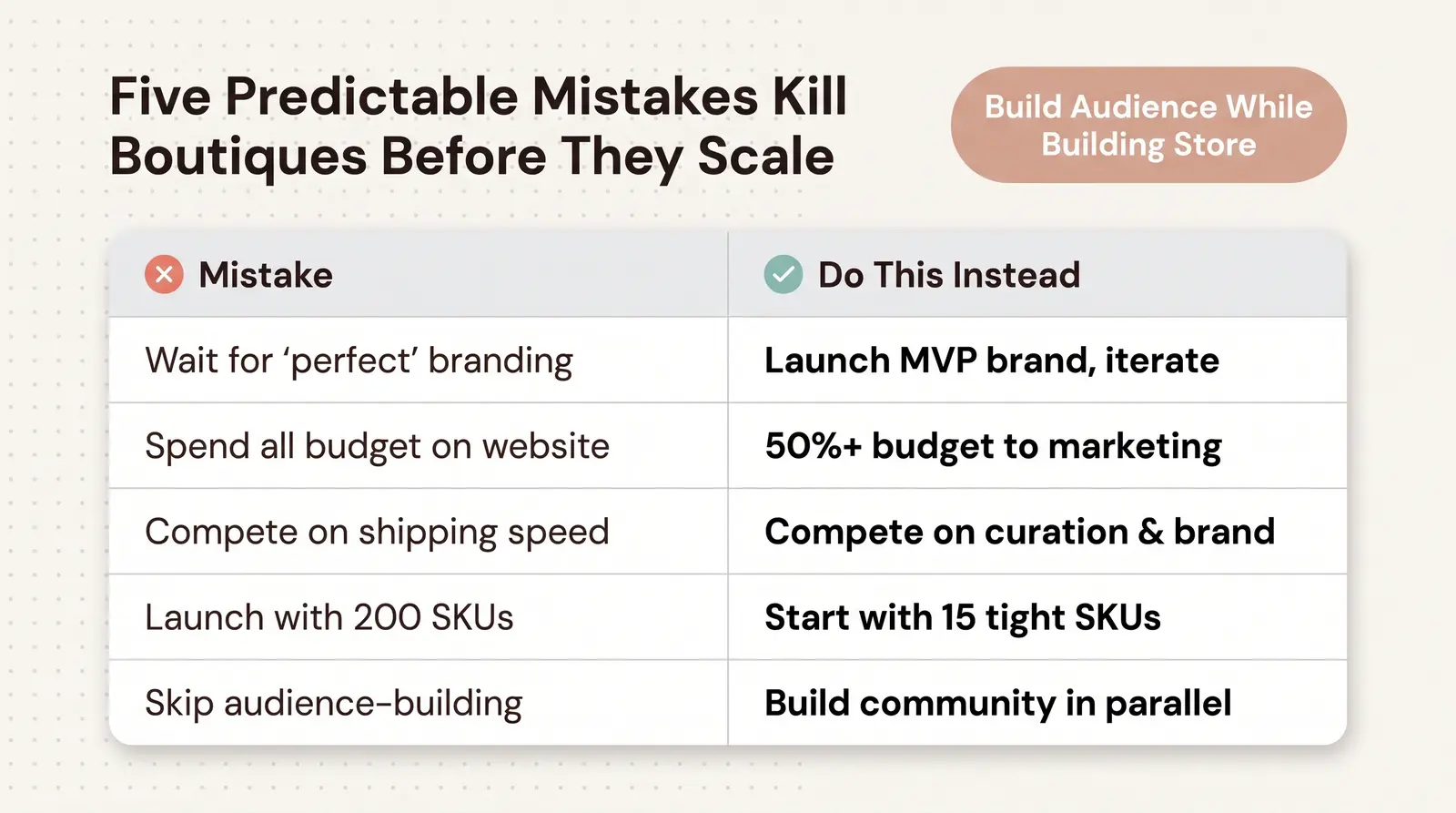
Even with a solid framework, new founders make predictable errors. Here are the most common ones and how to avoid them.
Mistake: Waiting until your branding is "perfect" to launch.
Your first-launch customers will give you more brand clarity than any moodboard session. Launch with a strong minimum viable brand and iterate based on real feedback. Perfection is a delay tactic.
Mistake: Spending all your budget on website design and nothing on marketing.
A beautiful website with no traffic generates zero revenue. Allocate at least 50% of your initial budget to audience building and content creation. The store is the destination. Marketing is the road that gets people there.
Mistake: Trying to compete with Amazon on shipping speed.
You cannot out-logistics the retail giants. Compete on curation, brand experience, and customer connection instead. Your customers are not buying from you because you are the fastest. They are buying because you are the most resonant.
Mistake: Launching with too many SKUs.
More is not better in a boutique context. A 200-item catalog at launch signals "generic store." A 15-item launch signals "curated brand." Start tight and expand based on what sells.
Mistake: Skipping audience-building entirely.
We often see founders spend three months on a logo and launch to zero sales because they skipped audience-building entirely. Build your community while you build your store. The two should happen in parallel, not in sequence.
A boutique is a small, highly curated retail store that targets a specific niche audience with a distinct brand identity. A regular retail store typically offers a wide variety of mass-market goods to a broad demographic. Boutiques compete on curation, taste, and brand experience rather than price or volume.
An online boutique business is an ecommerce store that sells a curated selection of products within a specific niche. It operates digitally, typically using dropshipping or third-party fulfillment to manage logistics without the overhead of a physical storefront. The defining characteristic is intentional curation and a strong brand identity.
Startup costs vary depending on your fulfillment model. Shopify estimates that typical online boutique startup costs range from $2,000 to $15,000 when sourcing inventory traditionally [5]. With a private-label dropshipping model, however, your upfront costs can be as low as $500 to $1,000, covering platform fees, a domain, and initial marketing.
Yes. Modern fulfillment models like dropshipping and private-label dropshipping allow you to run a fully branded boutique without ever purchasing or storing physical inventory. The supplier ships the product directly to your customer under your brand name, in your branded packaging.
A jewelry boutique is one of the most profitable online boutique categories due to strong margins, high perceived value, and low shipping costs. Because jewelry is lightweight and small, fulfillment expenses remain low, allowing founders to retain a larger percentage of each sale. The global jewelry market is projected to reach $578.45 billion by 2033 [4], with online sales growing rapidly year over year.