

This glossary compares 40 necklace chain types by strength, kink risk, pendant suitability, and price tier to help jewelers and store owners choose the right chain.
Published:
November 13, 2026
Author:
Yi Cui
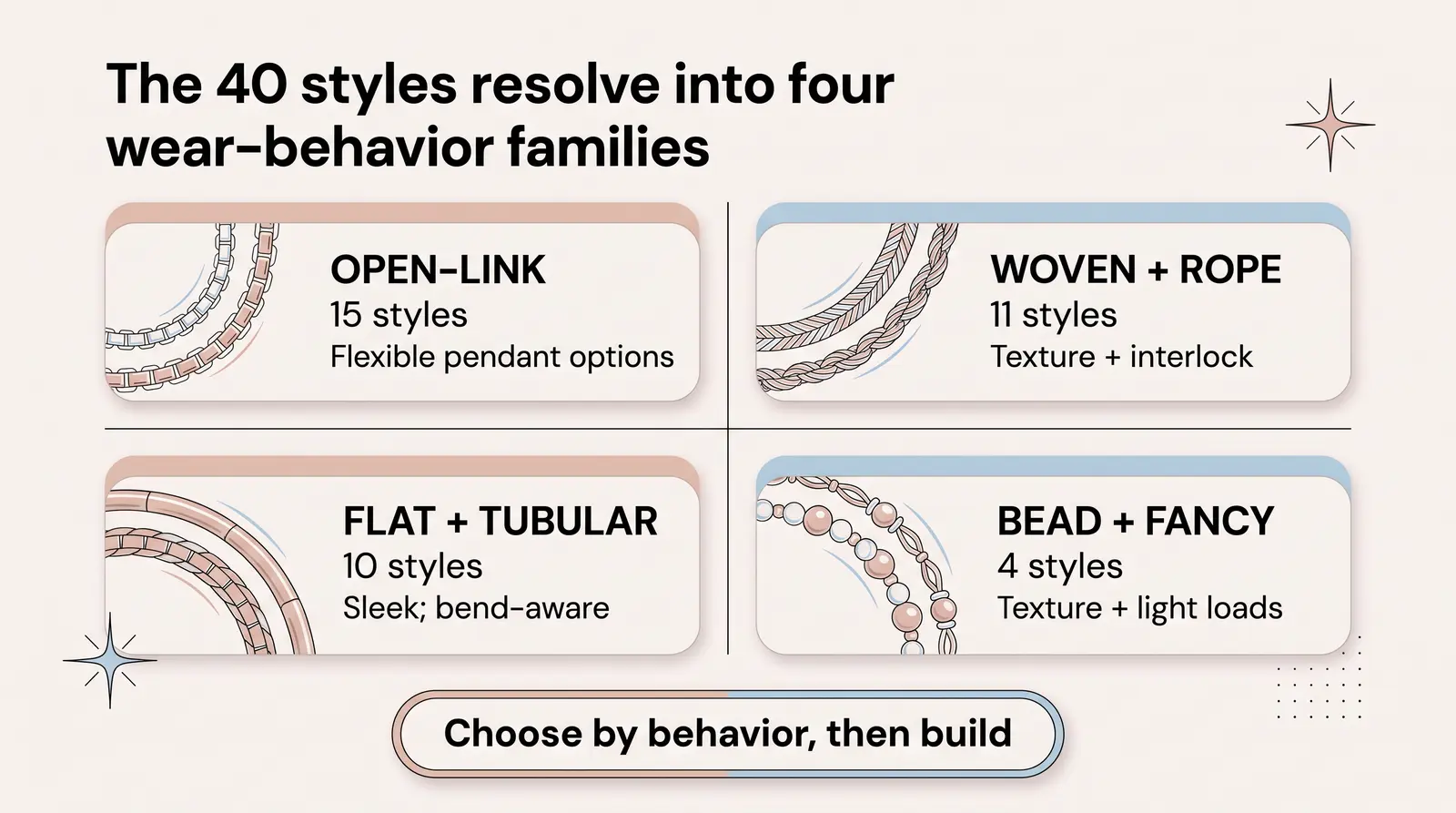
Necklace chain styles fall into open-link, woven, flat or tubular, and bead or fancy families. The right choice depends on how it will be worn: cable and box chains are practical pendant starting points, while herringbone and omega chains are usually better as standalone pieces. Style alone does not prove durability. Wire or wall thickness, solid versus hollow construction, soldered links, metal, clasp, and pendant load all matter. This glossary compares 40 common chain styles so you can narrow the field with fewer guesses. 2 3
The descriptions below consolidate common jewelry trade terminology. Aliases are grouped so that wheat and spiga, box and Venetian, mariner and anchor, satellite and Saturn, popcorn and Korean, and krinkle and peanut are not counted twice. Cuban and paperclip are listed separately because shoppers and suppliers commonly treat them as distinct retail choices, even though Cuban is a curb subtype and paperclip is a drawn cable variation. 1 2 3
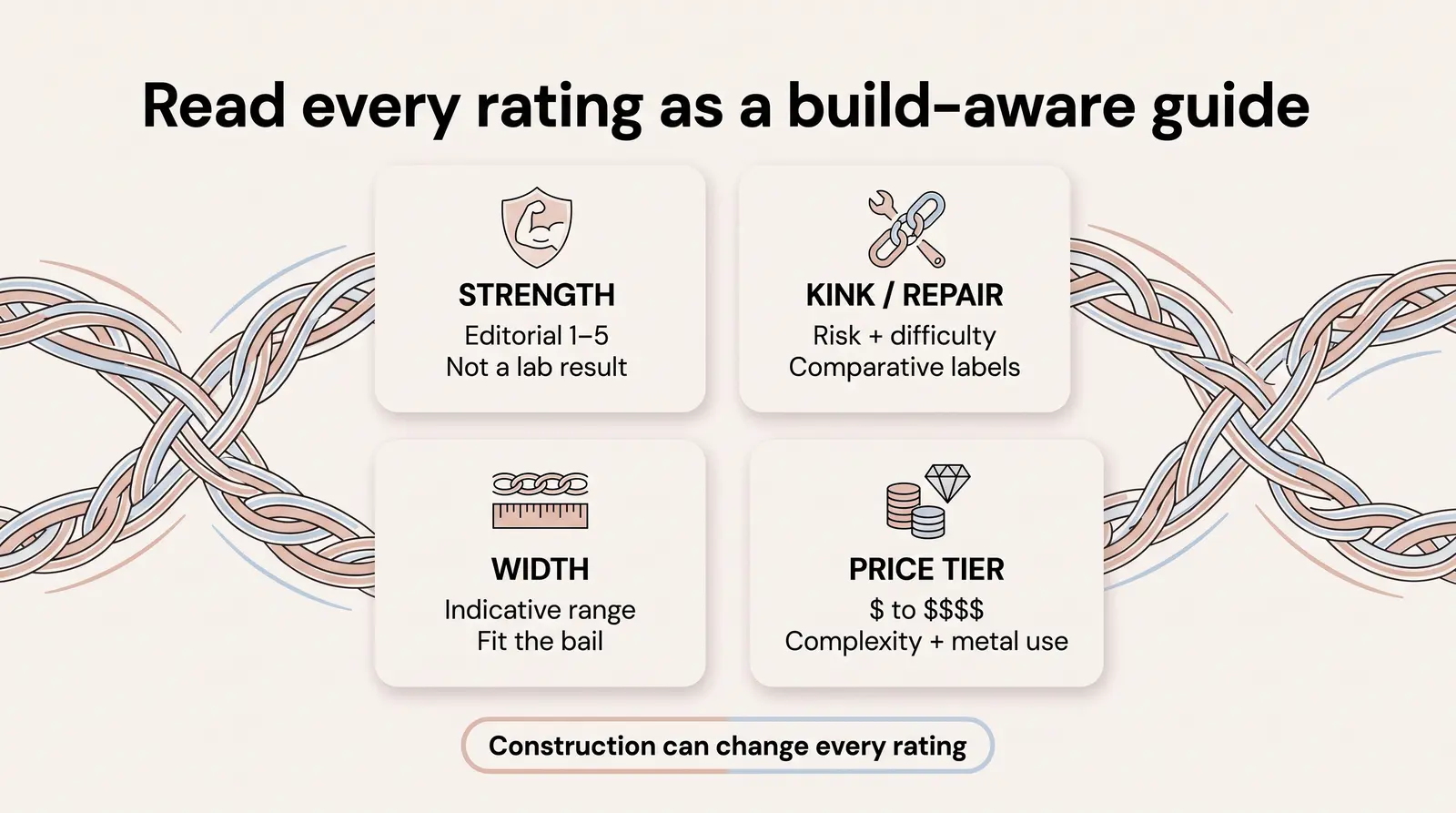
Strength is an editorial 1-5 judgment, not a lab result. It considers the structure's link redundancy, tendency to bend, and how easily a well-made version can take everyday use. A 5 is not unbreakable. Gauge or wall thickness, metal alloy, solid versus hollow build, solder quality, clasp, and end fittings can change the outcome substantially. Rio Grande and Halstead both note that soldering closes link gaps that could otherwise contribute to breakage, and that pendant weight must be matched to the actual chain. 2 3
Kink / repair reads as K: risk; R: repair difficulty. Low, medium, and high are comparative editorial labels. A high repair difficulty does not mean a repair is impossible. It means the construction can make a clean, durable, invisible-looking repair less likely or more labor-intensive.
Indicative width is an editorial retail range in millimeters for finished necklaces, not an industry standard or a specification for every item. Listings span from around 1 mm dainty chains to well above 3 mm statement chains, and the width of a particular pendant chain must work with its bail and end ring. 2 4
Price tier compares construction complexity and likely metal use at the same length, comparable metal, and comparable solid or hollow build. $ is simple, $$ is moderate, $$$ is more complex or metal-intensive, and $$$$ is a dense, intricate, or statement-grade construction. It is not a retail-price or margin estimate.
Market convention describes common catalog styling, not a rule about who can wear a chain. Trade guidance has historically associated around-1-mm chains with women's assortments and widths above 3 mm with men's assortments, but current styling crosses those lines freely. 4
A CMS or JavaScript table can make this comparison sortable by strength, pendant use, risk, width, or price. In Markdown, use the columns as a scan-friendly comparison instead.
| # | Family and style | Construction and look | Indicative width | Strength | Pendant-friendly? | Kink / repair | Market convention | Price tier |
|---|---|---|---|---|---|---|---|---|
| 1 | Open-link: Cable | Uniform round or oval links joined end to end. | 0.8-4 mm | 3 | Y, especially light pendants | K: Low; R: Medium | Broadly unisex | $ |
| 2 | Open-link: Rolo / belcher | Round or oval links made from fuller or half-round stock. | 1-6 mm | 3 | Y, light to moderate | K: Low; R: Medium | Broadly unisex | $$ |
| 3 | Open-link: Box / Venetian | Folded square links interlock into a geometric, box-like strand. | 0.8-5 mm | 4 | Y, a strong all-purpose option | K: Low; R: Easy-medium | Broadly unisex | $$ |
| 4 | Open-link: Curb | Twisted oval cable links lie flat in a uniform row. | 1.5-10+ mm | 4 | Y, if gauge and bail suit the pendant | K: Low; R: Easy-medium | Broad, bolder widths often marketed to men | $$ |
| 5 | Open-link: Cuban / Miami Cuban | A dense, closely packed curb subtype with bold rounded links. | 3-12+ mm | 4 | Y for substantial pendants only when specified | K: Low; R: Medium | Often men's statement styling, not exclusive | $$$ |
| 6 | Open-link: Figaro | Repeating long-and-short curb-like links, often one long link after several short ones. | 2-10 mm | 4 | Y, usually light to moderate | K: Low; R: Easy-medium | Often men's classic styling, also unisex | $$ |
| 7 | Open-link: Mariner / anchor / marine | Oval links with a center bar, inspired by anchor chain. | 2-10 mm | 4 | Y, especially in a modest width | K: Low; R: Medium | Broadly unisex, nautical or bold styling | $$ |
| 8 | Open-link: Paperclip / trombone | Elongated drawn cable links, sometimes with alternating small links. | 1.5-12 mm | 3 | Y, usually light pendants or charms | K: Low; R: Easy-medium | Often women's layering, now broadly unisex | $$ |
| 9 | Open-link: Long and short | A general alternating pattern of one long link with one or more short links. | 2-8 mm | 3 | Y, light to moderate | K: Low; R: Medium | Broadly unisex | $$ |
| 10 | Open-link: Bar and link | Straight, curved, or shaped bars alternate with small connecting links. | 2-8 mm | 3 | Y, light pendants if the bar pattern allows | K: Low; R: Medium | Often fashion and layering styles | $$ |
| 11 | Open-link: Ring and connector | Round rings alternate with flat-top connector pads or links. | 3-12 mm | 3 | Y, often charm-friendly | K: Low; R: Medium | Broadly unisex | $$ |
| 12 | Open-link: Figure-eight / infinity | Twisted figure-eight links alternate with round or oval links. | 2-6 mm | 3 | Y, light pendants | K: Low-medium; R: Medium | Often women's layering, not exclusive | $$ |
| 13 | Open-link: Satellite / Saturn / rosary | A base chain interrupted by evenly spaced accent beads. | 1-4 mm | 2 | Y, very light only | K: Low; R: Medium | Often women's layered styling | $$ |
| 14 | Open-link: Double or parallel curb | Two curb links sit side by side at each link position. | 3-12 mm | 4 | Y, moderate to substantial when well built | K: Low; R: Medium | Often bold or men's styling, also unisex | $$$ |
| 15 | Open-link: Valentino | A cable-like oval link with a bar or accent inside each link. | 1-5 mm | 3 | Y, light pendants | K: Low; R: Medium | Broadly unisex | $$ |
| 16 | Woven and rope: Rope | Twisted links connect in a continuous spiral that resembles fiber rope. | 1-8 mm | 4 | Y, if solid or suitably built | K: Medium; R: Hard, especially hollow | Broadly unisex | $$ |
| 17 | Woven and rope: French rope | A denser, double-row rope with a pronounced spiral. | 2-8 mm | 4 | Y, light to moderate after checking construction | K: Medium; R: Hard | Broadly unisex | $$$ |
| 18 | Woven and rope: Double rope | Paired link rows create a more substantial rope twist. | 3-10 mm | 4 | Y, moderate to substantial if specified | K: Medium; R: Hard | Often statement styling | $$$ |
| 19 | Woven and rope: Reverse rope | Rope links connect alternately from the front and back for a woven profile. | 2-7 mm | 4 | Y, light to moderate | K: Medium; R: Hard | Broadly unisex | $$$ |
| 20 | Woven and rope: Wheat / spiga | Close alternating figure-eight links create a braided, grain-like texture. | 1-6 mm | 4 | Y, a dependable pendant candidate when built well | K: Low-medium; R: Medium-hard | Broadly unisex | $$$ |
| 21 | Woven and rope: Foxtail | Two rows of angled oval links form a V-pattern with a square-edged profile. | 2-6 mm | 4 | Y, light to moderate | K: Low-medium; R: Hard | Broadly unisex | $$$ |
| 22 | Woven and rope: Franco | Dense V-shaped links create a square or rounded, substantial weave. | 2-10 mm | 5 | Y, including heavier pendants when appropriately specified | K: Low; R: Hard | Often men's bold styling, widely unisex | $$$ |
| 23 | Woven and rope: Byzantine | Repeating interlinked ring pairs make an ornate, dimensional, flexible weave. | 3-10 mm | 4 | Usually N, the weave is the focal point | K: Low-medium; R: Hard | Broadly unisex statement styling | $$$$ |
| 24 | Woven and rope: Barleycorn | Tapered, grain-like links alternate left and right in a scalloped line. | 2-7 mm | 3 | Y, light to moderate | K: Low-medium; R: Hard | Broadly unisex | $$$ |
| 25 | Woven and rope: Singapore | Twisted and flattened elongated-diamond links make a light-catching spiral. | 1-4 mm | 2 | Y, very light pendants only | K: Medium; R: Hard | Often women's layered styling | $$ |
| 26 | Woven and rope: Tinsel / twisted serpentine / nugget | A serpentine-derived S-link chain that is hammered and twisted for sparkle. | 1-4 mm | 2 | Y, very light only | K: Medium; R: Hard | Often women's layered styling | $$ |
| 27 | Flat and tubular: Herringbone | Opposed rows of V-shaped links create a broad, flat, mirror-like surface. | 1-8 mm | 1 | N, use as a standalone chain | K: High; R: High | Often women's statement styling, not exclusive | $$$ |
| 28 | Flat and tubular: Omega | Closely aligned plates crimped over a mesh core create a structured collar-like chain. | 2-8 mm | 2 | Usually N, unless the maker approves a light slide | K: High; R: High | Often formal or women's styling, also unisex | $$$ |
| 29 | Flat and tubular: Snake | Tightly joined curved plates or bands form a smooth, flexible tube. | 1-4 mm | 2 | Y, light pendants only | K: High; R: High | Broadly unisex, sleek styling | $$ |
| 30 | Flat and tubular: Serpentine | Flattened S-shaped links joined end to end make a light, patterned chain. | 1-4 mm | 2 | Y, very light only | K: Medium; R: Hard | Often women's layering | $$ |
| 31 | Flat and tubular: S-link | Interconnected S-shaped links make a flatter chain, more flexible than herringbone but bend-sensitive. | 2-8 mm | 2 | Usually N | K: High; R: High | Often fashion or statement styling | $$ |
| 32 | Flat and tubular: Mesh | Fine wire is woven or knitted into a fabric-like, flat or rounded mesh. | 2-12 mm | 3 | Usually N, protect the drape | K: Medium; R: Hard | Broadly unisex statement styling | $$$ |
| 33 | Flat and tubular: Panther / brick | Offset rectangular links stack in rows for a brick or mesh-like drape. | 3-12 mm | 3 | Usually N | K: Medium; R: Hard | Broadly unisex statement styling | $$$ |
| 34 | Flat and tubular: Cobra | Triangular links form a flat zigzag pattern through the center. | 3-8 mm | 2 | Usually N | K: Medium-high; R: Hard | Often bold statement styling | $$$ |
| 35 | Flat and tubular: Boston link | Flattened cable links create a thin, stacked flat profile. | 2-8 mm | 3 | Y, light only | K: Medium; R: Medium-hard | Often women's layering, also unisex | $$ |
| 36 | Flat and tubular: C-link | Curved, boomerang-like C links make a flat but more flexible chain. | 2-8 mm | 3 | Usually N | K: Medium; R: Medium-hard | Often fashion styling | $$ |
| 37 | Bead and fancy: Ball / bead | Spherical metal beads join through wire connectors or bars. | 1.5-6 mm | 2 | Y, light pendants or tags | K: Low; R: Medium | Broadly unisex, casual or industrial styling | $ |
| 38 | Bead and fancy: Popcorn / Korean | Hollow stamped links join into a light, rounded, bubbled tube. | 2-8 mm | 2 | Usually N, let the texture show | K: Medium; R: Hard | Often women's statement styling | $$$ |
| 39 | Bead and fancy: Margarita / Margherita | Flat rectangular links join widthwise into a sparkling, shifting tubular row. | 2-8 mm | 3 | Usually N | K: Medium; R: Hard | Often women's statement or layering styling | $$$ |
| 40 | Bead and fancy: Krinkle / peanut | Crimped cable links form a wavy, textured, lightweight chain. | 1-4 mm | 2 | Y, very small pendants only | K: Medium; R: Medium-hard | Often women's layering styling | $$ |
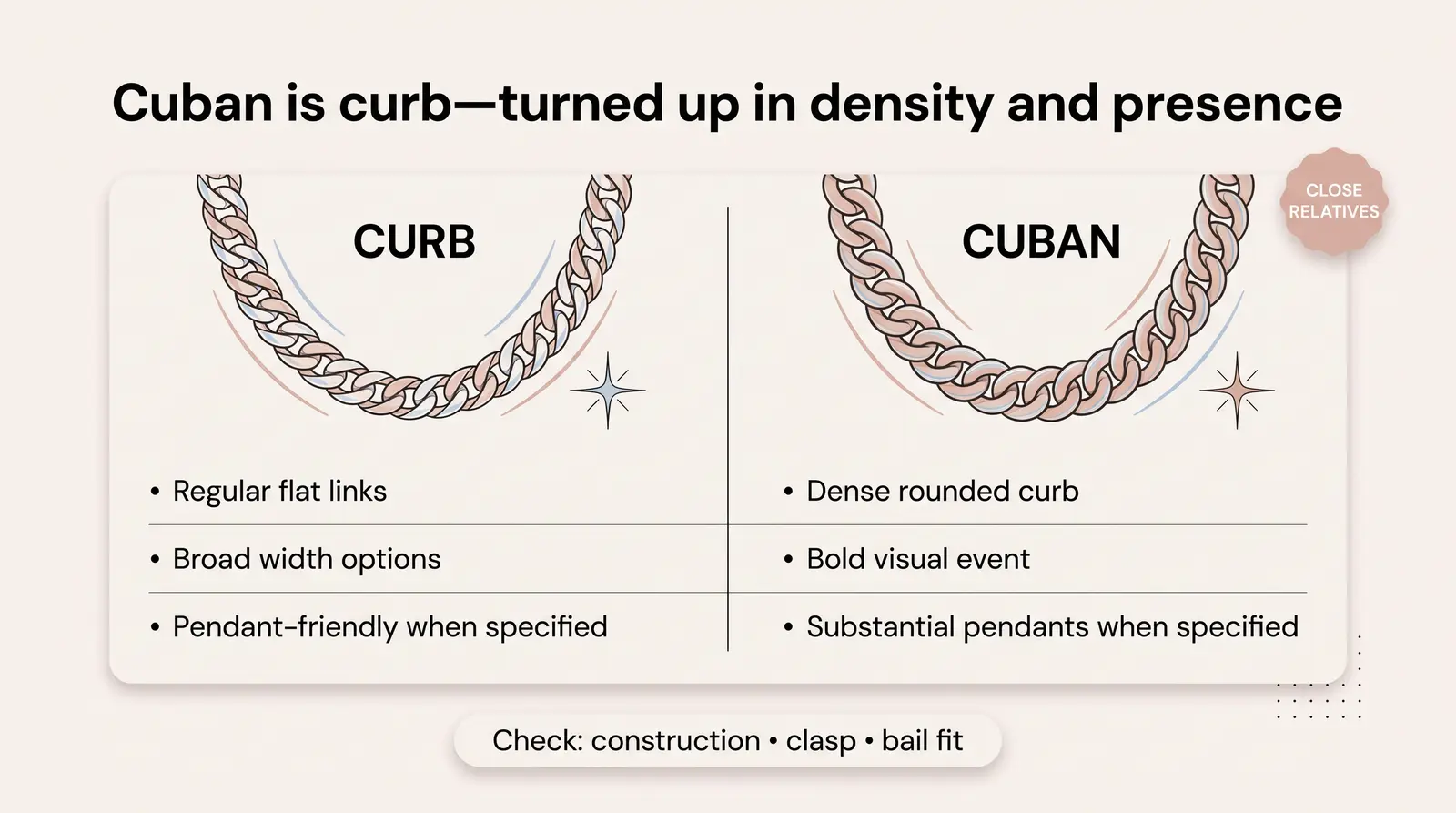
A curb chain starts as a cable-like chain whose links are twisted so the chain lies flat. A Cuban, often called a Miami Cuban in retail, is a closely packed, thicker curb subtype with a denser and more rounded visual profile. That is why the terms can overlap in listings. 1 3
Choose a curb chain when you want a flat, regular link pattern and broad width options. Choose a Cuban when the chain itself should be the visual event. Neither label confirms that a chain is solid, heavy, or suitable for a pendant. Check the exact width, construction, clasp, and whether the pendant bail fits before deciding.
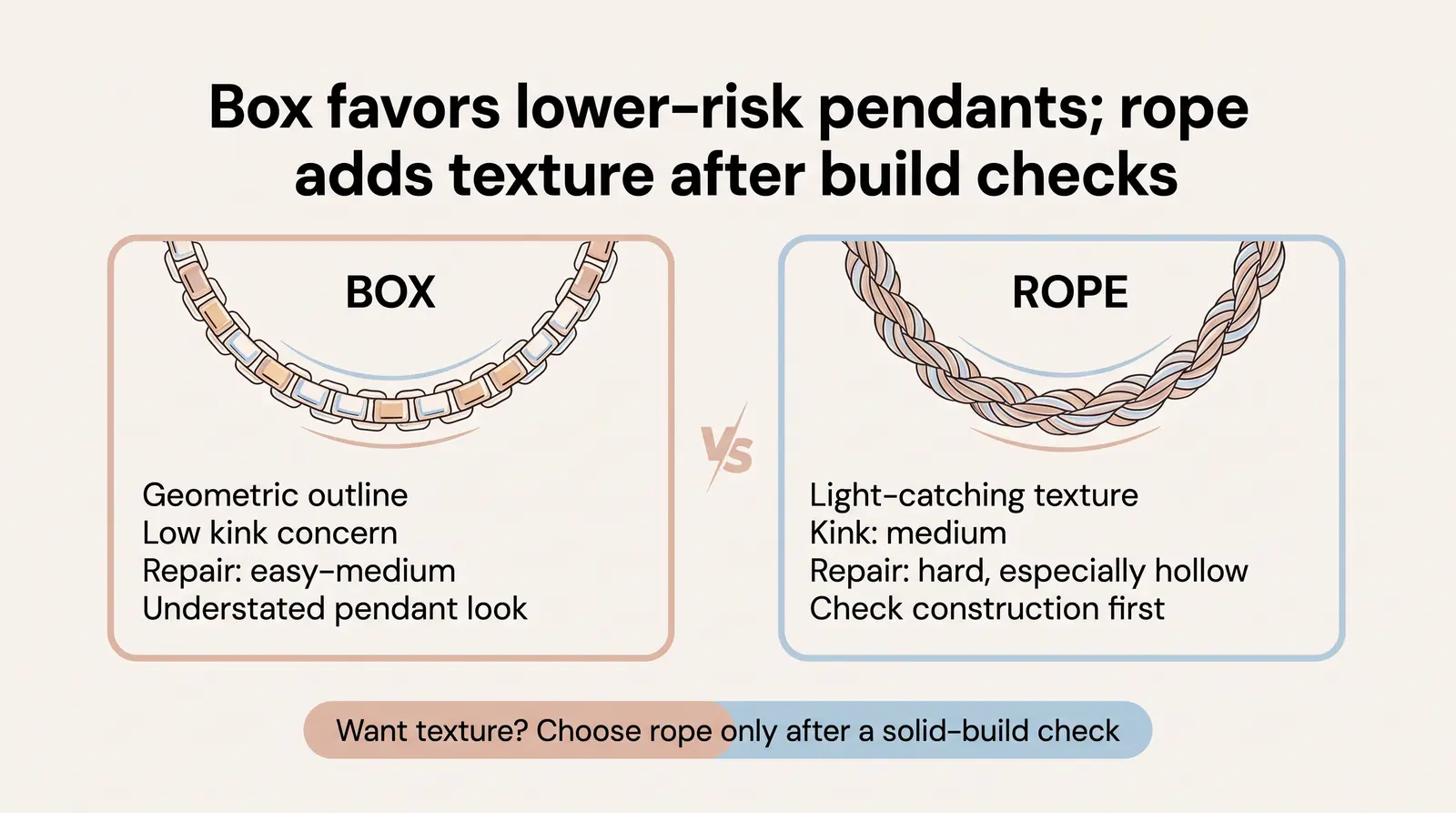
A rope chain has a twisted, light-catching surface. A box chain has interlocked square links and a cleaner geometric outline. Both can carry a pendant in a well-made version, but they behave differently.
Choose box for a more understated pendant presentation, a lower kink concern, and a construction that trade guidance describes as suitable for pendants and comparatively straightforward to repair. Choose rope when you want texture around a pendant and have checked that the chain is not a lightweight hollow version. Rope chains can be difficult to repair, particularly when hollow. 1 2
Start with the pendant, not the chain name. Rio Grande advises choosing a chain with enough strength for the pendant and ensuring that the finished chain's end ring will fit through the bail. 2
| Pendant job | Good starting styles | What to check before buying or listing | Styles to approach carefully |
|---|---|---|---|
| Small, light charm or minimalist pendant | Cable, rolo, box, ball, paperclip | Bail opening clears the chain and end ring; clasp is proportionate | Singapore, krinkle, satellite, and snake need a very light load |
| Moderate pendant or medallion | Box, wheat, rope, curb, mariner, Franco | Exact gauge or wall thickness; solid versus hollow; soldered links; bail depth | Paperclip, Figaro, and rope only after checking the specific build |
| Substantial pendant | Franco, box, curb, mariner, wheat | Maker's stated compatibility or a jeweler's assessment; secure clasp; pendant does not pull the chain out of line | Hollow chains and delicate flat or tubular chains |
| Slide or pendant intended to sit on the chain | Box, cable, snake only if the maker approves it | Internal bail width and depth across the chain's widest point | Herringbone and most omega chains |
Do not force a generic gram threshold onto every chain. A 4-mm chain can be hollow, solid, heavily soldered, thin-walled, or built with a clasp that becomes the weak point. The useful test is specific: measure the pendant's bail, compare it with the chain's widest point and end ring, then confirm the exact chain's construction and intended use. 2 3

Not in a universal, lab-tested sense. The strongest necklace chain type for one pendant may not be the strongest for another.
For everyday wear and heavier pendant potential, start by comparing well-made Franco, box, curb, mariner, and wheat chains. These structures have more substantial or more interlocked profiles than delicate flat chains. A thick Cuban can also be resilient, but a Cuban label does not tell you whether it is hollow, how links are joined, or how strong its clasp is. 1 2
The more useful durability question is: What is this exact chain made from, how are its links built, and what load will it carry? Check metal, solid or hollow construction, wire or wall thickness, soldered links, clasp, end rings, and the intended pendant. That detail often matters more than the style name. 2 3

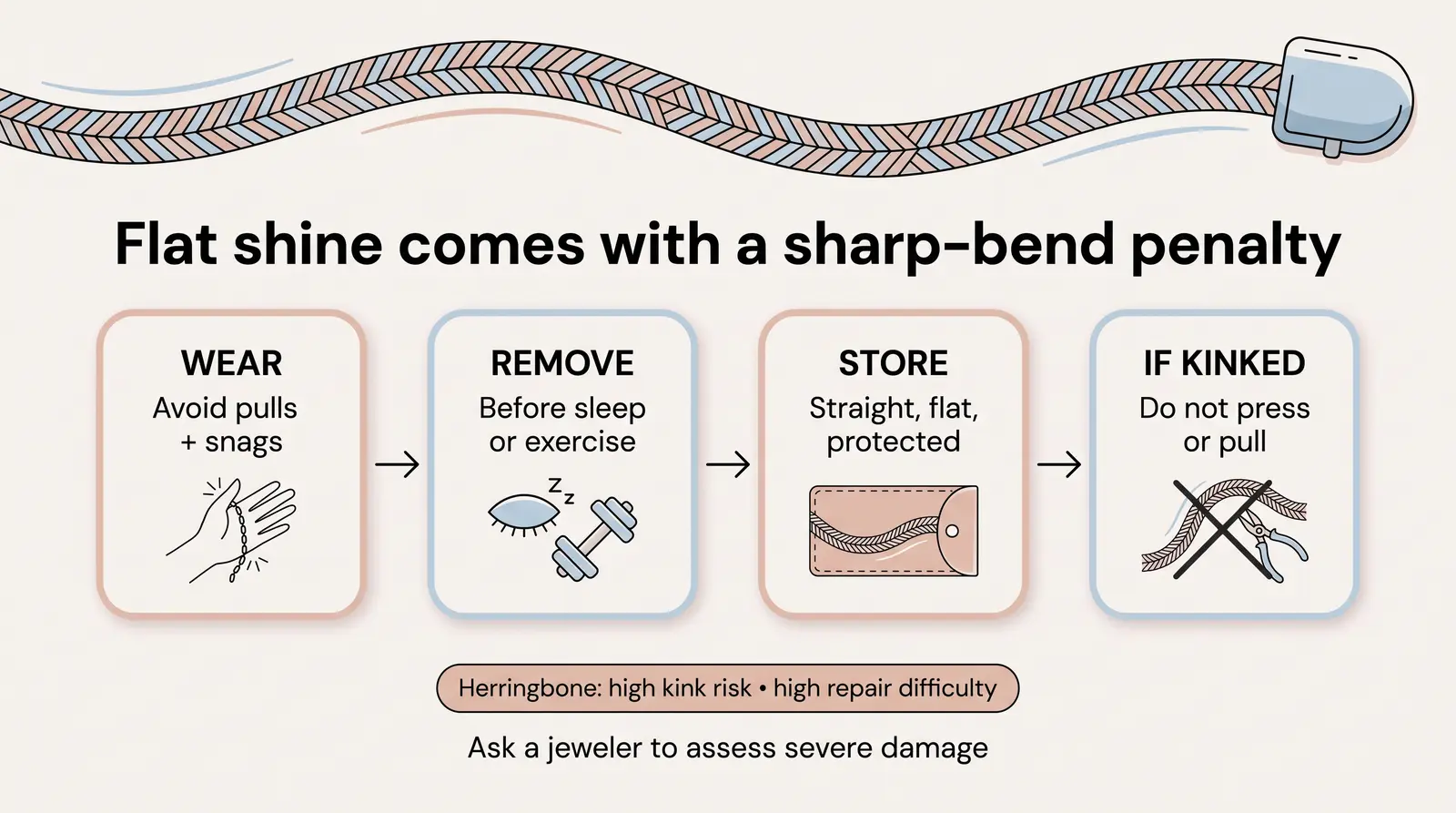
Herringbone is beautiful because its thin V-shaped links lie in a smooth, flat plane. That same flat construction does not tolerate a sharp bend well. Rio Grande specifically advises storing herringbone flat, avoiding pulls, and not using it for pendants because a kink can be difficult or impossible to remove cleanly. 5
For herringbone, omega, snake, and other bend-sensitive styles, take the necklace off before sleep, exercise, or situations where it can snag. Store it straight, flat, or in a dedicated compartment. If a kink appears, do not pull or press it at home. A jeweler can assess whether careful straightening or a section replacement is realistic, but severe damage may leave a weak or visible spot. 5
For any necklace, keep it away from chlorine, harsh cleaners, perfume, and lotion residue. Store pieces separately to reduce scratches and tangles. The Gemological Institute of America recommends protected storage and cautions that chemicals can discolor or damage precious metals and some gemstone jewelry. 6
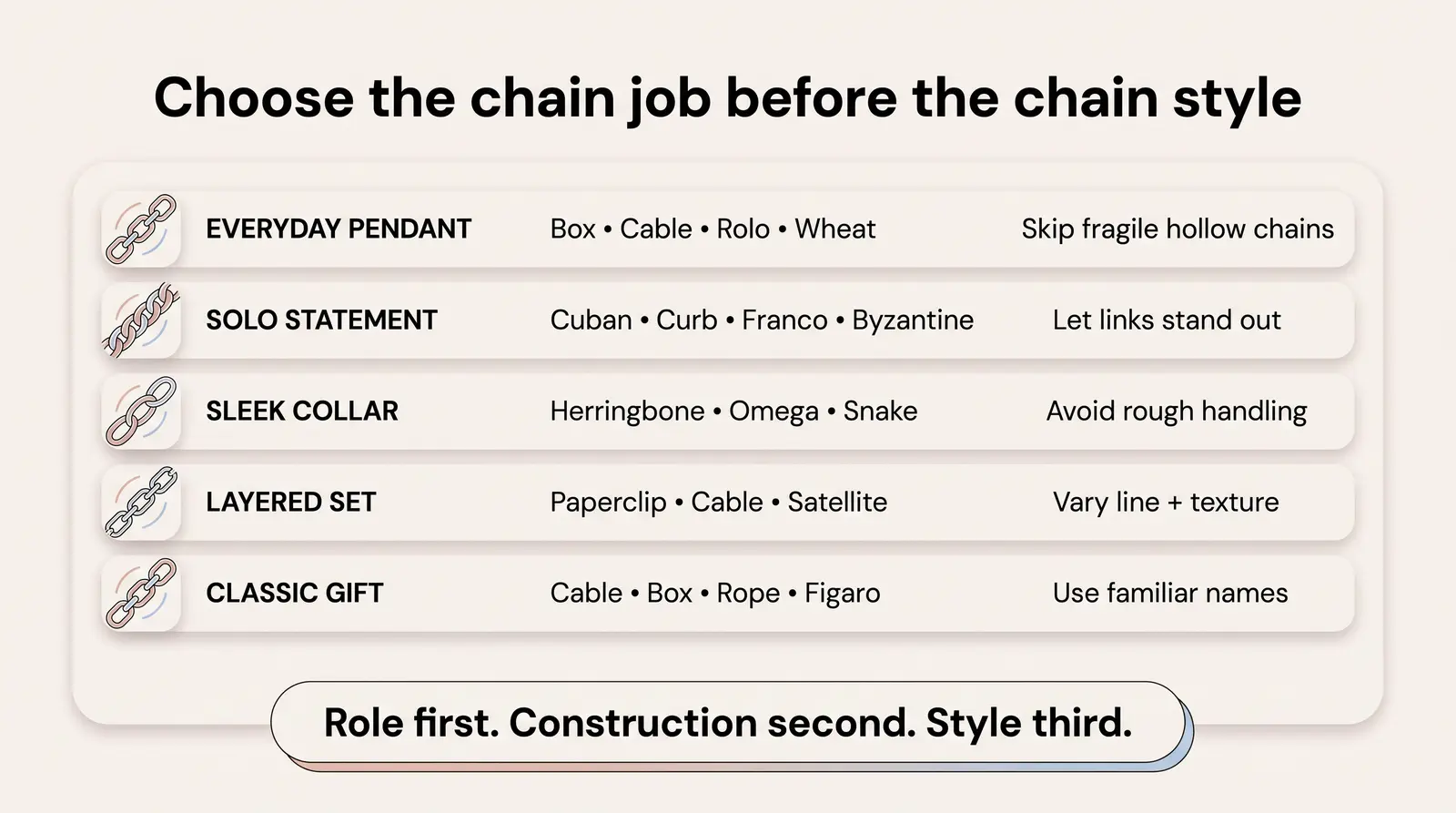
| Use | Strong choices | Why | Skip or reconsider |
|---|---|---|---|
| Everyday pendant | Box, cable, rolo, wheat | Familiar profiles with useful pendant options | Herringbone, omega, fragile hollow chains |
| Heavy-looking solo statement | Cuban, curb, Franco, Byzantine, mariner | The link pattern remains visible without a pendant | Fine satellite or ball chain |
| Sleek collar effect | Herringbone, omega, snake | Smooth, reflective, close-to-neck line | Large pendants and rough handling |
| Layered necklace set | Paperclip, cable, satellite, Singapore, krinkle | Each brings a distinct line or texture | Several heavy chains of the same scale |
| Giftable or easy-to-describe classic | Cable, box, rope, Figaro, curb | Familiar names and clear styling cues | Ambiguous fashion-chain names without close-up images |
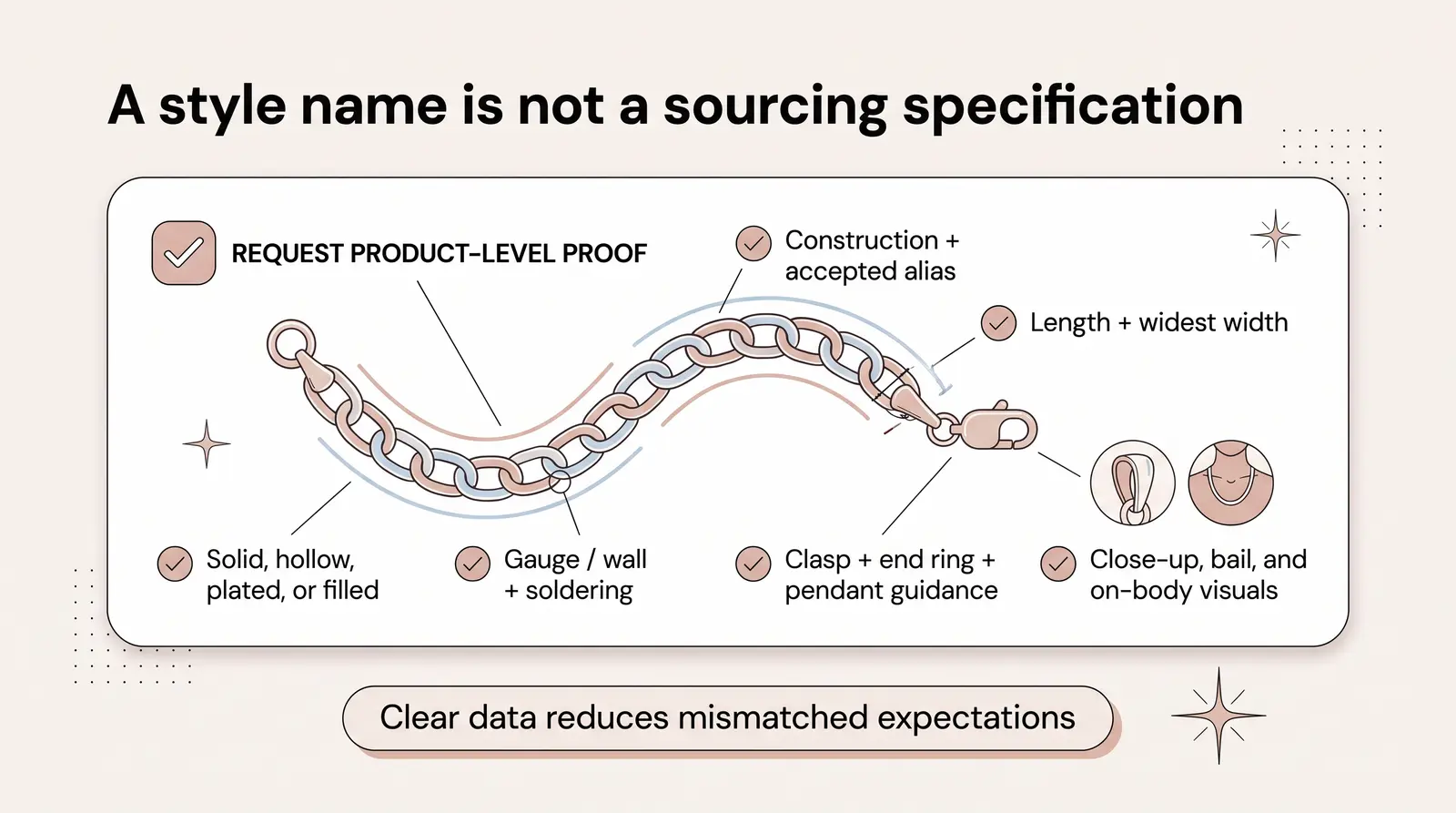
If you are building a private-label necklace line, do not source by a style name alone. Ask for the product-level information that changes wear, returns, and customer expectations:
Clear product data helps customers choose properly. Branvas' guide to writing accurate jewelry product descriptions recommends stating necklace style, chain length, pendant size, and layering information rather than relying on vague quality claims. 8
Once you know the construction you want to compare, you can browse the Branvas necklace catalog and check each live listing's stated details. Do not assume that a named chain construction, material, or feature is available until the individual product page confirms it. 7
If a private-label jewelry model fits your store, see how Branvas works before you plan a collection. The platform describes a model in which merchants choose catalog pieces and set retail prices, while Branvas handles post-sale fulfillment and branded packaging. 10
For merchandising, a useful next step is adding close-up link shots, clasp shots, and an on-body length visual to the listing. Branvas' Shopify jewelry store setup guide recommends a visual showing where 16-, 18-, and 20-inch chains sit, alongside scale and clasp imagery. 9
Paperclip chain is an elongated cable-link variation. It has the same basic open-link idea, but its long links create a more graphic, airy look. Its strength depends on link thickness, material, and joins, not the paperclip label alone. 3
Usually, no. Herringbone is designed to lie flat as a statement chain. Its flat, bend-sensitive links can kink under pendant load. Choose a box, cable, wheat, or suitably specified curb-style chain instead. 5
Not automatically. Cuban is a denser curb subtype and is often sold in heavier-looking widths, but the exact build decides durability. Compare solid versus hollow construction, link thickness, soldering, clasp, and the pendant or pull load. 1 3
There is no single best width. Start with the pendant's bail, the desired visual scale, and the wearer's styling preference. Then verify the particular chain's measured width, end ring, clasp, and construction. Traditional assortment norms are only a starting point, not a rule. 2 4
Sometimes. Open-link chains are often more repairable than flat or tubular styles. Herringbone, snake, omega, and S-link chains can be harder to restore cleanly after a sharp bend. Stop wearing a kinked chain, avoid tugging it, and ask a qualified jeweler to assess it. 1 5
The chosen primary cluster is types of necklace chains, chain types, and necklace chain styles. Representative organic results showed a commercial-investigative reader job: identify a chain visually, understand how it wears, decide whether it suits a pendant, and compare durability or care tradeoffs. The common format was an illustrated glossary with short style explanations. This article adds a transparent rating method, a 40-entry comparison set with aliases consolidated, pendant-and-bail decision guidance, repair-risk context, and a seller specification checklist.
Seven representative organic pages were opened during research across overview guides, comparison content, pendant or durability advice, and herringbone-care coverage. The search interface exposed ordinary organic results but did not expose reliable People Also Ask, image-pack, featured-snippet, or other named SERP modules. Those features are therefore not claimed here.
The secondary queries are compatible with this article and are addressed in dedicated comparison or decision sections: Cuban versus curb, rope versus box, strongest chain types, paperclip, Figaro, pendant selection, and herringbone kinking. A necklace-length guide is a separate reader task. It was not forced into this article.
A Branvas sitemap and blog audit found no public standalone article on chain types and no standalone necklace-length guide. The closest existing page is a Shopify jewelry setup guide that suggests showing 16-, 18-, and 20-inch chain placement in product media. This article should therefore be published as a new piece, not an update or replacement. Public site-search routes returned 404 during the audit, so coverage relies on the sitemap, blog inventory, and closest accessible pages rather than a functioning site search.

The working H1 was revised from "Types of Necklace Chains: A Visual Glossary of 40 Chain Styles With Strength, Weight, and Kink-Risk Ratings" to "Types of Necklace Chains: A Glossary of 40 Styles With Strength and Kink-Risk Ratings."

The following destinations were opened and verified during research:
No numeric catalog total, live price, margin, material-performance claim, or named-chain availability claim appears in the article. Those items should be checked against the relevant live SKU at the time of publication.

Do not hotlink third-party product images. Commission licensed macro photography or produce original CAD-based renders before publication. For every chain below, create two assets: a 45-degree macro of three to five links on a neutral background, and a straight or gently draped full-length view with a consistent scale reference retained for internal review. Photograph or render the actual construction, not a generic chain substitute.
| Style | Required distinguishing visual cue |
|---|---|
| Cable | Open round or oval links, one link crossing the next |
| Rolo / belcher | Fuller, rounder link profile than cable |
| Box / Venetian | Square interlocking cells and crisp edges |
| Curb | Flattened, twisted links lying in a flat plane |
| Cuban / Miami Cuban | Tight, dense curb links with rounded high-polish profile |
| Figaro | One elongated link followed by smaller curb links |
| Mariner / anchor | Oval link with an unmistakable center bar |
| Paperclip / trombone | Long rectangular or oval drawn links |
| Long and short | Alternating distinct long and short links |
| Bar and link | Bar element visibly alternating with connector link |
| Ring and connector | Round ring and flat connector-pad sequence |
| Figure-eight / infinity | Twisted figure-eight component between links |
| Satellite / Saturn | Small spaced bead accents on a fine base chain |
| Double or parallel curb | Two curb links running side by side |
| Valentino | Oval cable link with internal bar detail |
| Rope | Continuous helical twist with open-link sparkle |
| French rope | Denser, double-spiral rope texture |
| Double rope | Paired rope rows with visibly greater body |
| Reverse rope | Woven front-and-back link orientation |
| Wheat / spiga | Braided V-pattern resembling a wheat head |
| Foxtail | Tight angled V-links with squarer edges |
| Franco | Dense V-link grid, shown from two sides if possible |
| Byzantine | Interlocked ring pairs and deep dimensional texture |
| Barleycorn | Alternating tapered grain-like links |
| Singapore | Fine twisted, flattened diamond-link sparkle |
| Tinsel / twisted serpentine | Twisted S-link surface with light-catching facets |
| Herringbone | Flat, directional V-link chevrons with broad sheen |
| Omega | Smooth segmented collar surface with retained curve |
| Snake | Continuous tubular surface and subtle zigzag texture |
| Serpentine | Flat, repeated S-shaped links |
| S-link | Larger joined S forms and flexible flat drape |
| Mesh | Fine wire textile-like weave, include side profile |
| Panther / brick | Offset rectangular rows like bricks |
| Cobra | Centered zigzag line made by triangular links |
| Boston link | Flattened, stacked cable-link structure |
| C-link | Curved boomerang C shapes in a flat row |
| Ball / bead | Spherical balls and short connector bars |
| Popcorn / Korean | Hollow rounded cup or bubble texture |
| Margarita / Margherita | Widthwise rectangular links with changing sparkle |
| Krinkle / peanut | Crimped, wavy cable-link texture |
For product-page use, add an independent clasp close-up, an on-body scale image, and a short movement clip. Do not use the glossary rating as a substitute for actual SKU dimensions, material disclosure, or care instructions.