


Compare gold vermeil, gold filled, and PVD jewelry on margins, durability, and sourcing to choose the most profitable material for your brand.
Published:
April 15, 2026
Author:
Yi Cui
Most new jewelry sellers pick materials based on aesthetics or supplier availability, not margin logic—and it costs them. You might launch a beautiful collection, only to find that high return rates or razor-thin margins are quietly eating your business alive. The truth is, the material you choose dictates your pricing power, your customer lifetime value, and your ultimate profitability. This guide delivers a technical and financial comparison of gold vermeil, gold filled, and PVD, so you can make a data-backed sourcing decision. Whether you are an influencer launching a brand or an ecommerce entrepreneur scaling one, understanding gold vermeil vs gold filled and PVD is the first step to maximizing profit without sacrificing quality.

To make profitable sourcing decisions, you must first understand the technical specifications and legal definitions of the materials you are selling.
Gold Vermeil
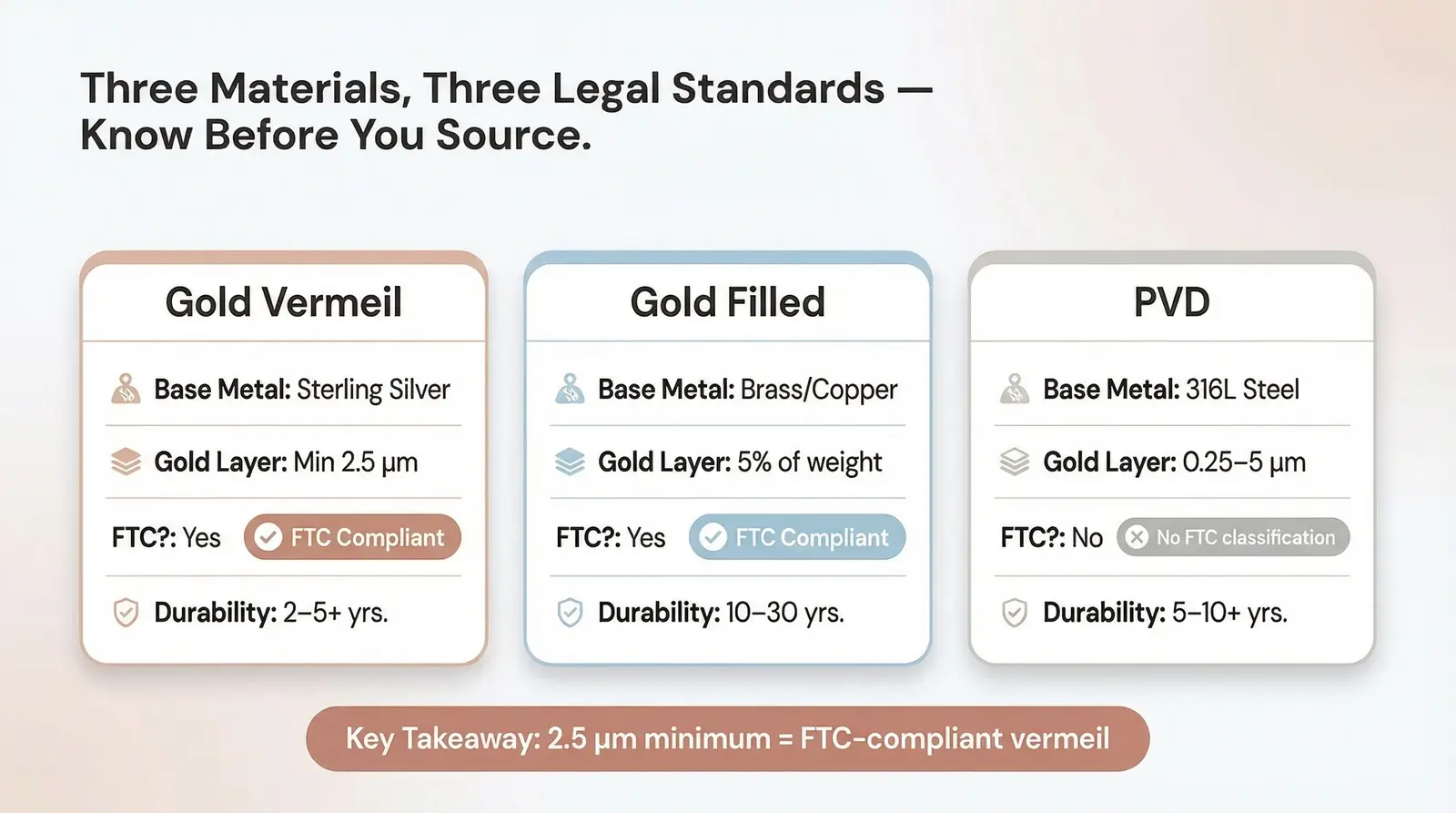
Under United States Federal Trade Commission (FTC) regulations, gold vermeil has strict legal requirements. The base metal must be sterling silver (92.5% pure silver). The gold coating must be at least 10 karat fineness, and crucially, it must have a minimum thickness of 2.5 microns [1]. This substantial gold layer—often five times thicker than standard gold plating—provides a premium feel and excellent durability, bridging the gap between fashion and fine jewelry.
Gold Filled
Gold filled jewelry is not plated; it is layered. A thick layer of gold (usually 12k or 14k) is mechanically bonded to a base metal, typically brass or copper, using heat and pressure. The FTC requires that the gold layer make up at least 5% (or 1/20th) of the item's total weight [1].
Here is a contrarian insight: Gold filled's legal definition is often misrepresented by suppliers—the "1/20th" rule refers to weight, not thickness, which means two pieces labeled "gold filled" can have radically different durability profiles depending on the surface area and the base metal used [2].
PVD (Physical Vapor Deposition)
PVD is not a material itself, but a highly advanced vacuum coating process. In a vacuum chamber, a solid material (like 14k or 18k gold) is vaporized into a plasma and bonded at the atomic level to a base metal, almost always 316L stainless steel or titanium [3]. The resulting coating is typically 0.25 to 5 microns thick. Because it bonds molecularly, PVD creates an incredibly hard, durable finish. However, because it does not meet the specific base metal or weight requirements of vermeil or gold filled, it has no FTC "gold" classification.
| Material | Base Metal | Gold Layer Thickness | FTC Regulated | Hypoallergenic | Typical Durability |
|---|---|---|---|---|---|
| Gold Vermeil | Sterling Silver | Minimum 2.5 microns | Yes | Yes | 2–5+ years |
| Gold Filled | Brass or Copper | 5% of total weight | Yes | Varies by base | 10–30 years |
| PVD | 316L Stainless Steel | 0.25–5 microns | No | Yes | 5–10+ years |
When customers search for waterproof jewelry plating, they are looking for pieces that can survive their daily lives—sweat, showers, and swimming—without turning their skin green or losing their color.
Gold vermeil offers excellent everyday durability, but it is not truly waterproof. Exposure to chlorine, saltwater, and harsh soaps will eventually wear down the 2.5-micron gold layer, exposing the sterling silver beneath. Gold filled is significantly more resilient due to its mechanically bonded gold layer, making it highly water-resistant and capable of withstanding daily showers, though prolonged exposure to harsh chemicals can still cause damage over decades.
PVD on stainless steel is the undisputed champion of waterproof performance. The atomic bond and the inherent non-corrosive nature of 316L stainless steel mean that PVD jewelry is legitimately waterproof, sweat-proof, and highly resistant to UV light and skin pH variations [3].
In our experience at Branvas, the #1 customer complaint we see sellers inherit from cheap plating is color transfer within 30 days—and it's almost always traced back to under-spec gold vermeil or unverified PVD suppliers.
| Material | Water/Sweat Resistance | Chlorine Resistance | UV/Sunlight Resistance | Skin pH Sensitivity | Expected Lifespan |
|---|---|---|---|---|---|
| Gold Vermeil | 3/5 | 2/5 | 4/5 | 4/5 | 3/5 |
| Gold Filled | 4/5 | 3/5 | 5/5 | 3/5 | 5/5 |
| PVD | 5/5 | 5/5 | 5/5 | 5/5 | 4/5 |
(Scores are on a 1–5 scale, where 5 is the most resistant/durable).

Understanding jewelry profit margins requires looking beyond the initial wholesale cost. You must factor in the retail price ceiling, return rates, and customer lifetime value (CLV).
Gold vermeil typically wholesales for $15 to $60 per unit, depending on the weight of the sterling silver and the complexity of the design. It comfortably retails for $50 to $200, yielding a gross margin of 100% to 200% [4]. Gold filled pieces have a similar wholesale range of $15 to $50, but because of their reputation for longevity, they can sometimes command slightly higher retail prices, pushing margins toward the 200% mark.
PVD jewelry offers a radically different cost structure. Because the base metal (stainless steel) is inexpensive and the vacuum process is highly efficient at scale, PVD pieces often wholesale for $3 to $15. They can retail for $30 to $80, generating massive gross margins of 300% to 500% [5].
PVD often outperforms gold vermeil on margin-per-complaint—not because it's cheaper to source, but because its superior durability cuts return rates and negative reviews, which erodes real-world margin more than most sellers account for.
| Material | Avg. Wholesale Cost | Typical Retail Price | Gross Margin % | Return Rate Risk | CLV Impact |
|---|---|---|---|---|---|
| Gold Vermeil | $15 – $60 | $50 – $200 | 100% – 200% | Moderate | High (Builds trust) |
| Gold Filled | $15 – $50 | $60 – $150 | 150% – 200% | Low | Very High |
| PVD | $3 – $15 | $30 – $80 | 300% – 500% | Very Low | High (Repeat buyers) |

To help sellers navigate these trade-offs, we developed the Branvas Material-Margin Matrix™. This framework evaluates each material across four critical dimensions to help you match your sourcing strategy to your brand positioning.
| Material | Margin Potential (1-5) | Brand Perception (1-5) | Durability / Return Risk (1-5)* | Sourcing Accessibility (1-5) | Composite Score |
|---|---|---|---|---|---|
| Gold Vermeil | 3 | 5 | 3 | 4 | 15 |
| Gold Filled | 3 | 4 | 4 | 3 | 14 |
| PVD | 5 | 3 | 5 | 5 | 18 |
*Durability / Return Risk is inverted: a higher score means higher durability and lower return risk.
Interpreting the Matrix:
PVD wins the composite score due to its unbeatable combination of high margins, extreme durability, and easy sourcing, making it the ultimate growth engine for new brands. Gold vermeil dominates in brand perception, making it the essential choice for premium, demi-fine positioning. Gold filled offers a balanced, heritage-quality option but can be harder to source in trend-driven designs.
At Branvas, we use this matrix during onboarding to help new brand owners make their first sourcing decision with confidence—not guesswork. If you're not sure where your brand fits, explore how Branvas works.

Let's call her Maya, an influencer launching her first jewelry brand. Instead of guessing, Maya builds a strategic 3-SKU starter collection that leverages the strengths of each material to optimize both perceived value and blended profit.
SKU 1: The Everyday Chain (PVD)
SKU 2: The Statement Hoop (Gold Vermeil)
SKU 3: The Heirloom Pendant (Gold Filled)
The Result: Maya achieves a blended gross margin of over 77% across the collection. The PVD chain funds her marketing and cash flow, while the vermeil and gold-filled pieces establish her brand's premium credibility.

Choosing the right material comes down to your target audience and business model.
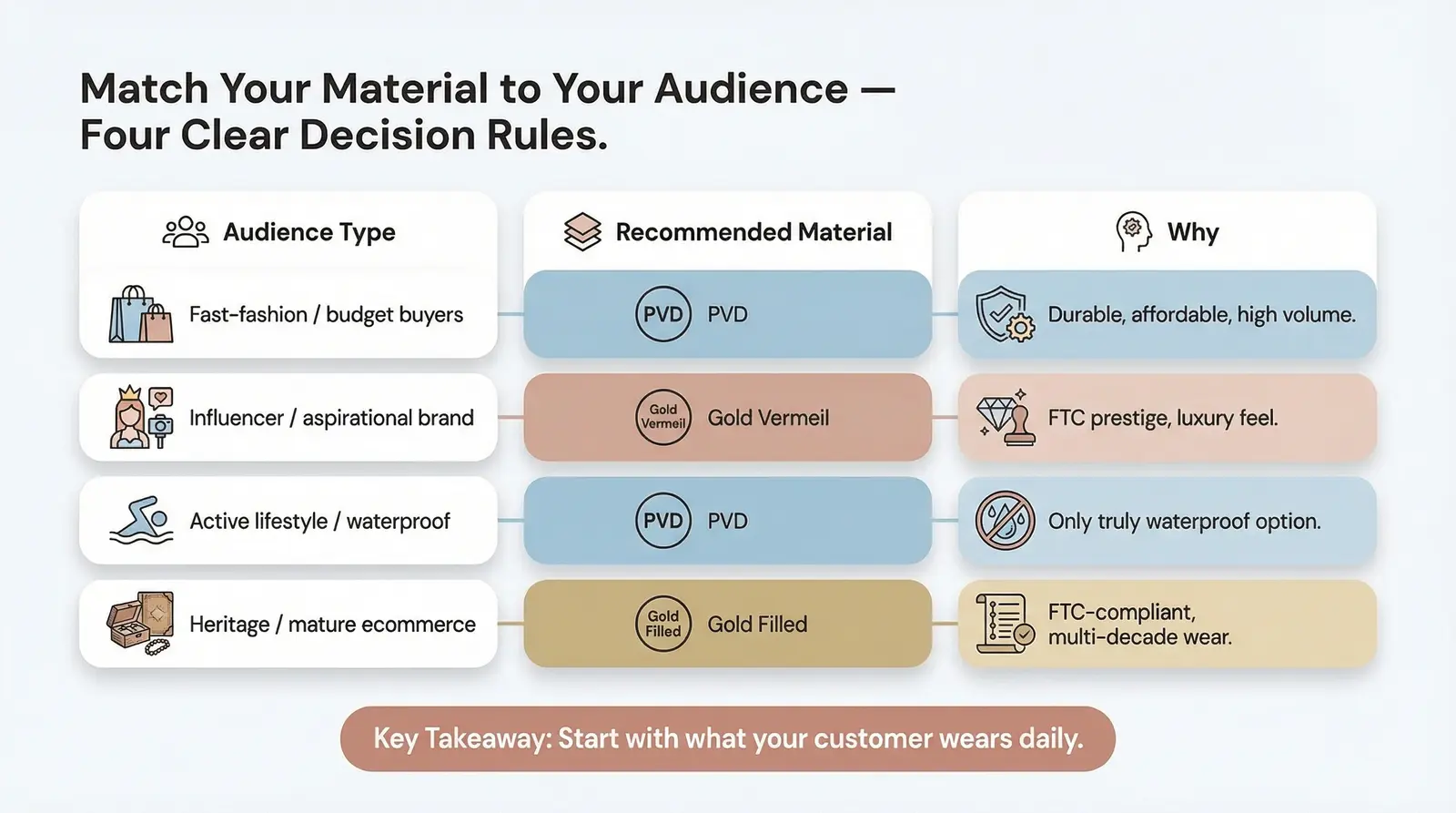
If your customers want the look of gold but prioritize affordability and trendiness, PVD on stainless steel is unbeatable. It allows you to offer durable, waterproof pieces at a price point that encourages impulse buying and high volume.
If you are an influencer monetizing an engaged audience, brand perception is everything. Gold vermeil provides the weight, luster, and FTC-backed prestige of fine jewelry, allowing you to command higher price points and build a luxury aesthetic. Learn more about solutions for influencers and creators.
For active lifestyle brands or sellers who want to aggressively market their jewelry as waterproof, sweat-proof, and gym-ready, PVD is the only material that can consistently deliver on that promise without generating returns.
If you are an ecommerce boutique owner targeting a mature demographic that values traditional craftsmanship and long-term wear, gold filled offers the best combination of FTC compliance and multi-decade durability. Learn more about solutions for ecommerce owners.
We often see founders struggle with over-indexing on material prestige before they've validated their audience—start with what your customer will actually wear daily, then move upmarket as your brand grows.
Sourcing jewelry is notoriously opaque. Finding a supplier who claims to sell gold vermeil is easy; finding one who actually plates to the FTC-required 2.5 microns is incredibly difficult. The same goes for PVD—many suppliers use cheap flash plating and call it PVD, leaving you to deal with the fallout when the pieces tarnish in a month.
Branvas eliminates this risk. We pre-vet every supplier in our network for strict plating spec compliance. Whether you are sourcing 2.5-micron gold vermeil, genuine 1/20th gold filled, or true vacuum-bonded PVD, you get exactly what you pay for. We handle the rigorous quality control so you don't get burned by under-spec materials.
Beyond sourcing, Branvas handles your branding, custom packaging, and blind fulfillment. Your customers receive beautifully packaged jewelry with your logo on the box, and they never know Branvas was involved. Your brand stays front and center, while we handle the logistics.
Ready to launch a jewelry brand built on the right materials from day one? See the Branvas catalog or check pricing to find the plan that fits your margin goals.

Q: What is the difference between gold vermeil and gold filled?
A: Gold vermeil consists of a sterling silver base coated with a minimum of 2.5 microns of gold. Gold filled involves mechanically bonding a layer of gold to a base metal (like brass), and the gold must make up at least 5% of the item's total weight. Vermeil is prized for its precious metal base, while gold filled is known for its extreme longevity.
Q: Is PVD jewelry actually waterproof?
A: Yes, PVD (Physical Vapor Deposition) coating on 316L stainless steel is highly water-resistant and can legitimately be worn in the shower, pool, or ocean. The vacuum-bonding process creates a finish that resists tarnishing, fading, and corrosion far better than traditional electroplating.
Q: Which jewelry material has the highest profit margin for sellers?
A: PVD-coated stainless steel typically offers the highest gross profit margins, often ranging from 300% to 500%. Its low wholesale cost combined with its high durability allows sellers to price it attractively while virtually eliminating the cost of returns due to tarnishing.
Q: Can I legally market gold filled jewelry as "gold"?
A: No, under FTC guidelines, you cannot market gold filled jewelry simply as "gold." You must clearly state that it is "gold filled" and include the karat fineness of the gold layer (e.g., "14k Gold Filled") to avoid deceiving consumers about the product's composition.
Q: What is the minimum gold thickness for gold vermeil under FTC rules?
A: To be legally sold as gold vermeil in the United States, the FTC requires the gold coating to be at least 2.5 microns thick. Additionally, the gold must be at least 10 karat fineness, and the base metal must be sterling silver.