


Learn FTC-compliant material wording for gold plated brass, stainless steel, and sterling silver jewelry product pages, with ready-to-use copy templates.
Published:
March 20, 2026
Author:
Yi Cui
Material wording is trust, and compliance. What you write on your product page is not just marketing copy. It is a legal disclosure, a customer expectation-setter, and a return-rate driver all in one sentence.
For jewelry sellers, whether you run a DTC brand, an influencer merch line, or an Etsy or Shopify store, the words you choose matter more than most people realize. This article gives you FTC-safe templates, claim guidance, and care copy you can paste directly onto your product pages. The stakes are real. Misleading material descriptions can lead to FTC enforcement risk, customer chargebacks, and high return rates driven by unmet expectations.
At Branvas, we review hundreds of product listings from new brand founders. Misleading material descriptions are one of the most common, and most avoidable, mistakes we see.
The Federal Trade Commission (FTC) Jewelry Guides, codified at 16 CFR Part 23, set strict rules for how jewelry materials must be disclosed [1]. These guides apply to every level of the trade, including manufacturers, suppliers, and retailers. They cover three key areas that every product page must address.
First, the base metal type must be named. Brass, zinc alloy, copper, and stainless steel are all distinct materials with different properties, and the FTC requires that the base metal be identified accurately. Second, plating type and thickness carry specific legal definitions. "Gold plated" requires a surface plating of gold alloy of reasonable durability, while "gold filled" requires the plating to constitute at least 1/20th of the total metal weight of the article [1]. Third, alloy purity must be disclosed accurately. Sterling silver, for example, must be at least 92.5% pure silver to legally carry that designation [1].
When sellers use vague or inaccurate terms, the consequences can be severe. They include FTC complaints, platform takedowns on Etsy or Amazon, and customer disputes that escalate into chargebacks [2] [3].
Most sellers worry about saying too much on the product page and overwhelming buyers. But the real risk is saying too little. Vague terms like "premium metal" or "high-quality alloy" are not legally neutral. Under Section 5 of the FTC Act, implied claims must be substantiated [4]. A phrase like "premium metal" implies a level of quality the seller may not be able to prove, and the FTC can act on implied claims just as it can on express ones.

Understanding the physical properties of your jewelry materials is the first step to writing compliant and accurate product descriptions. Here is how the three most common base materials compare.
| Attribute | Gold Plated Brass | Stainless Steel (316L) | Sterling Silver (.925) |
|---|---|---|---|
| Base metal | Brass (copper + zinc) | Surgical-grade steel alloy | 92.5% silver, 7.5% copper alloy |
| Plating durability | Low to Medium | High (IP or PVD plating) | N/A (solid metal) |
| Tarnish risk | Moderate to High | Very low | Moderate (oxidizes over time) |
| Nickel risk | Depends on alloy composition | Low (316L is nickel-reduced) | Low to moderate |
| Price point | Low | Low to Medium | Medium to High |
| Ideal use case | Fashion and trend pieces | Everyday wear | Heirloom and gifting |
| Recommended disclosure language | "Brass base with [X]k gold plating" | "316L stainless steel with gold PVD coating" | ".925 sterling silver" |
Brass is an affordable and versatile base metal made from copper and zinc. It is widely used for fashion jewelry because it is easy to cast into intricate shapes and takes plating well. The downside is that it is prone to tarnishing, and the copper content can cause skin reactions or leave green marks on the skin when the plating wears away [5].
316L stainless steel is highly durable, tarnish-resistant, and generally safe for sensitive skin. It does contain trace amounts of nickel, typically around 10 to 14%, but the nickel is tightly bound within the alloy's chromium oxide layer, which prevents it from leaching out at levels that trigger reactions in most people [6]. PVD (Physical Vapor Deposition) gold coating on stainless steel is significantly more durable than standard electroplating, often lasting two to four years with regular wear.
Sterling silver (.925) is a precious metal with inherent value and a classic aesthetic. It is nickel-free and hypoallergenic for most wearers, though the 7.5% copper alloy can occasionally cause reactions in people with copper sensitivity. Sterling silver requires regular maintenance because it oxidizes when exposed to air, moisture, and sulfur compounds [7].
When writing your product copy, the goal is to align the material's reality with the customer's expectations. Promising lifetime durability for a gold-plated brass ring is a fast track to unhappy customers and potential compliance issues.

At Branvas, we use a proprietary 4-part checklist when reviewing product listings for private-label jewelry brands. We call it the Branvas Material Disclosure Framework™. It ensures every listing is compliant, clear, and optimized for trust. Think of it as a quick audit you can run on any product page today.
1. BASE: Name the Base Metal
The first thing your product page must do is name the core material. This is not optional under FTC guidelines.
2. PLATE: Describe the Finish Accurately
If the piece has a plating or coating, the karat purity and plating type must be disclosed.
3. CLAIM: Qualify Skin and Durability Statements
Any promise about how the jewelry interacts with skin or holds up over time must be qualified and substantiated.
4. CARE: Set Realistic Maintenance Expectations
Care instructions are not just helpful. They are a form of disclosure that protects both the customer and the brand.

Here are ready-to-use templates you can paste directly onto your product pages. Each one is built around the Branvas Material Disclosure Framework™ and designed to be FTC-safe and customer-friendly.
Template 1: Gold Plated Brass
Material: Brass base with 14k gold plating.

Skin Safety: Free of lead and cadmium. If you have severe metal allergies, we recommend our sterling silver or gold vermeil options.

Durability: Gold plating will naturally wear over time with regular use. Heavier wear areas like rings and bracelets may show wear sooner than earrings or pendants.

Care Instructions: To extend the life of your jewelry, remove before showering, swimming, or exercising. Avoid contact with perfumes, lotions, and harsh chemicals. Store in a dry, cool place away from direct sunlight.
Template 2: Stainless Steel (316L) with Gold PVD/IP Plating
Material: 316L stainless steel with 18k gold PVD coating.

Skin Safety: Nickel-reduced and highly suitable for sensitive skin. 316L stainless steel is widely used in medical and body jewelry applications.

Durability: Highly tarnish-resistant and designed for everyday wear. PVD coating is more durable than standard electroplating.

Care Instructions: This piece is water-resistant, but to maintain its optimal shine, wipe it down with a soft cloth after exposure to water or sweat. Avoid prolonged submersion in chlorinated or salt water.
Template 3: Sterling Silver (.925)
Material: Solid .925 sterling silver.

Skin Safety: Nickel-free and safe for most sensitive skin types.

Durability: Sterling silver naturally oxidizes over time when exposed to air and moisture, but can be easily restored to its original shine with regular polishing.

Care Instructions: Store in an airtight container or anti-tarnish bag when not in use. Polish gently with a silver cleaning cloth to remove any natural tarnishing. Avoid contact with chlorine, bleach, and harsh cleaning agents.
Template 4: Gold Vermeil
Material: 18k gold vermeil. This piece features a thick 2.5-micron layer of 18k gold over a .925 sterling silver base, meeting the U.S. FTC definition of vermeil.

Skin Safety: Nickel-free and ideal for sensitive skin.

Durability: Offers superior longevity compared to standard gold plating due to the thicker gold layer and sterling silver base.

Care Instructions: Remove before swimming in chlorinated pools or hot tubs. Clean gently with a soft, dry cloth. Do not use harsh chemical cleaners, ultrasonic cleaners, or polishing dips, as these can strip the gold layer.
Avoid these phrases to keep your listings compliant and your customers happy.
| Avoid This Phrase | Why It's Risky | Say This Instead |
|---|---|---|
| "Hypoallergenic" (unqualified) | No legal definition; it is an implied claim the FTC can challenge | "Nickel-reduced; suitable for most sensitive skin" |
| "Tarnish-proof" | Absolute claim; nearly no metal qualifies | "Tarnish-resistant with proper care" |
| "Premium metal" | Vague implied quality claim with no legal meaning | "Brass base with 18k gold plating" |
| "Surgical steel" | Not a regulated or standardized term | "316L stainless steel" |
| "Solid gold look" | Implies solid gold content to a reasonable consumer | "Gold-plated finish" |
| "Waterproof" (for plated brass) | Plating degrades with repeated water exposure | "Water-resistant" or "Remove before swimming" |
| "Lifetime guarantee" (without written terms) | Creates a binding legal warranty | "Durable for everyday wear with proper care" |
| "Nickel-free" (for 316L stainless steel) | 316L contains 10-14% nickel; this claim is factually inaccurate | "Nickel-reduced" or "Low nickel release" |

Here is a realistic example of a product description a new jewelry brand might publish, and how it looks after a Branvas review.
Before (non-compliant):
The Luna Ring is made from premium hypoallergenic metal with a solid gold look. It is 100% tarnish-proof and waterproof, so you can wear it anywhere. Perfect for sensitive skin!
After (FTC-safe, Branvas-reviewed):
The Luna Ring features a durable brass base finished with 18k gold plating. It is free of lead and cadmium, making it suitable for most wearers. While highly tarnish-resistant, we recommend removing the ring before swimming or applying lotions to maintain its golden finish. Store in the included pouch when not in use.
Every change maps back to a compliance reason. "Premium hypoallergenic metal" becomes "brass base" because the base metal must be named. "Solid gold look" becomes "18k gold plating" because implying solid gold content is a violation of 16 CFR Part 23. "100% tarnish-proof and waterproof" becomes "highly tarnish-resistant" because absolute claims cannot be substantiated. "Perfect for sensitive skin" becomes a qualified statement because the unqualified claim is an implied health assertion.
This kind of revision also improves conversion. Customers who know exactly what they are buying and how to care for it are far less likely to return a product or leave a negative review. Clarity is a sales tool.
At Branvas, every private-label product listing is built with compliant material language from day one. If you're starting your jewelry brand, see how our catalog and brand studio work: branvas.com/catalog and branvas.com/brand-studio.

This term deserves its own section because it is one of the most misused words in jewelry ecommerce.
The FDA has stated that there is no federal standard or legal definition for the term "hypoallergenic" [8]. It means whatever a particular company wants it to mean. The FTC, which governs advertising claims, treats "hypoallergenic" as an implied claim that must be substantiated. If you use it and a customer has a reaction, you have potentially made a deceptive claim under Section 5 of the FTC Act.
From a dermatological perspective, nickel is the primary allergen in jewelry-related contact dermatitis. According to a large-scale analysis by the North American Contact Dermatitis Group covering over 44,000 patients, the average frequency of nickel sensitivity was 17.5%, making it the most common identifiable cause of metal-related contact dermatitis [9]. Cobalt and chromium are secondary allergens that can also be present in metal alloys [9].
This means that when a customer with a nickel allergy reads "hypoallergenic" on your product page, they reasonably expect they will not react. If they do, you have a trust problem and potentially a legal one.
We advise every Branvas brand to treat "hypoallergenic" like a red flag word. Not because you can never say it, but because you must be prepared to substantiate it if challenged.
Here are three compliant alternatives you can use instead:

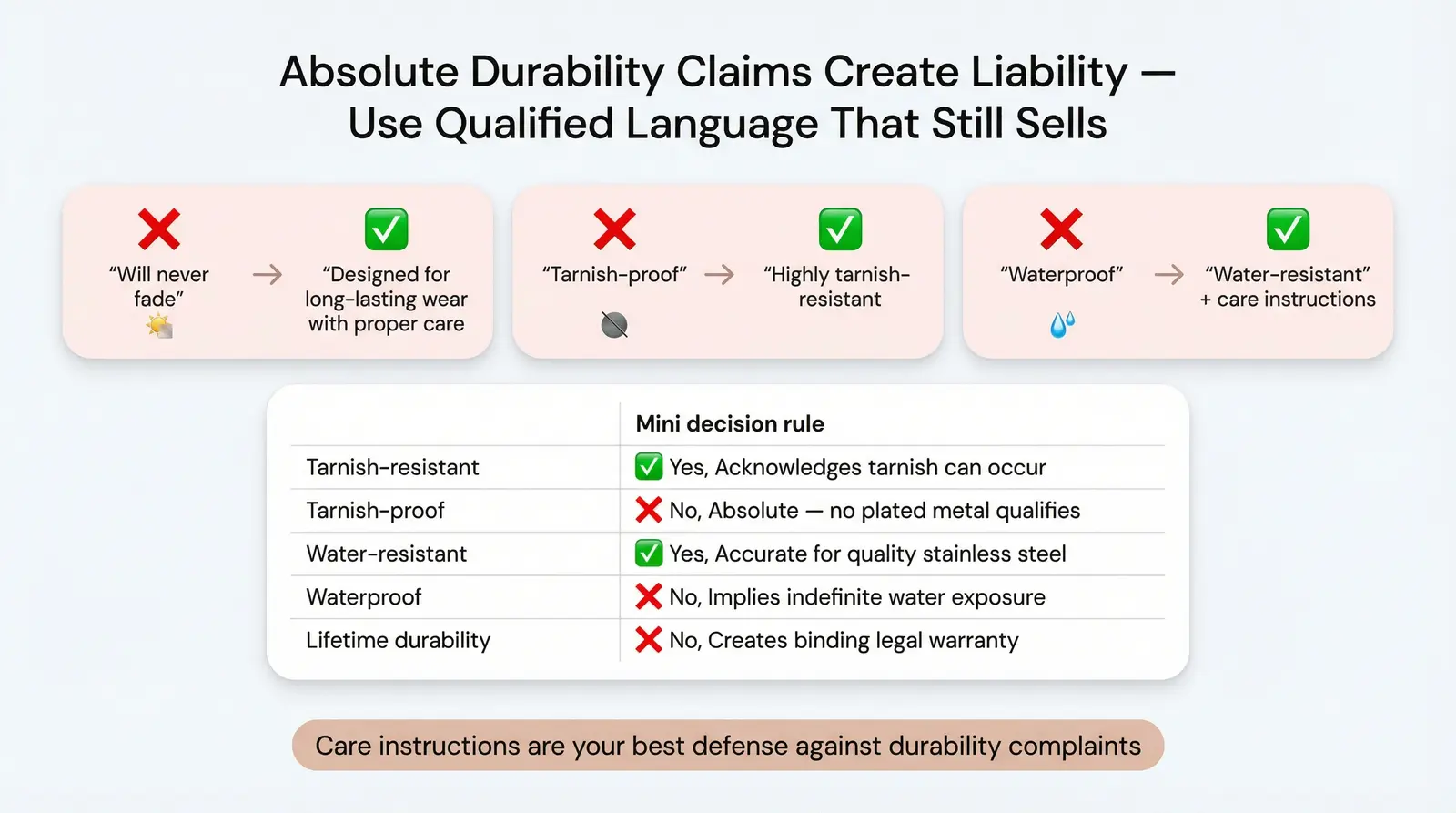
Absolute claims about durability create significant liability. Words like "tarnish-proof," "lifetime durability," or "permanent finish" are nearly impossible to substantiate for plated jewelry.
The distinction matters. "Tarnish-resistant" is a defensible claim because it acknowledges that tarnish can occur while indicating the material resists it. "Tarnish-proof" is an absolute claim that implies the material will never tarnish under any circumstances. No plated metal can honestly make that promise.
The same logic applies to water resistance. "Water-resistant" is accurate for most quality stainless steel pieces. "Waterproof" implies the piece can withstand any water exposure indefinitely, which is not true for plated jewelry.
Frame durability expectations honestly in a way that still reads well commercially:
Your care instructions are your best defense against durability complaints. Be explicit about what the customer should avoid, including chlorinated pools, hot tubs, perfumes, and harsh cleaning chemicals.
FTC compliance is the floor, not the ceiling. Ecommerce platforms have their own strict policies, and their enforcement can be faster and more immediate than a federal investigation.
Etsy requires sellers to accurately represent their items, including all details about materials and components [2]. Misleading descriptions can lead to listing removal or permanent shop suspension. Etsy does not verify material claims before a listing goes live, but it acts on buyer complaints, which means a single unhappy customer can trigger a review.
Amazon has rigorous Jewelry Quality Assurance Standards that require sellers to accurately disclose metal types, plating purity, and fineness [3]. Amazon uses specific terminology requirements, for example, "316L stainless steel" rather than "surgical steel." Failure to comply can result in immediate removal of selling privileges in the jewelry category.
Shopify gives you more control over your storefront, but you are still bound by their Acceptable Use Policy and all applicable consumer protection laws. If you use Shopify to sell through Google Shopping, Meta, or TikTok Shop, those channels enforce their own strict material disclosure rules independently.
Always check the specific jewelry and materials policy for every platform where you list your products. Platform enforcement can happen independently of any FTC action.

According to the FTC Jewelry Guides (16 CFR Part 23), you must disclose the base metal and the karat fineness of the gold plating. The correct format is something like "Brass base with 14k gold plating." You cannot simply call it "gold" or "14k gold" without qualifying that it is plated. Calling a plated piece "gold" without qualification is a violation of the guides.
There is no legal definition for "hypoallergenic" under U.S. law. The FTC treats it as an implied claim that must be substantiated. If you use it, you must have competent and reliable scientific evidence to back up the claim. It is safer and more defensible to use qualified terms like "nickel-reduced," "suitable for most sensitive skin," or "free of lead and cadmium."
Gold plated jewelry has a thin layer of gold electroplated over a base metal like brass. The minimum thickness under FTC guidelines is 0.175 microns. Gold filled jewelry has a much thicker layer of gold mechanically bonded to a base metal, constituting at least 1/20th of the item's total metal weight. Gold vermeil is a specific legal term requiring a sterling silver base coated with at least 2.5 microns of gold at 10 karat or higher.
Most high-quality stainless steel jewelry, particularly 316L grade, is safe for sensitive skin. While it does contain trace amounts of nickel (typically 10 to 14%), the nickel is tightly bound within the alloy and the chromium oxide layer prevents it from leaching out at levels that trigger reactions in most people. However, you should not call 316L stainless steel "nickel-free" because that claim is factually inaccurate.
Always include realistic care instructions based on the material. For gold plated brass, advise customers to remove the piece before swimming, showering, or exercising, and to avoid contact with perfumes and lotions. For stainless steel with PVD coating, note that it is water-resistant but should be wiped down after exposure to sweat or salt water. For sterling silver, recommend storing it in an airtight container and polishing it regularly with a silver cloth.

It is easy to view FTC guidelines and platform policies as a legal burden. Smart brand founders see them as a competitive advantage. Sellers who disclose materials accurately earn more trust, experience fewer returns, and generate stronger reviews. That is a measurable business outcome, not just a legal checkbox.
This transparency is a particular advantage for new brands trying to compete with established players. When a customer receives exactly what was described on the product page, they are far more likely to become a repeat buyer and leave a positive review. Compliance, done well, is a form of brand building.
If you're launching a private-label jewelry brand and want product listings that are compliant, conversion-optimized, and ready to scale, Branvas makes that the starting point, not an afterthought. Learn how it works at branvas.com/how-it-works or explore our profit calculator at branvas.com/profit-calculator to see what your margins look like. You can also find more resources for ecommerce and boutique store owners and for influencers and creators looking to launch their own jewelry line.