


Learn which jewelry claims like hypoallergenic and nickel-free require documentation, and use the Claim Confidence Framework to market safely and legally.
Published:
March 23, 2026
Author:
Yi Cui
If you can't prove it, don't claim it.
Imagine this scenario: you launch a stunning new jewelry collection. Your supplier's spec sheet said "hypoallergenic," so you proudly paste that word across your product listings, Instagram captions, and packaging. Sales are great. Then, a customer with sensitive skin buys a necklace, breaks out in a severe rash, and leaves a blistering one-star review. They file a chargeback. Suddenly, your platform—whether it's Amazon, Etsy, or Shopify—flags your listing for a misleading medical claim. When they ask for your documentation to prove the item is hypoallergenic, you realize you have absolutely nothing to show them.
This is the nightmare scenario that catches countless jewelry brand founders off guard. In the fast-paced world of ecommerce, terms like "hypoallergenic," "nickel-free," and "tarnish-resistant" are thrown around casually as marketing buzzwords. But to regulators, platforms, and consumers, these are objective claims that require hard proof.
This guide provides the exact framework and documentation checklist you need to market your jewelry confidently and legally. We will break down what these terms actually mean, the legal risks of using them without substantiation, and the specific documents you must collect to protect your brand from chargebacks, customer complaints, and regulatory action.
It is a common misconception that "hypoallergenic," "nickel-free," and "tarnish-resistant" are regulated product categories in the United States. They are not. They are marketing claims. Paradoxically, this lack of regulation makes using these terms more risky, not less. Because they are unregulated, the Federal Trade Commission (FTC) and consumer protection bodies judge them purely on whether they are substantiated and not misleading.
Under Section 5 of the FTC Act (15 U.S.C. § 45), making objective claims without a reasonable basis constitutes a deceptive practice [1]. The FTC requires that any objective claim be substantiated before it is published. While the FTC's Jewelry Guides (16 CFR Part 23) provide extensive rules on precious metals and gemstones, they do not define "hypoallergenic" [2]. The FDA took a similar stance on cosmetics in 1978, noting that "hypoallergenic" means whatever a company wants it to mean, but if a consumer is misled, the brand is liable [3].
The European Union offers a stark contrast. The EU does set a legal standard. Under the EU REACH Regulation (Annex XVII, Entry 27), "nickel-free" has a testable, legal meaning: nickel release must not exceed 0.5 µg/cm²/week for skin-contact items, and 0.2 µg/cm²/week for body-piercing jewelry [4]. If you sell into the EU, you must meet this standard.
The absence of regulation in the US doesn't protect you—it exposes you more. This is the "regulation vacuum trap" that catches small brands. Without a bright-line legal definition, any customer, platform moderator, or regulator can argue your claim was misleading based on their reasonable interpretation. If you claim a product is hypoallergenic and it causes a reaction, you have made a deceptive claim unless you have the lab tests to prove your product is exceptionally safe.

To navigate this landscape, you must understand exactly what you are claiming, what materials qualify, and what documentation is required to back it up.
| Claim | Plain-Language Meaning | US Regulatory Status | EU Standard | Qualifying Materials (typical) | Documentation Required | Risk if Undocumented |
|---|---|---|---|---|---|---|
| Hypoallergenic | Less likely to cause allergic reaction | No legal definition (FTC substantiation standard applies) | No specific jewelry standard | Surgical steel 316L, titanium, niobium, 14k+ solid gold | Supplier material cert + ideally patch-test or nickel-release test | HIGH |
| Nickel-Free | Contains no detectable nickel | No legal threshold in US | ≤0.5 µg/cm²/week (EN 1811 test) | 316L stainless steel, titanium, solid gold (14k+), platinum | Supplier mill cert + XRF or EN 1811 lab test | HIGH |
| Tarnish-Resistant | Resists oxidation/discoloration over time | No legal definition | No specific standard | PVD-coated stainless steel, rhodium-plated silver, gold vermeil | Supplier coating spec + internal wear/salt test data | MEDIUM |
There is no single allergen threshold that defines "hypoallergenic." Nickel is the number one jewelry allergen, affecting approximately 10 to 15 percent of women and a smaller percentage of men globally [5]. However, cobalt, chromium, copper, and certain resins can also trigger reactions.
If you use the word "hypoallergenic," you are implicitly claiming the product is safe for most sensitive-skin users. If it causes reactions, you have made a misleading claim under FTC standards unless you can substantiate it.
At Branvas, we often see founders copy "hypoallergenic" from their supplier's spec sheet without realizing that word is only as good as the documentation behind it. A supplier's word is not a legal defense.
"Nickel-free" is binary to the consumer but not to chemistry. Even 316L stainless steel, widely considered safe for sensitive skin, contains trace nickel—typically 10 to 14 percent by composition [6]. What matters is nickel release, not nickel content. The EN 1811 test measures how much nickel leaches out under simulated sweat conditions [7].
Brass contains zinc and copper, with no nickel by default. However, many brass alloys and platings include nickel for hardness. Brass jewelry plated without a nickel undercoat can be marketed as nickel-free if documented—but bare brass tarnishes quickly and can trigger copper reactions separately.
Stainless steel 316L is generally regarded as safe for nickel-sensitive individuals because its nickel is tightly bound in the alloy matrix. However, recent dermatological studies show that traditional electroplating can remove the protective passivation layer of 316L stainless steel, inducing nickel release even if the plating itself is nickel-free [6]. This makes documentation and testing critical even for "safe" base metals.
This is the "safest" of the three claims in terms of legal risk, but it is still a comparative claim. "Resistant" implies a standard that the product meets. If a customer's item tarnishes in two weeks, they have grounds to dispute the charge and leave a negative review.
Physical Vapor Deposition (PVD) coating on stainless steel is the gold standard for tarnish resistance. It deposits a hard coating without removing the steel's passivation layer [6]. Vermeil (thick gold over sterling silver) is also durable. Flash-plated brass, however, is not tarnish-resistant by any reasonable standard.
Practical guidance: qualify the claim. Use phrases like "tarnish-resistant with proper care" and provide clear care instructions to set accurate customer expectations.

To help brand founders navigate these risks, we developed the Branvas Claim Confidence Framework™. This is a four-step system for evaluating whether a jewelry claim is safe to publish. It is the exact internal process Branvas uses when onboarding products and supporting brand founders.
Know exactly what your product is made of: base metal, plating metal, plating thickness, and any coatings. Get a written material specification sheet from your supplier. Without this foundational document, you cannot claim anything.
For each claim you want to make, map it to the specific material attribute it depends on. Ask yourself: "What would a regulator or a platform moderator ask me to prove about this claim?" If you cannot answer that question with a specific document, do not publish the claim.
Collect the necessary proof. At a minimum, you need a supplier material certification or composition statement on official letterhead. If you are claiming "nickel-free" or "hypoallergenic," you need an XRF (X-ray Fluorescence) test report. XRF is a non-destructive screening tool that identifies metals present by percentage. For markets requiring strict compliance, like the EU and UK, you need an EN 1811 nickel release test from an accredited lab such as SGS, Intertek, or Bureau Veritas. If you are claiming "tarnish-resistant," you need a plating specification detailing micron thickness, plating metal, and base metal.
Grade each claim on a confidence scale before publishing:
Worked Example: "Brass + 18k Gold Plating" Pendant
A Branvas seller wants to list a new product as a "Nickel-free, hypoallergenic gold necklace."
Step 1 — Material ID: The base metal is brass (copper and zinc). The plating is 18k gold, 2 microns thick, over a nickel-free undercoat.
Step 2 — Claim Mapping: "Nickel-free" depends on whether the plating stack includes nickel. "Hypoallergenic" depends on low allergen release overall.
Step 3 — Documentation: The supplier certificate confirms a nickel-free undercoat. No EN 1811 test exists yet.
Step 4 — Calibration: "Nickel-free" is Yellow (supplier cert only). "Hypoallergenic" is Red (no test, and the brass base can cause copper sensitivity in some users).
Recommended listing language: "Made with brass and 18k gold plating. Nickel-free plating stack per supplier certification. Suitable for most skin types; those with known metal sensitivities should consult product care guidance."

Every jewelry brand should maintain a "Documentation Pack" for their products. This is your audit trail and your first line of defense if you ever face a platform dispute, chargeback, or regulatory inquiry.
The Jewelry Claim Documentation Pack:
[ ] Supplier Material Specification Sheet
Full composition of base metal and plating
On supplier letterhead, signed and dated
Re-request annually or if the supplier or source changes
[ ] XRF Screening Report
Non-destructive elemental analysis
Identifies metals present by percentage
Good screening tool; not sufficient alone for EU nickel-release compliance
Source: request from supplier or send sample to SGS, Bureau Veritas, or Intertek
[ ] EN 1811 Nickel Release Test (for EU/UK sales or "nickel-free" claims)
Simulated sweat test measuring µg/cm²/week release
Must be performed by an accredited lab
Threshold: ≤0.5 µg/cm²/week for skin-contact jewelry (EU REACH Annex XVII)
Cost: typically $150–$400 per SKU
[ ] Plating Specification Sheet
Plating metal (e.g., 18k gold, rhodium, PVD titanium)
Plating method (electroplating, PVD, etc.)
Plating thickness in microns (anything under 0.5 micron is flash plating — do not claim tarnish-resistant)
Undercoat and barrier layer details
[ ] REACH / RoHS Compliance Statement (if selling to EU/UK)
Supplier declaration of REACH compliance
Confirms absence of SVHC (Substances of Very High Concern) above threshold levels
[ ] Internal Wear/Tarnish Test Record (optional but recommended)
Internal QC test: salt spray, sweat simulation, or real-wear documentation
Useful to defend "tarnish-resistant" claims
[ ] Claim-to-Document Mapping Log
A simple internal spreadsheet tracking each published claim, the document supporting it, the document date, and the next review date
We recommend storing this documentation pack per SKU in a shared folder, organized by product line.
At Branvas, every product in our catalog is paired with a supplier documentation packet for exactly this reason—so brand founders have a starting point, not a blank page.
If you're sourcing through Branvas, our team can guide you on which existing catalog products have documented material specs and which claims are pre-supported. Explore our catalog at branvas.com/catalog or learn how our process works at branvas.com/how-it-works.

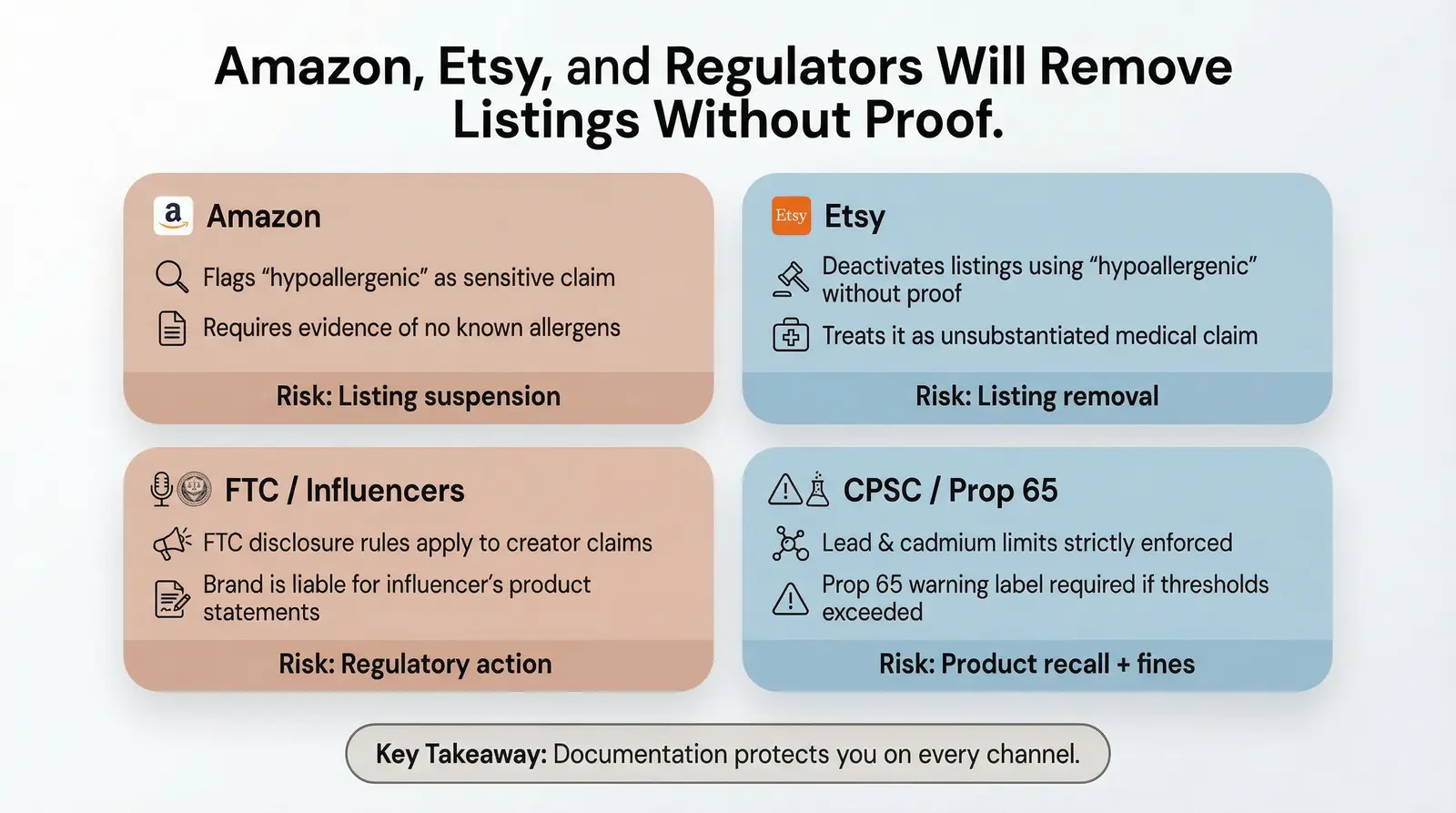
Beyond federal regulators, the platforms where you sell have their own strict policies on misleading product claims.
Amazon, Etsy, and Shopify actively police their marketplaces. Amazon specifically flags "hypoallergenic" as a sensitive claim in its jewelry category, stating sellers must not use the term unless the product is free of known allergens or there is evidence it does not cause reactions [8]. Etsy has been known to deactivate listings that use "hypoallergenic" without proof, treating it as an unsubstantiated medical claim [9].
Social media is not exempt. FTC disclosure rules apply to influencer-driven product claims. If a creator promoting a Branvas-powered brand says "this is hypoallergenic" in a TikTok video, that claim must be substantiated by the brand.
Additionally, if you sell into California, you must be aware of Proposition 65. If products contain lead or cadmium—which are sometimes found in cheap imported fashion jewelry—California's Prop 65 requires a specific warning label [10]. The Consumer Product Safety Commission (CPSC) also strictly regulates lead and cadmium, frequently recalling jewelry that exceeds federal limits [11]. We strongly recommend third-party testing for any imported fashion jewelry sold into California or marketed to children.
When you lack the rigorous third-party lab testing required to make absolute claims, you must adjust your language. Here is a quick-reference guide to replacing risky claims with safer, substantiated alternatives.
| Risky / Unsupported Claim | Safer Alternative (when not fully documented) |
|---|---|
| "Hypoallergenic" | "Made with 316L surgical-grade stainless steel" |
| "Nickel-free" | "Nickel-free plating stack per supplier certification" |
| "Won't tarnish" | "Tarnish-resistant with proper care; PVD-coated" |
| "Safe for sensitive skin" | "Made with materials suitable for most skin types; those with known metal sensitivities should review material specs" |
By adopting the Branvas Claim Confidence Framework™ and maintaining a rigorous Documentation Pack, you can market your jewelry brand with absolute confidence. You will protect your business from legal exposure, build genuine trust with your customers, and ensure your brand's reputation shines as brightly as your products.

[1] 15 U.S. Code § 45 - Unfair methods of competition unlawful. Legal Information Institute, Cornell Law School. https://www.law.cornell.edu/uscode/text/15/45
[2] 16 CFR Part 23 -- Guides for the Jewelry, Precious Metals, and Pewter Industries. Electronic Code of Federal Regulations. https://www.ecfr.gov/current/title-16/chapter-I/subchapter-B/part-23
[3] "Hypoallergenic" Cosmetics. U.S. Food and Drug Administration. https://www.fda.gov/cosmetics/cosmetics-labeling-claims/hypoallergenic-cosmetics
[4] Jewellery Regulations in the European Union: A Complete Guide. Compliance Gate. https://www.compliancegate.com/jewelry-products-regulations-european-union/
[5] Emanuele, R., et al. (2024). Nickel release from 316L stainless steel following a Ni-free electroplating cycle. HardwareX, 19, e00531. https://pmc.ncbi.nlm.nih.gov/articles/PMC11402685/
[6] Emanuele, R., et al. (2024). Nickel release from 316L stainless steel following a Ni-free electroplating cycle. HardwareX, 19, e00531. https://pmc.ncbi.nlm.nih.gov/articles/PMC11402685/
[7] EU Harmonizes EN 1811:2023 for Nickel Restriction under REACH. SGS. https://www.sgs.com/en-es/news/2024/01/safeguards-0224-eu-harmonizes-en-1811-2023-for-nickel-restriction-under-reach
[8] Listings Lounge: Advice for Creating Compelling Jewelry Listings. Amazon Seller Central Forums. https://sellercentral.amazon.com/seller-forums/discussions/t/85a80c8e-1d31-416b-beb7-1b82050b5fdc
[9] Listing removed for using “hypoallergenic”? Reddit r/EtsySellers. https://www.reddit.com/r/EtsySellers/comments/1n83ab2/listingremovedforusinghypoallergenic/
[10] California Proposition 65 Compliance – Warning Requirements. Bureau Veritas. https://www.cps.bureauveritas.com/needs/california-proposition-65-compliance-warning-requirements-restricted-substances-list-faq
[11] How the CPSC Regulates Jewelry and Accessories. The National Law Review. https://natlawreview.com/article/cut-clarity-and-compliance-how-cpsc-regulates-jewelry-and-accessories