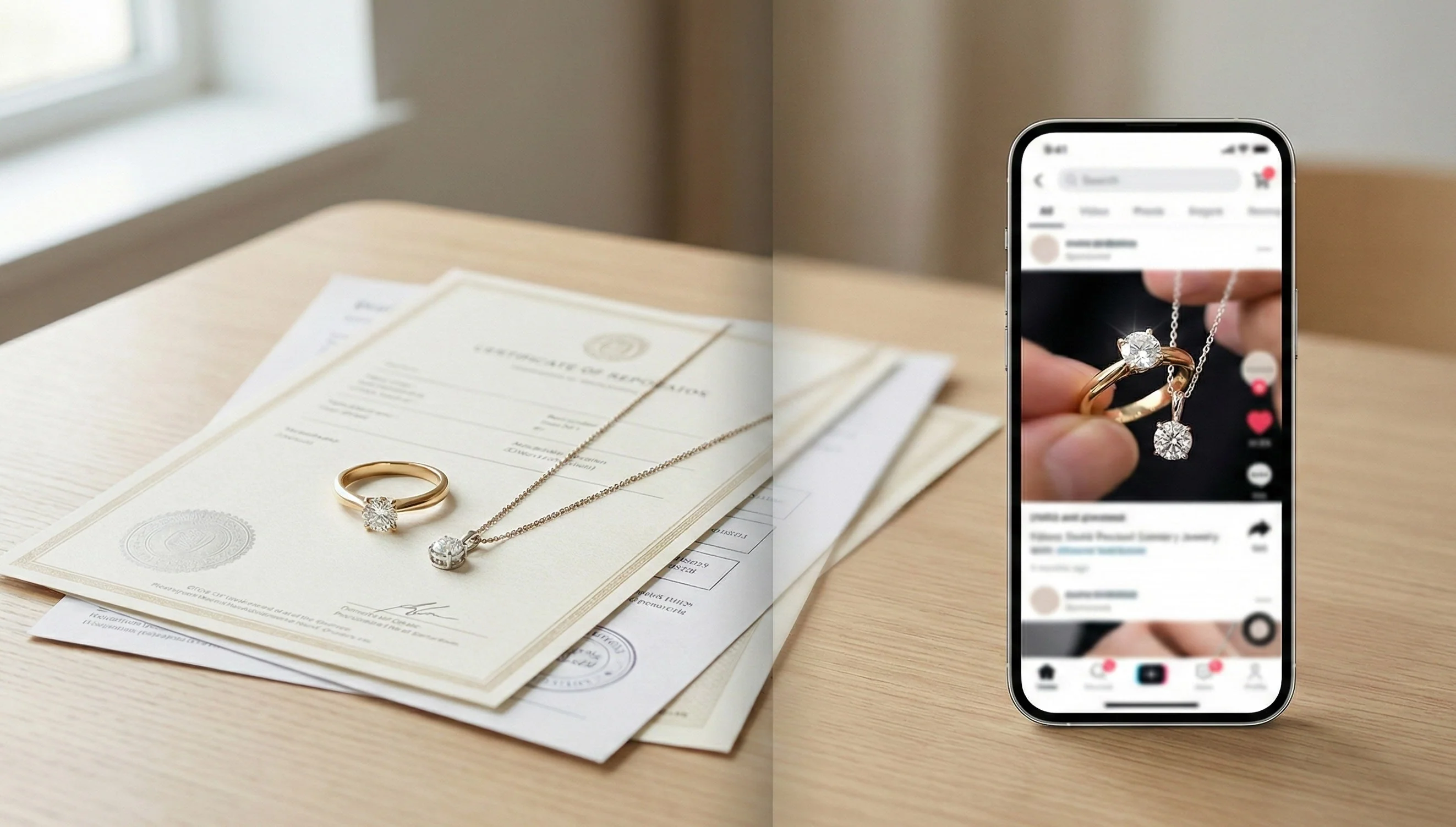



This guide covers the complete TikTok Shop jewelry approval document checklist, the 7 most common rejection reasons, and how to fix each one fast.
Published:
March 13, 2026
Author:
Yi Cui
Most rejections are paperwork, not product. The jewelry itself usually passes muster; what fails is the missing test report, a vague material description, or a non-compliant listing format. This article provides the complete document checklist, the most common rejection triggers, and real examples of listings that get approved, so you can get your jewelry live on TikTok Shop faster. At Branvas, we've helped dozens of private-label jewelry sellers navigate category approval, and the pattern is almost always the same—great products, incomplete paperwork.
TikTok Shop flags jewelry as a restricted category primarily due to consumer safety and regulatory liability. The main concerns are the presence of heavy metals like nickel, lead, and cadmium, which can cause skin reactions or be toxic, especially in children's jewelry. This is why compliance with standards like the CPSC (Consumer Product Safety Commission) in the US, REACH Regulation in the EU, and ASTM F2923 for children's jewelry is critical. [1] [2]
Many sellers mistakenly believe the restriction is about preventing counterfeit goods. While that's a factor, the primary driver is chemical and material safety compliance. TikTok, as a platform, wants to avoid liability for selling products that could harm consumers. Sellers who understand this shift their focus from brand authenticity to proving material safety, which is the key to a faster approval.

To simplify the approval process, we developed the CLEAR Framework at Branvas, based on our experience with countless successful submissions. It’s a five-category checklist system that covers every document and compliance point TikTok Shop reviewers look for.
| CLEAR Category | Document(s) Required | Where to Get It | Typical Turnaround | ⚠️ Common Rejection Trigger |
|---|---|---|---|---|
| C — Compliance | Lab test reports for heavy metals (lead, cadmium, nickel), material composition analysis. | Accredited third-party labs (e.g., SGS, Intertek, Bureau Veritas). [3] | 7-14 business days | Missing test reports for each unique material (e.g., one for 925 silver, another for 14k gold plate). |
| L — Legal | Business license/registration, government-issued ID for the account owner, tax information (W-9 or EIN). | Your local government/state registration office, IRS. | 1-5 business days | Mismatch between the legal business name and the TikTok Shop account name. |
| E — Evidence of Standards | Children’s Product Certificate (CPC) if selling kids' jewelry, proof of compliance with ASTM F2923, REACH, Prop 65. | Self-certified based on passing lab reports, or provided by your manufacturer. | 1-2 days (post-testing) | Selling children's jewelry without a CPC or required lead/cadmium testing. |
| A — Authorization | Trademark registration certificate (for private label), brand authorization letter (for resellers). | USPTO for trademarks; your supplier/brand owner for authorization letters. | 1-10 business days | The authorization letter is missing an expiry date or doesn't explicitly grant permission to sell on TikTok Shop. |
| R — Ready Listing | Compliant product title, detailed material description, high-resolution images (product + packaging), correct category selection. | Your own product information and photography. | 1-3 hours per listing | Using restricted terms like "gold" in a costume jewelry listing instead of "gold-tone." |
If you're launching a private-label jewelry brand and want all compliance documentation handled before your first listing goes live, explore how Branvas works — we source, brand, and fulfill jewelry that's already built for category approval.

Based on our research across seller forums, TikTok's official documentation, and our own client experiences, these are the most frequent hurdles:
Missing or Incorrect Lab Test Reports
This is the number one reason for rejection. Sellers either fail to provide any test reports or submit reports from non-accredited labs. You need a separate, valid test report for each material type you sell.
The Fix: Commission tests from a CPSC-accepted lab like SGS, Intertek, or Bureau Veritas for each material (e.g., 925 sterling silver, 14k gold-plated brass). Ensure the report tests for lead, cadmium, and nickel content/release as required by CPSC and REACH. [3]
Vague or Non-Compliant Material Descriptions
Your listing says "gold necklace," but the item is gold-plated brass. This is a fast track to rejection. TikTok requires absolute clarity to prevent misleading buyers.
The Fix: Be precise. If it's plated, state the base metal and the plating material and thickness. For example: "14k Gold-Plated Brass." For costume jewelry, use terms like "gold-tone" or "silvery." [4]
Incorrect Product Category
Listing fine jewelry under the "costume jewelry" category to bypass document requirements will get your product flagged. The reverse is also true.
The Fix: If your product contains any material from the "invite-only" list (gold, silver, platinum, gemstones, etc.), you must apply for the restricted category. If it contains none, list it under the appropriate fashion/costume jewelry subcategory. [4]
Flawed Brand Authorization
For private-label sellers, the trademark information must be perfect. For resellers, the authorization letter from the brand owner is often incomplete.
The Fix: If you're the brand owner, ensure your USPTO trademark is registered and the details match your TikTok Shop account exactly. If you're a reseller, your authorization letter must be on the brand's letterhead, be dated, have an expiry date, and explicitly state you are authorized to sell their products on TikTok Shop. [5]
Incomplete Product and Packaging Photos
TikTok's reviewers need to see everything. A single, blurry photo of the product isn't enough. They need to verify packaging and any on-product markings.
The Fix: Provide multiple high-resolution images (at least 600x600 pixels) showing the product from all angles, the packaging it comes in, and any compliance stamps (e.g., ".925" for sterling silver).
Missing Children's Product Certificate (CPC)
If your jewelry could be worn by a child (12 and under), it legally requires a CPC in the United States. Many sellers are unaware of this and get their products rejected for safety reasons.
The Fix: If you sell children's jewelry, you must have passing test results for lead and cadmium from a CPSC-accredited lab. Based on these results, you or your manufacturer must issue a Children's Product Certificate. [1]
Ignoring California Proposition 65
If you sell to customers in California, you must declare if your product contains any chemicals on the Prop 65 list, which includes lead, cadmium, and nickel.
The Fix: In your product listing attributes, find the "CA Prop 65" fields. If your product contains any of the listed chemicals, you must select "Yes" and specify the chemical. Failure to do so can lead to rejection and legal issues. [6]

Let's audit a common product: a simple gold-colored hoop earring.
Why it fails: The title is misleading ("Gold" instead of "Gold-tone"). The description is vague and makes an unsubstantiated "hypoallergenic" claim. The material is not specific. The single image is insufficient. No compliance is demonstrated.
Why it passes: The title and description are precise and accurate. It correctly uses "gold-tone" and specifies the base metal. It makes specific, verifiable claims about being nickel-free and lead-free, referencing the standards and test reports. The images are comprehensive.

Giving a single answer is tough, but here is a realistic timeline based on official guidance and seller reports:
To speed things up, have everything ready before you start. Name your files clearly (e.g., "SGSLabTest925SilverLeadCadmium.pdf"). A complete and organized first submission is the single best way to get approved in under two weeks.

Private-label sellers face a dual challenge: you must prove both product compliance and brand ownership. This means you're responsible for commissioning lab tests, designing compliant packaging, and registering your trademark—all before you can even apply. It's a significant upfront investment of time and money.
This is where a Brand-as-a-Service partner like Branvas changes the game. Instead of building the entire compliance infrastructure from scratch, you leverage one that's pre-built. The products in the Branvas catalog are already lab-tested to meet CPSC and REACH standards, and they come with the documentation you need for category approval. This allows you to focus on marketing and building your brand, not on navigating complex regulations.
For influencers and creators looking to launch their own line, this is the fastest path to market. You can explore our pre-vetted products in the Branvas catalog or learn more about our solution for influencers and creators.
Ready to launch a jewelry brand that's built for platform compliance from day one? Start with Branvas — we handle sourcing, branding, fulfillment, and the documentation that gets your listings approved.

Q: What certifications do I need to sell jewelry on TikTok Shop?
A: For fine jewelry, you need a Certificate of Authenticity for the material and third-party lab test reports verifying compliance with heavy metal standards (lead, cadmium, nickel). For children's jewelry, a Children's Product Certificate (CPC) is required in the US. For private-label brands, you'll also need your trademark registration certificate. [1] [5]
Q: Does TikTok Shop require lab test reports for all jewelry, or only certain types?
A: Lab test reports are primarily required for the "invite-only" or restricted category, which includes all fine jewelry (gold, silver, platinum, gemstones) and children's jewelry. Standard costume jewelry made of materials like acrylic or zinc alloy typically does not require test reports, but you cannot make any safety claims (like "hypoallergenic" or "nickel-free") without them. [3]
Q: How do I get a brand authorization letter for jewelry on TikTok Shop?
A: If you are reselling another company's branded jewelry, you must request a brand authorization letter directly from the brand owner or their authorized distributor. The letter must be on their official letterhead, grant you permission to sell on TikTok Shop, and have a clear validity period. You will upload this in the Qualification Center in your Seller Center. [5]
Q: Can I sell handmade or artisan jewelry on TikTok Shop without certifications?
A: It depends on the materials. If your handmade jewelry is crafted from materials like wood, clay, or textiles, you generally don't need lab certifications. However, if you use any metal, even in clasps or ear wires, you are responsible for ensuring it meets safety standards for lead and cadmium. If you use precious metals, you fall into the restricted category and will need the required documentation.
Q: What happens if my jewelry listing gets rejected — can I resubmit?
A: Yes. If your listing is rejected, TikTok will provide a reason. You can fix the issue—whether it's updating the description, uploading the correct document, or changing the category—and resubmit the product for review. There is no penalty for an initial rejection, but repeated violations can harm your shop's performance score.