



A 10-point QC checklist and supplier SOP template helps dropship jewelry sellers prevent tarnishing, allergies, and bad reviews before products ship.
Published:
March 18, 2026
Author:
Yi Cui
A $2 QC process can save a $200 refund and a bad review. A single viral 1-star review about tarnishing or an allergic reaction can suppress conversion rates store-wide, turning a profitable product into a liability overnight. For jewelry dropshippers, ecommerce boutique owners, and influencers, the challenge is building a repeatable, supplier-facing QC system that stops bad products from reaching customers—without needing to be a metallurgist or factory auditor. By the end of this article, you will have a concrete, material-specific QC checklist and a supplier SOP you can deploy immediately to protect your brand and your margins.
The structural reason dropshippers are exposed to quality issues is straightforward: there is no physical touchpoint before the product reaches the customer. When you rely on a supplier to fulfill orders directly, you surrender control over the final inspection. That gap between factory floor and customer doorstep is where most quality failures live.
This lack of oversight has measurable consequences. Data from Branvas client accounts shows that AliExpress-sourced jewelry consistently hits a 22% refund rate due to quality issues including tarnishing, items not matching descriptions, and damage during shipping—compared to roughly 8% for brand-vetted partners [1].
Here is the contrarian insight most sellers miss: the problem is rarely the supplier's intent. It is the absence of a written spec. Most jewelry defects are preventable at the brief stage, not the production stage. If you do not specify the exact plating thickness or material grade in your purchase order, the supplier will default to the cheapest interpretation of your request. In our experience at Branvas, the majority of tarnish and allergy complaints we have helped sellers resolve trace back to a single missing document: a material specification sheet sent to the supplier before the first order.
The good news is that this is entirely fixable. A written spec costs nothing to create and changes everything about what you receive.

Before you can inspect a product, you must define what you are inspecting it against. Inspecting a Tier 1 piece with Tier 3 expectations produces false failures and supplier disputes. To solve this, we use the Branvas Material-Grade Framework™, a simple 3-tier classification system that sellers use to set the right QC expectations before a single unit is inspected.
| Tier | Material | Minimum Plating / Purity Standard | Hypoallergenic? | Ideal Use Case |
|---|---|---|---|---|
| 1 | Gold-Plated Brass | ≥2.5 microns gold over nickel-free base | Conditional (base must be nickel-free) | Fashion / trend jewelry, lower price point |
| 2 | Stainless Steel (316L) | N/A (solid material) | Yes | Everyday wear, unisex, minimalist |
| 3 | Sterling Silver (.925) | N/A (solid; hallmarked) | Generally yes (except silver allergy) | Premium positioning, gifting |
Why must the material tier be declared before QC begins? Consider this worked example. A seller launches a "gold necklace" at $38 retail. Without specifying ≥2.5 micron plating and a nickel-free brass base in the supplier PO, they receive pieces plated at 0.5 microns. After 3 weeks of wear, tarnish complaints flood in. The supplier is not lying—they delivered what was implied, not what was specified. Using the Branvas Material-Grade Framework™ at the PO stage would have caught this before a single unit was produced.
Declare the tier first. Then inspect.

Work through these 10 checks in order. They are sequenced from easiest (visual, no tools required) to most technical (spec verification with documentation).
Inspect each piece under natural light, then under a 10× loupe. Look for patchiness, thin spots at high-wear edges (clasps, bale, jump rings), and any visible discoloration. For Tier 1 pieces, it is critical to understand that flash plating under 0.5 microns is effectively cosmetic only [2]. It will wear through within weeks under normal use. The surface should be smooth, reflective, and consistent across the entire piece. Any visible pitting, dull patches, or color variation is a fail.
Pass: Uniform finish with no visible thin spots or discoloration.
Fail: Patchiness, dull edges, or visible base metal at wear points.
Applies to: All Tiers.
You cannot measure plating thickness with the naked eye. Sellers must request XRF test reports from suppliers. X-ray fluorescence is the industry standard for non-destructive plating measurement and can accurately detect coatings as thin as 0.01 microns [3]. The minimum benchmark for any jewelry claiming durability is 2.5 microns, the threshold classified as heavy gold plating [3]. Ask the supplier to provide the XRF report in writing before approving the batch. If they cannot produce one, treat the plating thickness as unverified.
Pass: XRF report confirms ≥2.5 microns.
Fail: Report absent, or plating measures below 2.5 microns.
Applies to: Tier 1 only.
Nickel is the leading cause of metal allergies, affecting approximately 15% of women and 2% of men [4]. The EU REACH regulation (Annex XVII, Entry 27) sets strict nickel release limits: ≤0.5 µg/cm²/week for items in prolonged contact with skin, and ≤0.2 µg/cm²/week for pierced items such as earrings [4]. The US has no equivalent federal nickel limit for adult jewelry, but ASTM standards provide important reference points for manufacturers.
For stainless steel, the magnet test is a quick field screening check. Grade 316L (surgical grade, the standard for hypoallergenic claims) is non-magnetic due to its molybdenum content. Grade 304 is weakly magnetic and contains approximately 8% nickel with less corrosion resistance [5]. If a piece marketed as 316L attracts a magnet, request a grade certificate immediately.
Pass: Supplier provides nickel-free confirmation or grade certificate; magnet test negative for 316L.
Fail: No documentation; magnet attraction on a piece claimed to be 316L.
Applies to: Tier 1 and Tier 2.
Sterling silver must contain 92.5% pure silver, and genuine pieces carry a .925 stamp [6]. Common stamp locations include the clasp, the inside of a ring band, or an attached tag. The critical warning here is that silver-plated items are routinely mislabeled as sterling, either intentionally or through supply chain confusion. Counterfeit hallmarks exist, so do not stop at the stamp. For new supplier relationships, use a silver acid test kit: genuine sterling produces a creamy white reaction, while base metals turn green or another color.
Pass: .925 hallmark present and acid test confirms sterling.
Fail: No hallmark, or acid test indicates base metal.
Applies to: Tier 3 only.
Stone loss is one of the most damaging complaints a jewelry seller can receive because it happens on first wear. Perform a prong check (are all prongs present and flush against the stone?), a bezel check (no visible gaps between the metal rim and the stone), and a pavé check (no missing stones, and stones are set rather than glued). Then perform a gentle wiggle test: use tweezers or a fine tool to apply light lateral pressure to each stone. The pass criterion is strict. Zero movement. Zero visible gaps. Any stone that shifts even slightly needs to be flagged before the batch ships.
Pass: No movement on wiggle test; all prongs flush; no gaps.
Fail: Any stone movement, missing prong, or visible gap.
Applies to: All Tiers with stones.
Open and close lobster clasps, spring rings, toggle clasps, and box clasps 10 times each. Check for spring tension, alignment, and whether they self-close under gravity. A clasp that requires two hands to operate or that fails to click shut on the first try will generate complaints. For earring backs, test the butterfly clutch grip by inserting and removing the post 5 times. The clutch should grip firmly and not slide off without deliberate pressure.
Pass: Smooth operation with positive retention on all 10 cycles.
Fail: Any stiffness, misalignment, or failure to self-close.
Applies to: All Tiers.
Inspect jump rings, chain solder points, and pendant bale attachments under a 10× loupe. Open jump rings are the single most common cause of pendant loss complaints and are almost always a supplier-side failure that a quick loupe check would catch. Every connection point must be fully closed, with no visible gap. Solder joints should be smooth and flush, with no excess solder buildup or voids.
Pass: All jump rings fully closed; solder joints smooth and gap-free.
Fail: Any open jump ring or visible solder void.
Applies to: All Tiers.
Use a digital gram scale accurate to 0.1g. Weigh 5 units from a batch and compare against the approved sample weight. The acceptable variance is less than 5%. Weight consistency matters for two reasons. First, it signals perceived quality to the customer—a piece that feels lighter than expected reads as cheap. Second, significant weight deviation can indicate material substitution, where the supplier has used a cheaper or hollowed-out base metal to cut costs without changing the visual appearance.
Pass: All 5 units within 5% of the approved sample weight.
Fail: Any unit deviating more than 5% from the sample.
Applies to: All Tiers.
Brand packaging QC is just as important as the product itself. A product that arrives in damaged or incorrect packaging generates "arrived damaged" reviews even when the jewelry is perfect. Check that the logo is centered and un-smudged, that the tissue, ribbon, or card is present and undamaged, and that the poly bag is sealed. For sterling silver pieces, verify that an anti-tarnish strip is included in the packaging, as this is a simple and inexpensive way to prevent blackening during transit and storage.
Pass: All packaging elements present, undamaged, and correctly assembled.
Fail: Any missing element, smudged print, or unsealed bag.
Applies to: All Tiers.
Before releasing a SKU for sale, photograph one sample unit against a white background using a macro lens or smartphone macro mode. This step serves two purposes. First, it creates a quality baseline record that you can reference if a supplier dispute arises. Second, it confirms that the product matches your listing photography. If the sample photo and listing photo diverge materially in color, finish, or proportions, flag it before launch. Mismatched product photos are a leading driver of "item not as described" disputes and chargebacks.
Pass: Sample photo matches listing photography within acceptable visual tolerance.
Fail: Material color difference, size discrepancy, or finish mismatch.
Applies to: All Tiers.

The checklist only works if it is given to the supplier as a written SOP, not just used internally on arrival. A checklist you keep to yourself is a returns policy. A checklist your supplier signs is a quality contract.
We recommend Branvas sellers send this SOP on the first PO and reference it on every reorder. Suppliers who receive a written spec sheet before production produce measurably fewer defective units—and the document protects you in any dispute.
Supplier QC SOP Template
| Field | Specification |
|---|---|
| Product SKU / Style Code | [Insert SKU] |
| Material Tier (per Branvas Material-Grade Framework™) | [Tier 1 / 2 / 3] |
| Plating spec (microns, if applicable) | [e.g., ≥2.5 microns gold, 18K] |
| Nickel-free base confirmation | [Yes/No + XRF or lab test report required] |
| Hallmark requirement | [e.g., .925 stamp on clasp] |
| Stone setting standard | [Wiggle test pass: zero movement, zero gaps] |
| Clasp cycle test | [10× open/close pass required] |
| Unit weight spec | [e.g., 4.5g ± 5%] |
| Packaging checklist | [Branded box, anti-tarnish strip, tissue, sealed poly bag] |
| Pre-shipment photo requirement | [Yes: macro photo on white background required] |
| AQL inspection level | [AQL 2.5 for major defects, per ISO 2859-1] |
Working with a supplier who already follows a structured QC process? Branvas operates with built-in material specs and pre-shipment inspection standards across its entire catalog—so you are not starting from zero. Explore the Branvas Catalog to see materials, plating specs, and hypoallergenic certifications listed per SKU.

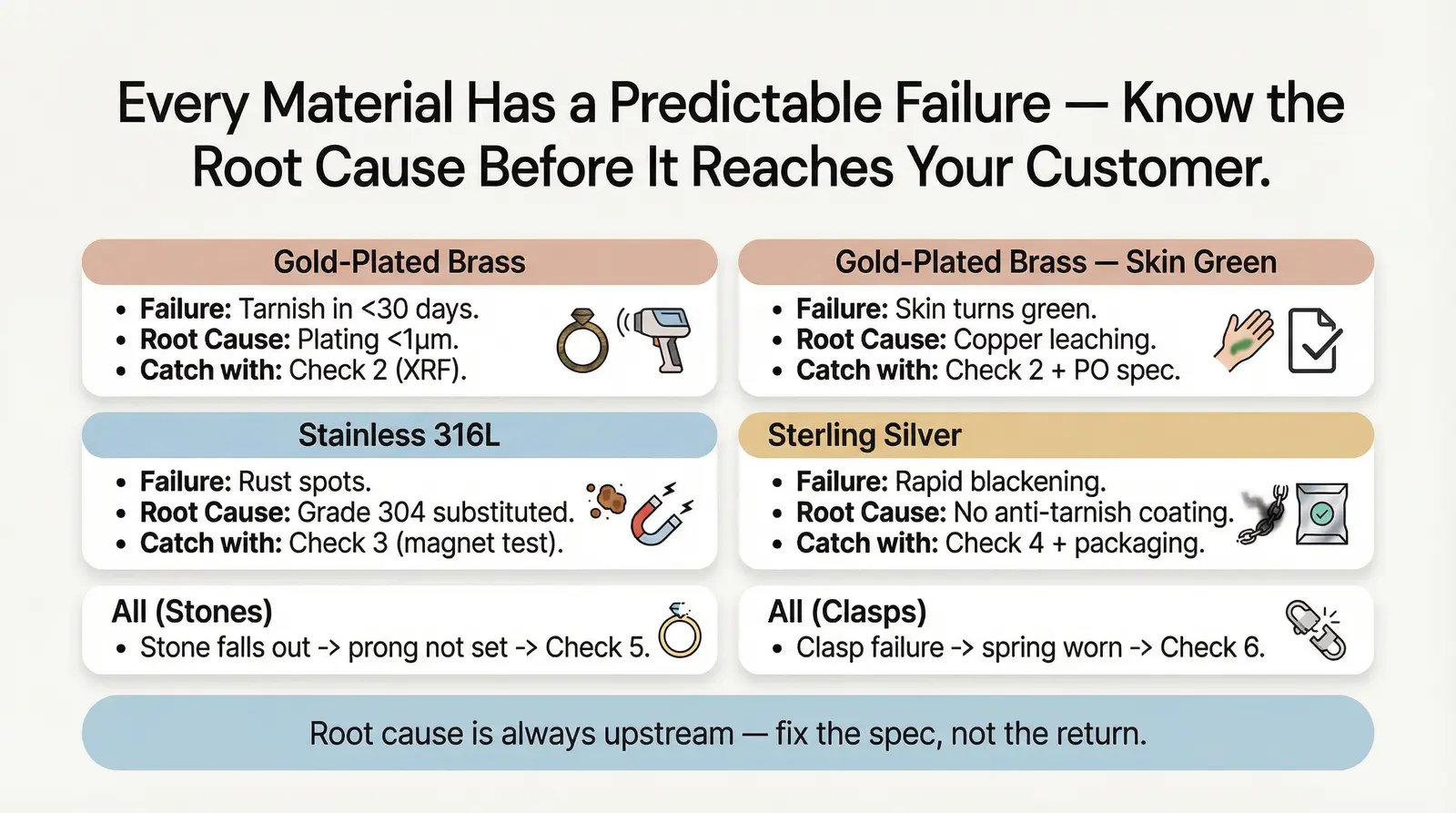
| Material | Most Common Failure | Root Cause | QC Check That Catches It |
|---|---|---|---|
| Gold-Plated Brass | Tarnish / color change within 30 days | Plating under 1 micron; nickel base exposed | Check 2 (XRF report), Check 3 (nickel compliance) |
| Gold-Plated Brass | Skin turning green | Copper leaching through thin plating | Check 2 + material spec in PO |
| Stainless Steel 316L | Rust spots | Incorrect grade (304 not 316L) | Check 3 (magnet test + grade cert) |
| Sterling Silver | Rapid blackening | Low-quality anti-tarnish coating | Check 4 (hallmark) + packaging (anti-tarnish strip) |
| Sterling Silver | "Not real silver" complaints | Silver-plated passed off as sterling | Check 4 (acid test) |
| All (with stones) | Stone falls out within first wear | Prong not properly set | Check 5 (wiggle test) |
| All | Clasp failure / jewelry lost | Spring worn or misaligned | Check 6 (10× cycle test) |
Branvas is a private-label jewelry Brand-as-a-Service. We source, brand, package, and fulfill—including blind shipping—on behalf of influencers, ecommerce sellers, and aspiring entrepreneurs who want to launch a jewelry brand without building a supply chain from scratch.
We build QC into our supplier relationships from day one. Plating specs are disclosed per SKU in our catalog. Nickel-free options are clearly flagged. Pre-shipment inspection standards are built into every supplier agreement, not added as an afterthought.
At Branvas, we have seen what happens when sellers skip the spec stage—and we have built our catalog and supplier SOPs specifically to absorb that risk so our brand partners do not have to manage it from scratch.
Ready to launch a jewelry brand without the QC headaches? Branvas handles sourcing, branding, and fulfillment with quality standards already baked in.
Start with Branvas →

Q: What plating thickness should I require for gold-plated jewelry that won't tarnish quickly?
A: For durable, everyday wear, require a minimum of 2.5 microns of gold plating, the threshold classified as heavy gold plating. Flash plating under 0.5 microns is purely cosmetic and will wear through within weeks. Always request an XRF test report from your supplier to verify the measurement before approving a batch.
Q: How do I know if my jewelry supplier is truly nickel-free?
A: Specify compliance with EU REACH standards (≤0.5 µg/cm²/week nickel release) in your purchase order and require a laboratory test report or XRF analysis confirming the base metal and plating composition. Do not rely on verbal assurances. For stainless steel, request a grade certificate confirming 316L rather than 304, and use the magnet test as a quick field screen.
Q: What is the difference between gold-plated and gold-filled jewelry for dropshipping purposes?
A: Gold-plated jewelry has a thin layer of gold electroplated onto a base metal, typically 0.5 to 2.5 microns. Gold-filled jewelry has a much thicker layer of gold mechanically bonded to the core, regulated by the FTC at a minimum of 1/20 of the item's total weight [2]. Gold-filled is significantly more durable and commands a higher price point, making it well-suited for premium dropshipping. Gold-plated is appropriate for trend-driven, lower-price-point items when the plating spec is properly enforced.
Q: How do I handle a customer complaint about jewelry tarnishing or causing an allergic reaction?
A: Issue a prompt refund or replacement to protect your store's review profile. Then trace the issue back to your supplier SOP: verify whether the item met the 2.5-micron plating standard and nickel-free requirement. If the supplier deviated from the spec sheet, document the discrepancy and hold them accountable for the defective batch. Use the incident to tighten your next PO specification.
Q: Do I need a third-party lab test for my dropship jewelry, or is a supplier cert enough?
A: A supplier-provided XRF report is usually sufficient for standard fashion jewelry when you have an established relationship and consistent results. However, if you are scaling rapidly, making hypoallergenic claims, or selling into the EU market where REACH compliance is legally required, periodic third-party lab testing provides independent verification that your supplier is maintaining standards over time.