



Choosing the right material isn’t just aesthetic—it’s strategic. We compare gold plated, vermeil, and solid gold to help resellers balance margins, durability, and customer trust for maximum profit.
Published:
January 29, 2026
Author:
Yi Cui
When you're building a jewelry business, the material you choose to sell isn't just about aesthetics or purity. It's a strategic decision that ripples through every aspect of your operation—from pricing and profit margins to customer trust, return rates, and ultimately, your brand's positioning in the market.
In our experience at Branvas, we've seen countless founders struggle with this choice. They often approach it as a simple quality question: "What's the best material?" But that's the wrong question. The real question is: "Which material aligns with my business model, target customer, and growth stage?" A jewelry material guide isn't just about understanding what gold plated, vermeil, and solid gold are—it's about understanding how each material affects your ability to sell confidently, scale sustainably, and build customer loyalty.
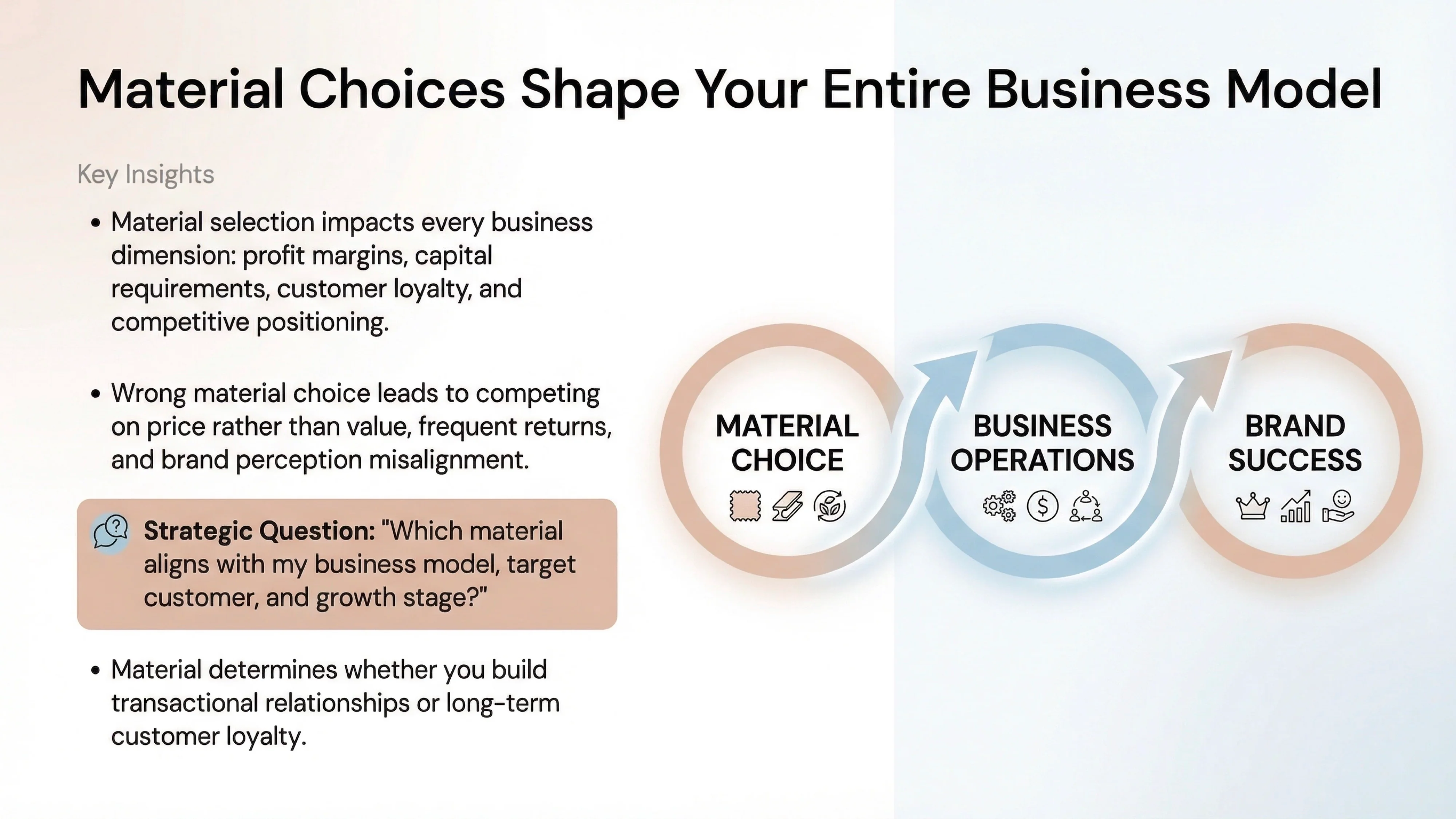
The material you select determines whether you're competing on price or value, whether you'll face frequent returns or satisfied repeat customers, and whether you're positioning yourself as a fast-fashion brand or a trusted jewelry destination. For resellers, dropshipping founders, and boutique owners, this decision shapes everything from your initial capital requirements to your long-term brand perception. This guide will help you navigate these trade-offs with clarity and confidence, not chemistry lectures or marketing fluff.
Before we dive into strategy, let's establish clear definitions for each material type. Understanding these distinctions is fundamental to making informed sourcing and positioning decisions.
Gold plated jewelry consists of a base metal—typically brass, copper, or alloy—coated with a thin layer of gold through an electroplating process. This gold layer is measured in microns and is generally less than 0.5 microns thick. While there's no specific FTC thickness requirement for gold plating, the thin layer means the gold coating can wear away relatively quickly with regular use, exposing the base metal underneath.
Gold vermeil (pronounced "ver-may") is a specific type of gold plating with strict legal standards. According to the Federal Trade Commission's Jewelry Guides, vermeil must consist of a sterling silver base coated with gold or gold alloy of at least 10 karat fineness [1]. The gold layer must be at least 2.5 microns thick—approximately five times thicker than typical gold plating. This combination of a precious metal base and substantial gold thickness creates a product that bridges the gap between plated and solid gold jewelry.
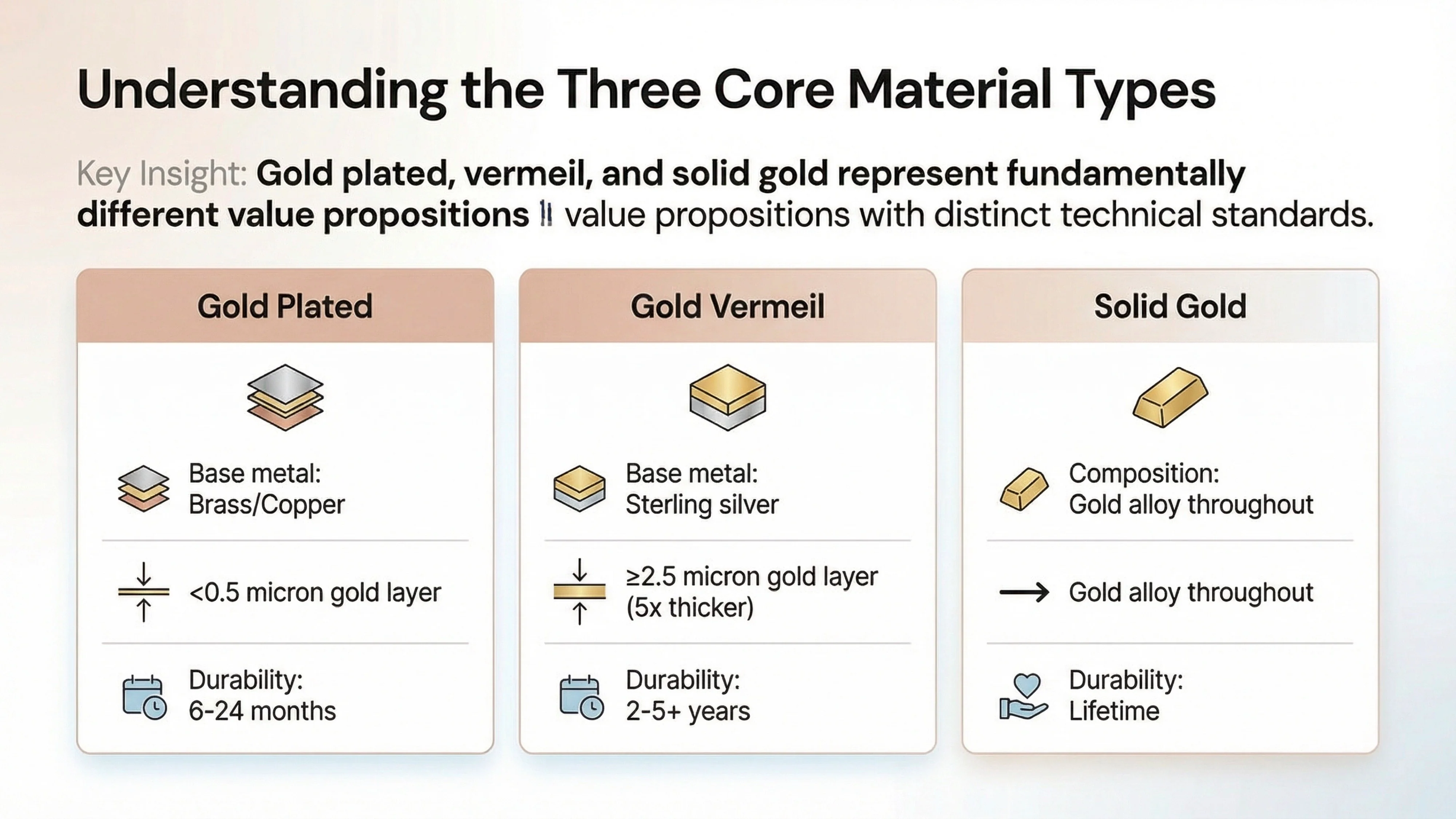
Solid gold jewelry is made entirely of gold alloy throughout the piece, not just on the surface. In the United States, gold must be at least 10 karat (41.7% pure gold) to be legally sold as "gold" [1]. Common purities include 10k, 14k (58.3% gold), and 18k (75% gold). The higher the karat, the greater the gold content, but also the softer and more expensive the metal. Solid gold doesn't tarnish, maintains its appearance indefinitely, and retains intrinsic value based on gold content.
These aren't just technical distinctions—they're the foundation of how customers perceive value, how long your products last, and how you price and position your offerings.
To help resellers evaluate materials strategically rather than emotionally, we've developed the Jewelry Material Trade-Off Matrix. This framework assesses each material across six critical dimensions that directly impact your business success.
|
Dimension |
Gold Plated |
Gold Vermeil |
Solid Gold |
|---|---|---|---|
|
Durability |
Low (6-24 months with regular wear) |
Moderate-High (2-5+ years with care) |
Excellent (generations) |
|
Perceived Value |
Fashion/temporary |
Demi-fine/quality |
Premium/investment |
|
Cost to Customer |
$10-$50 |
$50-$200 |
$200-$2,000+ |
|
Gross Margin Potential |
200-300% |
100-200% |
50-100% |
|
Customer Trust |
Lower (wear concerns) |
Moderate-High (quality expectations met) |
High (authenticity verification needed) |
|
Reseller Risk |
High (returns, complaints) |
Low-Moderate (balanced expectations) |
High (capital tied up, slow turnover) |
This matrix reveals a crucial insight that most new jewelry sellers misunderstand about materials: there is no universal "best" material. Each option excels in certain dimensions while presenting challenges in others.
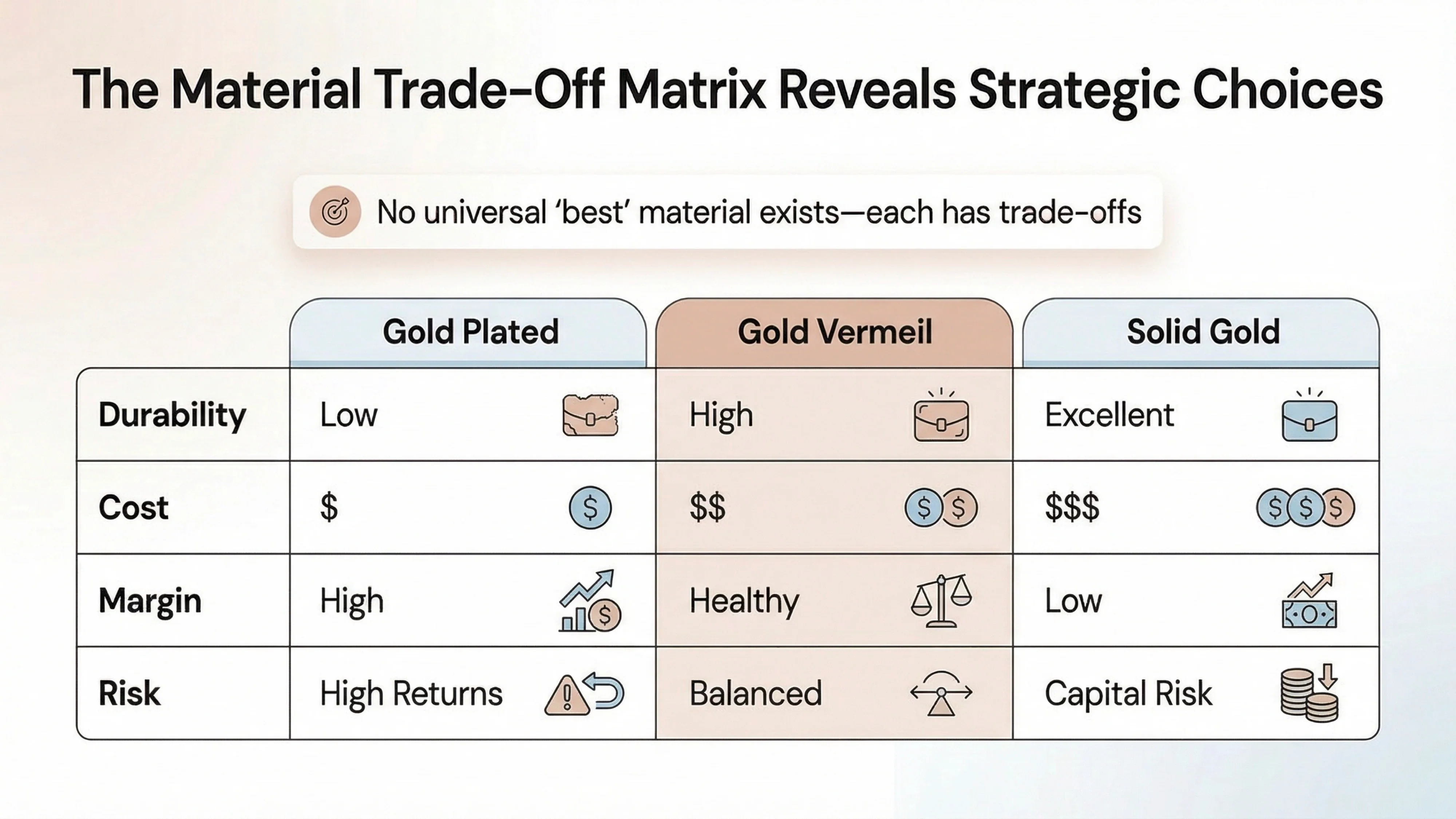
Gold plated offers the highest margin potential and lowest customer price point, making it accessible to price-sensitive shoppers. However, this comes at the cost of durability and customer trust. When the plating wears off after a few months, you risk negative reviews and returns that can damage your brand reputation far more than the initial profit was worth.
Solid gold represents the opposite trade-off. It delivers unmatched durability and perceived value, but requires significant capital investment and appeals to a much narrower customer base. For early-stage resellers, this often means slow inventory turnover and limited cash flow for testing new designs or marketing strategies.
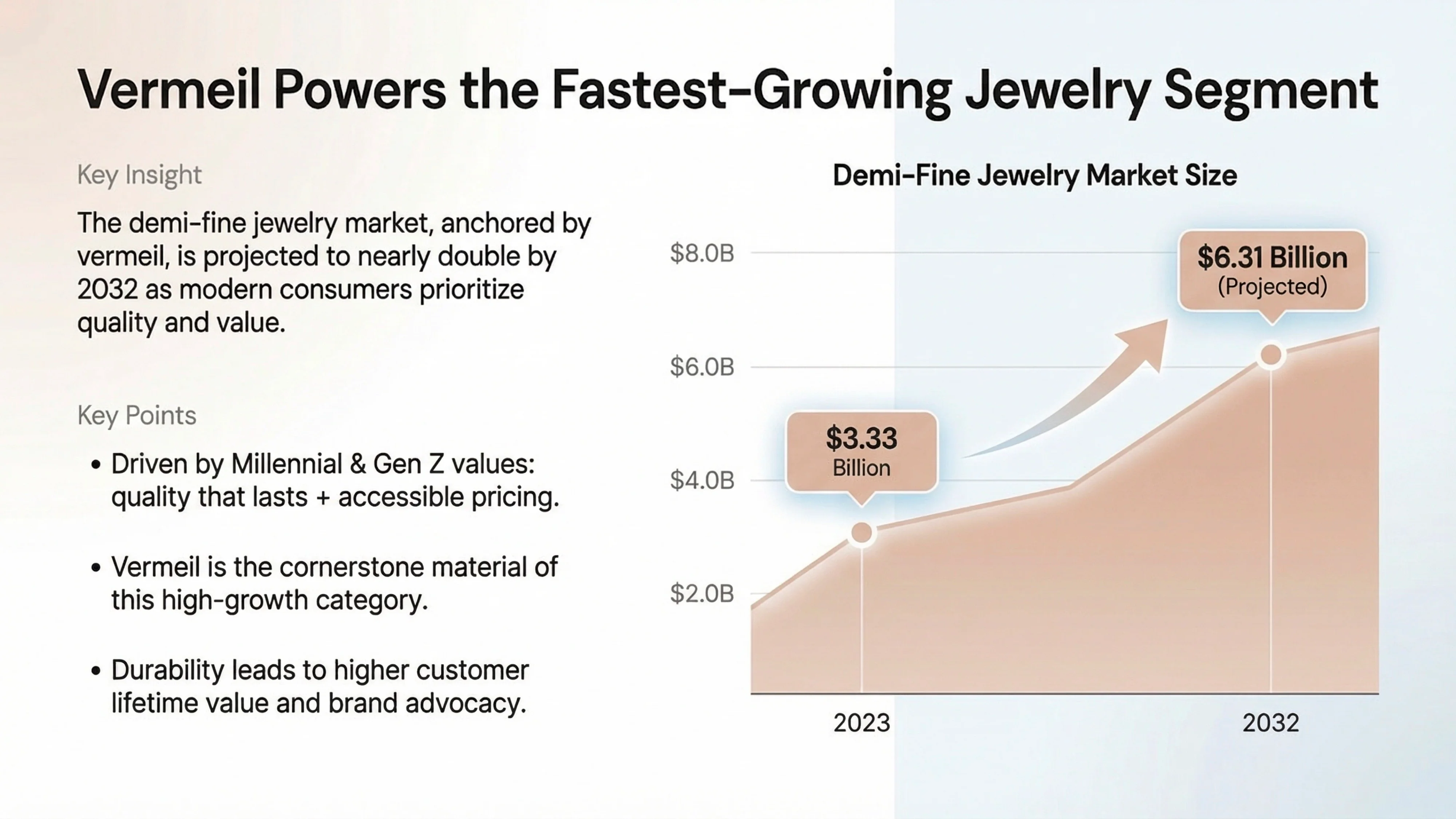
Gold vermeil occupies the strategic middle ground. It provides genuine durability (thanks to the 2.5-micron gold layer and sterling silver base), meets customer expectations for quality at its price point, and offers healthy margins without excessive capital requirements. This balance is why vermeil has become the foundation of the rapidly growing demi-fine jewelry category, projected to reach $6.31 billion globally by 2032 [2].
Gold plated jewelry serves a specific market segment, and understanding when it's appropriate—and when it's not—is essential for resellers who want to build sustainable businesses.
Gold plating involves depositing a thin layer of gold onto a base metal through electroplating. The base is typically brass, copper, or an inexpensive alloy. The gold layer ranges from 0.17 to 0.5 microns in thickness—thin enough that you could stack 200 layers and still not reach the thickness of a human hair. This minimal gold content keeps production costs low, which translates to accessible retail prices.
Gold plated jewelry typically retails between $10 and $50, making it the most accessible option for budget-conscious consumers. Wholesale costs can be as low as $2-$10 per piece, offering markup potential of 200-300% or more. For resellers focused on volume and fast fashion trends, these margins can be attractive.
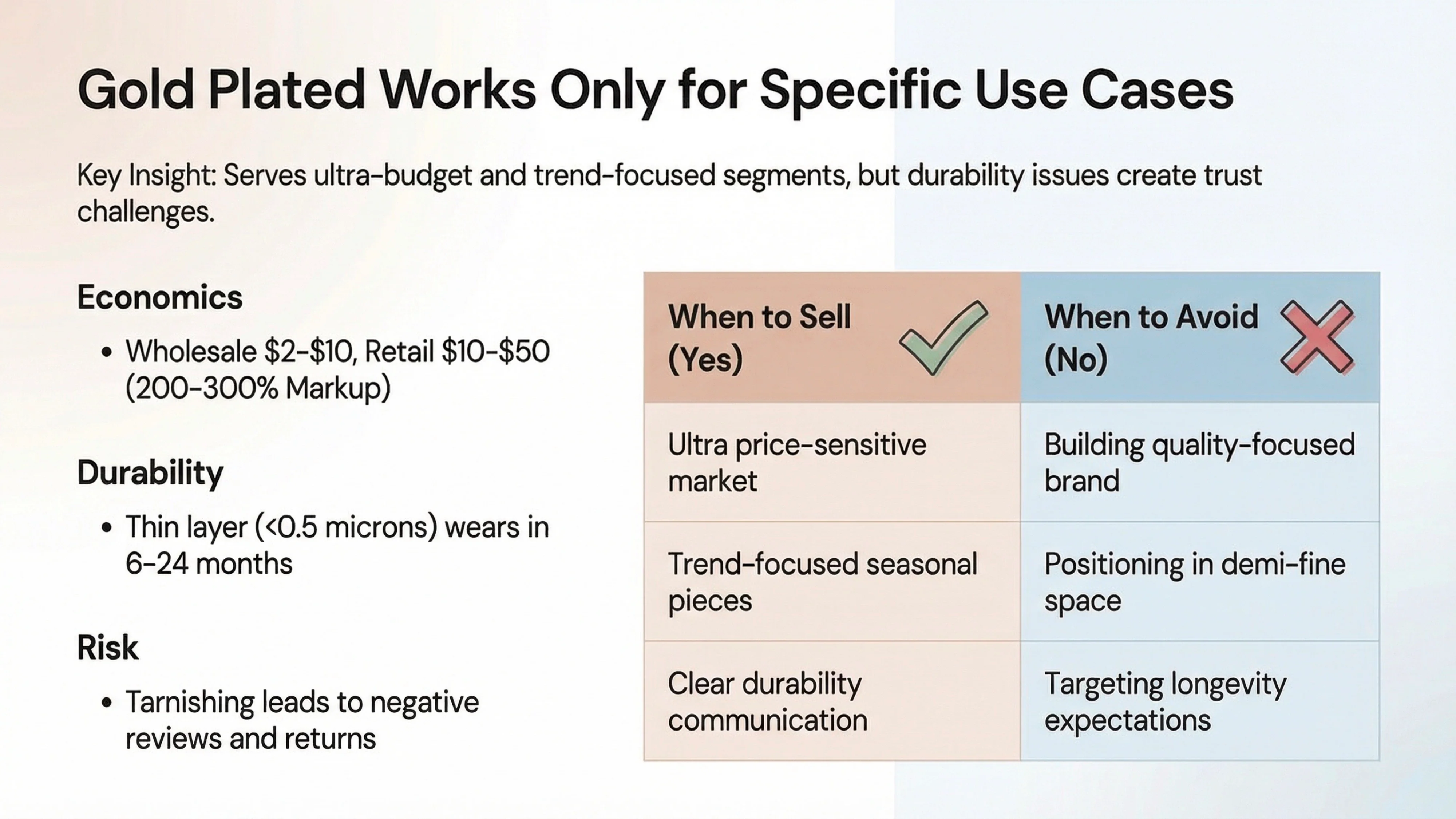
The primary advantage of gold plated jewelry is accessibility. It allows customers to experiment with styles, follow trends, and build a jewelry collection without significant financial commitment. For resellers, this means you can test new designs, respond quickly to trend cycles, and offer variety without substantial inventory investment.
Gold plated pieces are ideal for seasonal or trend-focused collections where customers understand they're purchasing fashion jewelry with a limited lifespan. If you're targeting customers who frequently rotate their accessories or want affordable options for special occasions, gold plated can serve that need.
The fundamental challenge with gold plated jewelry is durability. With regular wear, the thin gold layer begins to wear away within 6 to 24 months, exposing the base metal underneath [3]. This leads to tarnishing, discoloration, and the dreaded "green skin" effect when copper oxidizes. Even with careful handling—avoiding water, perfume, and chemicals—gold plated jewelry has a limited lifespan.
This durability issue creates customer trust challenges. When a customer pays $30 for a necklace that tarnishes after three months, they often feel deceived, even if the price point was appropriate for the quality. This leads to negative reviews, return requests, and damage to your brand reputation. In our experience at Branvas, the cost of managing these customer service issues often erodes the attractive initial margins.
Consider gold plated jewelry if:
Avoid gold plated jewelry if:
The key is transparency. If you sell gold plated jewelry, be explicit about what customers are buying. Avoid language that suggests permanence or high quality. Position it honestly as fashion jewelry, and you'll attract the right customers while protecting your reputation.
For most jewelry resellers—especially those building brands rather than just moving inventory—gold vermeil represents the optimal balance of quality, affordability, and profitability. This isn't marketing spin; it's a conclusion drawn from both regulatory standards and market realities.
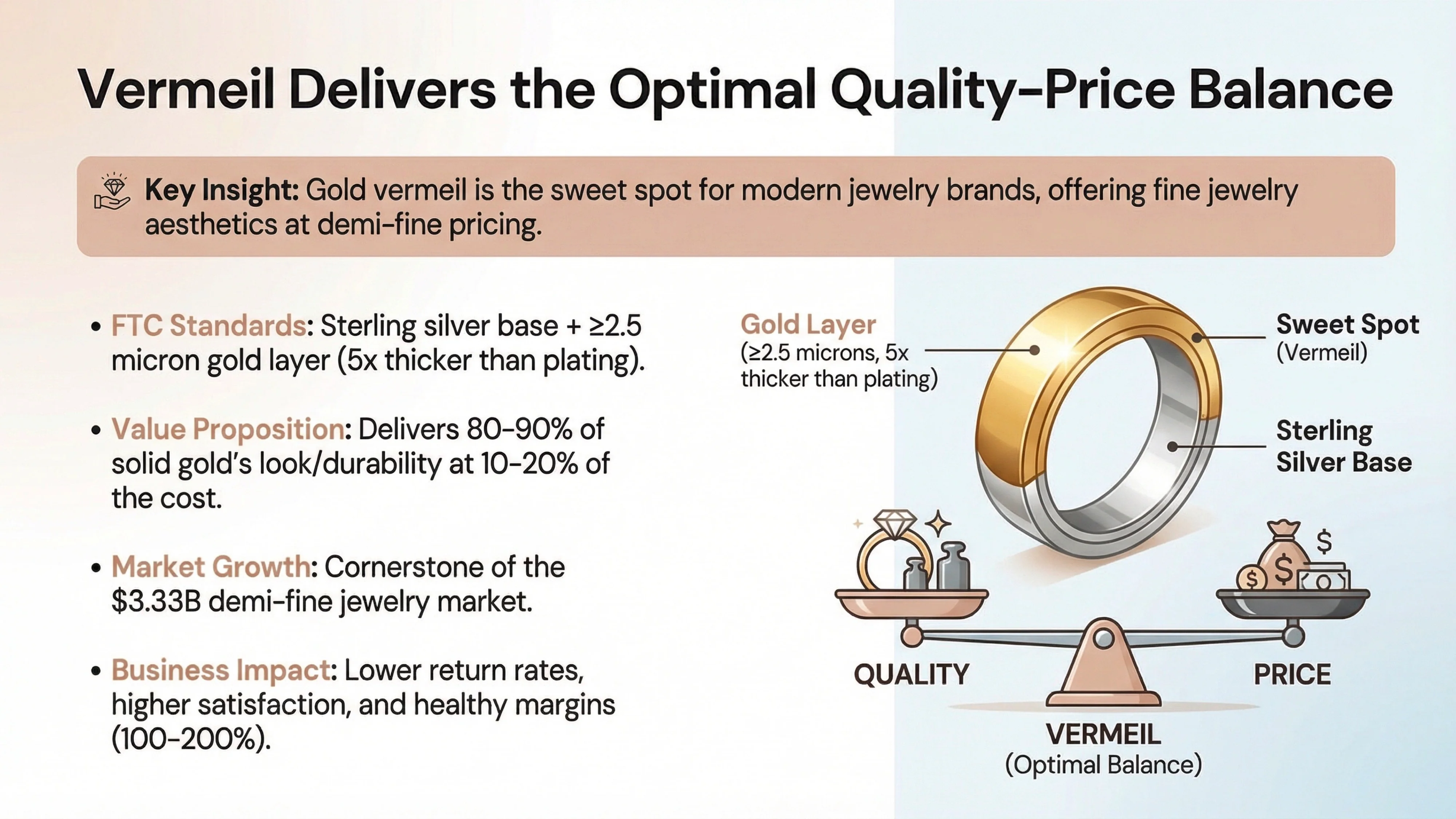
The Federal Trade Commission sets strict standards for what can be labeled "vermeil" [1]. To use this term, jewelry must meet three specific requirements:
These requirements create a product that's fundamentally different from standard gold plating. The sterling silver base is itself a precious metal, and the thick gold layer provides genuine durability.
Gold vermeil occupies a unique position in the market because it delivers the aesthetic and much of the durability of fine jewelry at a fraction of the cost. A vermeil necklace can look virtually identical to an 18k solid gold piece, yet retail for $80 instead of $800.
This price-to-quality ratio is possible because the bulk of the piece is sterling silver (significantly less expensive than gold) while the visible surface is genuine gold. Customers get the warm gold tone, the weight of precious metal, and durability that lasts years—not months. This is why vermeil has become the cornerstone of the "demi-fine" jewelry category, which has grown into a $3.33 billion market and is projected to nearly double by 2032 [2].
The 2.5-micron minimum thickness requirement for vermeil creates a substantial durability advantage over gold plating. While gold plated jewelry typically shows wear within 6-24 months, properly made vermeil can last 2-5 years or more with regular wear [4]. With proper care—removing jewelry before swimming, showering, or applying lotions—vermeil pieces can maintain their appearance even longer.
The sterling silver base also contributes to durability. Unlike brass or copper, which corrode and cause skin discoloration, sterling silver is stable and hypoallergenic for most people. Even if the gold layer eventually wears thin in high-contact areas (like the inside of a ring band), the exposed sterling silver remains attractive and doesn't cause the "green skin" issue associated with base metals.
Modern consumers, particularly millennials and Gen Z, have embraced demi-fine jewelry because it aligns with their values and purchasing behavior. They want quality that lasts, but they also want variety, trend responsiveness, and accessible price points. Vermeil delivers this combination.
Customers accept vermeil because the value proposition is transparent and fair. They understand they're not buying solid gold, but they're also not buying disposable fashion jewelry. They're investing in pieces they can wear regularly, build a collection around, and feel confident gifting or wearing to important occasions. This clarity builds trust—the foundation of repeat business.
From a reseller perspective, vermeil offers healthy margins without the extreme markups that can feel exploitative. Wholesale costs for vermeil pieces typically range from $15-$60 depending on complexity, while retail prices range from $50-$200. This represents a 100-200% markup—substantial enough to support your business while remaining competitive [5].
Equally important, vermeil's durability means lower return rates and customer service costs. When customers receive quality that meets or exceeds their expectations, they become repeat buyers and brand advocates rather than sources of complaints. This operational efficiency compounds your profitability over time.
In our experience at Branvas, gold vermeil consistently delivers the best balance between quality, margins, and customer satisfaction for growing brands. We've seen founders build six-figure businesses on vermeil collections because the material allows them to compete on value rather than price alone. Customers return not because they need to replace worn-out pieces, but because they want to expand their collections. That's the difference between a transaction and a relationship—and vermeil makes those relationships possible at scale.
Solid gold jewelry represents the pinnacle of the jewelry hierarchy—and for good reason. It offers unmatched durability, timeless appeal, and intrinsic value. However, for many jewelry resellers, especially those in early growth stages, solid gold presents practical challenges that can hinder rather than help business development.
When we talk about solid gold jewelry, we're referring to pieces made entirely from gold alloy throughout—not just on the surface. However, "solid gold" doesn't mean pure gold. Pure 24k gold is too soft for most jewelry applications, so it's alloyed with other metals like copper, silver, or palladium to increase durability.
The most common purities in the US market are:
The gold content directly affects both the price and the properties of the jewelry. Higher karat gold is more expensive, has a richer yellow color, but is also softer and more prone to scratching.
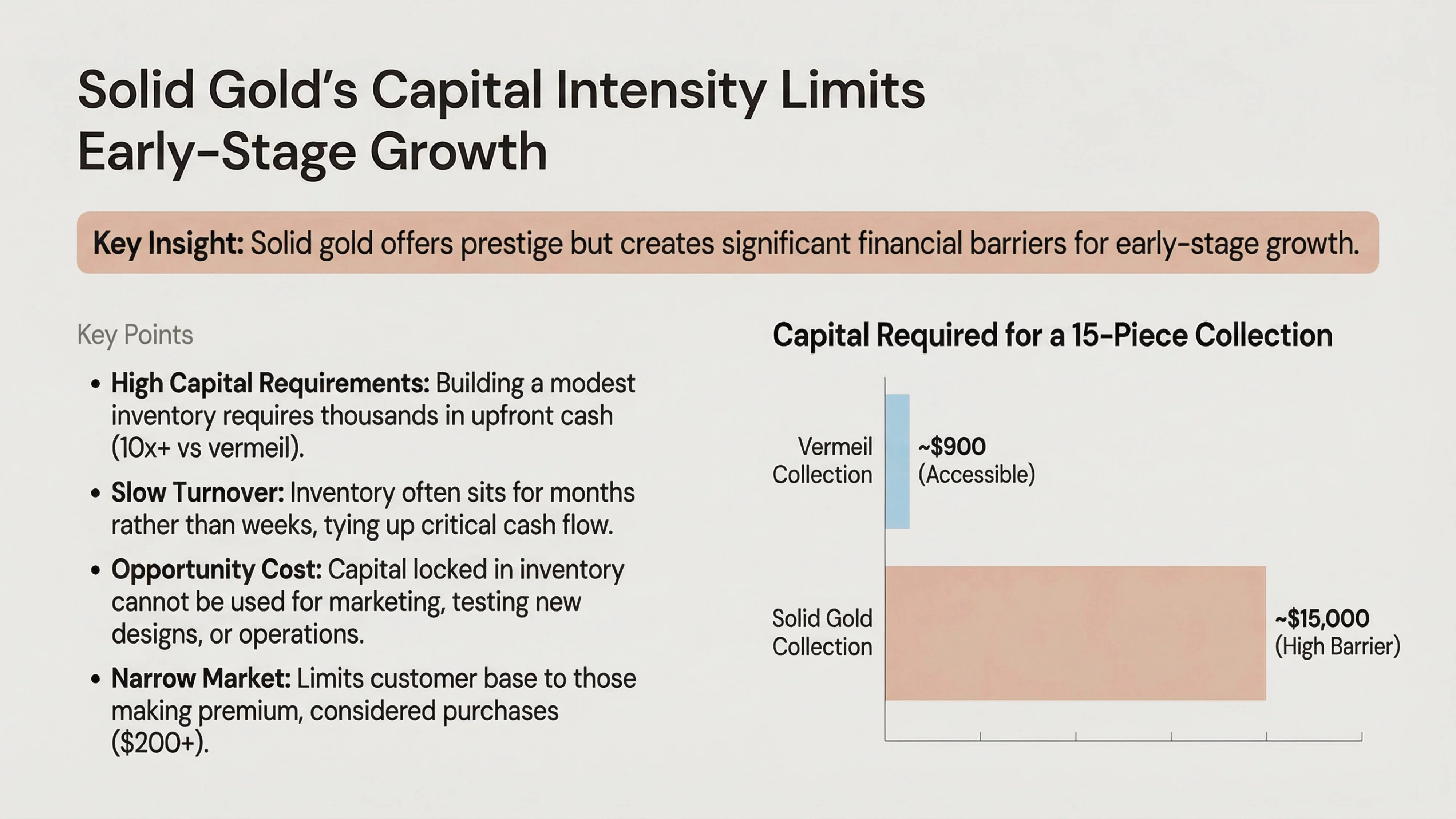
The most significant challenge solid gold presents for resellers is capital intensity. Wholesale prices for solid gold jewelry are substantially higher than plated or vermeil alternatives. A simple pair of 14k gold stud earrings might wholesale for $80-$150, while a comparable vermeil pair costs $15-$30. A solid gold necklace can easily wholesale for $300-$1,000 or more depending on weight and design.
This means building even a modest solid gold inventory requires thousands of dollars in upfront capital. For a new reseller trying to test designs, respond to customer feedback, and iterate on their product mix, this capital requirement creates significant constraints. Your money is tied up in inventory that may take months to sell, limiting your ability to experiment, market, or expand into new product categories.
Solid gold jewelry appeals to a narrower customer segment—those making considered purchases for special occasions, milestone gifts, or investment pieces. These customers take time to research, compare options, and make decisions. While gold plated and vermeil pieces might turn over in weeks, solid gold inventory can sit for months before finding the right buyer [6].
This slower turnover has cascading effects. It ties up capital longer, increases carrying costs, and limits your ability to respond to trends or seasonal opportunities. For jewelry businesses that rely on cash flow to fund growth, this can create a challenging cycle where your best inventory (by value) is also your least liquid.
Selling solid gold also comes with heightened customer expectations around authenticity and certification. Customers paying $500-$2,000 for a gold piece expect—and deserve—verification that they're receiving genuine gold at the stated purity. This means:
These requirements are manageable for established jewelers with expertise and systems in place, but they can be overwhelming for new resellers who are still learning the fundamentals of the business.
Solid gold isn't inherently wrong for resellers—it's a question of timing and business model. For early-stage resellers, solid gold often creates more problems than it solves:
These constraints slow your learning, limit your growth, and increase the risk of business failure before you've had a chance to find product-market fit.
Here's a perspective that contradicts conventional wisdom in the jewelry industry: starting with solid gold can actually damage your brand's long-term potential, even though it seems like the "premium" choice.
Most new jewelry founders believe that selling higher-quality materials automatically positions them as a premium brand. The logic seems sound: better materials equal better brand perception. But this overlooks several critical realities of building a jewelry business.
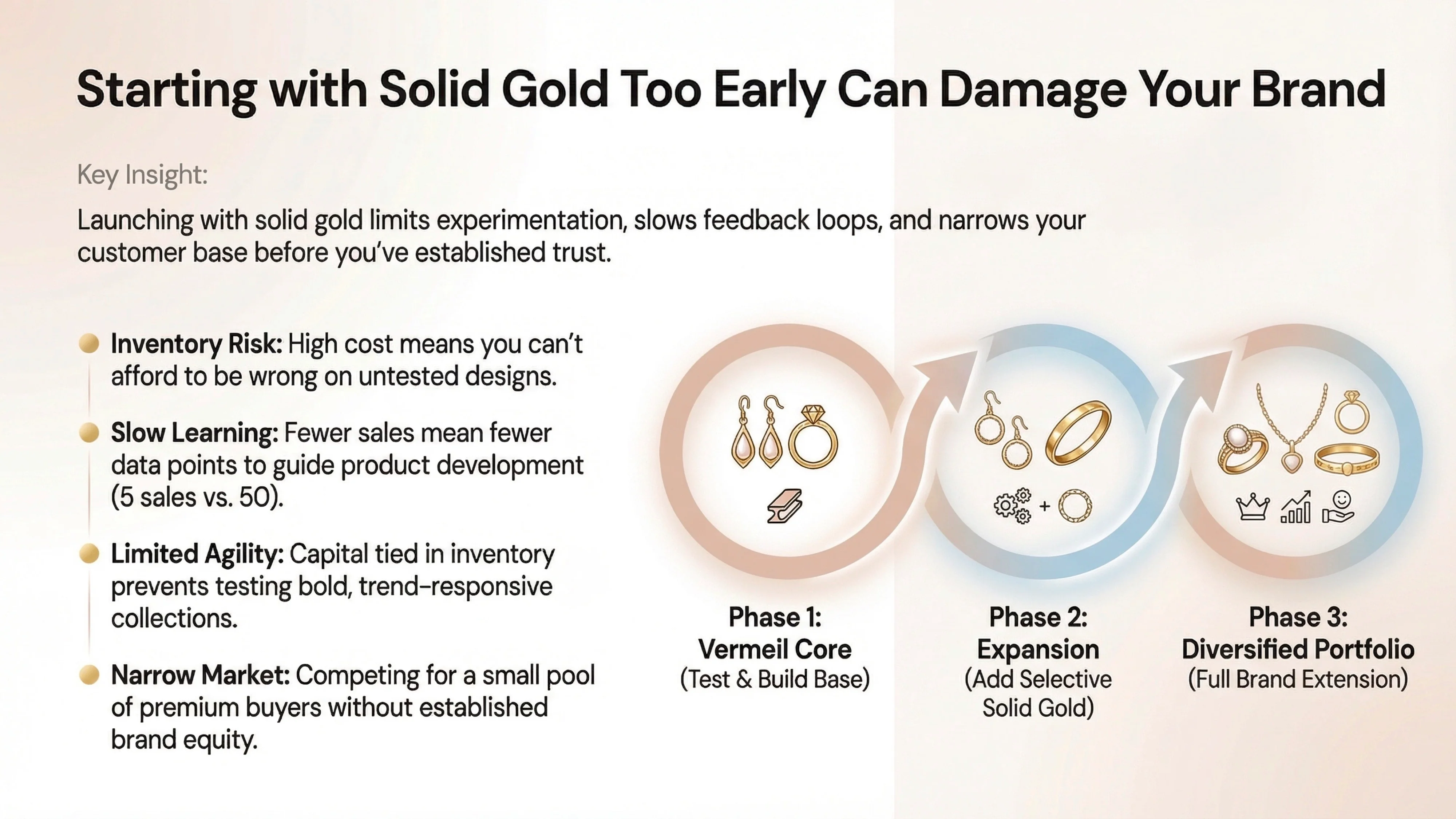
When you invest heavily in solid gold inventory early on, you're making a massive bet that you've correctly identified what your customers want—before you have sufficient data to know. If those pieces don't sell quickly, you're stuck with expensive inventory you can't easily liquidate, and no capital to pivot or try new approaches.
In contrast, starting with vermeil or even carefully positioned gold plated pieces allows you to test designs, gather customer feedback, and iterate rapidly. You can afford to be wrong, learn from it, and adjust. This experimentation phase is where you discover what resonates with your specific audience—insights that are invaluable when you eventually do introduce solid gold pieces.
Solid gold immediately narrows your addressable market to customers willing to spend $200+ on a single piece. For a new brand without established trust or recognition, this is a small audience. You're competing with established fine jewelry brands that have decades of reputation, and you're asking customers to make a significant financial commitment to an unproven brand.
Starting with more accessible price points (vermeil in the $50-$150 range) allows you to build a customer base, establish trust, and create brand advocates. Once you have loyal customers who love your designs and trust your quality, introducing solid gold pieces becomes much easier—they're already believers in your brand.
In the early stages of a jewelry business, speed of learning is more valuable than margin per piece. If you sell 50 vermeil pieces in a month, you get 50 data points about what customers love, what they return, what they rave about, and what falls flat. If you sell 5 solid gold pieces in that same month, you have far less information to guide your decisions.
This velocity of feedback is crucial for product development, marketing messaging, and customer understanding. Solid gold's slower turnover means you learn more slowly—a significant disadvantage when you're trying to establish a foothold in a competitive market.
Jewelry trends evolve constantly. The ability to quickly introduce new designs, test seasonal collections, and respond to emerging styles is a competitive advantage. When each new design requires a $500+ inventory investment per piece, you can't afford to experiment much. You become conservative, risk-averse, and slow to adapt.
With lower-cost materials, you can afford to try bold designs, limited editions, and trend-responsive pieces. Some will fail, but the successful ones will define your brand identity and attract your core customers. This creative freedom is difficult to maintain when working exclusively with solid gold.
This doesn't mean solid gold has no place in your business—it means timing matters. Consider introducing solid gold when:
At this stage, solid gold becomes a natural brand extension rather than a risky bet. Your existing customers are ready to invest more in your brand, and you have the operational maturity to serve them well.
One of the most common challenges resellers face is communicating material differences to customers in a way that's clear, honest, and helpful—without sounding technical or salesy. The language you use directly affects customer trust, return rates, and long-term satisfaction.
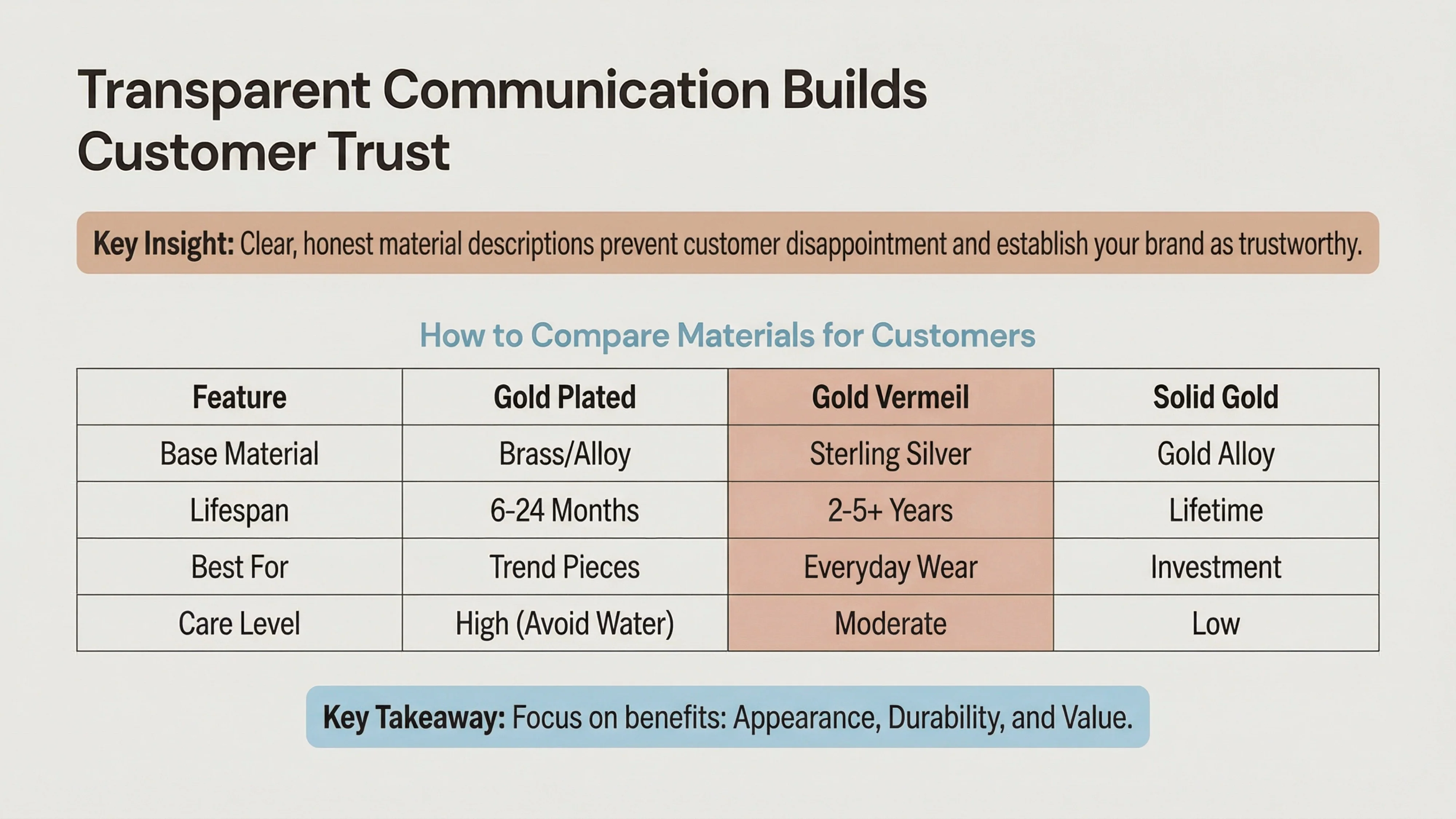
Avoid industry jargon and focus on what customers actually care about: how it looks, how long it lasts, and what they're paying for.
For Gold Plated: "This piece features a thin layer of real gold over a durable base metal. It offers the beautiful look of gold at an accessible price. With proper care—avoiding water, perfume, and lotions—it will maintain its appearance for several months of regular wear. Perfect for trend pieces and seasonal styles."
For Gold Vermeil: "This piece is crafted from sterling silver and coated with a thick layer of 18k gold (at least 5x thicker than standard gold plating). This creates jewelry that looks and feels like solid gold, with durability that lasts for years. It's the perfect balance of quality and value—genuine precious metals without the premium price tag."
For Solid Gold: "This piece is made entirely of 14k gold throughout—not just on the surface. It will never tarnish, never wear away, and can be passed down through generations. It's an investment piece that maintains both its beauty and its intrinsic value over time."
Notice how each description focuses on customer benefits (appearance, durability, value) rather than technical specifications. This approach helps customers make informed decisions based on their priorities.
Providing a clear comparison helps customers self-select the right material for their needs and budget.
|
Feature |
Gold Plated |
Gold Vermeil |
Solid Gold |
|---|---|---|---|
|
Base Material |
Brass or alloy |
Sterling silver |
Gold alloy throughout |
|
Gold Layer |
Thin coating |
Thick coating (5x+ plated) |
Solid throughout |
|
Typical Lifespan |
6-24 months |
2-5+ years |
Lifetime |
|
Best For |
Trend pieces, occasional wear |
Everyday jewelry, building a collection |
Investment pieces, heirlooms |
|
Price Range |
$10-$50 |
$50-$200 |
$200-$2,000+ |
|
Care Level |
High (avoid water, chemicals) |
Moderate (remove before swimming/showering) |
Low (very durable) |
This table empowers customers to make decisions based on their usage patterns and budget, reducing the likelihood of dissatisfaction after purchase.
Transparency builds trust, while misleading claims destroy it—often permanently. Follow these principles:
Be specific about materials: Don't use vague terms like "gold-toned" or "gold finish" when you mean gold plated. State clearly what the base metal is and what the coating is.
Don't overpromise durability: If a piece is gold plated, don't claim it will "last for years" or suggest it's comparable to solid gold. Set realistic expectations.
Disclose care requirements: Make care instructions prominent in product descriptions. Customers who know they need to remove jewelry before showering are less likely to be disappointed when they forget and see tarnishing.
Use FTC-compliant terminology: Follow the FTC Jewelry Guides [1] for terms like "vermeil," "gold," and "karat." Using these terms incorrectly isn't just misleading—it can be legally problematic.
The most successful jewelry resellers we work with at Branvas treat transparency as a competitive advantage, not a liability. They:
When you're transparent about what you're selling, you attract customers who want exactly that—and those are the customers who become loyal, repeat buyers.
Choosing the right material isn't about finding the "best" option—it's about aligning material choice with your business model, target customer, and growth stage. Use this decision framework to guide your strategy.
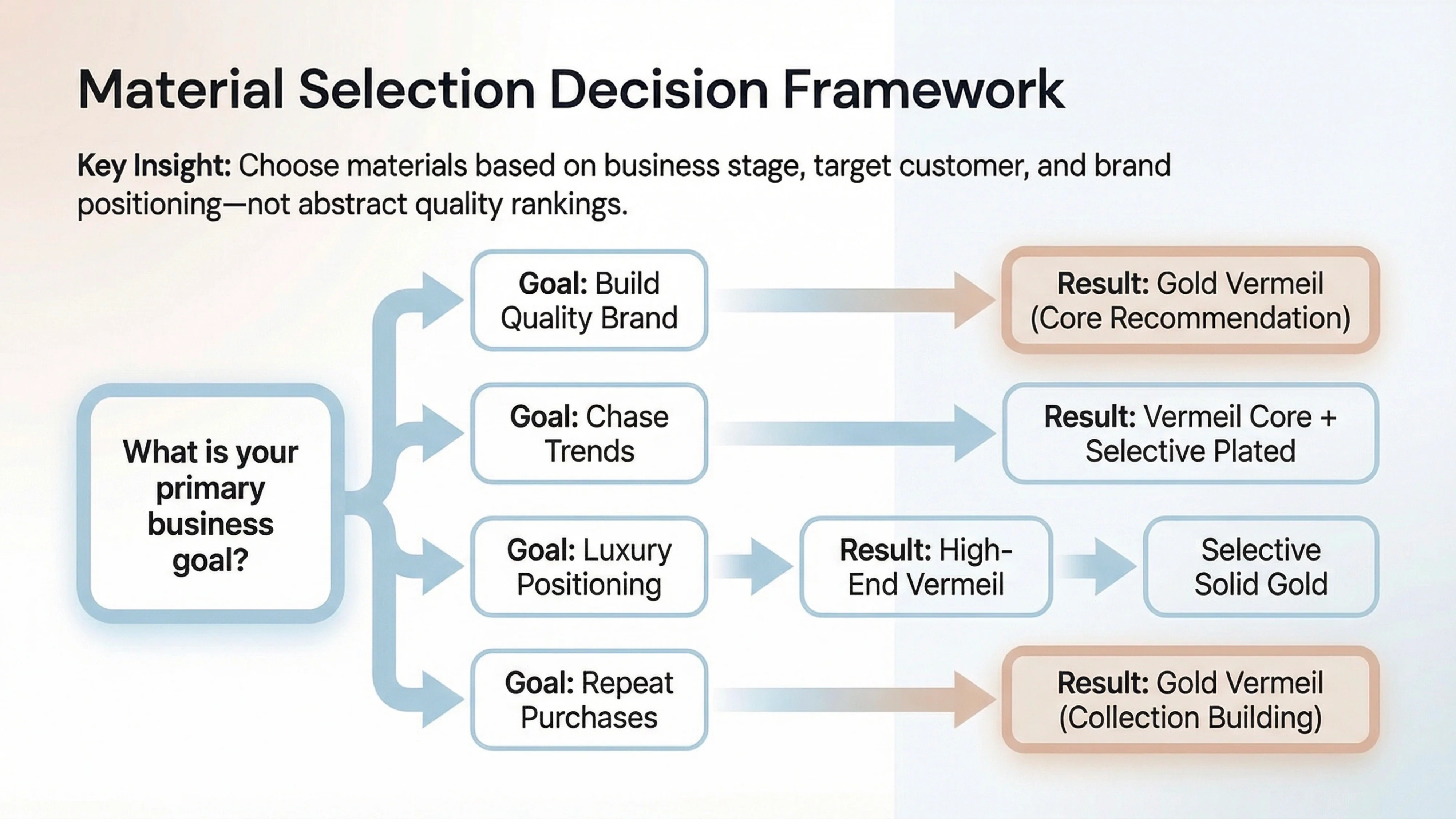
Recommendation: Focus on gold vermeil
When you're launching a jewelry business, vermeil offers the best combination of quality, affordability, and customer satisfaction. It allows you to:
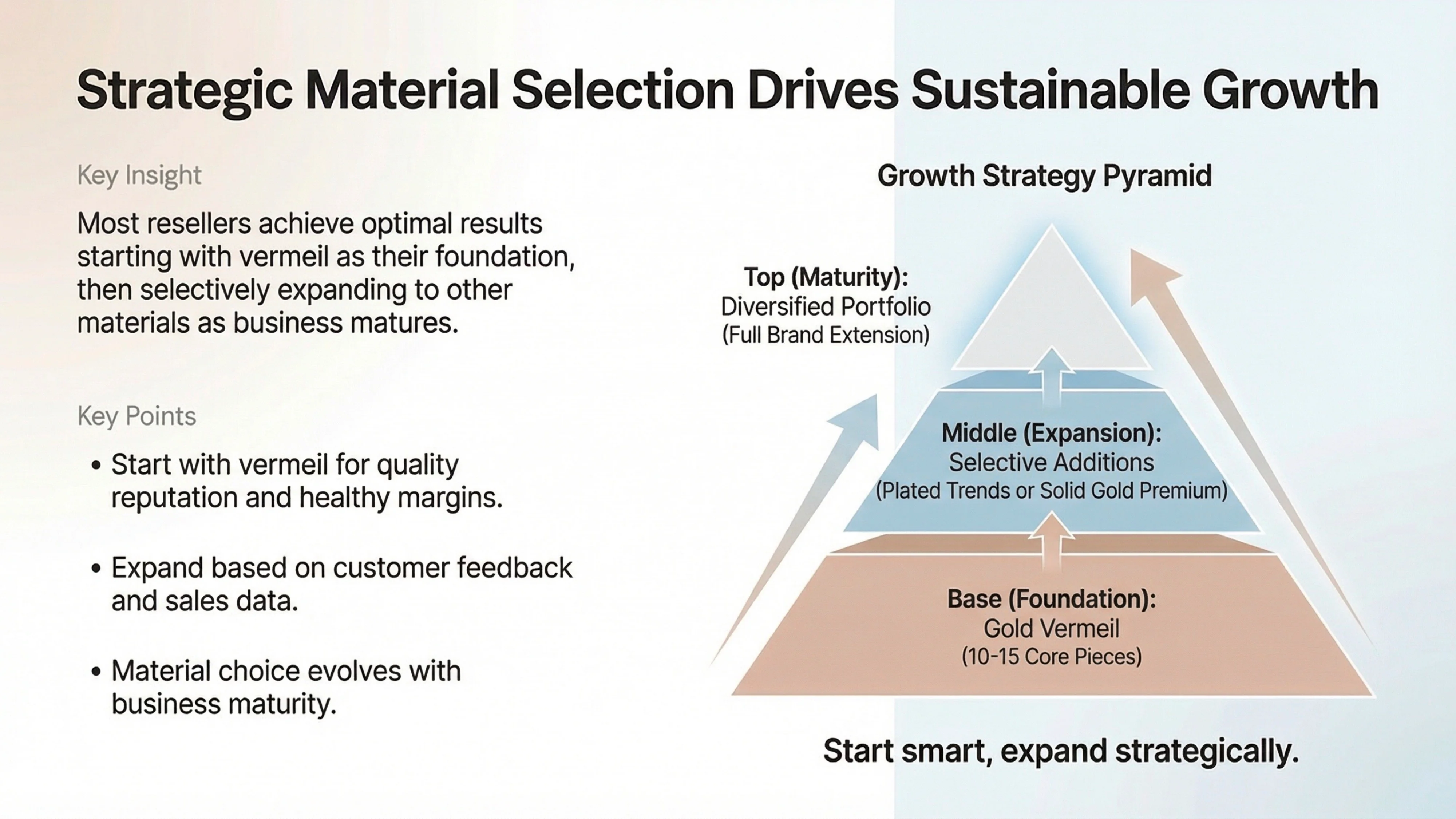
Start with a core collection of 10-15 vermeil pieces in your signature style. As you gain traction and understand what resonates with your customers, you can expand into complementary materials.
Recommendation: Gold vermeil as your foundation, with selective gold plated trend pieces
Fashion-forward brands need to respond quickly to trends while maintaining quality standards. A hybrid approach works well:
This approach gives you the flexibility to chase trends without compromising your brand's quality reputation.
Recommendation: Start with gold vermeil, introduce solid gold selectively
Even luxury brands don't need to be exclusively solid gold—many successful fine jewelry brands offer both vermeil and solid gold collections. Consider this progression:
This approach allows you to position as luxury without the capital intensity of a fully solid gold inventory.
Recommendation: Gold vermeil is your best bet
Repeat purchase behavior depends on customer satisfaction and accessible price points. Vermeil excels at both:
Design your collections to encourage stacking, layering, and coordinating—this drives repeat purchases as customers build their personal style with your pieces.
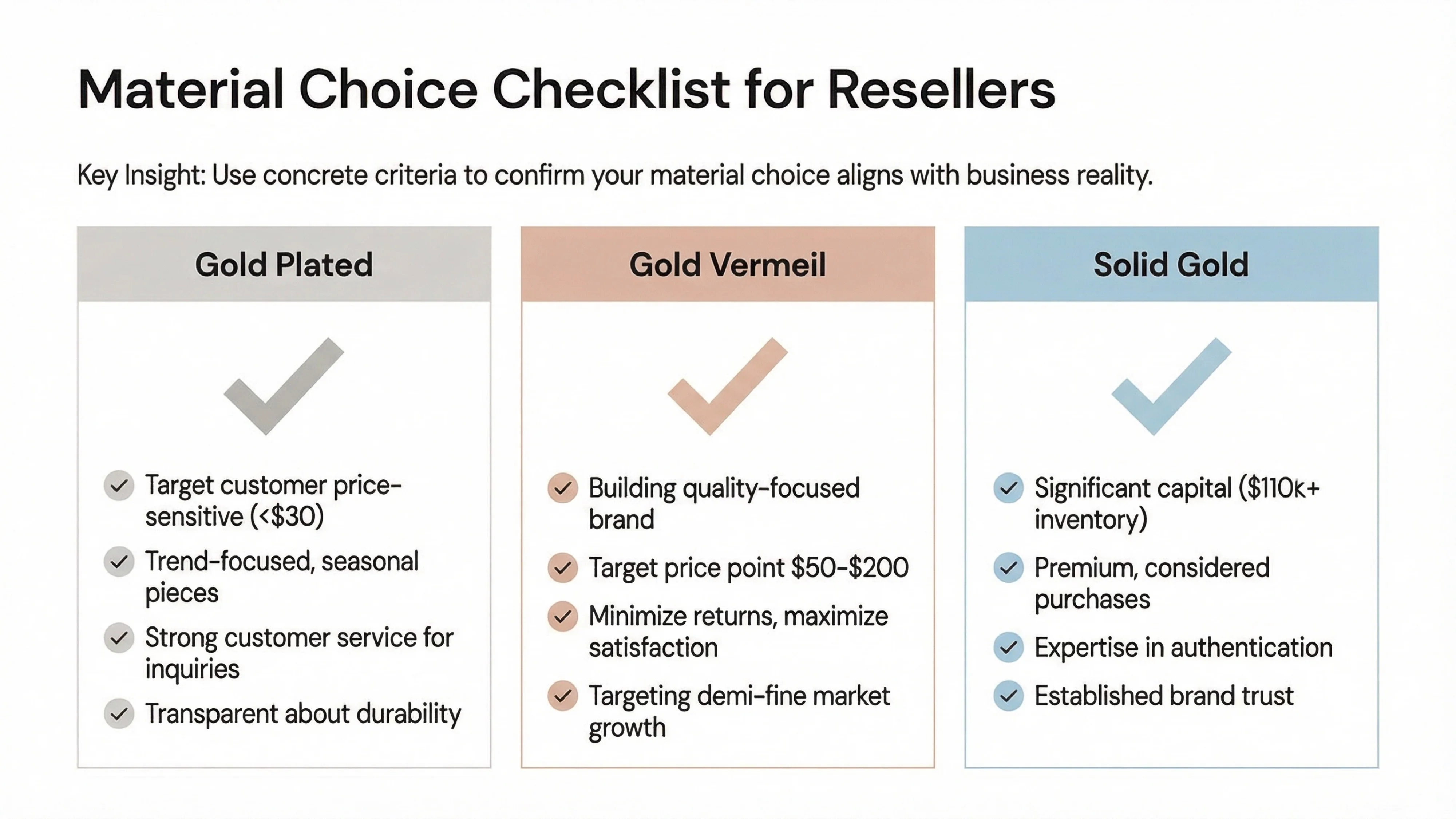
Use this checklist to confirm your material choice aligns with your business reality:
✅ Choose Gold Plated if:
✅ Choose Gold Vermeil if:
✅ Choose Solid Gold if:
Most resellers will find that vermeil offers the best foundation for sustainable growth, with selective expansion into other materials as their business matures.
At Branvas, we've built our platform specifically to address the challenges jewelry resellers face when sourcing quality materials and building sustainable brands. Our focus on gold vermeil and other brand-ready materials isn't arbitrary—it's based on years of working with founders and understanding what actually drives success in this industry.
We recognize that sourcing quality vermeil can be challenging for new resellers. Many wholesale suppliers have high minimum order quantities, inconsistent quality standards, or limited design options. This creates barriers for founders who want to offer quality materials but don't have the capital or expertise to navigate traditional jewelry supply chains.
Branvas solves this by providing access to verified, FTC-compliant vermeil jewelry with transparent specifications. You know exactly what you're getting: the base metal composition, the gold thickness, the karat weight. This transparency allows you to confidently market your products and set appropriate customer expectations—the foundation of trust and repeat business.
Beyond vermeil, we offer a curated selection of materials that meet the "brand-ready" standard: quality that supports premium positioning without requiring premium capital investment. This includes gold-filled jewelry, sterling silver, and carefully selected fashion jewelry that's designed for durability rather than disposability.
Risk comes in many forms for jewelry resellers: financial risk from inventory investment, reputational risk from quality issues, operational risk from returns and customer complaints. Branvas is designed to minimize all three.
Financial risk reduction comes from accessible pricing and reasonable minimum orders. You can test new designs and styles without committing thousands of dollars upfront. This allows you to learn what your customers want before making large inventory investments.
Reputational risk reduction comes from consistent quality. When you source from Branvas, you're not gambling on whether a supplier's "gold plated" actually means 0.1 microns or 0.5 microns. You're getting verified materials that meet stated specifications, which means customers receive what you promised.
Operational risk reduction comes from durability. Vermeil and other quality materials have lower return rates because they meet or exceed customer expectations. This means less time managing complaints and more time growing your business.
Building a jewelry brand requires consistency—in quality, in messaging, in customer experience. When you're sourcing from multiple suppliers with varying standards, maintaining that consistency is nearly impossible. You're constantly firefighting quality issues, explaining discrepancies, and managing customer disappointment.
Branvas provides the consistency that allows you to focus on what actually differentiates your brand: your design aesthetic, your customer relationships, your marketing voice. You can confidently say "all our jewelry is gold vermeil" and know that every piece meets that standard. This consistency builds customer trust and simplifies your operations.
We're not trying to be everything to everyone. We're specifically focused on supporting resellers who want to build quality-focused brands in the demi-fine jewelry space—the fastest-growing segment of the jewelry market. If you're targeting ultra-budget customers or exclusively selling fine jewelry, other platforms might serve you better. But if you're building a brand around the sweet spot of quality, affordability, and style, Branvas is designed for exactly that.
The best jewelry material for most resellers is gold vermeil, which balances quality, durability, profit margins, and customer satisfaction. Vermeil consists of sterling silver coated with a thick layer of gold (at least 2.5 microns), providing the appearance and much of the durability of solid gold at a fraction of the cost. This allows resellers to position themselves in the growing demi-fine jewelry market, with typical retail prices of $50-$200 and healthy margins of 100-200%. Vermeil's durability (2-5+ years with proper care) leads to lower return rates and higher customer satisfaction compared to gold plated alternatives, while requiring far less capital investment than solid gold inventory.
Yes, gold vermeil is significantly better than gold plated jewelry in terms of quality, durability, and customer satisfaction. Vermeil has three key advantages: (1) it uses a sterling silver base instead of brass or copper, which is more valuable and doesn't cause skin discoloration; (2) it has a much thicker gold layer (minimum 2.5 microns vs. typically 0.5 microns or less for plated); and (3) it lasts 2-5+ years with regular wear compared to 6-24 months for gold plated pieces. According to FTC standards, vermeil must meet strict requirements for base metal, gold thickness, and gold quality, while "gold plated" has no minimum thickness requirement. For resellers, vermeil's superior durability translates to fewer returns, better reviews, and stronger customer loyalty.
Gold vermeil is typically classified as "demi-fine" jewelry rather than fine jewelry. Fine jewelry traditionally refers to pieces made from solid precious metals (gold, platinum, silver) throughout, not just on the surface. However, vermeil occupies a premium position between fashion jewelry and fine jewelry, offering genuine precious metals (sterling silver base and real gold coating) with durability that far exceeds fashion jewelry. Many successful jewelry brands position vermeil as "accessible luxury" or "everyday fine jewelry" to communicate its quality level. The key is transparency: clearly explain what vermeil is, how it's made, and why it offers excellent value. This honest positioning attracts customers who want quality without fine jewelry prices—a large and growing market segment.
Solid gold jewelry is expensive because it's made entirely of gold alloy throughout the piece, not just on the surface. Gold is a precious metal with intrinsic value based on global commodity markets, and solid gold jewelry contains significant gold weight. For example, a solid 14k gold necklace might contain 5-10 grams of pure gold, which alone represents $300-$600 in material cost at current gold prices, before accounting for design, labor, or markup. Additionally, solid gold jewelry requires skilled craftsmanship, quality control for purity verification, and often includes hallmarking or certification. For resellers, this translates to wholesale costs of $200-$1,000+ per piece and significant capital requirements to build inventory. While solid gold offers unmatched durability and prestige, the high cost makes it challenging for early-stage resellers to stock and for many customers to afford.
Explain jewelry materials by focusing on what customers actually care about: appearance, durability, price, and care requirements. Use simple, benefit-focused language rather than technical jargon. For example, describe gold vermeil as "sterling silver coated with thick 18k gold—looks like solid gold, lasts for years, at a fraction of the price" rather than "2.5-micron electroplated gold over 925 sterling silver base." Create comparison tables showing lifespan, price range, and best use cases for each material. Be transparent about limitations: if a piece is gold plated, clearly state it's designed for occasional wear and will need care to maintain its appearance. Include care instructions prominently in product descriptions. Most importantly, never oversell or mislead—set realistic expectations so customers receive what they expect. This transparency builds trust, reduces returns, and creates loyal customers who appreciate your honesty.
[1] Federal Trade Commission. (2018). 16 CFR Part 23 - Guides for the Jewelry, Precious Metals, and Pewter Industries. Electronic Code of Federal Regulations. https://www.ecfr.gov/current/title-16/chapter-I/subchapter-B/part-23
[2] Fortune Business Insights. (2024). Demi Fine Jewelry Market Growth & Trends Analysis [2032]. https://www.fortunebusinessinsights.com/demi-fine-jewelry-market-108419
[3] Monica Vinader. (2024). Gold Vermeil vs Gold Plated: What's the Difference? https://www.monicavinader.com/us/our-blog/gold-plated-vs-gold-vermeil
[4] Diamond Rensu. (2023). Vermeil vs Gold Plated: Understanding the Differences. https://diamondrensu.com/blogs/education/vermeil-vs-gold-plated
[5] Fame Accessories. (2024). How Much Do Jewelry Resellers Make? Understanding The Potential Profits. https://www.fameaccessories.com/blog/2024/04/13/how-much-do-jewelry-resellers-make-understanding-the-potential-profits/
[6] Jewel360. (2025). Inventory Aging Reports: When To Mark Down Expensive Jewelry. https://jewel360.com/blog/inventory-aging-reports


