


TikTok Shop creators earn 13% average commissions, but returns, fees, and clawbacks reduce effective pay—making brand ownership a higher-margin alternative.
Published:
July 21, 2026
Author:
Yi Cui
TikTok Shop has fundamentally changed creator monetization, driving $15.1 billion in US Gross Merchandise Value (GMV) in 2025 alone [1]. For creators wondering how much TikTok Shop actually pays, the short answer is: more than traditional affiliate programs, but less than the gross numbers suggest.
For creators looking to maximize their earning potential, understanding these mechanics is the first step. The next logical step is moving from affiliate to owner.
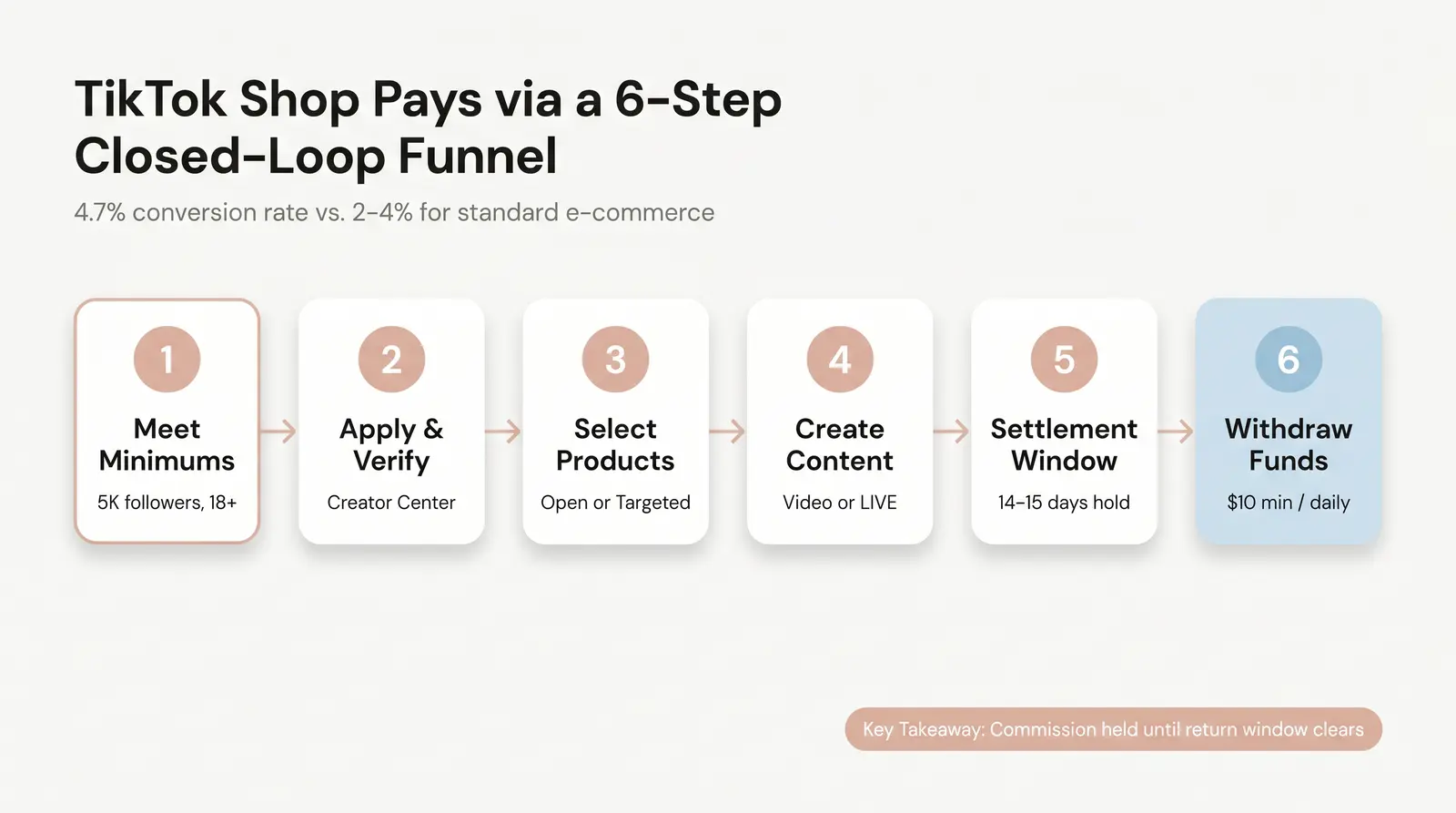
The TikTok Shop affiliate program is a native commerce engine that allows creators to promote products and earn a commission on every sale—without the buyer ever leaving the app. This frictionless, closed-loop system converts at an average of 4.7%, compared to the 2-4% standard for traditional e-commerce [5].
Here is exactly how to get paid on TikTok Shop:
Unlike Amazon Associates, which locks creators into rigid, single-digit rate cards, TikTok Shop commissions are set by individual sellers. This creates a highly competitive marketplace where brands bid for creator attention.
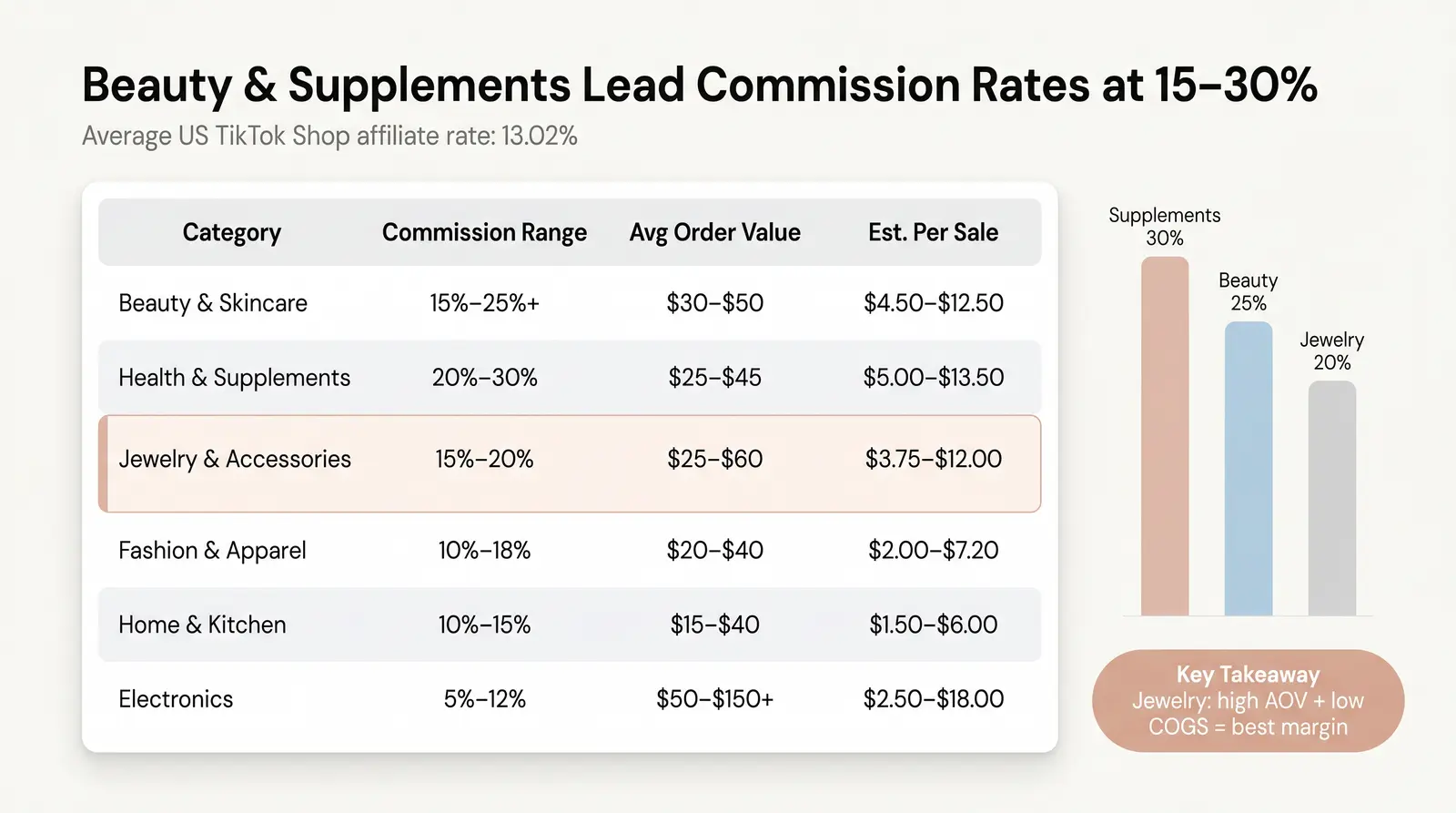
Based on 2025–2026 marketplace data, here is a breakdown of typical commission rates by category:
| Product Category | Typical Commission Range | Average Order Value (AOV) | Estimated Earnings Per Sale | Notes & Caveats |
|---|---|---|---|---|
| Beauty & Skincare | 15% – 25%+ | $30 – $50 | $4.50 – $12.50 | Highly competitive; requires strong before/after demo content. |
| Health & Supplements | 20% – 30% | $25 – $45 | $5.00 – $13.50 | High margins allow for aggressive commissions; strong repeat purchase rate. |
| Jewelry & Accessories | 15% – 20% | $25 – $60 | $3.75 – $12.00 | Excellent visual appeal and high perceived value; strong impulse buy category. |
| Fashion & Apparel | 10% – 18% | $20 – $40 | $2.00 – $7.20 | High volume, but notorious for high return rates which trigger commission clawbacks. |
| Home & Kitchen | 10% – 15% | $15 – $40 | $1.50 – $6.00 | Viral gadget potential, but lower AOV requires massive view volume. |
| Electronics | 5% – 12% | $50 – $150+ | $2.50 – $18.00 | Thinner margins dictate lower percentages, though absolute dollar earnings can be high. |
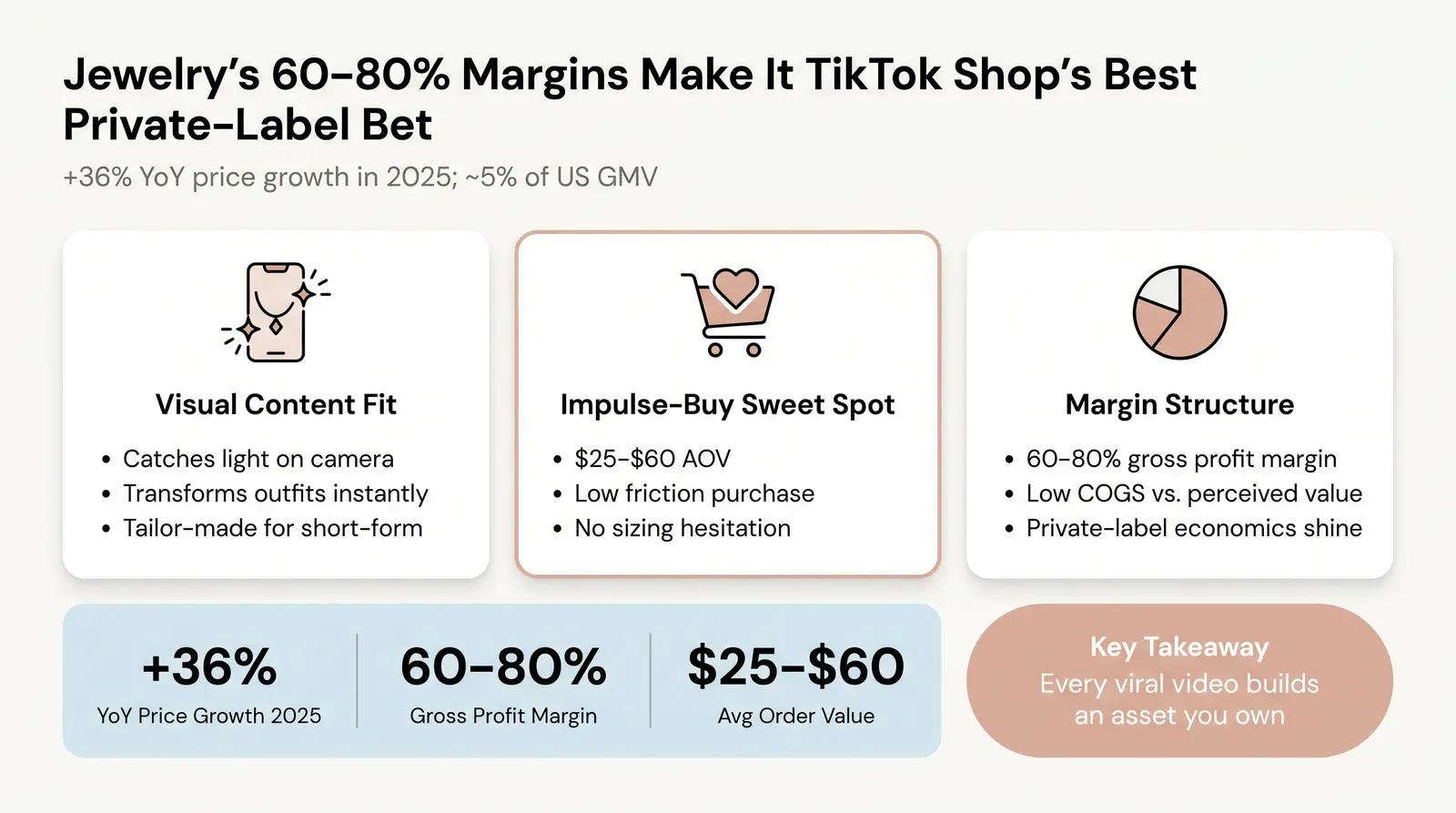
Notice where jewelry and accessories sit. The category offers a favorable commission band combined with a solid AOV. More importantly, jewelry has a low cost of goods sold (COGS) relative to its perceived retail value—a structural advantage that becomes crucial when we look at brand ownership later.
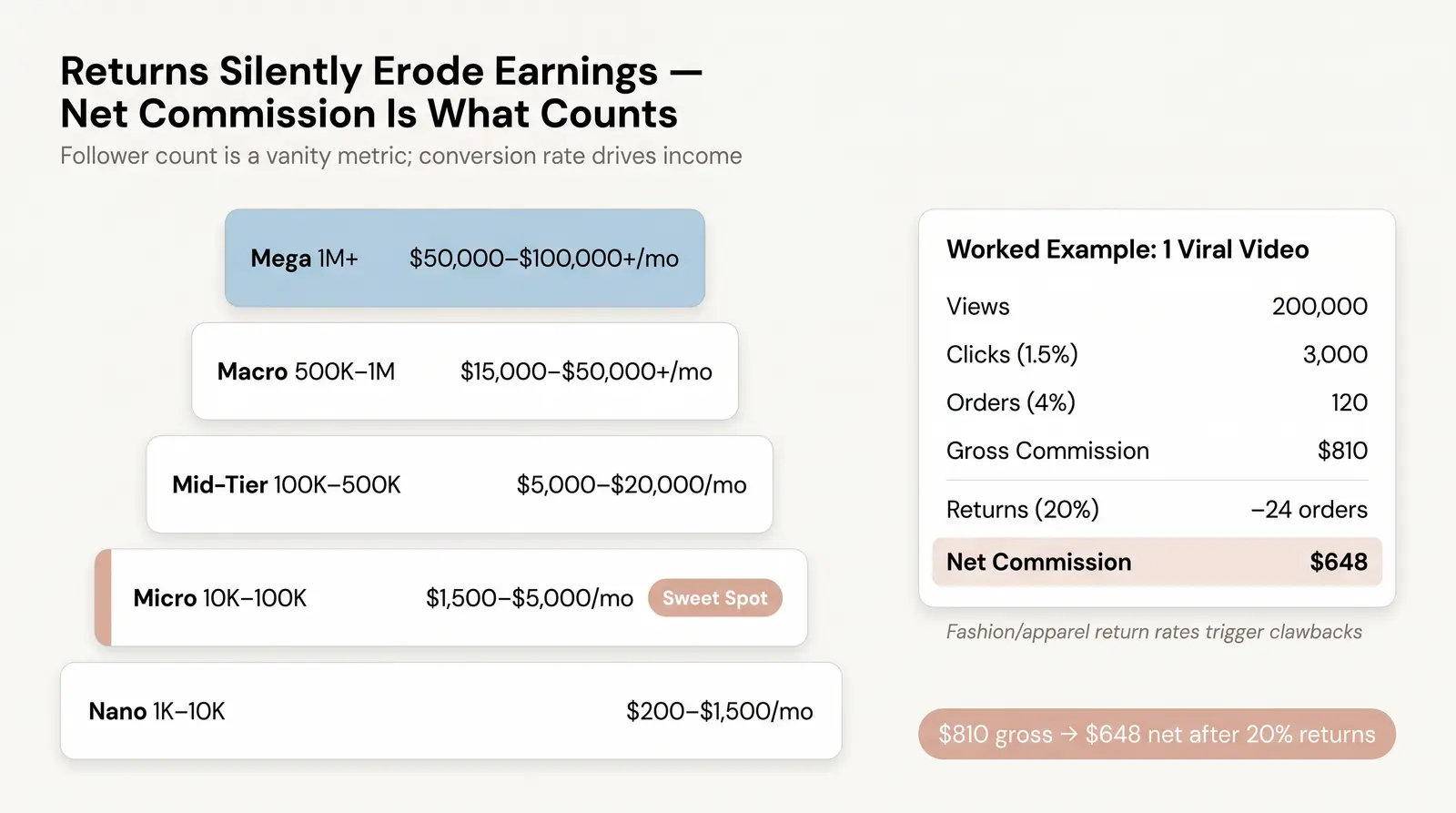
Follower counts are vanity metrics on TikTok Shop. Because the algorithm distributes content based on engagement and conversion velocity rather than pure follower base, earnings vary wildly.
Here are realistic monthly earnings estimates based on 2026 data:
The Worked Example: The Hidden Cost of Returns
Let’s look at the math for a micro-creator with 85,000 followers in the fashion and accessories niche.
She posts 3 videos a week promoting a $45 jewelry product at a 15% commission rate. One video hits the algorithm, generating 200,000 views.
On paper, she made $810 from one video. But here is the contrarian reality most creators ignore: Affiliate income is calculated on net retained revenue, not gross GMV.
If that product has a 20% return rate (common in fashion and apparel), 24 of those orders will be returned. TikTok Shop claws back the commission on returned items before the settlement window closes [11].
Furthermore, the creator spent 4 hours scripting, filming, and editing those three videos. When you factor in the effective hourly rate of content production, the net profit shrinks further. Most creators overestimate their TikTok Shop income because they fail to account for returns, refund clawbacks, and their own labor costs.
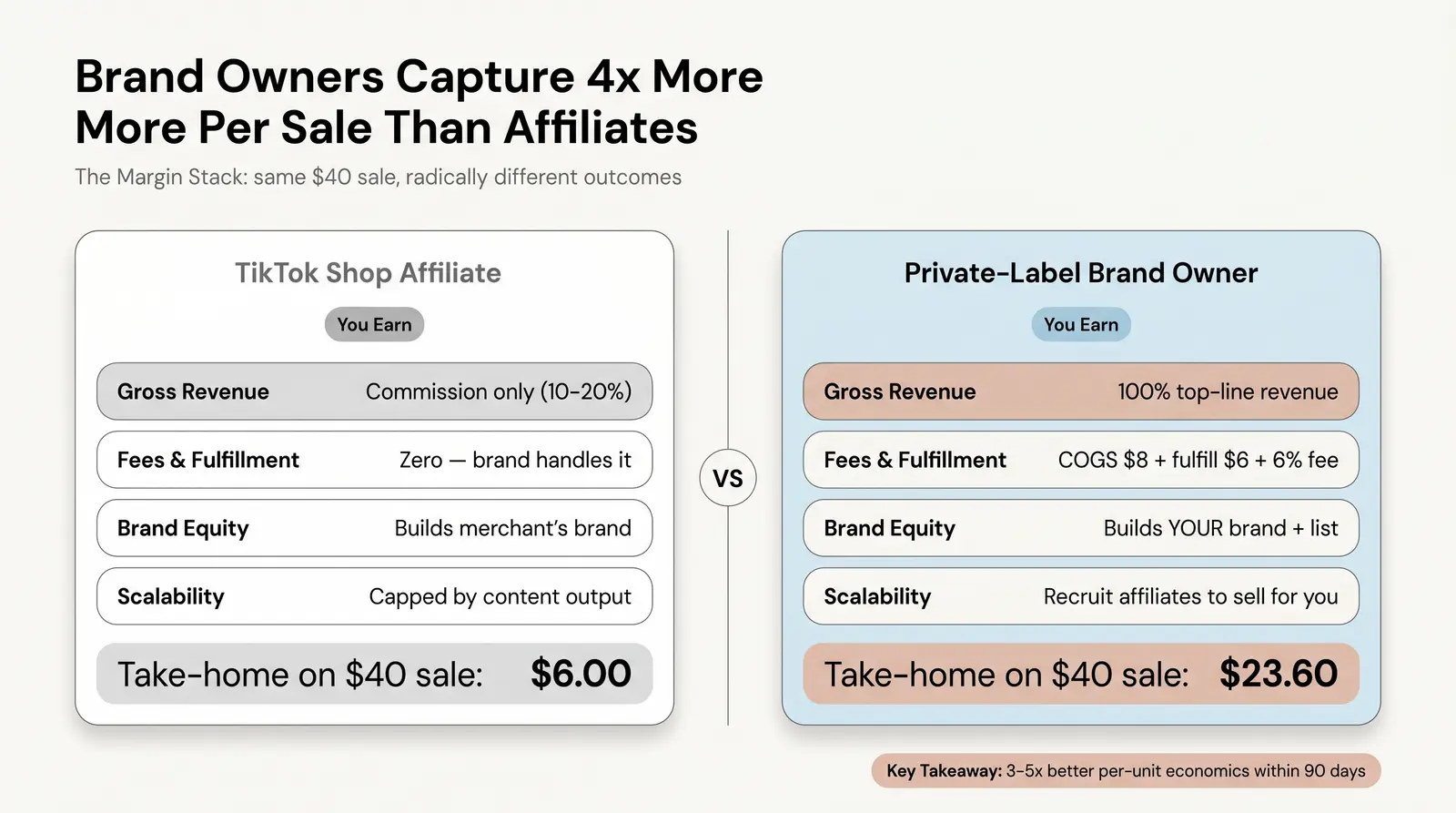
At Branvas, we use what we call the Margin Stack Model to help creators visualize the difference between affiliate economics and brand-owner economics.
Affiliate marketing is an incredible way to start monetizing, but it has a hard ceiling. You are essentially renting someone else's business. You bear the content creation cost, but the brand captures the customer data, the repeat purchases, and the long-term brand equity.
Here is how the economics shift when you move from promoting someone else's product to selling your own private-label brand:
| The Margin Stack | TikTok Shop Affiliate | Private-Label Brand Owner (via Branvas) |
|---|---|---|
| Layer 1: Gross Revenue | Captures 10% - 20% (Commission) | Captures 100% (Top-line Revenue) |
| Layer 2: Fees & Fulfillment | Zero cost (Brand handles logistics) | Absorbs COGS, TikTok 6% fee, and fulfillment costs |
| Layer 3: Brand Equity Accrual | Builds the merchant's brand recognition | Builds your own brand equity and customer list |
| Layer 4: Scalability Ceiling | Capped by content output and algorithm luck | Uncapped; can recruit other affiliates to sell for you |
Let’s apply realistic margin estimates to a $40 jewelry sale.
As an affiliate earning a generous 15% commission, your take-home is $6.00.
If you own the brand, that same $40 piece of jewelry might cost $8 to manufacture and $6 to fulfill. After TikTok's 6% referral fee ($2.40), your net margin is $23.60.
In our experience working with creators at Branvas, creators who make the switch from affiliate-only to owning a branded jewelry line typically see a 3–5x improvement in per-unit economics within their first 90 days—not because they work more, but because they stop splitting margin with a third-party brand.
Curious how your current TikTok Shop earnings stack up against what a private-label jewelry line could generate? Explore our Profit Calculator at branvas.com/profit-calculator to run your own numbers.
If you are considering the leap to brand ownership, jewelry and accessories is one of the highest-opportunity categories on TikTok Shop.
In 2025, while many e-commerce categories saw price compression, the jewelry and accessories category on TikTok Shop experienced a 36% year-over-year price increase [12]. It currently accounts for approximately 5% of US GMV, driven by several unique factors:
When you promote someone else's jewelry brand on TikTok Shop, you are training your audience to recognize their logo and packaging. When you launch your own line, every viral video builds an asset you actually own.
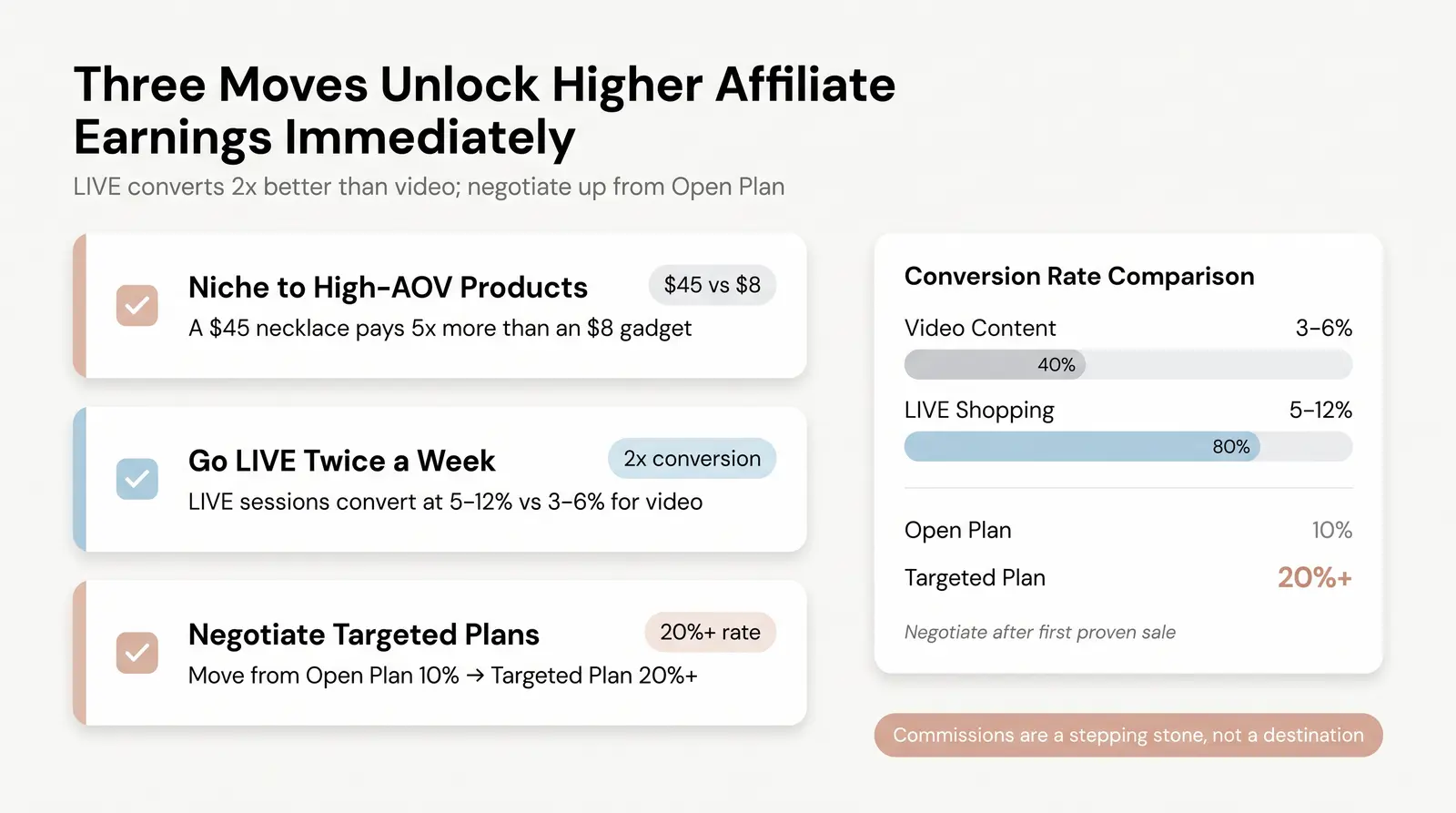
If you are currently an affiliate, here is how to maximize your immediate earnings:
However, recognize the ceiling of these tactics. The most successful creator-commerce operators eventually realize that renting margin is a stepping stone, not a destination.
If you're a creator ready to move beyond commissions and launch your own jewelry brand, Branvas makes it possible with no minimum order quantities and done-for-you branding — see how it works at branvas.com/how-it-works.
1. How much does TikTok Shop pay creators per sale?
TikTok Shop pays creators a percentage of the sale price, determined by the seller. The average US commission rate is 13.02%, but rates typically range from 10% to 20% depending on the product category. Beauty and supplements pay the highest (15-25%), while electronics pay the lowest (5-10%).
2. What is the minimum follower count to join TikTok Shop as an affiliate?
In the US, you generally need a minimum of 5,000 followers to join the standard TikTok Shop affiliate program. You must also be at least 18 years old and have posted a public video in the last 28 days. Creators with fewer followers may access pilot programs or secure targeted brand deals through agencies.
3. How and when does TikTok Shop pay out commissions?
TikTok Shop holds commissions during the product's return window, which is typically 14 to 15 days after the order is delivered. Once that settlement period clears, the funds are deposited into your TikTok Shop creator wallet. From there, you can withdraw the money to your linked bank account daily.
4. Can you make a full-time income from TikTok Shop affiliate commissions?
Yes. Mid-tier creators (100K–500K followers) with engaged audiences in high-converting niches like beauty, fashion, or jewelry can earn $5,000 to $20,000+ per month. However, it requires consistent content production (15+ videos a month) and a strategic focus on products with strong conversion rates and low return rates.
5. What's the difference between being a TikTok Shop affiliate and selling your own products on TikTok Shop?
An affiliate promotes other brands' products for a 10-20% commission, bearing the content creation effort while the brand handles fulfillment and keeps the customer data. Selling your own products (like a private-label jewelry line) means you capture 100% of the revenue margin, build your own brand equity, and can recruit other affiliates to sell for you.