


Fashion influencers earn 6x more revenue by launching a private-label jewelry brand instead of relying on affiliate commissions, capturing customer data and long-term brand equity.
Published:
September 9, 2026
Author:
Yi Cui
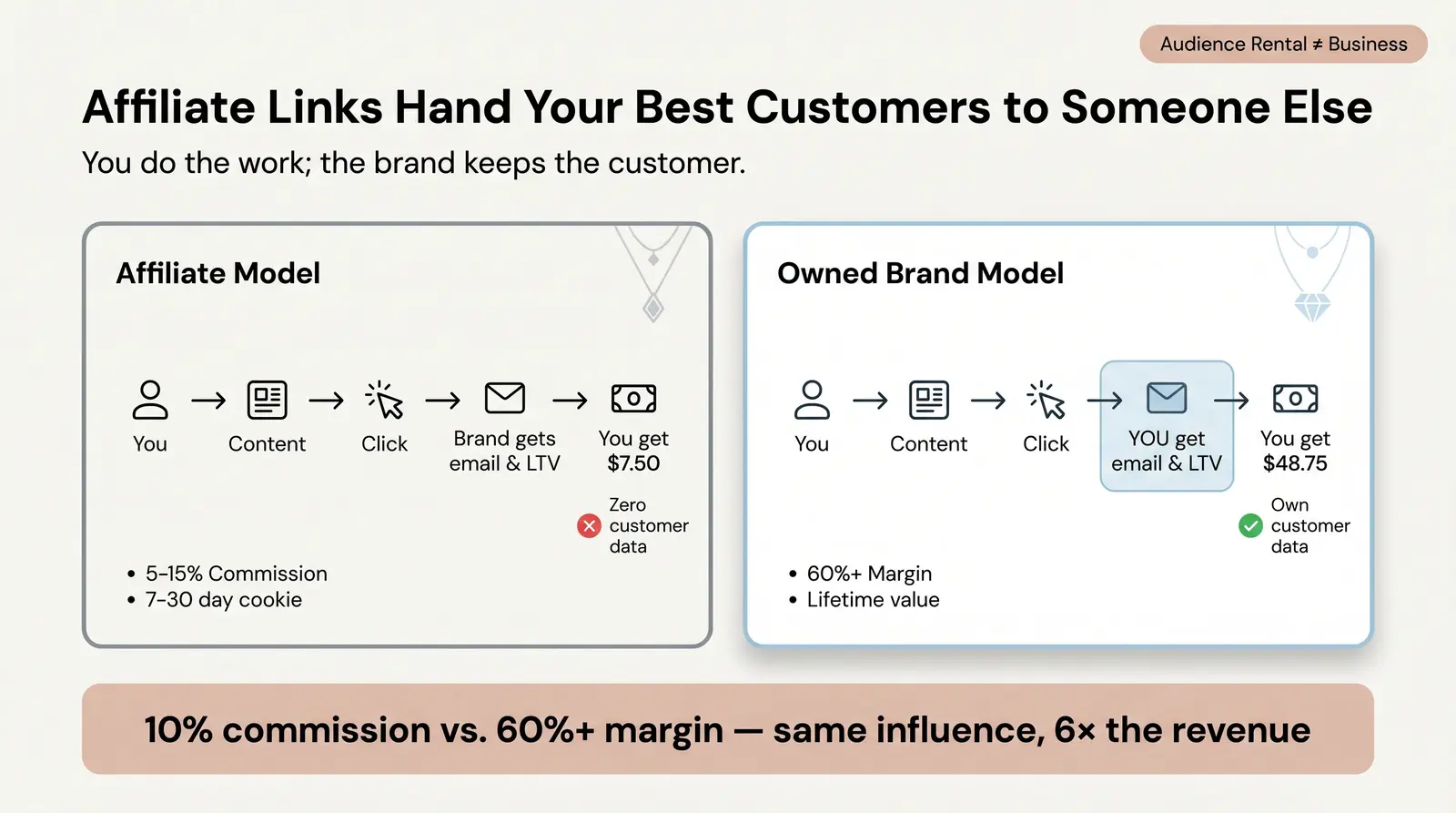
Stop renting your audience; own your brand. It is a shift in mindset that separates the creators who build lasting wealth from those who burn out chasing the next algorithm update. Imagine you drive 1,000 clicks to a jewelry partner's website, and 30 of those followers buy a $50 necklace. At a standard 10% affiliate commission, you earn $150. Now imagine those same 30 followers buying a $50 necklace from your own private-label jewelry line. With a 60% gross margin, you earn $900. That is a 600% increase in revenue for the exact same amount of influence, the same content, and the same trust you already built.
The math is undeniable, but the strategic gap is even wider. When you send a follower to another brand through an affiliate link, you are handing over the most valuable asset in commerce: the customer relationship. The brand captures their email address, their purchase history, and their lifetime value. You get a one-time payout. When you sell your own product, you capture the data, the repeat purchases, and the brand equity.
You have already done the hard part. You built the audience, earned their trust, and proved you can drive sales. The question is no longer whether you can sell jewelry. The question is why you are still settling for 10% of the upside when you could be capturing 60% and building an asset you actually own.
Affiliate monetization is the default starting point for most fashion influencers. You share a link, a follower clicks, a cookie tracks them for 7 to 30 days, and if they buy, you get a cut. In the jewelry and accessories space, typical affiliate commissions hover around 5% to 15% [1]. It feels like easy money because there is no inventory to manage and no customer service to handle.
But this model is fundamentally flawed for long-term growth. It is the definition of "audience rental." You are doing the heavy lifting of customer acquisition: creating the content, styling the pieces, and driving the traffic, while the brand reaps the long-term rewards. They get the customer's email address, the SMS opt-in, and the ability to retarget them for years to come. You get a single commission check.
Most influencers believe affiliate marketing is "low risk." The hidden risk, however, is that it transfers all your hard-earned brand equity to someone else. Platform dependency is a defining constraint on modern media business models, and attention without control is a fragile asset [2]. If an algorithm changes, a platform shuts down, or a brand slashes its commission rates, your income disappears overnight.
We talk to influencers every week who have hundreds of thousands of followers but own nothing: no customer list, no brand equity, no reorder revenue. They are trapped on a content treadmill, forced to constantly find new buyers because they have no way to re-engage the ones they already converted.
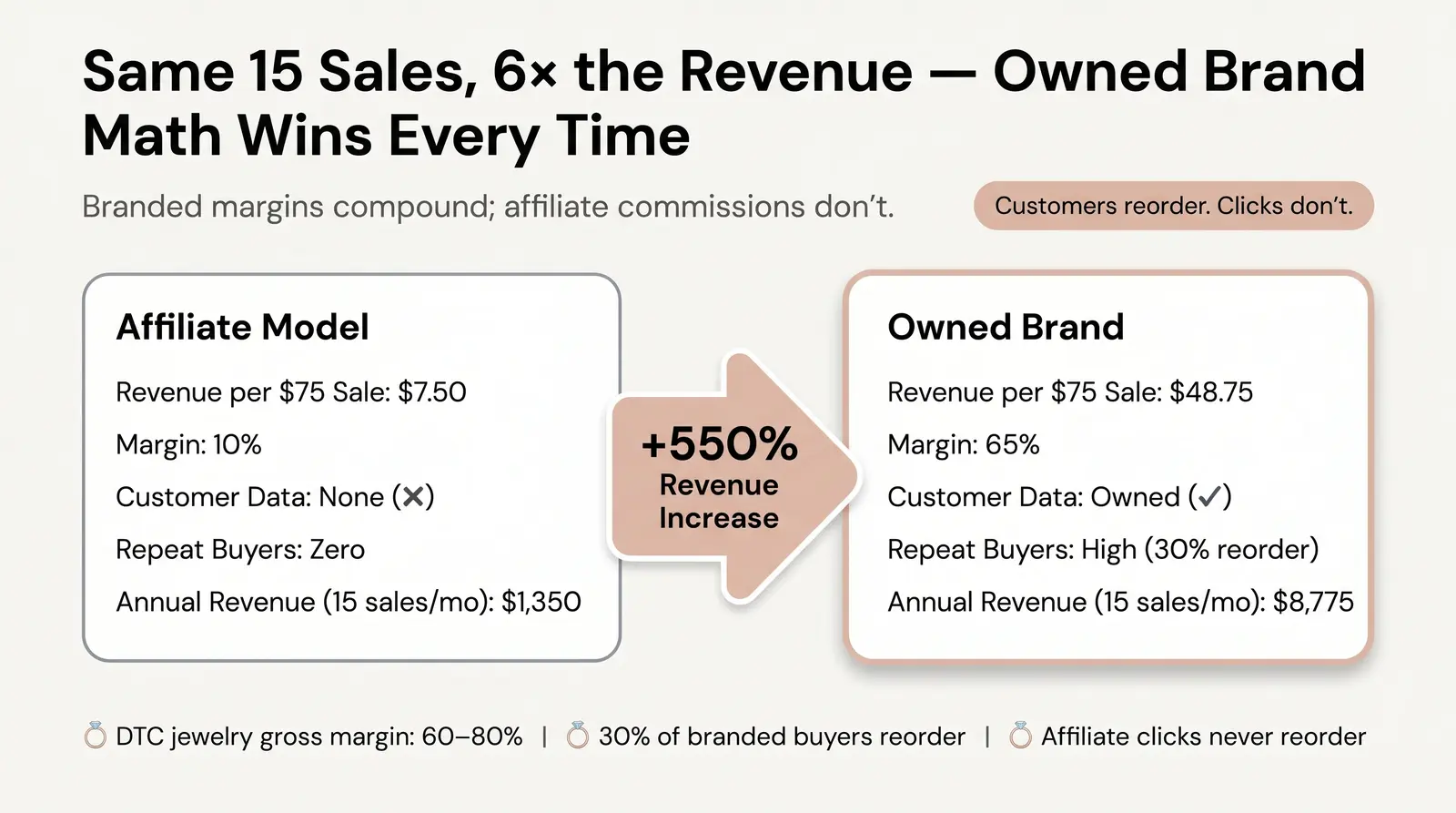
Transitioning from an affiliate model to an owned brand model changes the unit economics of your business entirely. For a direct-to-consumer (DTC) private-label jewelry brand, a healthy gross margin typically sits between 60% and 80% [3]. This means for every dollar in sales, you keep 60 to 80 cents after the cost of goods sold.
Consider "Influencer A," who has 50,000 engaged followers. Let's say she promotes a $75 gold vermeil chain necklace. In an affiliate scenario, she drives 500 clicks with a 3% conversion rate, resulting in 15 sales. At a 10% commission, she earns $112.50. If she runs that promotion once a month for a year, her annual revenue is $1,350.
Now look at the branded scenario. She launches her own private-label version of that $75 necklace with a 65% margin. The same 500 clicks and 3% conversion rate yield 15 sales. Her profit per sale is $48.75, netting her $731.25 for that single promotion. Over 12 months, that is $8,775. And that is before the compounding effect kicks in. Because she owns the customer data, 30% of those buyers return to purchase a second piece later in the year without any additional acquisition cost. Affiliate clicks do not reorder; branded customers do.
| Model | Revenue per $75 Sale | Margin % | Customer Data Owned | Repeat Purchase Potential | Brand Equity Built |
|---|---|---|---|---|---|
| Affiliate | $7.50 | 10% | No | Zero | None |
| Owned Brand | $48.75 | 65% | Yes | High | High |
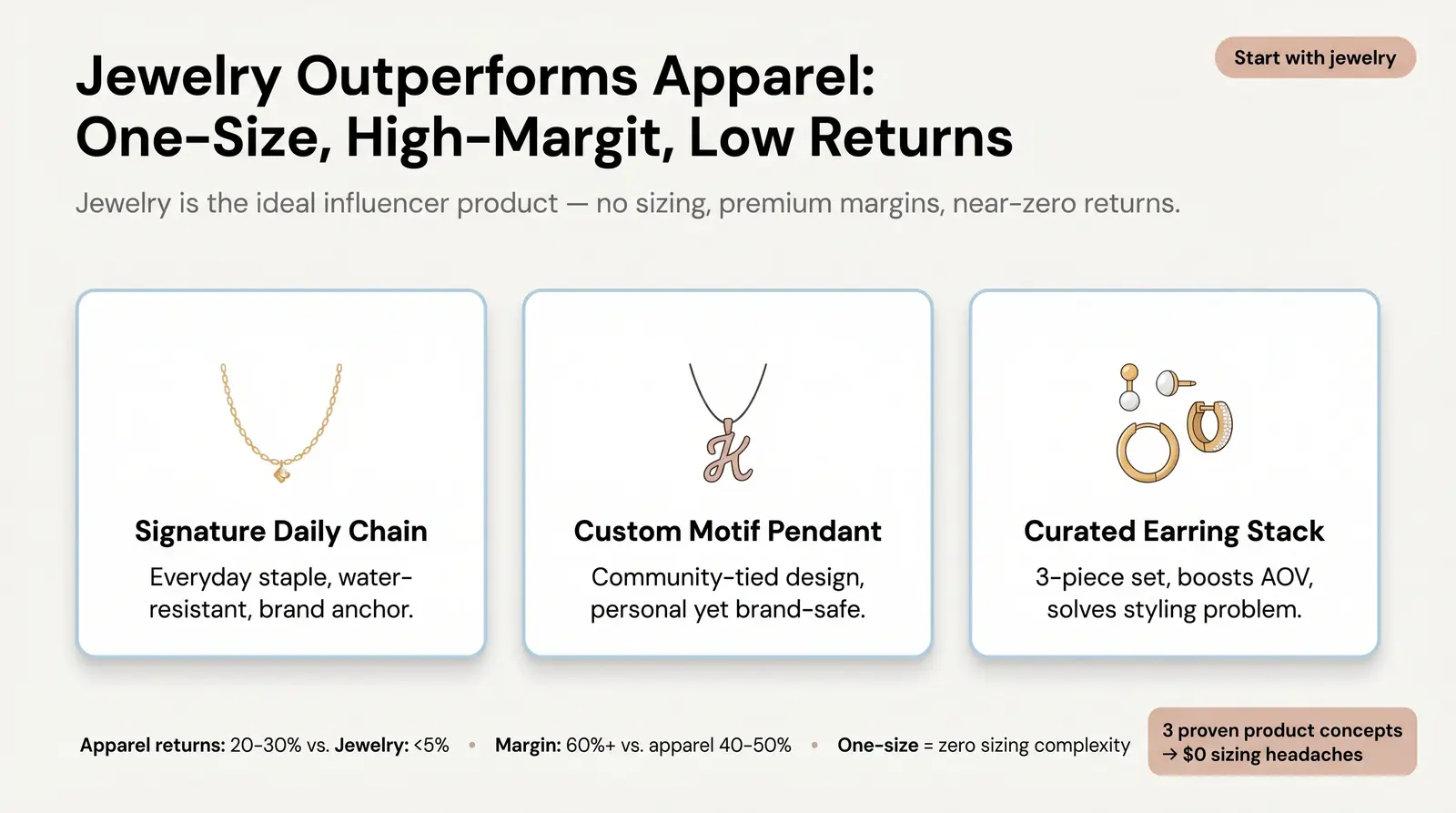
When creators think about launching products, they often default to printed t-shirts or hoodies. But for fashion and lifestyle influencers, apparel is notoriously difficult. It requires managing complex sizing matrices, dealing with high return rates (often 20% to 30%), and settling for lower margins.
Jewelry and accessories are the ultimate influencer merch ideas. They are one-size-fits-all, lightweight and cheap to ship, and boast incredibly low return rates. More importantly, they carry a high perceived value that supports premium pricing and 60%+ margins.
If you are considering an influencer jewelry brand, here are three proven product concepts that resonate with fashion audiences:
If you're exploring what products fit your audience, Branvas's product catalog is a good starting point. It's built specifically for creator brands.
The barrier to entry for starting a jewelry brand used to be insurmountable. You had to fly to overseas trade shows, wire thousands of dollars for minimum order quantities (MOQs), and turn your living room into a fulfillment center.
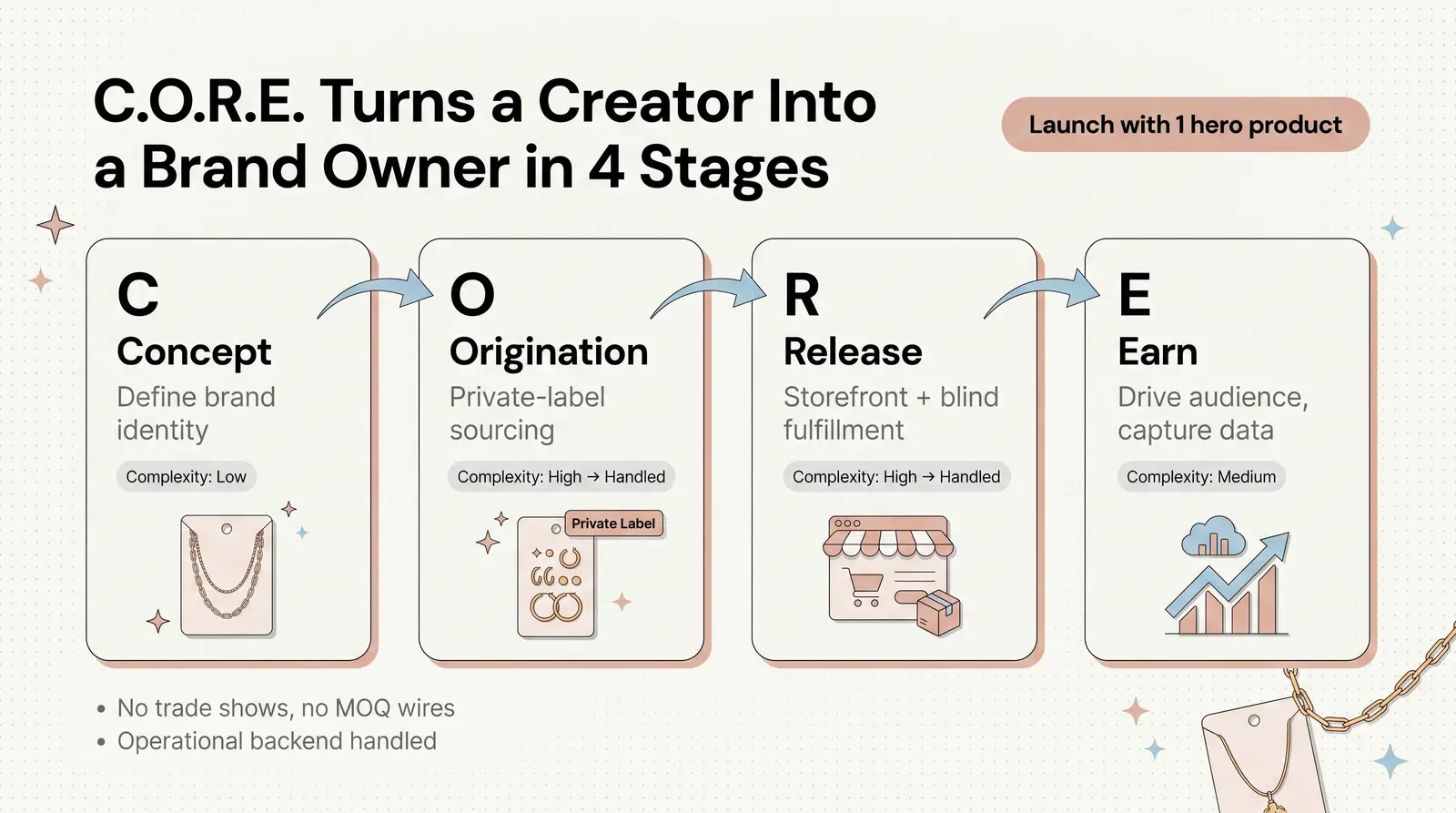
Branvas eliminates that friction. We are a Brand-as-a-Service platform that handles product sourcing, branding, packaging, and blind fulfillment. To help creators navigate the transition from affiliate to owner, we use The C.O.R.E. Brand Launch Model:
| Stage | Key Action | Branvas Role | DIY Complexity |
|---|---|---|---|
| C — Concept | Define your brand identity, target customer, and hero product. | Provide catalog of proven, high-margin jewelry styles. | Low |
| O — Origination | Source and private-label your product line. | Apply your custom branding to products and packaging. | High |
| R — Release | Set up your storefront and fulfillment pipeline. | Integrate with your store for automated, blind shipping. | High |
| E — Earn | Drive your audience to your store and capture data. | Fulfill orders on demand while you focus on marketing. | Medium |
In our experience at Branvas, influencers who launch with a single hero product and a clear aesthetic story outperform those who launch with a full catalog. Start focused.
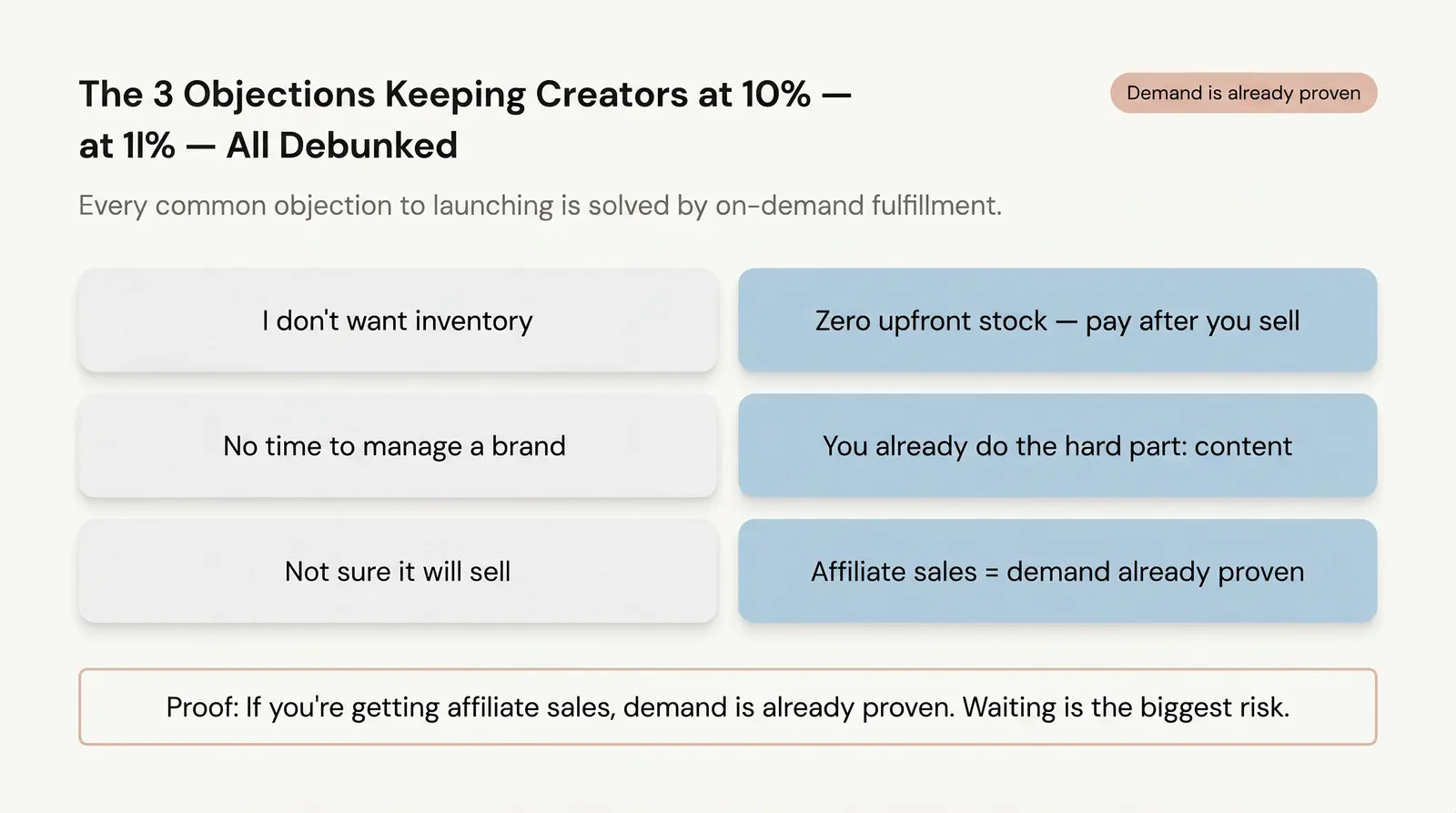
Despite the clear financial advantages, many creators hesitate to launch their own brands. Usually, it comes down to three outdated objections:
"I don't want to hold inventory."
You don't have to. The traditional wholesale model required buying hundreds of units upfront. Branvas operates on an on-demand, blind-shipping model. You only pay for a product after your customer has paid you. There is zero inventory risk.
"I don't have time to manage a brand."
You are already doing the hardest part of running a brand: marketing and content creation. Branvas acts as your operational backend. We handle the sourcing, the custom packaging, and the shipping. Your day-to-day workflow, creating content and engaging your audience, stays exactly the same.
"I'm not sure it will sell."
If you are currently generating affiliate sales, you already have demand proof. Your audience is already buying jewelry based on your recommendations; they are just buying it from someone else.
The biggest risk is not launching a product. It is waiting too long. The influencer who waits for "the right time" typically loses their window. Algorithm changes, platform shifts, and audience fatigue erode leverage faster than most creators expect [4]. The creator economy is shifting from audience size to audience ownership, and those who fail to adapt will be left behind.
Ready to stop leaving margin on the table? See how Branvas works for influencers and creators at branvas.com/solutions/influencers-creators.
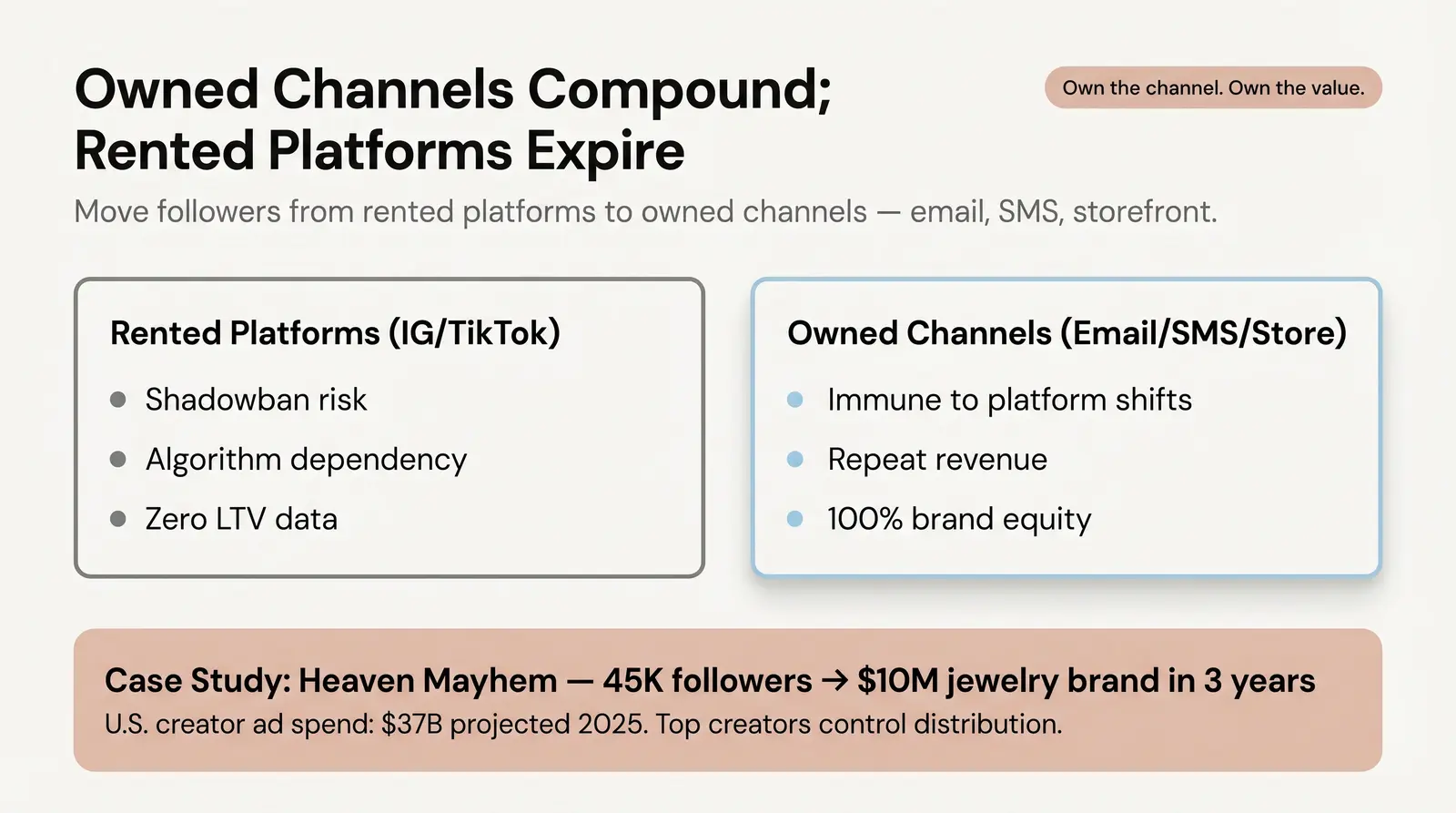
The creator economy is maturing. U.S. creator ad spend is projected to reach $37 billion in 2025, but the creators capturing the most value are those who control their own distribution and monetization [5].
Owning your audience means moving them off rented platforms (like Instagram or TikTok) and onto owned channels (like your email list, SMS list, and direct storefront). When you own the audience, you dictate the terms. You are immune to shadowbans, algorithm tweaks, and shifting affiliate payout structures.
Look at creators like Pia Mance, who leveraged her 45,000 followers to launch Heaven Mayhem. By starting with a small batch of curated vintage pendants and eventually moving to her own designs, she built a $10 million demi-fine jewelry business in just three years [6]. She didn't just monetize her audience; she built a standalone asset with enterprise value.
When you partner with Branvas, your customers never know we exist. We provide blind fulfillment, meaning the unboxing experience is 100% yours. The brand equity you build belongs entirely to you.
Learn more about how Branvas's how it works page breaks down the full Brand-as-a-Service model.
With traditional manufacturing, launching a jewelry brand can cost between $5,000 and $25,000 upfront due to minimum order quantities and tooling fees. However, using a Brand-as-a-Service platform like Branvas, you can launch with zero inventory costs. You only pay for the products after you make a sale, drastically reducing your financial risk.
White-label jewelry involves selling pre-designed, generic pieces from a manufacturer's catalog under your own brand name. Private-label jewelry allows for more exclusivity and customization, often involving unique designs or specific branding elements applied to the product. Branvas offers a streamlined approach, allowing you to curate high-quality pieces and apply your custom branding and packaging.
Yes. Affiliate programs typically pay a 5% to 15% commission on the retail price. When you sell your own private-label jewelry, your gross margins are typically 60% to 80%. Even after accounting for platform fees and marketing, your net profit per sale is significantly higher, and you gain the added value of repeat customers.
The best products to start with are high-quality, everyday staples that align with your personal style. Items like gold vermeil chain necklaces, huggie hoops, and minimalist rings perform exceptionally well. These pieces have broad appeal, low return rates, and can be easily styled in your daily content.
No, you need an engaged following, not necessarily a massive one. Micro-influencers with 10,000 to 50,000 highly engaged followers often see better conversion rates than mega-influencers. If your audience trusts your style recommendations and actively engages with your content, you have the foundation needed to launch a successful brand.
[1] 10+ Best Jewelry Affiliate Programs In 2026 - AffTank
[2] Platform Risk and Audience Ownership: Why Attention Without Control Is a Fragile Asset | The Media C-Suite
[3] Jewelry Business Profit Margin: Maximize Earnings - Westpack
[4] Owned vs Rented Audience: Why Audience Ownership Matters for Creators in 2026 | Memberful
[5] 2025 Creator Economy Ad Spend & Strategy Report - IAB
[6] How viral jewellery label Heaven Mayhem became a $10 million business | Vogue