


Stop chasing commissions. Discover why owning the customer makes dropshipping a scalable asset while affiliate marketing plateaus. A data-driven comparison of income versus equity for modern founders.
Published:
January 29, 2026
Author:
Yi Cui
Every year, thousands of aspiring entrepreneurs search for the fastest path to online income. Two business models consistently rise to the top of that search: affiliate marketing and dropshipping. Both promise low startup costs, flexible work arrangements, and the potential to earn while you sleep. Both can be launched from a laptop. And both have created success stories that flood social media feeds and YouTube channels.
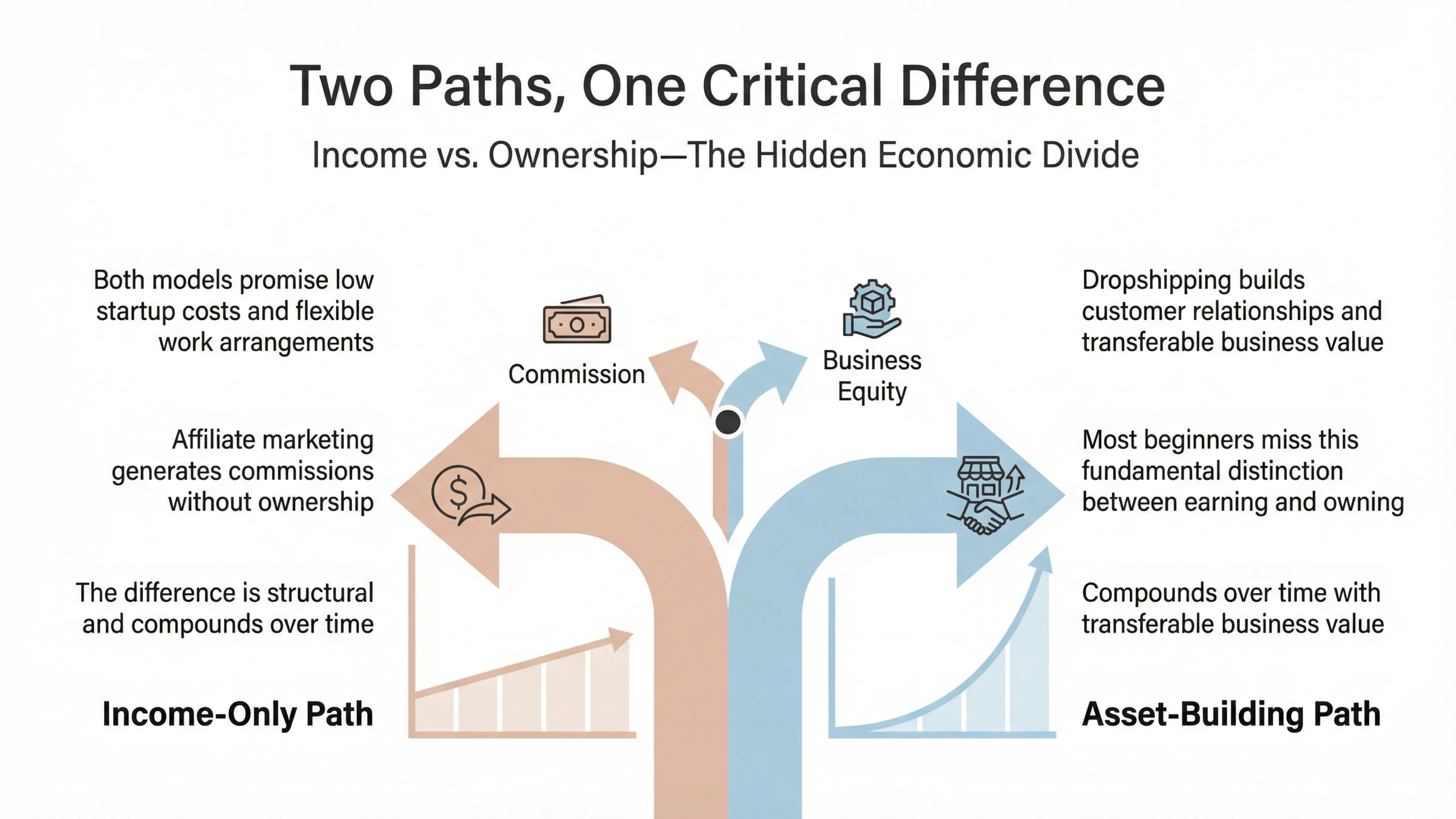
But here's what most comparison articles won't tell you: these two models lead to fundamentally different economic outcomes. One generates commissions without ownership. The other builds customer relationships and transferable business value. The difference between them isn't just operational—it's structural, and it compounds over time.
In our experience at Branvas, we've watched hundreds of founders navigate this decision. The ones who understand the distinction between income and ownership make dramatically different choices than those chasing quick revenue. This article will walk you through that distinction with clarity, data, and a decision framework that goes beyond surface-level pros and cons. By the end, you'll understand not just which model fits your current situation, but which one builds the kind of business that actually appreciates in value.
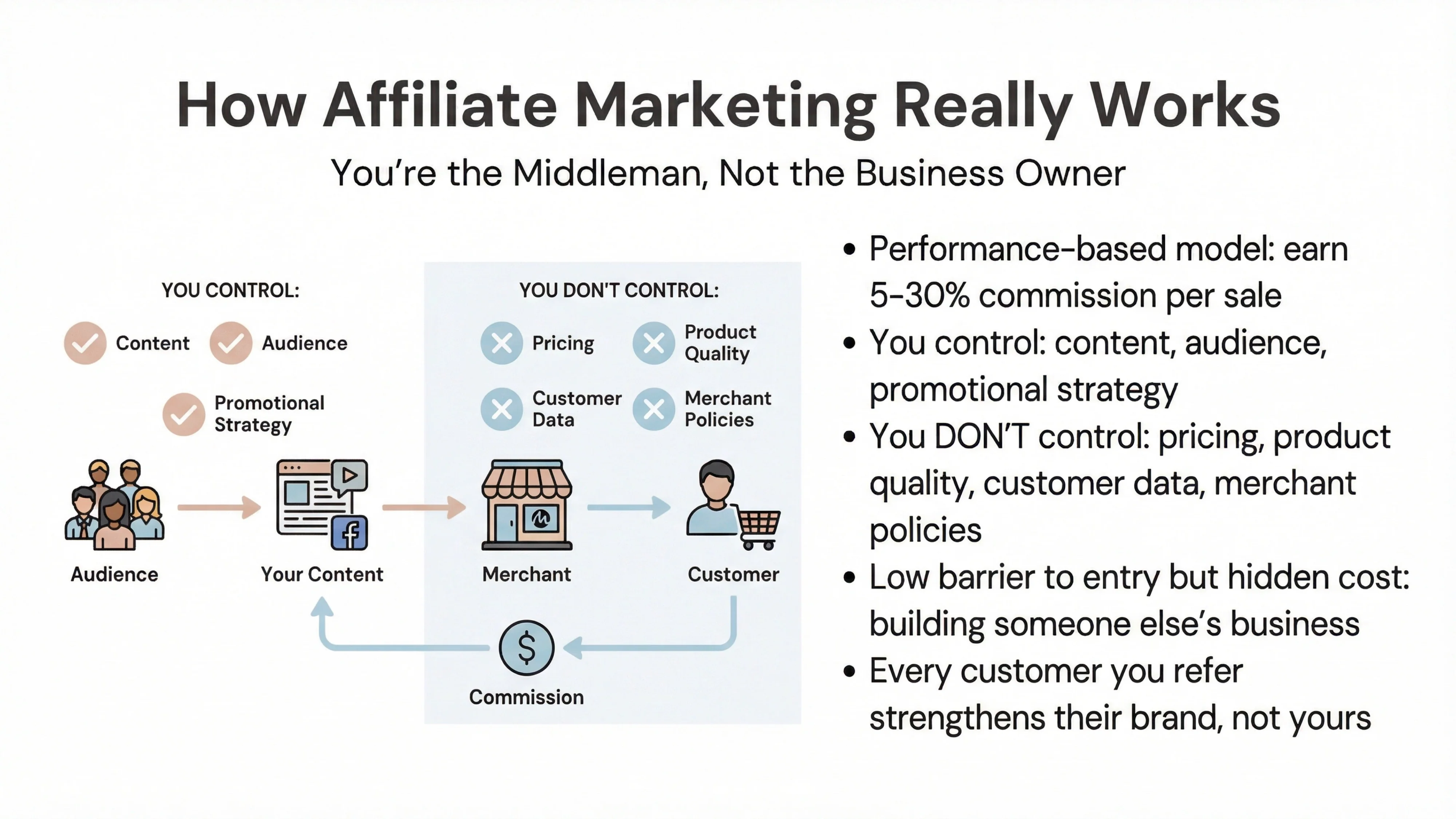
Affiliate marketing is a performance-based revenue model where you promote other companies' products or services and earn a commission when someone makes a purchase through your unique referral link. You act as a middleman—connecting an audience with a product—without ever touching inventory, handling customer service, or controlling the transaction.
The revenue flow is straightforward. A company (the merchant) provides you with a tracking link. You share that link through content—blog posts, YouTube videos, social media, email newsletters. When someone clicks your link and completes a purchase, the merchant's system attributes that sale to you and pays a percentage of the transaction value. Commission rates typically range from 5% to 30%, depending on the industry and product category [1][2]. In the SaaS space, commissions can reach 15-25% for mature programs, while physical products often sit closer to 5-10% [3].
What affiliates control is limited but important: they control their content, their audience, and their promotional strategy. What they don't control is far more significant. Affiliates don't control pricing, product quality, customer experience, fulfillment, or the merchant's decision to continue the affiliate program. They don't own the customer relationship—the merchant does. They don't capture customer data. And they can't pivot the offer or create repeat purchase loops without the merchant's cooperation.
The appeal of affiliate marketing is clear. There's no inventory risk, no customer support burden, no product development costs, and no fulfillment complexity. For content creators who already have an audience, it feels like a natural extension—monetizing attention without operational overhead. The barrier to entry is exceptionally low. You can start today with nothing more than a website or social media account and an affiliate network signup.
But this low-risk profile comes with a hidden cost: you're building someone else's business, not your own. Every customer you refer becomes their customer, not yours. Every transaction strengthens their brand equity, not yours. And every algorithm change, policy shift, or commission cut can erase months of work overnight.
Dropshipping is a retail fulfillment model where you sell products to customers without holding inventory. When a customer places an order in your online store, you forward that order to a supplier who ships the product directly to the customer. You own the customer relationship, set the pricing, and control the brand experience—but you don't warehouse or ship products yourself.
The revenue flow operates differently than affiliate marketing. You create an online store (typically on platforms like Shopify), list products at your chosen retail price, and drive traffic through marketing. When a customer buys, you collect the full payment. You then purchase the product from your supplier at the wholesale cost and keep the difference as profit. Your margin is the gap between what the customer pays you and what you pay the supplier.
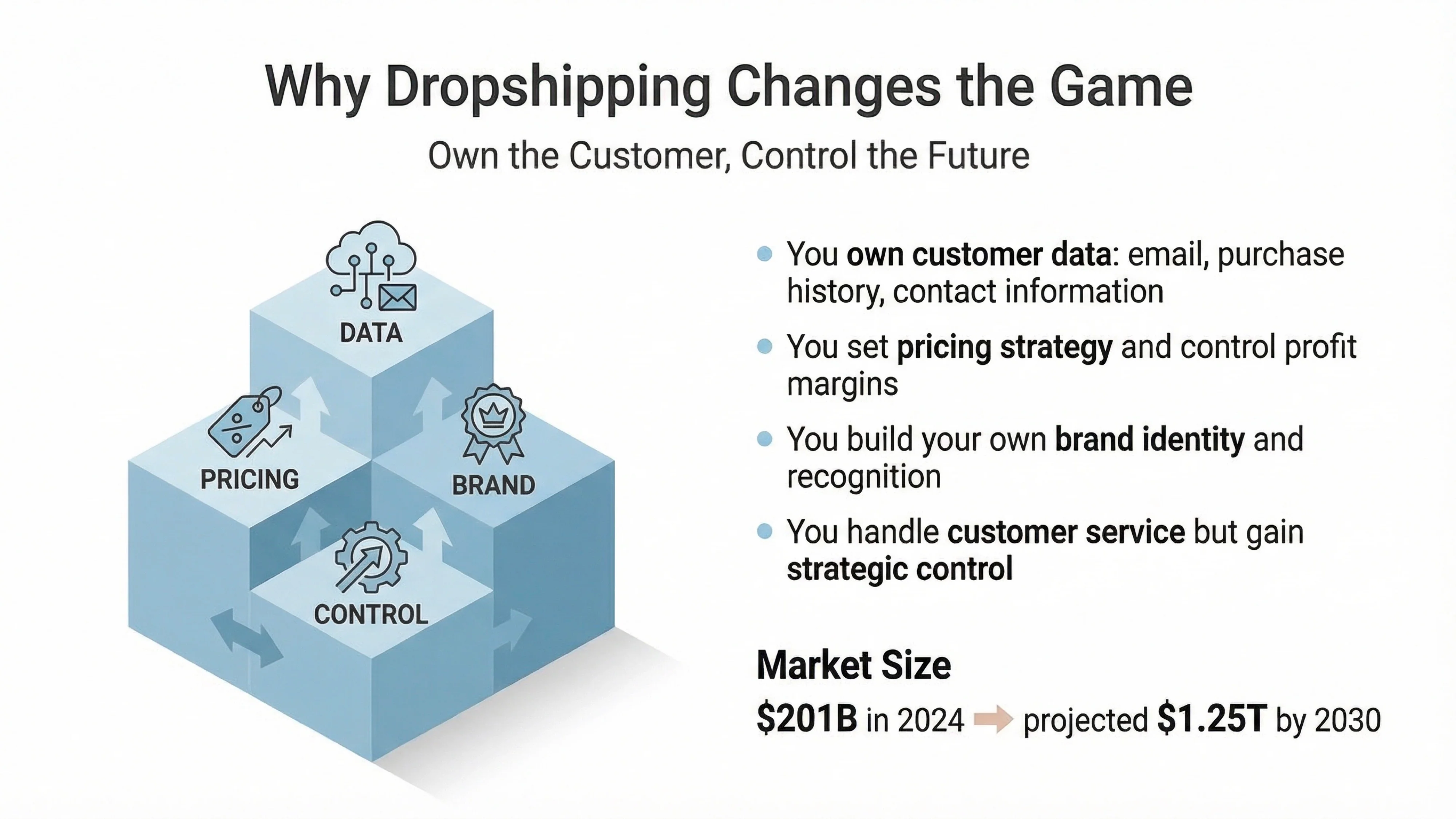
This structure creates a fundamentally different economic relationship. You own the customer. Their email address, purchase history, and contact information belong to you. You control the pricing strategy—you can run promotions, test price points, and optimize margins without asking permission. You control the brand—the store design, product descriptions, messaging, and positioning are entirely yours. You own the transaction data, which means you can analyze behavior, segment audiences, and build retention strategies.
The responsibility is greater, of course. You handle customer service inquiries. You manage refunds and disputes. You're accountable for the customer experience even though a third party fulfills the order. You need to coordinate with suppliers, ensure product quality, and maintain inventory availability. The operational lift is higher than affiliate marketing—but so is the strategic control.
What surprises most people who start with affiliate marketing is how quickly customer ownership changes the business dynamics. When you own the customer, you can sell to them again. You can introduce new products. You can build a brand that people recognize and trust. You can create an email list that generates revenue on demand. And most importantly, you can build an asset that has transferable value—something you can sell, scale, or use as collateral.
The global dropshipping market reached $201 billion in 2024 and is projected to grow to $1.25 trillion by 2030 [4]. Meanwhile, 27% of online retailers now use dropshipping as part of their business model [4]. These numbers reflect a broader shift: ecommerce is no longer just about moving products—it's about owning customer relationships in a digital-first economy.
Understanding the structural differences between dropshipping vs affiliate marketing requires looking beyond surface-level features. The table below breaks down the key dimensions that determine long-term business value.
|
Dimension |
Affiliate Marketing |
Dropshipping |
|---|---|---|
|
Customer Data Ownership |
No—merchant owns all customer information |
Yes—you own email, purchase history, contact details |
|
Pricing Control |
No—merchant sets prices and promotions |
Yes—you set retail prices and margins |
|
Brand Equity |
No—you promote someone else's brand |
Yes—you build your own recognizable brand |
|
Revenue Ceiling |
Limited by commission rates (5-30%) and traffic volume |
Scalable through repeat purchases, upsells, product expansion |
|
Repeat Revenue Potential |
Low—depends on merchant's product line and your ability to re-promote |
High—you can market to the same customers repeatedly |
|
Business Valuation |
Near zero—no transferable assets |
Meaningful—typically 2-4x annual profit for established stores [5] |
|
Risk Profile |
Low operational risk, high platform dependency risk |
Moderate operational risk, lower platform dependency |
|
Effort Distribution |
Front-loaded (content creation), ongoing (traffic generation) |
Front-loaded (store setup), ongoing (marketing + customer service) |
|
Profit Margins |
Fixed by commission structure (5-30%) |
Variable, typically 15-40% after costs [6] |
|
Exit Strategy |
None—income stops when promotion stops |
Sellable asset with established valuation multiples |
This comparison reveals a pattern that most beginners miss: affiliate marketing optimizes for immediate income, while dropshipping optimizes for asset creation. Affiliate marketing is a job that pays commissions. Dropshipping is a business that builds equity.
In our experience at Branvas, the founders who grasp this distinction early make fundamentally different decisions about where to invest their time. They stop chasing the next affiliate program and start building customer lists. They stop optimizing for clicks and start optimizing for lifetime value. They recognize that ownership compounds in ways that commissions never can.
To make the economic difference between these models tangible, we've developed a framework we call the Ownership Advantage Matrix. This framework maps the core dimensions of business value against the structural capabilities of each model.
|
Value Dimension |
Affiliate Marketing |
Dropshipping |
Why Ownership Matters |
|---|---|---|---|
|
Customer Ownership |
❌ No |
✅ Yes |
Customer data enables retargeting, segmentation, and lifetime value optimization |
|
Brand Equity |
❌ No |
✅ Yes |
Brand recognition reduces acquisition costs and enables premium pricing |
|
Pricing Power |
❌ No |
✅ Yes |
Pricing control allows margin optimization and promotional flexibility |
|
Repeat Revenue |
Limited |
High |
Owned customers can be marketed to repeatedly without new acquisition costs |
|
Business Valuation |
Near Zero |
2-4x Annual Profit |
Transferable assets create exit opportunities and financing options |
|
Data Leverage |
❌ No |
✅ Yes |
Transaction data informs product selection, marketing, and expansion strategy |
|
Strategic Flexibility |
Low |
High |
Ownership enables pivots, product additions, and market repositioning |
The matrix reveals why customer ownership is the fundamental variable that determines long-term value. When you own the customer relationship, you control the economic levers that drive compounding returns. Customer lifetime value (CLV) becomes your primary metric—not just traffic or conversion rates.
Research shows that understanding CLV allows businesses to make informed decisions about acquisition costs, retention strategy, and product development [7]. For ecommerce businesses, CLV determines how much you can afford to spend acquiring a customer while maintaining profitability. If your average customer generates $500 in lifetime value, you can sustainably spend up to that amount on acquisition and retention—creating a competitive moat that affiliate marketers simply cannot match.
This is the moment most affiliate marketers realize they've been optimizing the wrong variable. They've been chasing clicks when they should have been building customer lists. They've been promoting products when they should have been building brands. Income is not the same as ownership—and ownership is what compounds.
Here's the contrarian insight that most affiliate marketing content won't tell you: affiliate marketing is structurally designed to plateau. It's not a failure of execution—it's a feature of the business model itself.
The first reason is commission compression. As affiliate marketing has matured, commission rates have declined across most industries. Merchants have realized they can reduce payouts as competition among affiliates increases. What used to be 20-30% commissions in the early 2010s are now 10-15% in many categories [1][2]. The economic leverage has shifted from affiliates to merchants, and that trend continues.
The second reason is platform dependency. Most affiliate revenue flows through a handful of platforms—Amazon Associates, ClickBank, ShareASale, CJ Affiliate. These platforms control the terms, the tracking, the payouts, and the rules. They can change commission structures overnight. They can terminate accounts without detailed explanation. They can modify cookie windows, attribution models, and eligibility requirements unilaterally. You're building on rented land, and the landlord can change the lease at any time.
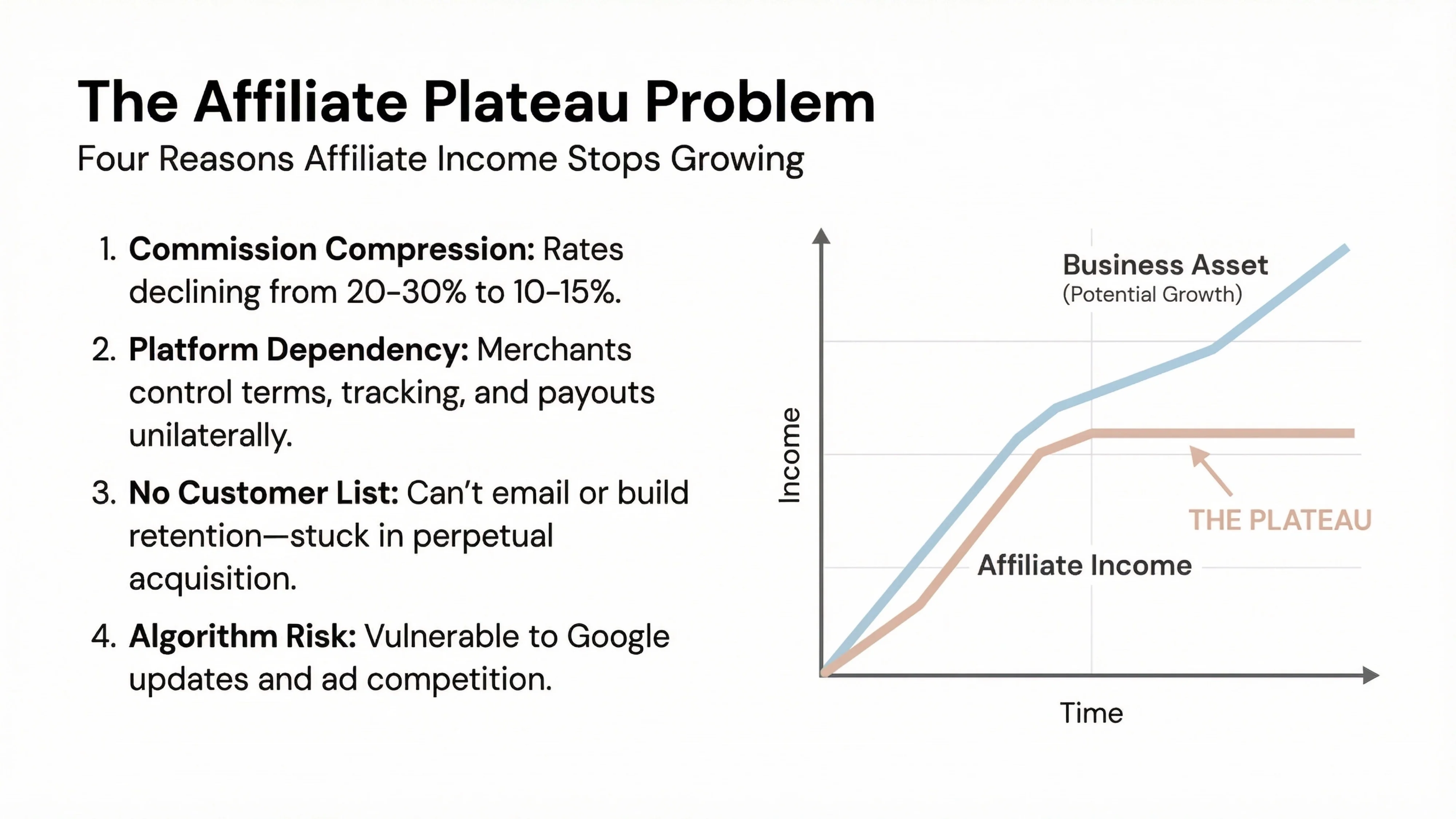
The third reason—and this is the one that surprises people—is that you don't own the customer list. Every sale you generate creates a customer for the merchant, not for you. You can't email them next month with a new offer. You can't segment them based on purchase behavior. You can't build a retention strategy. Your only option is to drive more traffic to the same affiliate link or find new affiliate programs to promote. You're stuck in a perpetual acquisition cycle with no compounding benefit.
The fourth reason is algorithm risk. If you're driving traffic through SEO, you're vulnerable to Google algorithm updates. If you're using social media, you're vulnerable to platform policy changes and reach throttling. If you're running paid ads, you're competing with merchants who have better unit economics because they own the customer. The creator economy, valued at $205 billion in 2024 and growing at 23.3% annually, is increasingly favoring creators who own their audience relationships rather than those who rent attention [8].
The result is a business model that generates income without leverage. You earn when you work, but the business doesn't appreciate in value. There's no equity being built. There's no exit strategy. And when you stop promoting, the income stops immediately. It's a high-skill job, not a compounding asset.
We often see founders struggle with this realization after 12-18 months of affiliate marketing. They've built traffic, they're earning commissions, but they feel trapped. They can't sell the business. They can't take a month off. They can't raise capital against future earnings. They've built a revenue stream, but not a business.
Dropshipping operates on a fundamentally different economic principle: customer ownership creates compounding value. Every transaction doesn't just generate revenue—it builds an asset that appreciates over time.
The first asset is the email and SMS list. When someone buys from your dropshipping store, you capture their contact information. That list becomes a marketing channel you own outright. You can send promotional emails, announce new products, run retargeting campaigns, and build automated sequences—all without paying acquisition costs again. Email marketing consistently delivers ROI of $36-$42 for every dollar spent in ecommerce [9], and that return belongs entirely to you.
The second asset is repeat purchase behavior. Ecommerce businesses with strong customer retention see 65% of revenue come from existing customers [10]. When you own the customer, you can optimize for lifetime value rather than one-time transactions. You can introduce complementary products, create bundles, offer subscriptions, and build loyalty programs. Each interaction strengthens the relationship and increases the probability of future purchases.
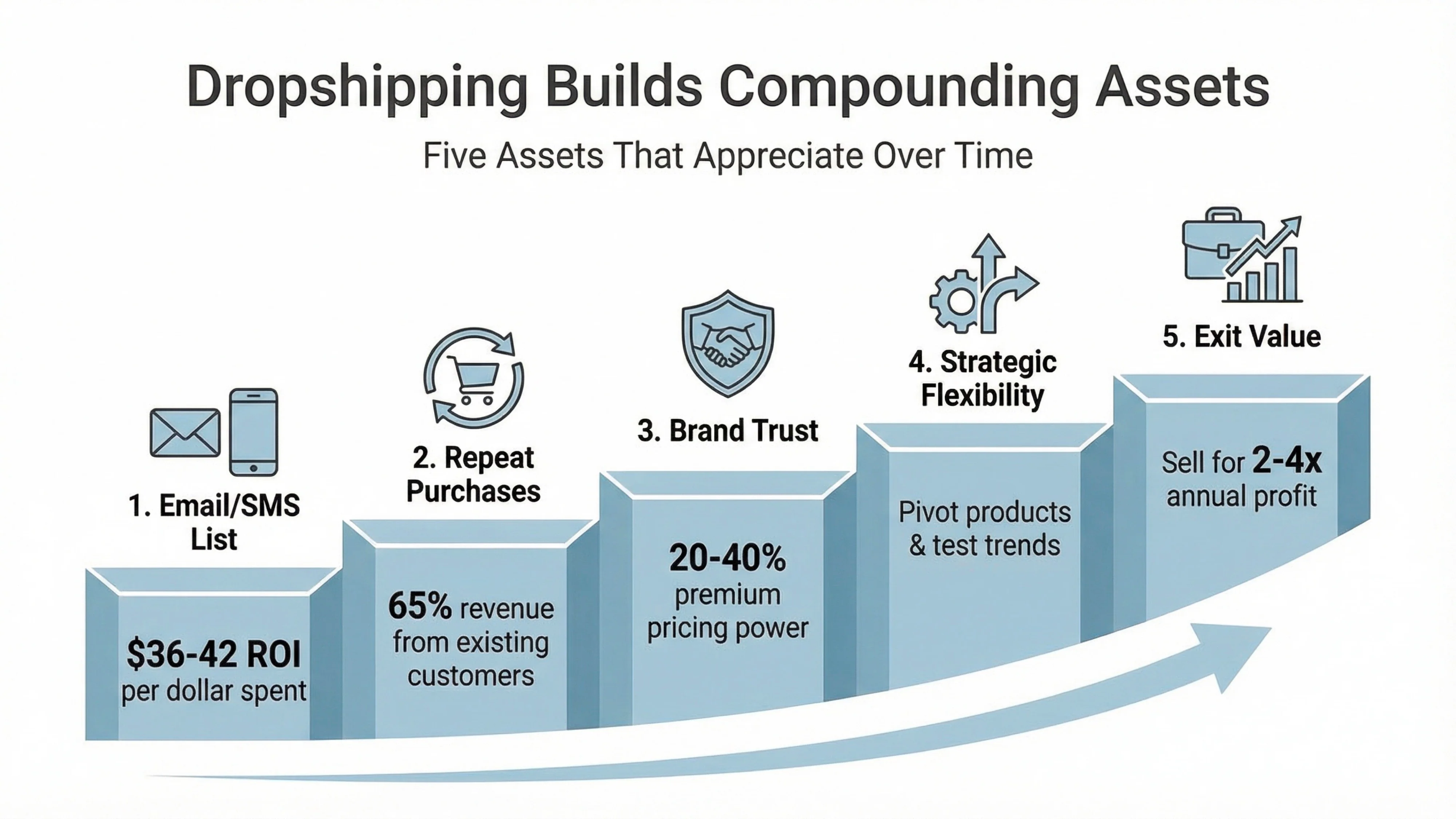
The third asset is brand trust. Over time, customers begin to recognize your store name, your packaging, your messaging. That recognition reduces acquisition costs because branded search traffic converts at higher rates than cold traffic. It also enables premium pricing—customers will pay more for brands they trust. This is why established ecommerce brands can command 20-40% higher prices than generic alternatives in the same category [11].
The fourth asset—and this is what most people miss—is the ability to pivot your offer. Because you own the customer relationship, you're not locked into a single product category or supplier. If a product stops performing, you can test alternatives. If a new trend emerges, you can add it to your catalog. If customer feedback reveals an unmet need, you can source a solution. This strategic flexibility is impossible in affiliate marketing, where you're entirely dependent on the merchant's product roadmap.
The fifth asset is exit value. Established ecommerce businesses routinely sell for 2-4x annual profit, and sometimes higher for businesses with strong brand equity and recurring revenue [5]. Marketplaces like Flippa, Empire Flippers, and FE International facilitate thousands of these transactions annually. Buyers are purchasing the customer list, the brand, the supplier relationships, and the operational systems—all assets that affiliate marketers simply don't possess.
In our experience at Branvas, founders who switch from affiliate marketing to dropshipping are shocked by how quickly customer ownership changes the business dynamics. They go from chasing traffic to nurturing relationships. They go from promoting other people's products to building their own brand. And most importantly, they go from earning income to building equity.
Global ecommerce sales reached $6.42 trillion in 2025 and are projected to hit $7.89 trillion by 2028 [12]. That growth is being captured by businesses that own customer relationships—not by affiliates who rent attention. The structural advantage of ownership becomes more pronounced as markets mature and acquisition costs rise.
Despite the structural limitations, affiliate marketing remains a rational choice in specific circumstances. Understanding when it makes sense—and when it doesn't—is critical to making an informed decision.
Affiliate marketing makes sense for content-first creators who have already built an audience around their expertise, personality, or niche. If you're a blogger, YouTuber, podcaster, or social media influencer whose primary value proposition is content rather than commerce, affiliate marketing can be a natural monetization layer. Your audience trusts your recommendations, and affiliate commissions provide revenue without distracting from content creation.
It makes sense for side income goals where you're not trying to build a full-time business or create transferable value. If you have a day job and want to earn an extra $500-$2,000 per month without operational complexity, affiliate marketing offers a low-commitment path. You can promote products in your spare time without worrying about customer service, fulfillment, or inventory management.
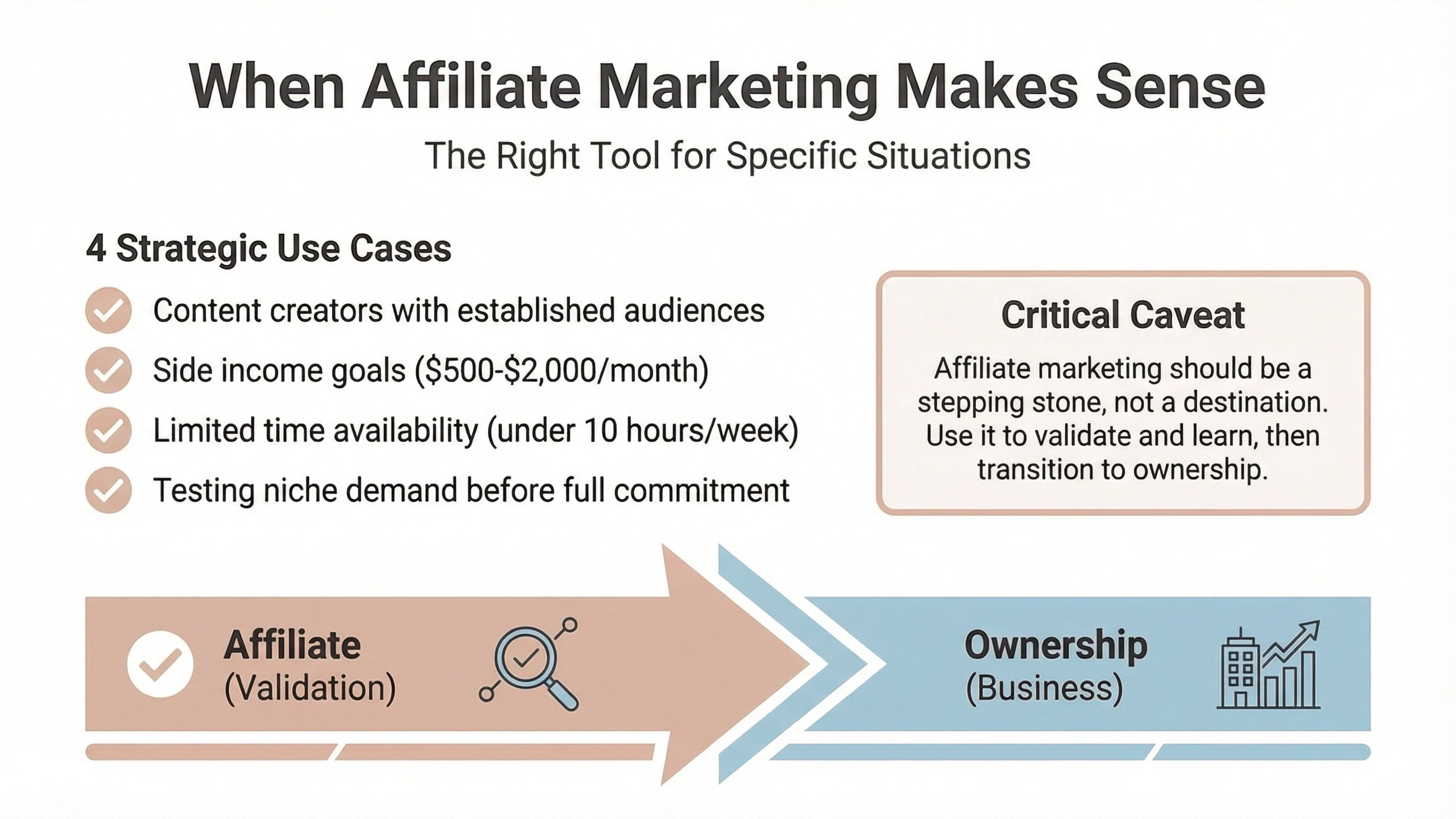
It makes sense when time availability is limited. Affiliate marketing requires less ongoing operational work than dropshipping. Once content is created and traffic is flowing, the revenue can be relatively passive (though maintaining traffic requires continuous effort). If you can't dedicate 20+ hours per week to building a business, affiliate marketing's lower operational burden may be more realistic.
It makes sense for testing audiences before committing to a full ecommerce business. If you're unsure whether a niche has commercial potential, affiliate marketing lets you validate demand with minimal investment. You can test different products, measure conversion rates, and understand customer behavior before investing in store infrastructure, supplier relationships, and inventory risk.
But here's the critical caveat: affiliate marketing should be a stepping stone, not a destination. If your goal is to build a business with transferable value, customer ownership, and compounding returns, affiliate marketing is a learning phase—not an end state. The skills you develop (traffic generation, conversion optimization, audience building) are valuable, but they're even more valuable when applied to a business model where you own the customer.
The creator economy is evolving rapidly, with individual content creators representing 57.2% of the market but businesses and brands growing at the fastest rate [8]. This shift reflects a broader recognition: the real value isn't in promoting products—it's in owning the relationship with the customer.
The operational burden of dropshipping—supplier coordination, quality control, fulfillment tracking—is often what prevents affiliate marketers from making the transition to ownership. This is where Branvas becomes relevant.
Branvas is designed to lower the operational friction of dropshipping while preserving the strategic advantages of customer ownership. Instead of spending hours sourcing suppliers, negotiating terms, and managing fulfillment logistics, founders can focus on what actually builds value: branding, audience development, and customer relationships.
The platform handles supplier vetting, order routing, and quality assurance—removing the most time-consuming aspects of traditional dropshipping. This allows founders to operate more like brand builders and less like logistics coordinators. You still own the customer. You still control pricing and positioning. You still build brand equity. But you're not drowning in operational complexity.
In our experience at Branvas, the founders who succeed are those who understand that attention is valuable, but owned customers are invaluable. They use content and marketing to drive traffic, but they route that traffic to a branded store where they capture customer data, build relationships, and create repeat revenue. They're not choosing between affiliate marketing and dropshipping—they're combining the audience-building skills of content creation with the asset-building structure of ecommerce.
This hybrid approach is increasingly common among sophisticated creators. They build audiences through content, then monetize those audiences through owned commerce rather than affiliate commissions. The result is a business model that compounds: each piece of content builds the audience, each purchase builds the customer list, and each customer interaction builds brand equity.
The infrastructure exists to make this transition seamless. What used to require months of supplier research, technical setup, and operational trial-and-error can now be launched in days. The barrier isn't technical anymore—it's conceptual. It's the shift from thinking like an affiliate (how do I get more clicks?) to thinking like a founder (how do I build a valuable business?).
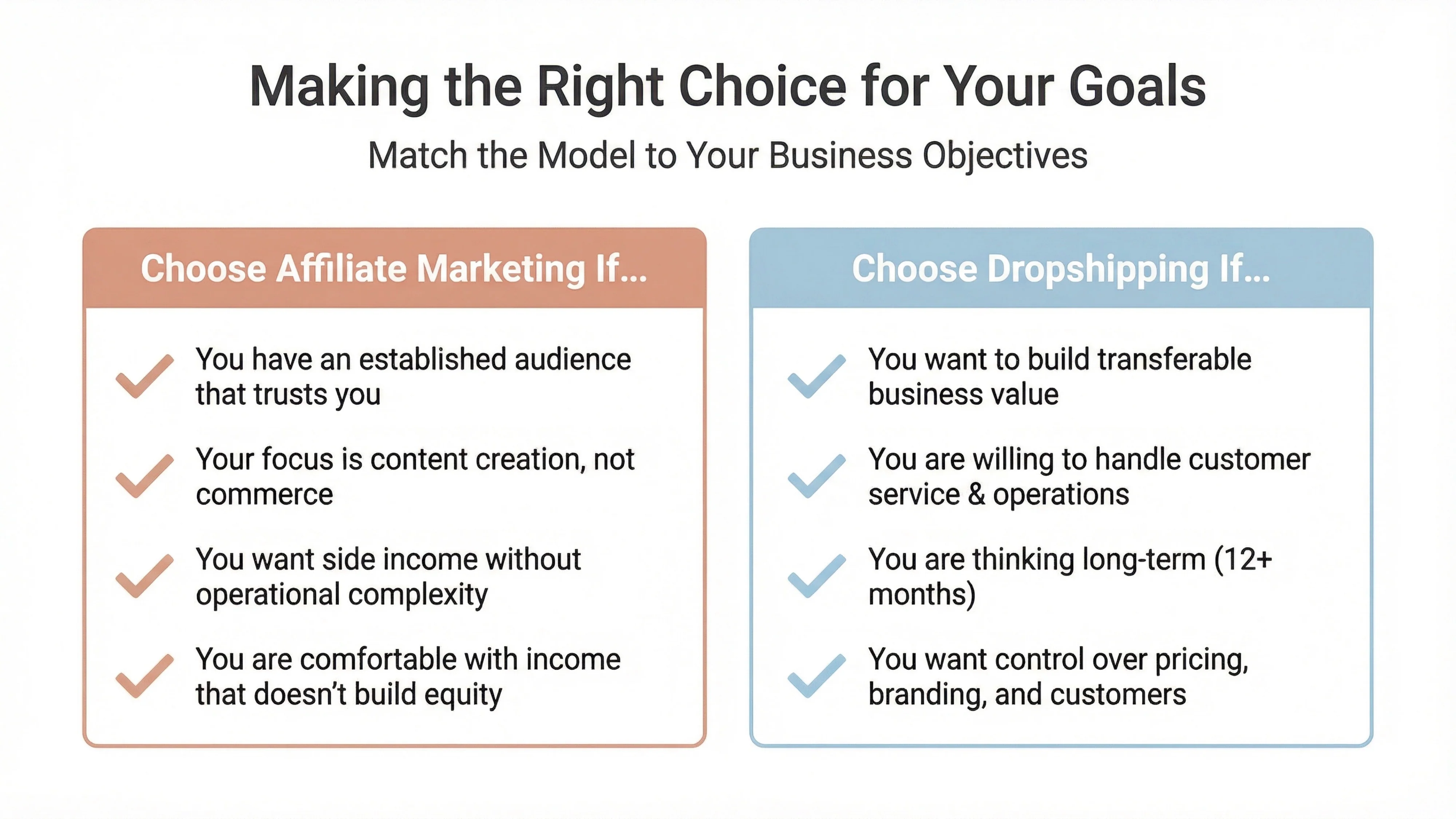
The right choice depends on your goals, resources, and timeline. Use this checklist to clarify which path aligns with your situation.
Choose affiliate marketing if:
Choose dropshipping if:
When to transition from affiliate → owned brand:
The optimal transition point is when you've validated demand through affiliate marketing and built an audience of at least 5,000-10,000 engaged followers. At this scale, you have enough traffic to make customer acquisition economically viable, and you've learned enough about your audience's preferences to select products strategically.
The transition doesn't have to be binary. Many successful founders run affiliate marketing and dropshipping in parallel—using affiliate commissions to fund customer acquisition for their owned store. Over time, they shift focus toward the owned business as customer lifetime value begins to exceed affiliate commissions.
The key question isn't "which model is easier?"—it's "which model builds the business I actually want to own?" If the answer involves equity, control, and long-term value, the path leads toward ownership. If the answer is supplemental income with minimal commitment, affiliate marketing may suffice.
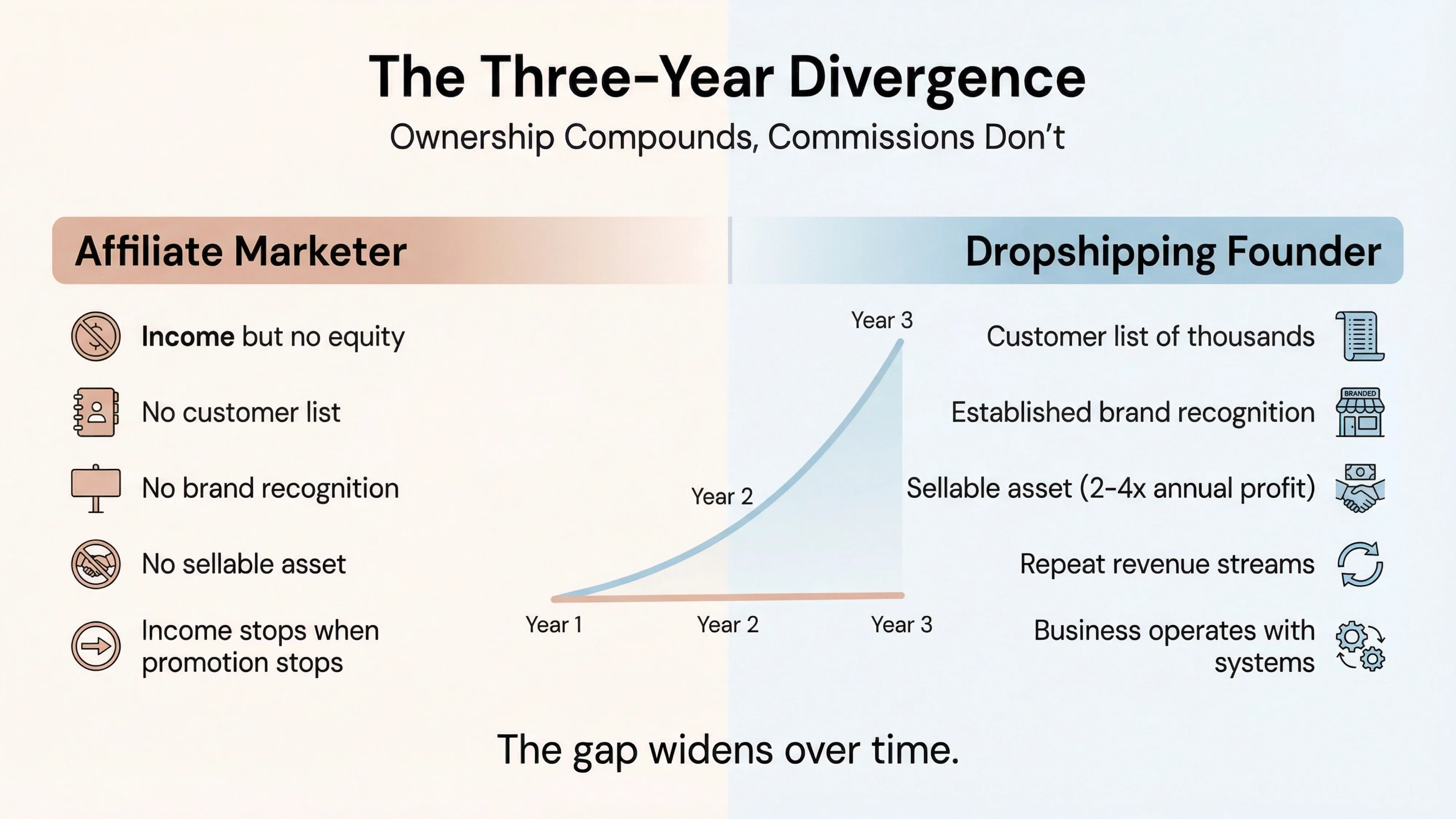
But understand this: the gap between these two paths widens over time. After three years, the affiliate marketer has income but no equity. The dropshipping founder has a customer list, brand recognition, and a sellable asset. The economic trajectories diverge because one model compounds and the other doesn't.
Dropshipping is a retail model where you sell products through your own online store, own the customer relationship, and control pricing and branding—but a supplier handles fulfillment. Affiliate marketing is a commission-based model where you promote other companies' products and earn a percentage of sales, but you don't own the customer, control pricing, or build brand equity. The fundamental difference is ownership: dropshipping builds a transferable business asset, while affiliate marketing generates income without equity.
Dropshipping is better for building long-term business value, customer ownership, and transferable equity. Affiliate marketing is better for content creators seeking low-commitment side income without operational complexity. Dropshipping requires more operational work but creates compounding value through customer lists, brand equity, and repeat revenue. Affiliate marketing is simpler to start but plateaus because you don't own the customer relationship. The "better" choice depends on whether you're optimizing for immediate income or long-term asset creation.
Dropshipping is more profitable long term because customer ownership enables repeat purchases, upsells, and lifetime value optimization. Affiliate marketing income is capped by commission rates (typically 5-30%) and traffic volume, with no compounding benefit. Dropshipping businesses can be sold for 2-4x annual profit, while affiliate marketing income stops when promotion stops. Research shows that 65% of ecommerce revenue comes from existing customers, a dynamic that only benefits businesses that own the customer relationship.
Yes, many successful entrepreneurs run both models in parallel. A common strategy is to use affiliate marketing to validate product demand and build an audience, then transition those customers to an owned dropshipping store. Some founders use affiliate commissions to fund customer acquisition for their dropshipping business. The hybrid approach combines the low-risk testing of affiliate marketing with the asset-building structure of dropshipping, allowing you to generate immediate income while building long-term equity.
Affiliates switch to dropshipping when they realize that commission income doesn't build transferable business value. After 12-18 months, many affiliate marketers hit a plateau—they're generating income but have no customer list, no brand equity, and no exit strategy. Dropshipping offers customer ownership, pricing control, and the ability to build a sellable asset. The transition is often triggered by the recognition that ownership compounds in ways that commissions never can, and that building someone else's customer base doesn't create long-term wealth.
[1] Affise. (2025). How to Set Affiliate Marketing Commission Guide. Retrieved from https://affise.com/blog/how-to-set-affiliate-marketing-commission-guide/
[2] Trackier. (2025). Affiliate Marketing Cost: Budget, Pricing and ROI Guide 2025. Retrieved from https://trackier.com/affiliate-marketing-cost-budget-and-pricing-breakdown/
[3] Rewardful. (2025). SaaS Affiliate Program Benchmarks by Industry. Retrieved from https://www.rewardful.com/articles/saas-affiliate-program-benchmarks
[4] Appscenic. (2025). 30+ Dropshipping Statistics You Need to Know in 2025. Retrieved from https://appscenic.com/blog/dropshipping-and-ecommerce-key-statistics/
[5] FE International. (2025). How to Value an E-Commerce Business. Retrieved from https://www.feinternational.com/blog/value-and-sell-an-e-commerce-business
[6] Digittrix. (2025). Dropshipping vs Traditional ECommerce: Which Is Better? Retrieved from https://www.digittrix.com/blogs/dropshipping-vs-traditional-ecommerce-which-is-better
[7] Shopify. (2024). What Is Customer Lifetime Value? The Complete Guide To CLV. Retrieved from https://www.shopify.com/blog/what-is-customer-lifetime-value
[8] Grand View Research. (2024). Creator Economy Market Size, Share & Trends Analysis Report By End Use, By Platform Type, By Creative Service, By Revenue Channel, By Region, And Segment Forecasts, 2025 - 2033. Retrieved from https://www.grandviewresearch.com/industry-analysis/creator-economy-market-report
[9] Saras Analytics. (2025). Ecommerce Customer Value: How to Calculate & Improve. Retrieved from https://www.sarasanalytics.com/blog/ecommerce-customer-lifetime-value
[10] Clear.co. (2024). Ecommerce Business Valuation: Simple Methods to Measure Success. Retrieved from https://www.clear.co/blog/ecommerce-business-valuation-guide
[11] Harvard Business School Online. (2024). Brand Equity Explained: How to Build and Measure Success. Retrieved from https://online.hbs.edu/blog/post/brand-equity
[12] Shopify. (2025). Global Ecommerce Sales Growth Report (2026). Retrieved from https://www.shopify.com/blog/global-ecommerce-sales [Data source: EMARKETER Forecast, Feb 2025]