

Launch an online store with near-zero budget using zero-inventory models like private-label fulfillment, free platforms, and organic social media traffic.
Published:
August 3, 2026
Author:
Yi Cui
Starting an online store with absolutely zero money is a myth. Starting one with near-zero money is completely achievable in 2026. Here is the honest version of what that looks like.
Every guide on this topic promises a completely free path to ecommerce success. Most of them are wrong, or at least imprecise.
The truth is that the inventory and warehousing costs (the ones that used to make ecommerce inaccessible) are genuinely gone. You do not need to buy stock upfront. You do not need a warehouse. You do not need a fulfillment team. Those barriers are real, and they have been removed by modern zero-inventory business models.
What you cannot avoid are the infrastructure costs. A custom domain name costs roughly $10 to $15 per year. Payment processors like Stripe and Shopify Payments charge 2.9% plus $0.30 on every transaction. If you want a real storefront instead of a marketplace listing, you will pay a monthly platform fee eventually.
In our experience at Branvas, the founders who succeed on near-zero budgets are the ones who go in knowing exactly where the floor is. Not the ones who discover fees mid-launch.
We call this the Zero-to-Launch Cost Audit: a decision matrix that helps founders identify which startup costs are truly unavoidable, which are deferrable, and which are entirely optional.
| Cost Category | Avoidable? | Lowest Realistic 2026 Price | Notes |
|---|---|---|---|
| Custom Domain Name | No | $10 to $15/year | A .myshopify.com subdomain kills trust. Buy the domain. |
| Platform Subscription | Deferrable | $0 to $29/month | Start on a free trial or the $5 Shopify Starter plan. Upgrade after your first sale. |
| Payment Processing | No | 2.9% + $0.30 per sale | You only pay this when you earn. Stripe, Shopify Payments, and PayPal all charge similar rates. |
| Inventory / Sourcing | Yes | $0 upfront | Use dropshipping or private-label fulfillment. You pay the supplier after the customer pays you. |
| Product Photography | Deferrable | $0 | Use supplier images to launch. Invest in custom photos after your first $200 in revenue. |
| Logo and Branding | Yes | $0 | Canva's free tier is sufficient for a launch-ready logo. |
| Paid Advertising | Yes | $0 | Organic TikTok, Instagram Reels, and Pinterest are your traffic channels until you have revenue to reinvest. |
| Email Marketing | Yes | $0 | Klaviyo's free tier handles up to 250 contacts. You do not need this on day one. |
Your realistic launch budget is $10 to $50. That covers a domain and your first month on a platform. Everything else is either free or deferred until you have revenue.

When you have no capital, traditional retail is out. You cannot buy wholesale inventory and store it somewhere. Every model below lets you launch without purchasing stock upfront.
| Business Model | Typical Startup Cost | Time to First Sale | Margin Range | Key Tradeoff |
|---|---|---|---|---|
| Dropshipping (Standard) | $30 to $50 | 1 to 4 weeks | 10% to 25% | Highly saturated. Long shipping times from overseas suppliers. Zero control over packaging or quality. |
| Print-on-Demand | $30 to $50 | 1 to 3 weeks | 15% to 30% | Great for designers. Margins are tight on apparel. Differentiation depends entirely on your creative output. |
| Digital Products | $10 to $30 | 1 to 2 weeks | 70% to 95% | Near-infinite margins, but requires significant upfront time to create a product worth buying. |
| Consignment / Resale | $0 | Days | 40% to 60% | Fast to launch on Depop or Facebook Marketplace. Impossible to scale without eventually buying inventory. |
| Private-Label Fulfillment | $30 to $50 | 1 to 3 weeks | 30% to 60% | The highest-margin physical product model for brand-builders. Supplier handles production, branding, and shipping. You never touch the product. |
Private-label fulfillment is the model that separates founders who are building a brand from founders who are running an arbitrage operation. You get the operational simplicity of dropshipping, but with custom packaging, branded inserts, and consistent product quality that actually generates repeat purchases. That is the model Branvas is built for first-time founders to use.
Be honest about the tradeoffs. Standard dropshipping is saturated and margin-thin. Print-on-demand is viable but commoditized. Digital products have the best margins but require a different skill set. Private-label fulfillment is the right choice if your goal is to build something with long-term brand equity.

If you are starting with no money, every product decision carries risk. The wrong category can mean high return rates, expensive shipping, product liability exposure, or a market so saturated that organic visibility is impossible. Jewelry avoids all of these problems.
Here is the case, built on data and logic.
High perceived value relative to shipping weight. A gold-tone necklace that retails for $39 weighs less than 30 grams. Shipping it domestically costs under $4. That ratio (high retail price, negligible shipping cost) is almost impossible to find in other categories. Compare that to home goods or electronics, where a $39 product might weigh two pounds and cost $8 to ship.
Strong social proof dynamics on visual platforms. Online jewelry sales are projected to account for 32.7% of total jewelry revenue in 2026, with TikTok and Instagram driving the majority of discovery [1]. Jewelry is inherently visual. A 15-second TikTok of a necklace catching light can generate thousands of views organically. That is free traffic.
No product liability. Supplements can cause adverse reactions. Skincare can trigger allergies. Electronics can malfunction. Jewelry, particularly fashion jewelry and gold-tone accessories, carries virtually no product liability risk. This matters when you are a solo founder with no legal budget.
Trend-driven demand that suits small catalogs. You do not need 100 SKUs. A 5-piece minimalist collection targeting a specific aesthetic — coastal, dark academia, Y2K — can generate consistent organic engagement because it speaks to a specific audience.
Repeat purchase behavior. Jewelry customers buy more than once. A healthy repeat purchase rate for online jewelry stores should climb from 20% in the early stages toward 40% over time [2]. That means your first customer is worth more than their first order.
A creator launches a 5-SKU minimalist gold-tone collection through a private-label partner in 2026.
The supplier handles production, branded packaging, and blind fulfillment directly to the customer. The founder handles content creation and customer communication. That is the entire operation.
To estimate your margins on a specific product before committing to a niche, use Branvas's profit calculator. If you're scoping jewelry as your first product, Branvas's catalog is a good place to check real unit costs and margins before you commit to a niche.

This is the operational playbook. Every step is free or near-free. The numbered format is intentional: these are sequential actions, not a menu of options.
1. Validate your niche before building anything.
Do not build a store yet. Post 5 to 10 short-form videos on TikTok or Instagram Reels about the aesthetic, lifestyle, or problem your product addresses. If you cannot get organic engagement from content, paid ads will not save you. Validation takes 7 to 10 days and costs nothing.
2. Choose your business model.
Review the comparison table above. For physical products where brand equity matters, private-label fulfillment is the right choice. For digital products or if you have design skills, print-on-demand is viable. Do not default to standard dropshipping just because it is the most-discussed option.
3. Pick your free or near-free platform.
Here is an honest 2026 comparison of the main options.
| Platform | Monthly Cost | Transaction Fee | Best For | Honest Limitation |
|---|---|---|---|---|
| Shopify (Basic) | $29/month ($29 annual) | 2.9% + $0.30 | Building a standalone brand | Requires you to drive your own traffic |
| Shopify (Starter) | $5/month | 5% | Selling via social links only | Not a real storefront |
| Etsy | $0 + $0.20/listing | 6.5% + ~3.5% processing | Handmade and vintage discovery | Total fees reach 10.4%. Algorithm favors established sellers. |
| TikTok Shop | $0 | 6% to 8% referral + 2% processing | Viral product launches | Requires active content creation. Fees add up fast on low-AOV products. |
| WooCommerce | $0 (plugin) + $3 to $5/month hosting | 2.9% + $0.30 (via Stripe) | Technical founders who want full control | Requires setup time and ongoing maintenance |
The contrarian insight most guides skip: The cheapest platform is rarely the most profitable one. For most zero-budget founders, the real ROI move is to start free, validate demand in 14 days, then upgrade before the margin leakage compounds. At $2,000 per month in sales, Etsy costs roughly $208 in fees while Shopify Basic costs around $109 — a $99 monthly difference that compounds to over $1,000 per year [3]. That savings covers your Shopify subscription three times over. Ecommerce conversion rates on dedicated storefronts also outperform marketplace listings for branded products, with top Shopify stores converting at 3.2% or higher versus Etsy's algorithm-dependent traffic [4].
4. Source your product or partner (inventory-free).
Find a supplier that handles blind dropshipping or private-label fulfillment with domestic US shipping times under 7 days. Verify their return policy and quality control process before you list a single product.
5. Brand it on a zero budget.
Use Canva's free tier to create a clean, text-based logo. Choose two fonts and two colors and use them consistently. Do not overthink this. A minimal, consistent brand identity beats an elaborate, inconsistent one every time.
6. Launch your store.
Build a minimum viable storefront. You need a home page, a product page with clear photography and a compelling description, and a shipping and returns policy. That is it. Launch before you are ready.
7. Drive your first traffic using free channels only.
Your traffic channels, in order of effectiveness for a new jewelry brand: TikTok organic, Instagram Reels, Pinterest (long-tail SEO value), and Reddit communities relevant to your niche. Post every day. Engage with every comment.
8. Get your first sale with specific tactics.
Do not wait for the algorithm to find you. Identify 20 to 30 people who have engaged with your content and send them a personalized message with a 15% discount code. Offer free shipping on the first order. Ask them directly for a review in exchange. Your first sale will almost certainly come from direct outreach, not passive discovery.
9. Reinvest your first revenue strategically.
Take the profit from your first 5 to 10 sales and use it in this order: buy a custom domain if you haven't already, upgrade your platform plan to reduce transaction fees, then order product samples to shoot your own custom content.

This is not a motivational roadmap. It is a realistic operational schedule for a zero-budget founder who is willing to post content daily and do direct outreach.
| Week | Focus | Key Actions | Decision Gate |
|---|---|---|---|
| Week 1 | Niche Validation | Post 5 to 7 TikToks or Reels. Research private-label or dropshipping partners. | If zero engagement after 7 days of content, pivot the niche before building anything. |
| Week 2 | Storefront Assembly | Sign up for a platform. Import products. Write product descriptions. Design logo. Buy domain. | If you have not validated demand by end of Week 2, stop and pivot the niche, not the model. |
| Week 3 | Content Engine Launch | Launch the store. Post 1 to 2 pieces of content daily. Focus on product aesthetics and lifestyle context. | If content is not generating saves and shares, revise the visual approach before continuing. |
| Week 4 | Direct Outreach | Engage with every comment. DM engaged followers with a personal discount code. | If no responses to 20+ direct messages, the product-market fit needs reassessment. |
| Weeks 5 to 6 | First Sale | Organic algorithms begin pushing consistent content to broader audiences. First sale typically occurs here. | If no sale by end of Week 6, audit your product page conversion rate and pricing. |
The most common failure point is Week 1. Founders skip validation and jump straight to building a store. They spend two weeks on a platform they are not sure works for their niche, then discover the product has no organic demand. Validate first. Build second.

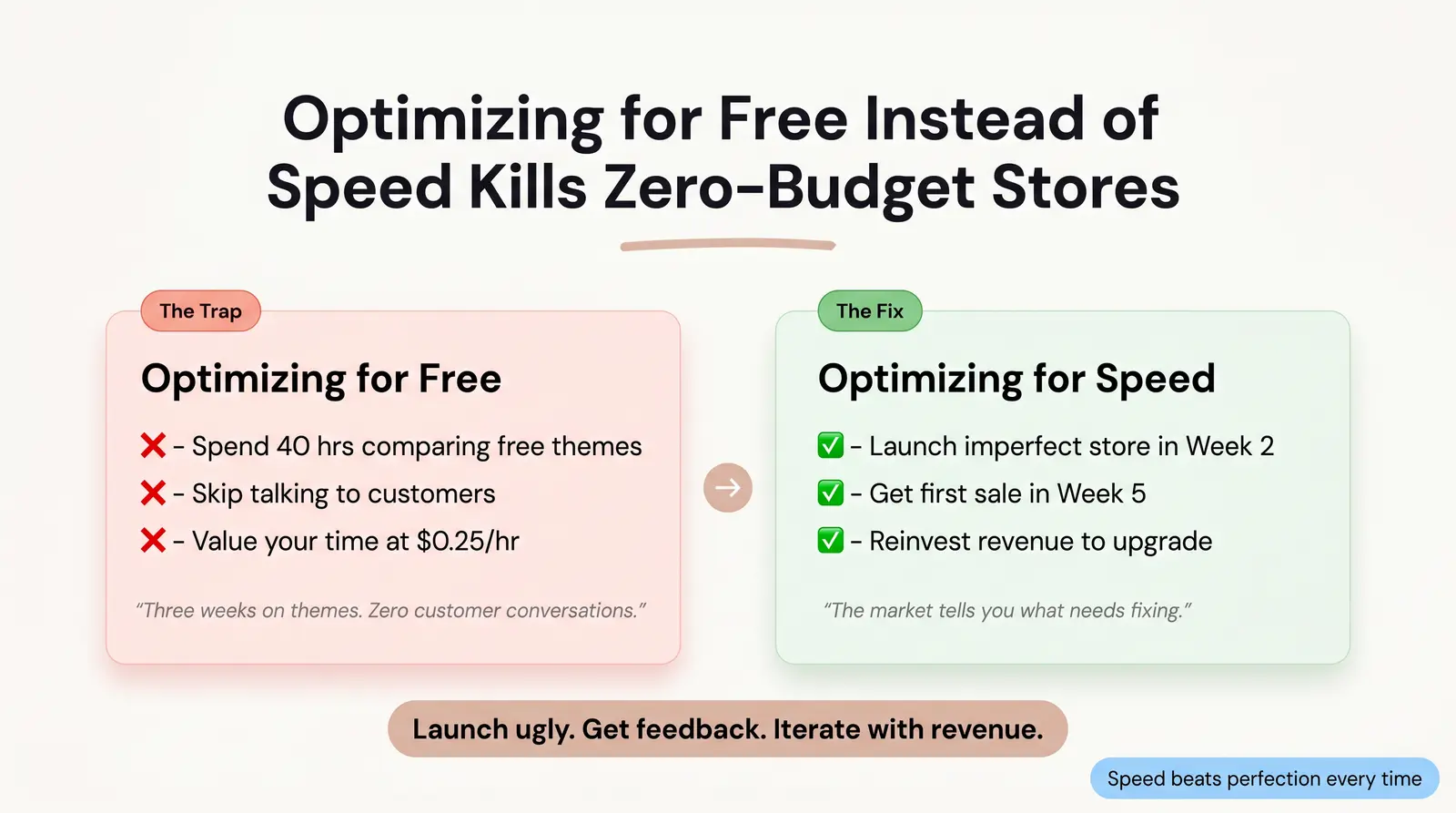
We see this constantly at Branvas: founders spend three weeks comparing free themes instead of talking to 10 potential customers.
The trap is optimizing for "free" instead of optimizing for speed-to-revenue. When you have no money, your only leverage is time. Spending 40 hours trying to save $10 a month on a platform fee effectively values your time at $0.25 per hour. That is the wrong trade.
The founders who succeed on zero budgets are not the ones with the most polished free store. They are the ones who launched an imperfect store in Week 2, got their first sale in Week 5, and used that revenue to upgrade everything. The market will tell you what needs fixing. You cannot figure that out by staring at a theme editor.
Launch ugly. Get feedback. Iterate with revenue.
1. Can I really start an online store with no money at all?
You can start with very close to zero, but not exactly zero. The unavoidable costs are a custom domain name (around $10 to $15 per year) and payment processing fees (2.9% plus $0.30 per sale, paid only when you earn). Everything else — inventory, advertising, custom photography, premium apps — can be deferred until you have revenue. If you use a free Shopify trial and drive traffic through organic social media, your total pre-revenue investment can be under $15.
2. What is the cheapest platform to start an online store?
WooCommerce is technically free as a plugin, but requires web hosting at around $3 to $5 per month. Shopify's Starter plan is $5 per month and lets you sell through social media links. TikTok Shop is free to set up and charges no monthly fee, but takes a 6% to 8% referral fee plus 2% payment processing on every sale. For a full standalone storefront, Shopify Basic at $29 per month (or $29 annually) is the most cost-effective option once you are generating consistent revenue.
3. Is dropshipping actually free to start?
The model itself requires no upfront inventory costs. You pay the supplier only after a customer pays you. However, you still need to cover your storefront infrastructure — a domain name and a platform subscription or hosting fee — before your first sale. The total pre-revenue cost for a dropshipping setup is typically $30 to $50. The bigger hidden cost of dropshipping is not the setup fee; it is the advertising spend required to drive traffic to a store with no organic audience.
4. How long does it take to make your first sale with no budget?
Without paid advertising, you are relying on organic social media algorithms. For a founder posting consistently on TikTok or Instagram Reels and doing direct outreach to engaged followers, the first sale typically occurs between Week 3 and Week 6. Founders who skip the content creation step and rely on marketplace discovery (Etsy, Amazon) often wait longer because new stores have no sales history to boost their algorithmic ranking.
5. What products are best to sell when you have no money to invest?
Jewelry and small accessories are the optimal starting category. They have high perceived value relative to their production cost, minimal shipping weight (which keeps fulfillment costs low), no product liability concerns, and strong organic performance on visual platforms like TikTok and Instagram. Digital products have even better margins but require a different skill set. If you want to sell a physical product and build a real brand, jewelry is the lowest-risk starting point. You can explore further resources and category guidance at Branvas Academy.
Ready to launch your jewelry brand without buying inventory? See how Branvas works →