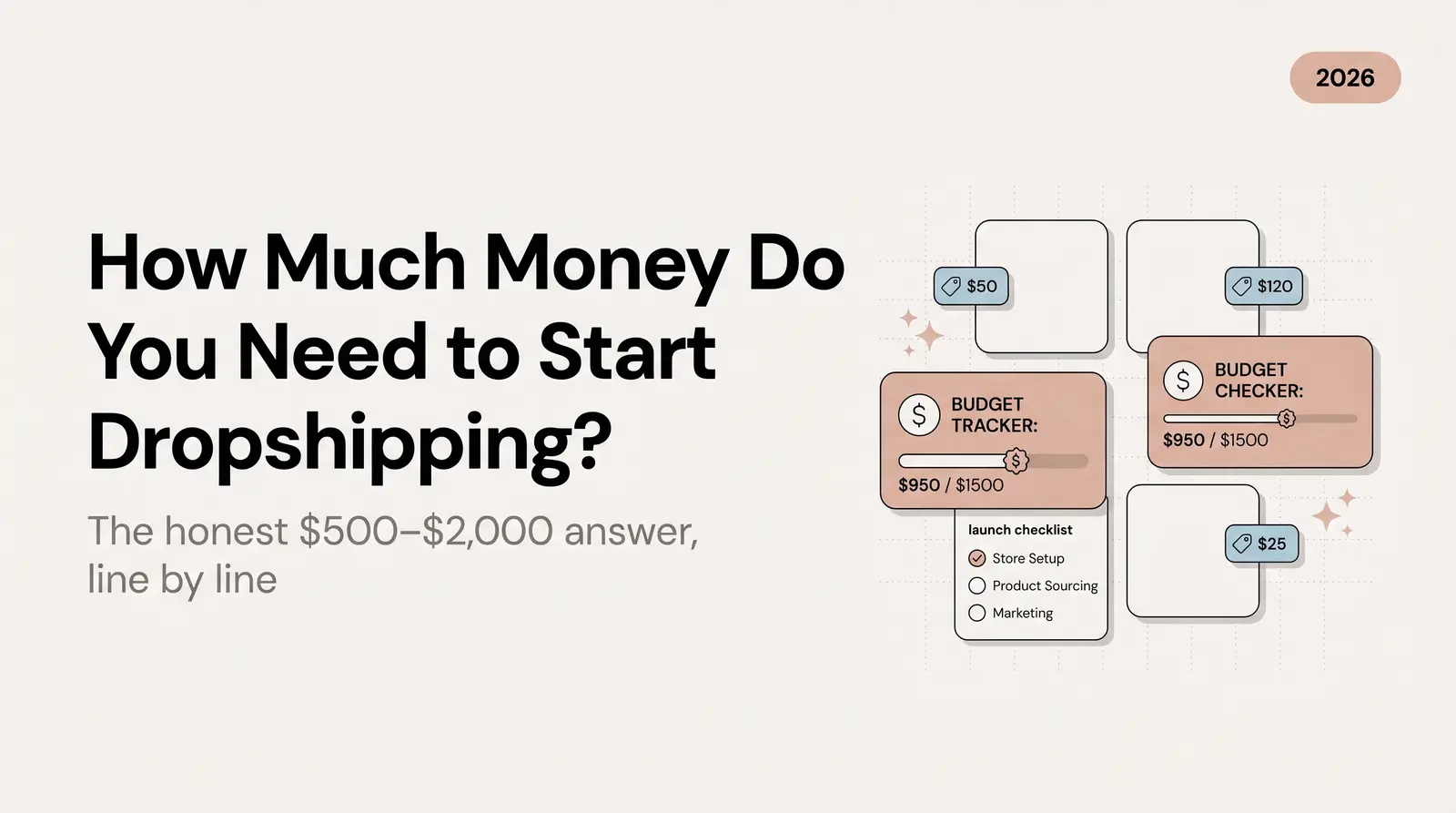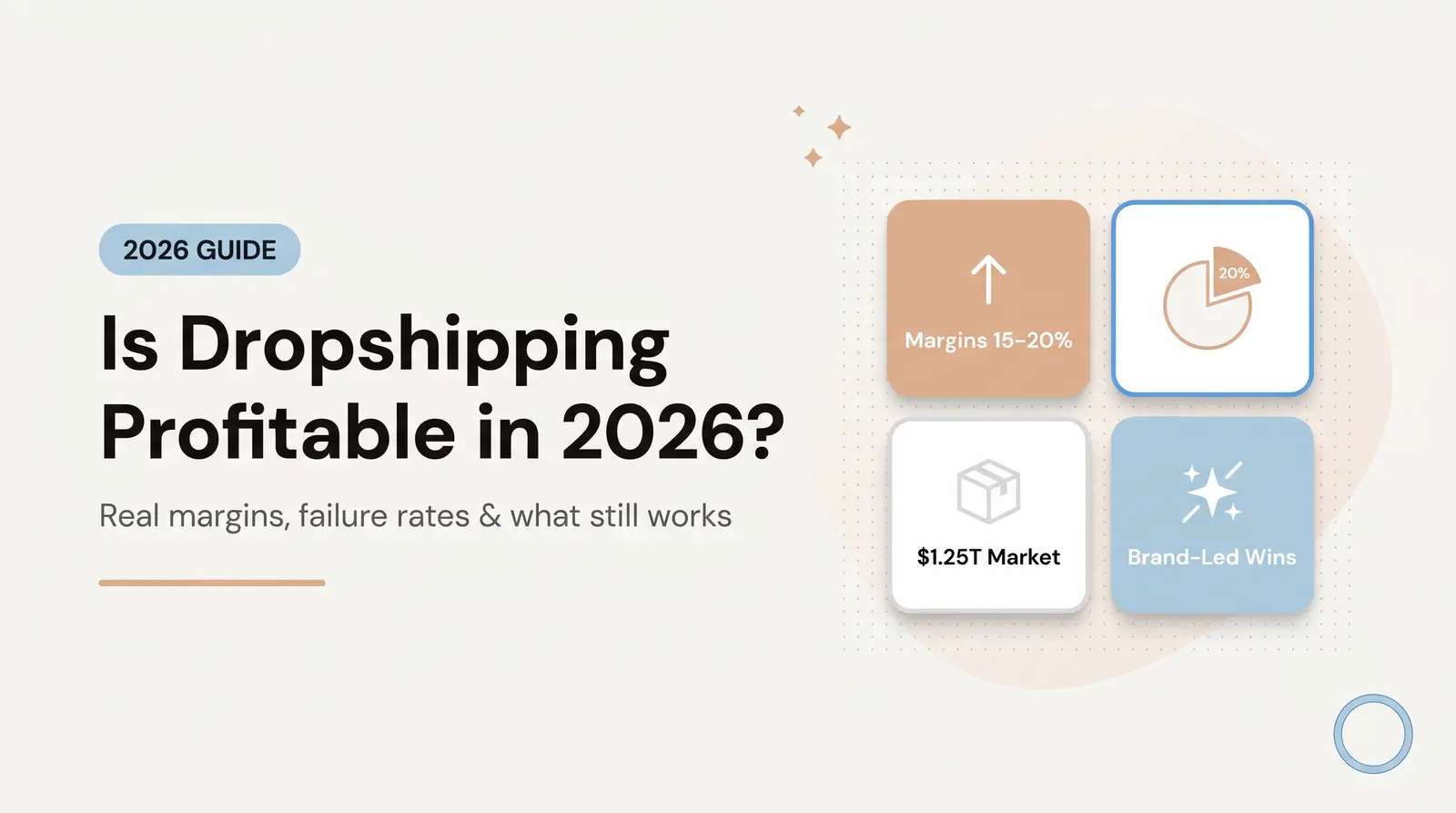



This guide breaks down realistic 2026 dropshipping startup costs, from a $500 lean launch to a $2,000 comfortable budget, revealing where beginners overspend and why jewelry offers the best margins.
Published:
July 30, 2026
Author:
Yi Cui
The realistic cost to start a dropshipping store in 2026 ranges from $500 for a lean, bootstrapped launch to $2,000 for a comfortable, confident start. While you can technically launch for under $100 using free trials and organic social media, this approach leaves zero room for error and significantly increases the failure rate. The biggest unavoidable costs are your ecommerce platform subscription, a custom domain, product samples, and an initial marketing budget to test your products.
Conversely, the most common areas where beginners waste money are premium store themes, expensive coaching courses, and running paid ads before validating their product-market fit. If you want to keep your startup costs low while maintaining high margins, jewelry and accessories are uniquely positioned as one of the lowest-barrier product verticals. The products are lightweight, cheap to ship, and command a high perceived value. For the absolute lowest viable starting point, explore our full $300 jewelry brand launch plan to see how it's done.
When researching how to start an online store, beginners are often bombarded with conflicting information. One guru claims you can start with zero dollars, while a premium course creator insists you need thousands. This confusion stems from a fundamental misunderstanding: the failure to separate one-time setup costs from ongoing/recurring operational costs. Most guides conflate the two, which is highly misleading. Your setup costs get the doors open, but your operational costs keep the lights on while you hunt for profitability.
To navigate this, we developed the Branvas Cost Clarity Framework™ — a proprietary mental model for categorizing every single dropshipping expense into one of four distinct tiers. Before spending anything, ask which tier the expense belongs to.
At Branvas, we've onboarded hundreds of first-time founders, and the pattern is consistent: the ones who fail fast tend to spend heavily on Tier 4 before they've validated a single sale. They build a beautiful, expensive store for a product nobody wants to buy.

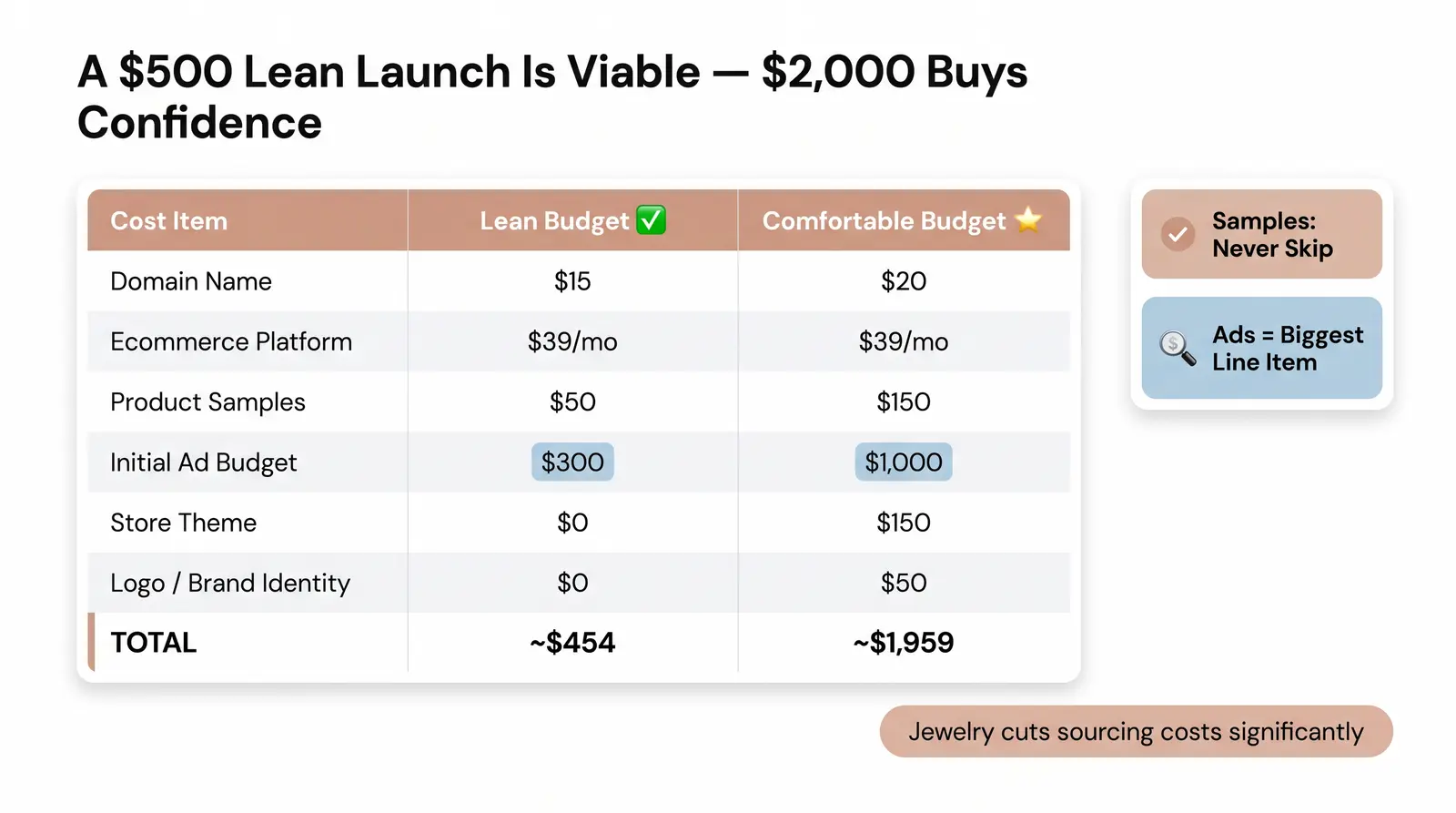
To give you a concrete idea of what a launch looks like today, here is a realistic breakdown of dropshipping startup costs in 2026. We have modeled two scenarios: a Lean Budget for the bootstrapped founder, and a Comfortable Budget for those who want a faster, more robust start.
| Cost Item | Lean Budget (Bootstrapped) | Comfortable Budget (Confident Start) | Notes |
|---|---|---|---|
| Domain name | ~$15 | ~$20 | A custom domain (e.g., .com) is essential for building trust. Do not use default platform subdomains. |
| Ecommerce platform (e.g., Shopify) | $39 | $39 | Shopify Basic is the industry standard. This is a monthly recurring cost. |
| Dropshipping app/supplier integration | $0 | $30 | Many apps offer free tiers for beginners. Upgrading provides better automation and faster shipping options. |
| Store theme | $0 | $150 | Free themes like Shopify's Dawn are excellent. Premium themes offer advanced customization but are optional early on. |
| Logo / brand identity | $0 | $50 | You can design a clean logo for free using Canva, or hire an affordable freelancer on Fiverr or Upwork. |
| Product samples | $50 | $150 | Never skip this. You must verify product quality and shipping times before selling to customers. |
| Initial ad budget (paid social/search) | $300 | $1,000 | This is your testing budget. You need enough data to find winning creatives and audiences. |
| Email marketing tool | $0 | $20 | Start with a free tier (like Klaviyo or Mailchimp for small lists) to capture abandoned carts. |
| Legal/business registration (optional early) | $0 | $300 | Varies by state/country. You can start as a sole proprietor, but an LLC protects personal assets. |
| Miscellaneous (stock images, apps, etc.) | $50 | $200 | A buffer for minor app subscriptions (like review apps) or unexpected small expenses. |
| TOTAL | ~$454 | ~$1,959 | Excludes ongoing monthly recurring costs beyond month one. |
Each line item represents a strategic choice. Your ecommerce platform and domain are your digital real estate; you cannot skip them. However, your store theme and logo can be executed for free if you are willing to invest your own time.
Product samples are a non-negotiable expense. Ordering samples is the only way to ensure quality control and understand the unboxing experience. Skipping this step risks high return rates and chargebacks. This is why jewelry is uniquely forgiving for beginners. The unit costs are low, they are incredibly cheap to ship, and they carry a high perceived value margin. You can order five different rings or necklaces to test for the price of one bulky electronics sample.
If you're eyeing jewelry or accessories as your niche, Branvas's private-label dropshipping model eliminates several of these line items entirely, including sourcing, packaging, and fulfillment.
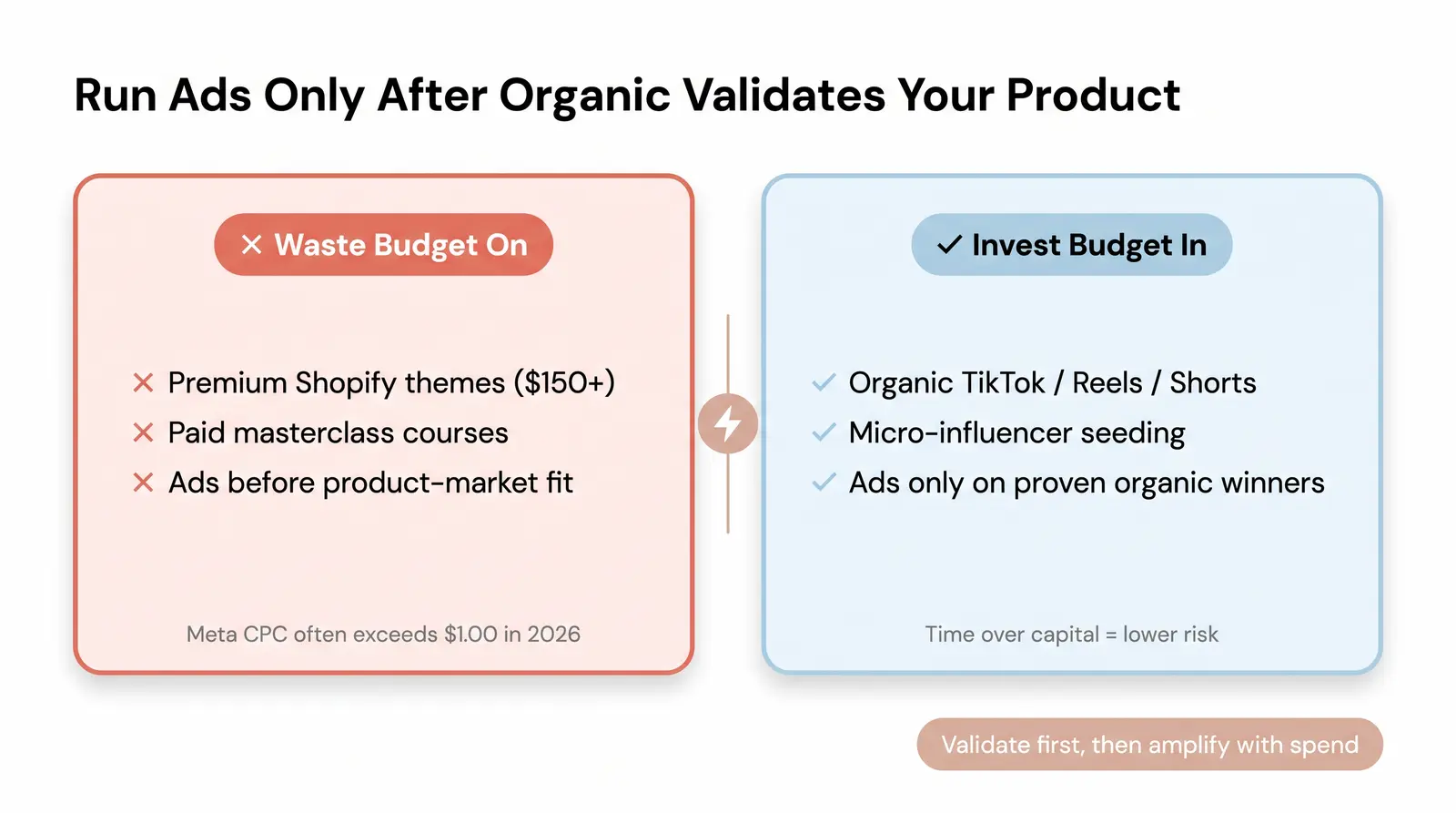
The fastest way to fail in dropshipping is to misallocate your limited capital. Beginners frequently drain their budgets on the wrong things, starving their business of the resources needed to actually acquire customers. The most common money drains include buying premium Shopify themes before validating a product, paying for expensive "masterclass" courses when the information is free online, and stacking unnecessary paid apps (countdown timers, spin-the-wheel popups) that slow down the site and look spammy.
However, there is a contrarian truth that most dropshipping guides ignore: paid ads should NOT be the first budget priority for most beginners.
This is not because ads do not work. It is because running paid ads before achieving product-market fit is statistically the fastest way to drain a beginner budget with zero learning. In 2026, the average Cost Per Click (CPC) on Meta platforms often exceeds $1.00 for ecommerce, and CPMs (Cost Per Mille) remain high [1]. If your store is unoptimized, your product is untested, and your creative is weak, you are simply donating money to Mark Zuckerberg.
We often see new store owners spend $500 on Facebook ads in week one and call dropshipping a scam. The product wasn't validated. The creative wasn't tested. The audience wasn't defined. The ads weren't the problem.
Instead of burning cash on ads immediately, beginners should validate their products through organic social media (TikTok, Instagram Reels, YouTube Shorts) or micro-influencer seeding. These methods require time rather than capital, allowing you to test messaging and product appeal with significantly lower financial risk. Once an organic video gains traction or an influencer drives sales, then you amplify that proven winner with paid ad spend.
When launching with a limited budget, your choice of niche dictates your survival. You need a product category that is cheap to source, inexpensive to ship, and easy to market. Jewelry and accessories represent the smartest low-budget entry point into ecommerce.
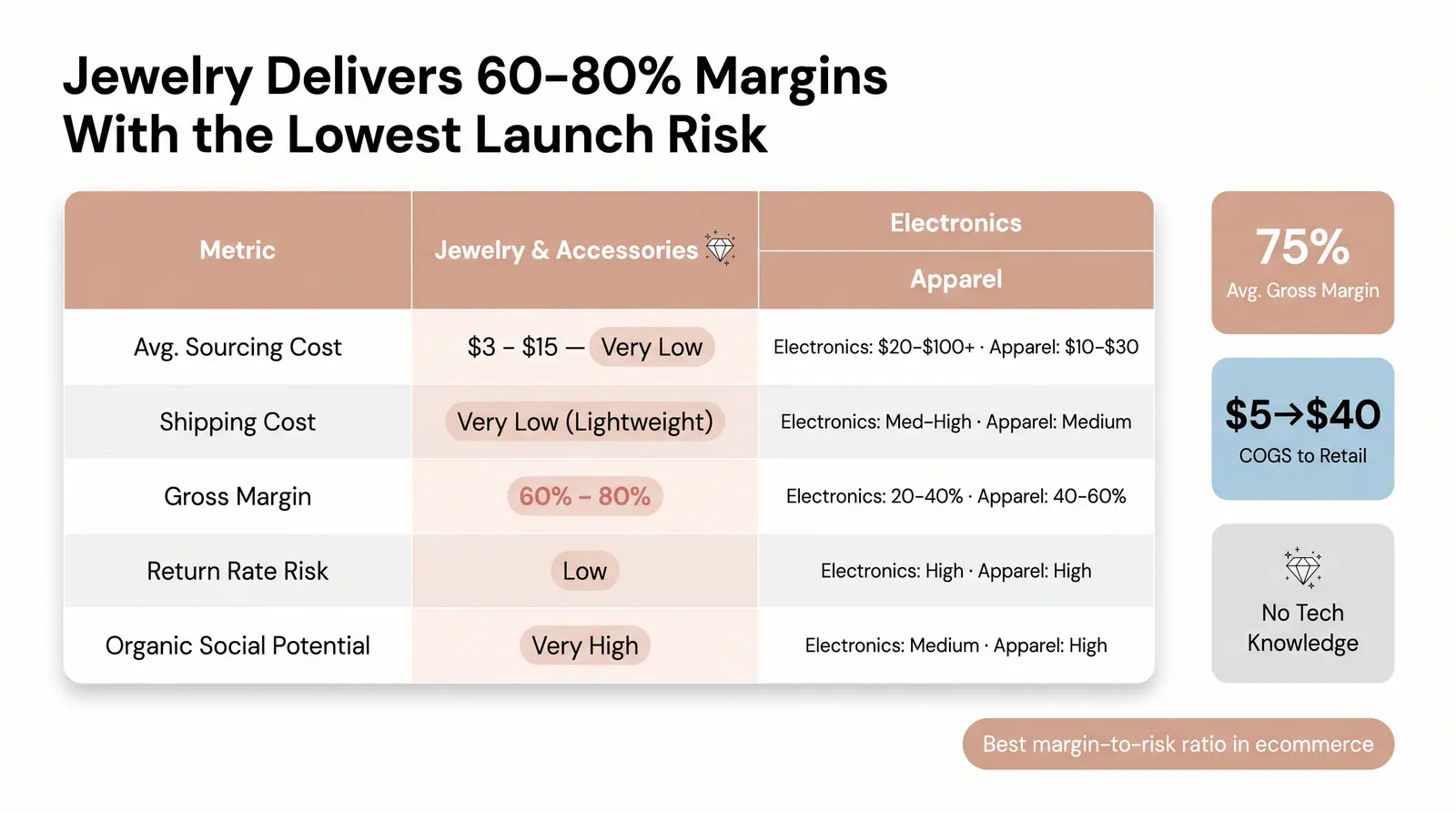
The economics of jewelry are incredibly favorable for dropshippers. The Cost of Goods Sold (COGS) is typically very low, yet the perceived value is high. A beautifully photographed necklace that costs $5 to produce can easily retail for $35 to $50, yielding gross margins between 60% and 80% [2]. Furthermore, jewelry is lightweight, meaning shipping costs rarely eat into your profit margins, and the items are small enough to avoid complex packaging or high return shipping fees.
To illustrate this, consider how jewelry compares to other popular dropshipping verticals:
| Metric | Jewelry & Accessories | Consumer Electronics | Apparel & Clothing |
|---|---|---|---|
| Avg. Sourcing Cost (COGS) | Very Low ($3 - $15) | High ($20 - $100+) | Medium ($10 - $30) |
| Shipping Complexity/Cost | Very Low (Lightweight) | Medium to High (Heavy/Fragile) | Medium (Varies by size) |
| Typical Gross Margin | 60% - 80% | 20% - 40% | 40% - 60% |
| Return Rate Risk | Low (Size is rarely an issue) | High (Defects, user error) | High (Sizing, fit issues) |
| Organic Social Potential | Very High (Highly visual) | Medium (Feature-focused) | High (Trend-dependent) |
Beyond the raw economics, jewelry requires zero technical knowledge to sell. You do not have to explain specifications or troubleshoot user errors. It photographs beautifully, making it perfect for organic social media marketing and impulse buys. It also has a massive, proven product-market fit with influencer commerce.
This is exactly why jewelry is Branvas's flagship vertical. We've built the entire sourcing, branding, and fulfillment stack around helping new sellers launch a private-label jewelry brand, often for as little as $300.
If you want to see exactly how to execute this, read our full $300 jewelry brand launch plan. For ecommerce and boutique store owners looking to expand their catalog, or aspiring entrepreneurs starting from scratch, the barrier to entry has never been lower.
Let's look at a realistic, grounded illustration of a launch. Meet Maya, a 26-year-old starting a private-label jewelry store on evenings and weekends with a strict $500 budget. She wants to validate her brand concept before investing more capital.
Using the Branvas Cost Clarity Framework™, here is how Maya allocates her $500:
Tier 1 – Must-Have (Launch Blockers): $54
Maya purchases a custom domain name for $15 and signs up for the basic Shopify plan at $39/month. She uses a free Shopify theme (Dawn) and connects her store to Branvas for free to import products.
Tier 2 – High-ROI Early Investments: $400
She spends $0 on a logo, designing a clean, minimalist text logo herself using Canva. She spends $50 ordering five different jewelry pieces as samples. She uses her iPhone to film unboxing videos and styling clips in natural light.
The remaining $350 is her dedicated ad testing budget. Instead of blowing it on day one, she posts organic TikToks for two weeks. When one video gets 10,000 views and generates two organic sales, she takes that exact video and puts her $350 ad budget behind it on Meta, spending $35 a day for 10 days.
Tier 3 & 4 – Nice-to-Have & Vanity Spending: $0
Maya skips the premium themes, the $50/month review apps, and the custom packaging (Branvas handles the branded packaging for her automatically).
The First 30 Days Outcome:
In a conservative scenario, Maya's $350 in ad spend breaks even, generating $350 in sales. Combined with her organic efforts, she proves the concept. In an optimistic scenario, her validated creative hits a 2.5x Return on Ad Spend (ROAS), generating $875 in sales. Because her jewelry margins are 75%, she clears enough gross profit to cover her next month's Shopify bill and reinvests the rest into scaling her winning ad. She launched a real business for $454.

While the upfront setup costs are manageable, dropshipping contains hidden operational costs that quietly erode margins if you do not plan for them. These are recurring expenses that must be factored into your pricing strategy from day one.
First are payment processing fees. Whether you use Shopify Payments, Stripe, or PayPal, expect to lose roughly 2.9% + $0.30 on every single transaction [3]. If you sell internationally, you may also face currency conversion fees.
Second is the cost of returns and refunds. Even with a low-return item like jewelry, some customers will demand refunds. If you do not factor a 3% to 5% return rate into your financial model, those refunds will come directly out of your net profit. Similarly, chargebacks (when a customer disputes a charge with their bank) often carry a $15 penalty fee on top of the lost revenue.
Finally, do not underestimate the time cost of customer service. Answering emails, tracking lost packages, and dealing with supplier delays takes hours every week. If you value your time at $25 an hour, spending ten hours a week on customer support is a $250 hidden operational cost. This is why partnering with a reliable fulfillment service that handles the logistics is critical for scaling.

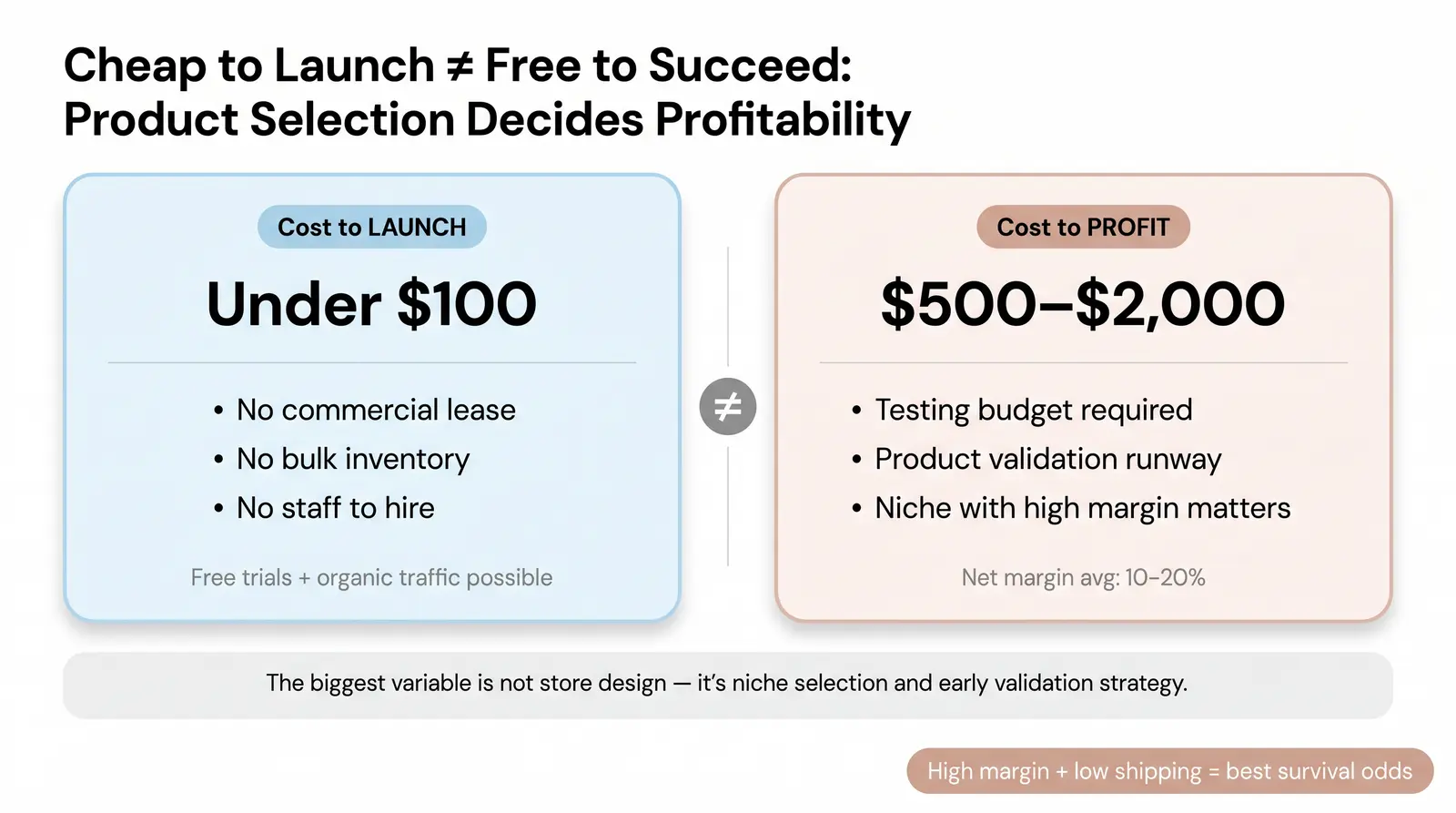
Yes, dropshipping is undeniably one of the lowest-barrier business models in ecommerce. You do not need to sign a commercial lease, you do not need to buy $10,000 worth of bulk inventory, and you do not need to hire staff to pack boxes.
However, "cheap to start" does not mean "free to succeed." There is a distinct difference between the cost to launch (which can be under $100) and the cost to reach profitability (which requires testing budget and runway).
The biggest variable in your time-to-profit is not how much you spend on a fancy store design; it is your product selection and your early validation strategy. Choosing a niche with high margins, low shipping costs, and strong emotional appeal gives you the best chance of surviving the initial testing phase.
If you're ready to launch your first store and want a product vertical with built-in margin and a supplier that handles the hard parts, explore how Branvas works: branvas.com/how-it-works
1. How much money do I need to start dropshipping with no experience?
For a beginner with no experience, a realistic budget is between $500 and $1,000. This covers the essential software (Shopify and a domain name), allows you to order product samples to verify quality, and leaves $300 to $500 for initial marketing and ad testing. Starting with less than $500 is possible but significantly increases your risk of failure, as you will lack the funds to properly test products or absorb early mistakes.
2. Can I start dropshipping for free?
Technically yes, but practically no. You can use free trials for ecommerce platforms and rely entirely on organic social media traffic (like TikTok or Instagram Reels) to generate sales without spending money on ads. However, this approach is highly unreliable, slow, and leaves you vulnerable when free trials expire. You will eventually need to pay for your domain, platform subscription, and transaction fees.
3. What is the biggest cost in dropshipping?
Marketing and advertising are by far the largest costs in dropshipping. While setting up the store and sourcing products is relatively inexpensive, acquiring customers requires capital. Most dropshippers spend the majority of their budget on paid ads (Meta, Google, TikTok) to test products and drive traffic. Customer acquisition costs dictate your profitability more than any other expense.
4. Is dropshipping profitable for beginners in 2026?
Yes, dropshipping remains profitable in 2026, but the margins depend heavily on the niche. The industry average net profit margin is between 10% and 20%. Beginners who succeed focus on products with high perceived value and low cost of goods sold (COGS). Those who fail usually try to sell commoditized, low-margin items and get crushed by rising advertising costs.
5. What's the cheapest product niche to start dropshipping?
Jewelry and fashion accessories are among the cheapest niches to start. The products are inexpensive to source, lightweight, and very cheap to ship globally. Furthermore, jewelry commands a high perceived value, allowing for gross margins of 60% to 80%. This provides a larger buffer for marketing costs compared to bulky items like electronics or home goods.