


This report compiles 2026 jewelry industry statistics covering global market size, lab-grown diamond adoption, men’s jewelry growth, sustainability trends, and ecommerce benchmarks for founders and analysts.
Published:
April 9, 2026
Author:
Yi Cui
In 2026, the jewelry industry has reached a historic pivot point where heritage luxury and disruptive technology no longer compete but converge. This report decodes the fundamental realignment of the global market, exploring how evolving consumer ethics and the democratization of fine jewelry are rewriting the rules of the trade.
The global jewelry market has entered a transformative era defined by shifting consumer values, volatile material costs, and the rapid expansion of digital commerce. As we navigate 2026, the industry is experiencing a profound "price up, units down" dynamic, where shoppers are purchasing fewer items but investing in higher-quality, more meaningful pieces. This shift is reshaping everything from entry-level price points to the competitive landscape between legacy houses and independent brands.
This comprehensive report serves as a citable 2026 reference resource for industry professionals, journalists, analysts, and ecommerce founders. It covers verified global market size valuations, detailed U.S. market analysis, segment breakdowns including the explosive growth of lab-grown diamonds and men's jewelry, emerging consumer trends, and critical ecommerce performance benchmarks.
For entrepreneurs and creators evaluating market opportunities, this data provides the foundation for strategic decision-making in an increasingly complex but highly lucrative sector.
The global jewelry market continues to demonstrate remarkable resilience despite macroeconomic headwinds and record-high precious metal prices. In 2025, the market was valued at USD 381.54 billion, and it is projected to reach USD 578.45 billion by 2033, expanding at a compound annual growth rate (CAGR) of 5.5% from 2026 to 2033 [1]. This growth is primarily driven by rising disposable incomes in emerging markets, evolving fashion trends, and an increasing consumer appetite for personalized luxury accessories.
The market is heavily segmented, with fine jewelry maintaining its dominance. Gold jewelry held the largest material share at 55.0% in 2025, while rings accounted for the largest product share at 33.9% [1]. However, the landscape is shifting as consumers adapt to the reality of gold prices that peaked near $4,400 per ounce in late 2025 [2]. This has led to a surge in demand for alternative materials and lighter designs, even as the overall market valuation climbs.
| Segment | 2024 Market Size (USD Bn) | 2026 Estimate (USD Bn) | CAGR | Key Driver |
|---|---|---|---|---|
| Fine Jewelry | 285.4 | 318.2 | 5.5% | Investment purchasing and bridal demand |
| Fashion/Costume | 45.2 | 51.8 | 7.1% | Trend-driven consumption and affordability |
| Luxury Watches | 48.1 | 53.5 | 5.4% | Status signaling and alternative asset investment |
| Total Global Market | 378.7 | 423.5 | 5.5% | Rising disposable income and digital penetration |
| Table 1: Global Jewelry Market by Segment, 2024–2026 (Estimated based on aggregated industry data) |
Citable Fact: The global jewelry market is projected to grow at a CAGR of 5.5% from 2026 to 2033, reaching an estimated valuation of USD 578.45 billion by the end of the forecast period. (Source: Grand View Research, 2025)
A common assumption among industry observers is that luxury market growth is driven primarily by ultra-high-net-worth consumers purchasing heritage brands. However, the data reveals a powerful democratization effect. The most significant volume growth is emerging from accessible fine jewelry and independent private-label brands that cater to the "HENRY" (High Earners, Not Rich Yet) demographic. These consumers are driving the expansion of the $500 to $2,500 price tier, proving that the middle market remains a potent engine for industry expansion when activated by compelling brand narratives and transparent sourcing.

The United States remains a cornerstone of the global jewelry trade, characterized by high consumer spending and rapid digital adoption. The U.S. jewelry market was valued at approximately USD 78.4 billion in 2024 and is projected to reach USD 97.62 billion by 2030, growing at a steady CAGR of 3.7% [3]. In 2025, the market experienced a healthy 5.6% growth rate, driven largely by a "premiumization" trend where average ticket prices increased even as overall unit sales declined [4].
The channel breakdown in the U.S. highlights a persistent consumer preference for trust and tactile experience, with 47% of buyers still preferring local or independent jewelers [5]. However, the direct-to-consumer (DTC) and ecommerce channels are capturing an increasingly significant share, particularly among younger demographics. When examining purchase occasions, the market is seeing a profound shift toward self-purchasing. A staggering 80% of Americans aged 18 and older are now more likely to buy fine jewelry for themselves rather than ask for it as a gift, with Millennials leading this trend at 86% [6].
In our experience at Branvas, U.S.-based sellers launching private-label jewelry lines consistently report that self-purchase gifting, especially in the $75 to $250 range, is their highest-volume category within the first six months of launch.
| Channel | 2024 Share (%) | 2026 Share (%) | YoY Change | Trend Direction |
|---|---|---|---|---|
| Independent Jewelers | 49.5% | 47.0% | -2.5% | Slight contraction as digital discovery grows |
| National Chains | 24.0% | 23.0% | -1.0% | Consolidation and footprint optimization |
| DTC / Ecommerce | 11.5% | 14.5% | +3.0% | Rapid expansion driven by social commerce |
| Department Stores | 9.0% | 8.0% | -1.0% | Continued structural decline |
| Marketplaces (Amazon/Etsy) | 6.0% | 7.5% | +1.5% | Steady growth in fashion and demi-fine segments |
| Table 2: U.S. Jewelry Sales by Channel, 2024 vs. 2026 (Estimated based on aggregated industry data) |

The lab-grown diamond (LGD) sector has transitioned from a disruptive novelty to a foundational pillar of the modern jewelry industry. By the end of 2025, an astonishing 42% of all diamond jewelry sold contained lab-grown diamonds, including 48% of all engagement rings [7]. The global lab-grown diamond market was valued at USD 29.73 billion in 2025 and is projected to cross USD 108.98 billion in the coming years [8].
This rapid adoption is heavily influenced by a widening price differential. In 2025, a natural 1-carat diamond cost an average of $4,200, while a comparable lab-grown diamond averaged $1,000 or less—representing a 73% price advantage for consumers [7]. This affordability has fundamentally altered consumer behavior; rather than pocketing the savings, buyers are opting for significantly larger stones. The average size of a lab-grown center diamond for an engagement ring increased from 1.31 carats in 2019 to 2.45 carats in 2025 [7].
While some analysts argue that the 26% year-over-year decline in lab-grown wholesale prices in 2025 [9] signals a race to the bottom, the data suggests a different reality. The price compression is actually expanding the total addressable market by transforming diamonds from rare milestone purchases into accessible fashion accessories. This democratization allows consumers to build fine jewelry wardrobes rather than relying on a single signature piece.
For ecommerce founders and influencers building jewelry brands in 2026, the LGD pricing shift represents a significant margin opportunity. Platforms like Branvas enable brands to source and private-label lab-grown and alternative fine jewelry at competitive price points, without minimum order complexity.

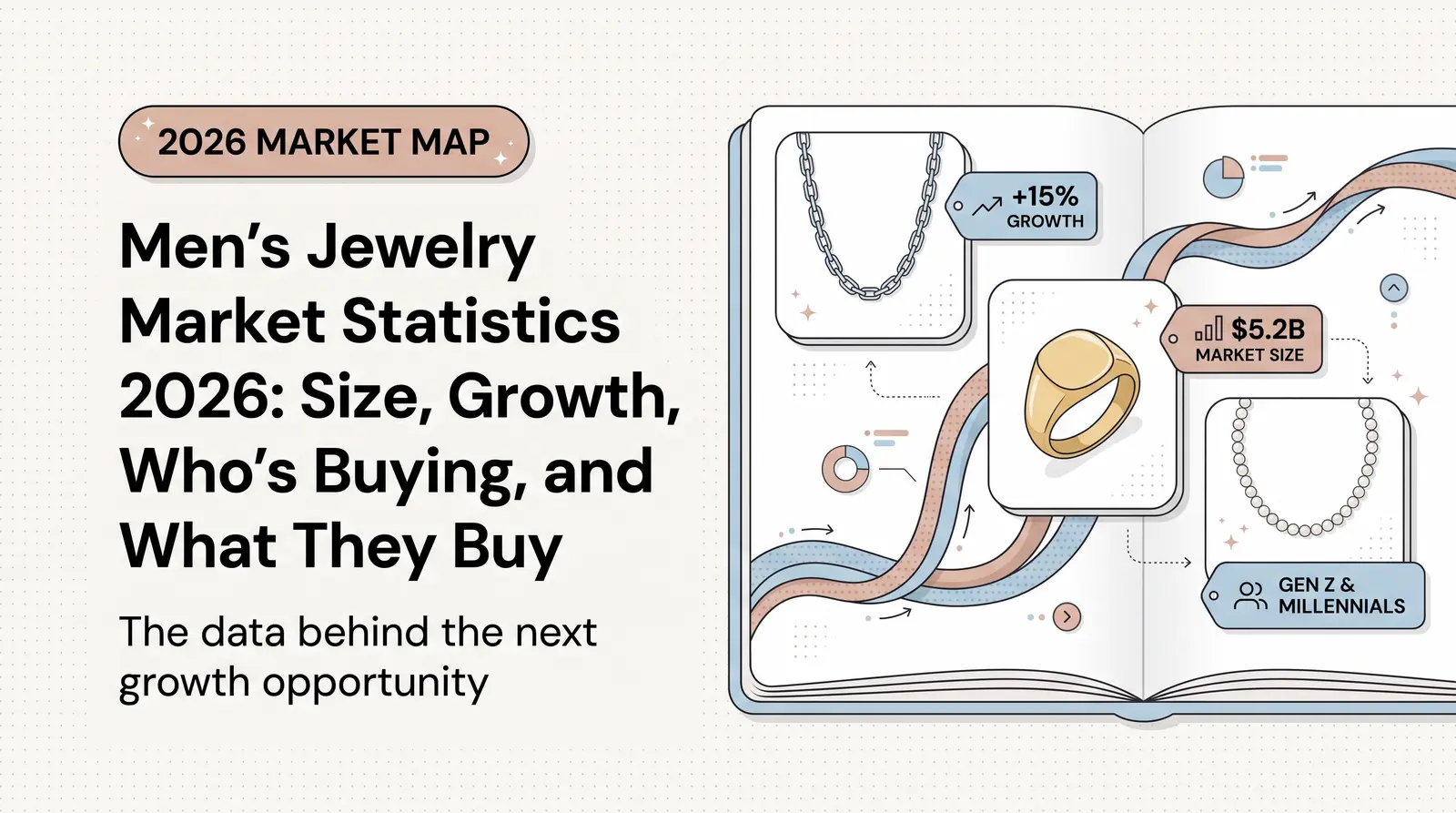
The men's jewelry market has emerged as the industry's most dynamic growth vector, shedding its niche status to become a mainstream powerhouse. The global men's jewelry market was valued at USD 48.56 billion in 2024 and is projected to grow at a robust CAGR of 9.9% from 2025 to 2034, reaching an estimated USD 124.13 billion [10]. In the U.S. alone, the market is anticipated to grow at an 8.4% CAGR, reaching USD 10.75 billion by 2032 [11].
This expansion is driven by a fundamental shift in cultural norms and the redefinition of modern masculinity. Influenced heavily by athletes, musicians, and the crossover appeal of streetwear and K-pop aesthetics, men are increasingly incorporating jewelry into their daily wardrobes. The ring segment currently dominates, accounting for USD 9.72 billion in revenue in 2024, while platinum pieces are seeing the fastest growth at a 10.0% CAGR [10]. Furthermore, the average order value in the men's segment is steadily climbing as consumers move from entry-level steel and leather toward fine metals and gemstones.
We often see aspiring brand founders underestimate the men's jewelry segment. It's frequently their second or third bestselling category once they add two or three SKUs, with notably lower return rates than women's fashion jewelry.
| Category | Est. Global Market Share (%) | YoY Growth Rate | Primary Consumer Age Group | Key Trend Driver |
|---|---|---|---|---|
| Rings & Signets | 35% | 10.5% | Millennials (28-43) | Heritage revival and personalization |
| Chains & Necklaces | 28% | 11.2% | Gen Z (18-27) | Streetwear and pop-culture influence |
| Bracelets & Cuffs | 22% | 8.5% | Gen X (44-59) | Luxury watch pairing and stacking |
| Earrings & Studs | 15% | 12.0% | Gen Z (18-27) | Gender-fluid fashion and K-pop aesthetics |
| Table 3: Men's Jewelry Market by Category, Growth Snapshot 2026 (Estimated based on aggregated industry data) |

Sustainability has evolved from a niche marketing angle to a baseline consumer expectation. In 2026, the sustainable jewelry market is on track to reach $61.75 billion by 2032 [12]. The demand is overwhelmingly generational; nearly 65% of Millennials and Gen Z customers are willing to pay a premium for sustainably sourced jewelry [13]. According to McKinsey, 31% of Gen Z consumers are willing to pay a premium for sustainable and ethically produced products, compared to only 12% of older generations [14].
However, the definition of sustainability is maturing. Consumers are no longer satisfied with vague "eco-friendly" claims. They are actively seeking verifiable certifications such as Fairtrade Gold, Responsible Jewellery Council (RJC) certification, and documented use of recycled metals. The ethical concerns extend beyond environmental impact to include fair labor practices, with consumers increasingly demanding transparency regarding the wages and working conditions of miners and craftspeople [13].
The non-obvious insight for 2026 is that sustainability signaling is necessary but no longer sufficient. Consumers are increasingly demanding verifiable proof, not just claims. In an era of heightened sensitivity to greenwashing, "authentic sustainability" requires radical supply chain transparency. Brands that can trace their materials from origin to final polish are capturing the highest willingness-to-pay premiums, while those relying on generic ethical statements are facing increased skepticism and cart abandonment.

The jewelry industry's digital transformation has accelerated, with online penetration reaching approximately 25% of total jewelry sales in 2025 [15]. The global online jewelry market is projected to be worth around USD 85.72 billion in 2026, growing at a robust CAGR of 13% [15]. While physical retail still commands 75% of the market, the distinction between online and offline is blurring. An estimated 80% of luxury jewelry purchases are now digitally influenced, even when the final transaction occurs in-store [15].
This digital shift is accompanied by distinct performance metrics across channels. The jewelry sector faces unique ecommerce challenges, notably the highest cart abandonment rate of any industry at 80-81.68% [16]. This is largely due to the high-consideration nature of fine jewelry, where trust, sizing uncertainty, and return policies create significant friction. Consequently, the average ecommerce conversion rate for luxury and jewelry sits at a modest 1.19%, compared to the global ecommerce average of 2.5-3% [17].
However, the category compensates with the highest Average Order Value (AOV) in ecommerce, averaging $313 [18]. Furthermore, customer acquisition costs (CAC) in the jewelry sector are the highest among major ecommerce categories, averaging $91 per customer [19].
At Branvas, we track onboarding data from new brand founders and consistently find that brands combining blind-shipped DTC fulfillment with a strong social proof strategy outperform marketplace-only sellers within 90 days of launch.
| Metric | Industry Benchmark | Top-Quartile Performance | Notes |
|---|---|---|---|
| Conversion Rate | 1.19% | 2.0%+ | Requires robust social proof and seamless UX |
| Average Order Value (AOV) | $313 | $450+ | Driven by bundling and premium materials |
| Cart Abandonment Rate | 81.68% | 65.0% | Highest of any ecommerce category |
| Return Rate | 16.9% | <10.0% | Sizing issues are the primary driver |
| Customer Acquisition Cost (CAC) | $91 | $65 | Heavily dependent on organic vs. paid mix |
| Table 4: Jewelry Ecommerce KPI Benchmarks, 2026 (Estimated based on aggregated industry data) |

Navigating the complexities of the 2026 jewelry landscape requires a structured approach. The Branvas Market Entry Framework™ is a proprietary decision matrix designed for independent brands, influencers, and DTC sellers evaluating market opportunities. The framework assesses viability across five critical dimensions, scored from 1 to 5 (1 = Weak, 5 = Strong):
Worked Example: Maya's Sustainable Fine Jewelry Launch
Maya, a lifestyle influencer with 180K Instagram followers, wants to launch a sustainable women's fine jewelry line in 2026.
Scoring Guide: 20–25: Strong Entry Signal; 15–19: Conditional Entry (Refine Model); Below 15: Reassess Segment or Operations.
If you're evaluating your own Market Entry Score, Branvas's How It Works page walks through exactly how founders move from idea to live brand, including private-label sourcing, packaging, and blind fulfillment. You can also explore pricing and the full product catalog to pressure-test your margin model before committing.

No single factor has shaped the 2026 jewelry landscape more profoundly than the price of gold. After peaking at approximately $4,400 per ounce in late 2025, gold has remained stubbornly elevated, with Morgan Stanley projecting the price could reach $4,800 per ounce by late 2026 [2]. This represents a roughly 60% increase over the prior year, and the ripple effects are visible at every level of the market, from mine to mall.
The most immediate consequence is the structural repricing of entry-level jewelry. What was once a $99 silver pendant is now a $200 piece. What was once a $500 gold ring now starts at $750. Industry leaders like Borsheims CEO Karen Goracke have noted that it is increasingly difficult for customers to find pieces within their budgets, particularly in the $500 and under range [2]. The new entry-level floor for fine jewelry is settling between $200 and $500, permanently redefining the accessible luxury tier.
This pricing pressure has triggered three distinct creative and commercial responses across the industry. First, designers are engineering lighter pieces, using negative space and heritage techniques to create visual presence without excess metal weight. Second, retailers are reintroducing silver and 10k gold options to serve price-sensitive customers who have been priced out of 14k and 18k. Third, and most importantly for the broader market, the gold price surge has dramatically accelerated the adoption of lab-grown diamonds as a value-engineering tool. By incorporating LGDs into designs at lower price points, brands can maintain perceived luxury while absorbing some of the gold cost increase.
For independent brand founders, the gold price environment creates a paradox. On one hand, it compresses accessible price points and reduces impulse purchase frequency. On the other hand, it drives consumers toward higher-quality, more considered purchases, which benefits brands with strong narratives and clear value propositions. The brands winning in this environment are those that can articulate why their piece is worth the investment, not just what it looks like.

The single most consequential behavioral shift in the 2026 jewelry market is the normalization of self-purchasing. Jewelry was historically positioned as a gift, a milestone marker, or a bridal purchase. That framing is now obsolete. According to a BriteCo survey of 2,000 Americans conducted in October 2025, 80% of adults aged 18 and older are now more likely to buy fine jewelry for themselves [6]. This is not a marginal trend; it is a structural realignment of the entire demand base.
The generational breakdown reveals important nuances for brand positioning. Millennials aged 30 to 44 are the most active self-purchasers at 86%, driven by milestone celebration, personal style investment, and a growing view of fine jewelry as a store of value. Gen X follows at 81%, motivated by a combination of discretionary income and a desire for understated luxury. Gen Z, at 75%, is the most digitally native cohort, heavily influenced by social media aesthetics, influencer endorsements, and the visual storytelling of platforms like TikTok and Instagram. Baby Boomers, while the least likely to self-purchase at 70%, represent a significant volume opportunity given their higher average disposable income.
| Generation | Self-Purchase Rate | Top Item | Avg. Max Spend | Primary Motivation |
|---|---|---|---|---|
| Millennials (30-44) | 86% | Rings | $2,500-$5,000 | Milestone celebration and style investment |
| Gen X (45-59) | 81% | Rings/Watches | $1,000-$2,500 | Understated luxury and discretionary reward |
| Gen Z (18-29) | 75% | Necklaces | Under $500 | Social media aesthetics and influencer culture |
| Baby Boomers (60-79) | 70% | Rings | $500-$1,000 | Sentimental value and personal reward |
| Table 6: Self-Purchase Behavior by Generation, 2025 (Source: BriteCo Survey, October 2025) |
The implications for product and marketing strategy are significant. The most popular self-purchase item across all demographics is rings at 31%, followed by necklaces and watches. However, Gen Z deviates from this pattern, preferring necklaces first due to the influence of social media styling content [6]. The most common spend across all groups is under $500, but Millennials show the highest willingness to invest, with 20% prepared to spend between $2,500 and $5,000 on a single piece.
This self-purchase revolution is directly fueling the growth of the demi-fine jewelry segment, which sits at the intersection of accessible price points and genuine material quality. The global demi-fine jewelry market was valued at USD 3.59 billion in 2025 and is projected to grow to USD 7.53 billion by 2034. This segment is particularly well-suited to influencer-led brands and private-label DTC models, where the brand story and community connection justify a premium over mass-market alternatives.
For aspiring jewelry brand founders, the self-purchase trend is the clearest market signal of 2026. It means your customer is not waiting for a partner, a birthday, or a holiday. They are buying for themselves, right now, because they want to. That changes everything about how you write copy, build product assortments, and structure your marketing calendar. Platforms like Branvas are specifically designed to help first-time brand founders capitalize on this demand without the traditional barriers of minimum order quantities or upfront inventory investment.

The global jewelry market is not monolithic. Growth trajectories vary significantly by region, driven by distinct cultural, economic, and demographic factors.
Asia-Pacific is the undisputed growth engine of the global market, accounting for approximately 60.4% of global jewelry sales in 2025 [1]. The region is projected to grow at a 5.9% CAGR through 2033 [20]. China is seeing a rebound in luxury jewelry and a surge in domestic brand loyalty, while India's market remains anchored by robust wedding jewelry demand, despite a 24% volume drop in 2025 driven by record gold prices [21].
The Middle East market was valued at USD 33.58 billion in 2025 and is expected to reach USD 66.63 billion by 2034 [22]. Unlike Western markets where gold is increasingly viewed as an investment vehicle, approximately 60% of gold demand in the Middle East remains dedicated to jewelry, driven by a strong gifting culture and high-net-worth consumers [23]. This cultural distinction makes the region uniquely resilient to gold price volatility.
Europe is experiencing steady growth at a projected 5.1% CAGR [1]. The region is characterized by a strong preference for sustainable and heritage jewelry, and the diamond jewelry market in Europe is expected to witness the fastest regional CAGR at 5.5% [1]. European consumers are leading the charge on supply chain transparency and ethical sourcing certifications.
North America (U.S. and Canada combined) was valued at USD 88.5 billion in 2024 and is projected to reach USD 112.04 billion by 2030 at a 4% CAGR [24]. North America is defined by DTC dominance, the rapid rise of influencer-led brands, and the most aggressive adoption of lab-grown diamonds of any region globally.
| Region | 2024 Market Size (USD Bn) | 2026 Estimate (USD Bn) | CAGR | Standout Trend |
|---|---|---|---|---|
| Asia-Pacific | 198.5 | 222.6 | 5.9% | Domestic brand loyalty and digital-first purchasing |
| North America | 88.5 | 95.7 | 4.0% | DTC dominance and lab-grown diamond adoption |
| Europe | 62.4 | 68.9 | 5.1% | Sustainable sourcing and heritage revival |
| Middle East | 31.2 | 35.8 | 7.2% | Resilient gold demand despite record high prices |
| Table 5: Regional Jewelry Market Growth Rates, 2024–2026 (Estimated based on aggregated industry data) |

The data across all eight fact sheets points to a consistent set of strategic signals for 2026. Here is the condensed intelligence.
The U.S. market grew 5.6% in 2025 despite a 5.6% drop in unit volume [4]. That is not a contradiction; it is the definition of premiumization. Consumers are buying less but spending more per piece. Brands that position around quality, story, and investment value are winning. Brands competing on price alone are losing ground.
Lab-grown diamonds have crossed the tipping point. With a 73% price advantage over mined stones and a 48% share of engagement rings [7], they are no longer a niche. They are the default for a growing segment of the market. The wholesale price decline of 26% in 2025 [9] is not a warning sign; it is a market expansion signal.
Men's jewelry is the fastest-growing segment in the industry, projected to reach $124.13 billion by 2034 at a 9.9% CAGR [10]. Most brand founders are still under-investing here. Two or three well-positioned men's SKUs can meaningfully change a brand's revenue profile.
Sustainability is now table stakes, not a differentiator. 65% of Millennials and Gen Z will pay a premium for ethical jewelry [13], but they are increasingly skeptical of unverified claims. Brands that can prove their sourcing story will command the premium. Brands that only claim it will face growing resistance.
The self-purchase revolution is the most actionable trend in this report. 80% of Americans are buying fine jewelry for themselves [6]. Your marketing calendar should not be built around Valentine's Day and Christmas. It should be built around the everyday moments when a person decides they deserve something beautiful.
Ecommerce in jewelry is hard but high-reward. The highest cart abandonment rate (81.68%) and highest CAC ($91) in ecommerce [16] [19] are offset by the highest AOV ($313) [18]. The brands that solve the trust and friction problem, through social proof, easy returns, and seamless UX, capture outsized returns.
Finally, 80% of luxury jewelry purchases are now digitally influenced [15]. If your brand does not have a compelling digital presence, you are invisible to the majority of your potential customers, even the ones who ultimately buy in a physical store.
1. What is the global jewelry market size in 2026?
The global jewelry market is estimated to reach approximately USD 423.5 billion in 2026, up from USD 381.54 billion in 2025. The market is projected to continue expanding at a compound annual growth rate (CAGR) of 5.5%, driven by rising disposable incomes in emerging markets and the rapid growth of digital commerce.
2. How fast is the U.S. jewelry market growing in 2026?
The U.S. jewelry market is growing at a steady CAGR of 3.7% to 4.0%, following a robust 5.6% growth year in 2025. This growth is characterized by a "premiumization" trend, where overall revenue is increasing due to higher average ticket prices, even as total unit sales experience slight declines.
3. What is the current market share of lab-grown diamonds in 2026?
As of late 2025 and entering 2026, lab-grown diamonds account for approximately 42% of all diamond jewelry sold and an impressive 48% of all engagement ring sales. This rapid market penetration is fueled by a 73% price advantage over natural diamonds, allowing consumers to purchase significantly larger stones for the same budget.
4. Is men's jewelry a good market to enter in 2026?
Yes, men's jewelry is currently the fastest-growing segment in the industry. The global men's jewelry market is projected to grow at a 9.9% CAGR through 2034. Driven by shifting cultural norms, streetwear influences, and the normalization of male accessorizing, categories like rings, chains, and bracelets offer significant margin opportunities with notably lower return rates than women's fashion jewelry.
5. What are typical ecommerce conversion rates for jewelry brands in 2026?
The average ecommerce conversion rate for the luxury and jewelry sector is 1.19%, which is lower than the global ecommerce average of 2.5-3%. This is due to the high-consideration nature of the product, which also results in an industry-high cart abandonment rate of over 81%. However, top-quartile brands that effectively leverage social proof and seamless UX can achieve conversion rates of 2.0% or higher.