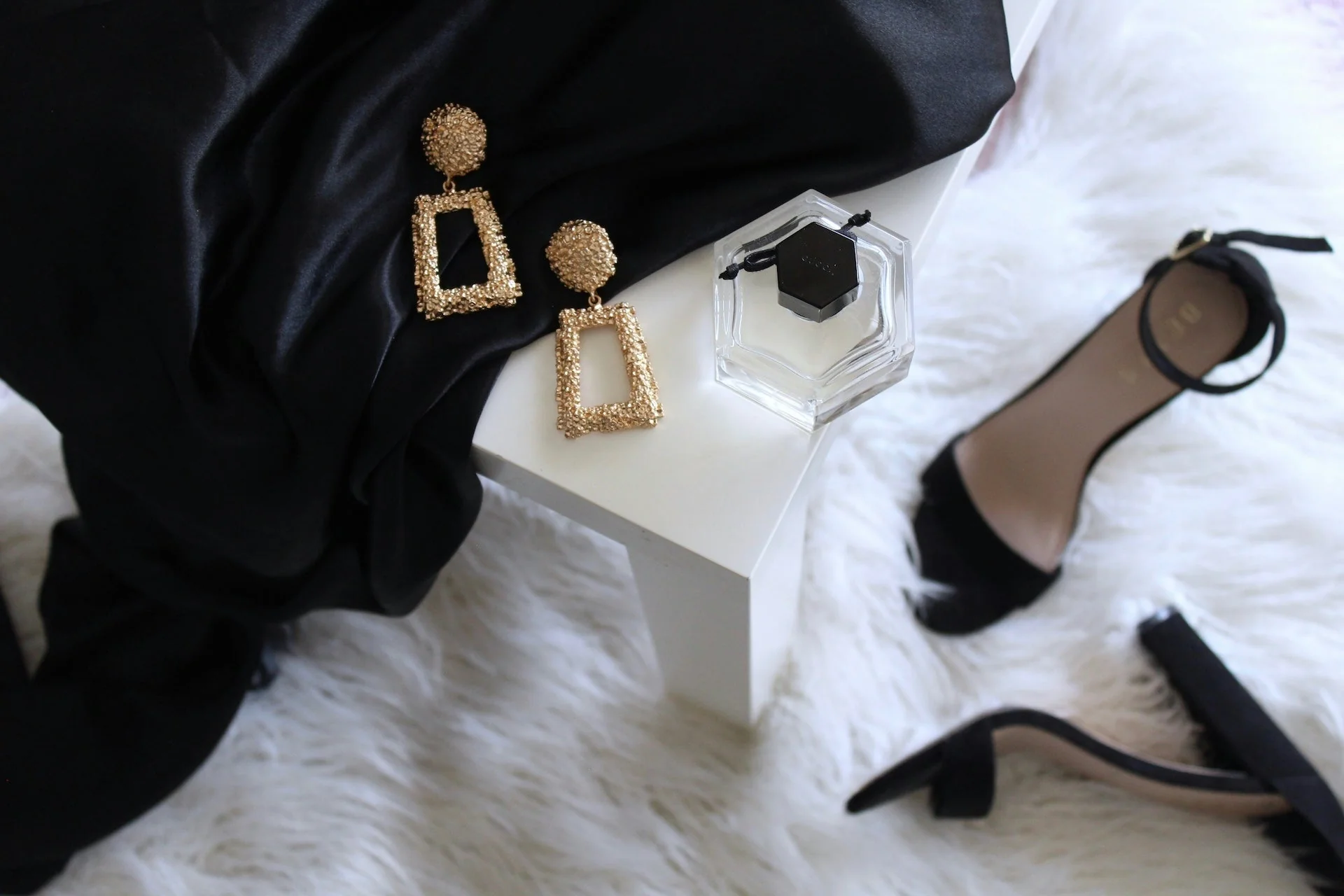



A practical 2026 playbook showing women’s apparel stores how to add jewelry as a strategic add-on, increase AOV by 20–30%, and boost revenue without acquiring new traffic.
Published:
January 29, 2026
Author:
Yi Cui
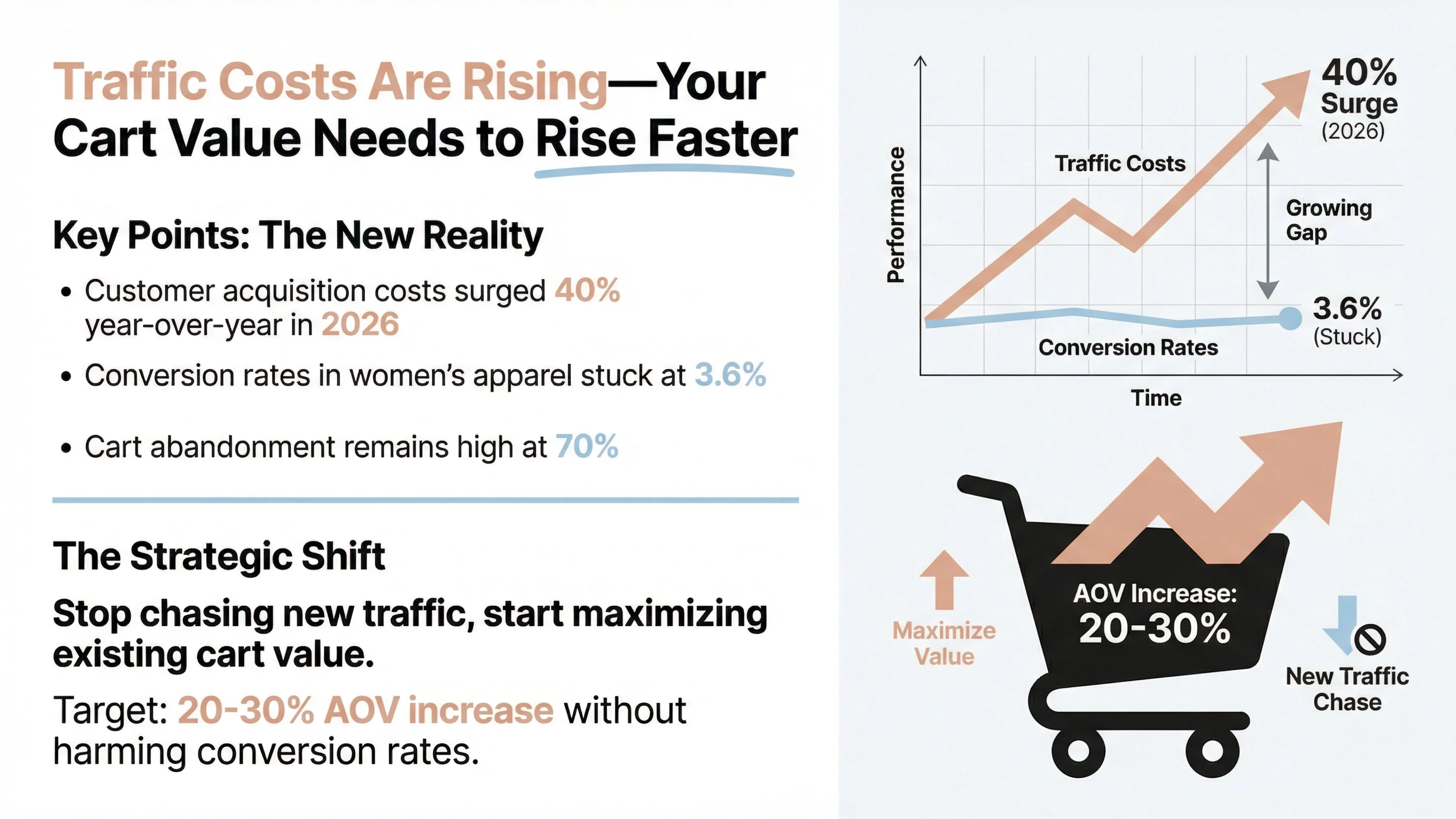
You don't need new traffic—you need a higher cart. This is the reality facing women's apparel store owners in 2026. Traffic costs continue to climb, with customer acquisition costs surging by 40% year-over-year according to recent eCommerce benchmarks [1]. Meanwhile, conversion rates in women's apparel hover around 3.6%, and cart abandonment remains stubbornly high at 70% [2]. For founders already generating consistent traffic, the fastest path to revenue growth isn't buying more visitors—it's increasing what each visitor spends.
This is where jewelry enters the conversation, not as a random product expansion, but as a strategic add-on category designed to increase AOV accessories without diluting your brand or adding operational complexity. When you add jewelry to clothing store offerings using a structured approach, you can raise average order values by 20-30% while maintaining or even improving conversion rates [3]. The key is treating jewelry not as a separate category, but as an outfit completion system.
In our experience at Branvas, the most successful apparel store upsell jewelry implementations follow a clear playbook: curated SKU selection, strategic placement rules, tiered pricing that doesn't rely on discounts, and a measurement framework that tracks what actually matters. This article delivers that playbook in full, with operational detail, proprietary frameworks, and the contrarian insights that separate winning strategies from generic advice.
Jewelry occupies a unique position in the fashion ecosystem. Unlike other accessories that may require complex sizing or create fulfillment challenges, jewelry offers high perceived value in a lightweight, low-risk format. The psychology of "complete the look" drives this advantage—customers who have already committed to purchasing an outfit are primed to consider the finishing touches that elevate their purchase from functional to aspirational.
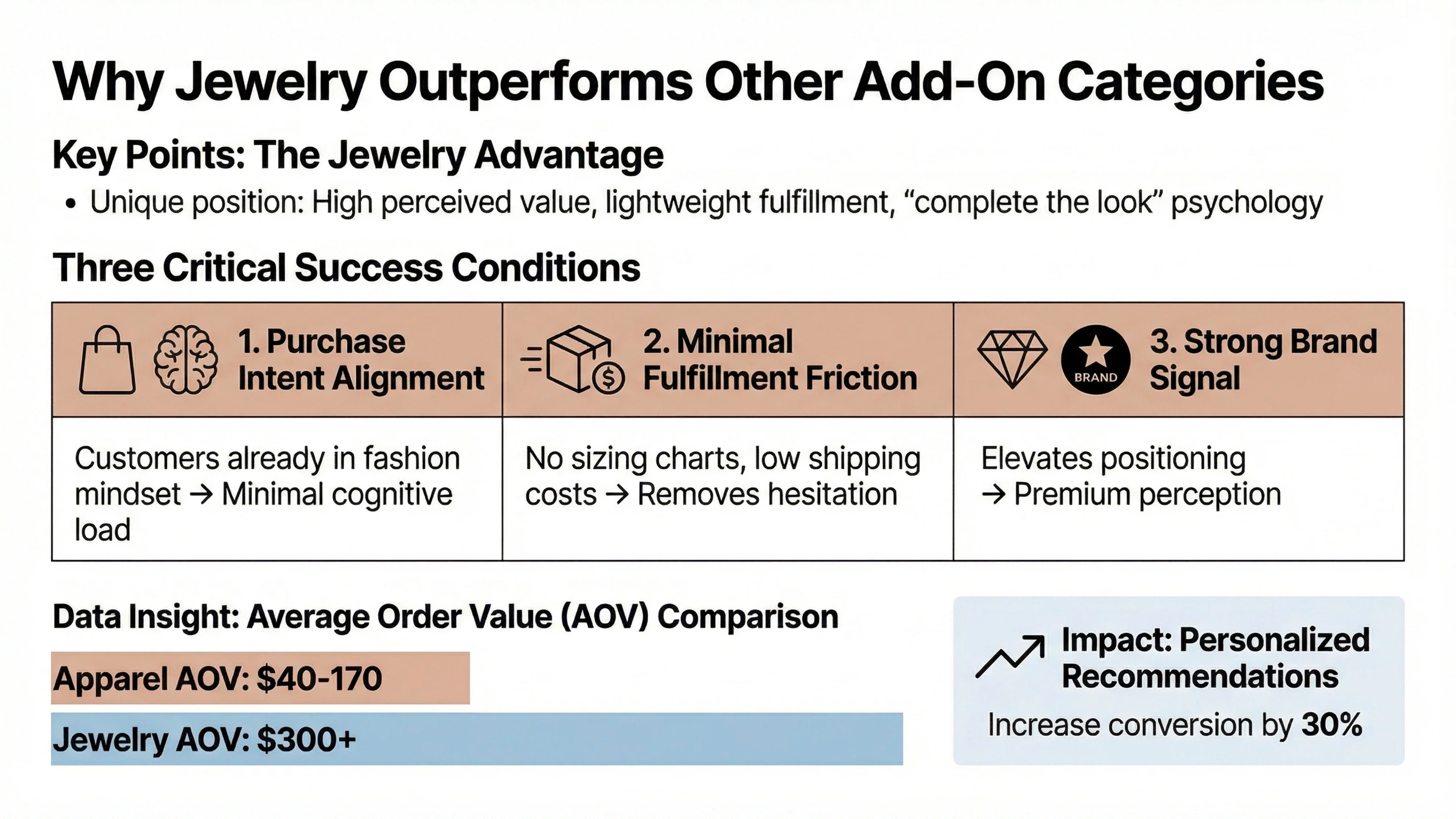
The data supports this intuition. According to Shopify's 2025 benchmarks, apparel and accessories typically generate AOV in the $40 to $170 range, while luxury and jewelry categories see AOV above $300 [4]. This disparity reveals an opportunity: when jewelry is positioned as a complement to apparel rather than a standalone purchase, it pulls the combined transaction closer to the premium end of the spectrum without requiring customers to make an entirely separate buying decision.
In our experience at Branvas, jewelry succeeds as an add-on because it satisfies three critical conditions. First, it aligns with the customer's existing purchase intent—they're already in a fashion mindset, making styling decisions, and visualizing how they'll wear their new pieces. Second, jewelry has minimal friction in fulfillment—no complex sizing charts, no heavy shipping costs, and straightforward returns policies. Third, jewelry carries strong brand signal value, allowing apparel brands to elevate their positioning without abandoning their core identity.
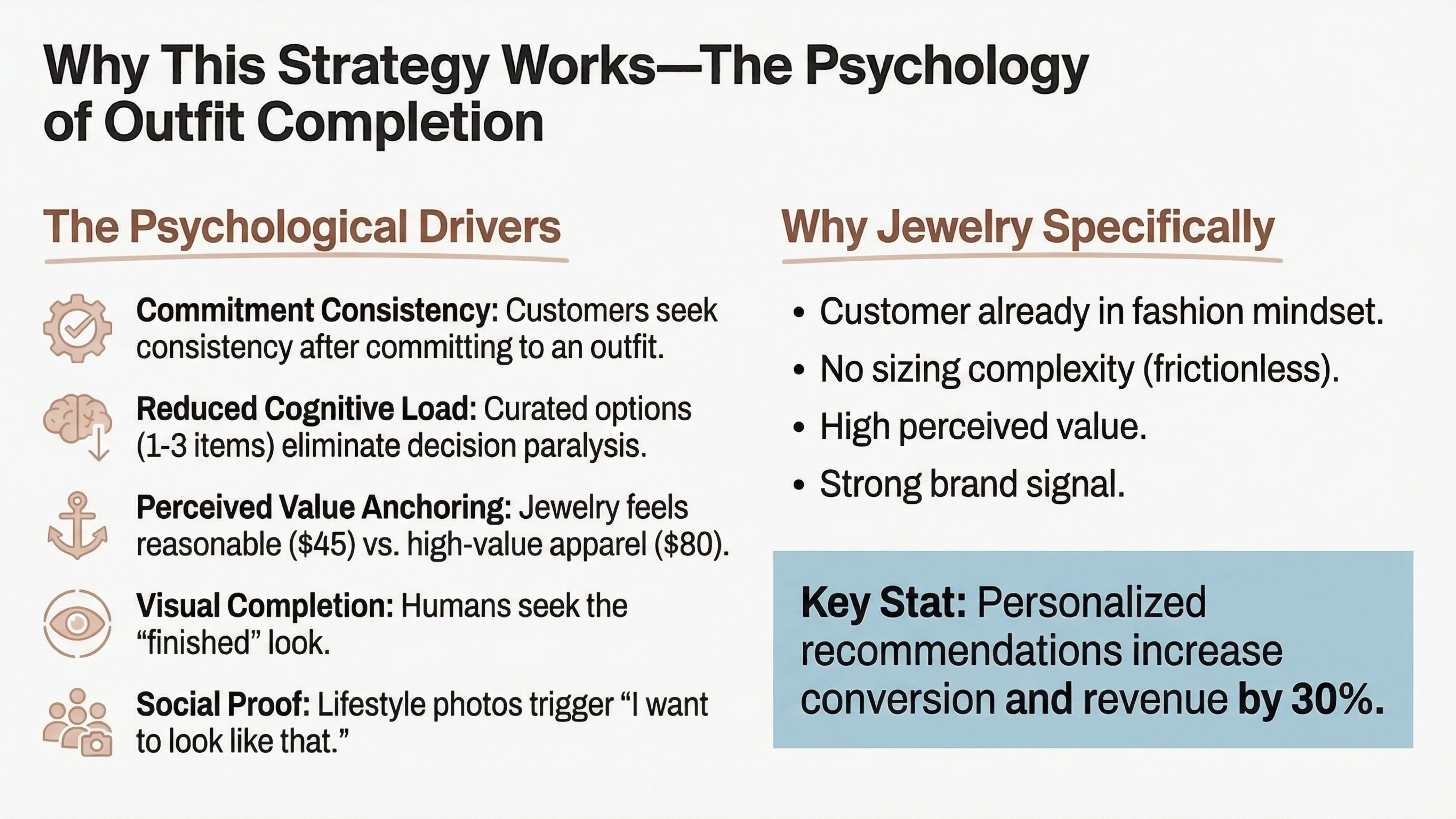
 The "complete the look" framework is not merely a merchandising tactic; it's rooted in consumer behavior research showing that personalized product recommendations and bundled offers can increase conversion and revenue by 30% [5]. When customers see jewelry presented as the natural completion of an outfit they're already purchasing, the cognitive load is minimal and the perceived value is high. This is fundamentally different from random cross-sells or aggressive upsells that feel disconnected from the customer's original intent.
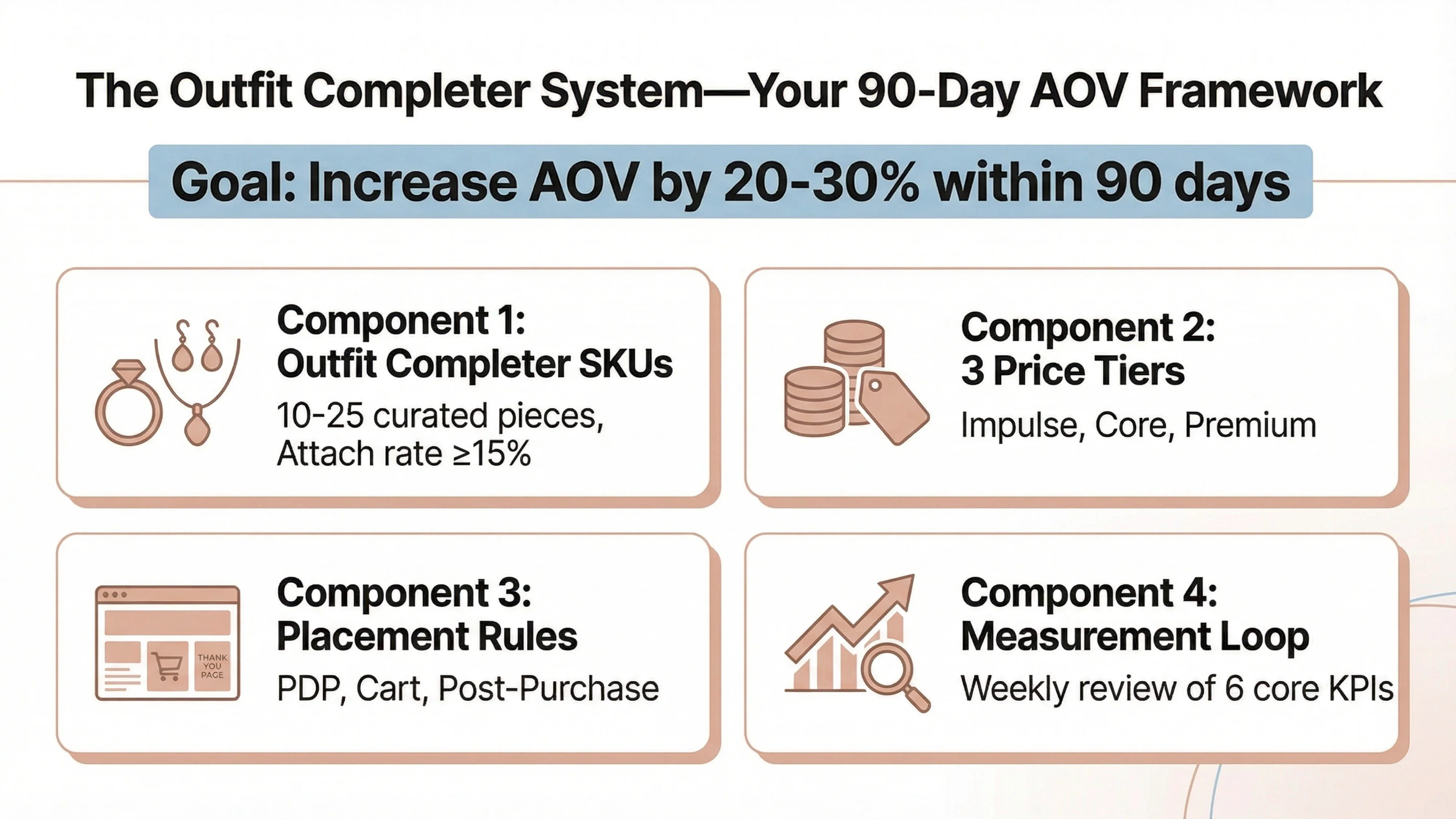
The Outfit Completer System (OCS) is a structured approach to integrating jewelry into women's apparel stores. Rather than treating jewelry as a separate product catalog, OCS positions jewelry as curated styling tools designed to complete outfits. This framework consists of four interconnected components: SKU curation, price tiering, placement rules, and a measurement loop.
Goal: Increase AOV by 20-30% within 90 days without negatively impacting conversion rates or brand perception.
Required SKU Count to Start: 10-25 carefully curated pieces across three price tiers. This is intentionally small—more SKUs don't raise AOV, better curation does.
Placement Rule Overview: Deploy jewelry offers at three strategic touchpoints—product detail pages (PDP), cart, and post-purchase—with different offer structures and messaging at each stage.
KPI Loop Overview: Track six core metrics weekly: base AOV, accessory attach rate, AOV with accessories, conversion rate impact, refund/return rate impact, and top-performing SKUs. Use these metrics to refine curation and placement continuously.
The OCS framework is designed to be implemented in phases, allowing founders to test, learn, and scale without overwhelming their operations or confusing their customers. In our experience at Branvas, brands that follow this structured approach see measurable AOV lift within 30 days and sustained improvements by the 90-day mark.
|
Component |
Description |
Success Metric |
|---|---|---|
|
Outfit Completer SKUs |
10-25 curated jewelry pieces designed to pair with core apparel styles |
Attach rate ≥15% |
|
3 Price Tiers |
Impulse ($15-35), Core ($40-80), Premium ($90-150+) |
Balanced distribution across tiers |
|
Placement Rules |
PDP (1-3 items), Cart (1 item), Post-Purchase (1 item) |
No negative conversion impact |
|
Measurement Loop |
Weekly review of 6 core KPIs with decision triggers |
AOV lift ≥20% within 90 days |
The most common mistake founders make when adding jewelry is launching with too many SKUs. The instinct is to offer variety, but in practice, excessive choice creates decision paralysis and dilutes the "complete the look" message. Instead, start with 10-25 SKUs carefully selected to pair with your existing apparel aesthetic.
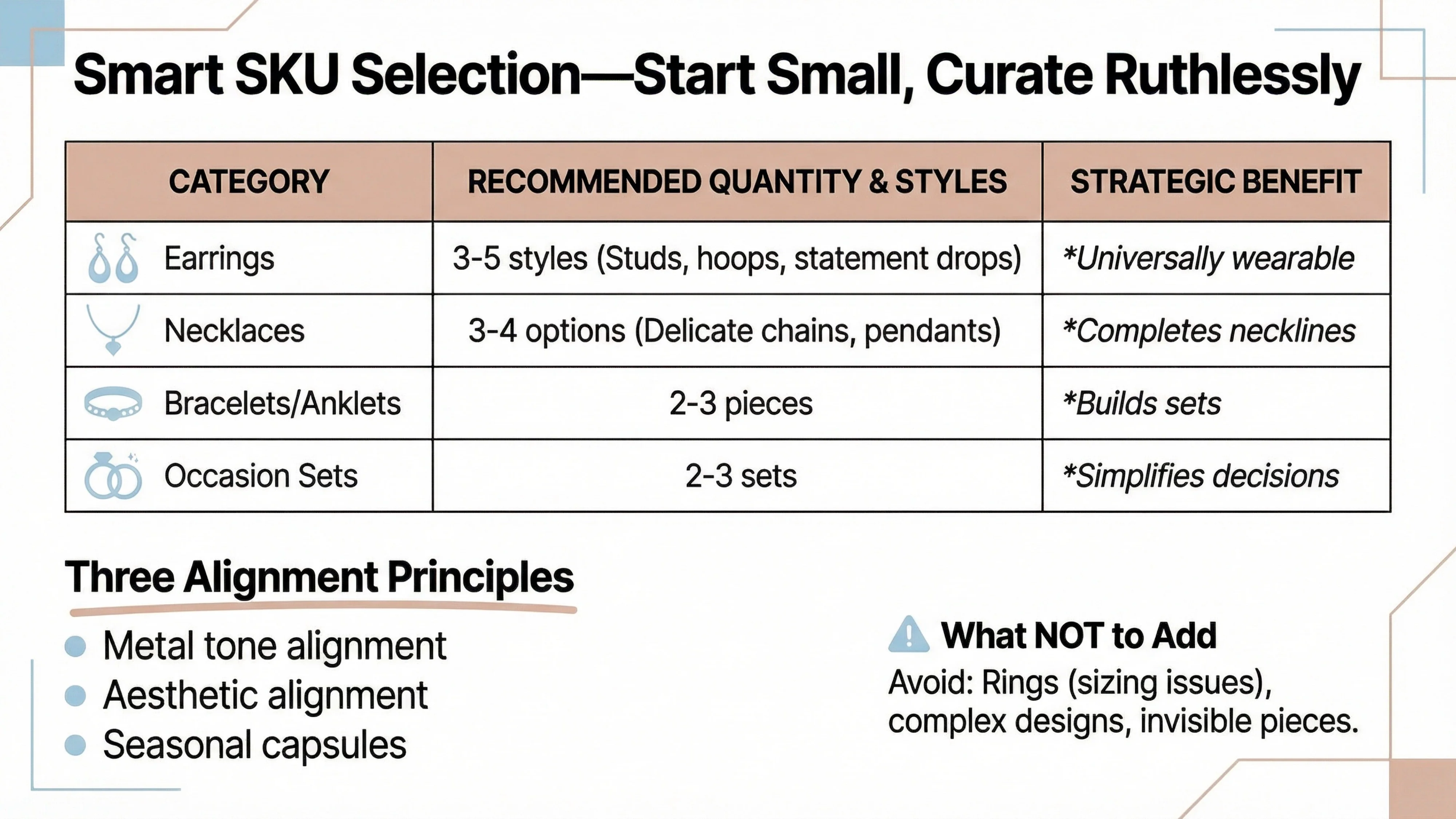
Categories to Include:
Earrings should be your anchor category—they're universally wearable, require no sizing, and have strong visual impact in product photography. Start with 3-5 styles that span your aesthetic range: studs for minimal looks, hoops for everyday versatility, and statement drops for occasion wear.
Necklaces complete necklines and add visual interest to outfit flats and lifestyle photography. Include 3-4 options across lengths: delicate chains for layering, pendants that work solo, and statement pieces for elevated looks. Ensure metal tones align with your apparel hardware (zippers, buttons, belt buckles).
Bracelets and anklets are lower-priority initially but valuable for building "sets" that increase basket size. Start with 2-3 versatile pieces—a simple chain bracelet, a cuff, and a delicate anklet if your brand skews casual or beachy.
Occasion sets are pre-curated combinations of matching pieces (e.g., earrings + necklace) that simplify the decision for customers and naturally increase AOV. These work particularly well for brands with event-driven customer segments (weddings, date nights, professional settings).
Match Rules:
Successful jewelry curation follows three alignment principles. First, metal tone alignment ensures jewelry doesn't clash with apparel hardware or brand aesthetic—if your apparel features gold zippers and warm-toned buttons, your jewelry should skew gold and brass rather than silver. Second, aesthetic alignment means jewelry should feel native to your brand's visual language. A minimal, Scandinavian-inspired apparel brand should offer clean, geometric jewelry, not ornate Victorian pieces. Third, seasonal capsules allow you to refresh jewelry offerings without expanding your core catalog—introduce seasonal colors, textures, or motifs that align with your apparel collections.
What NOT to Add First:
Avoid highly trendy pieces that will date quickly, complex or fragile designs that create return issues, jewelry that requires sizing (rings), and pieces with gemstones or materials that significantly increase price points beyond your customer's comfort zone. Also skip jewelry that doesn't photograph well with your apparel—if it's invisible in product shots, it won't drive attach rates.
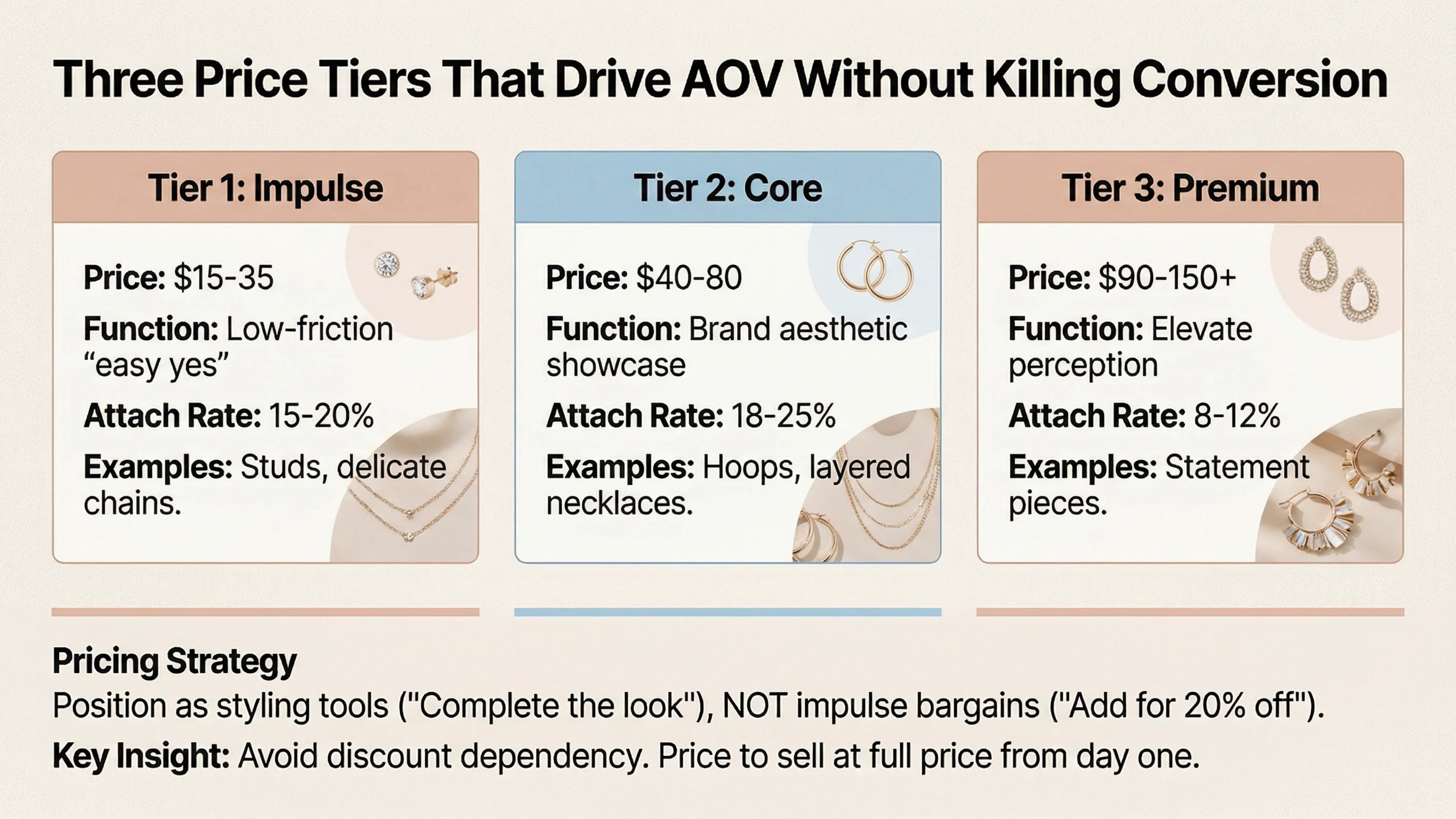
Pricing jewelry to maximize AOV without harming conversion requires a tiered approach that gives customers entry points at multiple commitment levels. The three-tier system—Impulse, Core, and Premium—creates a psychological pricing ladder that encourages customers to trade up while ensuring there's always an accessible option.
Tier 1: Impulse ($15-35)
These are low-friction add-ons designed to be easy "yes" decisions. Impulse-tier jewelry should feel like a no-brainer addition to an existing cart—the price point is low enough that customers don't need to deliberate, and the perceived value is high enough that it feels like a smart styling choice. Examples include simple stud earrings, delicate chain necklaces, and thin bangles. This tier drives volume and introduces customers to your jewelry offering without risk.
Tier 2: Core ($40-80)
Core-tier jewelry is where most attach revenue will come from. These pieces have enough substance and design interest to feel like meaningful additions, but they're priced within the range customers expect for quality accessories. This tier should represent your brand's aesthetic most clearly—it's where customers who are already committed to your apparel will naturally gravitate. Examples include hoop earrings with unique details, layered necklace sets, and statement cuffs. In our experience at Branvas, Core-tier pieces typically achieve the highest attach rates (18-25%) because they balance value and aspiration.
Tier 3: Premium ($90-150+)
Premium jewelry serves two functions: it elevates brand perception and it captures high-intent customers who want the best version of the look. These pieces should feel special—limited availability, superior materials, distinctive design. Premium jewelry won't drive the highest attach rates, but it will significantly lift AOV when customers do convert. Examples include statement earrings with semi-precious stones, substantial chain necklaces, and designer-collaboration pieces. Position Premium jewelry as the "complete the look" option for your most elevated apparel pieces.
Pricing Without Discount Dependency:
The key to sustainable AOV growth is pricing jewelry to sell at full price, not relying on discounts to drive attach rates. This requires positioning jewelry as styling tools, not impulse bargains. Use language like "complete the look," "pairs perfectly with," and "designed to match" rather than "add for 20% off." When jewelry is framed as an essential part of the outfit, customers evaluate it on style fit, not discount depth. According to recent research, the death of moderate discounting is one of the most significant signals in eCommerce—brands that train customers to expect 20-30% off everything erode margins and condition customers to wait for sales [6].
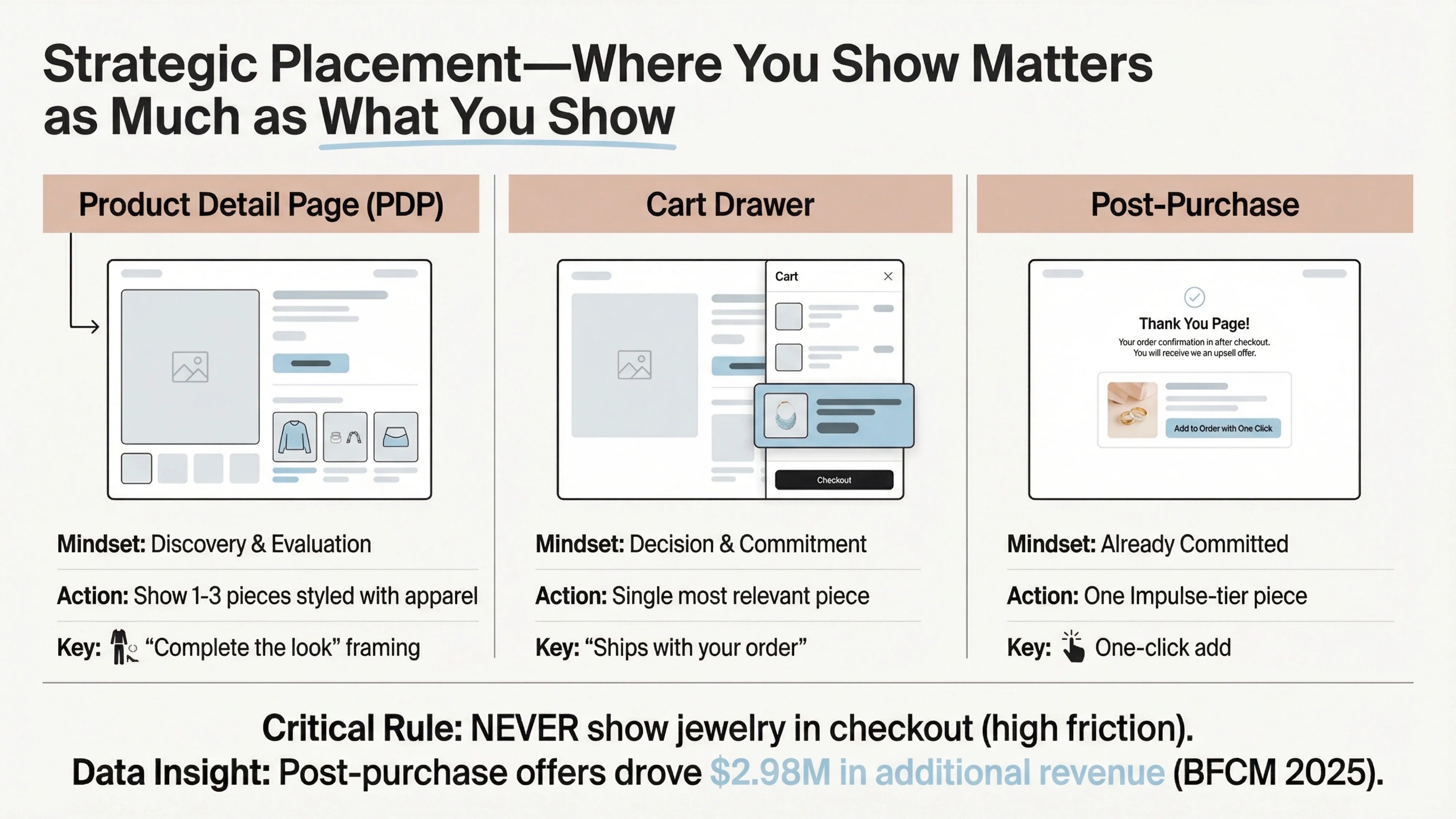
Where you show jewelry offers is as important as what you show. Each placement—product detail page (PDP), cart, and post-purchase—has different customer intent, different attention levels, and different conversion dynamics. Successful jewelry integration requires tailored strategies for each.
Product Detail Page (PDP):
On the PDP, customers are in discovery and evaluation mode. They're considering the apparel item, imagining how they'll wear it, and assessing fit and style. This is the ideal moment to introduce jewelry as outfit completion, because the customer is already visualizing the full look.
Show 1-3 jewelry pieces maximum, selected based on the specific apparel item. If the customer is viewing a black slip dress, show delicate gold earrings and a layered necklace that complement the neckline. If they're viewing a casual tee, show simple hoops and a chain bracelet. Use "complete the look" language and show the jewelry styled with the apparel item in photography—this is critical, as mismatched or generic product shots make jewelry feel like an afterthought rather than an intentional pairing.
Avoid overwhelming the PDP with too many cross-sells. Research from Baymard Institute consistently shows that irrelevant or excessive product recommendations harm conversion [7]. Keep jewelry offers visually clean, contextually relevant, and easy to add to cart without navigating away from the main product.
Cart Drawer / Cart Page:
In the cart, customer intent has shifted—they've committed to the apparel purchase and are now evaluating the total transaction. This is a high-leverage moment for a single, highly relevant jewelry offer, but it's also a fragile moment where clutter or friction can trigger abandonment.
Show the single most relevant jewelry piece based on cart contents. If the cart contains a dress, show earrings or a necklace. If the cart contains multiple items, prioritize jewelry that complements the highest-value item. Use clear messaging about shipping compatibility ("ships with your order") and returns clarity ("easy returns, just like your apparel").
Avoid showing multiple jewelry options in the cart—this creates decision fatigue at the worst possible moment. Also avoid aggressive discount messaging that makes the jewelry feel like a clearance item rather than a curated recommendation. The goal is to make adding jewelry feel like a smart styling decision, not a desperate upsell.
Post-Purchase:
Post-purchase offers are low-friction because the customer has already completed checkout and committed their payment information. This placement is ideal for a single, low-cost jewelry add-on that feels like a bonus rather than a sales tactic.
Show one Impulse-tier jewelry piece that aligns with what the customer just purchased. Use language like "one more thing to complete your look" and make the add-on process as simple as possible—one-click add, no re-entering payment information, clear confirmation that it will ship with the original order.
According to Rebuy's BFCM 2025 data, post-purchase offers drove $2.98M in additional revenue during the four-day period, demonstrating the effectiveness of this placement when executed well [8]. However, post-purchase offers must be carefully calibrated—if the jewelry feels irrelevant or the process feels complicated, it can create buyer's remorse and increase return rates.
Placement Checklist:
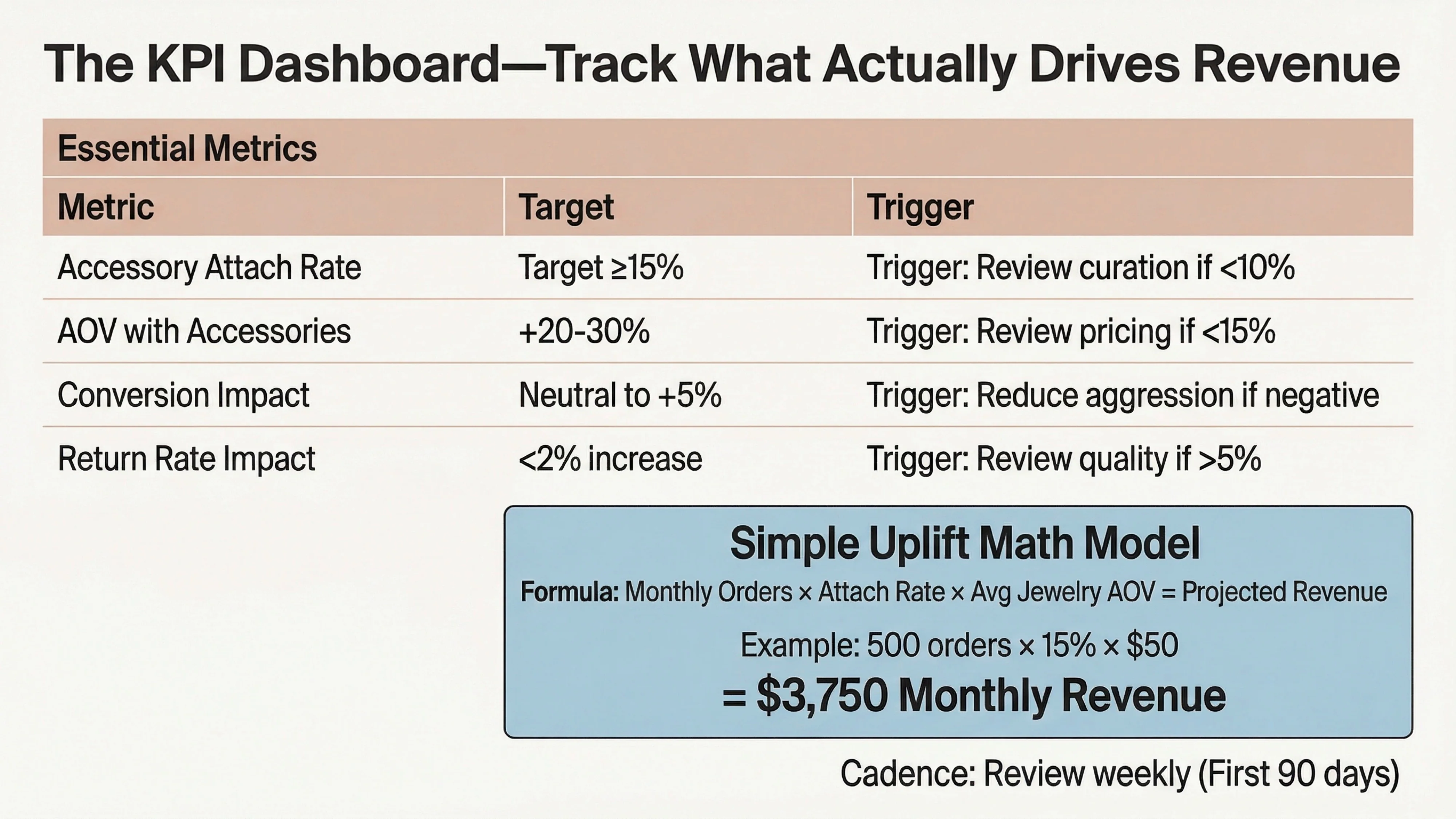
Measuring jewelry performance requires a focused set of metrics that reveal both revenue impact and potential friction points. Too many founders track vanity metrics (total jewelry revenue) without understanding the underlying dynamics (attach rate, conversion impact, return rate). The KPI dashboard below provides the essential metrics and decision triggers.
|
Metric |
Definition |
Target |
Decision Trigger |
|---|---|---|---|
|
Base AOV |
Average order value for orders without jewelry |
Benchmark |
Track trend over time |
|
Accessory Attach Rate |
% of orders that include jewelry |
≥15% |
If <10%, review curation and placement |
|
AOV with Accessories |
Average order value for orders that include jewelry |
+20-30% vs base |
If <15%, review pricing tiers |
|
Conversion Rate Impact |
Change in overall site conversion rate after jewelry launch |
Neutral to +5% |
If negative, reduce placement aggression |
|
Refund/Return Rate Impact |
Change in return rate for orders with jewelry vs without |
<2% increase |
If >5%, review jewelry quality/photography |
|
Revenue from Accessories |
Total revenue attributed to jewelry SKUs |
Growing weekly |
If flat, refresh curation |
|
Top 5 Completer SKUs |
Best-performing jewelry pieces by attach rate and revenue |
Updated weekly |
Double down on winners, cut losers |
|
Bundle Take Rate |
% of customers who purchase jewelry sets vs individual pieces |
10-20% |
If low, improve set presentation |
Cadence:
Review this dashboard weekly during the first 90 days, then shift to bi-weekly once performance stabilizes. Each metric should drive a specific decision—if attach rate drops below 10%, review whether jewelry is being shown at the right touchpoints and whether the curation still aligns with current apparel offerings. If conversion rate goes negative, reduce the number of placements or test less aggressive messaging. If return rates spike, investigate whether jewelry photography accurately represents the product or whether quality issues are emerging.
Simple Uplift Math Model:
To project the revenue impact of jewelry integration, use this formula:
Projected Monthly Jewelry Revenue = (Monthly Orders × Attach Rate × Average Jewelry AOV)
Example: A store with 500 monthly orders, 15% attach rate, and $50 average jewelry AOV would generate $3,750 in monthly jewelry revenue. If jewelry increases overall AOV by 25%, the store's total monthly revenue increases from $40,000 (500 orders × $80 base AOV) to $43,750 (425 orders without jewelry × $80 + 75 orders with jewelry × $130), a net gain of $3,750 or 9.4% revenue lift.
This model is intentionally simple—it doesn't account for every variable, but it provides a clear framework for evaluating whether jewelry integration is delivering the expected return.
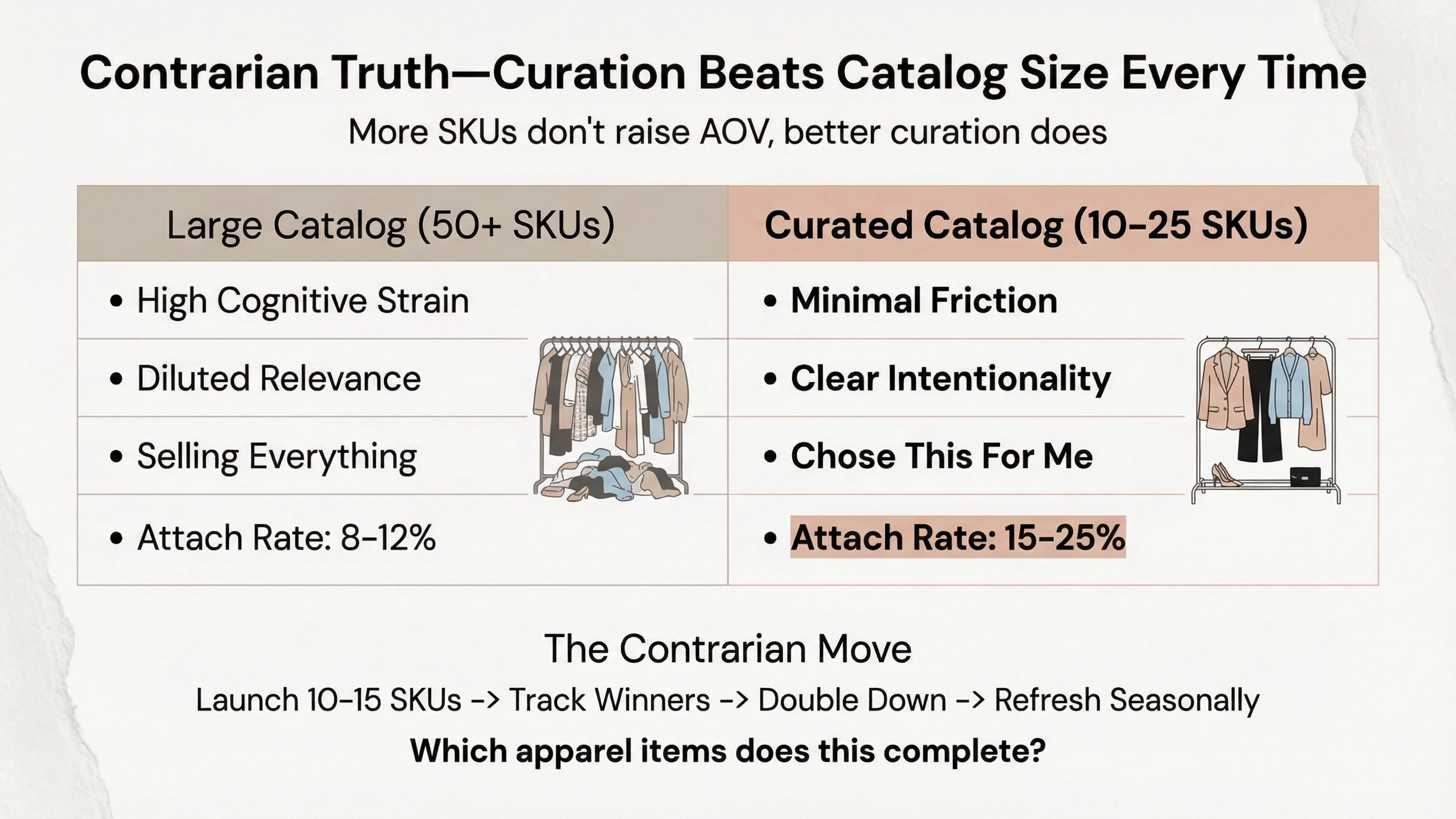
The conventional wisdom in eCommerce is that more options lead to more sales. The logic seems sound: if you offer 100 jewelry SKUs instead of 20, you'll capture more customer preferences and drive more revenue. In practice, the opposite is true—more SKUs don't raise AOV, better curation does.
This insight is supported by decades of research on choice overload and decision paralysis. When customers are presented with too many options, they experience cognitive strain, take longer to make decisions, and are more likely to abandon the purchase entirely [9]. In the context of jewelry as an add-on category, excessive choice is particularly damaging because customers are already mid-purchase—they've committed to apparel, and jewelry is a secondary decision. If that secondary decision becomes complicated, they'll skip it.
In our experience at Branvas, the fastest AOV wins happen when founders resist the urge to expand their jewelry catalog and instead focus on ruthless curation. A tightly curated set of 15-20 jewelry pieces that clearly align with the brand's aesthetic and pair obviously with core apparel items will outperform a sprawling catalog of 50+ pieces every time. The reason is simple: relevance and trust win over variety.
This principle is reinforced by recent data from Rebuy's BFCM 2025 analysis, which showed that brands like NAADAM drove nearly half of their incremental revenue from a single tool—the "Complete the Look" carousel—rather than from broad product recommendations [10]. The success came from showing fewer, better-matched options, not from maximizing SKU count.
The contrarian move is to launch with a minimal jewelry catalog and expand only when data shows clear demand for additional styles. Start with 10-15 SKUs across three price tiers, track which pieces drive the highest attach rates, and double down on those winners. Cut underperformers ruthlessly. Refresh seasonally with new styles that align with apparel launches, but resist the temptation to maintain a permanent, ever-growing jewelry catalog.
Accessories should be "styling-first," not "SKU expansion." Every jewelry piece in your catalog should have a clear answer to the question: "Which apparel items does this complete?" If the answer is vague or generic, cut the SKU.
Even with a solid framework, jewelry integration can fail if execution is poor. We often see founders struggle with the same recurring issues—issues that are entirely avoidable with the right awareness and planning.
Mismatched Photography Makes Jewelry Look Cheap
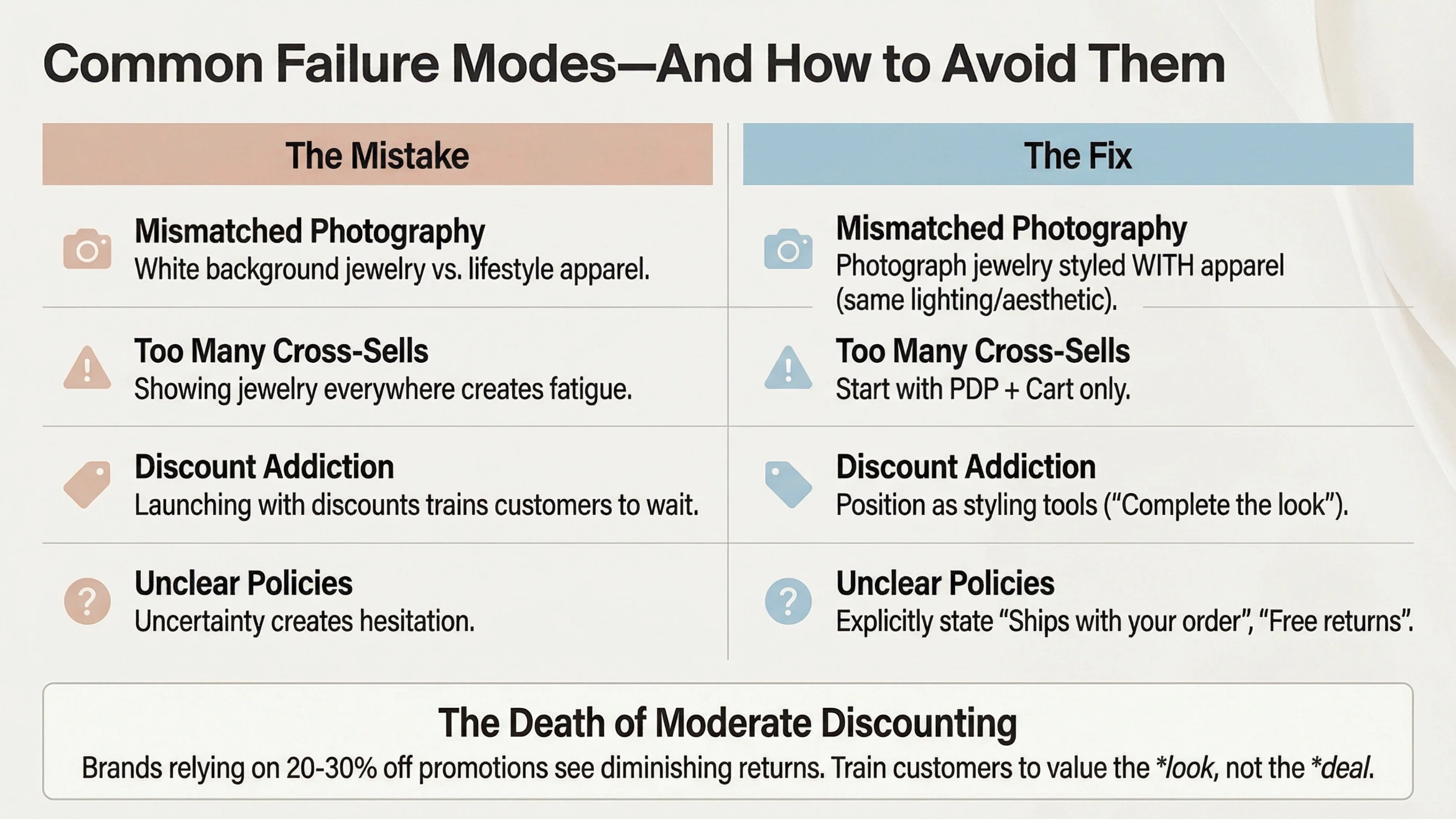
The fastest way to kill jewelry attach rates is to show jewelry on a white background while apparel is shown in lifestyle photography. The visual disconnect signals that jewelry is an afterthought, not a curated recommendation. Customers won't mentally connect the jewelry to the outfit, and the jewelry will feel like a generic upsell rather than a styling tool. The fix is simple but requires investment: photograph jewelry styled with your apparel, on models or in flat lays, using the same lighting and aesthetic as your core product photography. If budget is tight, start with flat lay photography showing jewelry paired with apparel—this is less expensive than full model shoots but still creates the visual connection customers need to see.
Too Many Cross-Sells
Founders often launch jewelry integration by showing jewelry everywhere—PDP, cart, checkout, post-purchase, email, SMS. The result is cross-sell fatigue, where customers tune out all recommendations because they feel bombarded. In our experience at Branvas, less is more. Start with PDP and cart only, measure performance, and expand to post-purchase only after you've confirmed that the first two placements aren't harming conversion. Avoid showing jewelry in checkout—this is a high-friction moment where any distraction can trigger abandonment.
Discount Addiction
If you launch jewelry with a discount ("Add earrings for 20% off!"), you train customers to expect discounts on all jewelry. This erodes margins and makes it nearly impossible to sell jewelry at full price later. The fix is to position jewelry as styling tools from day one, using language like "complete the look" and "pairs perfectly with" rather than discount-driven messaging. According to recent eCommerce research, the death of moderate discounting is one of the most significant trends in 2026—brands that rely on 20-30% off promotions are seeing diminishing returns as customers become conditioned to wait for deeper discounts [11].
Unclear Shipping/Returns Policies
Customers hesitate to add jewelry if they're unsure whether it will ship with their apparel order or if returns are complicated. Make shipping and returns policies explicit at every placement: "Ships with your order," "Free returns, just like your apparel," "No additional shipping cost." This clarity removes friction and increases attach rates.
Brand Inconsistency
Jewelry that doesn't align with your brand's aesthetic creates cognitive dissonance and damages brand perception. If your apparel is minimal and modern, ornate Victorian jewelry will feel out of place. If your brand is bohemian and relaxed, ultra-minimal geometric jewelry won't resonate. The fix is to treat jewelry curation as an extension of your brand's creative direction, not as a separate product category. Every jewelry piece should feel like it belongs in your brand's world.
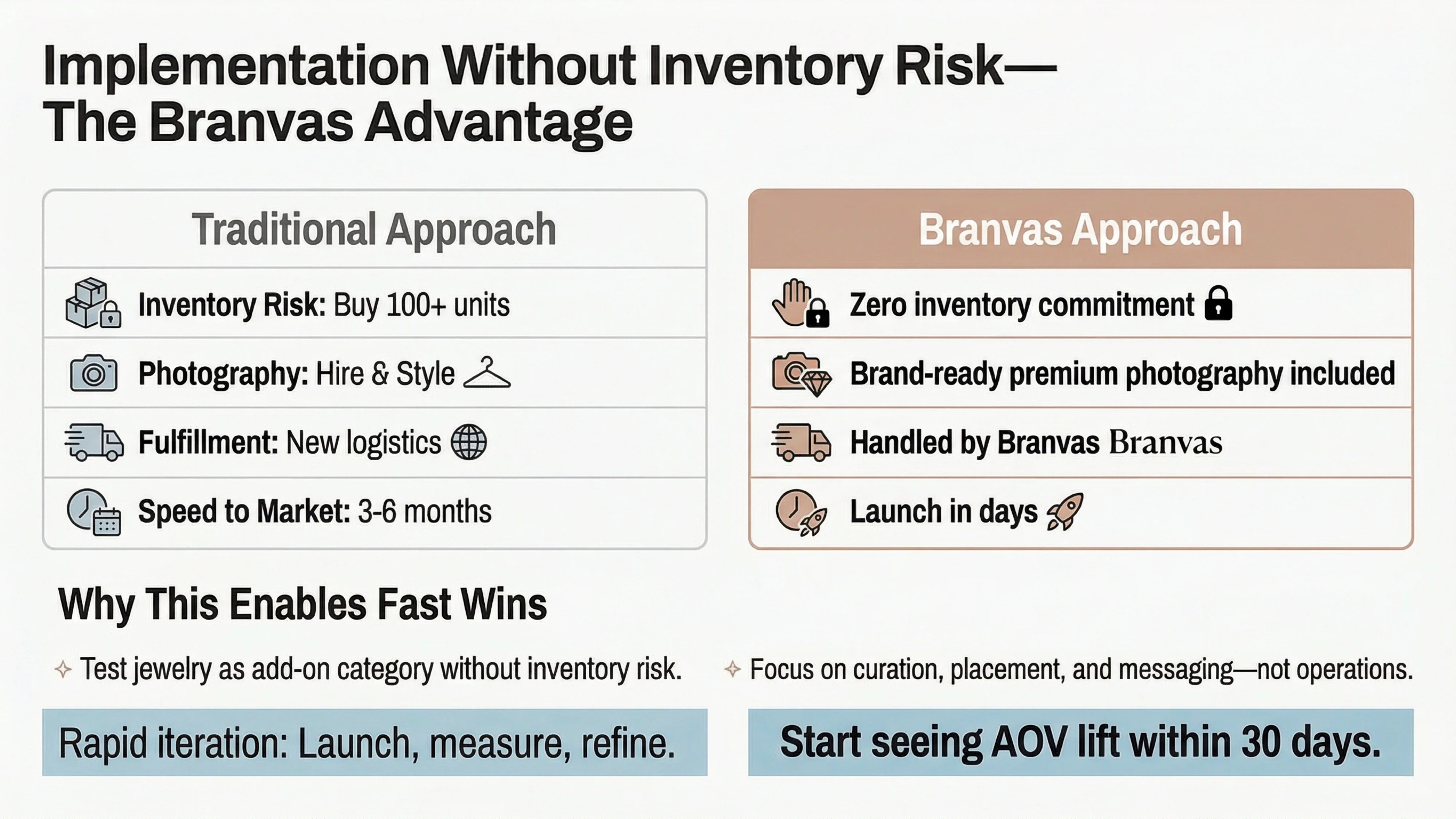
The challenge most apparel founders face when considering jewelry as an add-on category is operational complexity. Sourcing jewelry, managing inventory, ensuring quality, creating brand-aligned photography, and handling fulfillment all add friction to an already demanding business. This is where Branvas becomes the enabler.
Branvas provides brand-ready jewelry with product photography that matches premium apparel aesthetics, eliminating the visual disconnect that kills attach rates. The jewelry sets are designed to pair with outfits, not to stand alone, which aligns perfectly with the Outfit Completer System. And because fulfillment is handled by Branvas, apparel founders don't add operational drag—no new inventory to manage, no new fulfillment workflows, no new return processes.
In our experience at Branvas, the fastest AOV wins happen when founders can test jewelry as an add-on category without committing to inventory risk or operational complexity. This allows for rapid iteration—launch with 10-15 SKUs, measure performance, refine curation, and scale only what works. The ability to build bundles (if applicable) further enhances AOV by creating pre-curated "complete the look" sets that simplify the customer's decision and increase basket size.
If you want to test jewelry as an add-on category without inventory risk, Branvas can help you implement the Outfit Completer System with minimal friction and maximum speed to results.
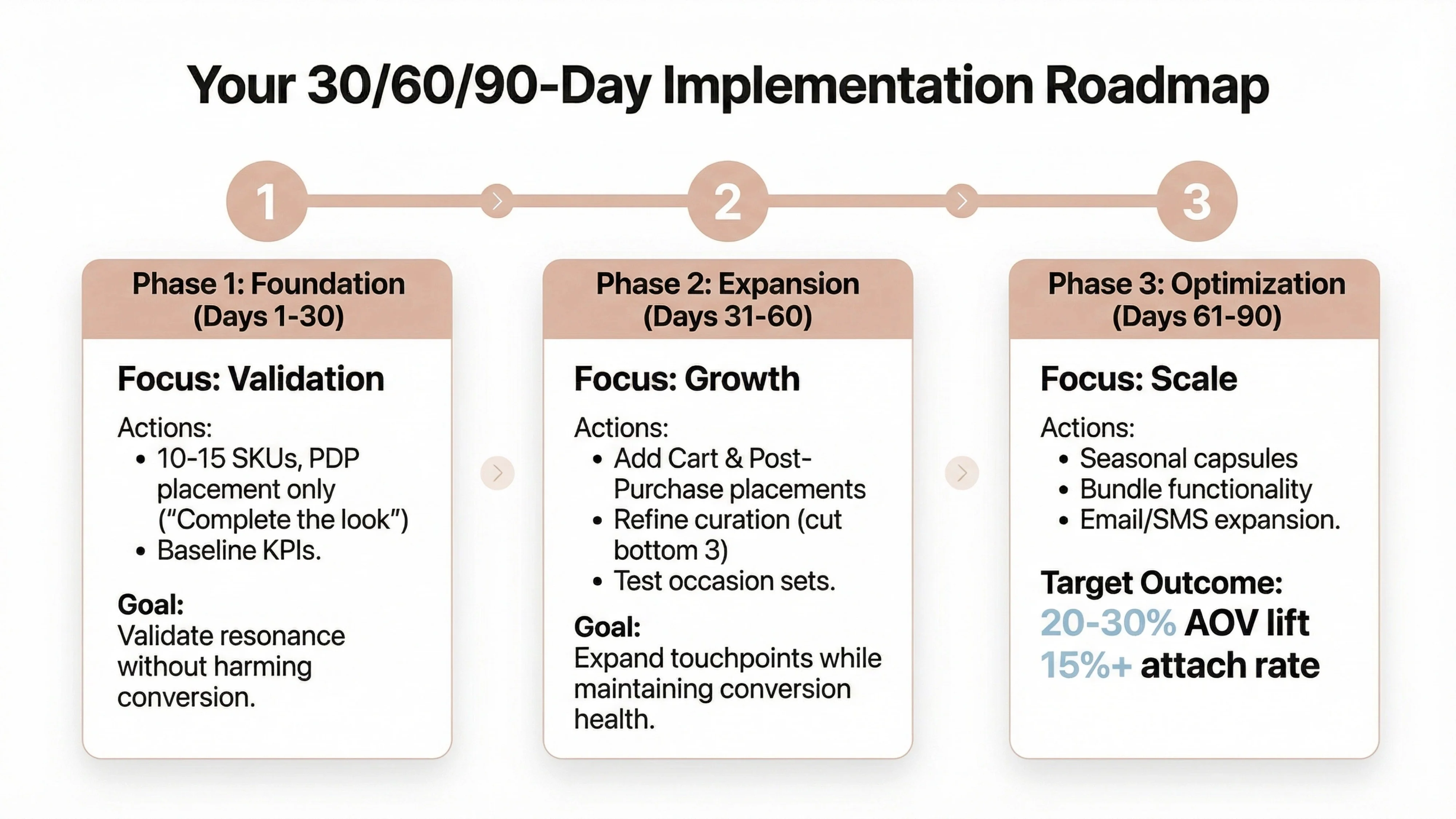
Implementing jewelry as an add-on category requires a phased approach that allows for testing, learning, and scaling without overwhelming your operations or confusing your customers.
30 Days: Foundation
Add 10-15 jewelry SKUs across three price tiers (Impulse, Core, Premium). Ensure all jewelry is photographed styled with your apparel, not on white backgrounds. Implement PDP placement only—show 1-3 jewelry pieces on product detail pages with "complete the look" messaging. Set up baseline KPI tracking: base AOV, attach rate, conversion rate, return rate. Avoid cart and post-purchase placements during this phase—focus on validating that jewelry resonates with your customers and doesn't harm conversion.
60 Days: Expansion
Add cart placement—show the single most relevant jewelry piece based on cart contents. Implement post-purchase offers for Impulse-tier jewelry only. Refine jewelry curation based on 30-day performance data—double down on top 5 performers, cut bottom 3 underperformers. Test "occasion sets" (pre-curated jewelry combinations) to increase basket size. Review KPI dashboard weekly and adjust placement aggression if conversion rate shows negative impact.
90 Days: Optimization
Launch seasonal jewelry capsule aligned with your apparel collection launch. Implement "bundle outfits with jewelry" functionality—create pre-built outfit + jewelry combinations for key apparel pieces. Optimize price tiers based on performance data—if Premium tier has <5% attach rate, consider lowering price point or improving presentation. Expand to email and SMS channels with jewelry recommendations for past purchasers. By this point, you should see 20-30% AOV lift for orders that include jewelry, 15%+ attach rate, and neutral to positive conversion rate impact.
Use a dropshipping or fulfillment partner like Branvas that provides brand-ready jewelry with photography and handles fulfillment. This allows you to test jewelry as an add-on category without committing to inventory purchases or managing additional fulfillment workflows. Start with 10-15 curated SKUs, measure attach rates and AOV impact, and scale only what works. The key is ensuring jewelry photography matches your apparel aesthetic so customers see jewelry as a natural outfit completion, not a disconnected upsell.
Jewelry is the highest-leverage accessory for increasing AOV because it has high perceived value, minimal fulfillment complexity, and strong "complete the look" psychology. Earrings and necklaces should be your priority—they're universally wearable, require no sizing, and have strong visual impact in product photography. Start with 3-5 earring styles and 3-4 necklace styles across three price tiers (Impulse $15-35, Core $40-80, Premium $90-150+). Avoid accessories that require sizing (rings) or create fulfillment challenges (large bags, heavy belts) until you've validated jewelry performance.
Show jewelry at strategic touchpoints (PDP, cart, post-purchase) with clear "complete the look" framing, not aggressive discount messaging. On the PDP, show 1-3 jewelry pieces styled with the apparel item. In the cart, show only the single most relevant piece with shipping/returns clarity. Avoid showing jewelry in checkout, as this is a high-friction moment where distractions trigger abandonment. Track conversion rate impact weekly—if it goes negative, reduce placement aggression or improve jewelry relevance. The key is making jewelry feel like a styling tool, not a sales tactic.
Place jewelry offers at three touchpoints: product detail page (PDP), cart, and post-purchase. On the PDP, show 1-3 jewelry pieces with "complete the look" messaging and styled photography. In the cart, show the single most relevant jewelry piece based on cart contents. Post-purchase, show one Impulse-tier jewelry piece with one-click add functionality. Avoid showing jewelry in checkout, as this creates friction at a critical conversion moment. Use apps like Rebuy, Shopify Bundles, or custom theme modifications to implement these placements without slowing down site performance.
Use Shopify's native Bundles app or third-party apps like Rebuy to create pre-curated outfit + jewelry combinations. Start by identifying your top 5-10 apparel items and pairing each with 1-2 jewelry pieces that complete the look. Photograph the full outfit + jewelry together so customers can visualize the complete styling. Offer a small bundle discount (5-10%) to incentivize purchasing the full set, but avoid deep discounts that erode margins. Track bundle take rate (% of customers who purchase bundles vs individual items)—target 10-20%. If take rate is low, improve bundle presentation or simplify the selection to make the decision easier.
[1] Yotpo. (2025). Ecommerce Benchmarks 2026: The Efficiency Imperative. Retrieved from https://www.yotpo.com/blog/ecommerce-benchmarks-2026/
[2] Baymard Institute. (2025). 50 Cart Abandonment Rate Statistics 2026. Retrieved from https://baymard.com/lists/cart-abandonment-rate
[3] Rebuy. (2025). Rebuy Recap: BFCM 2025 [Infographic]. Retrieved from https://www.rebuyengine.com/blog/bfcm-2025
[4] Shopify. (2025). Average Order Value (AOV): Formula, Benchmarks and 7 Ways to Increase It (2026). Retrieved from https://www.shopify.com/blog/average-order-value
[5] Shopify. (2025). Average Order Value (AOV): Formula, Benchmarks and 7 Ways to Increase It (2026). Retrieved from https://www.shopify.com/blog/average-order-value
[6] 42signals. (2026). 2026 Ecommerce Trends Forecast: Market Signals to Watch. Retrieved from https://www.42signals.com/blog/2026-ecommerce-trends-forecast/
[7] Baymard Institute. (2021). 6 Ways to Improve the Relevance of Cross-Sells in the Cart. Retrieved from https://baymard.com/blog/product-recommendations-cart
[8] Rebuy. (2025). Rebuy Recap: BFCM 2025 [Infographic]. Retrieved from https://www.rebuyengine.com/blog/bfcm-2025
[9] Baymard Institute. (2025). 50 Cart Abandonment Rate Statistics 2026. Retrieved from https://baymard.com/lists/cart-abandonment-rate
[10] Rebuy. (2025). Rebuy Recap: BFCM 2025 [Infographic]. Retrieved from https://www.rebuyengine.com/blog/bfcm-2025
[11] 42signals. (2026). 2026 Ecommerce Trends Forecast: Market Signals to Watch. Retrieved from https://www.42signals.com/blog/2026-ecommerce-trends-forecast/
[12] McKinsey & Company. (2025). The State of Fashion 2026: When the rules change. Retrieved from https://www.mckinsey.com/industries/retail/our-insights/state-of-fashion
[13] Shopify. (2025). Conversion Rate Optimization for Fashion Brands: 2026 Guide. Retrieved from https://www.shopify.com/enterprise/blog/fashion-conversion-rate-optimization