


Learn how to sell lab-grown diamonds online without inventory using private-label fulfillment, achieving 60-75% margins while building a premium ethical jewelry brand.
Published:
April 8, 2026
Author:
Yi Cui
Luxe quality at a price your customers will love.
The global jewelry market is undergoing a seismic shift, and lab-grown diamonds are at the epicenter. Far from being just a cheaper alternative to mined stones, lab-grown diamonds have emerged as a distinct, fast-growing ecommerce category driven by consumer demand for sustainability, transparency, and value. The global lab-grown diamond market reached $27.2 billion in 2023 and is projected to hit $97.85 billion by 2034, growing at a compound annual growth rate of 14.15% [1]. In the United States alone, lab-grown diamonds now account for over 45% of all engagement ring sales, reshaping consumer expectations and retail economics [2].
For aspiring ecommerce sellers, influencers, and boutique owners, this presents an unprecedented opportunity. The barrier to entry has never been lower, thanks to modern fulfillment models that eliminate the need for massive upfront capital. This guide provides a step-by-step blueprint for how to sell lab-grown diamonds online without carrying inventory, allowing you to build a profitable, high-margin jewelry brand with minimal risk.
To successfully sell lab-grown diamonds, you must first understand what they are—and what they are not. Lab-grown diamonds are created using advanced technological processes, primarily Chemical Vapor Deposition (CVD) or High Pressure High Temperature (HPHT), which replicate the natural conditions under which diamonds form [3]. The result is a stone that is chemically, physically, and optically identical to a mined diamond. They are pure carbon.
This is a critical distinction from diamond simulants like moissanite or cubic zirconia. Moissanite is made of silicon carbide, not carbon, and exhibits different refractive properties (often described as a "disco ball" effect) [4]. Conflating lab-grown diamonds with moissanite or marketing them simply as "cheap diamonds" is a strategic error that can severely hurt your brand positioning. Lab-grown diamonds are real diamonds, recognized as such by the Federal Trade Commission (FTC) [5].
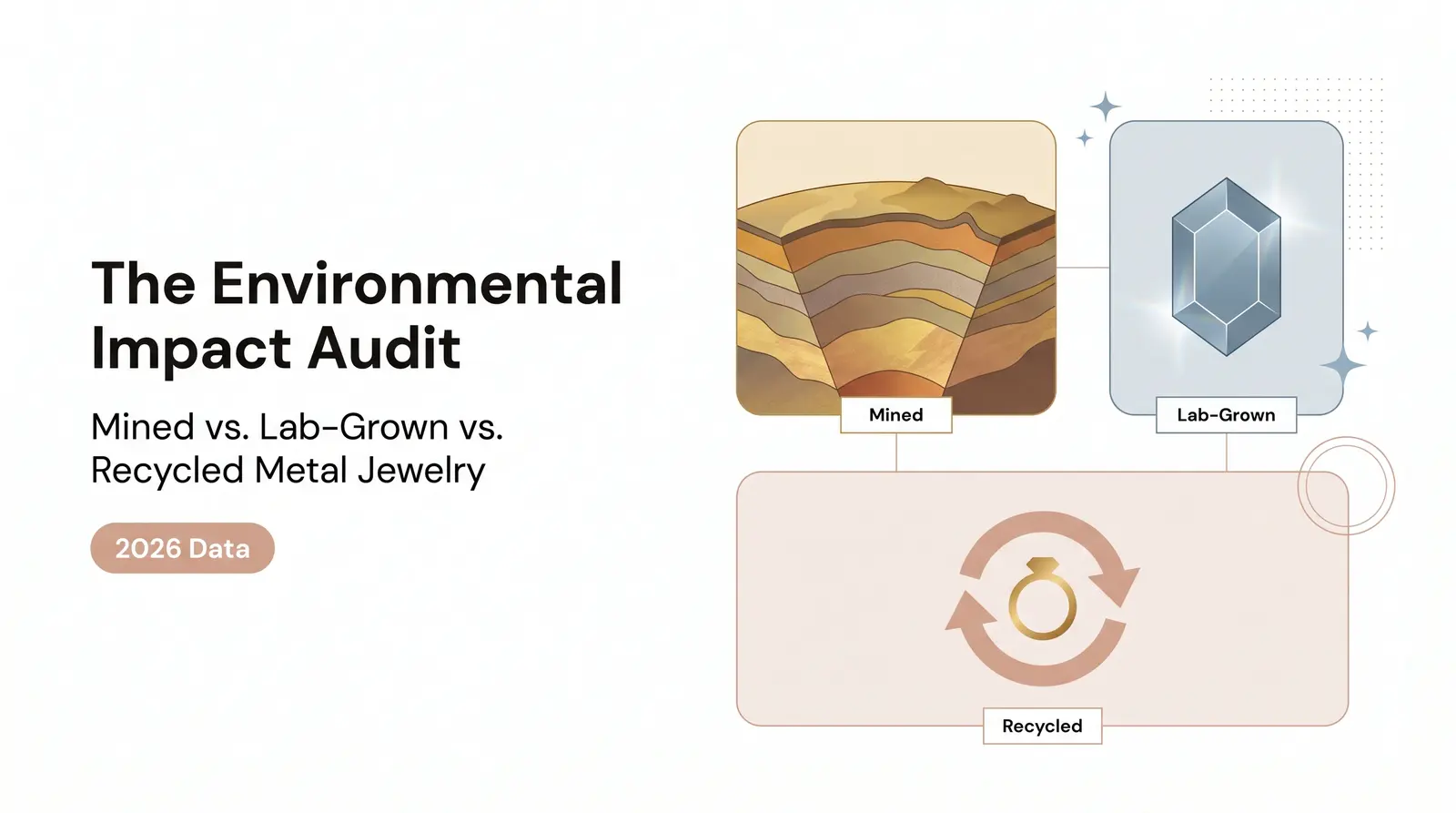
The appeal of lab-grown diamonds extends far beyond price. They offer a compelling ethical and sustainability narrative. Producing a lab-grown diamond generates up to 60% fewer carbon emissions than mining a natural diamond and eliminates the severe land disruption and water consumption associated with traditional mining operations [6]. For today's conscious consumer, this conflict-free sourcing is a powerful motivator. Research indicates that 60% of Gen Z consumers say sustainability directly influences their purchasing decisions [7].
To navigate this landscape, we recommend utilizing The Lab-Grown Diamond Positioning Triangle™. This proprietary framework, which we often use at Branvas when helping sellers position their brand, balances three crucial axes:
Sellers must balance all three elements. Leaning too heavily on price turns your product into a commodity, while ignoring the ethical narrative leaves a powerful marketing tool on the table.

The economics of selling lab-grown diamonds are highly favorable for retailers. While natural diamonds typically offer gross margins of 40% to 45%, lab-grown diamonds generate gross margins of 60% to 65%—and sometimes as high as 74% for specific cuts and sizes [8]. Because the wholesale cost of lab-grown diamonds is significantly lower, retailers can offer attractive pricing to consumers while still capturing substantial profit per unit.
However, the traditional jewelry business model requires buying and holding expensive inventory, creating a massive barrier to entry. Purchasing a diverse range of cuts, clarities, and carat weights ties up hundreds of thousands of dollars in capital. This inventory risk is why many aspiring brand founders never launch.
Dropshipping and private-label fulfillment solve this problem entirely. By partnering with a Brand-as-a-Service platform, you can offer a deep catalog of fine jewelry without purchasing a single piece upfront.
| Business Model | Upfront Cost | Inventory Risk | Brand Control | Scalability |
|---|---|---|---|---|
| Buy & Hold Inventory | High | High | High | Medium |
| Generic Dropshipping | Low | None | Low | Medium |
| Private-Label Brand-as-a-Service (Branvas) | Low–Medium | None | High | High |
Consider "Sophia," a lifestyle influencer with 40,000 Instagram followers. She wants to launch a minimalist everyday fine jewelry line featuring lab-grown diamonds. Under a traditional model, she would need at least $50,000 to manufacture her initial collection. Using a private-label fulfillment model, her upfront costs are limited to branding and storefront setup. If she sells a 1-carat lab-grown diamond pendant for $800 (with a wholesale and fulfillment cost of $300), her gross profit is $500 per unit. At a modest volume of 50 orders per month, Sophia generates $25,000 in monthly gross profit—with zero inventory risk.

Building a successful jewelry brand requires a systematic approach. We call this The Branvas Zero-Inventory Launch System™.
If you're evaluating fulfillment partners, Branvas offers private-label jewelry sourcing with blind shipping and custom packaging — purpose-built for sellers who want brand control without inventory risk. Explore how it works →

Marketing lab-grown diamonds requires a delicate balance of education and aspiration. Your content marketing strategy should educate buyers on the scientific equivalence of lab-grown and mined diamonds without sounding preachy or overly technical. Focus on the benefits: larger, higher-quality stones for the same budget, coupled with peace of mind regarding their origin.
From an SEO perspective, target high-intent commercial queries. Optimize your product pages and blog content for terms like "lab grown diamond rings," "moissanite rings online," and "ethical fine jewelry." These searches indicate a buyer who is already educated on the category and is actively looking to purchase.
Influencer and creator marketing is particularly effective for jewelry. However, product-only content rarely performs well. Instead, focus on micro-influencer seeding and User-Generated Content (UGC) that showcases the jewelry being worn in real-life, aspirational settings. Lifestyle content helps the customer visualize how the piece will elevate their own look.
When running paid social campaigns, focus on creatives that stop the scroll. Before-and-after comparisons, educational Reels explaining the 4Cs of lab-grown diamonds, and high-definition "sparkle" content under dynamic lighting tend to yield the highest return on ad spend.
Crucially, consumer psychology research reveals a non-obvious insight: ethical messaging alone is insufficient to drive luxury purchases. Studies show that luxury purchases are primarily driven by internal identity aspirations and the desire for status [9]. If a brand relies solely on "green" or "ethical" messaging without delivering a premium, aspirational aesthetic, consumers may perceive the product as lower quality. You must pair your ethical stance with undeniable luxury and aspiration.

For the ecommerce seller, deciding between moissanite and lab-grown diamonds depends on your target audience and brand positioning.
Moissanite offers an incredibly accessible price point. A 1-carat moissanite stone might retail for $500 to $800, making it highly attractive to budget-conscious consumers or those looking for travel jewelry. It has excellent durability and a higher refractive index than a diamond, resulting in more colorful flashes of light. However, consumer perception of moissanite is firmly rooted in the "diamond alternative" category.
Lab-grown diamonds, conversely, command a higher price point (typically $1,000 to $3,000 for a 1-carat stone) and offer significantly higher gross profit margins in absolute dollars. Because they are chemically identical to mined diamonds, they carry the prestige and emotional weight of a "real diamond," making them the preferred choice for engagement rings and heirloom pieces.
The most effective positioning strategy is often to sell both under a unified brand, using moissanite as an entry-level offering and lab-grown diamonds as your premium tier. This allows you to capture a wider range of search volume and customer budgets while maintaining a cohesive brand identity. (Note: Branvas carries both, allowing you to easily implement this tiered strategy).

Yes, it is entirely legal to sell lab-grown diamonds online. However, you must comply with the Federal Trade Commission (FTC) Jewelry Guides. The FTC requires sellers to clearly and conspicuously disclose that the diamonds are not mined. You must use approved descriptors such as "laboratory-grown," "laboratory-created," or "[manufacturer name]-created" immediately preceding the word "diamond." You cannot use terms like "real," "natural," or "genuine" to imply the stone was mined from the earth [5].
The profit potential is substantial due to the category's high margins. Retailers typically see gross margins of 60% to 75% on lab-grown diamonds, compared to 40% to 45% for mined diamonds [8]. For example, if you sell a lab-grown diamond ring for $2,000 and your wholesale/fulfillment cost is $600, your gross profit is $1,400 per unit. By utilizing a dropshipping model, you eliminate inventory holding costs, allowing more of that gross profit to flow directly to your bottom line.
In the United States, there is no specific "jewelry license" required to sell lab-grown diamonds online. You will need standard business documentation, such as a general business license (depending on your city/state), an Employer Identification Number (EIN), and a sales tax permit. However, while you don't need a license to sell them, the diamonds themselves should come with a grading report or certification from a reputable gemological laboratory, such as the IGI or GIA, to verify their authenticity and quality for your customers.
For sellers, the primary differences lie in price point, margin, and consumer perception. Lab-grown diamonds are pure carbon and chemically identical to mined diamonds, allowing you to market them as real diamonds at a premium price point with high absolute dollar margins. Moissanite is made of silicon carbide; it is a diamond simulant. It is much cheaper to source and sell, making it great for volume sales and budget-conscious buyers, but it lacks the prestige and higher per-unit profit of a lab-grown diamond.
Yes, you can sell on all these platforms without holding inventory by using a private-label dropshipping partner. Shopify is the most flexible platform for this model. Etsy allows dropshipping, but you must disclose your production partner in your listings and ensure the designs are your own or customized. Amazon permits dropshipping but has strict policies; you must be the seller of record, and for jewelry, Amazon requires you to provide Diamond Grading Reports for lab-created diamonds and adhere to their specific Jewelry Quality Assurance Standards.
Selling lab-grown diamonds online represents a rare convergence of high consumer demand, excellent profit margins, and ethical positioning. The market is expanding rapidly as millennials and Gen Z consumers increasingly reject the environmental and financial costs of mined diamonds in favor of sustainable, accessible luxury.
Historically, the barrier to entering the fine jewelry market was the immense capital required to hold inventory. Today, that barrier has been completely removed. By leveraging private-label fulfillment, you can launch a premium jewelry brand, control your marketing and customer experience, and scale your business without ever touching a single piece of inventory.
Ready to launch your lab-grown diamond jewelry brand without touching a single piece of inventory? Branvas handles sourcing, branding, and fulfillment — so you can focus on building your audience and making sales. Start your brand on Branvas →
For more information on our product offerings, visit our catalog or explore our solutions for ecommerce and boutique store owners.
[1] Lab Grown Diamonds: Why Etsy Leads $97B Market Opportunity — ShelfTrend
[2] Lab-Grown Diamonds 2025, Fast Growth, Bigger Stones — CaratX
[3] HPHT and CVD Diamond Growth Processes | How Lab-Grown Diamonds Are Made — GIA
[4] Moissanite vs. Lab Diamond | What's the Difference? — Brilliant Earth
[5] In the Loupe: Advertising Diamond, Gemstones and Pearls — Federal Trade Commission
[6] Environmental Benefits of Lab-Grown Diamonds — Golden Bird Jewels
[7] Lab-Grown Diamonds and the Future of Consumer Behavior: A Love for Sustainability and Transparency — SightX
[8] The Rise of Lab-Grown Diamonds: A Multifaceted Challenge for Jewelers — Gordon Brothers
[9] Consumers' Implicit Motivation Of Purchasing Luxury Brands — National Center for Biotechnology Information