

Five proven models let you sell products online without inventory, from affiliate marketing to private-label dropshipping, each mapped to your brand-building stage and revenue goals.
Published:
May 28, 2026
Author:
Yi Cui
The entrepreneur's guide to building a brand from scratch. Millions of ambitious creators and founders want to sell products online, but the assumption that you need upfront capital, warehouse space, or bulk inventory stops most before they even start. The reality is that the barrier to entry has never been lower, provided you choose the right framework. This article maps out five real, working models to sell products without inventory—including one that most generic guides ignore entirely—and helps you choose the right path for your specific goals.
Choosing to operate without inventory is not a hack; it is a legitimate structural choice for modern commerce. The global e-commerce market is projected to reach $3.88 trillion in 2026 [1], and asset-light business models are driving a significant portion of that growth. By eliminating the need to forecast demand, pay for storage, and manage complex logistics, founders can redirect their capital and energy toward what actually moves the needle: marketing, customer acquisition, and brand building.
However, not all inventory-free models are created equal. They exist on a spectrum. On one end, you have models with the lowest effort but also the lowest brand equity and thinnest margins. On the other end, you find models requiring more strategic effort but offering the highest brand equity and defensibility. Understanding where you want to play on this spectrum is the first step to building a sustainable business. We will explore this concept further in the Branvas Brand-Building Readiness Spectrum below.

Affiliate marketing involves promoting other companies' products and earning a commission for every sale made through your unique referral link. You do not handle the product, customer service, or fulfillment.
The startup cost is effectively zero, making it highly accessible. The primary advantage is the complete lack of operational overhead. However, the cons are significant: you have zero control over the product, pricing, or customer experience, and you are building someone else's brand equity, not your own. This model is best for content creators, bloggers, or influencers who already have an engaged audience but are not yet ready to launch their own product line.
Selling digital products—such as online courses, ebooks, templates, or software—is a highly scalable way to sell without physical inventory. Once the product is created, it can be sold infinitely with near-zero marginal cost.
The startup cost is low in terms of capital but high in terms of time and expertise required to create the initial asset. The pros include incredibly high profit margins (often 70% to 90%) and instant delivery. The main drawback is the significant upfront effort required to produce high-quality content that people are willing to pay for. This model is best for educators, subject matter experts, and creators who want to monetize their specialized knowledge.
Print-on-demand (POD) allows you to sell custom designs on white-label products like t-shirts, mugs, and phone cases. When a customer places an order, the POD supplier prints your design and ships it directly to the buyer.
Startup costs are minimal, usually limited to design software or hiring a freelance designer. The pros include the ability to offer a wide variety of products without holding stock and the creative freedom to test new designs quickly. The cons are lower profit margins compared to sourcing products yourself and limited control over product quality and shipping times. POD is best for artists, graphic designers, and meme-creators looking to monetize their visual assets.
Generic dropshipping is the traditional model where you list products from third-party suppliers (often based overseas) on your store. When an order comes in, the supplier ships the unbranded product directly to the customer.
The startup cost is low, typically just the cost of setting up a Shopify store and running initial ads. The pros are the vast selection of products available to test and the lack of inventory risk. However, the cons are severe: you are selling the exact same commoditized products as thousands of other stores, leading to price wars, thin margins, and zero brand loyalty. Shipping times can also be notoriously long. This model is best for marketers who excel at media buying and want to test product trends quickly, though it is increasingly difficult to sustain long-term.
Private-label dropshipping, or Brand-as-a-Service (BaaS), is the "Level 2" of inventory-free selling. It takes the logistical advantages of dropshipping and layers on the crucial elements of brand building. In this model, a specialized partner supplies high-quality products, applies your custom branding and packaging, and blind-ships the orders directly to your customers.
What separates this from generic dropshipping is ownership of the customer experience. You are not just moving a product; you are delivering a branded unboxing experience. The supplier remains invisible, and the customer only interacts with your brand. This builds real, compounding brand equity, allowing you to command premium pricing and foster repeat purchases.
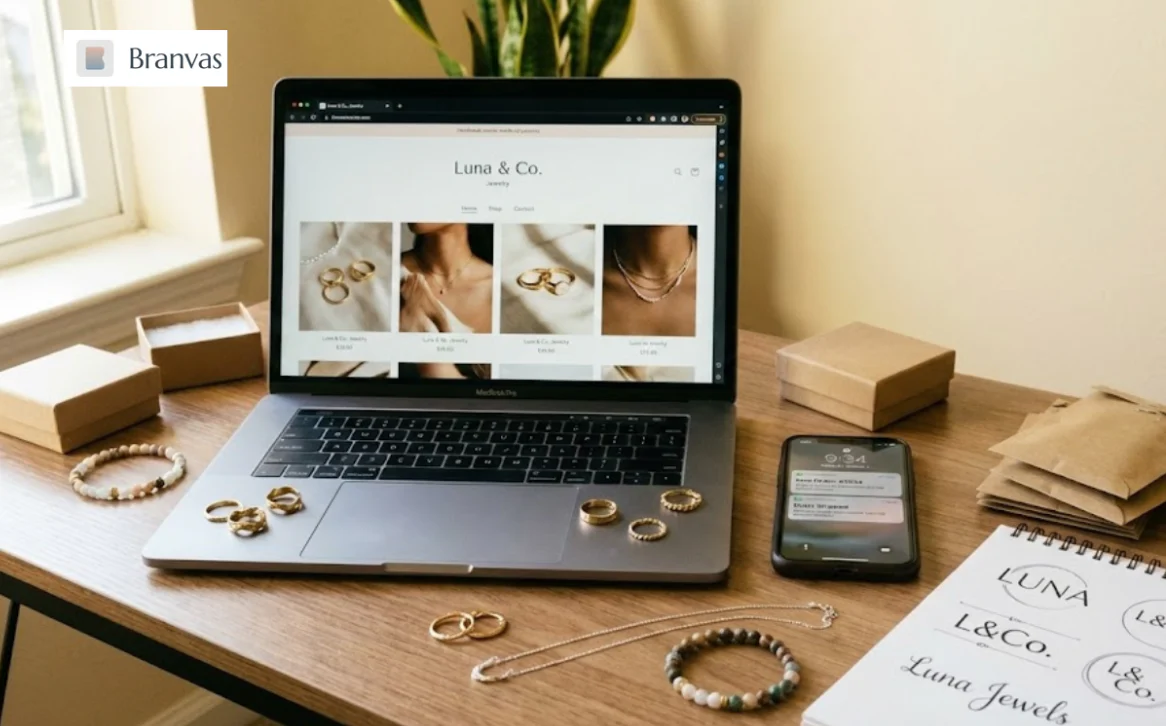
At Branvas, we enable this specifically for jewelry and accessories. Founders can select from over 600 proven bestsellers, use our Brand Studio to generate premium visuals, and have every order shipped globally in custom, brand-ready packaging. For example, a boutique owner can launch a cohesive jewelry line in under an hour, setting their own retail prices to achieve healthy 40% to 60% gross margins, all while Branvas handles the fulfillment invisibly.

To help founders navigate these options, we developed the Branvas Brand-Building Readiness Spectrum. This framework maps each inventory-free model to a seller's stage of brand maturity, risk tolerance, and revenue goals.
| Level | Model | Brand Equity Built | Startup Cost | Best For | Scalability |
|---|---|---|---|---|---|
| 1 | Affiliate Marketing | None | $0 | Audience monetization | Low (capped by audience size) |
| 2 | Generic Dropshipping | Very Low | Low | Trend testing, media buyers | Medium (high churn rate) |
| 3 | Print-on-Demand | Low to Medium | Low | Artists, designers | Medium |
| 4 | Digital Products | Medium | Time-intensive | Experts, educators | High |
| 5 | Private-Label Dropshipping (BaaS) | High | Low to Medium | Brand builders, influencers | Very High |
Use this table as a decision tool. If your goal is simply to generate a few extra dollars with zero commitment, Level 1 or 2 might suffice. However, if your objective is to build a defensible asset that grows in value over time—a real business you could potentially sell—you must operate at Level 4 or 5.

The internet is flooded with courses promising that generic dropshipping is the ultimate path to passive income. Here is the contrarian truth: generic dropshipping's "zero-barrier entry" is actually its biggest liability.
Because anyone can start a generic dropshipping store in an afternoon, everyone does. This means you are selling the exact same product, sourced from the exact same supplier, to the exact same audience as thousands of competitors. The inevitable result is margin compression. You are forced to compete on price, while simultaneously battling rising customer acquisition costs (CAC), which have surged by 60% in recent years across e-commerce verticals [2].
The data reflects this harsh reality. Industry statistics show that 80% to 90% of dropshipping businesses fail within their first year, and only 1% to 5% ever build a profitable, sustainable operation [3] [4].
In our experience at Branvas, the founders who struggle most aren't the ones with small budgets—they're the ones who treated their store as a catalog instead of a brand. The sellers who win long-term are those who layer brand identity, premium presentation, and perceived value on top of the inventory-free model. That is exactly the problem private-label dropshipping solves.

Selecting the right model depends entirely on your current resources and long-term ambitions. Use this quick decision guide:
If you're leaning toward building a real brand—especially in jewelry or accessories—Branvas's How It Works page is worth 5 minutes of your time before you commit to a generic supplier.

Let's look at how this works in practice.
Founder Profile: Sarah is a lifestyle micro-influencer with 15,000 engaged Instagram followers. She wants to monetize her audience but doesn't want to deal with the logistics of shipping boxes from her living room.
The Step-by-Step Process:
The Economics:
Let's break down a sample SKU, such as the "Curved Spark Bar Necklace."
| Metric | Amount |
|---|---|
| Branvas Unit Cost (COGS) | $9.00 |
| Suggested Retail Price | $45.00 |
| Gross Margin | 80% ($36.00) |
| Estimated Monthly Orders (at modest volume) | 50 |
| Estimated Monthly Gross Profit | $1,800.00 |
We've seen this play out dozens of times at Branvas—the speed advantage of not managing inventory lets founders focus entirely on audience and brand storytelling, rather than packing tape and postage labels.

Yes, models like affiliate marketing require zero financial investment to start. However, if you want to build your own store (using dropshipping or print-on-demand), you will need a small budget for platform fees (like Shopify) and initial marketing or domain registration.
Generic dropshipping involves selling unbranded products shipped directly from a supplier, often resulting in a commoditized customer experience. Private-label dropshipping (Brand-as-a-Service) allows you to sell products under your own brand name, with custom packaging and blind fulfillment, building long-term brand equity.
Digital products typically offer the highest gross margins (often 70% to 90%) because there are no physical goods to manufacture or ship. Among physical product models, private-label dropshipping offers the best margins (often 40% to 80%) because you can command a premium price for a branded experience.
Absolutely. The key is controlling the customer experience. By using a Brand-as-a-Service partner that provides premium, custom-branded packaging and reliable fulfillment, your customers experience a cohesive, high-end brand, completely unaware that you don't hold the inventory yourself.
Blind shipping means the supplier ships the product directly to your customer without including any of their own promotional materials, invoices, or logos. It matters because it preserves the illusion that the product came directly from your brand's warehouse, maintaining trust and a premium brand image.
The best inventory-free model is the one that aligns with your long-term brand ambition, not just the one with the lowest barrier to entry. While generic dropshipping might seem like an easy place to start, it often leads to a race to the bottom. For sellers who want to build something defensible, profitable, and lasting, private-label dropshipping represents the highest-leverage path available today.
Ready to launch your own jewelry or accessories brand without holding a single piece of inventory? See how Branvas works → or explore the product catalog to find your first collection.