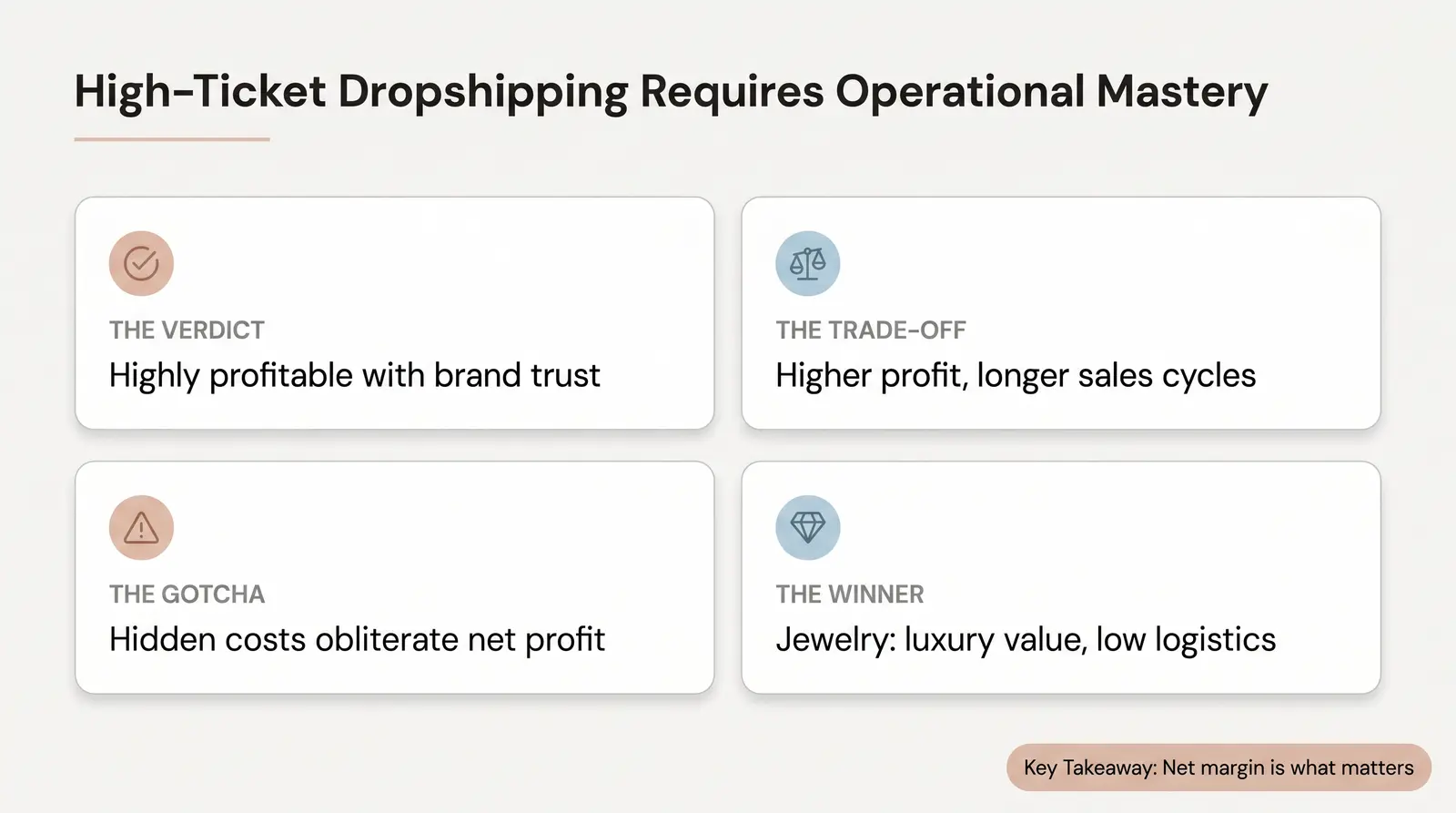



Introduction: Why "High-Ticket" Matters More in 2026
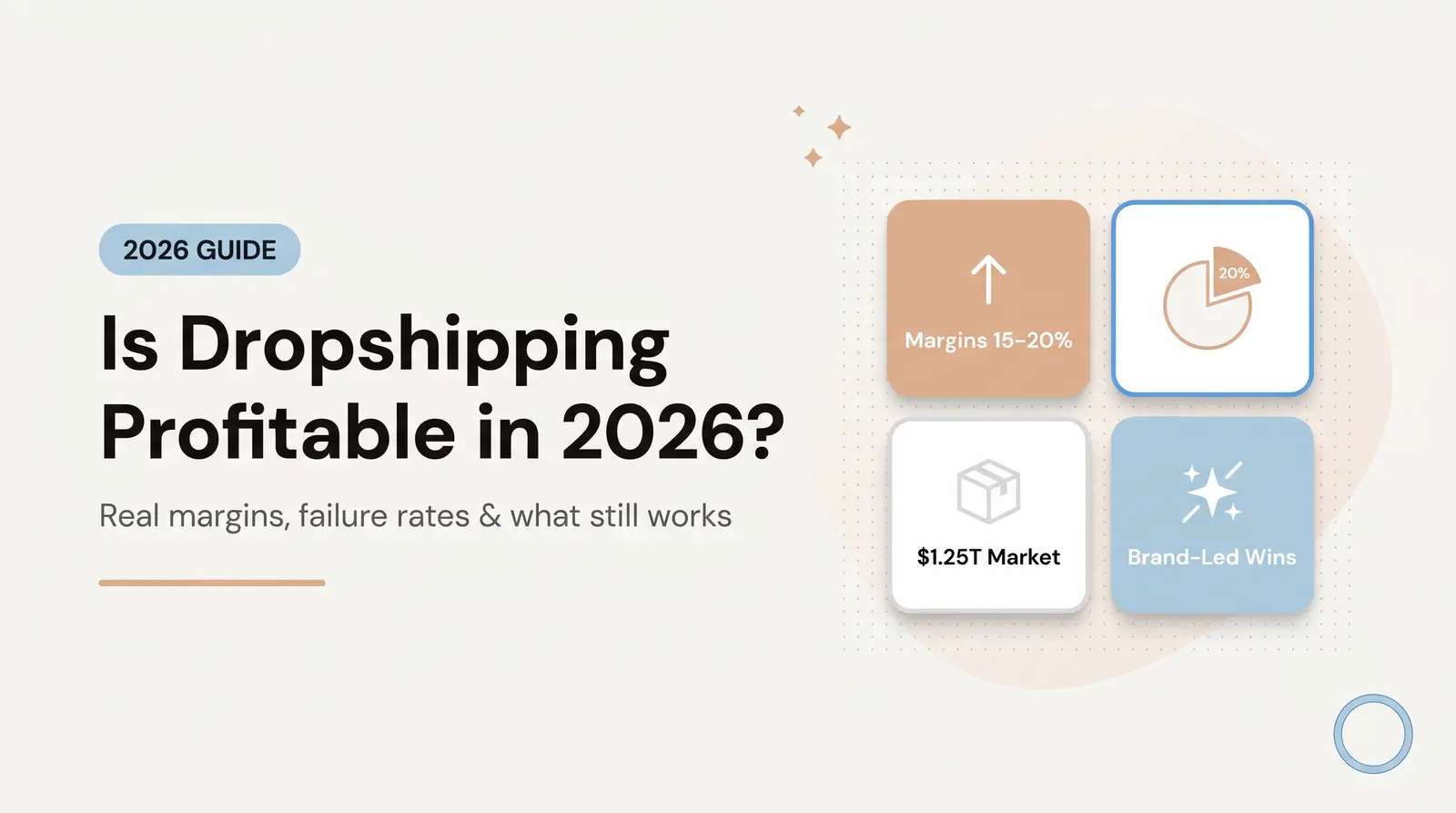
The economics of dropshipping have fundamentally changed. Customer acquisition costs have surged 40% in just two years, with the average ecommerce business now spending $78 to acquire a single customer [1]. Meanwhile, the global dropshipping market has ballooned to $445.5 billion in 2025 and is projected to reach $1.25 trillion by 2030 [2]. This explosive growth has brought unprecedented competition, pushing advertising costs higher and profit margins thinner.
In our experience at Branvas, we've watched countless founders chase volume with low-ticket products, only to discover they're working harder for less profit. The math is brutal: when you're selling $15 phone cases with a $10 customer acquisition cost, you need flawless execution just to break even. One return, one customer service issue, or one failed ad campaign can wipe out weeks of profit.
This is why understanding what makes a niche truly "high-ticket" has become critical for survival in 2026. The best dropshipping niches 2026 aren't just about selling expensive products—they're about finding the intersection of healthy margins, operational efficiency, and genuine brand-building potential. The dropshipping model itself accounts for 23% of global ecommerce sales, representing $1.6 trillion in annual revenue [2], but only 10% to 20% of dropshipping stores manage to stay profitable long-term [2].

This article introduces a proprietary evaluation framework and honestly assesses ten popular high ticket dropshipping niches. We'll examine not just what looks good on paper, but what actually works when you factor in shipping costs, return rates, customer expectations, and the realities of building a brand that can command premium prices. By the end, you'll understand why jewelry consistently outperforms other high-ticket categories—and whether it's the right choice for your business.
What Makes a Dropshipping Niche "High-Ticket" (Beyond Price)
Most founders make a critical mistake: they equate "high-ticket" with "high price." They see a $500 standing desk or a $300 drone and assume the margins will be proportionally better. This is dangerously wrong.
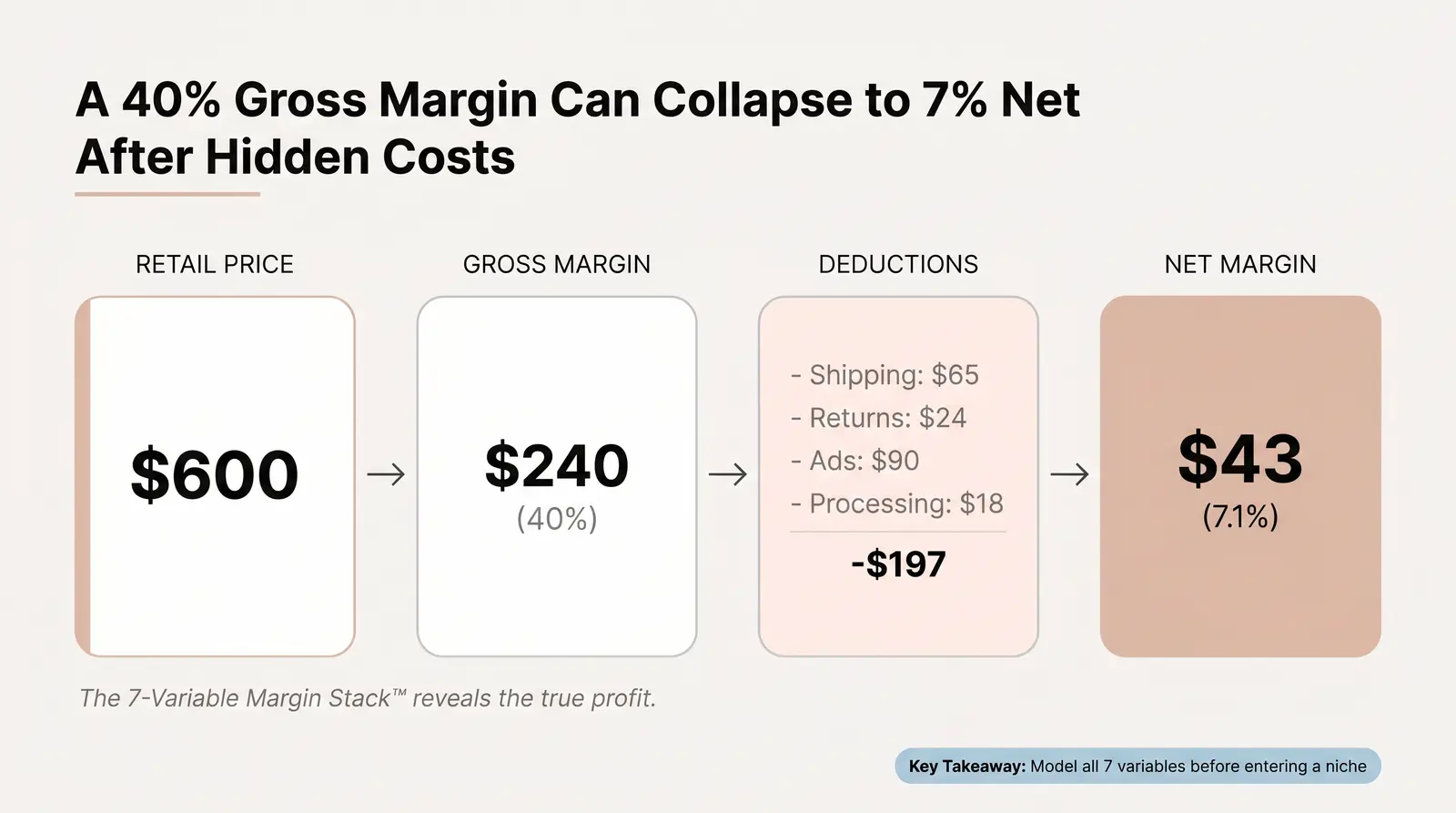
True high-ticket dropshipping isn't about the sticker price—it's about the relationship between average order value (AOV), gross margin, and operational costs. A $400 piece of furniture might seem high-ticket, but after you account for $80 in shipping, a 40% return rate, white-glove delivery expectations, and a $98 customer acquisition cost [1], you're often left with single-digit profit margins.
Here's what actually defines a high-ticket niche worth pursuing:
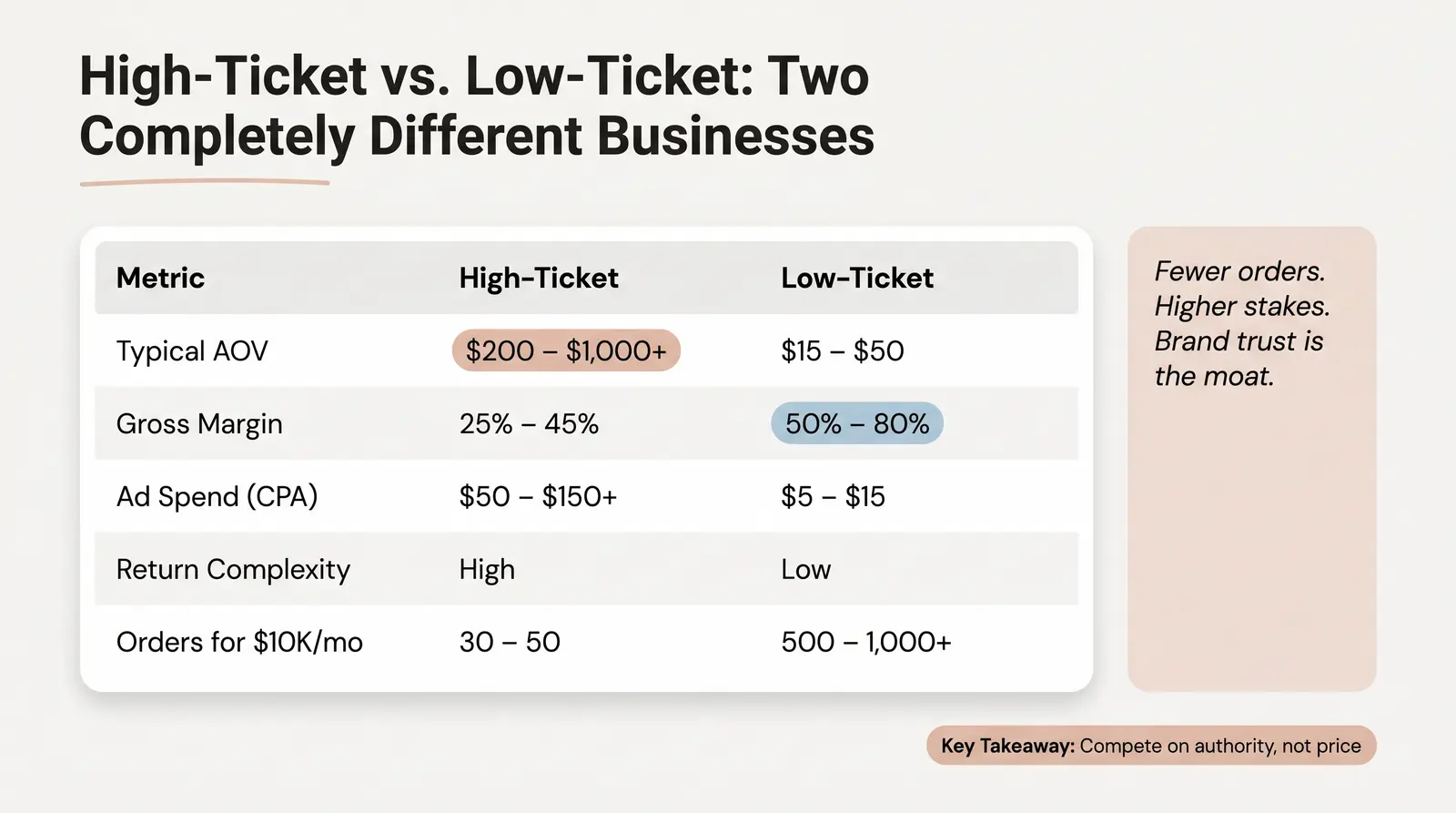
Average Order Value (AOV) vs. True Margin: The global ecommerce AOV sits around $144 [3], but what matters is your margin after all costs. A $200 product with 60% margins ($120 gross profit) beats a $500 product with 25% margins ($125 gross profit) when you factor in that the cheaper item costs less to ship, has lower return rates, and requires less customer hand-holding.

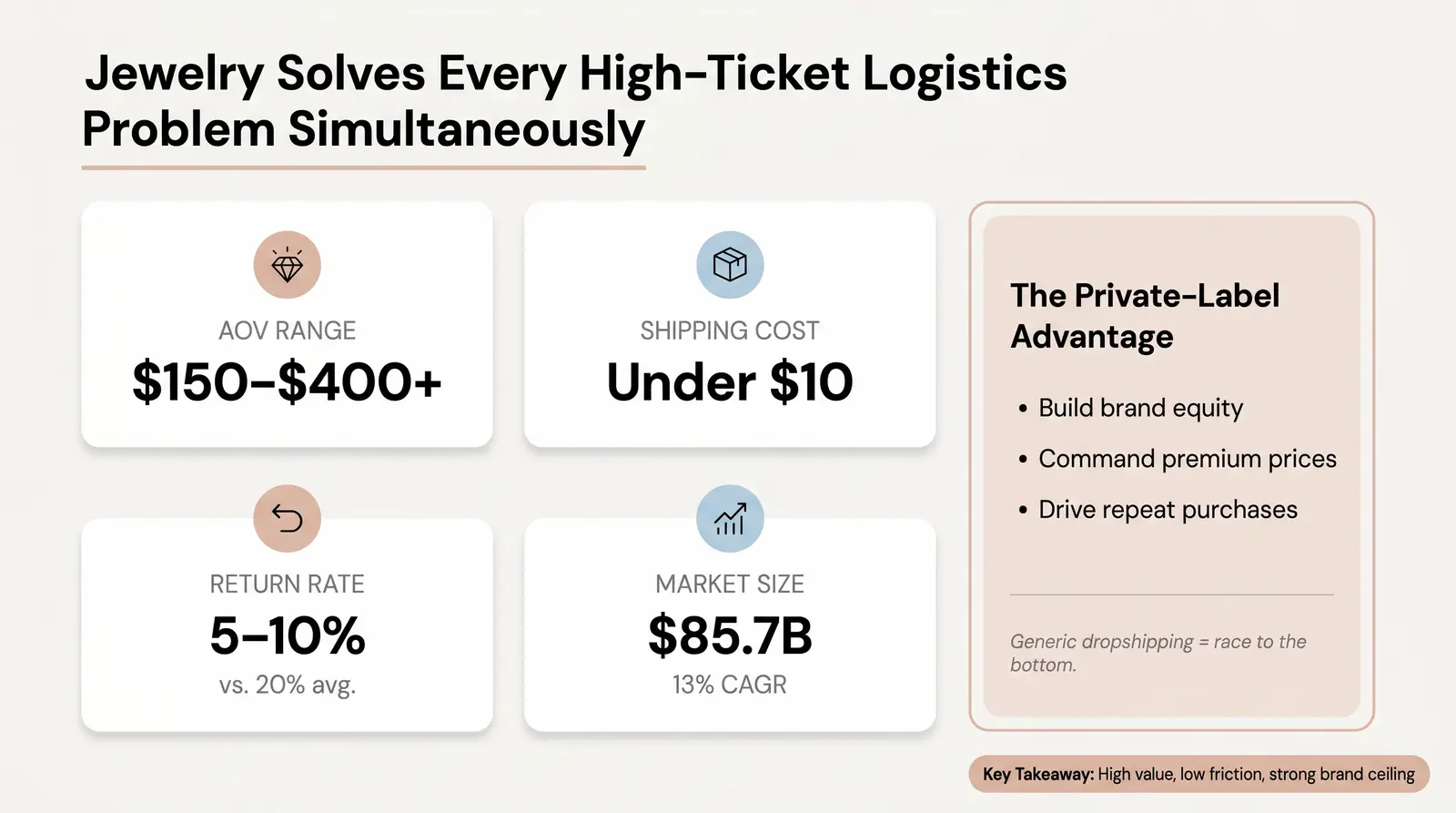
Customer Expectations and Operational Complexity: Price creates expectations. When someone spends $600 on a home office chair, they expect white-glove delivery, easy returns, responsive customer service, and a warranty. Each of these expectations adds operational drag that eats into your margins. In contrast, a $150 jewelry piece can ship in a small box, has minimal return rates, and requires virtually no post-purchase support.
Brand Leverage and Pricing Power: The best high-ticket niches allow you to build a brand that commands premium pricing. This means products where the perceived value can exceed the actual cost through storytelling, design, and emotional connection. Commodity products—no matter how expensive—will always face downward price pressure.
What surprises most people when evaluating niches is that the most profitable "high-ticket" businesses often aren't selling the most expensive products. They're selling products with the best margin × brandability × operational efficiency ratio. A $180 necklace with 70% margins, 5% return rates, and $3 shipping costs will outperform a $600 office chair with 30% margins, 25% return rates, and $75 shipping costs every single time.
The dropshipping industry's 15% to 20% net profit margins [2] mask enormous variation between niches. Some categories consistently deliver 30%+ margins, while others struggle to break 10%. The difference isn't random—it's structural, based on the fundamental economics of the product category.
Proprietary Framework: The High-Ticket Niche Scorecard
After helping dozens of founders evaluate what to sell online, we developed a systematic framework for assessing high-ticket dropshipping opportunities. This isn't theory—it's battle-tested across multiple six-figure brands and refined through real profit-and-loss data.
The High-Ticket Niche Scorecard evaluates every potential niche across seven critical dimensions, each scored from 1 to 10, for a maximum score of 70 points. Here's how it works:
1. Average Order Value (AOV) Potential (Weight: 1.0x)
How much can you realistically charge per transaction? We're looking for niches where AOV exceeds $120 to justify customer acquisition costs. Score 10 for AOV above $200, score 5 for $100-150, score 1 for below $80.
2. Gross Margin Potential (Weight: 1.5x)
What percentage of revenue remains after product and shipping costs? With average CAC at $78 and rising [1], you need at least 50% gross margins to build a sustainable business. Score 10 for margins above 60%, score 5 for 40-50%, score 1 for below 30%.
3. Brandability (Weight: 1.5x)
Can you differentiate through brand, or are you selling commodities? The best dropshipping niches 2026 allow you to tell stories, create emotional connections, and build pricing power. Score 10 for highly emotional/personal products, score 5 for moderate differentiation potential, score 1 for pure commodities.
4. Repeat Purchase Potential (Weight: 1.2x)
Will customers buy again, or is this a one-time purchase? The average ecommerce repeat purchase rate is 28.2% [4], but top categories achieve 40%+. Score 10 for natural repeat/collection behavior, score 5 for occasional repurchase, score 1 for once-per-decade purchases.

5. Content/Creator Friendliness (Weight: 1.3x)
How well does the product perform in visual content? With TikTok converting 45.5% of users into buyers [5] and social media boosting dropshipping sales by 32% [2], visual appeal is non-negotiable. Score 10 for highly photogenic/video-friendly products, score 5 for moderate visual appeal, score 1 for boring/technical products.
6. Operational Complexity (Weight: 1.0x - Inverse)
How much operational drag comes with fulfillment? Consider shipping costs, damage rates, return rates, and customer service burden. The average ecommerce return rate is 16.9% [6], but some categories see 40%+. Score 10 for lightweight/durable/low-return products, score 5 for moderate complexity, score 1 for heavy/fragile/high-return products.
7. Trust Barrier (Weight: 1.0x - Inverse)
How much trust is required to buy online from an unknown brand? High ticket dropshipping faces inherent skepticism. Score 10 for low-risk purchases, score 5 for moderate trust requirements, score 1 for high-trust/high-risk purchases (like luxury watches or medical devices).
Why This Framework Matters: Traditional niche research focuses on search volume and competition. But we've seen founders succeed in "saturated" niches with great fundamentals and fail in "unsaturated" niches with terrible unit economics. This scorecard forces you to evaluate the structural profitability of a niche before you invest time and capital.
The framework also reveals a counterintuitive truth: the highest-scoring niches often aren't the most expensive products. They're products with the best balance across all seven dimensions. A $150 product that scores 8/10 across the board (total: 56/70) will dramatically outperform a $500 product that scores 10/10 on AOV but 3/10 on operational complexity and brandability (total: 38/70).
10 Best Dropshipping Niches for 2026 (Evaluated Honestly)
We've applied our High-Ticket Niche Scorecard to ten popular categories. These are the best dropshipping niches 2026 based on real market data, not hype. Each evaluation includes typical AOV, margin profiles, honest pros and cons, and our proprietary score.
1. Home Furniture
Typical AOV: $400-800
Margin Profile: 25-35% after shipping
Scorecard Rating: 32/70
Pros: High average order values, strong consumer demand, large addressable market with furniture accounting for 10% of the dropshipping market [2].
Cons: Catastrophic operational complexity. Shipping costs routinely hit $75-150 per item, damage rates are high, returns are nightmares (try processing a return on a damaged sectional sofa), and customers expect white-glove delivery. The furniture dropshipping category faces unique hurdles including complicated return processes and high shipping damage risks [7].
Who It's Best For: Established businesses with logistics expertise and capital reserves to handle returns. Not recommended for first-time dropshippers.
Scorecard Breakdown: AOV (9/10), Margin (4/10), Brandability (5/10), Repeat Purchase (2/10), Content (6/10), Operational Complexity (2/10), Trust Barrier (4/10)
2. Fitness Equipment
Typical AOV: $200-500
Margin Profile: 30-40%
Scorecard Rating: 41/70
Pros: Strong repeat purchase potential (accessories, supplements), passionate community, good content performance on social platforms.
Cons: Heavy shipping costs, seasonal demand fluctuations, high return rates (especially for apparel), competitive market with established brands.
Who It's Best For: Founders with fitness expertise who can create authentic content and build community.
Scorecard Breakdown: AOV (7/10), Margin (6/10), Brandability (6/10), Repeat Purchase (7/10), Content (8/10), Operational Complexity (4/10), Trust Barrier (3/10)
3. Electronics & Tech Accessories
Typical AOV: $80-250
Margin Profile: 20-35%
Scorecard Rating: 35/70
Pros: Massive market, constant innovation creating new product opportunities, decent AOV.
Cons: Electronics see return rates of 10-16% on average, but 15-30% on Amazon due to defects and high customer expectations [8]. Warranty expectations, rapid obsolescence, intense price competition, and low brandability make this a challenging category.
Who It's Best For: Tech-savvy founders who can move quickly and don't mind thin margins.
Scorecard Breakdown: AOV (5/10), Margin (4/10), Brandability (3/10), Repeat Purchase (4/10), Content (7/10), Operational Complexity (5/10), Trust Barrier (7/10)
4. Outdoor Gear & Camping
Typical AOV: $150-400
Scorecard Rating: 44/70
Pros: Passionate customer base, strong repeat purchase behavior, good content opportunities, seasonal collection behavior.
Cons: Seasonal demand concentration, bulky shipping for some items, quality expectations are high.
Who It's Best For: Outdoor enthusiasts who can create authentic content and build community around adventures.
Scorecard Breakdown: AOV (7/10), Margin (6/10), Brandability (7/10), Repeat Purchase (6/10), Content (8/10), Operational Complexity (5/10), Trust Barrier (5/10)

5. Smart Home Products
Typical AOV: $100-300
Margin Profile: 30-45%
Scorecard Rating: 38/70
Pros: Growing market, good margins, tech-forward positioning, ecosystem expansion opportunities.
Cons: Technical support requirements, compatibility issues, installation concerns, high trust barrier for unknown brands, warranty expectations.
Who It's Best For: Tech-savvy founders who can provide excellent customer support and technical guidance.
Scorecard Breakdown: AOV (6/10), Margin (7/10), Brandability (4/10), Repeat Purchase (6/10), Content (7/10), Operational Complexity (4/10), Trust Barrier (4/10)
6. Beauty Devices
Typical AOV: $120-300
Margin Profile: 40-60%
Scorecard Rating: 49/70
Pros: Excellent margins, strong visual content performance, repeat purchase through consumables, passionate community, beauty/personal care represents 13% of dropshipping market [2].
Cons: Regulatory considerations, efficacy skepticism, requires education-heavy marketing, some warranty concerns.
Who It's Best For: Beauty-focused founders who can create educational content and build trust through before/after documentation.
Scorecard Breakdown: AOV (6/10), Margin (9/10), Brandability (7/10), Repeat Purchase (7/10), Content (9/10), Operational Complexity (6/10), Trust Barrier (5/10)
7. Watches
Typical AOV: $150-600
Margin Profile: 35-50%
Scorecard Rating: 42/70
Pros: Strong brand differentiation potential, gifting occasions, collection behavior, emotional purchases, part of the jewelry & watches category growing at 5.3% CAGR [9].
Cons: High trust barrier for luxury positioning, authentication concerns, competitive market with established brands, one-time purchase tendency for most customers.
Who It's Best For: Founders with design sense who can build aspirational brands and overcome trust barriers.
Scorecard Breakdown: AOV (8/10), Margin (7/10), Brandability (8/10), Repeat Purchase (4/10), Content (8/10), Operational Complexity (7/10), Trust Barrier (0/10)
8. Jewelry
Typical AOV: $120-250
Margin Profile: 55-75%
Scorecard Rating: 61/70 ⭐
Pros: Exceptional margins, minimal shipping costs, low return rates, strong emotional purchase drivers, gifting occasions, collection behavior, excellent visual content performance, repeat purchase rates of 20-30% [10], online jewelry sales growing at 7.9% CAGR [9].
Cons: Trust building required for new brands, perceived value must exceed actual cost through branding.
Who It's Best For: Brand-focused founders who excel at visual storytelling and understand emotional marketing.
Scorecard Breakdown: AOV (6/10), Margin (10/10), Brandability (10/10), Repeat Purchase (9/10), Content (10/10), Operational Complexity (10/10), Trust Barrier (6/10)
9. Luxury Fashion Accessories
Typical AOV: $100-350
Margin Profile: 45-65%
Scorecard Rating: 48/70
Pros: Strong margins, excellent content performance, brand differentiation opportunities, fashion represents 30% of dropshipping market with 24.8% CAGR through 2030 [2].
Cons: Highly seasonal, trend-dependent, authentication concerns for luxury positioning, fashion CAC averages $72 [1].
Who It's Best For: Fashion-forward founders with strong aesthetic sense and trend awareness.
Scorecard Breakdown: AOV (6/10), Margin (8/10), Brandability (8/10), Repeat Purchase (6/10), Content (9/10), Operational Complexity (7/10), Trust Barrier (4/10)
10. Niche B2B Office Supplies
Typical AOV: $200-600
Margin Profile: 30-45%
Scorecard Rating: 39/70
Pros: Less competitive than B2C, higher order values, repeat purchase behavior, lower return rates, 36% of businesses engage in B2B dropshipping [2].
Cons: Longer sales cycles, requires industry expertise, smaller addressable market, less visual content opportunities.
Who It's Best For: Founders with B2B experience and industry connections who can navigate longer sales cycles.
Scorecard Breakdown: AOV (8/10), Margin (6/10), Brandability (4/10), Repeat Purchase (7/10), Content (3/10), Operational Complexity (7/10), Trust Barrier (4/10)

The Hidden Problems with Most High-Ticket Niches
Here's the contrarian truth that most dropshipping gurus won't tell you: expensive products often make terrible dropshipping businesses. We've seen this pattern repeat dozens of times—a founder identifies a "high-ticket" niche, gets excited about $500+ AOV, and then discovers their actual profit per order is lower than someone selling $80 products.
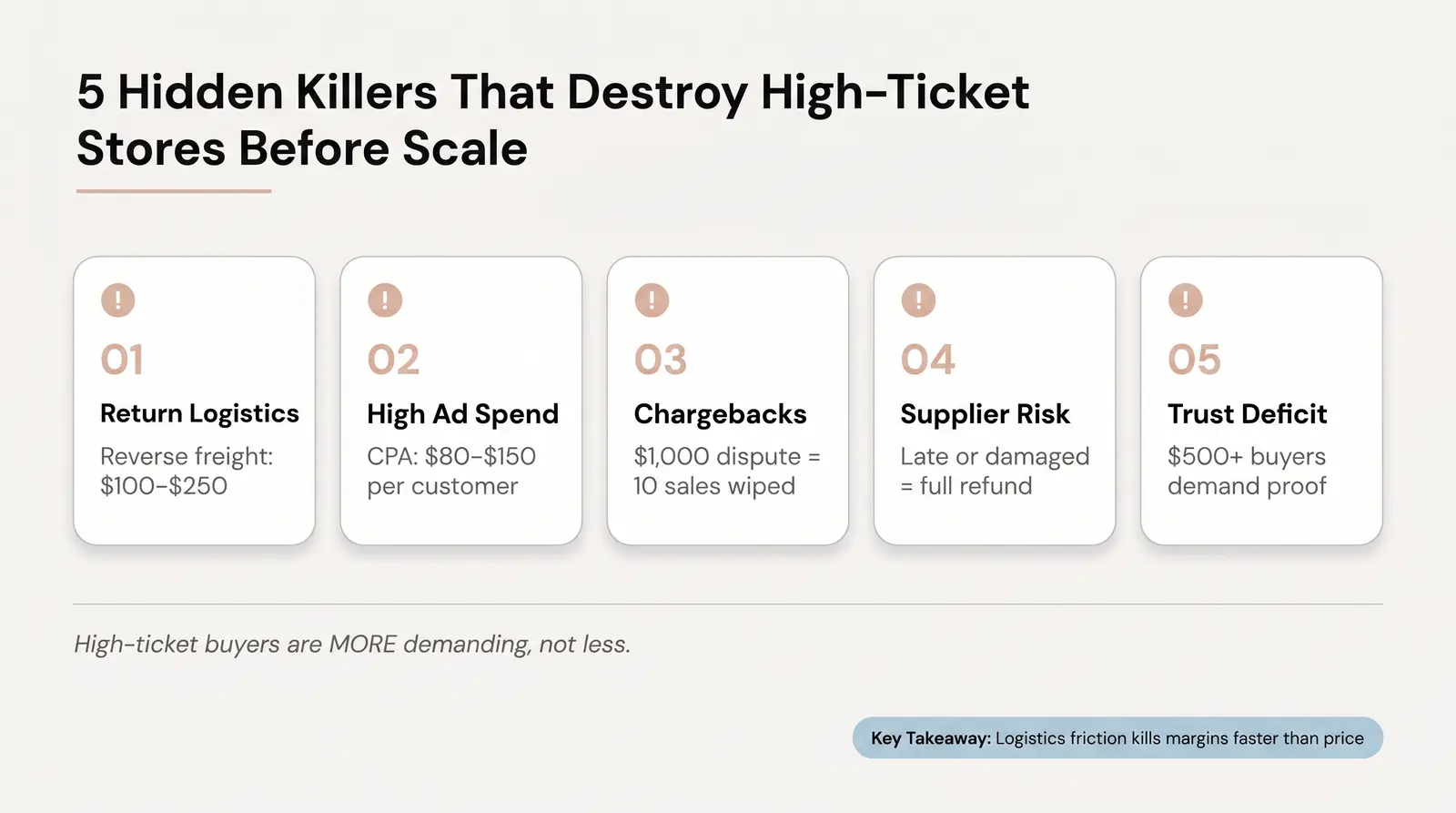
Why does this happen? Because most high-ticket niches come with structural problems that destroy profitability:
The Shipping Cost Trap: A $600 standing desk might have a 40% margin ($240) before shipping. But shipping that desk costs $80-120, immediately cutting your gross profit to $120-160. Compare that to a $150 jewelry piece with 65% margins ($97.50) and $3 shipping, leaving you with $94.50 gross profit. The jewelry has better absolute profit despite being less than a quarter of the price.
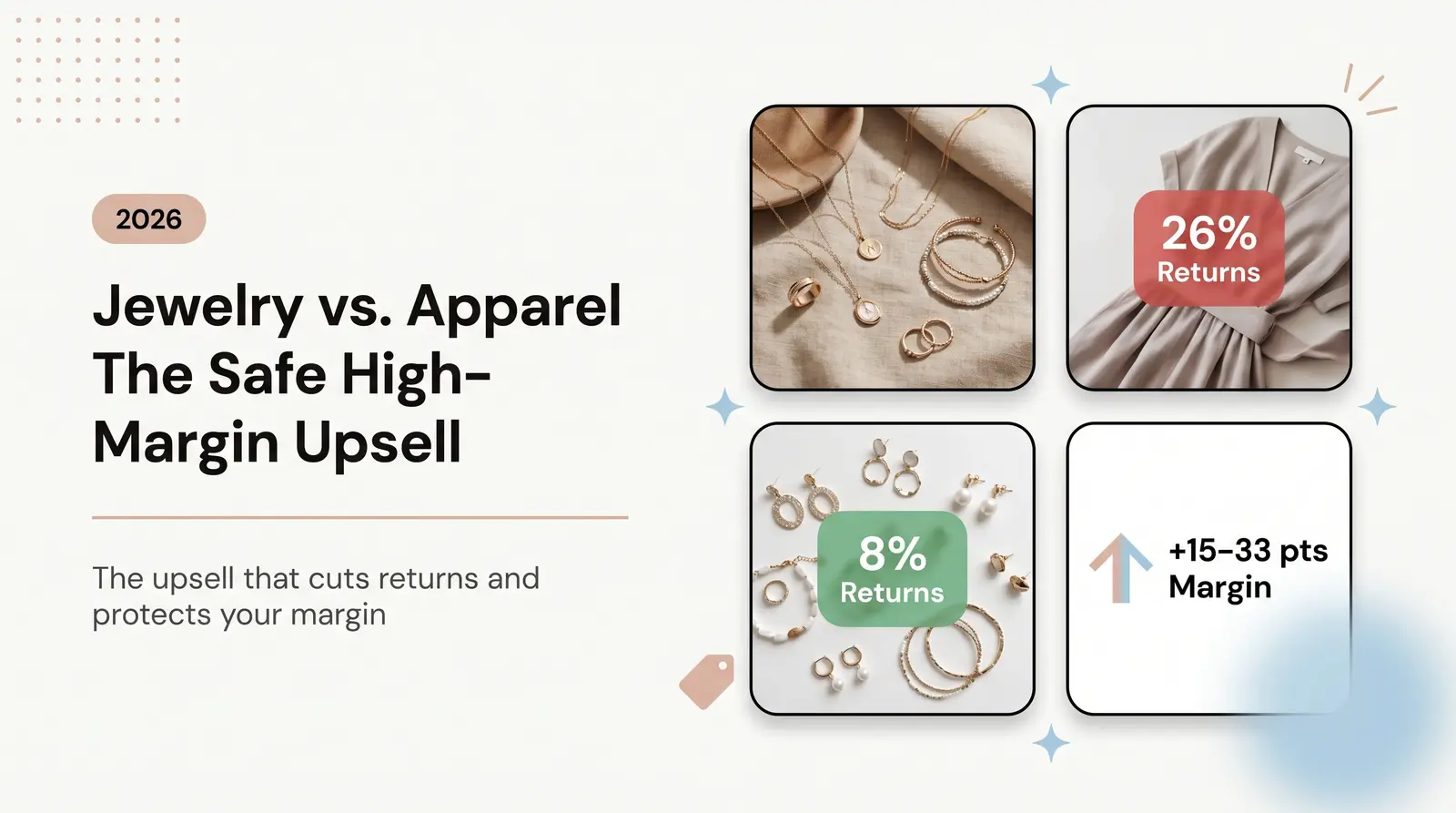
The Return Rate Nightmare: The average ecommerce return rate is 16.9% [6], but this masks enormous category variation. Dropshipping clothing sees 40% return rates [6], while electronics on Amazon face 15-30% returns [8]. Furniture returns are logistically nightmarish and can cost more to process than the original profit. Each return doesn't just erase the profit from that sale—it often costs you additional money in reverse logistics.
The Warranty Expectation Problem: High-ticket items come with warranty expectations. Customers spending $500 expect at least a one-year warranty, responsive customer service, and easy replacements if something goes wrong. This creates ongoing operational burden and liability that low-ticket sellers never face.
The One-Time Purchase Ceiling: Many high-ticket categories suffer from purchase frequency problems. How often does someone buy a new desk? A new TV? A new kayak? Often once every 5-10 years. This means you're constantly chasing new customers at $78+ CAC [1] with no repeat purchase revenue to offset acquisition costs. The math becomes brutal: you need perfect execution on every single order because there's no second chance with that customer.
The Customer Acquisition Friction: As price increases, so does purchase consideration time. A $20 impulse buy happens in seconds. A $500 purchase requires research, comparison shopping, reviews, and often spousal approval. This means your ad-to-purchase conversion rates plummet, driving up your effective CAC. During Black Friday/Cyber Monday, CAC increases 2.5-3x normal rates [1], making high-consideration purchases even more expensive to drive.
In our experience at Branvas, the most consistently profitable dropshipping brands are not selling the biggest products—they're selling the most meaningful ones. Products that create emotional connections, justify repeat purchases, and maintain healthy margins after all operational costs. This is why jewelry consistently outperforms categories that look better on paper.

Why Jewelry Wins the High-Ticket Game
After evaluating hundreds of dropshipping niches, jewelry emerges as the clear winner for founders seeking sustainable high ticket dropshipping success. This isn't hype—it's structural economics backed by market data.
High Perceived Value, Minimal Operational Costs: Jewelry occupies a unique position: customers perceive it as high-value and are willing to pay premium prices, yet the operational costs are remarkably low. A $180 necklace ships in a small padded envelope for under $5, weighs almost nothing, and is virtually immune to shipping damage. Compare this to furniture or electronics, where shipping alone can consume 15-20% of the sale price.
Emotional and Gifting Purchases Drive Repeat Behavior: The global jewelry market reached $366.79 billion in 2024 and is projected to hit $578.45 billion by 2033 [9], with online sales growing at the fastest rate of 7.9% CAGR [9]. This growth is driven by jewelry's unique emotional positioning. People buy jewelry for anniversaries, birthdays, graduations, promotions, holidays, and self-reward. Each life milestone creates a new purchase occasion. Healthy jewelry brands achieve 20-30% repeat customer rates [10], nearly double the 28.2% ecommerce average [4].
Visual-First Content Performance: Jewelry is perfectly optimized for the platforms driving ecommerce growth. With TikTok converting 45.5% of users into buyers [5] and active social media presence boosting dropshipping sales by 32% [2], visual appeal is everything. Jewelry photographs beautifully, videos showcase sparkle and movement, and user-generated content (customers wearing pieces) creates authentic social proof. This is why 70% of shoppers report buying after discovering products on Instagram, Facebook, or TikTok [2].
Collection Behavior and Repeat Purchases: Unlike furniture or electronics (one-time purchases), jewelry naturally encourages collection behavior. A customer who buys one necklace will return for earrings, then a bracelet, then a ring. Women's jewelry accounts for 71.7% of the market [9], and women who connect with a brand often build entire collections over time. This transforms customer acquisition from an expense into an investment.
Brand Differentiation and Pricing Power: Jewelry is one of the few categories where brand and storytelling can justify dramatic price premiums. The same silver necklace can sell for $40 or $400 depending on brand positioning, design story, and emotional connection. This pricing power is rare in dropshipping, where most categories face relentless commoditization and price competition.
Minimal Returns and Support Requirements: While dropshipping clothing sees 40% return rates [6] and electronics face 15-30% [8], jewelry return rates are dramatically lower—typically under 10% for quality pieces. There are no warranty concerns, no technical support requirements, no installation questions. The customer service burden is minimal, allowing you to focus on growth rather than firefighting operational issues.
In our experience at Branvas, the most consistently profitable dropshipping brands are not selling the biggest products—they're selling the most meaningful ones. Jewelry checks every box: strong margins (55-75%), low operational complexity, excellent content performance, repeat purchase behavior, and genuine brand-building potential. The online jewelry market is projected to reach $115.4 billion by 2029 [11], with online channels growing faster than any other distribution method.
This is why we built Branvas specifically for jewelry dropshipping—because the fundamentals are simply better than any other high-ticket category.

Jewelry vs Other High-Ticket Niches (Comparison Table)
|
Dimension |
Jewelry |
Furniture |
Electronics |
Fitness Equipment |
|---|---|---|---|---|
|
Typical AOV |
$120-250 |
$400-800 |
$80-250 |
$200-500 |
|
Gross Margin |
55-75% |
25-35% |
20-35% |
30-40% |
|
Shipping Cost |
$3-8 |
$75-150 |
$8-25 |
$15-50 |
|
Return Rate |
<10% |
20-30% |
15-30% |
15-25% |
|
Repeat Purchase |
High (20-30%) |
Very Low |
Low |
Moderate |
|
Content Performance |
Excellent |
Moderate |
Good |
Good |
|
Operational Complexity |
Very Low |
Very High |
Moderate |
Moderate |
|
Brandability |
Excellent |
Moderate |
Low |
Moderate |
|
Trust Barrier |
Moderate |
Moderate |
Low |
Low |
|
Scorecard Rating |
61/70 |
32/70 |
35/70 |
41/70 |
|
Best For |
Brand builders |
Logistics experts |
Volume players |
Community builders |
The comparison reveals why jewelry consistently outperforms: it combines high margins with low operational costs, creating actual profit per order that exceeds much more expensive categories. A $180 jewelry sale with 65% margins and $5 shipping generates $112 gross profit. A $600 furniture sale with 30% margins and $100 shipping generates $80 gross profit. The jewelry sale is more profitable despite being one-third the price.
Where Branvas Fits (Subtle, Educational Promotion)
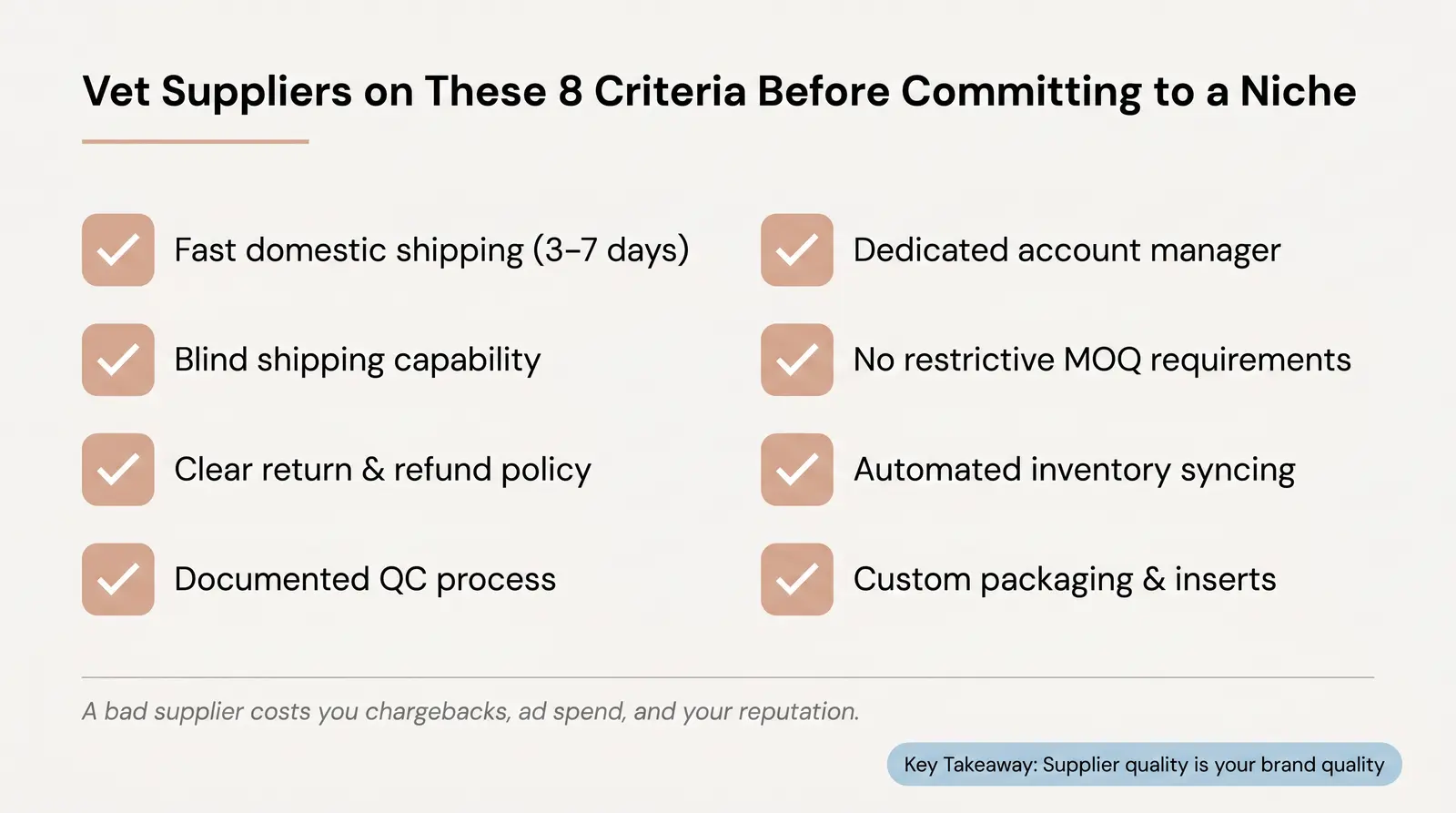
Building a successful jewelry dropshipping brand requires solving several operational challenges: sourcing quality products, maintaining consistent fulfillment, creating professional product photography, and managing inventory across suppliers. These operational tasks consume time that should be spent on brand-building and customer acquisition.
Branvas was purpose-built to eliminate this operational drag. The platform provides curated, high-quality jewelry products with professional photography, automated fulfillment, and quality control—allowing founders to focus entirely on what actually drives success: brand positioning, content creation, and customer relationships.
Instead of spending weeks vetting suppliers, negotiating terms, and managing logistics, Branvas users can launch a branded jewelry store in days. The platform handles product sourcing, photography, fulfillment, and quality assurance, while you own the customer relationship and brand equity.

This operational leverage is critical in 2026, where customer acquisition costs have risen 40% in two years [1] and only 10-20% of dropshipping stores stay profitable long-term [2]. Success requires focusing your limited time and capital on activities that differentiate your brand—not on operational tasks that can be systematized.
For founders committed to building a genuine jewelry brand (not just another generic dropshipping store), Branvas provides the infrastructure to compete with established players while maintaining the margins needed for sustainable growth.
How to Choose the Right High-Ticket Niche for You
While jewelry scores highest on our framework, the "best" niche depends on your specific situation, skills, and goals. Use this decision checklist to evaluate fit:
Time Availability: How many hours per week can you dedicate? Furniture and electronics require significant customer service time. Jewelry and beauty devices require content creation time. B2B requires sales outreach time. Match the niche's time demands to your availability.
Starting Capital: What's your runway? Categories with high return rates (furniture, clothing) require more capital reserves to handle refunds and restocking. Jewelry's low return rates and minimal shipping costs make it more capital-efficient for bootstrapped founders.

Risk Tolerance: How much uncertainty can you handle? Fashion and trend-based niches offer explosive upside but high risk. Evergreen categories like jewelry and fitness offer steadier, more predictable growth.
Content Creation Ability: Are you comfortable on camera? Do you have design skills? Visual categories (jewelry, beauty, fashion) reward content creation ability. B2B and technical categories reward industry expertise and relationship-building.
Long-Term Goals: Are you building to sell, or building for cash flow? High-repeat-purchase categories (jewelry, beauty, pet supplies) create more valuable businesses with higher exit multiples. One-time purchase categories require constant customer acquisition but can scale faster initially.
Personal Interest and Authenticity: Can you authentically represent this niche? With social media boosting dropshipping sales by 32% [2] and TikTok converting 45.5% of users [5], authentic content is non-negotiable. Choose a niche where you can create genuine, engaging content without faking interest.
The founders who succeed in high ticket dropshipping aren't necessarily those who choose the "best" niche—they're those who choose the right niche for their specific strengths and commit to building a genuine brand rather than chasing quick wins.

FAQ: High-Ticket Dropshipping in 2026
What are the best dropshipping niches in 2026?
The best dropshipping niches 2026 are those that balance high margins with low operational complexity. Based on our High-Ticket Niche Scorecard, jewelry (61/70) ranks highest, followed by beauty devices (49/70), luxury fashion accessories (48/70), and outdoor gear (44/70). However, the "best" niche depends on your specific skills, capital, and goals. Focus on categories with margins above 50%, repeat purchase potential, and strong visual content performance.
Is high ticket dropshipping still profitable?
Yes, but profitability requires strategic niche selection. The global dropshipping market reached $445.5 billion in 2025 and is growing at 22% CAGR [2], but only 10-20% of stores stay profitable long-term [2]. Success requires choosing niches with strong fundamentals: margins above 50%, low operational complexity, and repeat purchase potential. With average CAC at $78 and rising 40% in two years [1], high-ticket niches with strong margins are increasingly necessary to offset acquisition costs.
What should I sell online to make higher margins?
Focus on products that combine high perceived value with low operational costs. Jewelry delivers 55-75% margins with minimal shipping costs and low return rates. Beauty devices offer 40-60% margins with repeat purchase potential. Avoid categories where operational costs (shipping, returns, warranties) consume margins—furniture and electronics often have deceptively low true margins despite high prices. Look for lightweight, durable, emotionally resonant products that photograph well and encourage repeat purchases.
Why is jewelry a good dropshipping niche?
Jewelry excels across all critical dimensions: exceptional margins (55-75%), minimal operational costs ($3-8 shipping), low return rates (<10%), strong repeat purchase behavior (20-30%), and excellent visual content performance. The online jewelry market is growing at 7.9% CAGR [9], faster than any other distribution channel, driven by social commerce growth. Jewelry's emotional positioning creates natural gifting occasions and collection behavior, transforming customer acquisition from an expense into an investment. It's one of the few categories where brand and storytelling can justify dramatic price premiums.
Is high ticket dropshipping better than low ticket?
High-ticket dropshipping is increasingly necessary as customer acquisition costs rise (up 40% in two years to $78 average [1]). Low-ticket products require perfect execution at scale to achieve profitability, while high-ticket products with strong margins provide more room for error and experimentation. However, "high-ticket" should mean "high-margin," not just "high-price." A $150 product with 65% margins and low operational costs outperforms a $500 product with 30% margins and high shipping/return costs. Focus on true profit per order, not just AOV.
References
[1] UpCounting. (2025). "Average eCommerce Customer Acquisition Cost 2025 by Industry." Retrieved from https://www.upcounting.com/blog/average-ecommerce-customer-acquisition-cost
[2] SellersCommerce. (2025). "Detailed Dropshipping Statistics In 2025." Retrieved from https://www.sellerscommerce.com/blog/dropshipping-statistics/
[3] SpeedCommerce. (2025). "E-Commerce Average Order Value - E-commerce Benchmarks." Retrieved from https://www.speedcommerce.com/insights/e-commerce-average-order-value-e-commerce-benchmarks/
[4] OpenSend. (2025). "7 Repeat Purchase Rate Statistics For eCommerce Stores." Retrieved from https://opensend.com/post/repeat-purchase-rate-ecommerce
[5] eMarketer. (2025). "TikTok Set to Lead Social Commerce in 2024." Retrieved from https://www.sellerscommerce.com/blog/dropshipping-statistics/
[6] Shopify. (2025). "Ecommerce Returns: Average Return Rate and How to Reduce It." Retrieved from https://www.shopify.com/enterprise/blog/ecommerce-returns
[7] Artisan Furniture. (2025). "Furniture Dropshipping: Complete Beginner's Guide." Retrieved from https://www.artisanfurniture.net/news/furniture-dropshipping-beginners-guide/
[8] Uniqbe. (2025). "Dropship Electronic Products: The Ultimate 2025 Guide." Retrieved from https://uniqbe.com/blog/dropshipping/dropship-electronic-products/
[9] Grand View Research. (2024). "Jewelry Market Size, Share & Trends Analysis Report 2025-2033." Retrieved from https://www.grandviewresearch.com/industry-analysis/jewelry-market
[10] Joy Joya. (2024). "How to Inspire Your Jewelry Customers to Return Again and Again." Retrieved from https://joyjoya.com/blogs/podcast/how-to-inspire-your-jewelry-customers-to-return-again-and-again
[11] Jewel360. (2024). "10 Online Jewelry Sales Statistics You Need To Know." Retrieved from https://jewel360.com/blog/online-jewelry-sales-statistics
[12] Dropship Lifestyle. (2025). "15 Profitable High-Ticket Dropshipping Products." Retrieved from https://www.dropshiplifestyle.com/profitable-high-ticket-dropshipping-products/
[13] McKinsey & Company. (2025). "State of the Consumer Trends Report 2025." Retrieved from https://www.mckinsey.com/industries/consumer-packaged-goods/our-insights/state-of-consumer
[14] Statista. (2024). "E-commerce Average Order Value 2024." Retrieved from https://www.statista.com/statistics/1423630/online-shopping-average-order-value/
[15] LoyaltyLion. (2025). "The Average CAC in Ecommerce (2025)." Retrieved from https://loyaltylion.com/blog/blog-average-cac-ecommerce
[16] TrueProfit. (2025). "Dropshipping Profit Margins and Earnings Insights." Retrieved from https://www.sellerscommerce.com/blog/dropshipping-statistics/
[17] Shopify. (2025). "What is Global Ecommerce? Trends and How to Expand." Retrieved from https://www.shopify.com/enterprise/blog/global-ecommerce-statistics
[18] National Retail Federation. (2024). "Consumer Returns in the Retail Industry." Retrieved from https://www.shopify.com/enterprise/blog/ecommerce-returns
[19] Fortune Business Insights. (2025). "Jewelry Market Size, Share, Growth & Trends, 2025-2032." Retrieved from https://www.fortunebusinessinsights.com/jewelry-market-102107
[20] Technavio. (2026). "Online Jewelry Market Growth Analysis - Size and Forecast." Retrieved from https://www.technavio.com/report/online-jewelry-market-industry-analysis
[21] IBISWorld. (2025). "Online Jewelry & Watch Sales in the US Industry Analysis." Retrieved from https://www.ibisworld.com/united-states/industry/online-jewelry-watch-sales/5099/
[22] Oberlo. (2024). "Online Jewelry Sales Statistics (2017–2029)."
[23] Digital Commerce 360. (2022). "Jewelry Ecommerce Statistics." Retrieved from https://www.digitalcommerce360.com/jewelry-ecommerce-statistics/
[24] Printful. (2025). "Top 11 Dropshipping Statistics You Need to Know in 2025." Retrieved from
[25] AutoDS. (2025). "Essential Dropshipping Statistics You Need To Know In 2025." Retrieved from