


Selling designer-inspired or dupe jewelry carries serious trademark, trade dress, and copyright risks across all platforms—building an original brand is the safer, more scalable path.
Published:
July 31, 2026
Author:
Yi Cui
This article is for informational purposes only and does not constitute legal advice. Consult a qualified IP attorney for your specific situation.
Many ecommerce sellers and dropshippers are walking into a legal blind spot without realizing it. You see a trending piece of jewelry on TikTok, find a supplier offering a nearly identical version for a fraction of the price, and list it on your store as "designer-inspired." It feels like a smart business move, but it quietly invites DMCA takedowns, platform bans, and potentially devastating lawsuits. Many sellers do not realize they have crossed a legal line until their funds are frozen and their inventory is destroyed. This article explores the complex legal landscape of selling dupes and lookalike products, breaking down the intellectual property risks and pointing toward a safer, more scalable alternative.
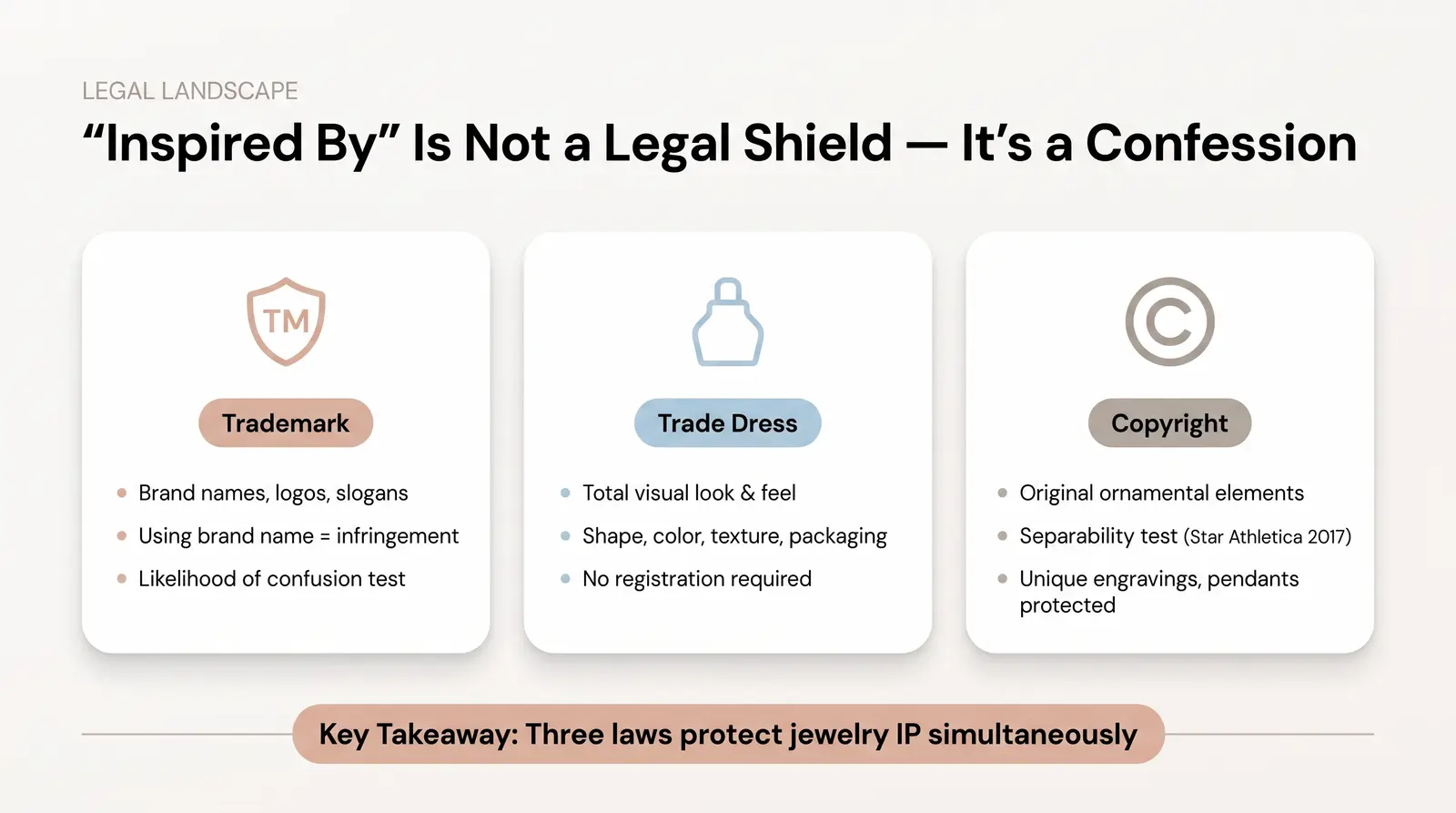
The line between legal inspiration and illegal infringement is thinner than most sellers assume. In the eyes of the law, "inspired by" is not a protective shield; it is often a confession. To understand your legal exposure, you must understand the three main pillars of intellectual property law that apply to physical products like jewelry and accessories.
Trademark law protects brand names, logos, and slogans that identify the source of a product. If you use a luxury brand's name in your product title, tags, or description—even just to say your item is "inspired by" them—you are likely committing trademark infringement. The Lanham Act strictly prohibits using a mark in a way that causes a likelihood of consumer confusion.
Trade Dress is a subset of trademark law that protects the total visual appearance or "look and feel" of a product. This includes its size, shape, color, texture, and packaging. If your product mimics the distinctive, non-functional design of a famous brand's item to the point where consumers might be confused about its origin, you are risking a trade dress infringement claim. A design does not need to be registered to receive trade dress protection under the Lanham Act.
Copyright protects original works of authorship, including the ornamental and sculptural elements of jewelry. While functional elements like clasps or standard chain links are generally not copyrightable under the "useful article doctrine," unique artistic expressions are protected. The Supreme Court's 2017 decision in Star Athletica v. Varsity Brands established the "separability test," confirming that artistic features incorporated into a useful article can be copyrighted if they can be perceived as separate two- or three-dimensional works of art. In jewelry, this means an original floral engraving or a distinctive sculptural pendant is fully protected by copyright law, while the basic concept of a ring or a hoop earring is not.
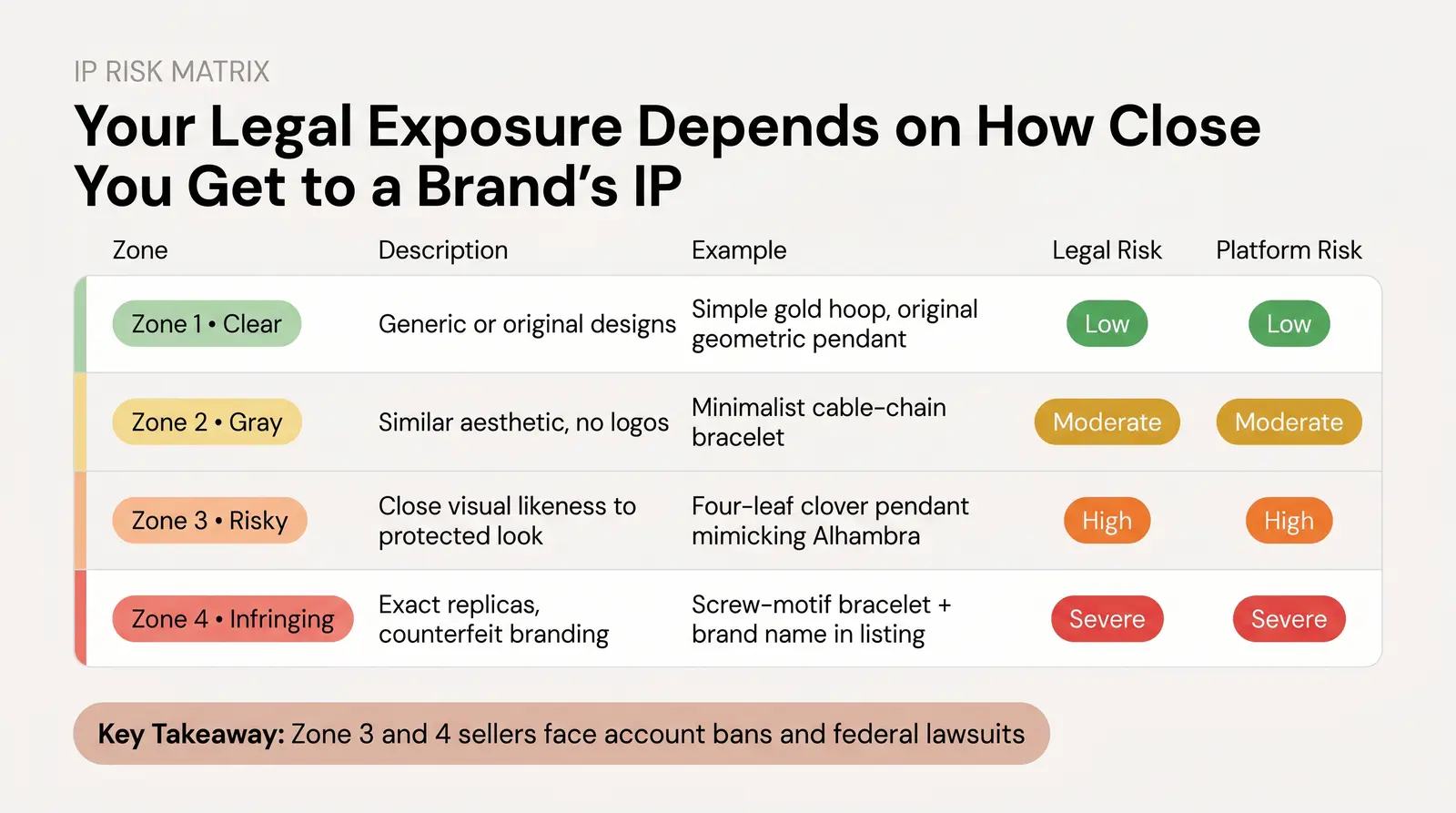
Understanding your legal exposure requires evaluating exactly how close your product gets to an existing brand's intellectual property. We developed the Branvas IP Risk Matrix™ to help sellers map their behavior against the corresponding legal and platform enforcement risks.
| Risk Zone | Description | Jewelry Example | Legal Risk | Platform Enforcement Risk |
|---|---|---|---|---|
| Zone 1: Clear | Generic or entirely original designs with no overlap with famous brands. | A simple gold hoop earring or an original geometric pendant design. | Low. No infringement issues. | Low. Safe to sell on all platforms. |
| Zone 2: Gray (Style-Adjacent) | Products that share a similar aesthetic or silhouette but lack distinctive logos or protected trade dress. | A minimalist cable-chain bracelet that evokes a popular style without copying specific twisted-wire proportions or branded end-caps. | Moderate. Risk of initial interest confusion or aggressive brand enforcement, even if ultimately defensible. | Moderate. Potential for automated takedowns that require counter-notices to resolve. |
| Zone 3: Risky (Trade Dress Proximity) | Close visual likeness to a brand's distinctive, non-functional look and feel, even without logos. | A four-leaf clover pendant with beaded edges that closely mimics the Van Cleef & Arpels Alhambra collection. | High. Significant exposure to trade dress and design patent infringement claims. | High. High likelihood of DMCA takedowns, listing removals, and temporary account suspensions. |
| Zone 4: Infringing | Exact replicas, counterfeit branding, logo replication, or near-identical trade dress. | A bracelet featuring a screw motif and a locking mechanism identical to the Cartier Love bracelet, marketed using the brand name. | Severe. Counterfeiting charges, treble damages, statutory damages up to $2 million per mark, and potential criminal liability. | Severe. Immediate account bans, frozen funds, and permanent removal from platforms like Amazon and Etsy. |
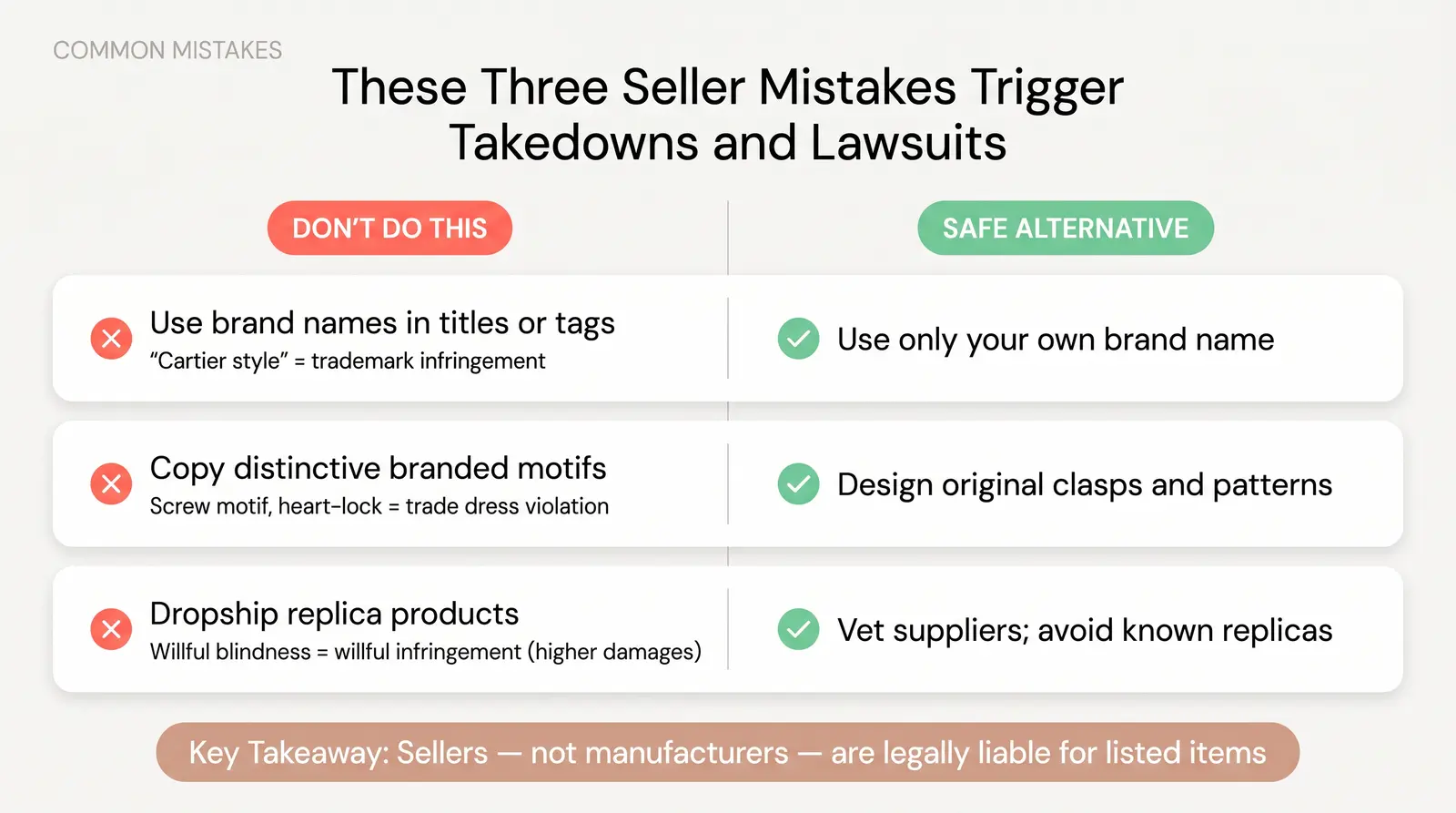
Even well-intentioned sellers frequently make mistakes that trigger legal action. One of the most common errors is using a luxury brand name, or a phonetic variant, in product titles, tags, or descriptions. Including keywords like "Cartier style" or "Gucci dupe" to capture search traffic is a direct violation of trademark law.
Another frequent misstep is copying distinctive branded elements. A generic bangle is fine, but adding a specific screw motif or a heart-lock design that is synonymous with a luxury house crosses into trade dress infringement. The U.S. Customs and Border Protection regularly seizes shipments of jewelry that replicate protected configurations, noting that a product does not need to bear a brand's wordmark to violate its trade dress.
Dropshipping from suppliers who sell replicas is a massive vulnerability. Many sellers mistakenly believe that the manufacturer bears the legal responsibility. In reality, the seller listing the item and collecting the payment is directly liable for trademark and copyright infringement. Federal courts have consistently ruled that "willful blindness"—ignoring red flags about a supplier's inventory—is the legal equivalent of willful infringement, which carries significantly higher statutory damages.
Selling these items on platforms with aggressive IP enforcement exacerbates the risk. Brands actively monitor marketplaces and utilize automated tools to sweep for infringing listings, catching sellers who thought they were flying under the radar.
Major ecommerce platforms are under increasing pressure to combat the $467 billion global trade in counterfeit goods, and they have developed aggressive enforcement mechanisms that favor brand owners.
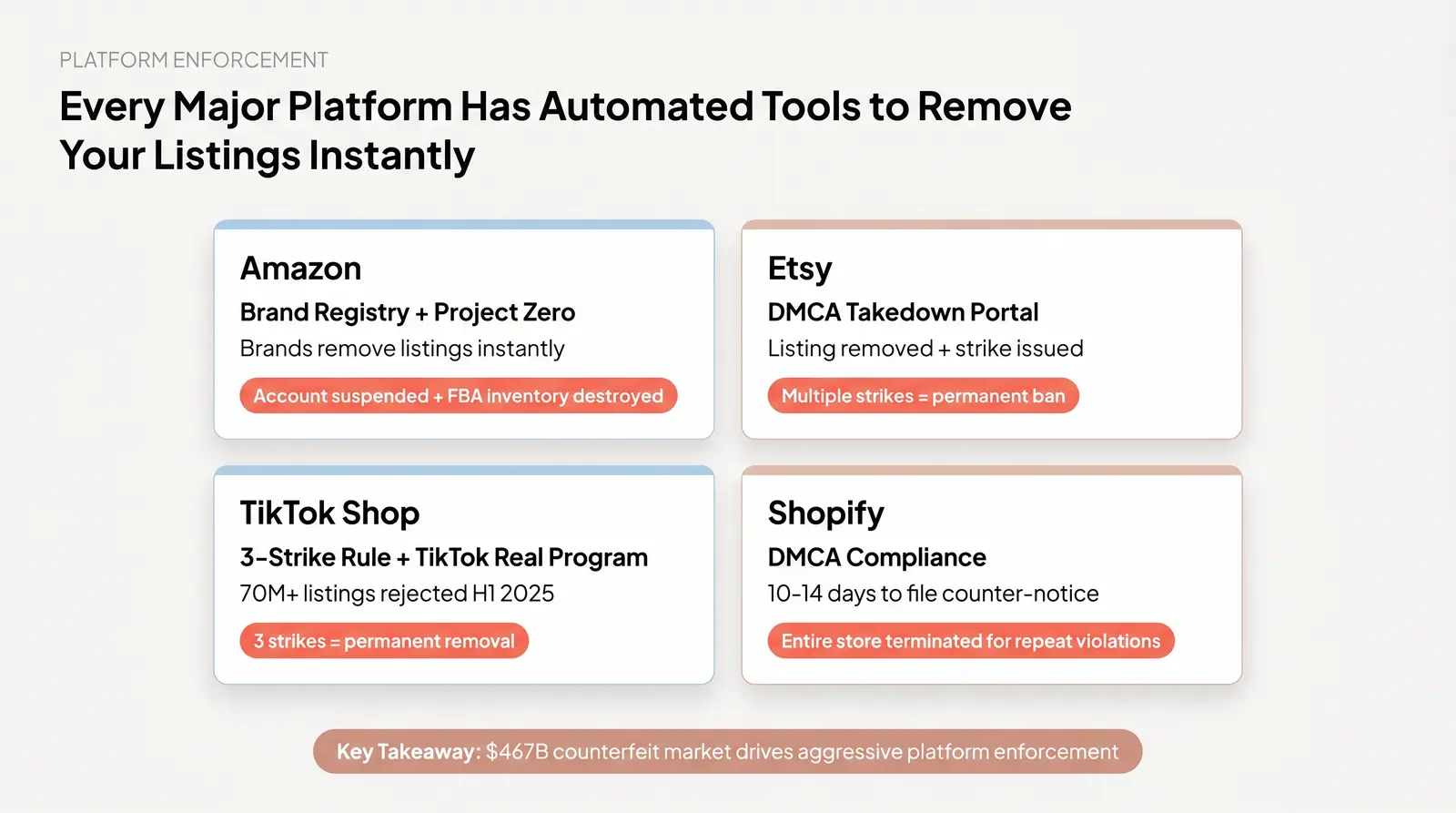
Amazon operates Brand Registry and Project Zero, tools that grant trademark owners extensive power. Project Zero allows enrolled brands to instantly remove suspected infringing listings without waiting for Amazon to review the complaint. Machine learning algorithms also scan the marketplace in real time to proactively remove suspect listings. Sellers caught violating IP policies face immediate account suspension, frozen funds, and the destruction of FBA inventory.
Etsy is legally required to comply with the Digital Millennium Copyright Act (DMCA). When a brand submits a takedown notice via the Etsy Reporting Portal, the platform removes the listing and notifies the seller. While sellers can file a counter-notice, accumulating multiple IP violations will result in permanent account termination.
TikTok Shop has implemented a strict three-strike rule for intellectual property violations, leading to permanent account removal. In response to the rampant "dupe culture" on the app, TikTok recently launched the "TikTok Real" program to streamline the notice-and-takedown process for trademark infringement, rejecting over 70 million product listings in the first half of 2025 alone.
Shopify also strictly adheres to DMCA procedures. Upon receiving a valid notice, Shopify will take down the offending pages and notify the merchant. While merchants have 10 to 14 business days to file a counter-notice, Shopify retains the discretion to terminate entire stores for repeat infringement or even a single instance of egregious counterfeiting.
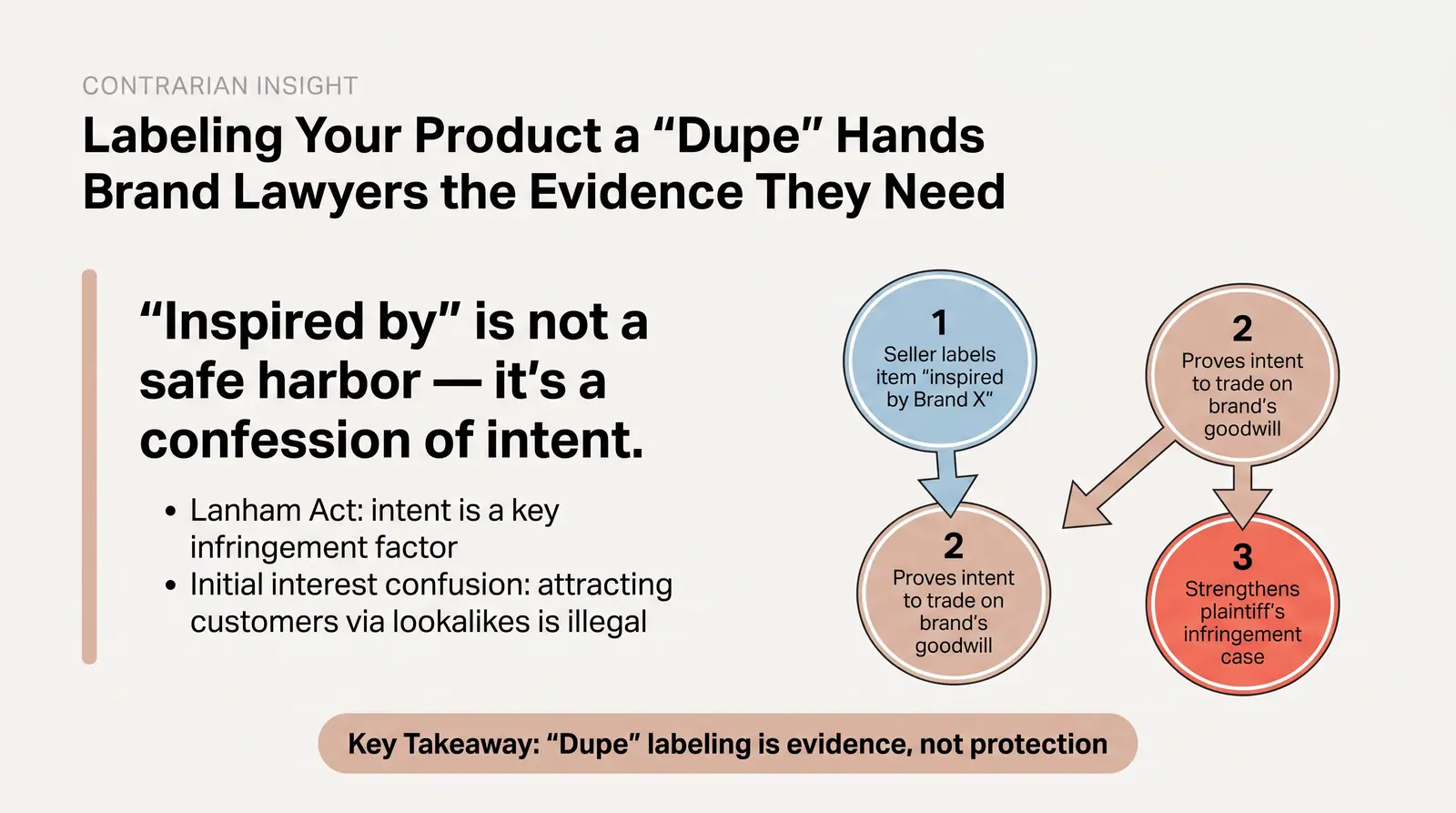
Many sellers operate under the dangerous misconception that explicitly labeling a product as a "dupe" or "inspired by" a famous brand provides a legal safe harbor. The reality is entirely the opposite. Using these phrases does not protect you legally; it actively creates evidence of your intent to trade on another brand's goodwill.
Under the Lanham Act, courts determine trademark infringement based on the "likelihood of confusion." One of the key factors in this analysis is the intent of the alleged infringer. When you advertise a product as "inspired by Cartier," you are admitting that you intentionally modeled your product after their design to attract their customers. This satisfies the intent factor and significantly strengthens the plaintiff's case.
Furthermore, courts recognize the doctrine of "initial interest confusion." This occurs when a consumer is initially attracted to your product because it looks like a famous brand's item, even if they realize before purchasing that it is a cheaper alternative. The law protects brands from competitors who use confusingly similar designs to get a foot in the door. By labeling your item a dupe, you are handing the brand's lawyers the exact evidence they need to prove you are unfairly capitalizing on their reputation.
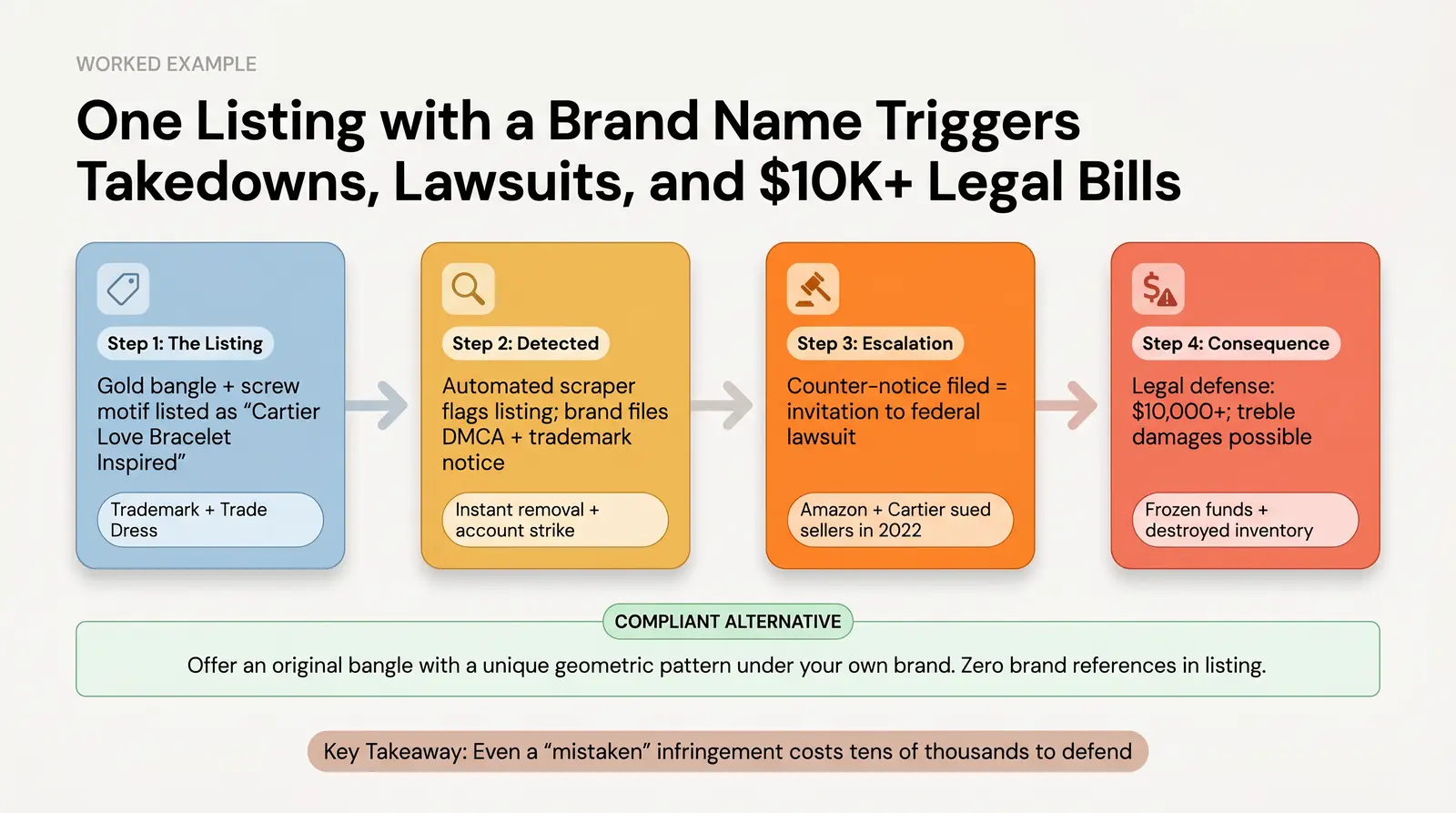
Consider a realistic scenario: An Etsy seller sources a gold-plated bangle featuring a distinct screw motif. They list it as a "Minimalist Screw Bangle - Cartier Love Bracelet Inspired."
This listing immediately triggers multiple severe legal risks. First, using the word "Cartier" in the title is direct trademark infringement. Second, the screw motif and binding closure replicate Cartier's registered configuration trademarks and protected trade dress.
What happens next? Cartier's brand protection team, or an automated web scraper, flags the listing. They submit a DMCA and trademark takedown notice to Etsy. Etsy immediately removes the listing and issues a strike against the seller's account.
If the seller attempts to fight the takedown by filing a counter-notice, they are essentially daring a multi-billion-dollar conglomerate to sue them in federal court. In 2022, Amazon and Cartier jointly filed lawsuits against sellers and an influencer who used "hidden links" to sell counterfeit Love bracelets. The cost of defending such a lawsuit—even if the seller mistakenly believed they were operating legally—can easily reach tens of thousands of dollars, not including the potential for treble damages and the disgorgement of profits.
The compliant alternative? The seller should offer an original bangle design—perhaps featuring a unique geometric pattern or an original clasp mechanism—marketed under their own brand name, with absolutely no reference to luxury jewelry houses in the listing text or tags.
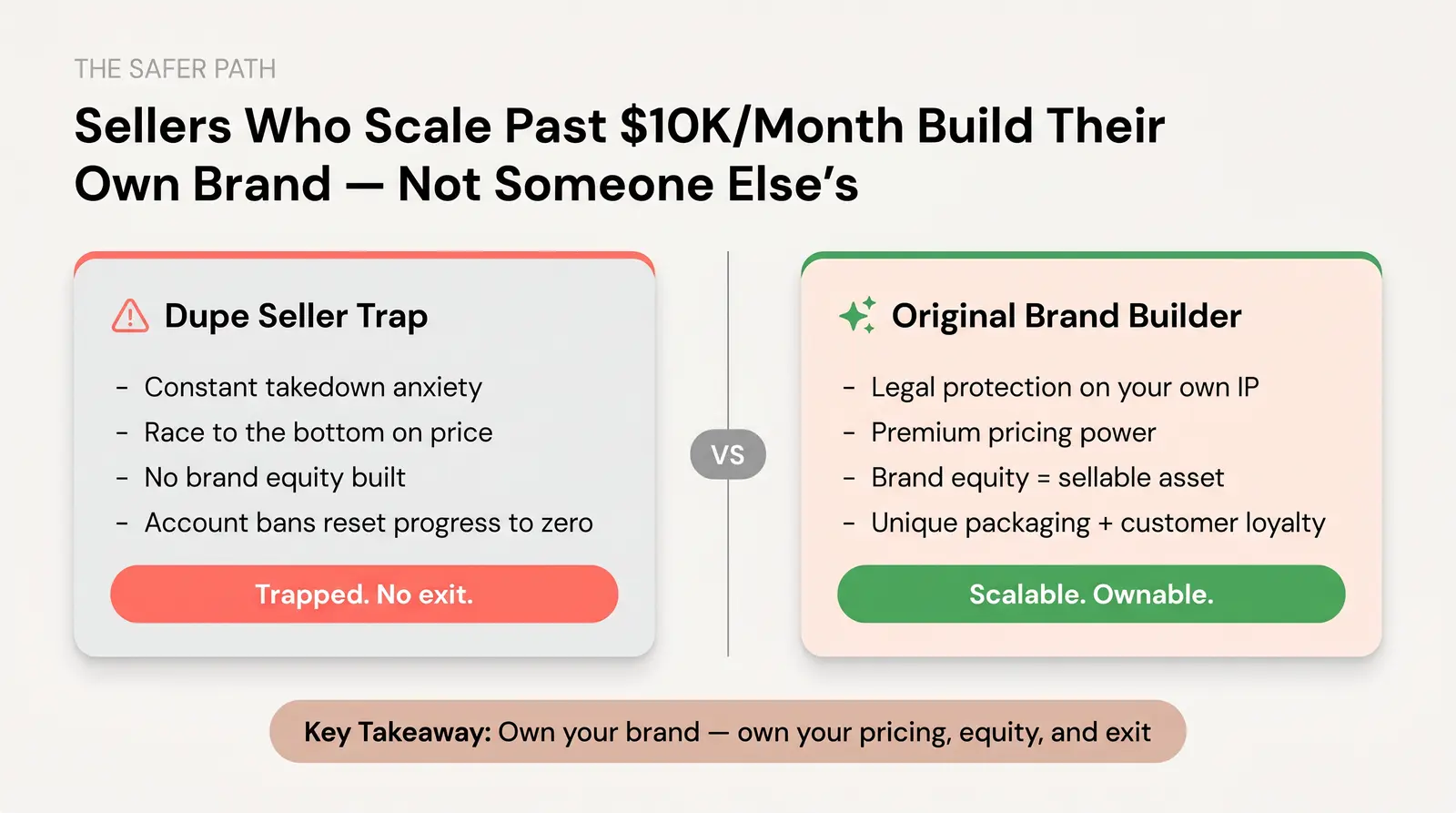
Navigating the minefield of intellectual property law is exhausting and ultimately limits your growth. Selling lookalikes traps you in a cycle of hiding from takedowns, constantly creating new seller accounts, and competing solely on price against thousands of other dropshippers.
Building an original private-label brand is both legally safer and exponentially more commercially valuable over the long term. When you own the brand, you own the equity. You dictate the pricing, control the customer experience, and build an asset that can eventually be sold.
In our experience at Branvas, the sellers who scale past $10K per month are not riding another brand's aesthetic—they are building their own. They invest in unique packaging, develop a cohesive brand identity, and source quality products that stand on their own merits.
Branvas enables influencers, ecommerce sellers, and aspiring entrepreneurs to launch a fully branded, original jewelry line fast. We handle product sourcing, branding, packaging, and blind shipping fulfillment, allowing you to focus on marketing and growth without the anxiety of IP infringement. You get your own name, your own packaging, and your own identity, without needing to copy anyone.
If you are still figuring out what your brand could look like, our Brand Studio at [branvas.com/brand-studio] is a good place to start exploring. You can view our extensive catalog at [branvas.com/catalog] and learn more about our tailored solutions for ecommerce and boutique store owners at [branvas.com/solutions/ecommerce-and-boutique-store-owners].
Disclaimer: This article is for informational purposes only and does not constitute legal advice. Consult a qualified IP attorney for your specific situation.
1. Is it legal to sell "inspired by" jewelry online?
It is generally illegal if the jewelry copies protected trade dress, patented designs, or uses the original brand's name in the marketing. The phrase "inspired by" does not offer legal protection and can actually be used as evidence of intent to infringe.
2. What's the difference between a dupe and a counterfeit product?
A true dupe is a legal alternative that shares a general style but does not copy protected design elements or logos. A counterfeit is an illegal replica that uses identical or substantially indistinguishable trademarks and trade dress to deceive consumers.
3. Can I get sued for selling lookalike products even if I don't use brand names?
Yes. If your product's design closely mimics the distinctive, non-functional appearance of another brand's product, you can be sued for trade dress infringement or design patent infringement, regardless of whether you used their brand name.
4. What happens if I receive a DMCA takedown on Etsy or Amazon?
The platform will immediately remove your listing and issue a strike against your account. Multiple strikes will lead to permanent account suspension and frozen funds. While you can file a counter-notice, doing so may provoke the brand owner to file a federal lawsuit against you.
5. How do I sell jewelry online without infringing on designer IP?
The safest approach is to source generic or highly original designs, avoid using any luxury brand names or trademarked terms in your listings, and focus on building your own unique brand identity and packaging.
The line between "inspired" and "infringing" is thinner and more legally consequential than most ecommerce sellers assume. Attempting to profit from another brand's intellectual property through lookalikes and dupes is a high-risk game that frequently ends in platform bans, seized funds, and expensive lawsuits. The real opportunity—and the only sustainable path to significant ecommerce wealth—is in building something original.
Ready to launch a jewelry brand you fully own? Branvas makes it simple →