


Use the BSES scoring framework and 7-step vetting checklist to find ethical jewelry suppliers, avoid greenwashing, and build a transparent supply chain.
Published:
June 8, 2026
Author:
Yi Cui
Values-driven shopping is the new standard. For modern jewelry brands, ethical sourcing is no longer an optional marketing angle. It is a competitive and reputational necessity. This guide delivers a step-by-step vetting framework, a comprehensive checklist, a decision matrix, and a worked example to help you build a defensible, values-aligned supply chain.
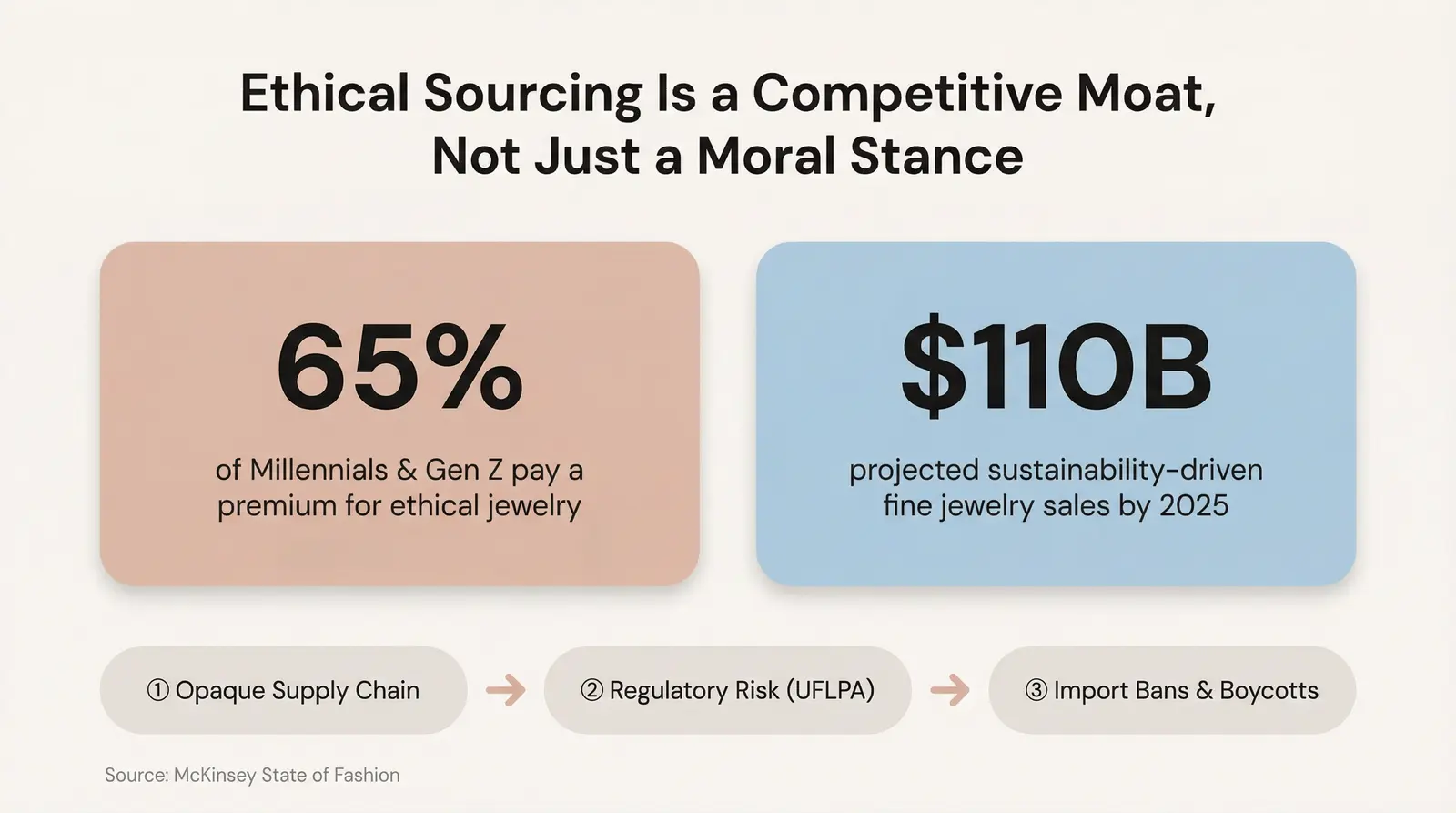
The demand for sustainable and ethically sourced jewelry is accelerating rapidly. Recent data indicates that nearly 65% of millennials and Gen Z customers are willing to pay a premium for sustainably sourced jewelry, and they are actively demanding transparency in production [1]. Furthermore, McKinsey's State of Fashion report projects that sustainability-influenced purchases will account for 20 to 30 percent of all fine-jewelry sales by 2025, representing up to $110 billion [2].
Here is the less obvious insight: ethical sourcing is not just a moral stance. It is a moat against supply chain disruption and regulatory risk. As global scrutiny tightens, brands that fail to trace their materials face severe consequences. The U.S. Uyghur Forced Labor Prevention Act (UFLPA), for instance, has demonstrated how quickly opaque supply chains can lead to import bans and seized merchandise [3]. Brands caught in greenwashing scandals or linked to human rights abuses risk immediate consumer boycotts and irreparable reputational damage.
We often see founders at Branvas assume that ethical sourcing adds cost without adding value. But the data, and our experience, tell a different story. Building a transparent supply chain from day one protects your brand from future regulatory shocks while capturing the growing segment of values-driven consumers.
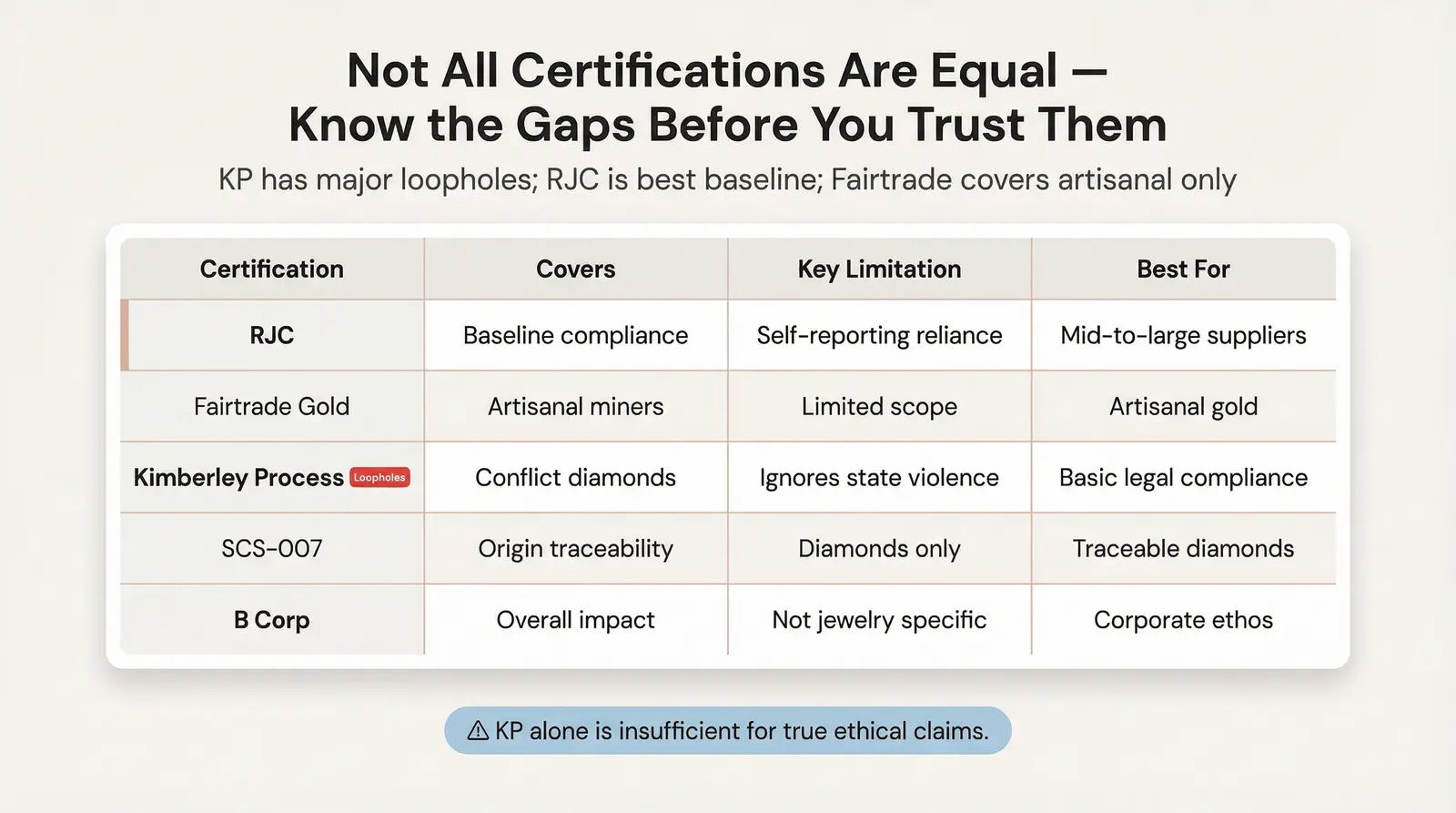
Navigating the alphabet soup of jewelry certifications can be overwhelming. While many suppliers claim to be "certified," the actual rigor of these standards varies wildly. Understanding what each certification guarantees, and what it omits, is crucial for effective vetting.
| Certification Name | What It Covers | Limitations | Best For |
|---|---|---|---|
| Responsible Jewellery Council (RJC) | Comprehensive standards for human rights, labor rights, health, safety, and product integrity across the supply chain [4]. | Audits can be infrequent, and the certification relies heavily on self-reporting before third-party verification. | Broad baseline compliance for mid-to-large suppliers. |
| Fairtrade Gold | Ensures artisanal and small-scale miners receive a fair minimum price and a premium for community development [5]. | Limited scope; only applies to gold from specific certified artisanal mining organizations. | Brands specifically targeting artisanal gold sourcing. |
| Kimberley Process (KP) | Aims to prevent the trade of "conflict diamonds" that finance rebel movements against recognized governments [6]. | Significant loopholes; does not cover lab-grown stones, state-sponsored violence, or broader human rights abuses [6]. | Basic legal compliance for natural diamonds, but insufficient for true ethical claims. |
| SCS-007 | A multi-stakeholder sustainability standard for diamonds, covering origin traceability, ethical stewardship, and climate neutrality [7]. | Relatively new standard; primarily focused on diamonds rather than colored gemstones or metals. | Brands prioritizing highly traceable natural or lab-grown diamonds. |
| B Corp | Assesses a company's overall social and environmental impact, transparency, and legal accountability [8]. | Not specific to the jewelry supply chain; evaluates the business as a whole rather than individual material sourcing. | Evaluating a supplier's overarching corporate ethos and operational transparency. |
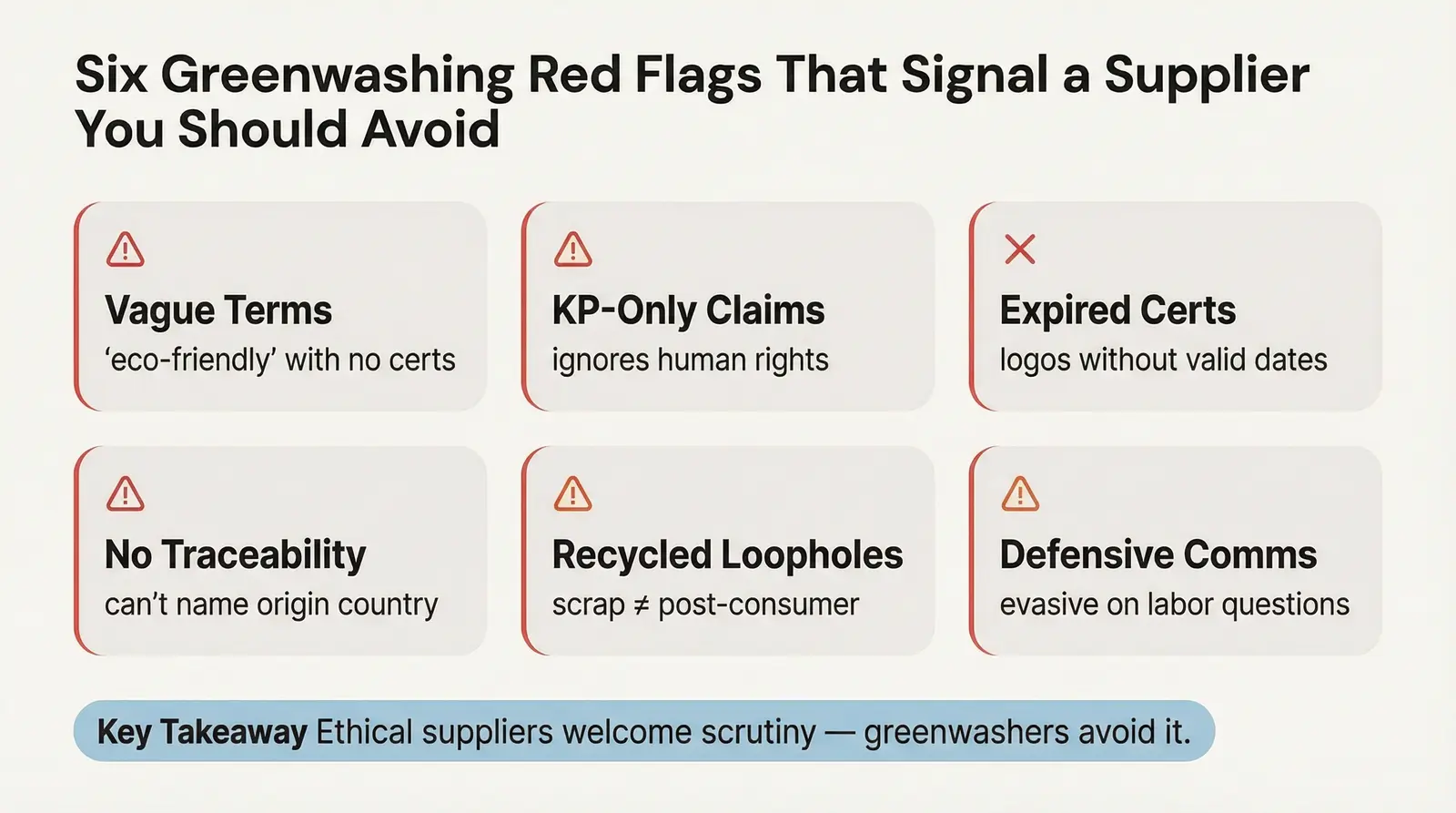
It is important to note that the Kimberley Process, often touted as the gold standard for conflict-free diamonds, has significant loopholes. It narrowly defines conflict diamonds as those funding rebel movements, entirely ignoring state-sponsored violence, environmental degradation, and abuses in artisanal mining [6]. Relying solely on the KP for ethical claims is a common pitfall for emerging brands.
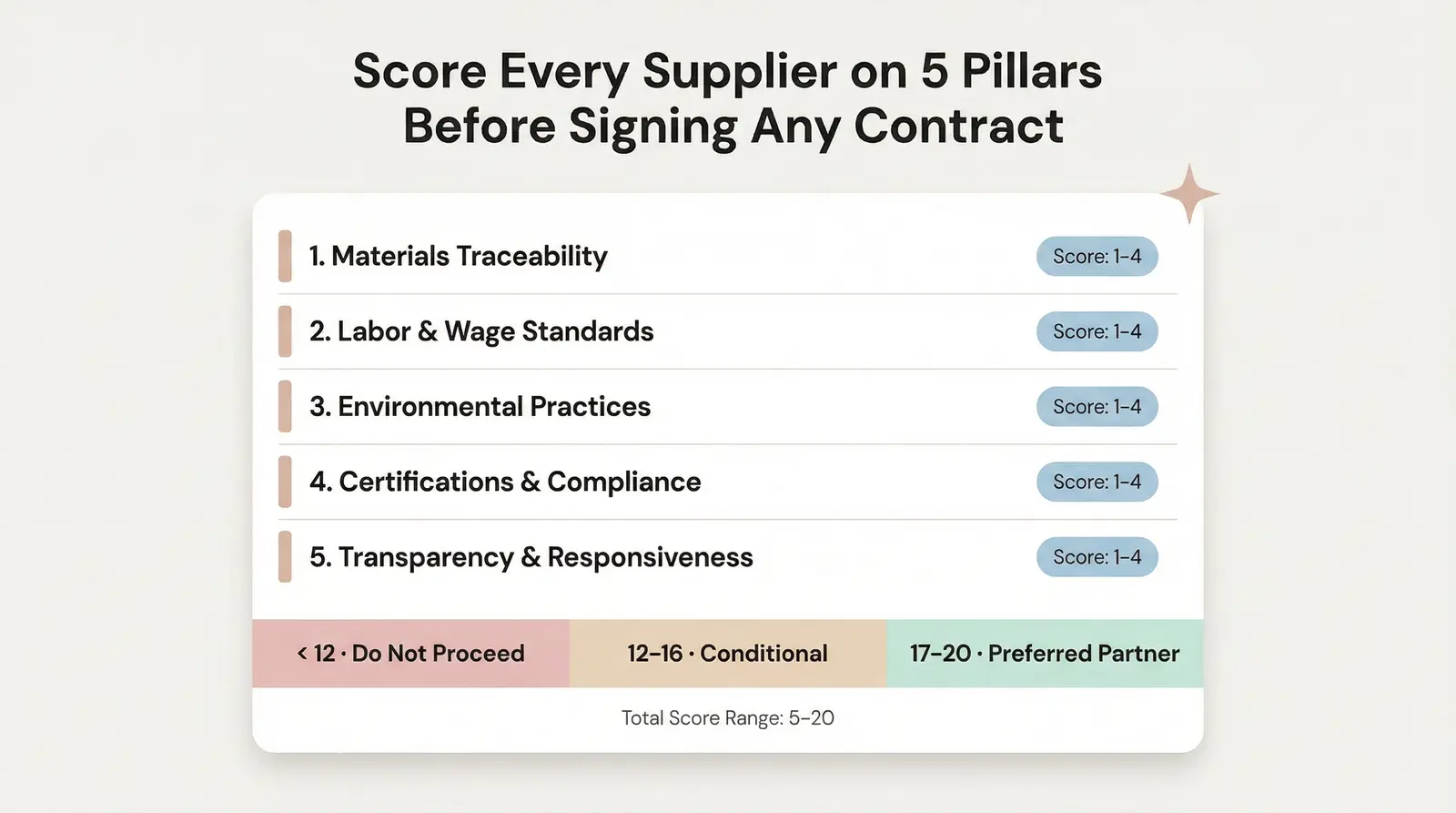
In our experience at Branvas, most early-stage founders skip structured vetting entirely. That's usually where greenwashing exposure happens. To solve this, we developed the Branvas Supplier Ethics Score (BSES): a 5-pillar scoring framework that founders can use to objectively compare suppliers.
The BSES evaluates suppliers across five critical dimensions, scoring each from 1 to 4:
Total Score Guide (Range: 5 to 20):
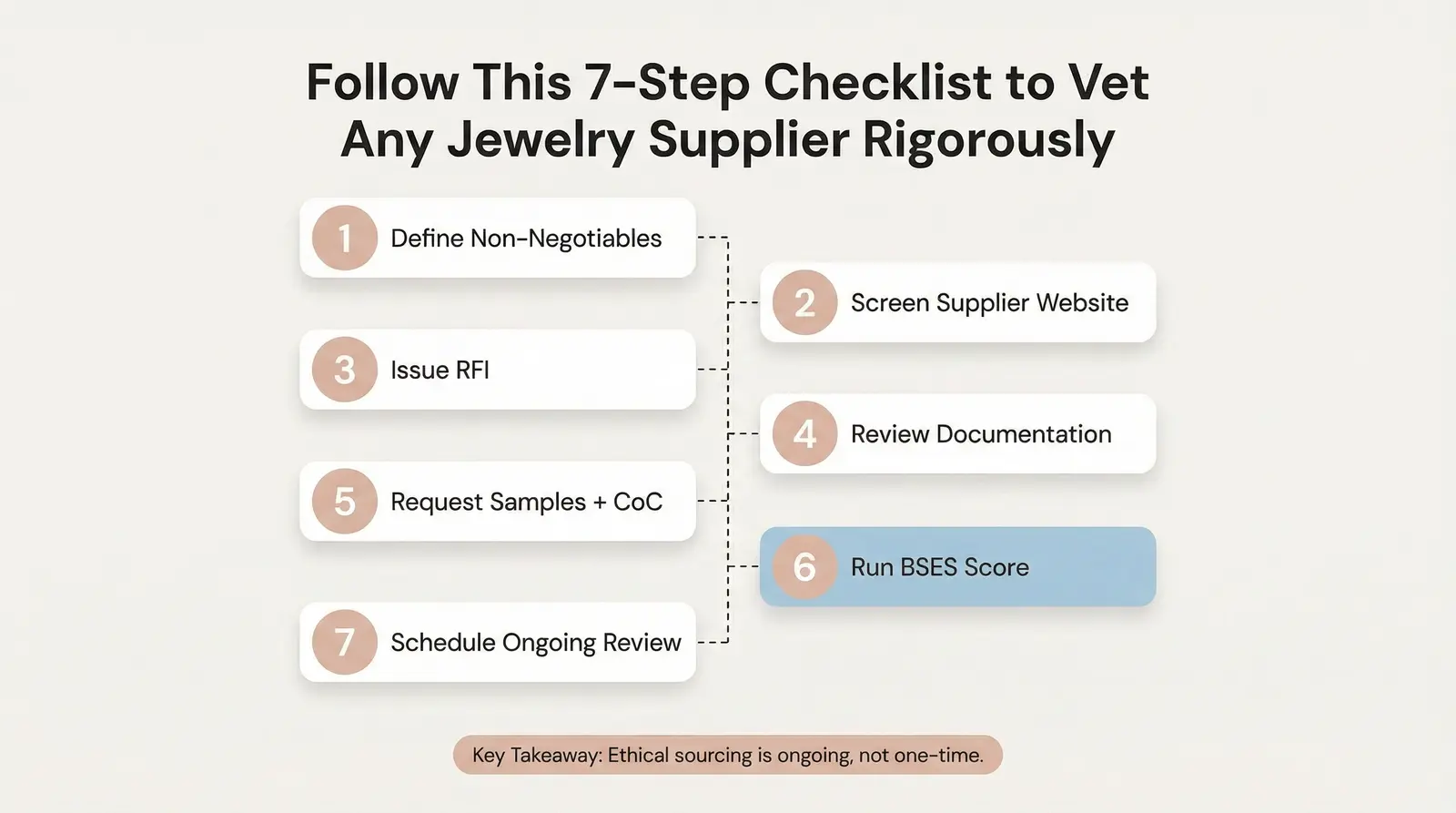
A rigorous vetting process requires more than just reading a supplier's "About Us" page. Follow these practical steps to evaluate potential partners effectively.
Jewelry Supplier Checklist
- [ ] Defined material and certification non-negotiables.
- [ ] Screened supplier website for specific claims vs. vague greenwashing.
- [ ] Sent RFI with specific questions on labor, materials, and environment.
- [ ] Verified validity and expiration dates of all provided certifications.
- [ ] Requested and reviewed chain-of-custody documentation for samples.
- [ ] Calculated the supplier's BSES score.
- [ ] Scheduled the next compliance review date.
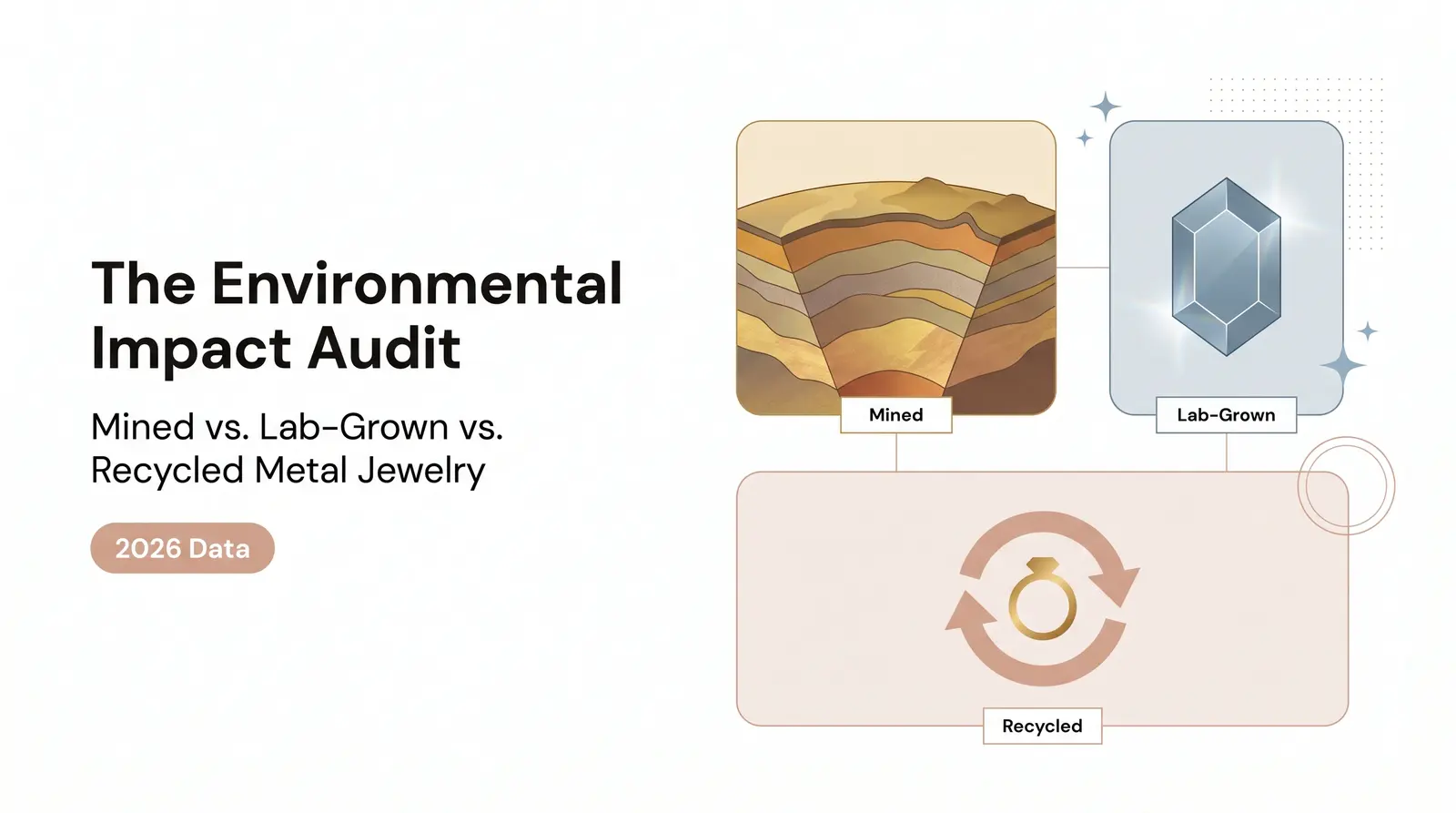
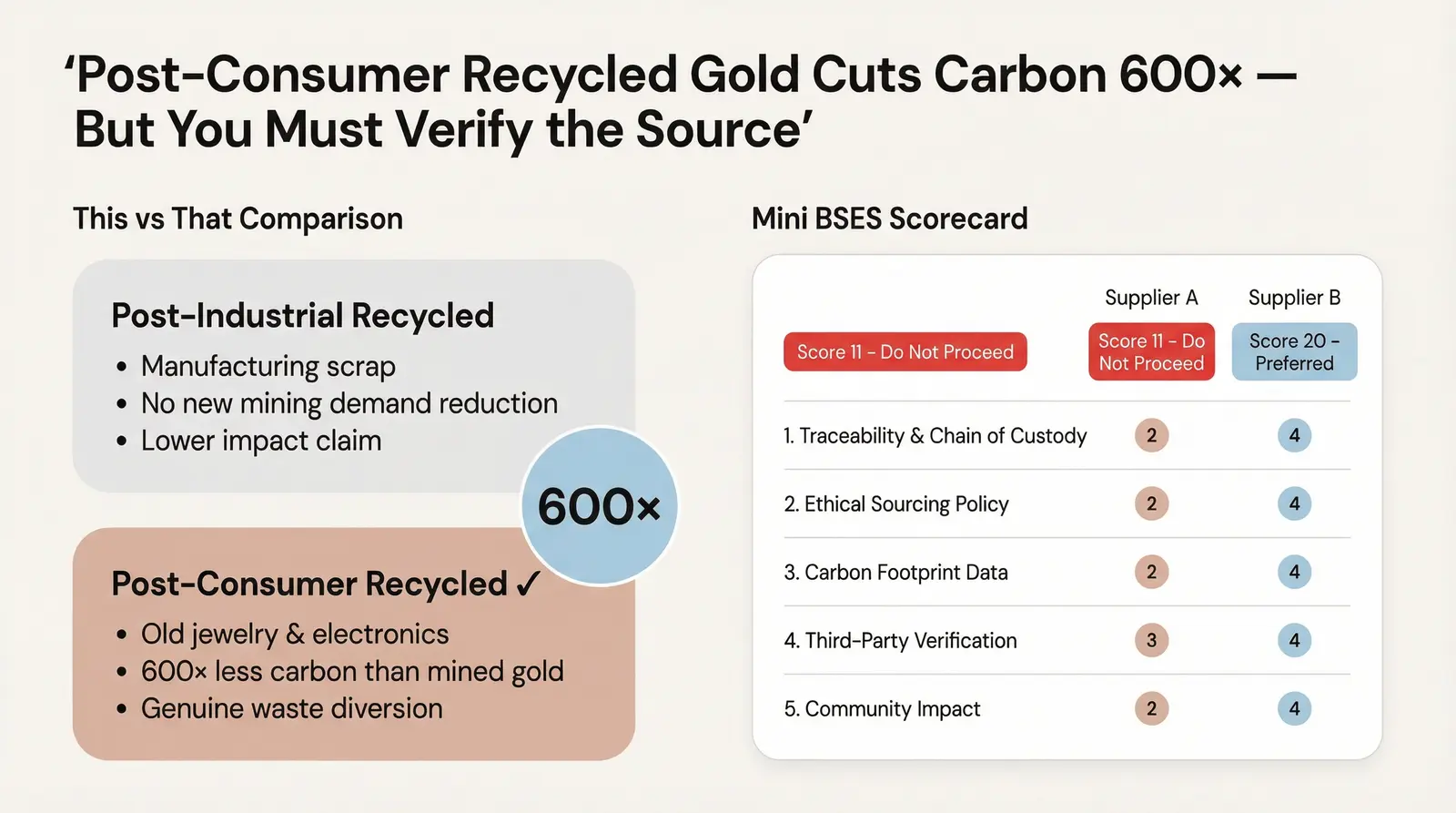
When evaluating materials, the distinction between post-industrial and post-consumer recycled metals is critical. Post-industrial recycled gold often comes from manufacturing scrap that is simply melted down and reused. While efficient, it does not reduce the demand for newly mined gold. Post-consumer recycled gold, derived from old jewelry or electronics, genuinely diverts waste and has a significantly lower carbon footprint. It generates approximately 600 times less carbon than newly mined gold [9].
For gemstones, the choice often lies between lab-grown stones, which have a smaller environmental footprint but require significant energy to produce, and ethically mined or reclaimed vintage stones. Sustainable packaging is also essential; look for FSC-certified paper, recycled plastics, and biodegradable materials to ensure your entire product lifecycle aligns with your values.
Worked Example: Applying the BSES Framework
Consider Sara, a founder launching a demi-fine jewelry brand. She evaluates two potential suppliers using the BSES framework:
| BSES Pillar | Supplier A (The "Eco" Factory) | Supplier B (The Transparent Partner) |
|---|---|---|
| Materials Traceability | 2 (Claims "recycled" but lacks proof) | 4 (Provides post-consumer recycled certificates) |
| Labor & Wage Standards | 2 (Pays minimum wage, no audits) | 4 (Living wage certified, annual third-party audits) |
| Environmental Practices | 3 (Basic water recycling) | 4 (Zero-discharge facility, strict chemical protocols) |
| Certifications & Compliance | 2 (Expired RJC certification) | 4 (Current RJC and SCS-007 certifications) |
| Transparency & Responsiveness | 2 (Hesitant to share factory photos) | 4 (Offered a virtual factory tour immediately) |
| Total Score | 11 (Do not proceed) | 20 (Preferred partner) |
Sara correctly chooses Supplier B, avoiding the greenwashing risks associated with Supplier A.
If navigating supplier vetting sounds like a full-time job, that's because it can be. Branvas pre-vets all manufacturing partners against our BSES framework so you don't have to start from zero. Explore how Branvas works.
Greenwashing is rampant in the jewelry industry. Protect your brand by watching for these common warning signs:
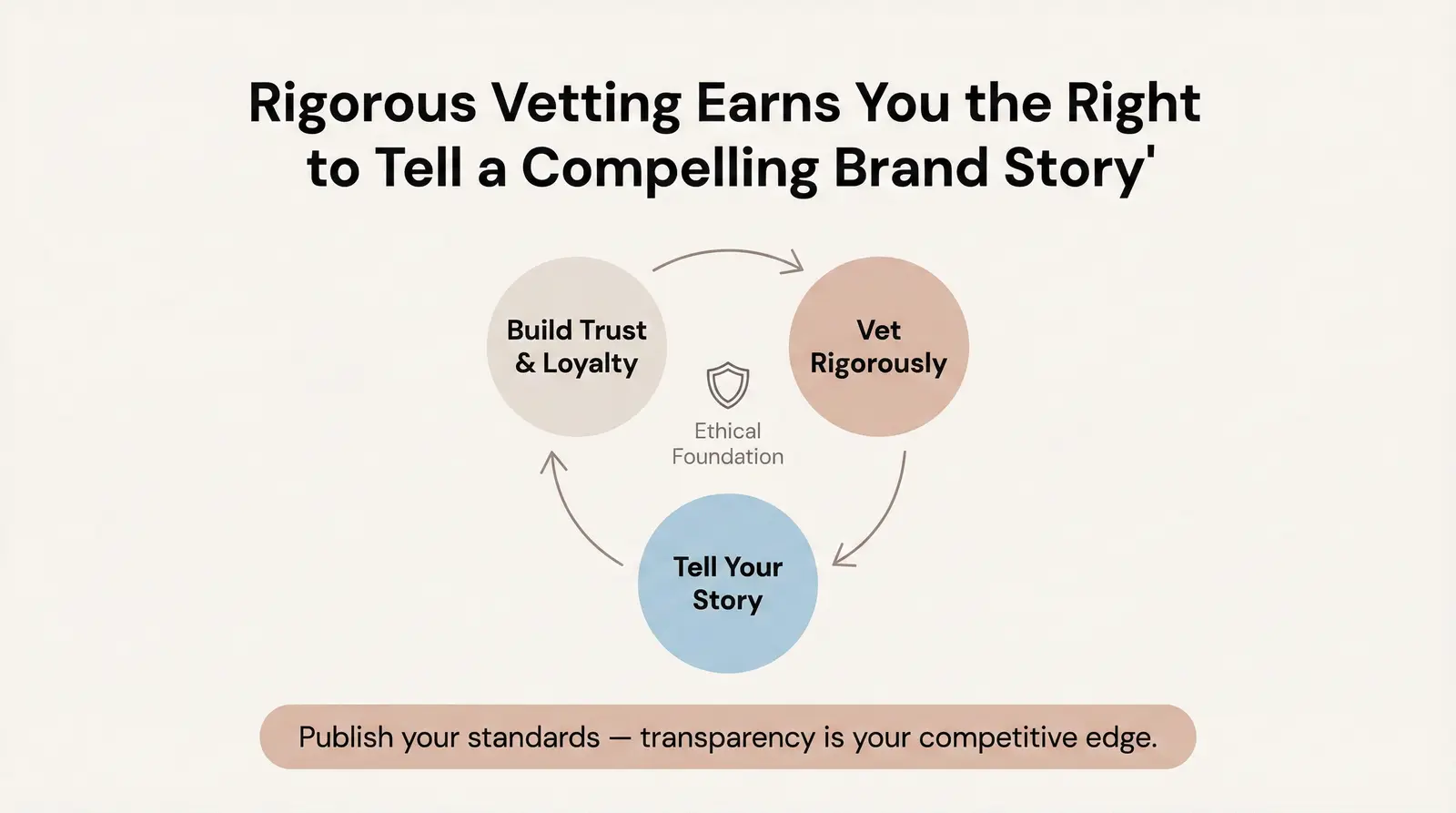
Ethical sourcing is more than a compliance exercise. It is the foundation of your brand's identity. When you commit to rigorous supplier vetting, you earn the right to tell a compelling, marketable story. Publishing your supplier standards and vetting process builds deep customer trust and loyalty in a crowded market.
For founders who want to move fast without compromising on values, Branvas offers private-label jewelry sourcing with built-in ethical standards, blind fulfillment, and full branding support. You focus on building your brand story while we handle the supply chain. See our catalog or learn how it works.
Ready to launch an ethical jewelry brand without the sourcing headache? Start with Branvas and let us handle supplier vetting, sourcing, and fulfillment. Lead with your values from day one.
What makes a jewelry supplier truly ethical?
A truly ethical jewelry supplier prioritizes transparency, fair labor practices, and environmental responsibility throughout their entire operation. They can trace their materials back to the source, ensure safe working conditions and fair wages for all employees, and actively minimize their environmental impact through sustainable practices and materials.
How do I verify a jewelry supplier's ethical certifications?
Do not take logos on a website at face value. Ask the supplier for their official certification documents and check the expiration dates. Furthermore, verify their status directly through the certifying organization's official website or database, such as the RJC or B Corp directories, to ensure the certification is current and valid.
What is recycled gold and is it really more sustainable?
Recycled gold is gold that has been previously refined and repurposed, reducing the need for new mining. It is significantly more sustainable, generating a fraction of the carbon emissions compared to newly mined gold. However, it is crucial to distinguish between post-consumer recycled gold (from old products) and post-industrial scrap, as post-consumer recycling has a more profound environmental benefit.
How do I avoid greenwashing when sourcing jewelry?
Avoid greenwashing by demanding specificity and proof. Be wary of vague claims like "eco-friendly" and insist on recognized third-party certifications. Ask detailed questions about their supply chain, request chain-of-custody documentation, and look for transparency; ethical suppliers will be eager to share their practices, while greenwashers will often be evasive.
Can small jewelry brands realistically source ethically on a tight budget?
Yes, small brands can source ethically, though it requires diligence. Start by defining strict non-negotiables and focusing on a few key materials, like certified recycled silver, which is often more accessible. Partnering with platforms like Branvas, which pre-vet suppliers, can also provide small brands with access to ethical supply chains without the massive overhead of independent auditing.