


Learn how jewelry brands can build credible sustainable sourcing practices across five key pillars to avoid greenwashing and drive long-term growth.
Published:
January 29, 2026
Author:
Yi Cui
"Sustainability is no longer a marketing angle — it's a baseline expectation. Jewelry brands that can clearly demonstrate responsible sourcing and ethical practices are the ones earning trust, loyalty, and long-term growth."
The jewelry industry, with its deep roots in mining and luxury, is under intense scrutiny. From the environmental devastation caused by unregulated mining to concerns over labor conditions and the sheer volume of waste, the entire supply chain is being questioned. The industry's proximity to the fast-fashion model, characterized by rapid trend cycles and disposable products, has only amplified the call for accountability. Consumers, armed with more information than ever, are demanding transparency and proof of ethical conduct, making sustainability a critical factor in their purchasing decisions.
However, "sustainability" in jewelry is not a simple yes-or-no question. It is a complex spectrum of commitments that spans material sourcing, manufacturing, packaging, and a product's end-of-life. There is no single finish line. Instead, it is a continuous journey of improvement, where brands must make conscious choices about where they can make the most meaningful impact. A brand’s position on this spectrum is becoming a defining element of its identity and a key differentiator in a crowded market.
This article will provide a clear framework for understanding this spectrum. It will help you, as a brand founder or entrepreneur, to assess where your business currently stands and identify concrete, actionable steps to move forward. By the end, you will have the tools to build a more responsible business, communicate your efforts with credibility, and turn your sustainability commitments into a powerful asset for building trust and driving growth.
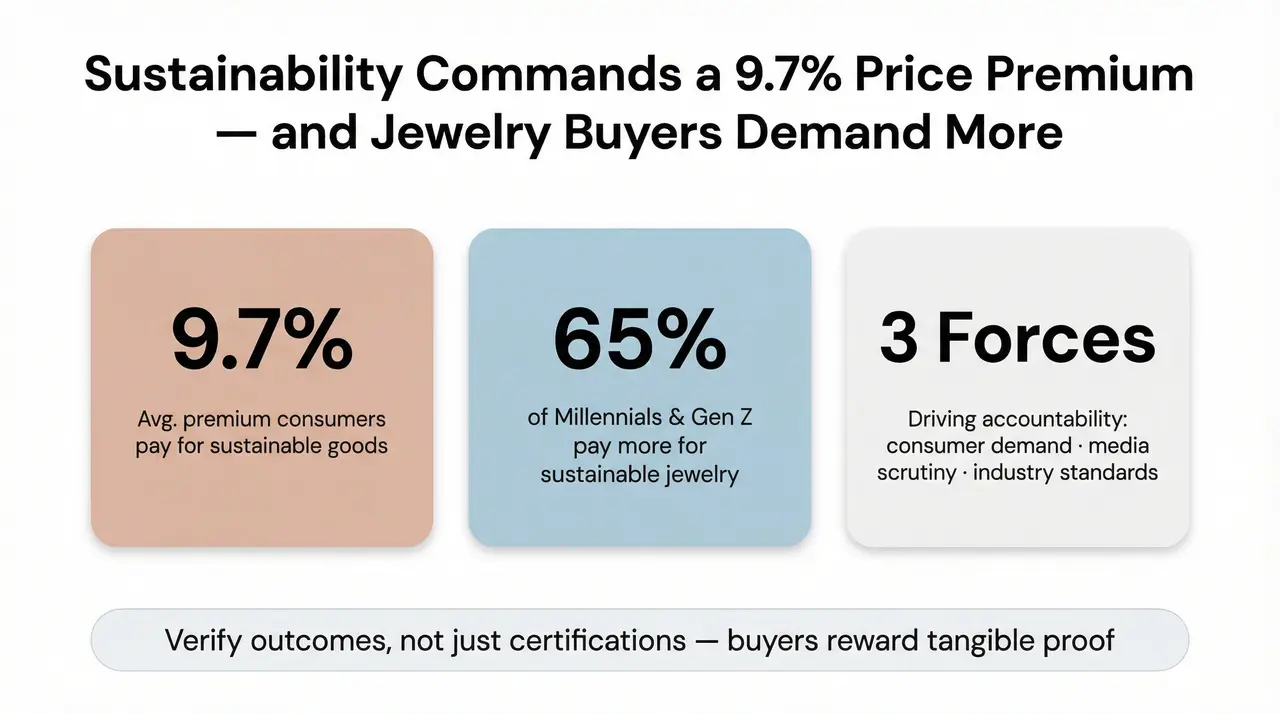
The shift toward sustainability is not just a trend. It is a fundamental reshaping of consumer values and market dynamics. For jewelry brands, understanding and adapting to this change is no longer optional. The demand for ethical and transparent sourcing is driven by a confluence of data-backed consumer behavior, widespread media coverage, and influential industry-wide initiatives. Recent data consistently shows that sustainability is a major factor in purchasing decisions, especially among younger consumers. According to a 2024 PwC survey, consumers are willing to pay an average premium of 9.7% for sustainably produced goods [1]. For jewelry, this sentiment is even more pronounced. A 2025 study highlighted that nearly 65% of Millennial and Gen Z customers are willing to pay more for sustainably sourced jewelry, demanding transparency beyond the traditional "4 Cs" of diamond quality [2]. This indicates a powerful market force that rewards brands that can substantiate their ethical claims.
The conversation is being amplified by relentless media coverage and social accountability. Documentaries exposing the harsh realities of artisanal mining and influencer-led campaigns calling out brands for "greenwashing" have made consumers highly skeptical of vague environmental claims. This has created a new standard of accountability where brands are expected to provide verifiable proof of their sourcing practices. Failure to do so can result in significant reputational damage and loss of consumer trust.
In response, the industry has developed several key initiatives to standardize responsible practices. Organizations like the Responsible Jewellery Council (RJC), Fairmined, and Fairtrade Gold have established frameworks for ethical sourcing and production. While imperfect, these certifications provide a baseline for accountability. The Kimberley Process Certification Scheme (KPCS), for example, was created to prevent the trade of conflict diamonds, though its limitations are now widely acknowledged. These frameworks, alongside emerging ESG (Environmental, Social, and Governance) standards, are pushing the entire industry toward greater transparency and responsibility.
Non-Obvious Insight: Many sustainability certifications are process-based, not outcome-based. This means a brand can be certified for having certain policies or procedures in place, but this doesn’t guarantee that their operations produce no harmful outcomes. For example, a certified facility might still generate significant waste or have a large carbon footprint. This distinction is critical because it highlights the "attitude-behavior gap," where consumer willingness to pay for sustainable goods doesn't always translate into actual purchases, especially when the perceived value or impact is unclear [3]. Brands must therefore focus on communicating tangible, outcome-driven results, not just the fact that they are certified.
Sustainability in the jewelry industry is not a monolithic concept. It is a multifaceted spectrum of practices and commitments. To build a genuinely responsible brand, it is essential to understand the five interconnected pillars that form the foundation of a credible sustainability strategy. Each pillar represents an opportunity to make a positive impact and build trust with your customers.
Material Sourcing
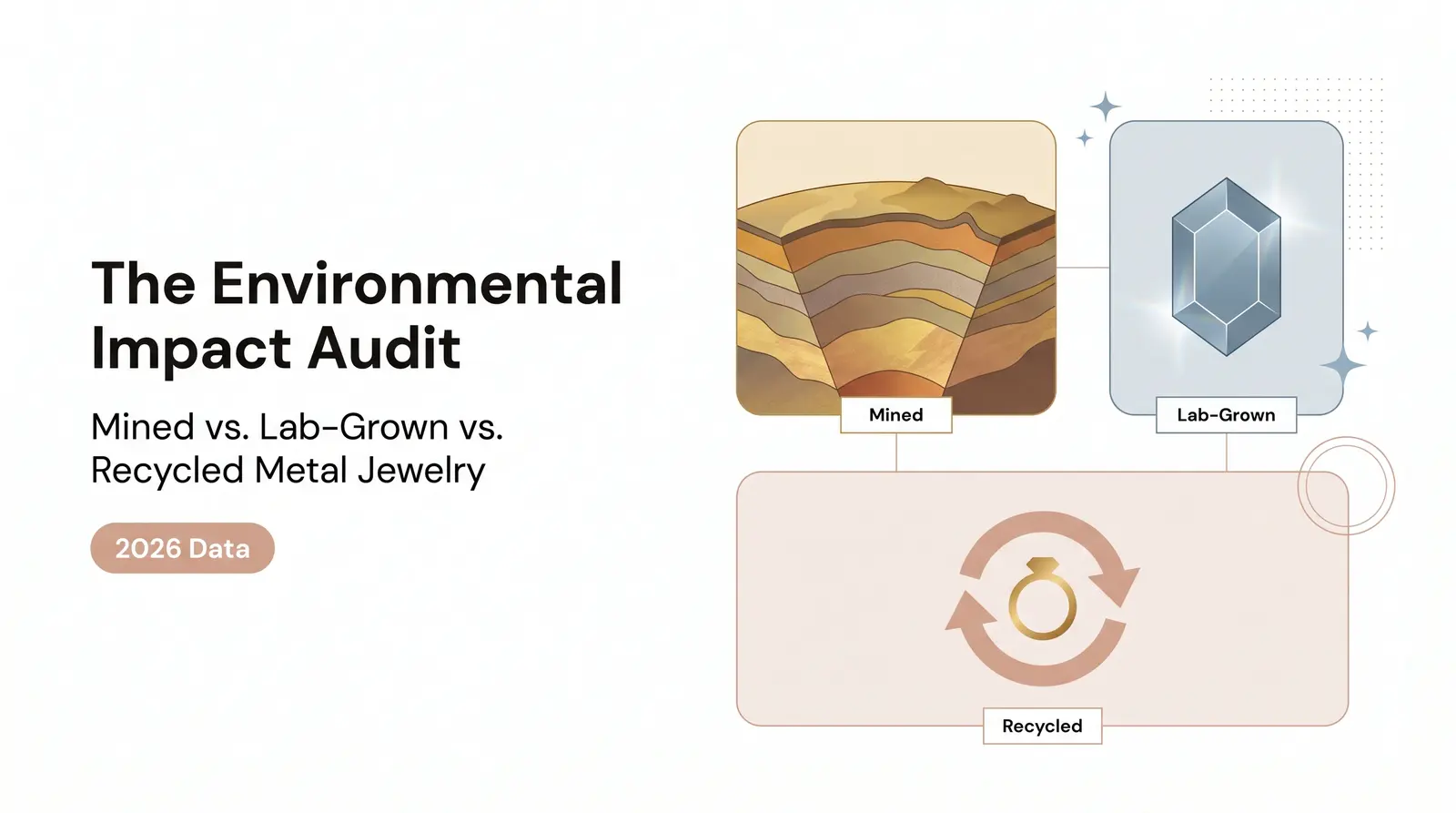
This is often the most scrutinized aspect of the jewelry supply chain. It involves the responsible acquisition of raw materials, including metals and gemstones. Key considerations include the use of recycled metals like gold, silver, and brass, which significantly reduces the environmental impact of mining. Verifying "recycled" claims is crucial and often requires documentation from suppliers certified by standards like the SCS Recycled Content Standard [4]. For gemstones, the debate between lab-grown versus mined continues, with lab-grown diamonds offering a conflict-free alternative with a smaller environmental footprint in terms of land use and carbon emissions, especially when produced with renewable energy [5]. For mined stones, certifications like the Kimberley Process for diamonds are a starting point, but true transparency requires a traceable supply chain that can verify the origin and journey of each stone.
Manufacturing Practices
Beyond the raw materials, the manufacturing process itself has a significant environmental and social footprint. This includes the energy consumed during casting, polishing, and finishing, as well as the management of chemical waste. For instance, traditional gold refining often uses cyanide, a highly toxic chemical. Responsible manufacturing involves implementing cleaner production techniques, reducing water usage, and ensuring that any chemical byproducts are treated and disposed of safely. Furthermore, it extends to social responsibility, including providing fair wages and ensuring safe working conditions for all employees. Regular factory audits by third-party organizations are essential to verify these practices.
Supply Chain Transparency
Transparency is the bedrock of a credible sustainability claim. It requires a willingness to disclose information about your suppliers and the entire chain of custody, from mine to market. This can be achieved through detailed vendor disclosure, where suppliers provide documentation of their own sourcing and labor practices. Chain-of-custody documentation tracks the journey of materials as they move through the supply chain. For brands seeking the highest level of assurance, third-party auditing provides independent verification of their claims. Emerging technologies like blockchain-based traceability platforms (e.g., Everledger, Provenance) are also offering new ways to create immutable records of a product's journey, providing an unprecedented level of transparency for consumers [6].
Packaging & Shipping
A brand's commitment to sustainability should extend to its packaging and shipping practices. This means moving away from single-use plastics and opting for materials that are recycled, recyclable, or biodegradable. Using FSC-certified boxes ensures that the paper comes from responsibly managed forests [7]. Other sustainable options include using recycled or biodegradable fill materials and minimizing the overall amount of packaging used. For shipping, offering carbon-neutral or offset shipping options allows brands to mitigate the environmental impact of logistics. These small but visible details can significantly reinforce a brand's sustainability message.
Product Lifecycle & Circularity
A truly sustainable approach considers the entire lifecycle of a product. This involves designing for longevity and durability, rather than catering to fleeting trends. It also means taking responsibility for a product at the end of its life. Implementing repair programs can extend the life of a piece of jewelry, while take-back or recycling schemes allow customers to return old pieces to be repurposed. This "circular" model, where materials are kept in use for as long as possible, represents a fundamental shift away from the linear "take-make-dispose" model of consumption and is a powerful way to demonstrate a deep commitment to sustainability.
Table 1: The Jewelry Sustainability Spectrum — Pillar-by-Pillar Action Matrix
| Pillar | Minimum Viable Commitment | Mid-Tier Best Practice | Gold Standard |
|---|---|---|---|
| Material Sourcing | Use some recycled metals (e.g., silver) in select collections. Ask suppliers for conflict-free assurances. | Feature collections made predominantly with certified recycled metals (gold, silver). Source gemstones from suppliers with documented origins. | Use 100% certified recycled or Fairmined/Fairtrade metals. Provide full traceability for all gemstones, using blockchain or third-party verification. |
| Manufacturing Practices | Work with suppliers who have a stated code of conduct for labor and environmental practices. | Conduct internal audits of key suppliers to verify working conditions and environmental management. | Achieve third-party certification for your manufacturing facilities (e.g., RJC, B Corp). Publish audit results and energy/water usage data. |
| Supply Chain Transparency | List your primary suppliers on your website. | Provide detailed information about your Tier 1 suppliers, including their locations and certifications. | Publish a full, transparent supply chain map, including Tier 1 and Tier 2 suppliers. Use blockchain for chain-of-custody verification. |
| Packaging & Shipping | Use recyclable packaging and avoid excess plastic. | Use 100% recycled and/or FSC-certified packaging. Offer carbon-neutral shipping options. | Implement plastic-free packaging for all products. Use compostable mailers and offer a packaging take-back program. |
| Product Lifecycle & Circularity | Offer a repair service for your products. | Design for durability and offer a lifetime warranty. Launch a take-back program for old jewelry to be recycled. | Operate a full circular model with repair, refurbishment, and resale programs. Publish an annual circularity report. |

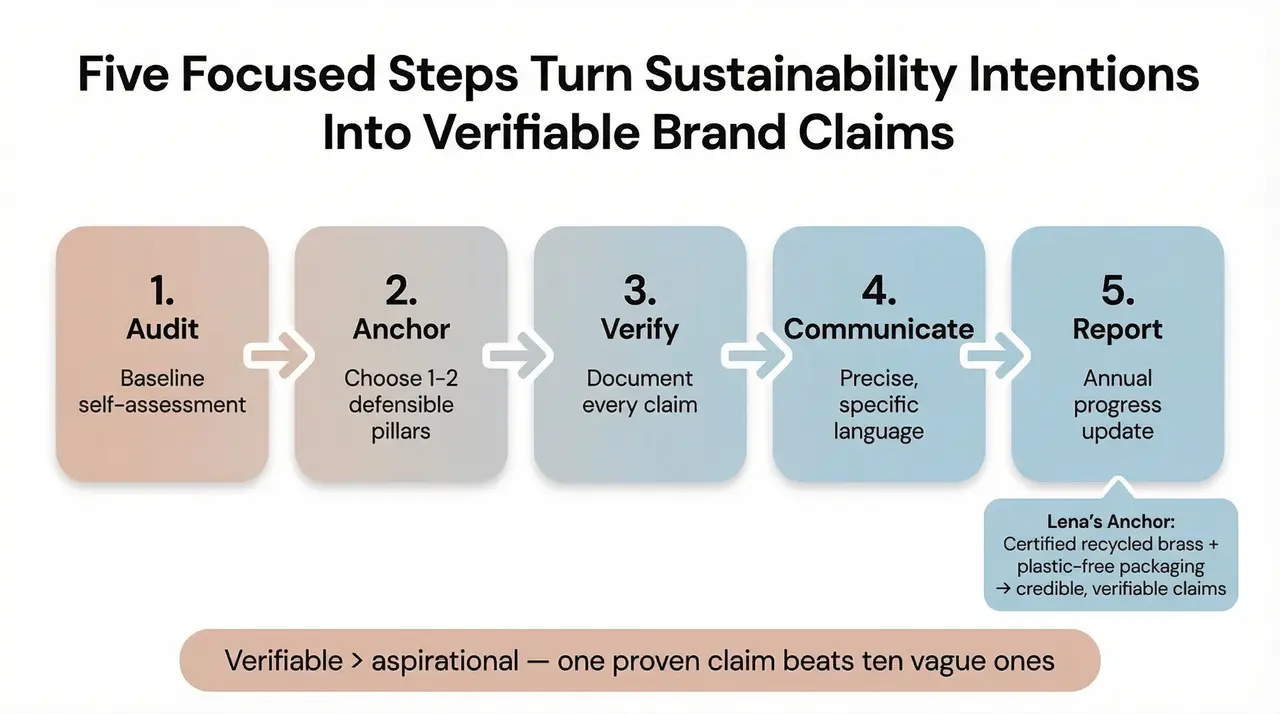
Navigating the complexities of sustainability can be daunting for any brand, especially for emerging entrepreneurs. To provide a clear path forward, we’ve developed the Branvas Sustainability Alignment Framework (BSAF). This five-step decision system is designed to help you assess your current position, define an authentic strategy, and communicate your commitments with credibility.
Step 1: Audit Your Starting Point
Before you can move forward, you need to know where you stand. Conduct a thorough inventory of your current materials, suppliers, and packaging. Use the "Minimum Viable Commitment" column in Table 1 as a checklist to perform a self-audit. Honestly assess each of the five pillars and give yourself a score. This initial audit will reveal your strengths and, more importantly, highlight the areas where you have the most significant opportunities for improvement. This is not about judgment; it is about establishing a baseline.
Step 2: Identify Your Brand's Sustainability Anchor
Trying to be perfect across all five pillars from day one is a recipe for failure and a common greenwashing trap. Instead, choose one or two pillars that are most authentic and defensible for your brand to serve as your "sustainability anchor." For a fine jewelry brand, this might be a commitment to using only certified recycled gold and providing full gemstone traceability. For a fashion-accessories brand, the anchor might be innovative, plastic-free packaging and a robust product take-back program. The key is to focus your efforts where you can make a genuine, verifiable impact that aligns with your brand’s core identity.
Step 3: Source Verifiably, Not Aspirationally
Your sustainability claims are only as strong as the evidence that backs them up. Make claims that you can document and prove. Understand the critical difference between a verifiable claim like, "Our earrings are cast in 100% certified recycled brass," and a vague, risky statement like, "We are a sustainable brand." Work with suppliers who can provide the necessary documentation, such as SCS certifications for recycled content or chain-of-custody records for gemstones. If a supplier cannot verify their claims, you cannot responsibly pass those claims on to your customers.
Step 4: Communicate With Precision
Once you have verifiable claims, communicate them with clarity and precision. Avoid generic, unsubstantiated adjectives like "eco-friendly" or "green." Instead, use specific language that is supported by your evidence. Create a dedicated sustainability page on your website where you can detail your commitments, list your certifications, and even name your key suppliers. Use percentages, data, and stories to bring your efforts to life. This level of transparency builds trust and demonstrates that your commitment to sustainability is more than just marketing.
Step 5: Iterate and Report
Sustainability is not a one-time achievement. It is a process of continuous improvement. Use your initial audit as a benchmark and set clear, achievable goals for the year ahead. At the end of the year, report on your progress. Even small brands can do this effectively through a blog post, a social media series, or an update to their sustainability page. Be transparent about your successes and your challenges. This ongoing dialogue shows that you are committed to the journey and reinforces your brand's authenticity.
Worked Example:
Lena, a beauty influencer, decides to launch her own private-label jewelry line through Branvas. Using the BSAF, she first audits her potential starting point. She realizes that claiming full traceability on a wide range of gemstones would be difficult to verify initially. Instead, she decides to anchor her brand on two strong, defensible pillars: (a) using certified recycled brass for all her plated pieces and (b) committing to 100% plastic-free packaging. She works with Branvas to ensure her suppliers provide SCS certification for the recycled brass and that all her branded boxes and mailers are made from FSC-certified, recycled materials. On her website, she doesn’t make a sweeping claim of being a "100% sustainable brand." Instead, her sustainability page clearly states: "Our collection is crafted from certified 100% recycled brass, and we ship every order in beautiful, plastic-free packaging." This precise, verifiable claim is far more credible and builds more trust than a vague, all-encompassing statement."In our experience at Branvas, the founders who build the most durable brand reputations aren't necessarily the ones who claim to do everything right — they're the ones who pick two or three sustainability commitments they can genuinely stand behind and communicate them with evidence."
Greenwashing is the act of making false or misleading claims about the environmental benefits of a product, service, or company. In the jewelry industry, this can take many forms: loosely using the term "recycled" without any documentation, claiming a piece is "ethical" without providing supply chain transparency, or using nature-inspired imagery in marketing without any substantive sustainable practices to back it up. As consumers become more educated and skeptical, the reputational risk of being accused of greenwashing has become a significant threat that no brand can afford to ignore.
The legal landscape around environmental claims is also tightening. In the United States, the Federal Trade Commission's (FTC) Green Guides provide a framework for what constitutes deceptive environmental marketing, and the agency is expected to release updates that will further strengthen these regulations [8]. Similarly, the European Union is advancing its Green Claims Directive, which will require companies to substantiate their environmental claims with verifiable evidence [9]. In the UK, the Advertising Standards Authority (ASA) is actively cracking down on brands making unsubstantiated "green" claims. These regulatory developments mean that greenwashing is no longer just a reputational risk; it is a legal and financial one.
The consequences of being caught greenwashing can be severe. They range from consumer boycotts and social media pile-ons that can tarnish a brand's reputation overnight to formal enforcement actions by regulatory bodies like the FTC, which can result in significant fines and mandated changes to marketing practices. For an emerging brand, a greenwashing scandal can be an existential threat, eroding the trust that is so critical to building a loyal customer base.
To avoid these pitfalls, it is essential to conduct a simple "greenwashing audit" of your own brand communications. Review your website, product descriptions, and social media content. Ask yourself: Are we using vague, undefined terms like "eco-friendly," "green," or "conscious"? Can we provide specific, verifiable evidence for every sustainability claim we make? If the answer is no, it is time to revise your language to be more precise and transparent.
Non-Obvious Insight: The most common form of greenwashing in the jewelry industry is not intentional fraud. It is often the result of founders unknowingly repeating the unsubstantiated claims of their suppliers. Many suppliers will describe their metals as "recycled" or their gems as "ethically sourced" without providing any documentation to back it up. However, the legal and reputational responsibility for these claims rests with the brand that makes them to the public, not the supplier who whispered them in private. It is your responsibility to verify every claim before you make it.

For jewelry brands committed to sustainability, third-party certifications and industry initiatives provide a valuable way to verify claims and signal trust to consumers. While no single certification is a silver bullet, understanding the most credible standards is essential for building a responsible supply chain. Here is a practical overview of the key players and what they cover.
Responsible Jewellery Council (RJC): The RJC is one of the most comprehensive certification bodies in the jewelry and watch industry. Its Code of Practices (COP) standard audits businesses against stringent requirements for business ethics, human rights, social performance, and environmental management [10]. RJC certification is relevant for all players in the supply chain, from mining companies to retailers. However, its limitations include the fact that it is a process-based standard, meaning it certifies that a company has the right systems in place but does not guarantee that its outcomes are sustainable. It is also a complex and costly certification, which can make it challenging for smaller, emerging brands to achieve.
Fairmined / Fairtrade Gold: These two certifications focus specifically on artisanal and small-scale mining (ASM) operations, ensuring that miners receive a fair price for their gold, work in safe conditions, and follow environmental best practices. Fairmined is an initiative of the Alliance for Responsible Mining, and it offers a premium to miners for gold that is extracted under strict social and environmental standards. It also offers an "Ecological Gold" certification for gold mined without the use of any toxic chemicals [11]. Fairtrade Gold operates on a similar model, providing a minimum price and a premium to mining communities to invest in their development. The key difference lies in their operational structures and the specific standards they enforce, but both represent a powerful way to support the most vulnerable actors in the supply chain.
Kimberley Process Certification Scheme (KPCS): The KPCS was established to prevent the trade of "conflict diamonds," meaning rough diamonds used by rebel movements to finance wars against legitimate governments. While it has had some success, the KPCS has faced significant criticism for its narrow definition of conflict, which does not include human rights abuses, violence, or environmental degradation outside the context of rebel movements [12]. Its state-led, consensus-based structure has also made it slow to reform. As a result, while KPCS certification is a legal requirement for the international trade of rough diamonds, it is no longer considered a sufficient guarantee of ethical sourcing by many consumers and civil society groups.
B Corp Certification: B Corp certification is a holistic standard that measures a company’s entire social and environmental performance, from its supply chain and materials to its employee benefits and community engagement. It is not specific to the jewelry industry, but it provides a powerful signal that a brand is committed to using business as a force for good. The rigorous verification process, conducted by the non-profit B Lab, makes B Corp certification a highly credible and respected mark of a truly responsible business [13].
SCS Global Services / Rainforest Alliance: These organizations offer a range of third-party verification and certification services that can be applied to the jewelry supply chain. SCS Global Services, for example, provides the SCS Recycled Content Standard, which is used to verify that a product is made from 100% recycled materials [4]. They also offer a Sustainability Rated Diamond certification that applies to both natural and lab-grown diamonds. These specific, claim-based certifications can be a more accessible and targeted way for emerging brands to verify their sustainability claims without undergoing a full-system audit like RJC or B Corp.
Emerging Blockchain/Traceability Platforms: A new generation of technology platforms is using blockchain to bring unprecedented transparency to the jewelry supply chain. Companies like Provenance and Everledger allow brands to create a secure, digital record of a product’s journey, from the mine to the consumer. This technology makes it possible to track every transaction and transfer of ownership, providing a verifiable chain of custody that can substantiate claims of ethical and responsible sourcing [6].
For an emerging brand, the key is to choose certifications that are both credible and realistic for your scale of operations. Starting with a specific claim-based certification, like SCS Recycled Content, can be a powerful first step.

A credible sustainability strategy is not just a defensive measure to mitigate risk; it is a powerful engine for brand growth. By embedding transparency and ethical practices into your business, you can build deep and lasting connections with your customers, command premium pricing, and unlock new opportunities for partnerships and press coverage.
Sustainability storytelling is at the heart of this strategy. When you can share the authentic story behind your products—where the materials came from, who made them, and how you are minimizing your environmental impact—you transform a simple transaction into an emotional connection. This is what builds brand equity and drives repeat purchases. A dedicated transparency page on your website, a "meet our suppliers" content series, or a simple annual impact report can all be powerful tools for this kind of storytelling, even for a small brand.
This values alignment also helps you attract the right audience. In a world of endless choice, consumers are increasingly drawn to brands that reflect their own values. By taking a clear and verifiable stance on sustainability, you are not just acquiring customers; you are building a community of like-minded individuals who are invested in your brand’s success. This community becomes your most powerful marketing asset, driving word-of-mouth referrals and defending your brand against criticism.
Furthermore, a strong and verifiable sustainability position gives you pricing power. When you can clearly demonstrate the added value of your ethical sourcing and responsible manufacturing, you can justify a premium price. Consumers are willing to pay more for products they can trust, but that trust must be earned through transparency and evidence [1]. This allows you to move beyond competing on price alone and instead compete on the strength of your brand and the integrity of your products.
Finally, a credible sustainability strategy opens doors to new partnerships. Curated sustainable marketplaces, both online and offline, are actively seeking out brands with a proven commitment to ethical practices. Sustainability-focused media outlets and influencers are also more likely to feature brands that have a compelling and verifiable story to tell. These opportunities can provide a significant boost in visibility and credibility, helping you reach a wider audience of conscious consumers.
"If you're building a jewelry brand from scratch and want sourcing and packaging that you can actually stand behind, Branvas is designed to give founders a vetted starting point — so you're not making blind claims about supply chains you've never seen."

In practice, it means making conscious, verifiable choices about where your materials come from. This includes prioritizing certified recycled metals, sourcing gemstones from suppliers who can document their origin and labor practices, and working with manufacturing partners who are committed to minimizing their environmental impact and providing safe, fair working conditions. It is about moving beyond aspirational claims and focusing on tangible, provable actions.
The key is to start small and be strategic. Use the BSAF framework to identify one or two "anchor" commitments that are authentic to your brand. This could be as simple as committing to 100% plastic-free, recycled packaging or launching a single collection made from certified recycled silver. The goal is not to be perfect overnight but to take a credible first step and build from there.
Both are excellent certifications that support artisanal and small-scale miners, but they have slightly different models. Fairmined, an initiative of the Alliance for Responsible Mining, sets a standard and a premium for gold mined under strict environmental and social criteria, and even offers an "Ecological Gold" standard for gold mined without chemicals. Fairtrade Gold also guarantees a minimum price and a premium to miners, which is then invested in community projects. Both are highly credible, and the choice often depends on the specific sourcing relationships a brand is able to build.
It is a complex question with no simple answer, as "sustainability" is a spectrum. Lab-grown diamonds generally have a smaller environmental footprint in terms of land use and water consumption. When produced using renewable energy, their carbon footprint can also be significantly lower than that of mined diamonds. However, the energy intensity of diamond synthesis is a key factor. Mined gemstones, when sourced from responsible, certified operations like Fairmined, can provide vital livelihoods for artisanal mining communities. The most sustainable choice depends on a brand’s specific values and priorities.
The best way to avoid greenwashing is to be precise and honest. Never use vague terms like "eco-friendly" or "green" without specific, verifiable proof. If you claim your gold is recycled, be prepared to show the certification. If you claim your gems are ethically sourced, be able to document their origin. Build a dedicated sustainability page on your website to explain your commitments in detail. Transparency is your best defense against accusations of greenwashing.
The journey toward sustainability in the jewelry industry is a marathon, not a sprint. It is a path of continuous improvement, where every step forward, no matter how small, contributes to a more responsible and transparent future. The idea that sustainability is a binary, pass/fail test is a myth. Instead, it is a spectrum of choices and commitments, and the most successful brands will be those that find their authentic place on that spectrum and communicate it with honesty and evidence.
For founders and entrepreneurs, this is not a burden to be feared but an opportunity to be embraced. By reframing sustainability as a core pillar of your brand identity, you can transform it from a compliance exercise into a powerful asset for building trust, fostering community, and driving long-term growth. In a market where consumers are increasingly voting with their values, a credible commitment to ethical and responsible practices is the ultimate competitive advantage.
"Ready to build a jewelry brand on a foundation you can be proud of? Explore how Branvas works — from vetted product sourcing to branded, plastic-free packaging — and launch with credibility from day one. See the Branvas catalog or talk to our team to get started."