TL;DR
If you are looking for low-cost business ideas with high profit potential in 2026, the answer is not a single idea. It is a framework for evaluating them. Here is what this guide covers:
- "High margin" is not the same as "high profit." A 70% gross margin business with heavy ad spend can net less than a 40% gross margin service business. Net margin is what actually matters.
- Private-label jewelry is our top pick for inventory-free founders. It offers 55%–80% gross margins, zero inventory requirements, and strong brand-building potential.
- You can start a real business for under $500. The key is substituting financial capital with sweat equity, especially in the early months.
- Private-label product brands let you launch a branded business without manufacturing anything yourself, using platforms that handle sourcing, packaging, and fulfillment.
- The LCHM Filter is a proprietary Branvas framework introduced in this guide to help you score any business idea across five criteria before you commit.
What Makes a Business "Low-Cost, High-Margin"? (The LCHM Filter)
At Branvas, we built the LCHM Filter after seeing hundreds of aspiring founders pick ideas based on "what sounds cool" rather than what the unit economics actually support. The result was always the same: six months of effort, a few hundred dollars spent, and a business that looked great on paper but barely covered its own costs.
The Low-Cost, High-Margin (LCHM) Filter is a 5-criteria scoring model we use internally to evaluate business ideas for aspiring founders. Each criterion is scored from 1 to 5, with 5 representing the best possible outcome.
- Startup Capital Required: How much cash do you need before your first sale? Lower cost earns a higher score.
- Gross Margin Potential: What percentage of revenue remains after the cost of goods sold? Higher margin earns a higher score.
- Time-to-First-Sale: How quickly can you realistically generate revenue? Faster earns a higher score.
- Inventory / Overhead Risk: Are you forced to hold stock or pay fixed monthly costs before you earn a dollar? Lower risk earns a higher score.
- Brand Differentiation Ceiling: How much can you build a real, defensible brand versus competing purely on price? Higher brand potential earns a higher score.
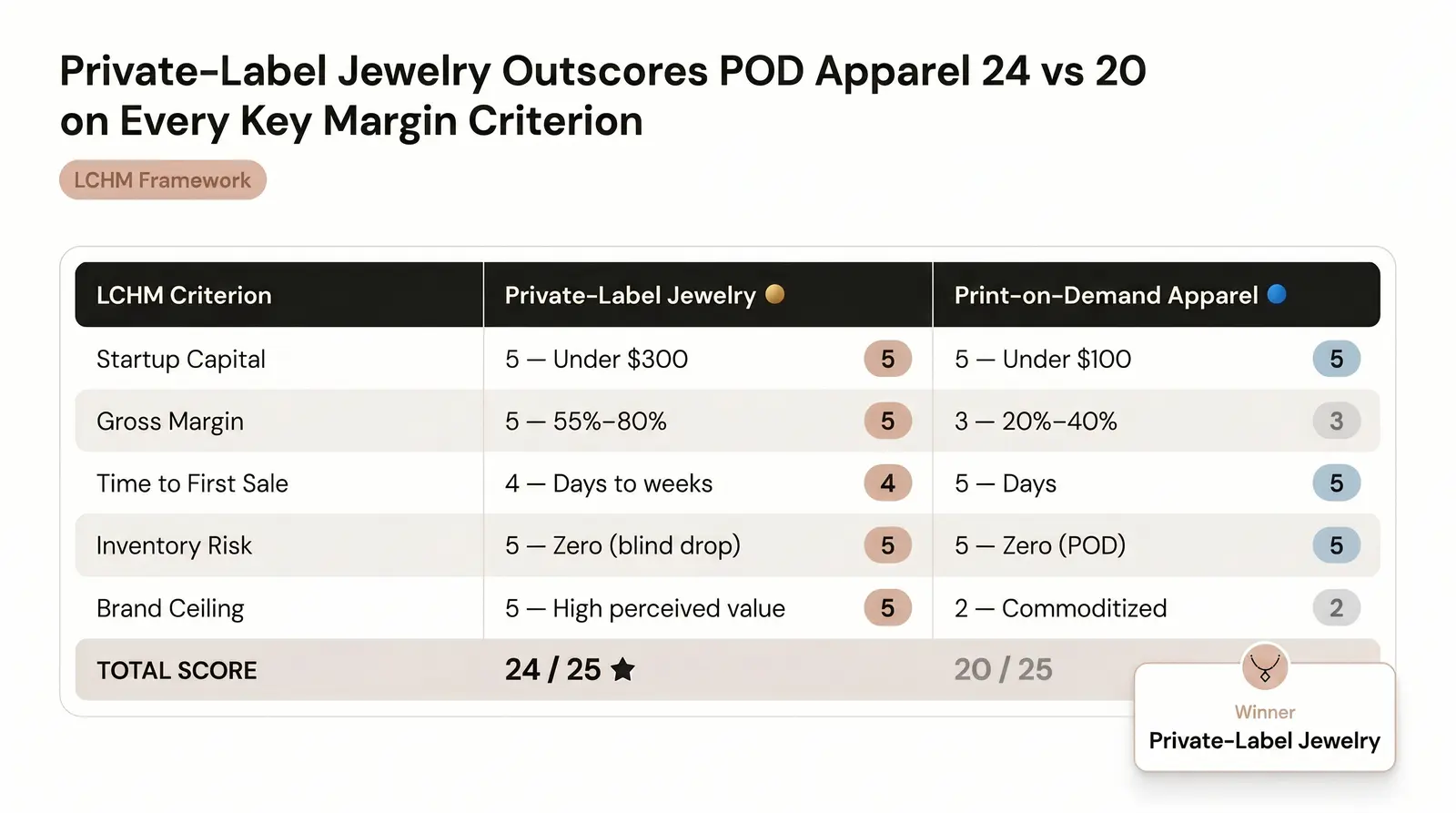
To show this framework in action, here is a side-by-side comparison of two popular inventory-free product models: private-label jewelry and print-on-demand (POD) apparel.
| LCHM Criterion |
Private-Label Jewelry |
Print-on-Demand Apparel |
| Startup Capital Required |
5 (Can launch for under $300) |
5 (Can launch for under $100) |
| Gross Margin Potential |
5 (Typically 55%–80%) |
3 (Typically 20%–40%) |
| Time-to-First-Sale |
4 (Days to weeks) |
5 (Days) |
| Inventory / Overhead Risk |
5 (Zero with blind dropshipping) |
5 (Zero with POD) |
| Brand Differentiation Ceiling |
5 (High perceived value, custom packaging) |
2 (Highly commoditized, hard to differentiate) |
| Total LCHM Score |
24 / 25 |
20 / 25 |
Print-on-demand is genuinely accessible, and its near-zero startup cost is a real advantage. But it struggles with margin compression and brand differentiation. Private-label jewelry, by contrast, allows you to build a premium brand with much healthier unit economics and a much higher ceiling for long-term growth.
20 Low-Cost Business Ideas With High Profit Margins
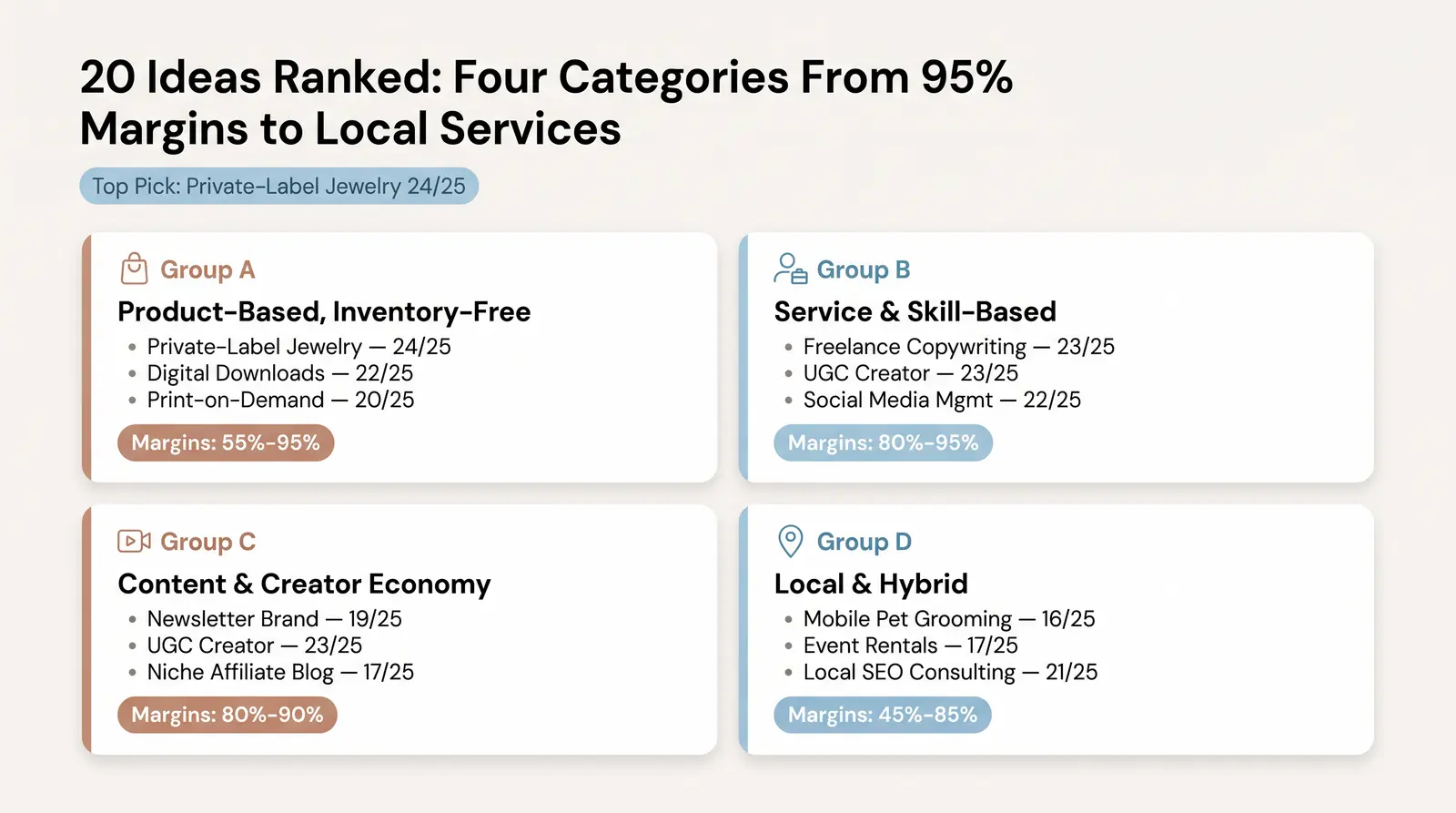
The following 20 ideas are grouped into four categories. Each includes a structured profile covering startup cost, gross margin, time to first sale, LCHM score, a genuine insight on why it works, and one honest risk to watch for.
Group A: Product-Based, Inventory-Free
1. Private-Label Jewelry Brand
- Startup Cost: $150 – $500
- Realistic Gross Margin: 55%–80%
- Time to First Sale: 7–14 days
- LCHM Filter Score: 24/25
- Why It Works: Jewelry carries an exceptionally high perceived value relative to its manufacturing cost. It is lightweight, cheap to ship, has no sizing issues like apparel, and performs extremely well on visual platforms like TikTok and Instagram. The global online jewelry market is projected to grow at a CAGR of 18.7% from 2025 to 2030, according to Technavio, making this a high-growth category with room for new entrants [5].
- Watch Out For: Customer acquisition cost (CAC). Because the market is competitive, you must build organic social media traction or a strong brand aesthetic before scaling with paid ads. Paid ads on low average order values can erode margins quickly.
If you source 50 units of a gold-plated necklace at $8 per unit landed cost and sell at $38, your gross margin is approximately 79%. With Branvas's blind fulfillment, you never touch inventory. Platforms like Branvas make this model accessible with no minimum order quantity (MOQ) requirements and custom branding from day one. Curious what your margins could look like? Try the Branvas Profit Calculator to model your numbers before you commit.
See also: How to Start a Jewelry Store With $300
2. Print-on-Demand Apparel
- Startup Cost: $50 – $200
- Realistic Gross Margin: 20%–40%
- Time to First Sale: 3–7 days
- LCHM Filter Score: 20/25
- Why It Works: You design a graphic, upload it to a POD provider, and they print and ship it when a customer buys. It is the ultimate zero-inventory way to test creative concepts and build a niche community brand.
- Watch Out For: Razor-thin margins. After platform fees, ad costs, and the base cost of the garment, net profit is often in the single digits unless you have a large organic audience driving traffic.
3. Digital Downloads and Printables
- Startup Cost: $0 – $100
- Realistic Gross Margin: 80%–95%
- Time to First Sale: 7–30 days
- LCHM Filter Score: 22/25
- Why It Works: You create the product once (a Notion template, a wedding planner PDF, or digital art) and sell it an unlimited number of times. The only recurring costs are your time and platform fees. Digital product margins regularly exceed 80%, making this one of the highest-margin business models available to anyone with a computer.
- Watch Out For: High competition and platform algorithm reliance. You must optimize your listings precisely to be discovered in saturated marketplaces like Etsy.
4. Dropshipping Niche Products
- Startup Cost: $200 – $1,000
- Realistic Gross Margin: 30%–50%
- Time to First Sale: 14–30 days
- LCHM Filter Score: 18/25
- Why It Works: You can sell physical goods without holding inventory. By targeting a hyper-specific niche (e.g., ergonomic office accessories for remote workers), you can reach a passionate audience willing to pay a premium.
- Watch Out For: Shipping times and quality control. Relying on overseas suppliers can lead to weeks-long delivery windows and customer service challenges that damage your brand reputation.
5. Private-Label Skincare and Beauty
- Startup Cost: $500 – $1,500
- Realistic Gross Margin: 50%–70%
- Time to First Sale: 30–60 days
- LCHM Filter Score: 19/25
- Why It Works: The beauty industry runs on branding, not formulas. White-label manufacturers allow you to put your brand on pre-formulated serums, lip glosses, or moisturizers with significant markup potential. Private-label skincare can yield 50% to 70% margins when priced correctly.
- Watch Out For: Higher initial capital requirements for sample testing, label design, and minimum order quantities compared to jewelry or digital products.
6. Phone Case and Tech Accessories Brand
- Startup Cost: $100 – $300
- Realistic Gross Margin: 40%–60%
- Time to First Sale: 7–14 days
- LCHM Filter Score: 20/25
- Why It Works: Phone cases are impulse purchases. They are cheap to source via POD or dropshipping, easy to ship, and allow for endless creative designs targeted at specific fandoms, aesthetics, or professions.
- Watch Out For: Constant hardware updates. You must refresh your product lineup with every new iPhone or Android release to stay relevant.
Group B: Service and Skill-Based
7. Freelance Copywriting and Content Writing
- Startup Cost: $0 – $100
- Realistic Gross Margin: 90%+
- Time to First Sale: 14–30 days
- LCHM Filter Score: 23/25
- Why It Works: Every business needs words: emails, landing pages, ads, and product descriptions. If you can write copy that converts, you can charge premium project rates with virtually zero overhead. This is one of the best cheap business ideas to start for anyone with strong writing skills.
- Watch Out For: Client acquisition. You are trading time for money, and finding high-paying clients requires consistent cold outreach and portfolio building.
- Startup Cost: $50 – $200
- Realistic Gross Margin: 80%+
- Time to First Sale: 14–30 days
- LCHM Filter Score: 22/25
- Why It Works: Local businesses and e-commerce brands need a presence on TikTok and Instagram but lack the time or expertise. You provide a recurring monthly service, which means predictable income.
- Watch Out For: Scope creep. Clients often expect 24/7 community management and daily content creation for a flat fee. Set clear deliverables and boundaries from day one.
9. Online Tutoring and Coaching
- Startup Cost: $0 – $150
- Realistic Gross Margin: 90%+
- Time to First Sale: 7–14 days
- LCHM Filter Score: 21/25
- Why It Works: If you have specialized knowledge in SAT prep, coding, fitness, or any in-demand skill, you can monetize it over Zoom. It is highly flexible and requires no physical location.
- Watch Out For: The income ceiling. You only have so many hours in a week, which limits your maximum revenue until you transition to group coaching or recorded courses.
10. Bookkeeping and Virtual CFO Services
- Startup Cost: $200 – $500
- Realistic Gross Margin: 70%–85%
- Time to First Sale: 30–60 days
- LCHM Filter Score: 20/25
- Why It Works: Small businesses consistently struggle with cash flow management and financial reporting. Providing virtual financial services generates incredibly sticky, high-retention monthly recurring revenue.
- Watch Out For: The requirement for precision and, often, formal certifications or software proficiency in tools like QuickBooks or Xero.
11. Freelance Graphic Design
- Startup Cost: $50 – $300
- Realistic Gross Margin: 85%+
- Time to First Sale: 14–30 days
- LCHM Filter Score: 21/25
- Why It Works: Visual branding is non-negotiable for modern businesses. From logos to social media assets, skilled designers can build a lucrative client base with strong repeat business.
- Watch Out For: AI disruption. Basic design tasks are being automated, so you must focus on high-level brand strategy and complex creative work to justify premium rates.
12. Resume and LinkedIn Profile Writing
- Startup Cost: $0 – $50
- Realistic Gross Margin: 95%
- Time to First Sale: 7–14 days
- LCHM Filter Score: 22/25
- Why It Works: Job seekers will pay for a competitive edge. It is a highly systematized service you can deliver quickly once you have templates and processes in place.
- Watch Out For: One-off transactions. Unlike social media management, clients rarely need a new resume monthly, so you must maintain a constant pipeline of new leads.
Group C: Content and Creator Economy
- Startup Cost: $50 – $200
- Realistic Gross Margin: 80%–90%
- Time to First Sale: 60–90 days (via sponsorships)
- LCHM Filter Score: 19/25
- Why It Works: You own your audience, which is the most defensible asset in media. By curating valuable, niche-specific content, you can monetize via sponsorships, premium subscriptions, or affiliate links.
- Watch Out For: The slow grind. Building an engaged subscriber base takes months of consistent, high-quality writing before any meaningful revenue appears.
14. YouTube and Short-Form Content Creator
- Startup Cost: $0 – $500
- Realistic Gross Margin: 80%+
- Time to First Sale: 90–180 days
- LCHM Filter Score: 18/25
- Why It Works: The creator economy is projected to reach $234 billion in 2026, according to Exploding Topics. Monetization comes from AdSense, brand deals, and affiliate marketing, making it a highly scalable, long-term asset.
- Watch Out For: Algorithm volatility and burnout. You are at the mercy of platform changes and must produce content consistently to maintain growth.
15. UGC (User-Generated Content) Creator
- Startup Cost: $0 – $100
- Realistic Gross Margin: 90%+
- Time to First Sale: 14–30 days
- LCHM Filter Score: 23/25
- Why It Works: Brands need authentic-looking video ads for TikTok and Meta. As a UGC creator, you film content at home for a flat fee of $150 to $300 or more per video, without needing to post it to your own audience. The median UGC rate in 2026 is approximately $175 per video, according to Influee [2].
- Watch Out For: Inconsistent workflow. This is freelance gig work, meaning your income fluctuates based on how many brand deals you secure each month.
16. Niche Affiliate Website or SEO Blog
- Startup Cost: $100 – $300
- Realistic Gross Margin: 85%+
- Time to First Sale: 90–180 days
- LCHM Filter Score: 17/25
- Why It Works: You write content targeting specific search terms and earn a commission when readers buy through your links. The global affiliate marketing industry was valued at $18.5 billion in 2024 and is projected to reach $31.7 billion by 2031.
- Watch Out For: Google algorithm updates. A single core update can significantly reduce your traffic overnight, making diversification essential.
Group D: Local and Hybrid
17. Mobile Pet Grooming
- Startup Cost: $500 – $2,000 (basic setup, excluding vehicle)
- Realistic Gross Margin: 50%–70%
- Time to First Sale: 14–30 days
- LCHM Filter Score: 16/25
- Why It Works: Pet owners value convenience and are willing to pay a premium for at-home services. The business model has extremely high customer retention since pets need grooming on a recurring schedule.
- Watch Out For: High upfront costs if you need to purchase or retrofit a dedicated grooming van, plus the physical labor and travel time involved in each appointment.
18. Event and Party Rentals
- Startup Cost: $500 – $2,000
- Realistic Gross Margin: 60%–80%
- Time to First Sale: 30–60 days
- LCHM Filter Score: 17/25
- Why It Works: Purchasing a photo booth, bounce house, or luxury event seating once allows you to rent it out dozens of times, generating excellent return on a one-time asset investment.
- Watch Out For: Weekend commitments and logistics. You are trading your Saturdays to deliver, set up, and tear down equipment at events.
19. Pressure Washing
- Startup Cost: $300 – $1,000
- Realistic Gross Margin: 45%–65%
- Time to First Sale: 7–14 days
- LCHM Filter Score: 18/25
- Why It Works: Pressure washing is highly satisfying, visually marketable (perfect for TikTok before-and-after content), and requires minimal training to get started. It is one of the best business ideas under $500 for hands-on entrepreneurs.
- Watch Out For: Seasonality. Depending on your climate, this may only be viable for six to eight months of the year.
20. Local SEO Consulting for Small Businesses
- Startup Cost: $50 – $200
- Realistic Gross Margin: 85%+
- Time to First Sale: 30–60 days
- LCHM Filter Score: 21/25
- Why It Works: Plumbers, dentists, and roofers need to rank on Google Maps to survive. If you can optimize their Google Business Profiles and local citations, you deliver measurable, high-value results that clients will pay for monthly.
- Watch Out For: Client education. You often spend significant time explaining what SEO is before you can close a sale.
The Honest Truth About "High Margins" (Contrarian Insight)
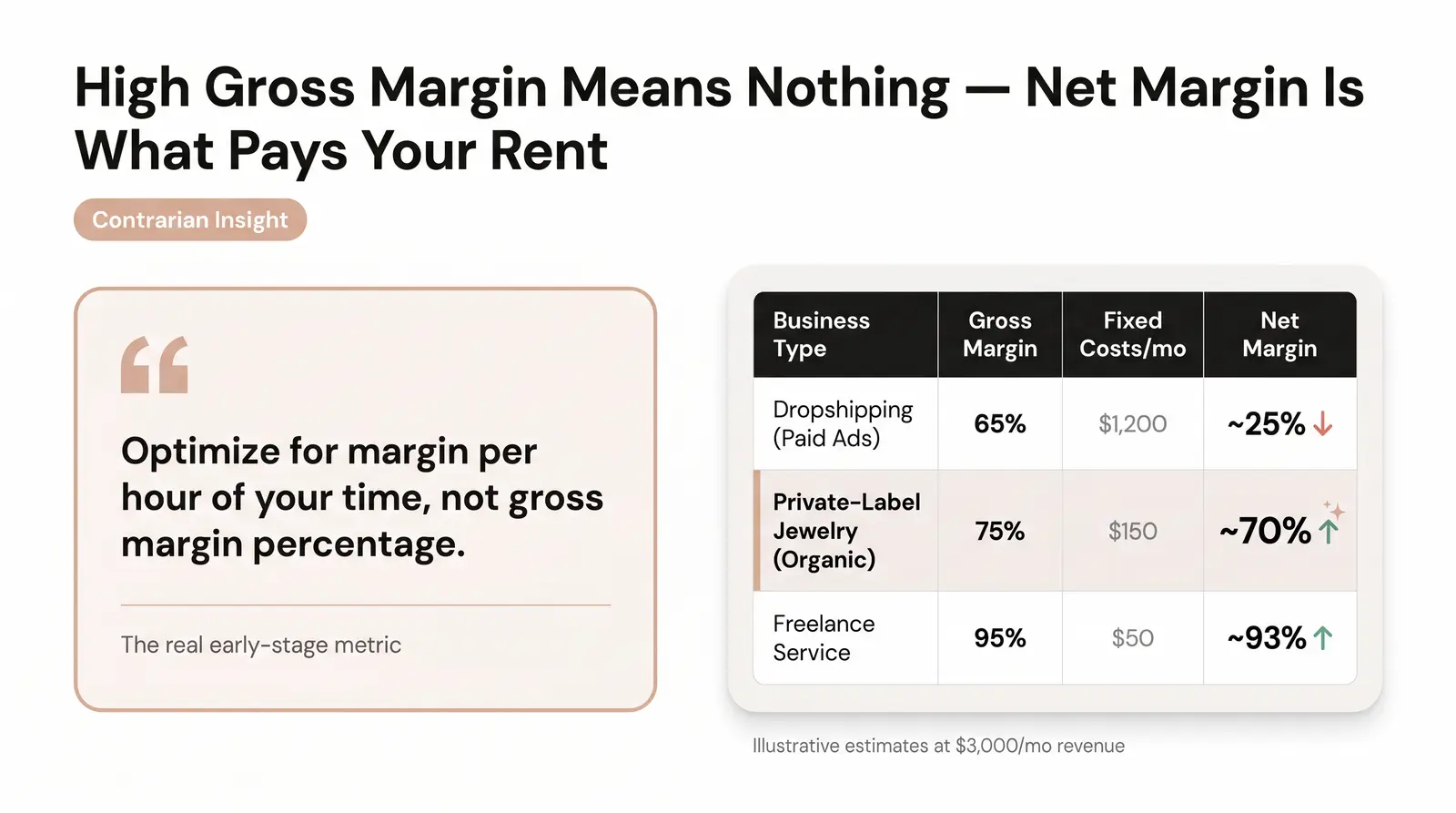
Most high margin business idea listicles celebrate gross margin but never mention that net margin is what pays your rent. A 70% gross margin business with $800 per month in ad spend, SaaS tools, and platform fees can net less than a 40% gross margin local service business with zero overhead.
The real metric to optimize early is margin per hour of your time, not gross margin percentage in isolation [1].
We often see founders chase the highest gross margin number on a spreadsheet, only to discover six months later that their "high-margin" business is barely breaking even after tools, ads, and their own time.
Consider this illustrative comparison of three early-stage businesses, each generating $3,000 per month in revenue. The figures below are realistic estimates, not guarantees, and are intended to show how fixed costs compress net margins.
| Business Type |
Gross Margin % |
Est. Monthly Fixed Costs |
Est. Monthly Revenue |
Net Margin % |
| Dropshipping (Heavy Paid Ads) |
65% |
$1,200 (Ads + SaaS) |
$3,000 |
~25% |
| Private-Label Jewelry (Organic) |
75% |
$150 (Shopify + Domain) |
$3,000 |
~70% |
| Freelance Service Business |
95% |
$50 (Software only) |
$3,000 |
~93% |
The takeaway is not that dropshipping is bad. It is that paid ads fundamentally change the economics of any business. If you are bootstrapping, you must ruthlessly defend your net margin by keeping fixed costs low and prioritizing organic acquisition channels until you have proven product-market fit.
How to Choose the Right Idea for You (Decision Matrix)
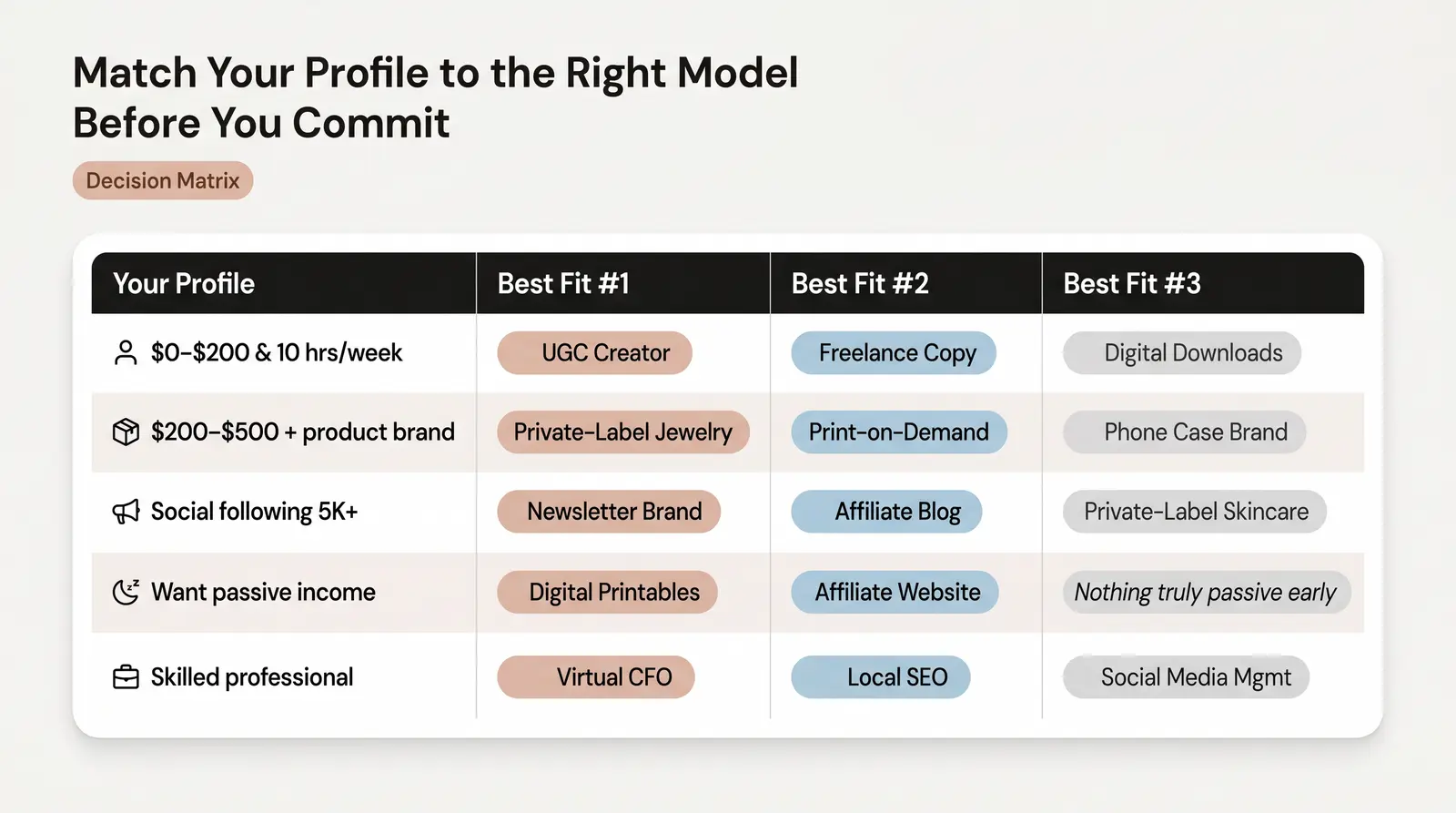
Do not get paralyzed by choice. Use this matrix to identify the model that best fits your current situation.
| Your Profile |
Best Fit #1 |
Best Fit #2 |
Best Fit #3 |
| $0–$200 and 10 hrs/week |
UGC Content Creator |
Freelance Copywriting |
Digital Downloads |
| $200–$500 and want a product brand |
Private-Label Jewelry |
Print-on-Demand Apparel |
Phone Case Brand |
| Social following of 5K+ |
Newsletter Media Brand |
Niche Affiliate Blog |
Private-Label Skincare |
| Want passive income streams |
Digital Printables |
Niche Affiliate Website |
(Nothing is truly passive early on) |
| Skilled professional or freelancer |
Virtual CFO Services |
Local SEO Consulting |
Social Media Management |
How to Launch a Low-Cost Product Brand in 2026 (Step-by-Step)
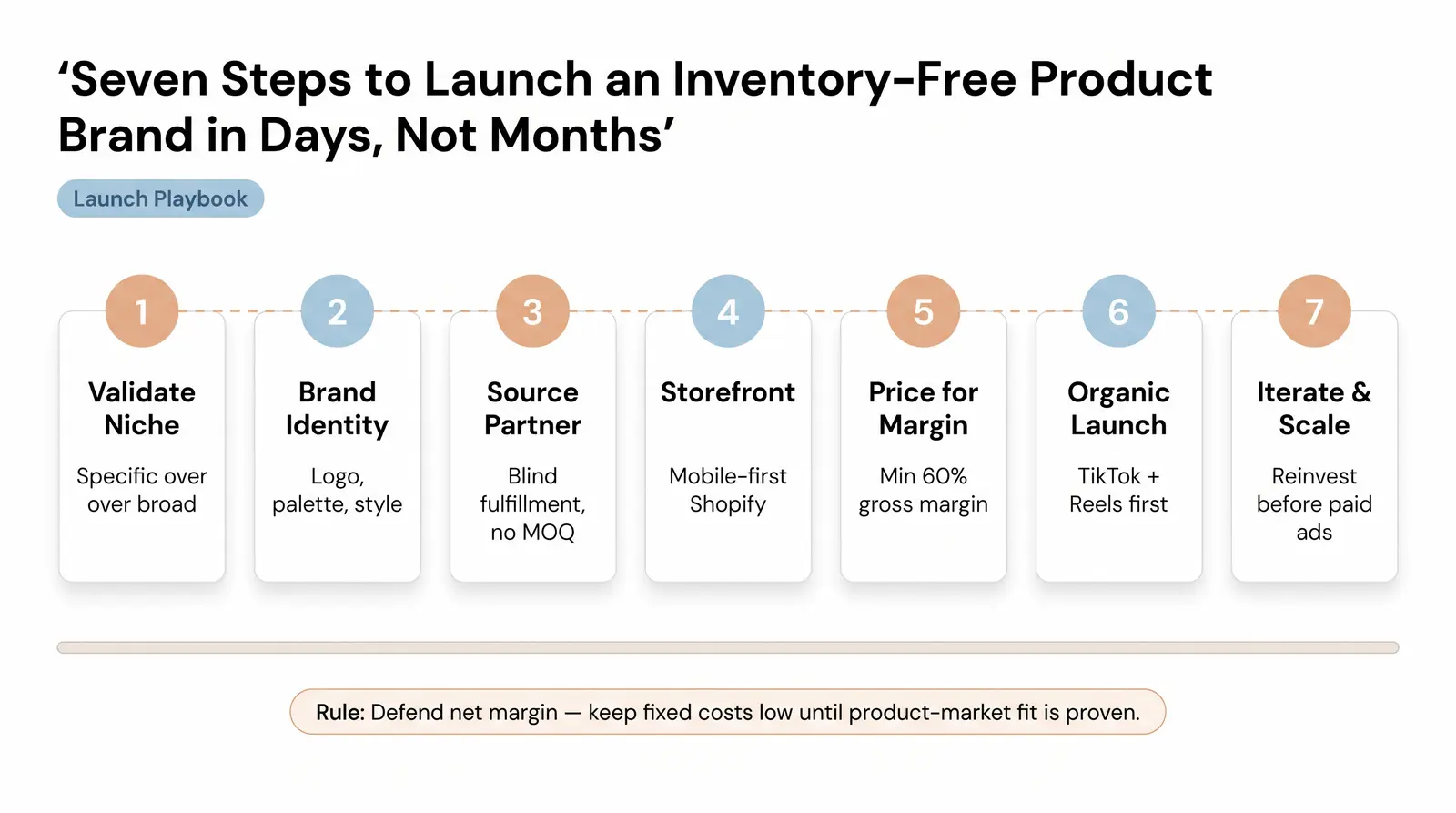
If you are leaning toward the inventory-free product route, here is a practical playbook for getting off the ground fast without wasting money.
Step 1: Validate a Niche. Do not sell "jewelry." Sell "minimalist gold jewelry for corporate women." Specificity lowers your marketing costs and makes your brand instantly recognizable.
Step 2: Define Your Brand Identity. Create a cohesive visual identity using Canva or Adobe Express. Your logo, color palette, and product photography style must communicate premium quality from the first impression.
Step 3: Choose a Sourcing Partner. Find a partner that handles the heavy lifting. Browse the Branvas catalog for private-label jewelry and accessories with blind dropshipping built in, so you never touch inventory.
Step 4: Set Up Your Storefront. Launch a clean, mobile-optimized Shopify store. Keep the design focused entirely on conversion, not decoration.
Step 5: Price for Margin. Do not race to the bottom. Price your products to maintain at least a 60% gross margin. That buffer is what allows you to invest in marketing later without going negative.
Step 6: Launch with Organic Content. Order product samples and film short-form video content for TikTok, Instagram Reels, and YouTube Shorts. Authentic, founder-led content consistently outperforms polished ads at this stage.
Step 7: Iterate and Scale. Analyze which products and content formats drive sales, then double down. Reinvest your first profits into better content and a broader product range before spending on paid ads.
If jewelry or accessories fits your brand, Branvas makes it possible to launch in days, not months, with private-label branding, no inventory, and blind fulfillment built in. See how it works.
Whether you are a first-time founder exploring options at branvas.com/solutions/aspiring-entrepreneurs or an ecommerce seller looking to expand into jewelry, transparent pricing and an inventory-free model are the keys to low-risk scale.
FAQ
1. What is the most profitable low-cost business to start in 2026?
Service-based businesses like freelance copywriting, virtual CFO services, and UGC content creation offer the highest net profit margins, often exceeding 80%, because they require almost zero capital to start. For product-based businesses, private-label jewelry and digital downloads offer the best combination of low startup costs and high gross margins. The right answer depends on your skills, available time, and whether you want to build a brand or sell a service.
2. Can I start a business with $500 or less?
Yes. $500 is more than enough to cover a domain name, a Shopify subscription, basic design software, and initial product samples for a jewelry or POD brand. The key to succeeding with under $500 is substituting financial capital with sweat equity, specifically by relying on organic social media marketing rather than paid advertising in the early months. According to Shopify, many successful businesses have launched with under $1,000 [3].
3. What business has the highest profit margin?
Digital products, including templates, online courses, and printables, have the highest gross profit margins, often exceeding 90%, because there are no physical manufacturing or shipping costs. Among physical products, jewelry, cosmetics, and specialized supplements typically offer the highest gross margins. The distinction between gross and net margin matters enormously, however. A high-gross-margin business with heavy ad spend can net far less than a low-overhead service business.
4. Is jewelry a good low-cost, high-margin business?
Yes, and it is one of the best. Jewelry has an exceptionally high perceived value, meaning a piece that costs $8 to source can realistically sell for $38 or more. It is lightweight and cheap to ship, and the global online jewelry market is growing at a CAGR of 18.7% through 2030 [5]. By using a private-label dropshipping model, you can launch a branded jewelry business without purchasing bulk inventory upfront, making it one of the most capital-efficient product businesses available.
5. How long does it take to make money from a low-cost business?
It depends on the model. Freelance services and UGC creation can generate revenue within 14 to 30 days if you actively pitch clients. Product-based businesses relying on organic social media typically take 30 to 60 days to see consistent sales. Content-based businesses like blogs or YouTube channels often take 6 to 12 months to monetize meaningfully. The fastest path to revenue is almost always a service business, while the highest long-term leverage comes from building a product brand or content asset.
References
- How to Make Big Money from Dropshipping Jewelry: A Complete Data-Driven Guide to Margins, Branding, and Real-World Profit Strategies - ScaleOrder, 2025
- UGC Rates 2026: The Ultimate Guide With Real Numbers - Influee, 2025
- How Much Does It Cost to Start a Business? - Shopify, 2025
- Affiliate Marketing Statistics for 2026 - AffiliateStatistics.marketing, 2026
- Online Jewelry Market Analysis, Size, and Forecast 2026-2030 - Technavio, 2026
- Creator Economy Market Size 2025-2030 - Exploding Topics, 2026